
Inheritance and Polymorphism Chris Kiekintveld CS 2401 Fall


- Slides: 37
Inheritance and Polymorphism Chris Kiekintveld CS 2401 (Fall 2010) Elementary Data Structures and Algorithms
Review: Classes s User-defined data types s Defined using the “class” keyword s Each class has associated s Data members (any object type) s Methods that operate on the data s New instances of the class are declared using the “new” keyword s “Static” members/methods have only one copy, regardless of how many instances are created Java Programming: Program Design Including Data Structures 2
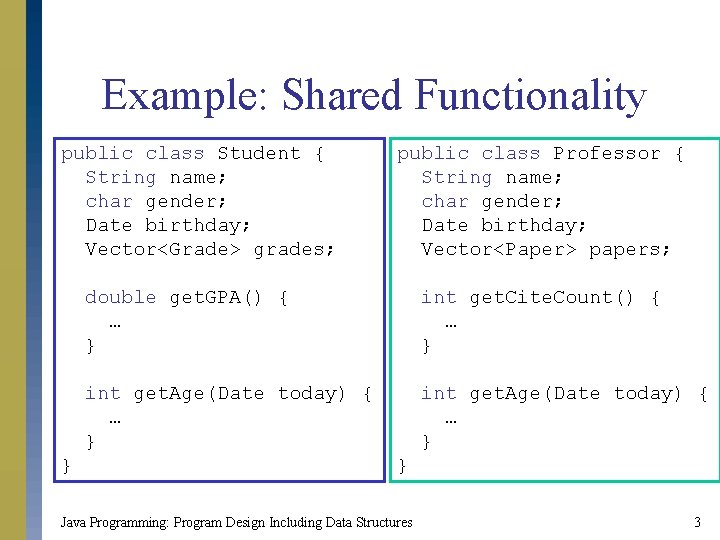
Example: Shared Functionality public class Student { String name; char gender; Date birthday; Vector<Grade> grades; } public class Professor { String name; char gender; Date birthday; Vector<Paper> papers; double get. GPA() { … } int get. Cite. Count() { … } int get. Age(Date today) { … } } Java Programming: Program Design Including Data Structures 3
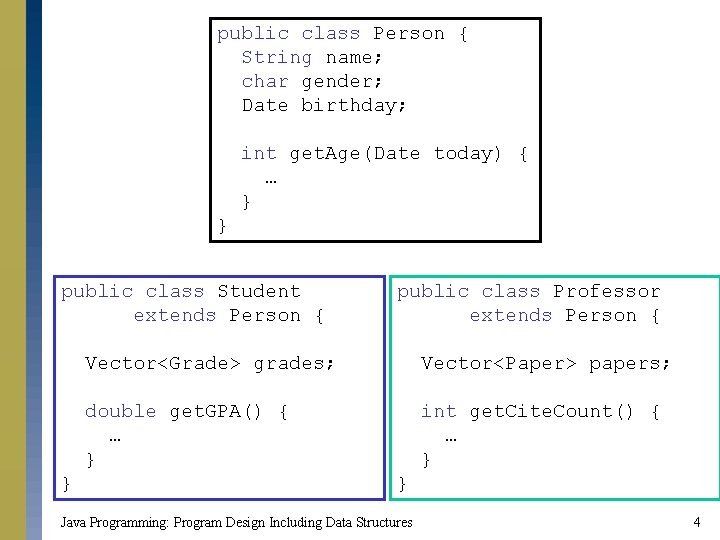
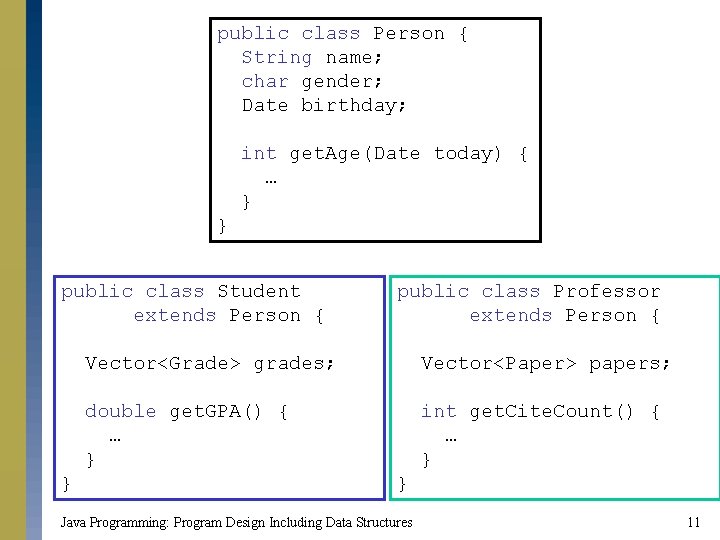
public class Person { String name; char gender; Date birthday; int get. Age(Date today) { … } } public class Student extends Person { } public class Professor extends Person { Vector<Grade> grades; Vector<Paper> papers; double get. GPA() { … } int get. Cite. Count() { … } } Java Programming: Program Design Including Data Structures 4
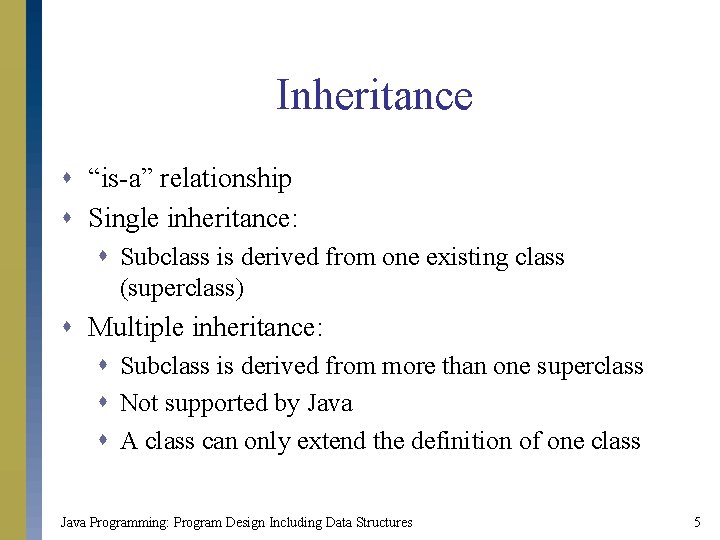
Inheritance s “is-a” relationship s Single inheritance: s Subclass is derived from one existing class (superclass) s Multiple inheritance: s Subclass is derived from more than one superclass s Not supported by Java s A class can only extend the definition of one class Java Programming: Program Design Including Data Structures 5
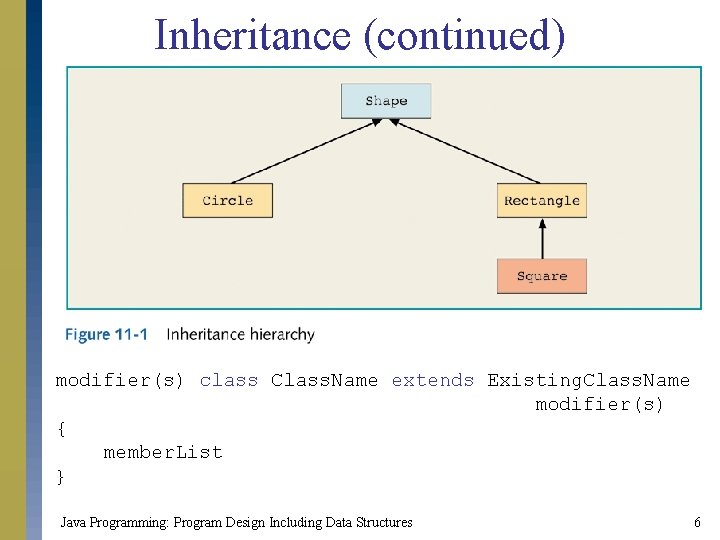
Inheritance (continued) modifier(s) class Class. Name extends Existing. Class. Name modifier(s) { member. List } Java Programming: Program Design Including Data Structures 6
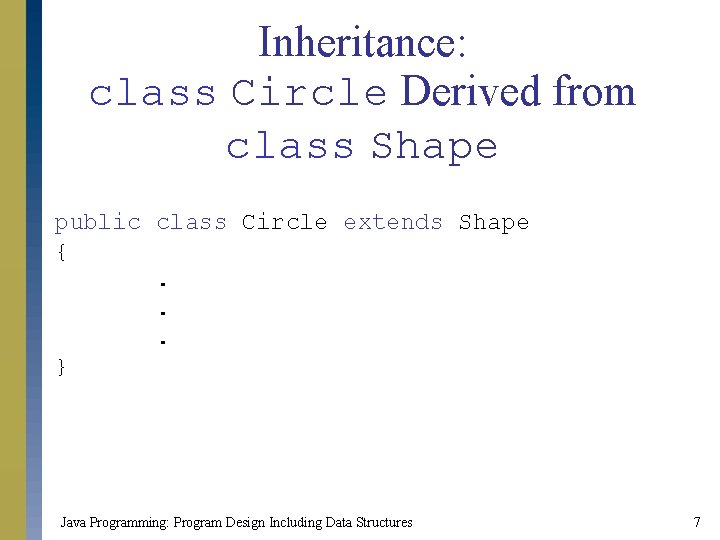
Inheritance: class Circle Derived from class Shape public class Circle extends Shape {. . . } Java Programming: Program Design Including Data Structures 7
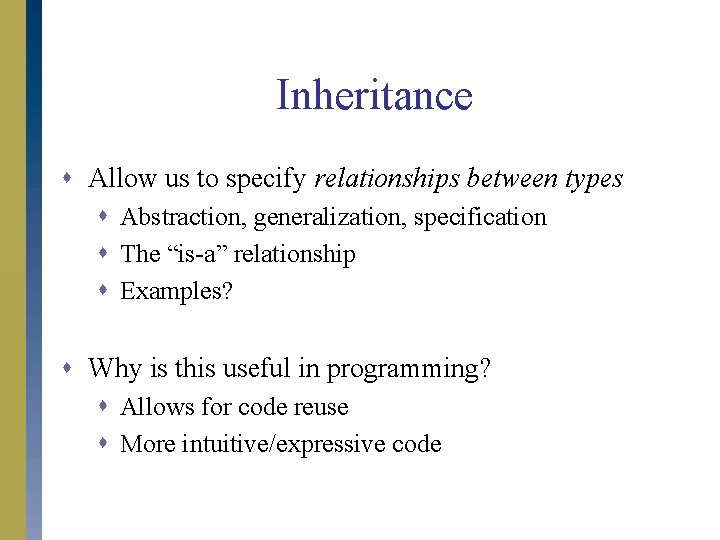
Inheritance s Allow us to specify relationships between types s Abstraction, generalization, specification s The “is-a” relationship s Examples? s Why is this useful in programming? s Allows for code reuse s More intuitive/expressive code
Code Reuse s General functionality can be written once and applied to *any* subclass s Subclasses can specialize by adding members and methods, or overriding functions
Inheritance: Adding Functionality s Subclasses have all of the data members and methods of the superclass s Subclasses can add to the superclass s Additional data members s Additional methods s Subclasses are more specific and have more functionality s Superclasses capture generic functionality common across many types of objects Java Programming: Program Design Including Data Structures 10
public class Person { String name; char gender; Date birthday; int get. Age(Date today) { … } } public class Student extends Person { } public class Professor extends Person { Vector<Grade> grades; Vector<Paper> papers; double get. GPA() { … } int get. Cite. Count() { … } } Java Programming: Program Design Including Data Structures 11
Brainstorming s What are some other examples of possible inheritance hierarchies? s Person -> student, faculty… s Shape -> circle, triangle, rectangle… s Other examples? ? ? Java Programming: Program Design Including Data Structures 12
UML Diagram: Rectangle What if we want to implement a 3 d box object? Java Programming: Program Design Including Data Structures 13
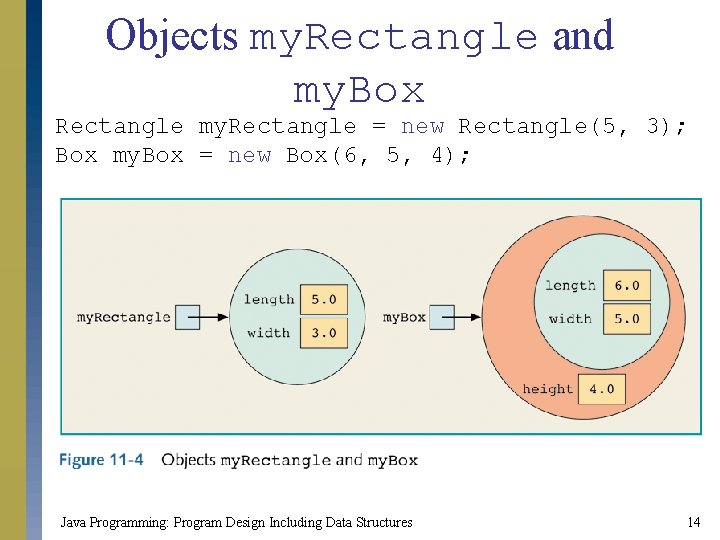
Objects my. Rectangle and my. Box Rectangle my. Rectangle = new Rectangle(5, 3); Box my. Box = new Box(6, 5, 4); Java Programming: Program Design Including Data Structures 14
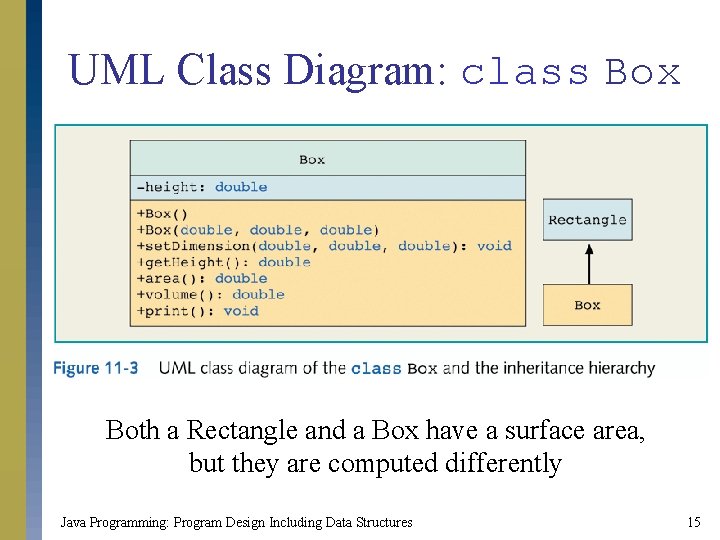
UML Class Diagram: class Box Both a Rectangle and a Box have a surface area, but they are computed differently Java Programming: Program Design Including Data Structures 15
Overriding Methods s A subclass can override (redefine) the methods of the superclass s Objects of the subclass type will use the new method s Objects of the superclass type will use the original Java Programming: Program Design Including Data Structures 16
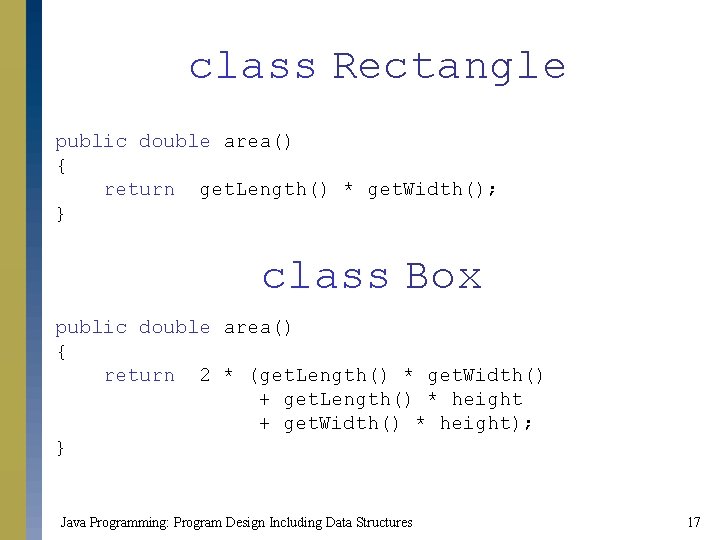
class Rectangle public double area() { return get. Length() * get. Width(); } class Box public double area() { return 2 * (get. Length() * get. Width() + get. Length() * height + get. Width() * height); } Java Programming: Program Design Including Data Structures 17
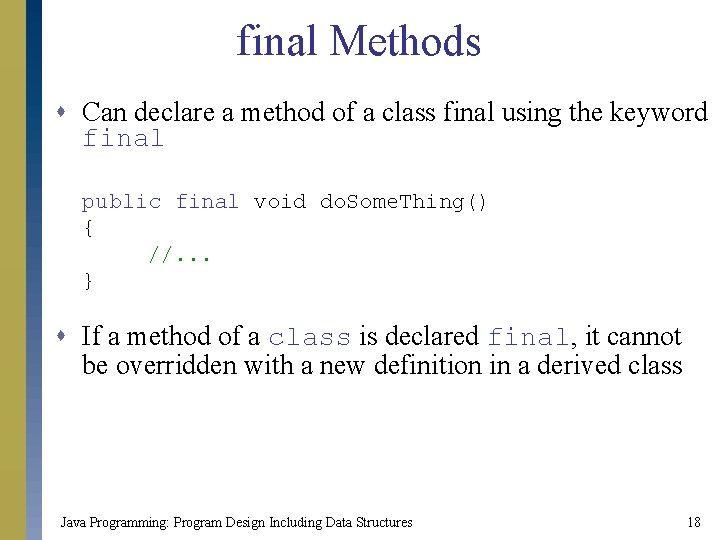
final Methods s Can declare a method of a class final using the keyword final public final void do. Some. Thing() { //. . . } s If a method of a class is declared final, it cannot be overridden with a new definition in a derived class Java Programming: Program Design Including Data Structures 18
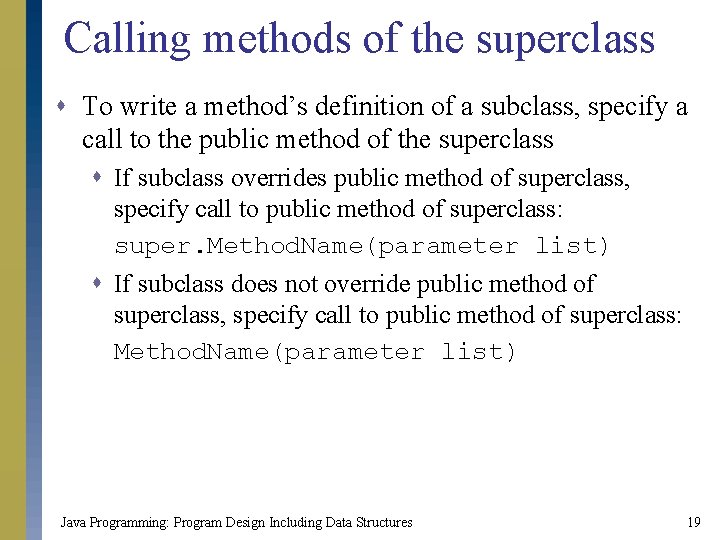
Calling methods of the superclass s To write a method’s definition of a subclass, specify a call to the public method of the superclass s If subclass overrides public method of superclass, specify call to public method of superclass: super. Method. Name(parameter list) s If subclass does not override public method of superclass, specify call to public method of superclass: Method. Name(parameter list) Java Programming: Program Design Including Data Structures 19
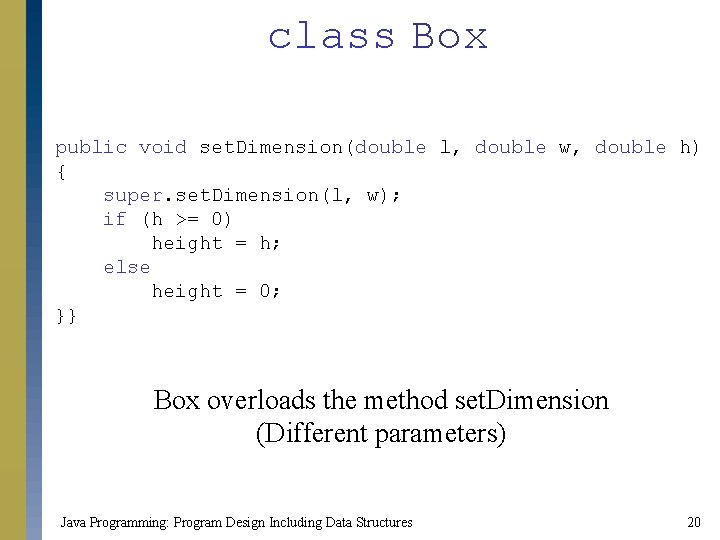
class Box public void set. Dimension(double l, double w, double h) { super. set. Dimension(l, w); if (h >= 0) height = h; else height = 0; }} Box overloads the method set. Dimension (Different parameters) Java Programming: Program Design Including Data Structures 20
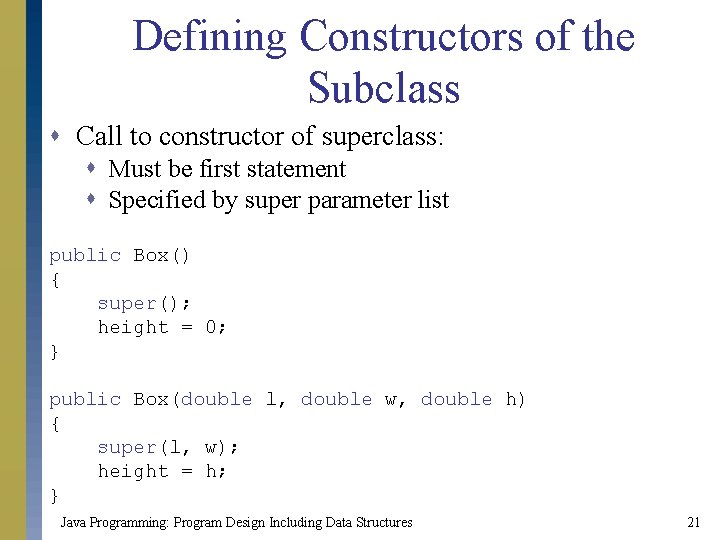
Defining Constructors of the Subclass s Call to constructor of superclass: s Must be first statement s Specified by super parameter list public Box() { super(); height = 0; } public Box(double l, double w, double h) { super(l, w); height = h; } Java Programming: Program Design Including Data Structures 21
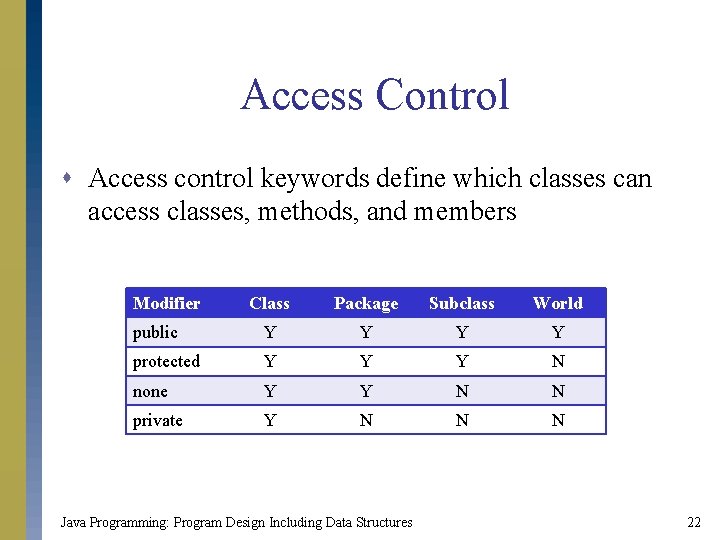
Access Control s Access control keywords define which classes can access classes, methods, and members Modifier Class Package Subclass World public Y Y protected Y Y Y N none Y Y N N private Y N N N Java Programming: Program Design Including Data Structures 22
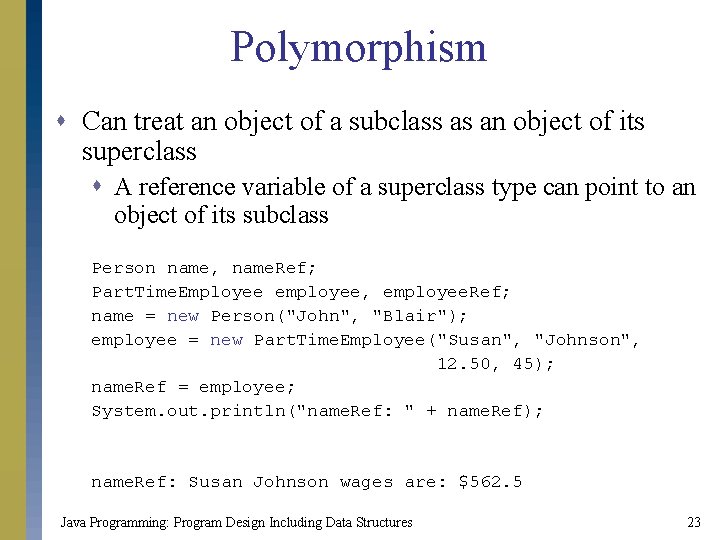
Polymorphism s Can treat an object of a subclass as an object of its superclass s A reference variable of a superclass type can point to an object of its subclass Person name, name. Ref; Part. Time. Employee employee, employee. Ref; name = new Person("John", "Blair"); employee = new Part. Time. Employee("Susan", "Johnson", 12. 50, 45); name. Ref = employee; System. out. println("name. Ref: " + name. Ref); name. Ref: Susan Johnson wages are: $562. 5 Java Programming: Program Design Including Data Structures 23
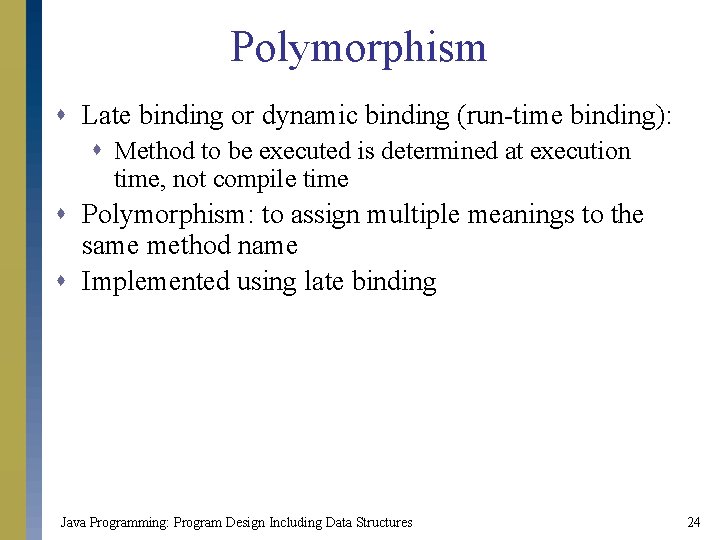
Polymorphism s Late binding or dynamic binding (run-time binding): s Method to be executed is determined at execution time, not compile time s Polymorphism: to assign multiple meanings to the same method name s Implemented using late binding Java Programming: Program Design Including Data Structures 24
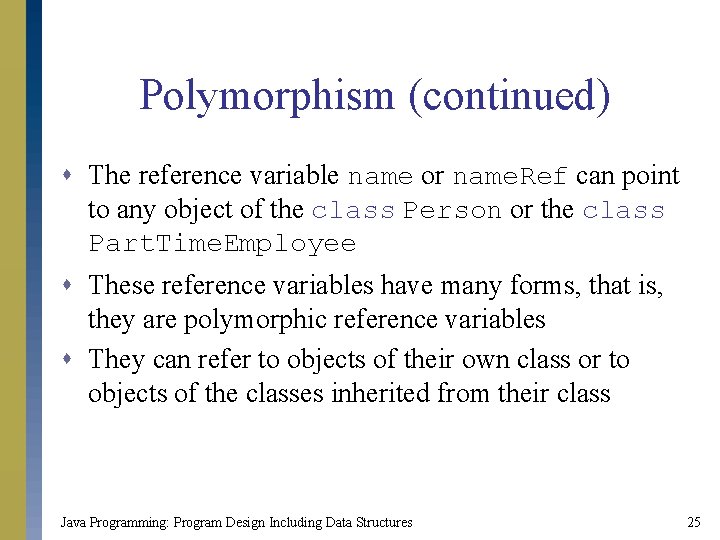
Polymorphism (continued) s The reference variable name or name. Ref can point to any object of the class Person or the class Part. Time. Employee s These reference variables have many forms, that is, they are polymorphic reference variables s They can refer to objects of their own class or to objects of the classes inherited from their class Java Programming: Program Design Including Data Structures 25
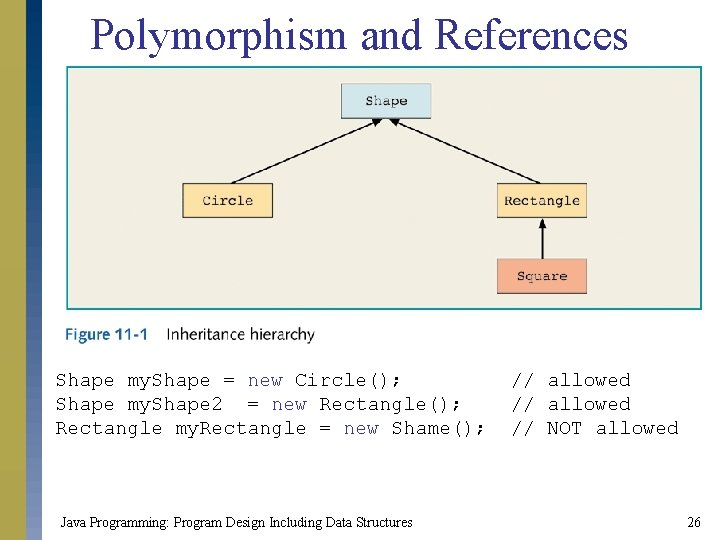
Polymorphism and References Shape my. Shape = new Circle(); Shape my. Shape 2 = new Rectangle(); Rectangle my. Rectangle = new Shame(); Java Programming: Program Design Including Data Structures // allowed // NOT allowed 26
Polymorphism (continued) s Can also declare a class final using the keyword final s If a class is declared final, then no other class can be derived from this class s Java does not use late binding for methods that are private, marked final, or static s Why not? Java Programming: Program Design Including Data Structures 27
Casting s You cannot automatically make reference variable of subclass type point to object of its superclass s Suppose that sup. Ref is a reference variable of a superclass type and sup. Ref points to an object of its subclass: s Can use a cast operator on sup. Ref and make a reference variable of the subclass point to the object s If sup. Ref does not point to a subclass object and you use a cast operator on sup. Ref to make a reference variable of the subclass point to the object, then Java will throw a Class. Cast. Exception—indicating that the class cast is not allowed Java Programming: Program Design Including Data Structures 28
Polymorphism (continued) s Operator instanceof: determines whether a reference variable that points to an object is of a particular class type s This expression evaluates to true if p points to an object of the class Box. Shape; otherwise it evaluates to false: p instanceof Box. Shape Java Programming: Program Design Including Data Structures 29
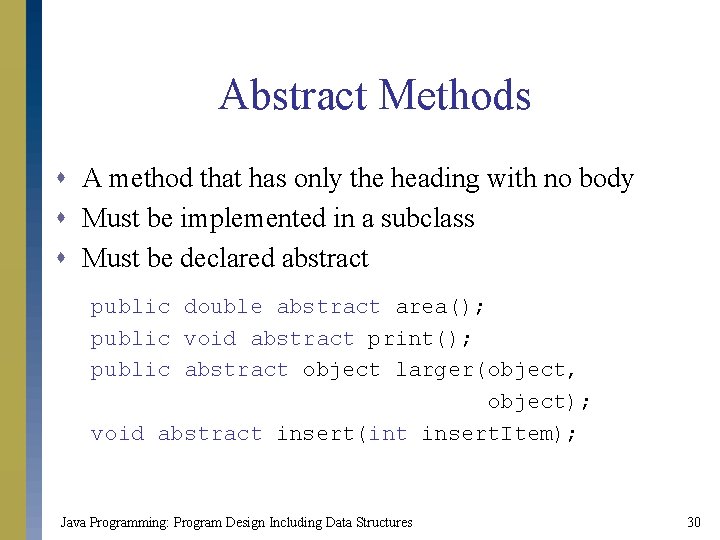
Abstract Methods s A method that has only the heading with no body s Must be implemented in a subclass s Must be declared abstract public double abstract area(); public void abstract print(); public abstract object larger(object, object); void abstract insert(int insert. Item); Java Programming: Program Design Including Data Structures 30
Abstract Classes s A class that is declared with the reserved word abstract in its heading s An abstract class can contain instance variables, constructors, finalizers, and non-abstract methods s An abstract class can contain abstract methods Java Programming: Program Design Including Data Structures 31
Abstract Classes (continued) s If a class contains an abstract method, the class must be declared abstract s You cannot instantiate an object of an abstract class type; can only declare a reference variable of an abstract class type s You can instantiate an object of a subclass of an abstract class, but only if the subclass gives the definitions of all the abstract methods of the superclass Java Programming: Program Design Including Data Structures 32
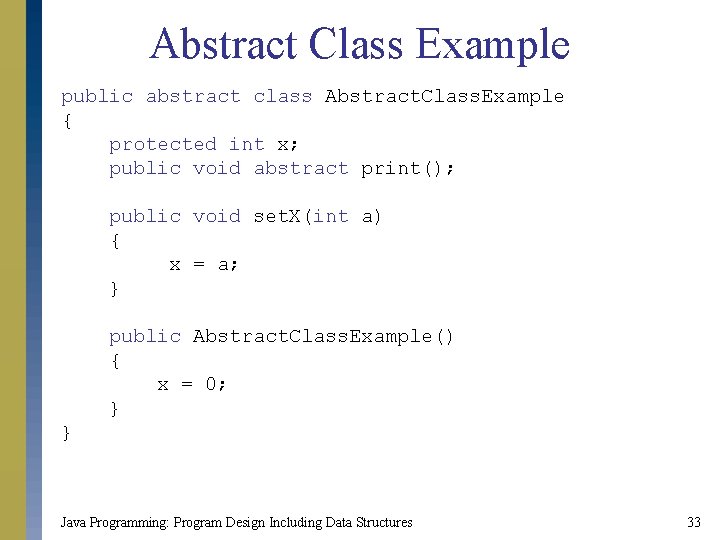
Abstract Class Example public abstract class Abstract. Class. Example { protected int x; public void abstract print(); public void set. X(int a) { x = a; } public Abstract. Class. Example() { x = 0; } } Java Programming: Program Design Including Data Structures 33
Interfaces s A class that contains only abstract methods and/or named constants s How Java implements multiple inheritance s To be able to handle a variety of events, Java allows a class to implement more than one interface Java Programming: Program Design Including Data Structures 34
Composition s Another way to relate two classes s One or more members of a class are objects of another class type s “has-a” relation between classes s For example, “every person has a date of birth” Java Programming: Program Design Including Data Structures 35
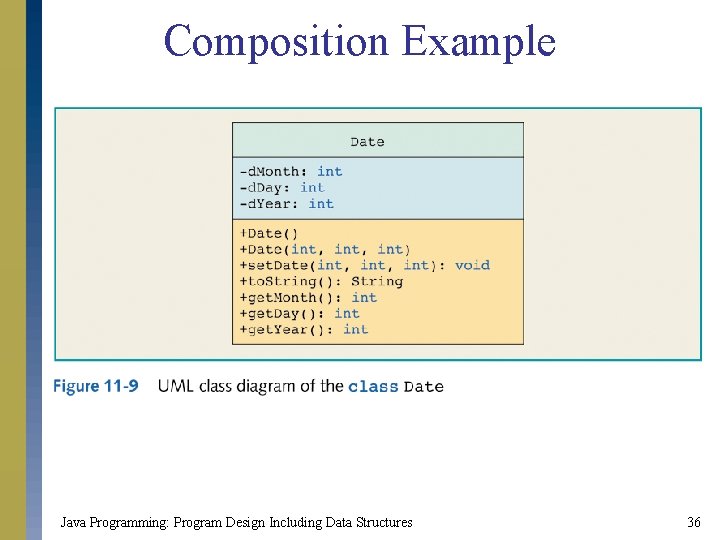
Composition Example Java Programming: Program Design Including Data Structures 36
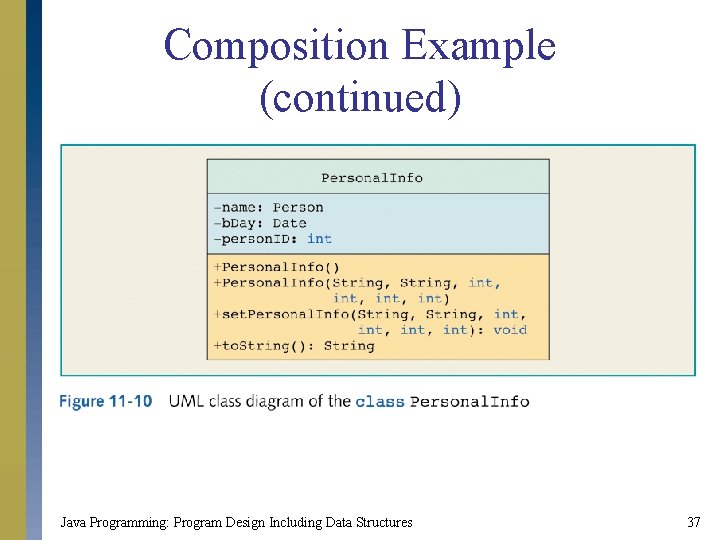
Composition Example (continued) Java Programming: Program Design Including Data Structures 37