
INHALED ANAESTHETICS Dr Deepak Singla Introduction These are

- Slides: 50
INHALED ANAESTHETICS Dr. Deepak Singla
Introduction • These are the most common drug used for G/A • Popularity is based on their – Ease of administration – Ability to monitor their effects – Relatively inexpensive – Prevents recalls and provides MR also
History • The discovery of anaesthetic properties of N 2 O, diethyl ether and chloroform in 1840 s • Long duration of 80 years before other inhaled anaesthetic were introduced. In 1950, all were flammable toxic exception of N 2 O • Halothane was synthesized in 1951 • Introduced for clinical use in 1956 • Due to enhance dysarrhythmogenic effect of epenephrine led to search for new derivative
History (contd…) • Enflurane – Introduced in clinical use in 1973 – Nephrotoxicity seems less likely – Does not enhance dysarrhythmogenic effect of epinephrine – It has epileptogenic potential • Isoflurane, isomer of enflurane, introduced in 1981. Resistant to metabolism making organ toxicity unlikely
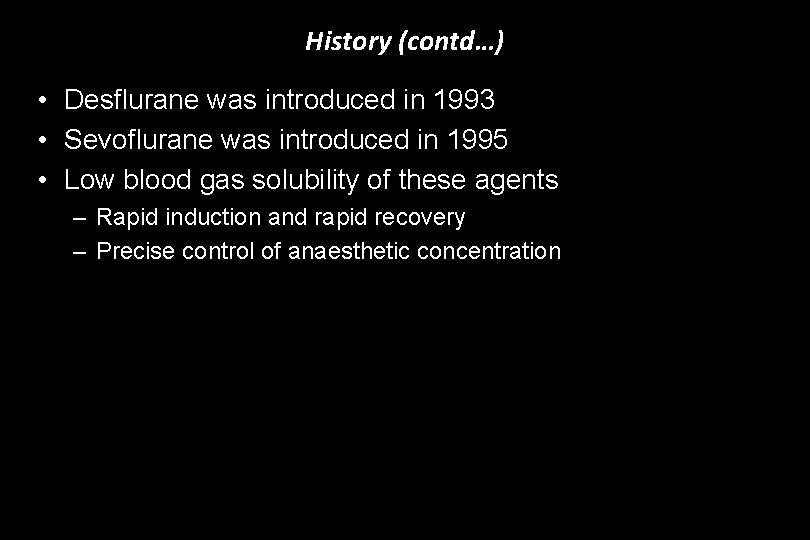
History (contd…) • Desflurane was introduced in 1993 • Sevoflurane was introduced in 1995 • Low blood gas solubility of these agents – Rapid induction and rapid recovery – Precise control of anaesthetic concentration
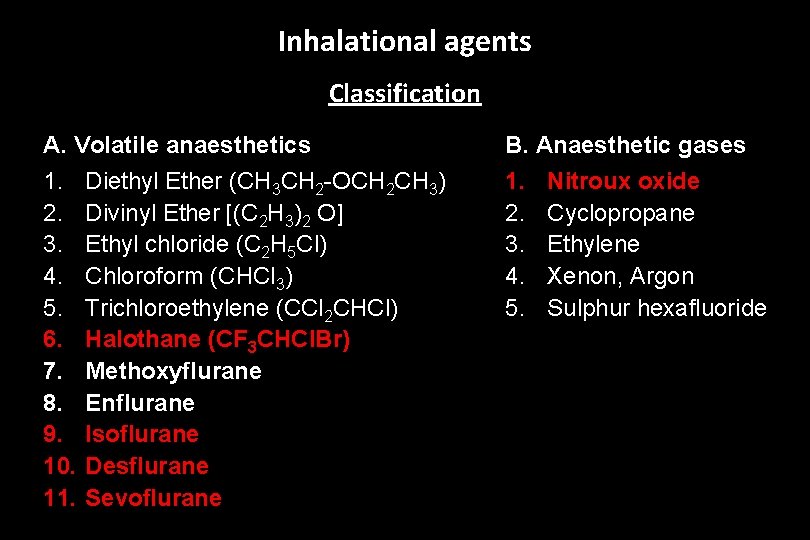
Inhalational agents Classification A. Volatile anaesthetics B. Anaesthetic gases 1. 2. 3. 4. 5. 6. 7. 8. 9. 10. 11. 1. 2. 3. 4. 5. Diethyl Ether (CH 3 CH 2 -OCH 2 CH 3) Divinyl Ether [(C 2 H 3)2 O] Ethyl chloride (C 2 H 5 Cl) Chloroform (CHCl 3) Trichloroethylene (CCl 2 CHCl) Halothane (CF 3 CHCl. Br) Methoxyflurane Enflurane Isoflurane Desflurane Sevoflurane Nitroux oxide Cyclopropane Ethylene Xenon, Argon Sulphur hexafluoride
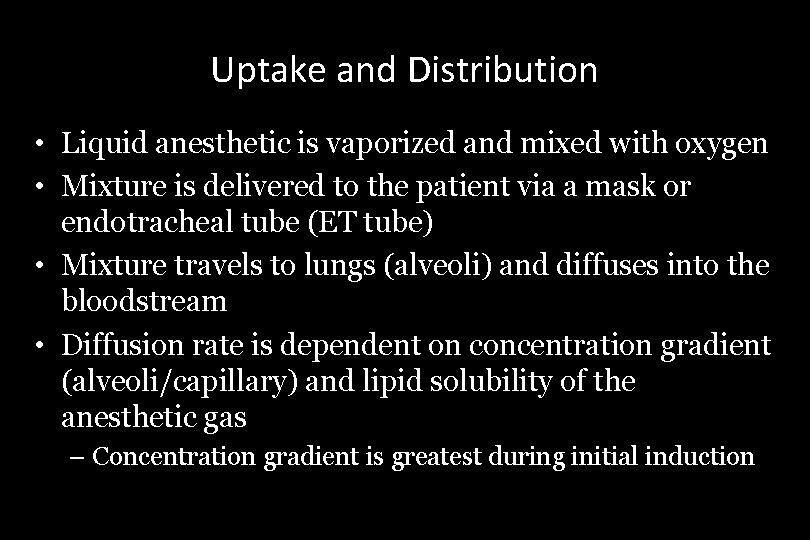
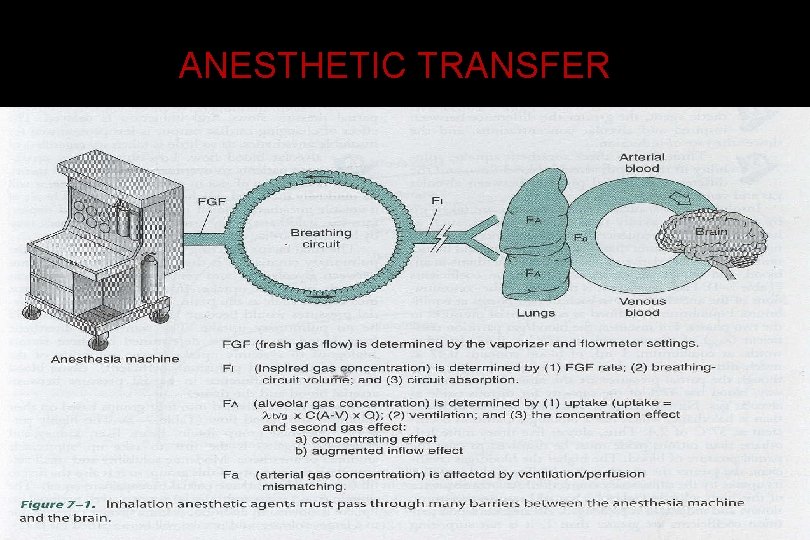
Uptake and Distribution • Liquid anesthetic is vaporized and mixed with oxygen • Mixture is delivered to the patient via a mask or endotracheal tube (ET tube) • Mixture travels to lungs (alveoli) and diffuses into the bloodstream • Diffusion rate is dependent on concentration gradient (alveoli/capillary) and lipid solubility of the anesthetic gas – Concentration gradient is greatest during initial induction
ANESTHETIC TRANSFER
Physical and Chemical Properties of Inhalant Anesthetics • Important properties to consider – – Vapor pressure Partition coefficient Minimum alveolar concentration (MAC) Rubber solubility
Vapor Pressure • Is the amount of pressure exerted by the gaseous form of a substance when in equilibrium – i. e. – it’s ability to evaporate • Determines how readily an inhalation anesthetic will evaporate in the anesthetic machine vaporizer • Dependent upon temperature and anesthetic agent
Blood: Gas Partition Coefficient • The measure of the solubility of an inhalation anesthetic in blood as compared to alveolar gas (air) • Indication of the speed of induction and recovery for an inhalation anesthetic agent • Low blood: gas partition coefficient – Agent is more soluble in alveolar gas than in blood at equilibrium – Agent is less soluble in blood – Faster expected induction and recovery
MINIMUM ALVEOLAR CONCENTRATION (MAC) Ø It is the steady state expired gas concentration of an anesthetic • • At 1 atm pressure That prevents movement In response to surgical stimulus In 50% patients Analogous to ED 50 Ø Best measure of anesthetic potency as it mirrors the brain partial pressure. Ø MAC values of different anesthetic are roughly additive.
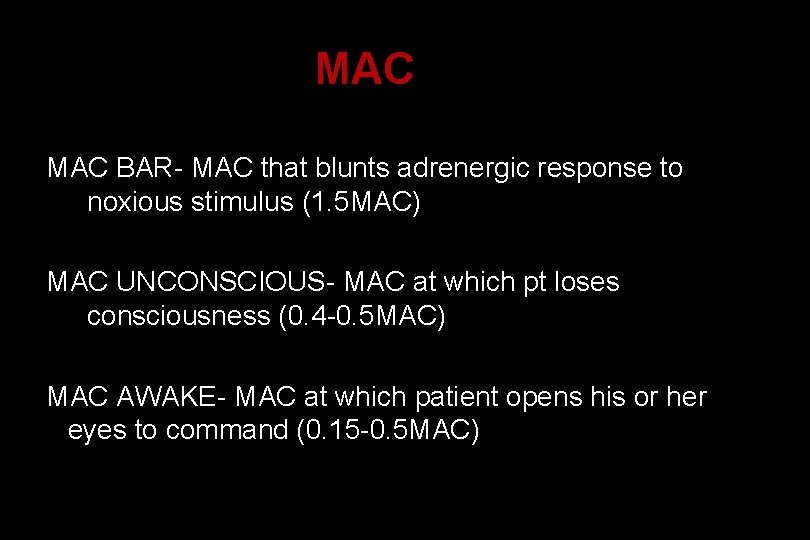
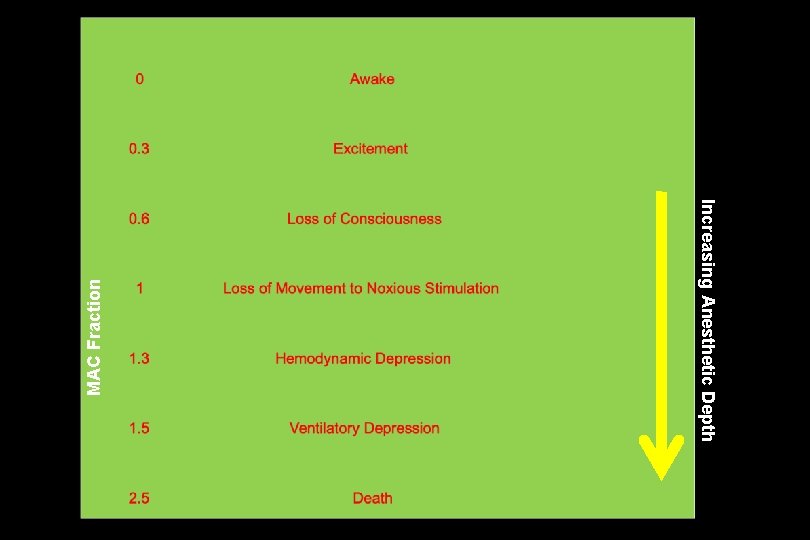
MAC BAR- MAC that blunts adrenergic response to noxious stimulus (1. 5 MAC) MAC UNCONSCIOUS- MAC at which pt loses consciousness (0. 4 -0. 5 MAC) MAC AWAKE- MAC at which patient opens his or her eyes to command (0. 15 -0. 5 MAC)
MAC Fraction Increasing Anesthetic Depth
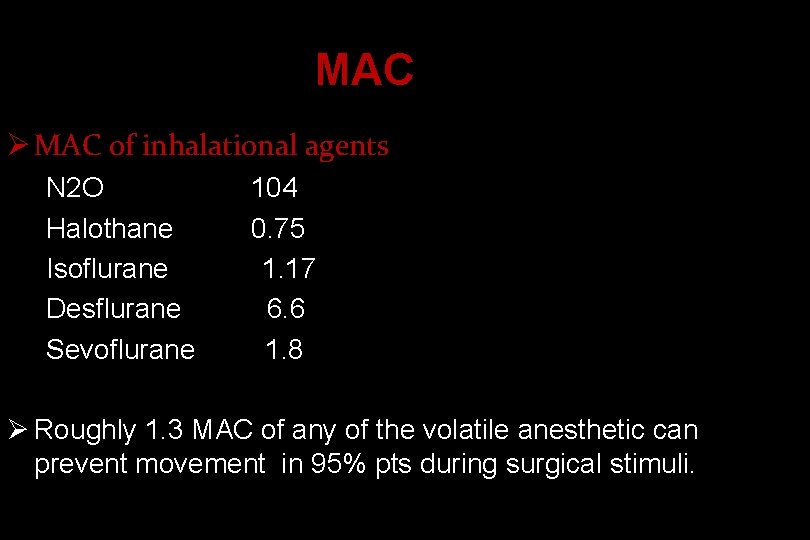
MAC Ø MAC of inhalational agents N 2 O Halothane Isoflurane Desflurane Sevoflurane 104 0. 75 1. 17 6. 6 1. 8 Ø Roughly 1. 3 MAC of any of the volatile anesthetic can prevent movement in 95% pts during surgical stimuli.
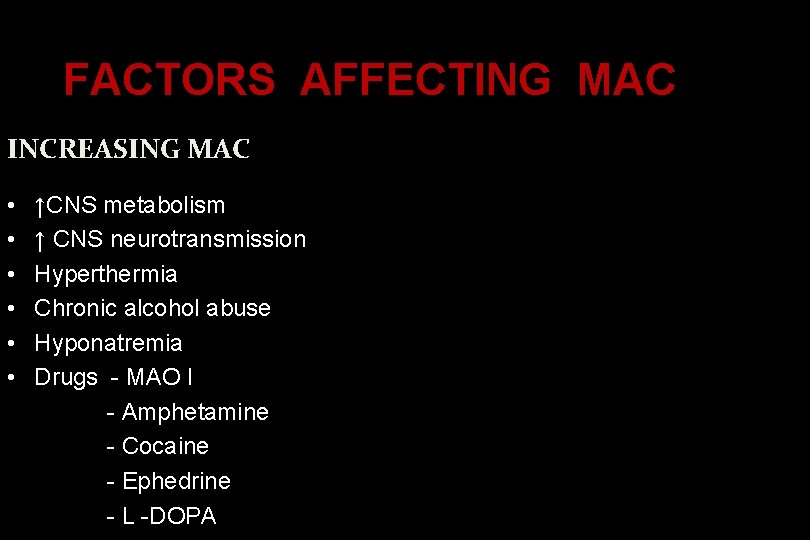
FACTORS AFFECTING MAC INCREASING MAC • • • ↑CNS metabolism ↑ CNS neurotransmission Hyperthermia Chronic alcohol abuse Hyponatremia Drugs - MAO I - Amphetamine - Cocaine - Ephedrine - L -DOPA
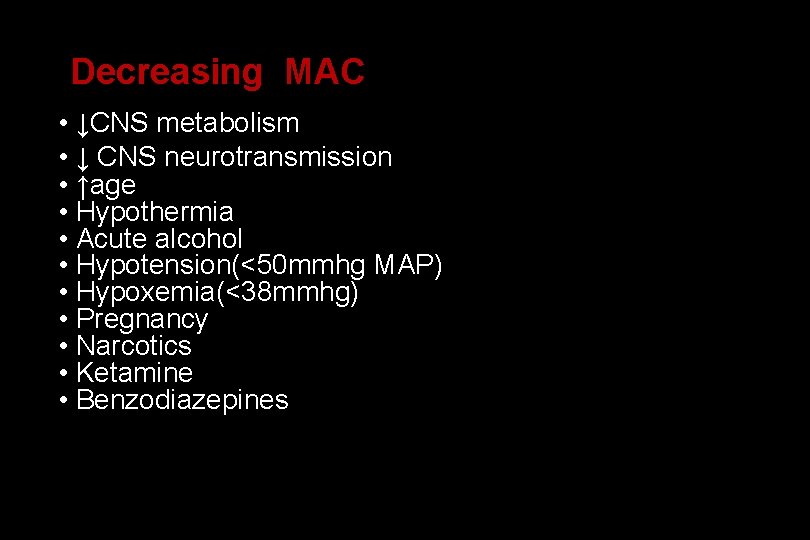
Decreasing MAC • ↓CNS metabolism • ↓ CNS neurotransmission • ↑age • Hypothermia • Acute alcohol • Hypotension(˂50 mmhg MAP) • Hypoxemia(˂38 mmhg) • Pregnancy • Narcotics • Ketamine • Benzodiazepines • Lithium • Local anesthetics
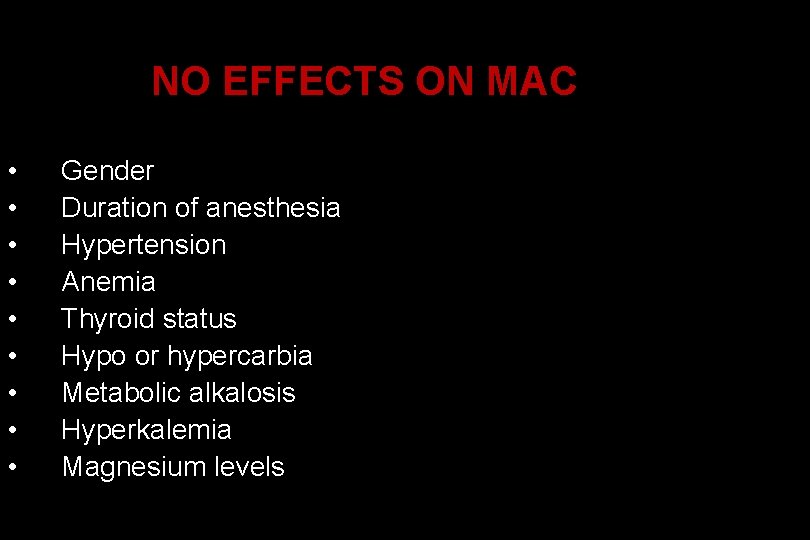
NO EFFECTS ON MAC • • • Gender Duration of anesthesia Hypertension Anemia Thyroid status Hypo or hypercarbia Metabolic alkalosis Hyperkalemia Magnesium levels
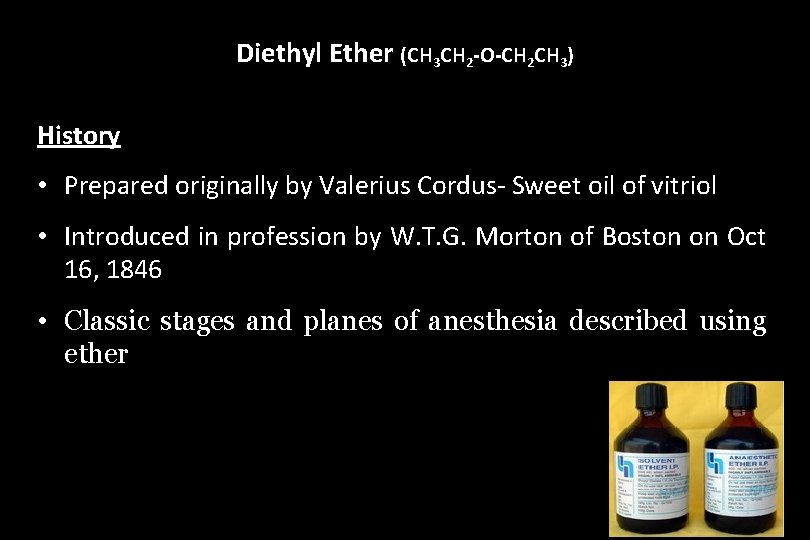
Diethyl Ether (CH 3 CH 2 -O-CH 2 CH 3) History • Prepared originally by Valerius Cordus- Sweet oil of vitriol • Introduced in profession by W. T. G. Morton of Boston on Oct 16, 1846 • Classic stages and planes of anesthesia described using ether
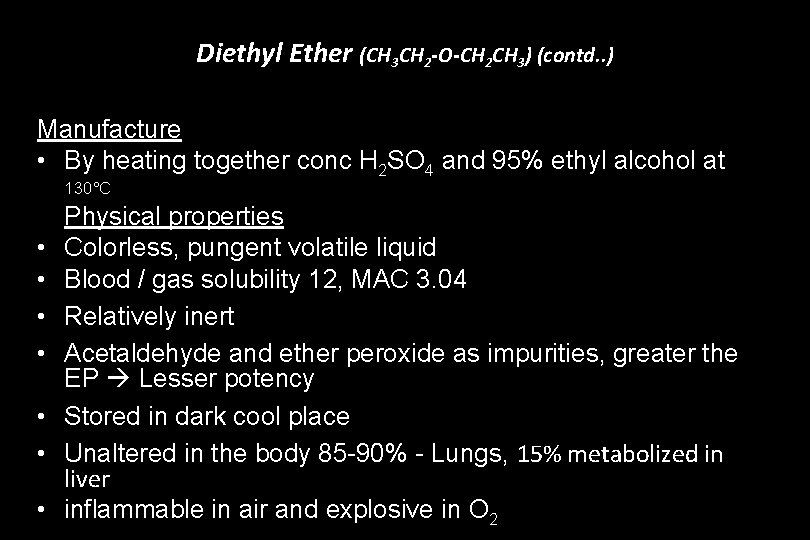
Diethyl Ether (CH 3 CH 2 -O-CH 2 CH 3) (contd. . ) Manufacture • By heating together conc H 2 SO 4 and 95% ethyl alcohol at 130°C • • Physical properties Colorless, pungent volatile liquid Blood / gas solubility 12, MAC 3. 04 Relatively inert Acetaldehyde and ether peroxide as impurities, greater the EP Lesser potency Stored in dark cool place Unaltered in the body 85 -90% - Lungs, 15% metabolized in liver inflammable in air and explosive in O 2
EFFECTS ON ORGAN SYSTEM A. Circulatory system • Heart rate First increased Unaltered Blood pressure – Decreased BP after 1 st hour – below phase II – Vaso Motor Centre paralysis in deep plane – Functioning Sympathetic Nervous System BP – Ether increase in sympathetic adrenal activity • Cardiac output – Lighter Plane of Anaesthesia CO increases – Deep Plane of Anaesthesia CO decreases • Arrhythmia – rare, adrenaline safer with ether
B. Respiratory system • RR increase Ist then decrease in deeper plane • Ether vapour – Irritant Laryngospasm • Ether dilates bronchial musculature • Hence induction – Gradual C. Nervous system • Central nervous system – Induce analgesia Excitement Anaesthesia – Medullary depression Late, precedes the serious cardiac depression – CBF increases CSF pressure
• Sympathetic nervous system – Ether • Central stimulation increase blood catecholamine level • Increase in HR • Increased production of glycogen increased BS level • Centration of spleen • Dilatation – Gut and inhibition of movements • Dilatation of coronary arteries • Dilation of pupils • Parasympathetic – NS central depression
D. Alimentary system • PONV (>50% patients) • Salivary gland stimulation – Induction and depressed later on • Gastrointestinal atony • Liver function decreased, decreased sec of bile and bile salts E. Urinary system • Urine flow – diminished • Dec in plasma volume and renal Vaso-Constriction
Advantages of Ether • Relatively non-toxic, safe and potent • Relatively cheap and can be used without sophisticated apparatus • Excellent relaxation • Respiratory depression not accompanied by serious cardiac damage in A/o hypoxia • Maintained BP, no tendency to arrhythmias • Thus ether – very safe, less experienced anaesthetist. Having wide safety margin
Disadvantages of Ether • Induction and recovery slow • Mucous secretion from upper airway • Causes albumin urea • Inflammable: Explodes, sparks flames • Ether convulsion : Triad – Deeper ether anaesthesia – Hyperthermia – Hypocapnea
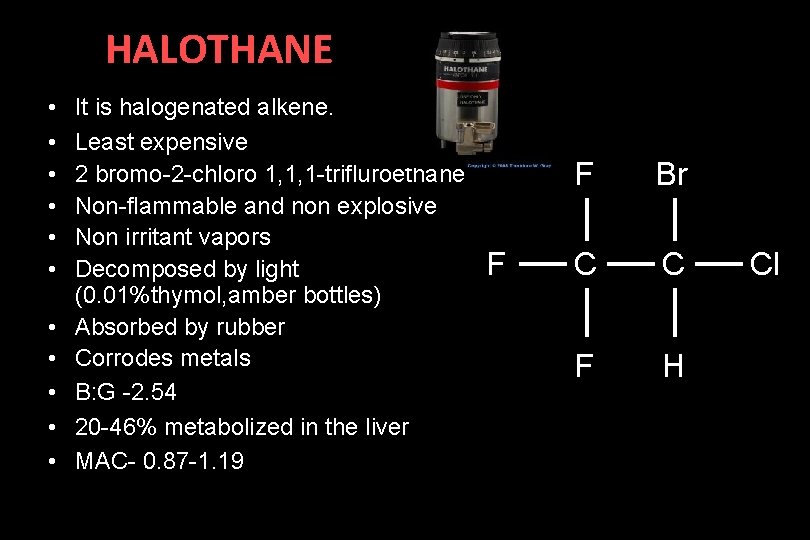
HALOTHANE • • • It is halogenated alkene. Least expensive 2 bromo-2 -chloro 1, 1, 1 -trifluroethane Non-flammable and non explosive Non irritant vapors Decomposed by light (0. 01%thymol, amber bottles) Absorbed by rubber Corrodes metals B: G -2. 54 20 -46% metabolized in the liver MAC- 0. 87 -1. 19 F F Br C C F H Cl
EFFECTS ON ORGAN SYSTEM 1. CARDIOVASCULAR: Dose dependent reduction of arterial blood pressure by direct myocardial depression. It is a coronary artery vasodilator. It causes slowing of SA node conduction resulting in bradycardia. Sensitizes heart to catecholamine and induces arrhythmias 2. RESPIRATORY SYSTEM: Causes rapid , shallow breathing. Decrease in alveolar ventilation and Paco 2 elevated. Potent bronchodilator.
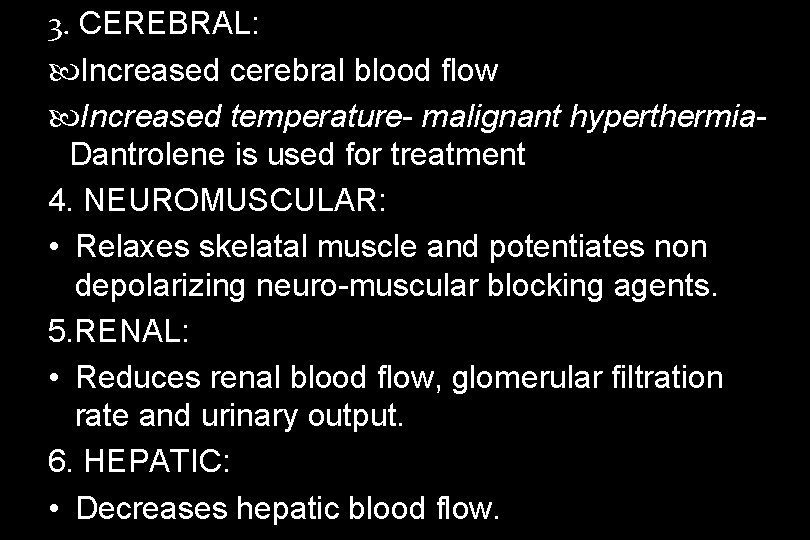
3. CEREBRAL: Increased cerebral blood flow Increased temperature- malignant hyperthermia. Dantrolene is used for treatment 4. NEUROMUSCULAR: • Relaxes skelatal muscle and potentiates non depolarizing neuro-muscular blocking agents. 5. RENAL: • Reduces renal blood flow, glomerular filtration rate and urinary output. 6. HEPATIC: • Decreases hepatic blood flow.
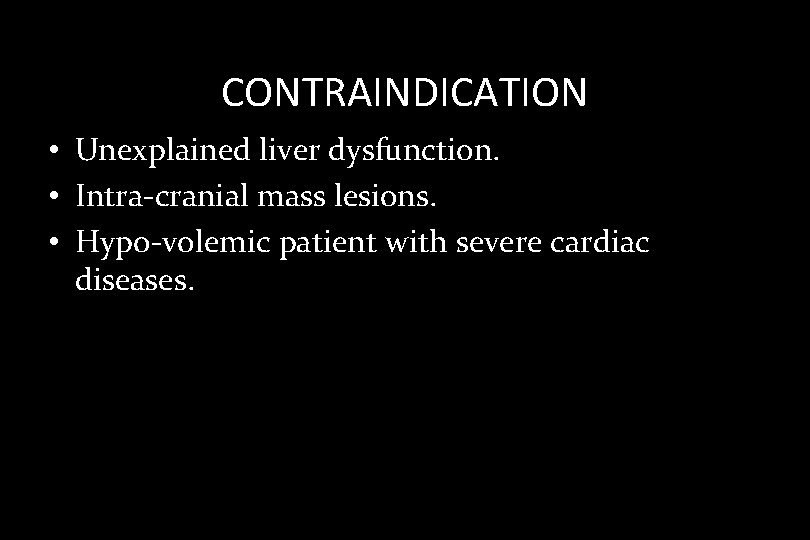
CONTRAINDICATION • Unexplained liver dysfunction. • Intra-cranial mass lesions. • Hypo-volemic patient with severe cardiac diseases.
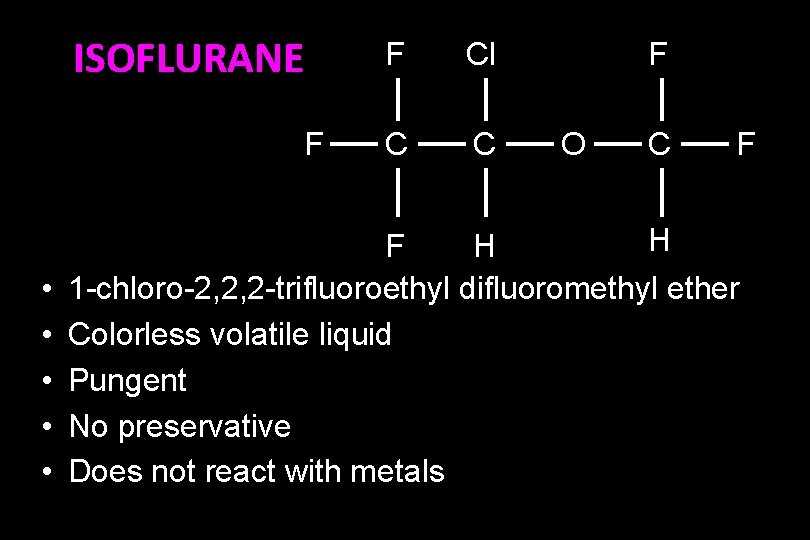
ISOFLURANE F • • • F Cl C C F O C F H 1 -chloro-2, 2, 2 -trifluoroethyl difluoromethyl ether Colorless volatile liquid Pungent No preservative Does not react with metals
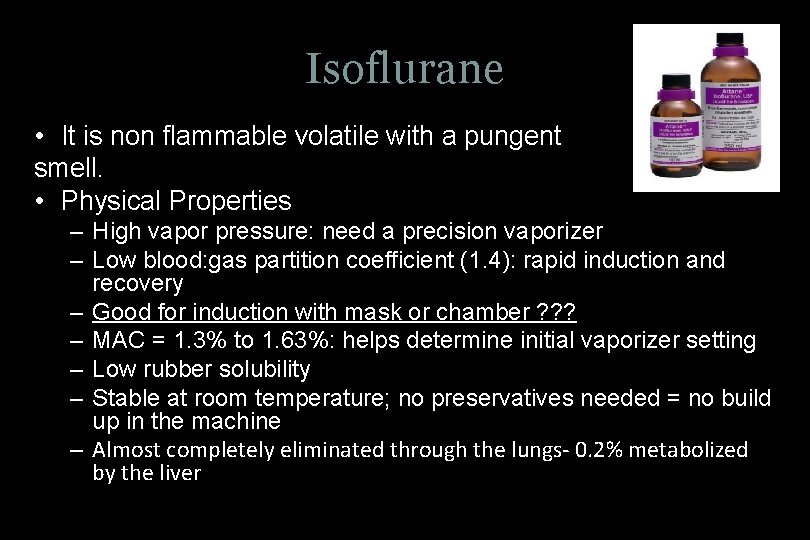
Isoflurane • It is non flammable volatile with a pungent smell. • Physical Properties – High vapor pressure: need a precision vaporizer – Low blood: gas partition coefficient (1. 4): rapid induction and recovery – Good for induction with mask or chamber ? ? ? – MAC = 1. 3% to 1. 63%: helps determine initial vaporizer setting – Low rubber solubility – Stable at room temperature; no preservatives needed = no build up in the machine – Almost completely eliminated through the lungs- 0. 2% metabolized by the liver
EFFECTS ON ORGAN SYSTEM CARDIOVASCULAR: Causes minimal cardiac depression. Maintains cardiac output, heart rate, and rhythm Fewest adverse cardiovascular effects Rapid increase in MAC lead to increase in HR and BP. Dilates coronary arteries. (Coronary Steal) 2. RESPIRATORY SYSTEM: Respiratory depression. Irritant to upper airway
3. CEREBRAL: Maintains cerebral blood flow If conc > 1 MAC causes increase in CBF and Intracranial pressure. 4. NEUROMUSCULAR: Induces adequate to good muscle relaxation 5. RENAL: Decreases renal blood flow , glomerular filtration rate and urinary output. 6. HEAPTIC: Reduces hepatic blood flow.
INDICATIONS • For Cardiac and Neuro- Surgery • In patients with hepatic or renal compromise CONTRAINDICATION • No such contraindication. • Caution in asthmatics
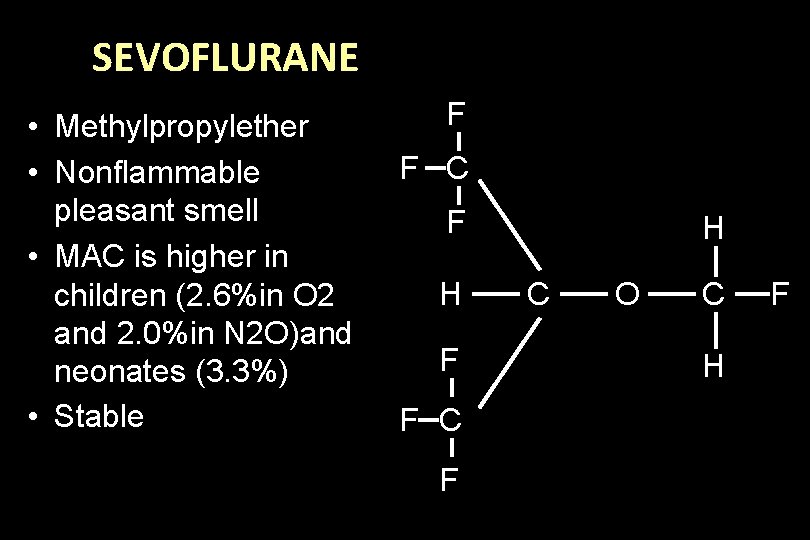
SEVOFLURANE • Methylpropylether • Nonflammable pleasant smell • MAC is higher in children (2. 6%in O 2 and 2. 0%in N 2 O)and neonates (3. 3%) • Stable F F C F H C O C H F
Sevoflurane High vapor pressure: need a precision vaporizer Low Blood: gas partition coefficient (0. 65) = rapid induction and recovery Good for induction with a mask or chamber. Easier to mask a patient, more pleasant smelling High controllability of depth of anesthesia MAC = 2. 34% to 2. 58% Cost about 10 x more than Isoflurane Eliminated by the lungs, minimal hepatic metabolism- 2 -5% Can react with potassium hydroxide (KOH) or sodium hydroxide (Na. OH) in desiccated CO 2 absorbent to produce a chemical (Compound A) that causes renal damage
EFFECTS ON ORGANS 1. CARDIOVASCULAR SYSTEM: • Mildly depresses myocardial contractility. • May prolong QT interval, but no significance. 2. RESPIRATORY SYSTEM: • Depresses respiratory rate. • It reverses broncho-spasm 3. CEREBRAL: • Maintains cerebral blood flow • Increases CBF and intra-cranial pressure. • Some paddling and excitement during recovery • No post-op analgesia
4. RENAL SYSTEM: • Slightly decreases renal blood flow. Higher Conc Causes Nephro-toxicity 5. HEPATIC: • Decreases portal vein blood flow but increases hepatic artery blood flow thus maintaining total hepatic blood flow. 6. NEUROMUSCULAR: • Adequate muscle relaxation.
INDICATION • For induction • Especially useful in children • In patients with reactive upper airway CONTRAINDICATION • No such contraindication • Caution in severe hypo-volemia.
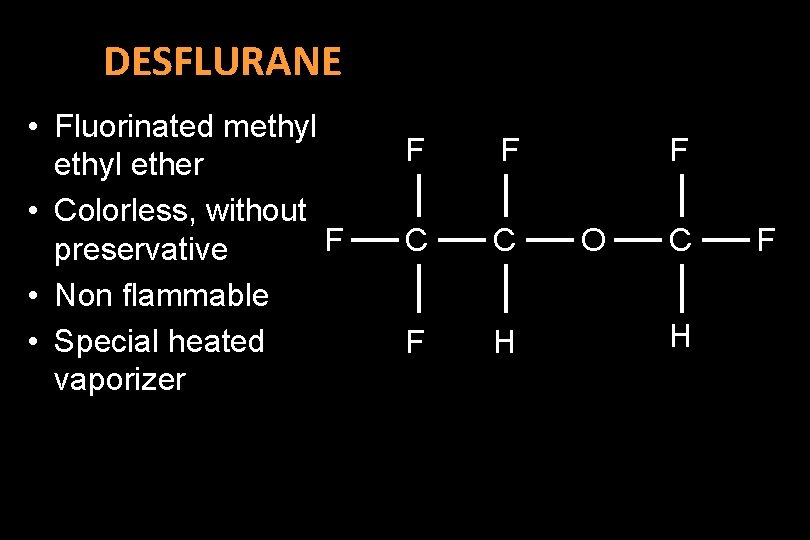
DESFLURANE • Fluorinated methyl ether • Colorless, without F preservative • Non flammable • Special heated vaporizer F F C C F H F O C H F
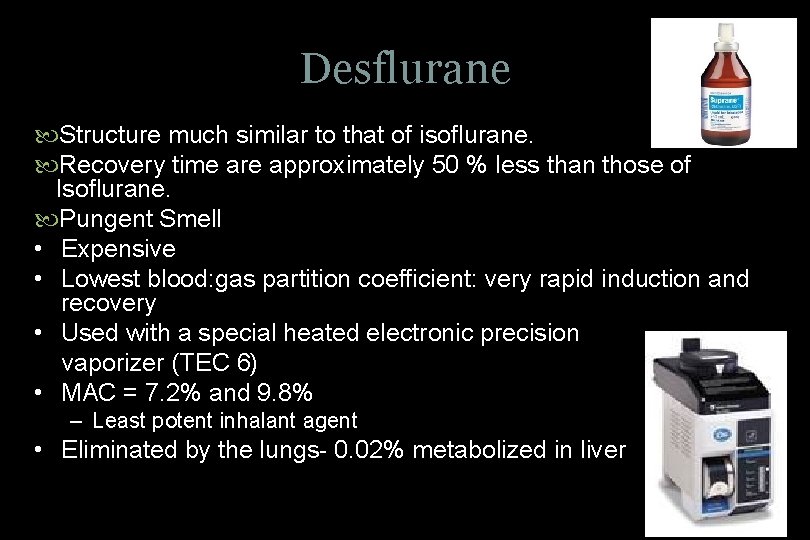
Desflurane Structure much similar to that of isoflurane. Recovery time are approximately 50 % less than those of Isoflurane. Pungent Smell • Expensive • Lowest blood: gas partition coefficient: very rapid induction and recovery • Used with a special heated electronic precision vaporizer (TEC 6) • MAC = 7. 2% and 9. 8% – Least potent inhalant agent • Eliminated by the lungs- 0. 02% metabolized in liver
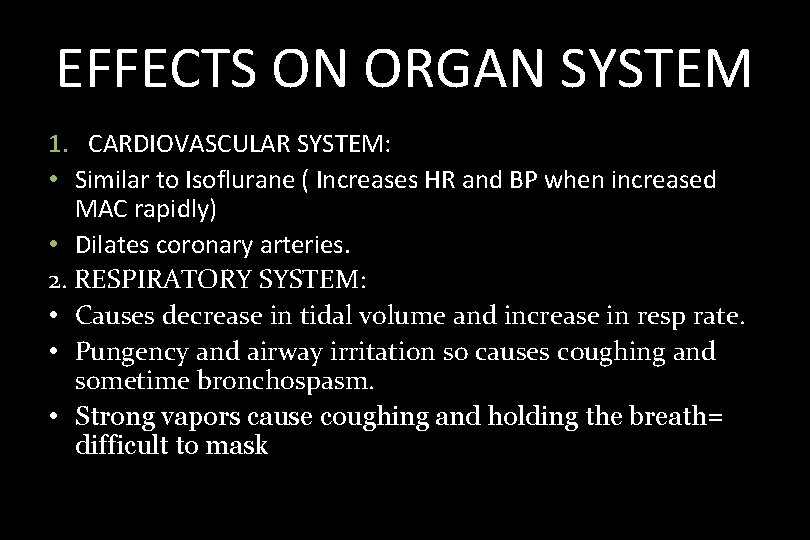
EFFECTS ON ORGAN SYSTEM 1. CARDIOVASCULAR SYSTEM: • Similar to Isoflurane ( Increases HR and BP when increased MAC rapidly) • Dilates coronary arteries. 2. RESPIRATORY SYSTEM: • Causes decrease in tidal volume and increase in resp rate. • Pungency and airway irritation so causes coughing and sometime bronchospasm. • Strong vapors cause coughing and holding the breath= difficult to mask
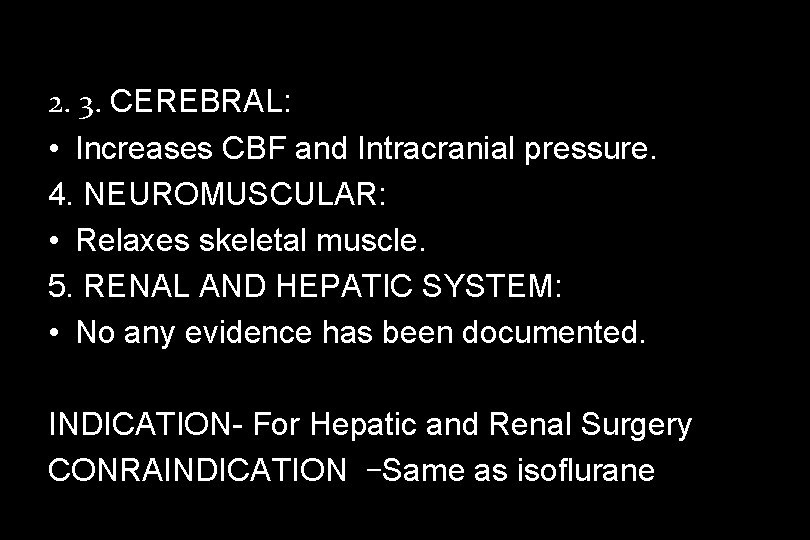
2. 3. CEREBRAL: • Increases CBF and Intracranial pressure. 4. NEUROMUSCULAR: • Relaxes skeletal muscle. 5. RENAL AND HEPATIC SYSTEM: • No any evidence has been documented. INDICATION- For Hepatic and Renal Surgery CONRAINDICATION –Same as isoflurane
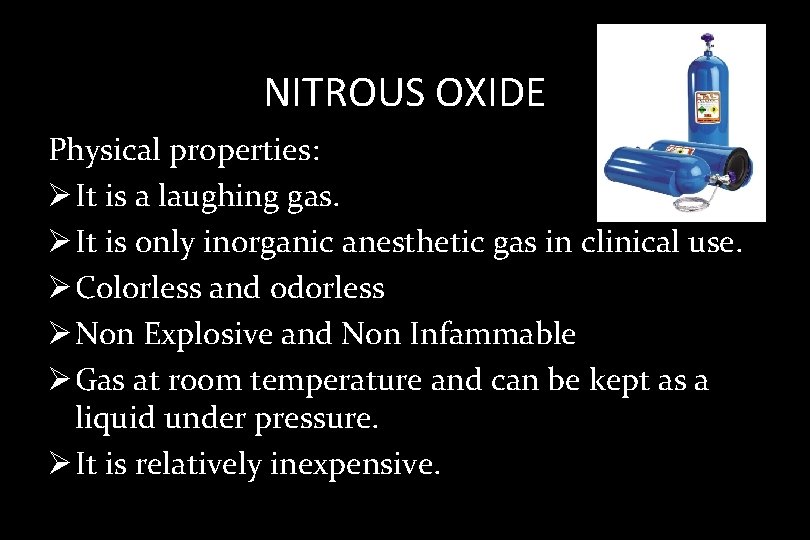
NITROUS OXIDE Physical properties: Ø It is a laughing gas. Ø It is only inorganic anesthetic gas in clinical use. Ø Colorless and odorless Ø Non Explosive and Non Infammable Ø Gas at room temperature and can be kept as a liquid under pressure. Ø It is relatively inexpensive.
Effects of Nitrous Oxide on Organ System 1. CARDIOVASCULAR SYSTEM • Stimulate sympathetic nervous system. • Directly depresses myocardial contractility. • Arterial blood pressure , heart rate and cardiac output are slightly increased. 2. RESPIRATORY SYSTEM: • Increases respiratory rate with decreases tidal volume. • Minimal change in minute ventilation.
3. CEREBRAL: • Increases CBF thus increasing intracranial pressure. 4. RENAL SYSTEM: • It decreases renal blood flow thus leads to drop in glomerular filtration rate and urinary output. 5. HEPATIC SYSTEM: • Decreases the Hepatic blood flow but to a lesser extent than other inhalation agents. 6. GASTROINTESTINAL: • It causes post operative Nausea and Vomiting.
CONTRAINDICATION OF N 2 O • • • Air embolism Pneumothorax Acute Intestinal Obstruction Tension Pneumocephalus Tympanic membrane grafting
Uses of N 2 O Mixed with oxygen at 40 -67%, then delivered to patient Reduces MAC 20 -30% Used with Halothane and Methoxyflurane to reduce the adverse effects of these gases
THANK YOU