
Inge Hill Start Up Palgrave 2015 1 CHAPTER





- Slides: 21
© Inge Hill Start Up, Palgrave 2015 1
CHAPTER 13 Marketing planning and implementation © Inge Hill Start Up, Palgrave 2015 2
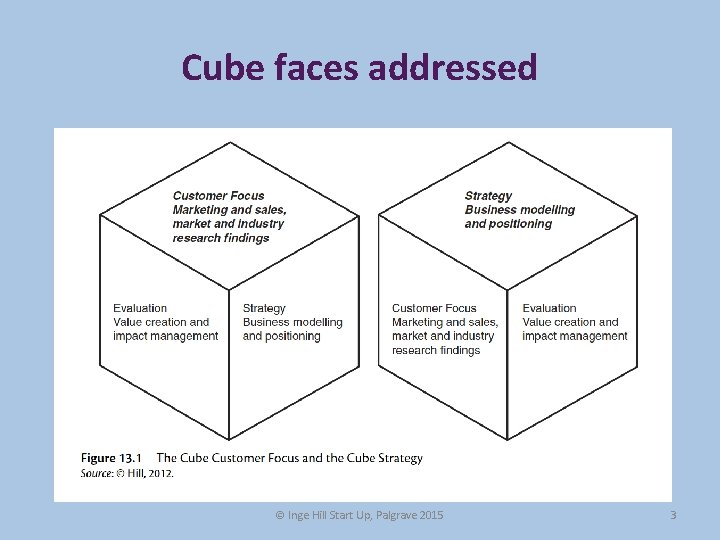
Cube faces addressed © Inge Hill Start Up, Palgrave 2015 3
Learning outcomes • Explore marketing for start-ups • Evaluate practical essentials in marketing • Identify how to develop a brand from the start • Examine marketing on a shoestring • Compare social media marketing for business with social media use for leisure • Differentiate cause-related and social marketing • Discuss marketing plan(ning) © Inge Hill Start Up, Palgrave 2015 4
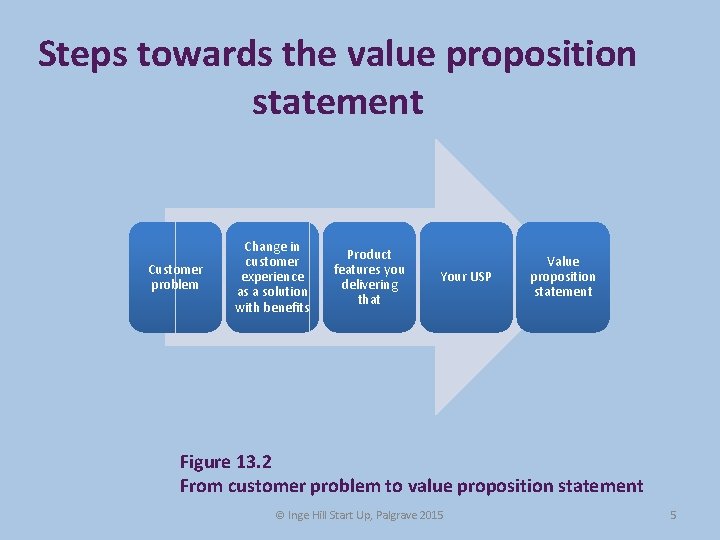
Steps towards the value proposition statement Customer problem Change in customer experience as a solution with benefits Product features you delivering that Your USP Value proposition statement Figure 13. 2 From customer problem to value proposition statement © Inge Hill Start Up, Palgrave 2015 5
Marketing • The strategic business function that creates value by stimulating, facilitating and fulfilling customer demand. It does this by building brands, nurturing innovation, developing relationships, creating good customer service and communicating benefits. • With a customer centric view, marketing brings positive return on investment, satisfies shareholders and stakeholders from business and the community, and contributes to positive behavioural change and a sustainable business future. • Chartered Institute of Marketing (2010) Shape the agenda, tomorrow’s word - Re-evaluating the role of marketing. (p. 14) © Inge Hill Start Up, Palgrave 2015 6
Simple marketing models / frameworks AIDA • Attention • Interest • Desire • Action 7 Ps of marketing communication • Price • Product • Promotion • Place • People • Processes • Physical evidence • Packaging © Inge Hill Start Up, Palgrave 2015 7
Mission statement • Specifies in more detail how the company intends to achieve the stated vision, • Names some of the goals and the purpose it was created for. • “At Crowdentials, our mission is to help companies raise capital and ease the burden of complying with the JOBS Act with automated solutions. We believe that those raising funding shouldn't be blindsided by laws they didn't know existed and shouldn’t pay hefty fees and spend countless hours to stay compliant. ” – (www. crowdentials. com, accessed September 2014) © Inge Hill Start Up, Palgrave 2015 8
Vision statement • Aspirational statement future oriented: • Sums up why the company exists, its core purpose: • Case study Richard Rodman: “Crowdentials strives to grow our economy by helping every company and investor focus on raising and investing capital in a safe and cost effective manner. In the next 10 years, companies won’t view regulations as cumbersome but rather a necessary step to protecting all parties involved in a transaction. ” • (www. crowdentials. com, accessed September 2014) © Inge Hill Start Up, Palgrave 2015 9
Mottos / slogans • One simple message • Expressive, easy to grasp the first time • Tone: serious, funny, light-hearted or aggressive • Example: car manufacturer FORD • “Built for the Road Ahead”, (double meaning of the physical road ahead and the figurative meaning of the way to the future. ) © Inge Hill Start Up, Palgrave 2015 10
Develop a brand from the start • Brand = “A set of associations that a person (or group of people) makes with a company, product, service, individual or organisation. ” Design Council (www. designcouncil. org. uk/newsopinion/power-branding, accessed 19 -8 -2014). • Brand = intellectual asset and resource • • • A brand can include The company or product name Colours and graphics Motto or tagline Shapes Tastes or scents. Protect it early on with a trademark or design. © Inge Hill Start Up, Palgrave 2015 11
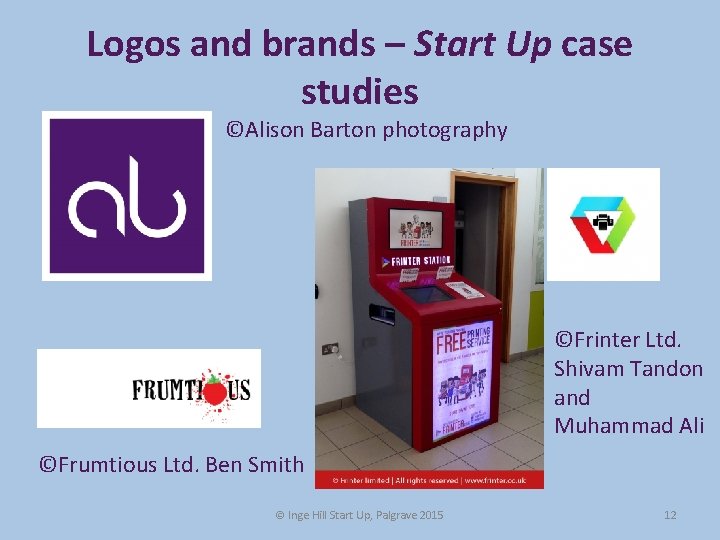
Logos and brands – Start Up case studies ©Alison Barton photography ©Frinter Ltd. Shivam Tandon and Muhammad Ali ©Frumtious Ltd. Ben Smith © Inge Hill Start Up, Palgrave 2015 12
Brands have four levels of meaning to potential consumers: • Utilitarian sign – indication that this product or services does what it says or claims. • Commercial sign – Values of the brand such as value for money, quality. • Socio-cultural sign – Social effects of buying or not buying the product or service. • Mythical Value – Heroic images about the product or service such as James Bond’s Aston Martin. © Inge Hill Start Up, Palgrave 2015 13
E-marketing / digital marketing • Website – Content – SEO • Email marketing • Social media for business – – Facebook Twitter Pinterest Linked. In • Online business networks and directories • Affiliate marketing online • Pay-per-click advertising • QR-codes © Inge Hill Start Up, Palgrave 2015 14
Word of Mouth marketing • Probably the most powerful of all media because: • You are always marketing your business, if you want it or not. • It is an interactive discussion between two individuals although the organisation cannot control what is said. • It allows for feedback and confirmation of the message. • The source (friend) carries greater levels of credibility that an advertisement. © Inge Hill Start Up, Palgrave 2015 15
Cause related marketing • Marketing partnerships that can be either corporate led or social enterprise / charity led. • Goals for corporates: – Deliver on corporate social responsibility goals – Maximise sales – Improve company reputation • Goals for non-profits: – Raise funds – Raise awareness of organisation and/or mission © Inge Hill Start Up, Palgrave 2015 16
Cause related marketing cont. • Example: Age Concern and Innocent Smoothies • http: //www. ageuk. org. uk/get-involved/events-and-challenges/the-bigknit/ accessed 5/8/2015 • “Big Knit 2015” – cause: – Help older people to keep warm and well in winter; heating and befriending visits. • People in the UK knit small hats that go on top of Smoothis bottles • Then from each sale of a small or large bottle, 25 p go to Age Concern © Inge Hill Start Up, Palgrave 2015 17
Social marketing • Focus: behavioral change in target group • Creating social good by solving challenges through promoting behavior change – Example: giving up smoking = new behaviour • Core product = benefits the new behaviour will generate – Better health after giving up smoking • Augmented product = tangible products and services supporting the behavior change – Free counselling, • Competition = other behavior that is easier to maintain, organisations sending out other messages – Continuing to smoke, messages sent in adverts by the tobacco companies © Inge Hill Start Up, Palgrave 2015 18
Marketing planning - SOSTAC • • • Situation analysis Objectives definition Strategy Tactics Action Control © Inge Hill Start Up, Palgrave 2015 19
Marketing action planning © Inge Hill Start Up, Palgrave 2015 20
Questions? © Inge Hill Start Up, Palgrave 2015 21