
Ing Arnotka Netrvalov Trust Modeling Introduction September 2008
Ing. Arnoštka Netrvalová Trust Modeling (Introduction) September 2008
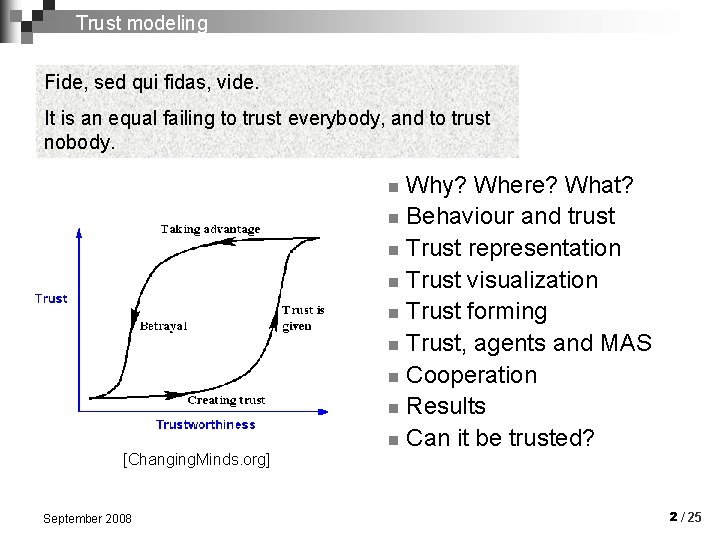
Trust modeling Fide, sed qui fidas, vide. It is an equal failing to trust everybody, and to trust nobody. Why? Where? What? n Behaviour and trust n Trust representation n Trust visualization n Trust forming n Trust, agents and MAS n Cooperation n Results n Can it be trusted? n [Changing. Minds. org] September 2008 2 / 25
Trust modeling WHY? WHERE? Phenomenon of everyday life n Internet n n e-banking – credibility n e-commerce n e-service n PC September 2008 – trustworthiness of partners – quality, promptness and computing 3 /25
Trust modeling WHERE? WHAT? Computing and trust P 2 P systems – security (working together of nodes) n GRID computing – security (reliability of sources, users) n AD HOC networks – message integrity (node =server, router, n client, malicious nodes, special protocols, cryptographic codes) n MAS – security dependability (malicious agent detection, migrating, selection of „the best“ agent, system’s optimization) n Semantic web – credibility of sources (machine information collection) September 2008 4 /25
Trust modeling Trust definition Trust (or symmetrically, distrust) is a particular level of the subjective probability with which an agent will perform a particular action, both before we can monitor such an action (or independently of our capacity of ever to be able to monitor it) and in a context in which it affects our own action. Gambetta's definition was derived as a summary of the contributions to the symposium on trust in Cambridge, England, 1988. September 2008 5 /25
Trust modeling Behaviour and trust “I trust him. ” “How much do I trust him? ” “How much I think, he trusts me ? ” n What does it mean? n Can trust be measured? What is visual representation of trust? n September 2008 6 /25
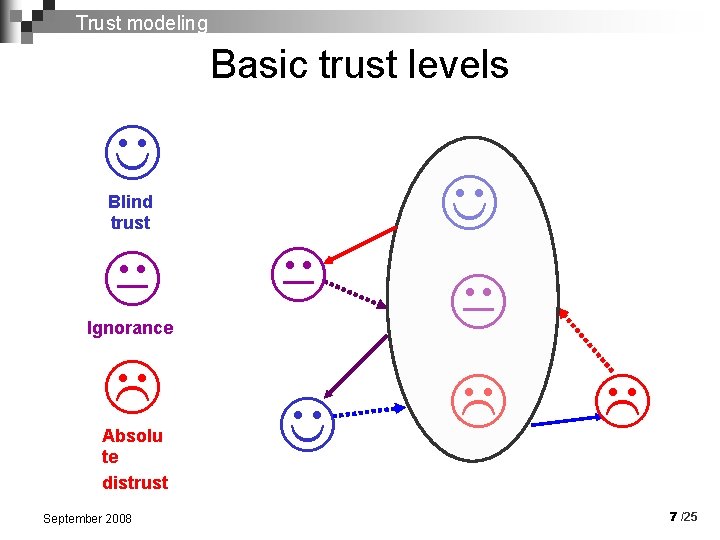
Trust modeling Basic trust levels Blind trust Ignorance Absolu te distrust September 2008 7 /25
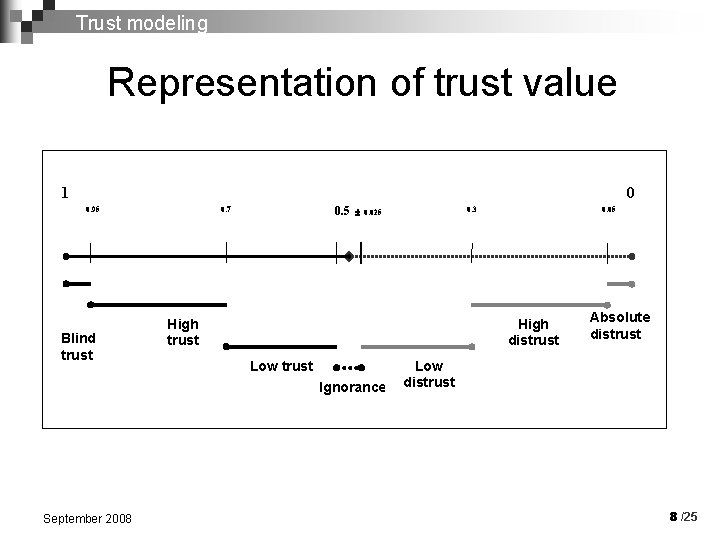
Trust modeling Representation of trust value 1 0 0. 95 Blind trust 0. 7 0. 5 0. 025 High trust 0. 05 High distrust Low trust Ignorance September 2008 0. 3 Absolute distrust Low distrust 8 /25
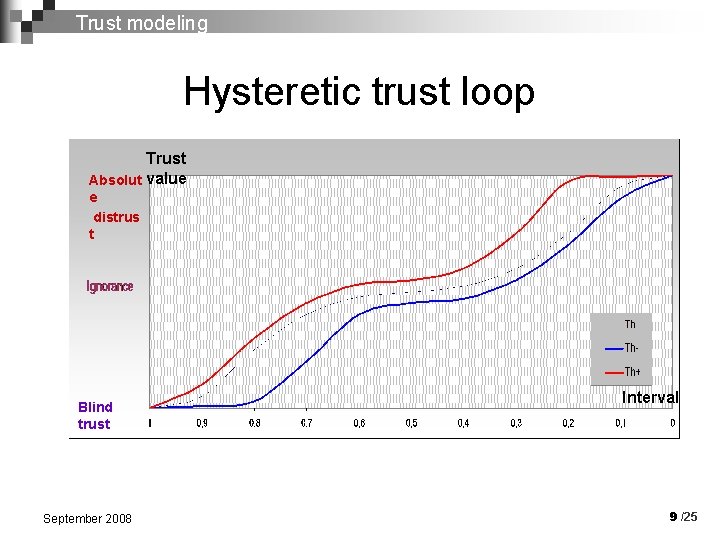
Trust modeling Hysteretic trust loop Trust Absolut value e distrus t Blind trust September 2008 Interval 9 /25

Trust modeling Trust visualization „Trust square“: two relation for couple and one value per relationship trust (1, 0) (1, 1) Subject A distrust (0. 5, 0. 5) (0, 1) (0, 0) distrust Subject B September 2008 10 /25
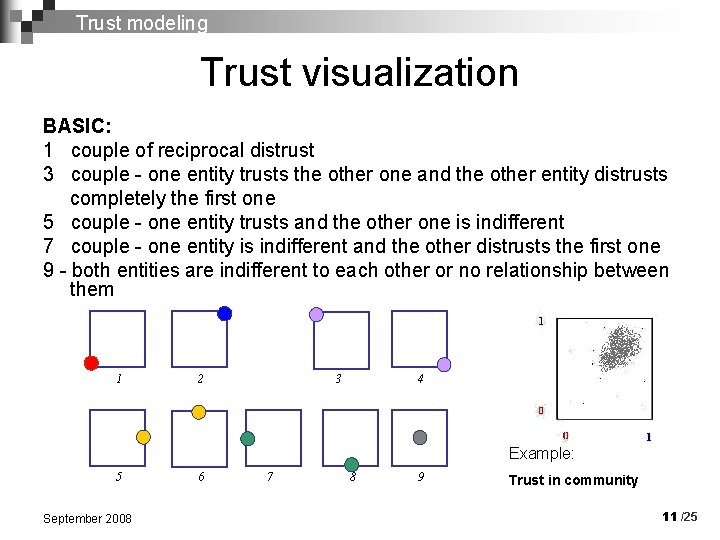
Trust modeling Trust visualization BASIC: 1 couple of reciprocal distrust 3 couple - one entity trusts the other one and the other entity distrusts completely the first one 5 couple - one entity trusts and the other one is indifferent 7 couple - one entity is indifferent and the other distrusts the first one 9 - both entities are indifferent to each other or no relationship between them 1 2 3 4 Example: 5 September 2008 6 7 8 9 Trust in community 11 /25
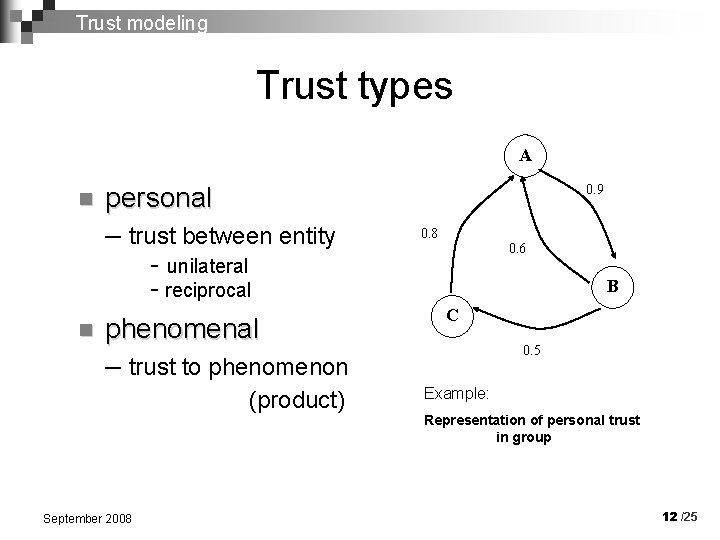
Trust modeling Trust types A n n personal – trust between entity - unilateral - reciprocal phenomenal – trust to phenomenon (product) September 2008 0. 9 0. 8 0. 6 B C 0. 5 Example: Representation of personal trust in group 12 /25
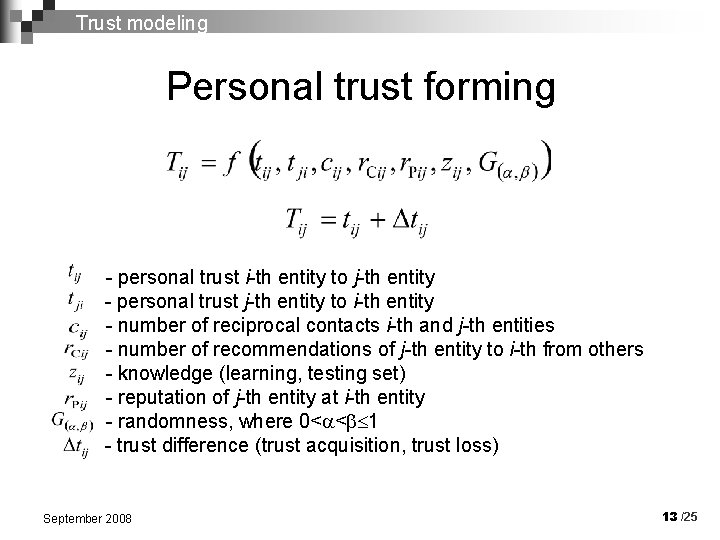
Trust modeling Personal trust forming - personal trust i-th entity to j-th entity - personal trust j-th entity to i-th entity - number of reciprocal contacts i-th and j-th entities - number of recommendations of j-th entity to i-th from others - knowledge (learning, testing set) - reputation of j-th entity at i-th entity - randomness, where 0< < 1 - trust difference (trust acquisition, trust loss) September 2008 13 /25
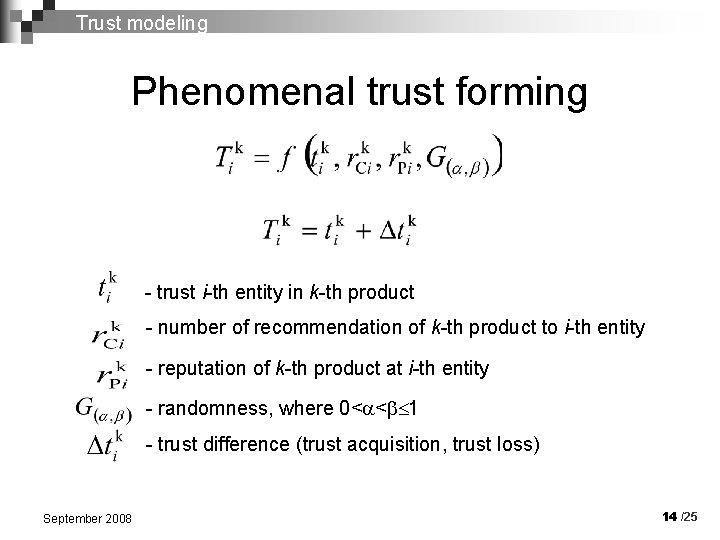
Trust modeling Phenomenal trust forming - trust i-th entity in k-th product - number of recommendation of k-th product to i-th entity - reputation of k-th product at i-th entity - randomness, where 0< < 1 - trust difference (trust acquisition, trust loss) September 2008 14 /25
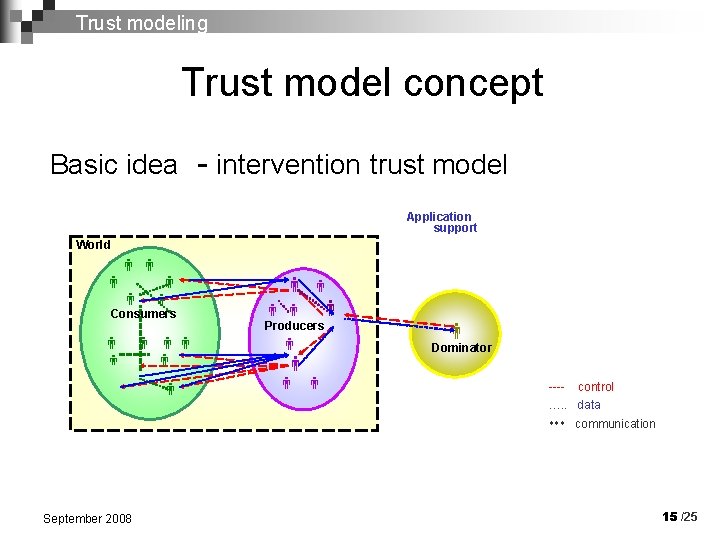
Trust modeling Trust model concept Basic idea - intervention trust model Application support World Consumers Producers Dominator ---- control …. . data communication September 2008 15 /25
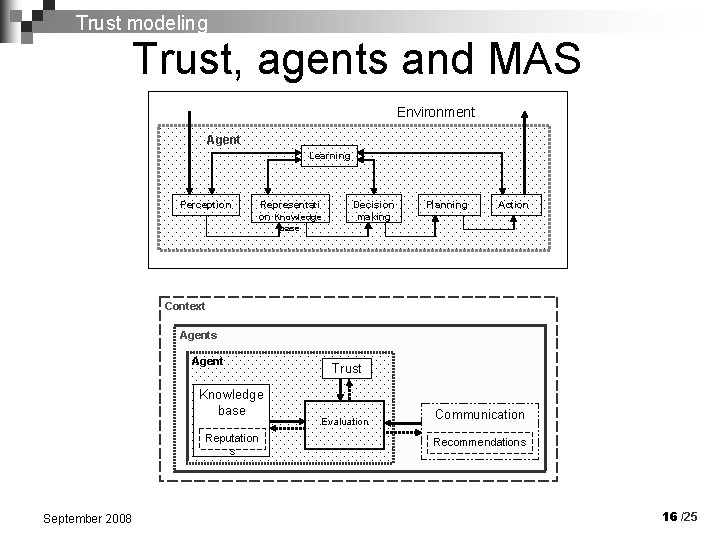
Trust modeling Trust, agents and MAS Environment Agent Learning Perception Representati on Knowledge Decision making Planning Action base Context Agents Agent Knowledge base Reputation s September 2008 Trust Evaluation Communication Recommendations 16 /25
Trust modeling Software for agent modeling and simulation n RETSINA (Reusable Environment for Task-Structured Intelligent Networked Agents ) - Carnegie Mellon University Swarm (Swarm Intelligence) - Santa FE Research Institute JADE (Java Agent DEvelopment Framework) JADE - development of MAS(FIPA standards), middleware n n n Runtime environment Libraries for development of agent Graphical tool package for administration and monitoring of agents September 2008 17 /25
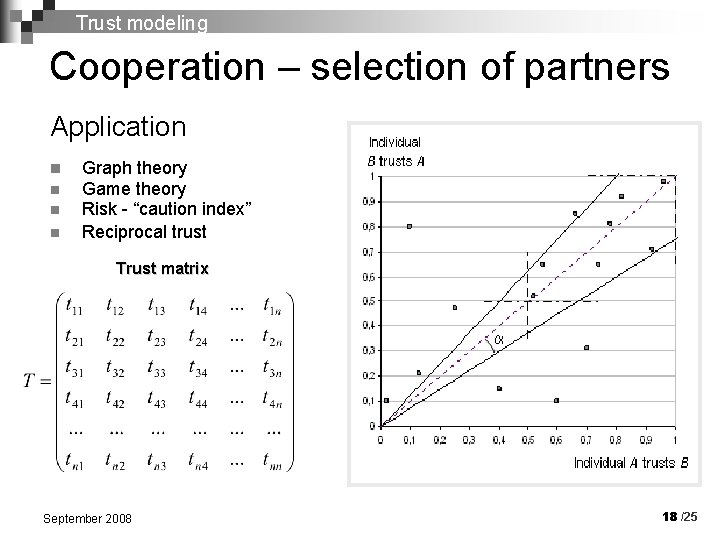
Trust modeling Cooperation – selection of partners Application n n Graph theory Game theory Risk - “caution index” Reciprocal trust Trust matrix September 2008 18 /25
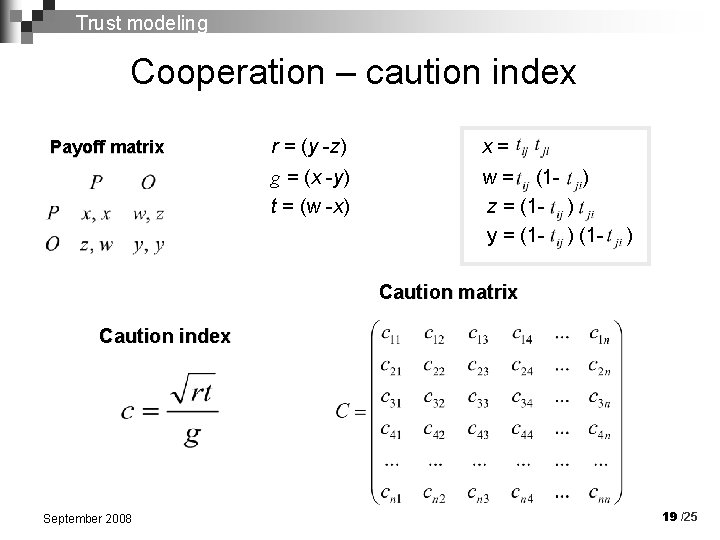
Trust modeling Cooperation – caution index Payoff matrix r = (y -z) x= g = (x -y) t = (w -x) w = (1 - ) z = (1 - ) y = (1 - ) Caution matrix Caution index September 2008 19 /25
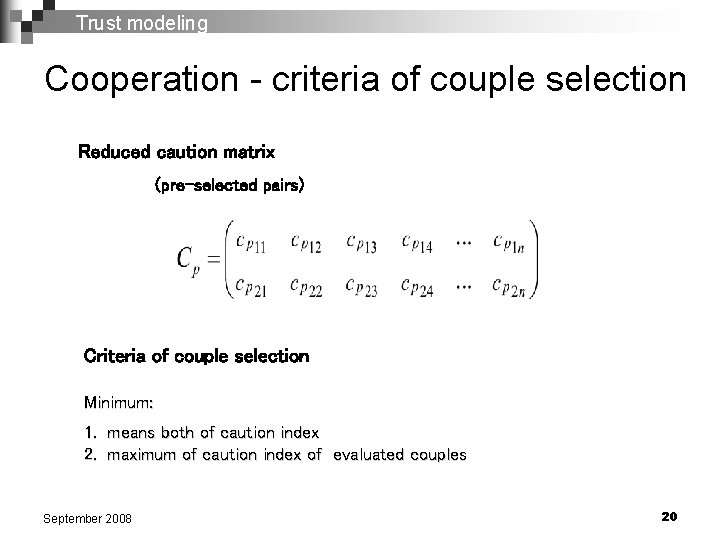
Trust modeling Cooperation - criteria of couple selection Reduced caution matrix (pre-selected pairs) Criteria of couple selection Minimum: 1. means both of caution index 2. maximum of caution index of evaluated couples September 2008 20
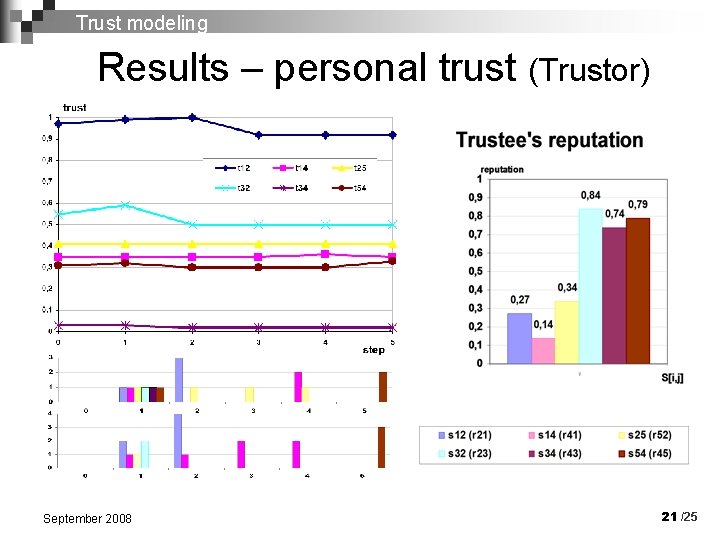
Trust modeling Results – personal trust (Trustor) September 2008 21 /25
![Trust modeling Results - cooperation Example (n=15, =10°, tij - random): [0; 6] [4;](http://slidetodoc.com/presentation_image_h2/d3a89d07dfc9fd169536bbef38972d07/image-22.jpg "Trust modeling Results - cooperation Example (n=15, =10°, tij - random): [0; 6] [4;")
Trust modeling Results - cooperation Example (n=15, =10°, tij - random): [0; 6] [4; 9] [4; 13] [5; 9] [5; 10] [9; 12] [12; 14] c[0. 45; 0. 15] c[0. 52; 0. 35] c[0. 19; 0. 51] c[0. 40; 0. 49] c[0. 36; 0. 50] c[0. 56; 0. 24] c[0. 40; 0. 36] Group size n (α=15°) t[0. 96; 0. 82] t[0. 79; 0. 72] t[0. 78; 0. 94] t[0. 71; 0. 74] t[0. 72; 0, 79] t[0. 88; 0. 72] t[0. 83; 0. 81] Number of identical couples/1000 runs 15 669 50 659 100 663 500 672 1 000 662 September 2008 t BA 1 0, 78; 0, 94 0, 96; 0, 82 0, 83; 0, 81 0, 8 0, 72; 0, 79 0, 71; 0, 74 0, 79; 0, 72 0, 88; 0, 72 0, 7 0, 8 0, 9 1 t AB 22 /25
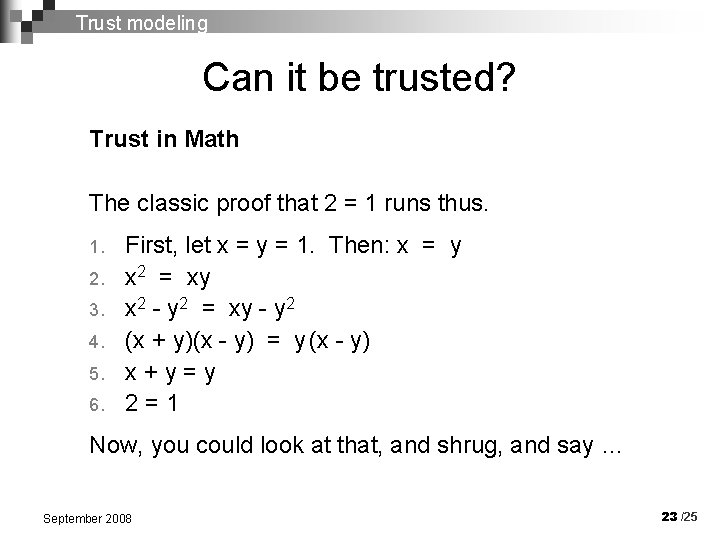
Trust modeling Can it be trusted? Trust in Math The classic proof that 2 = 1 runs thus. 1. 2. 3. 4. 5. 6. First, let x = y = 1. Then: x = y x 2 = xy x 2 - y 2 = xy - y 2 (x + y)(x - y) = y (x - y) x+y=y 2=1 Now, you could look at that, and shrug, and say … September 2008 23 /25
Trust modeling Důvěra, práce a výsledky „Malá důvěra je příčinou třenic a sporů, často vyvolaných neetickým či neprofesionálním jednáním. Jejím projevem jsou skryté agendy a politikaření skupin. Bývá zdrojem nezdravé rivality, vede k uvažování „výhra-prohra“ a ústí do defenzivní komunikace. Důsledkem je snížení rychlosti a zvýšení námahy při řešení úkolů. “ … … „Tím nejdůležitějším faktorem ovlivňujícím důvěru jsou výsledky. Avšak být důvěryhodným, neznamená jen mít výsledky, ale také docílit, aby o nich věděli i ostatní. “ Stephen M. R. Covey: Důvěra: jediná věc, která dokáže změnit vše, Management Press, 2008 [Stephen M. R. Covey: The Speed of Trust, Free Press, New York, 2006] September 2008 24 /25
Thank you for your attention. September 2008
- Slides: 25