
INFS 795 Dr Domeniconi Comparison of Principal Component


- Slides: 35
INFS 795 Dr. Domeniconi Comparison of Principal Component Analysis and Random Projection in Text Mining Steve Vincent April 29, 2004 1
Outline Introduction Previous Work Objective Background on Principal Component Analysis (PCA) and Random Projection (RP) Test Data Sets Experimental Design Experimental Results Future Work 2
Introduction “Random projection in dimensionality reduction: Applications to image and text data” from KDD 2001, by Bingham and Mannila compared principal component analysis (PCA) to random projection (RP) for text and image data For future work, they said: “A still more realistic application of random projection would be to use it in a data mining problem” 3
Previous Work In 2001, Bingham and Mannila compared PCA to RP for images and text In 2001, Torkkola discussed both Latent Semantic Indexing (LSI) and RP in classifying text for very low dimension levels n n LSI is very similar to PCA for text data Used the Reuters-21578 data base In 2003, Fradkin and Madigan discussed background of RP In 2003, Lin and Gunopulos combined LSI with RP n No real data mining comparison between the two 4
Objective Principal Component Analysis (PCA): n n Find components that make projections uncorrelated by selecting the highest eigenvalues of the covariance matrix Maximizes retained variance Random Projection (RP) n n Find components that make projections uncorrelated by multiplying by a random matrix Minimizes computations for a particular dimension size Determine whether RP is a viable dimensionality reduction method 5
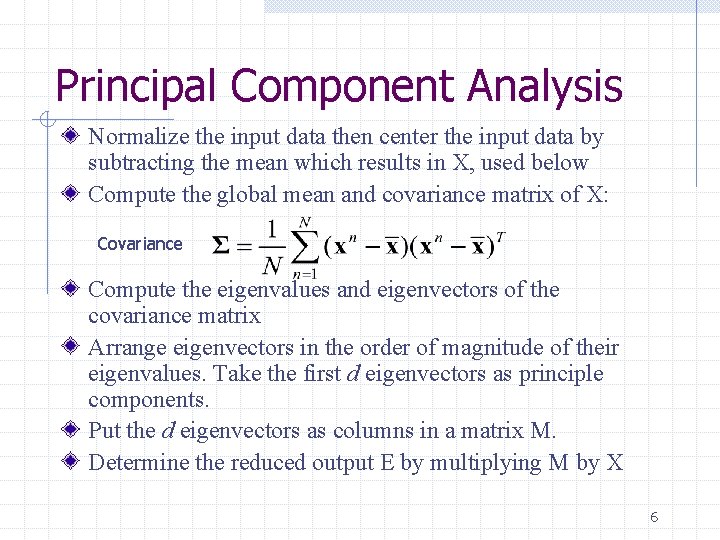
Principal Component Analysis Normalize the input data then center the input data by subtracting the mean which results in X, used below Compute the global mean and covariance matrix of X: Covariance Compute the eigenvalues and eigenvectors of the covariance matrix Arrange eigenvectors in the order of magnitude of their eigenvalues. Take the first d eigenvectors as principle components. Put the d eigenvectors as columns in a matrix M. Determine the reduced output E by multiplying M by X 6
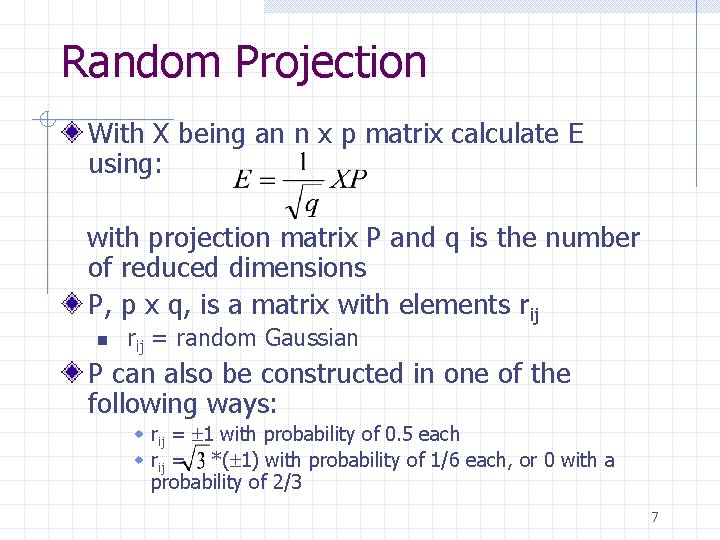
Random Projection With X being an n x p matrix calculate E using: with projection matrix P and q is the number of reduced dimensions P, p x q, is a matrix with elements rij n rij = random Gaussian P can also be constructed in one of the following ways: w rij = ± 1 with probability of 0. 5 each w rij = *(± 1) with probability of 1/6 each, or 0 with a probability of 2/3 7
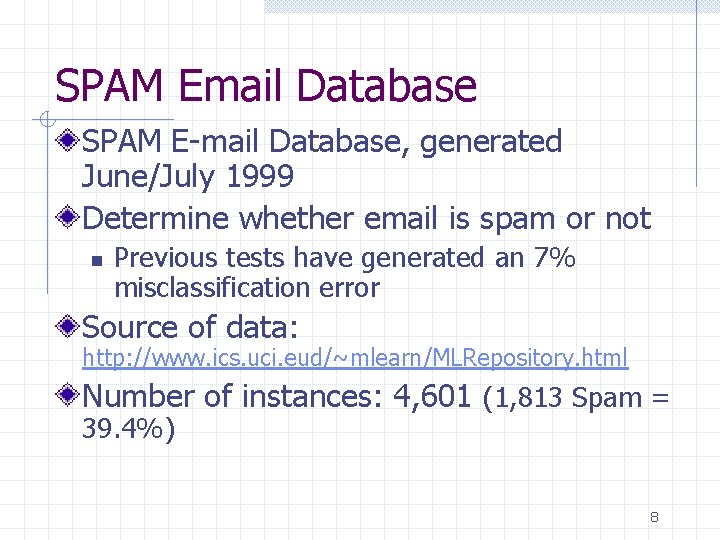
SPAM Email Database SPAM E-mail Database, generated June/July 1999 Determine whether email is spam or not n Previous tests have generated an 7% misclassification error Source of data: http: //www. ics. uci. eud/~mlearn/MLRepository. html Number of instances: 4, 601 (1, 813 Spam = 39. 4%) 8
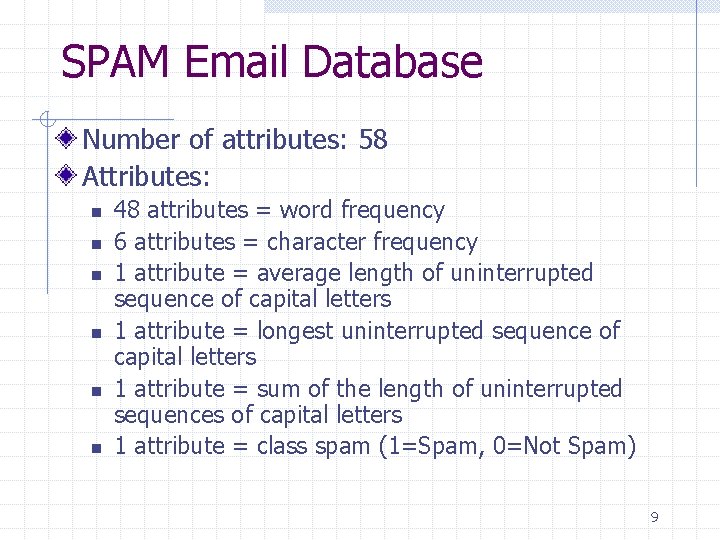
SPAM Email Database Number of attributes: 58 Attributes: n n n 48 attributes = word frequency 6 attributes = character frequency 1 attribute = average length of uninterrupted sequence of capital letters 1 attribute = longest uninterrupted sequence of capital letters 1 attribute = sum of the length of uninterrupted sequences of capital letters 1 attribute = class spam (1=Spam, 0=Not Spam) 9
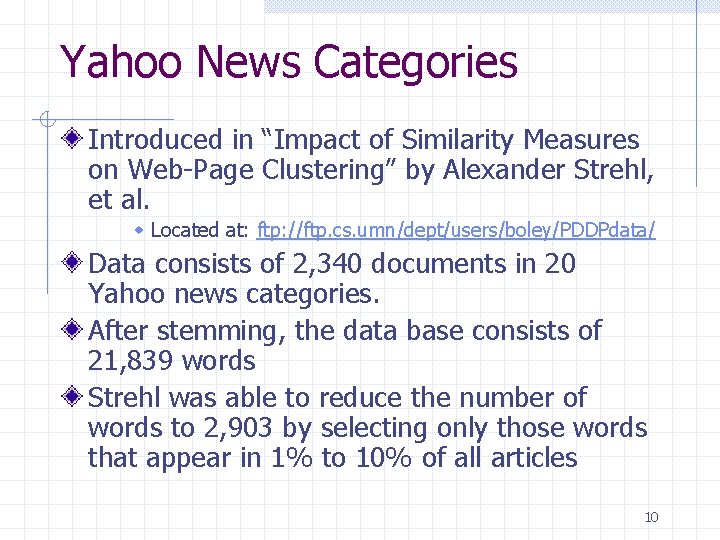
Yahoo News Categories Introduced in “Impact of Similarity Measures on Web-Page Clustering” by Alexander Strehl, et al. w Located at: ftp: //ftp. cs. umn/dept/users/boley/PDDPdata/ Data consists of 2, 340 documents in 20 Yahoo news categories. After stemming, the data base consists of 21, 839 words Strehl was able to reduce the number of words to 2, 903 by selecting only those words that appear in 1% to 10% of all articles 10
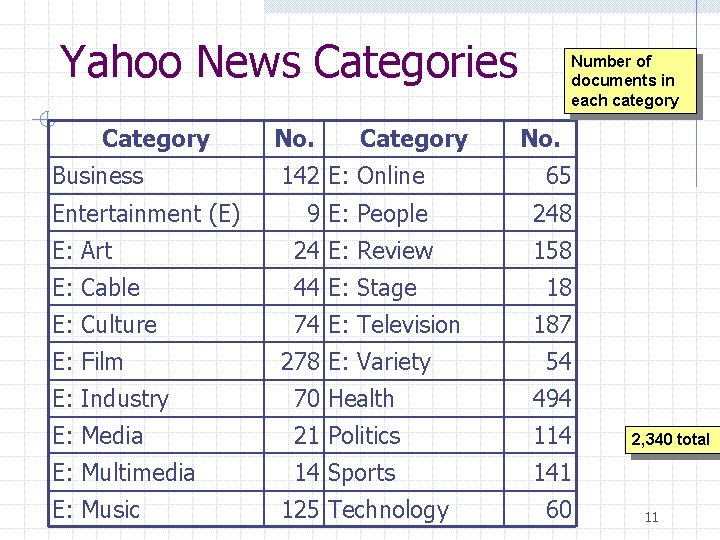
Yahoo News Categories Category Business No. Category Number of documents in each category No. 142 E: Online 65 9 E: People 248 E: Art 24 E: Review 158 E: Cable 44 E: Stage E: Culture 74 E: Television Entertainment (E) E: Film 278 E: Variety 18 187 54 E: Industry 70 Health 494 E: Media 21 Politics 114 E: Multimedia 14 Sports 141 E: Music 125 Technology 60 2, 340 total 11
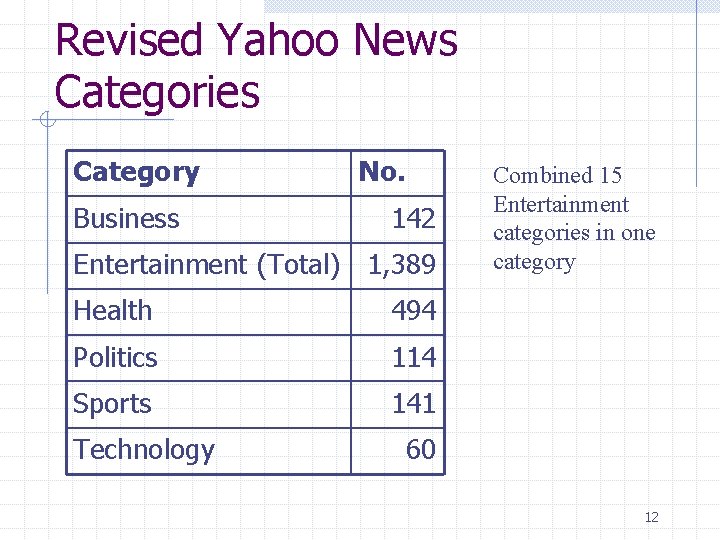
Revised Yahoo News Categories Category Business No. 142 Entertainment (Total) 1, 389 Health 494 Politics 114 Sports 141 Technology Combined 15 Entertainment categories in one category 60 12
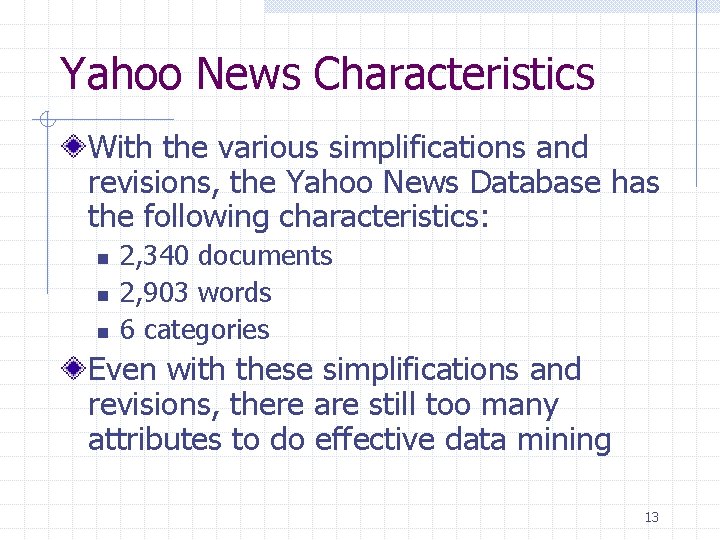
Yahoo News Characteristics With the various simplifications and revisions, the Yahoo News Database has the following characteristics: n n n 2, 340 documents 2, 903 words 6 categories Even with these simplifications and revisions, there are still too many attributes to do effective data mining 13
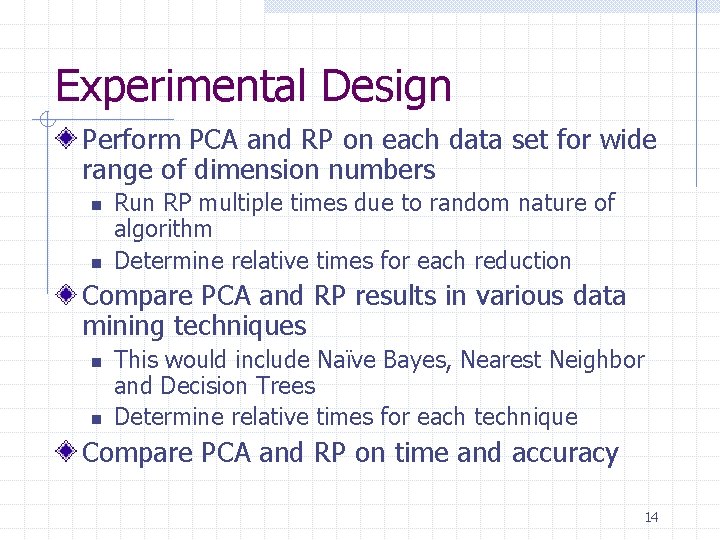
Experimental Design Perform PCA and RP on each data set for wide range of dimension numbers n n Run RP multiple times due to random nature of algorithm Determine relative times for each reduction Compare PCA and RP results in various data mining techniques n n This would include Naïve Bayes, Nearest Neighbor and Decision Trees Determine relative times for each technique Compare PCA and RP on time and accuracy 14
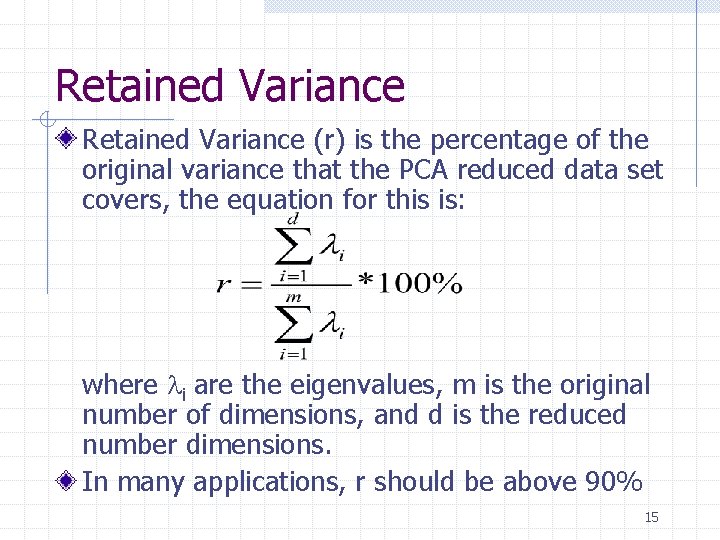
Retained Variance (r) is the percentage of the original variance that the PCA reduced data set covers, the equation for this is: where li are the eigenvalues, m is the original number of dimensions, and d is the reduced number dimensions. In many applications, r should be above 90% 15
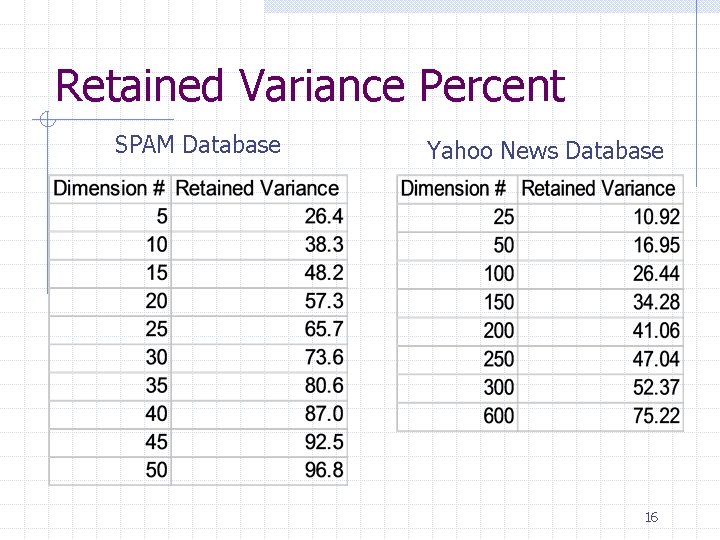
Retained Variance Percent SPAM Database Yahoo News Database 16
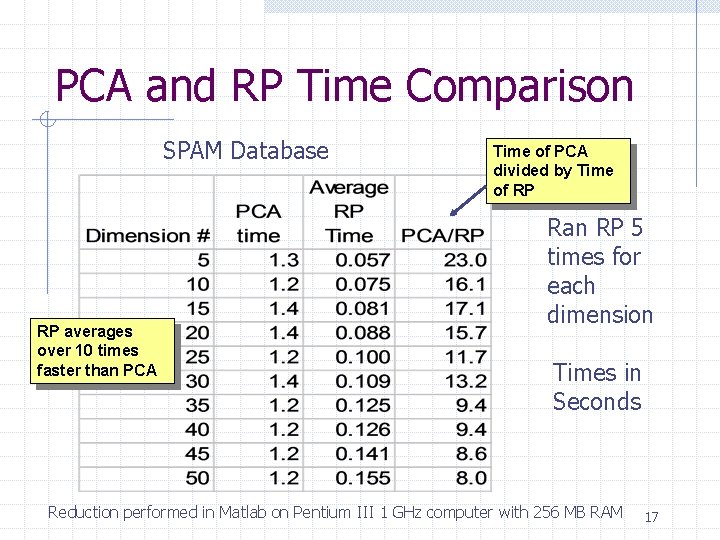
PCA and RP Time Comparison SPAM Database RP averages over 10 times faster than PCA Time of PCA divided by Time of RP Ran RP 5 times for each dimension Times in Seconds Reduction performed in Matlab on Pentium III 1 GHz computer with 256 MB RAM 17
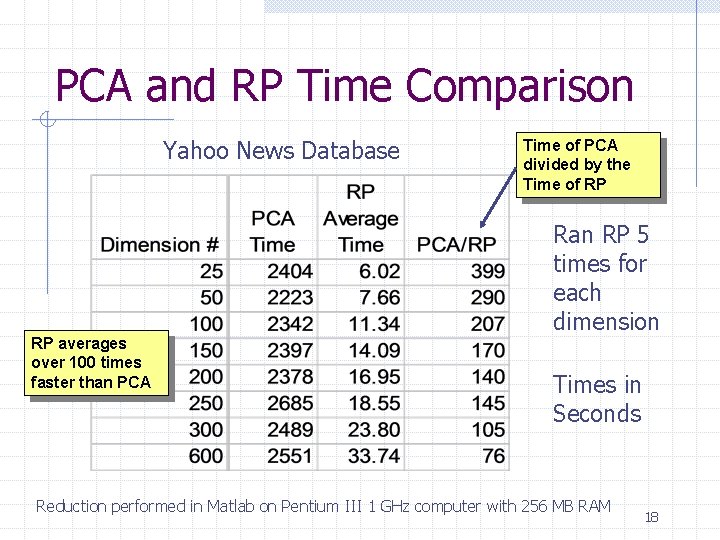
PCA and RP Time Comparison Yahoo News Database RP averages over 100 times faster than PCA Time of PCA divided by the Time of RP Ran RP 5 times for each dimension Times in Seconds Reduction performed in Matlab on Pentium III 1 GHz computer with 256 MB RAM 18
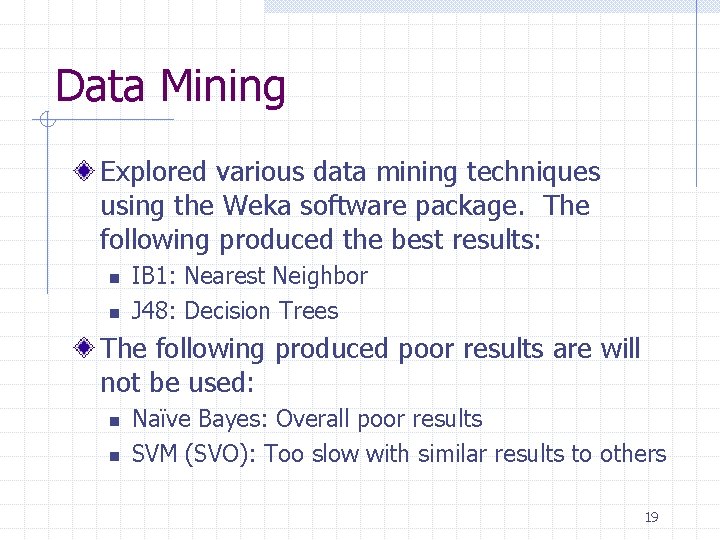
Data Mining Explored various data mining techniques using the Weka software package. The following produced the best results: n n IB 1: Nearest Neighbor J 48: Decision Trees The following produced poor results are will not be used: n n Naïve Bayes: Overall poor results SVM (SVO): Too slow with similar results to others 19
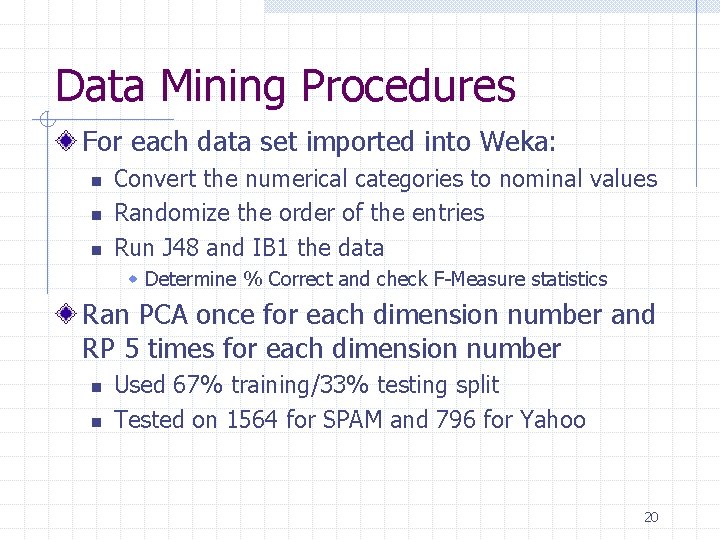
Data Mining Procedures For each data set imported into Weka: n n n Convert the numerical categories to nominal values Randomize the order of the entries Run J 48 and IB 1 the data w Determine % Correct and check F-Measure statistics Ran PCA once for each dimension number and RP 5 times for each dimension number n n Used 67% training/33% testing split Tested on 1564 for SPAM and 796 for Yahoo 20
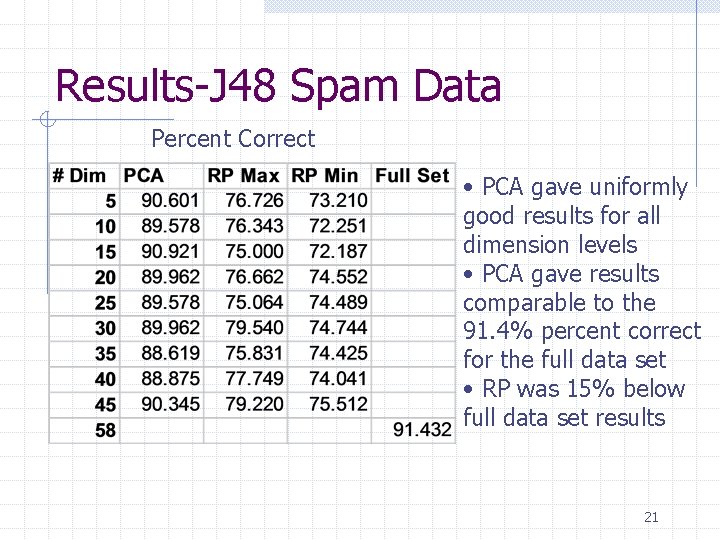
Results-J 48 Spam Data Percent Correct • PCA gave uniformly good results for all dimension levels • PCA gave results comparable to the 91. 4% percent correct for the full data set • RP was 15% below full data set results 21
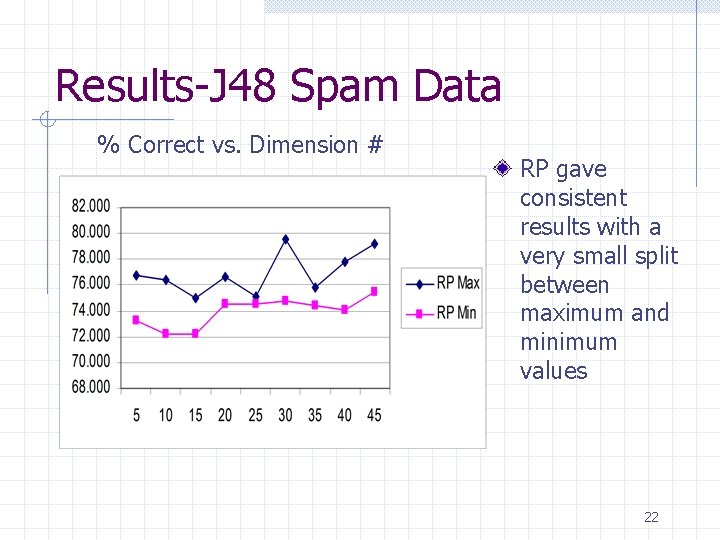
Results-J 48 Spam Data % Correct vs. Dimension # RP gave consistent results with a very small split between maximum and minimum values 22
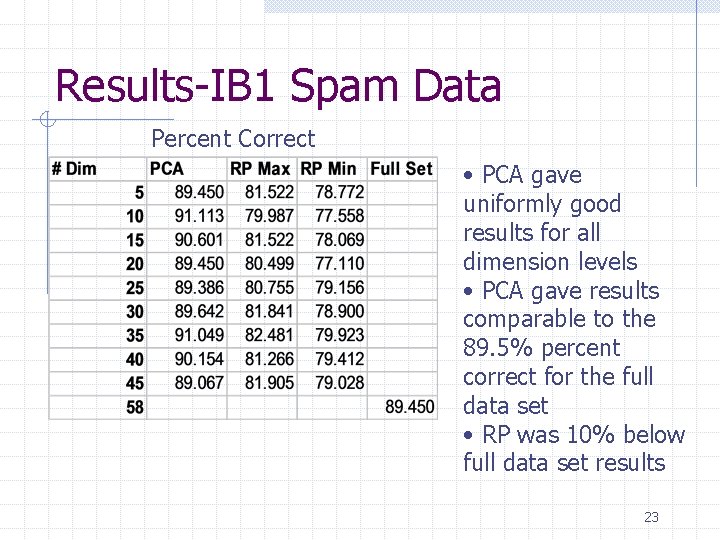
Results-IB 1 Spam Data Percent Correct • PCA gave uniformly good results for all dimension levels • PCA gave results comparable to the 89. 5% percent correct for the full data set • RP was 10% below full data set results 23
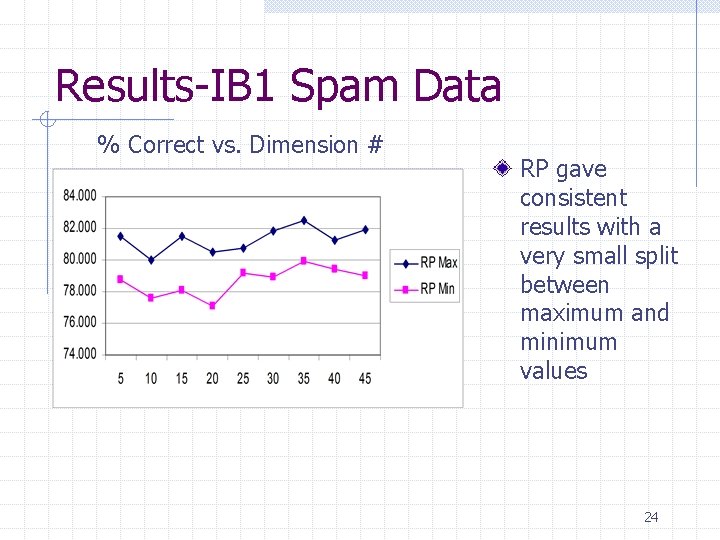
Results-IB 1 Spam Data % Correct vs. Dimension # RP gave consistent results with a very small split between maximum and minimum values 24
Results SPAM Data PCA gave consistent results for all dimension levels n Expected lower dimension levels to not perform as well RP gave consistent, but lower, results for all dimension levels n Also expected lower dimension levels to not perform as well 25
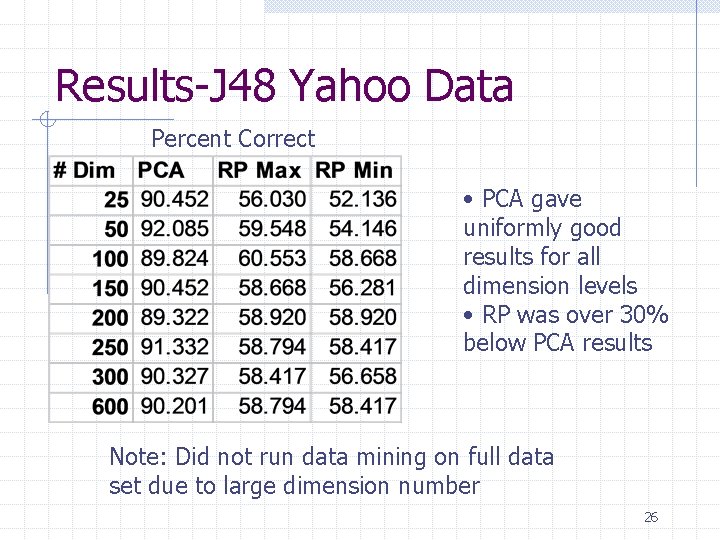
Results-J 48 Yahoo Data Percent Correct • PCA gave uniformly good results for all dimension levels • RP was over 30% below PCA results Note: Did not run data mining on full data set due to large dimension number 26
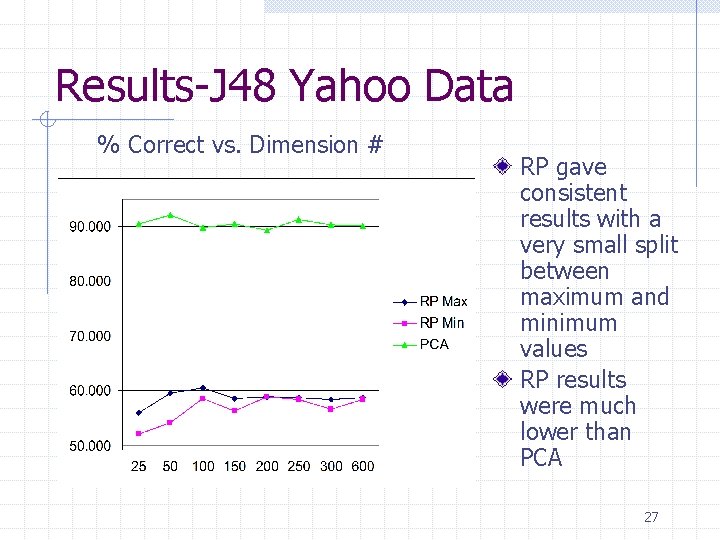
Results-J 48 Yahoo Data % Correct vs. Dimension # RP gave consistent results with a very small split between maximum and minimum values RP results were much lower than PCA 27
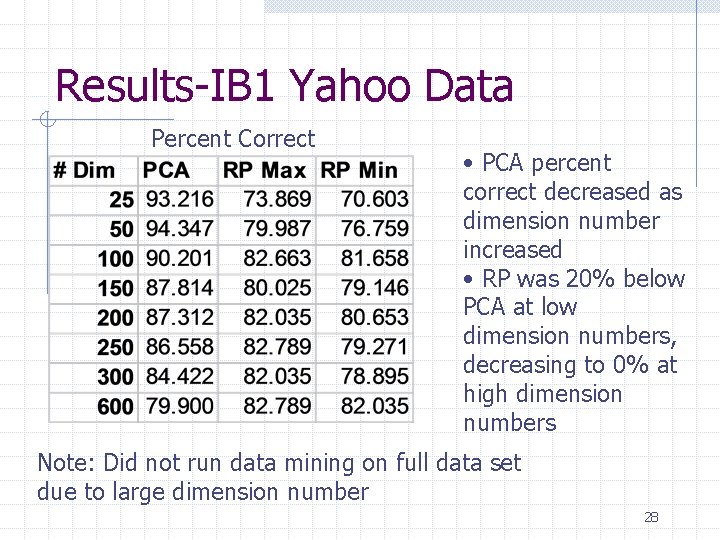
Results-IB 1 Yahoo Data Percent Correct • PCA percent correct decreased as dimension number increased • RP was 20% below PCA at low dimension numbers, decreasing to 0% at high dimension numbers Note: Did not run data mining on full data set due to large dimension number 28
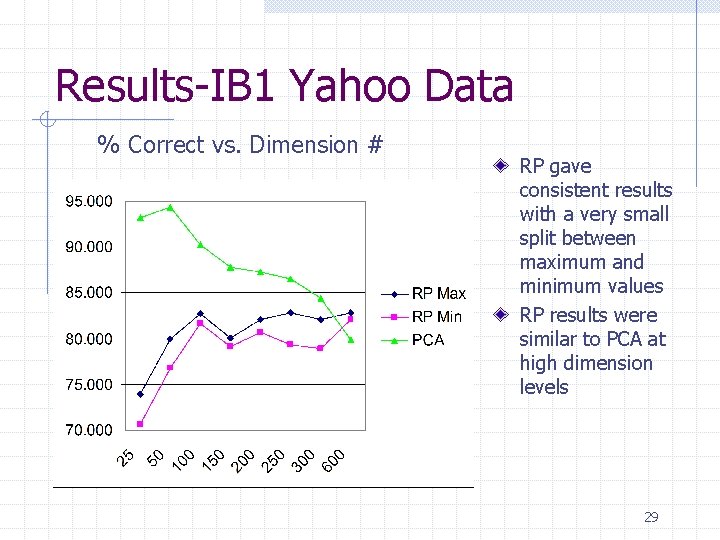
Results-IB 1 Yahoo Data % Correct vs. Dimension # RP gave consistent results with a very small split between maximum and minimum values RP results were similar to PCA at high dimension levels 29
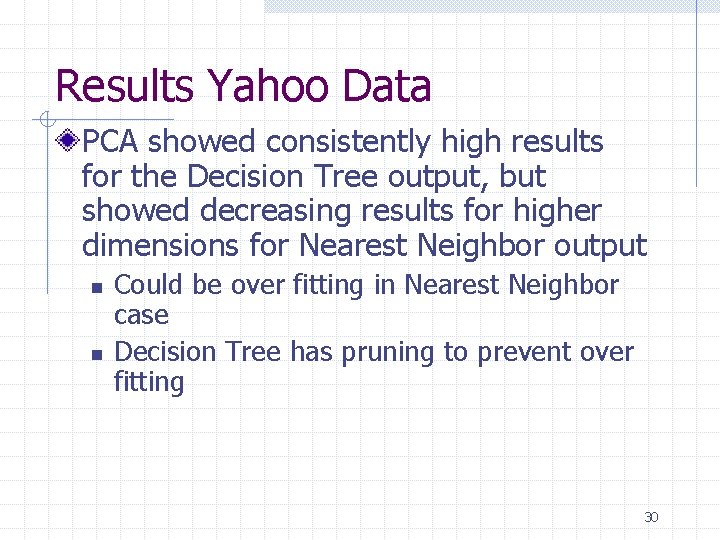
Results Yahoo Data PCA showed consistently high results for the Decision Tree output, but showed decreasing results for higher dimensions for Nearest Neighbor output n n Could be over fitting in Nearest Neighbor case Decision Tree has pruning to prevent over fitting 30
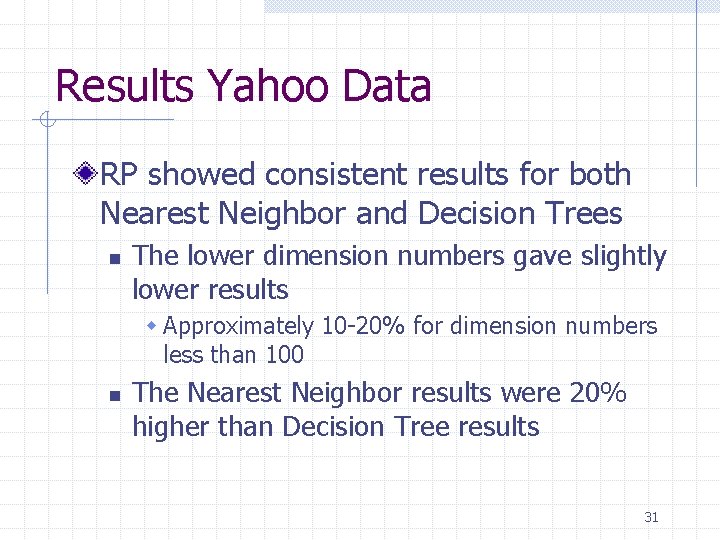
Results Yahoo Data RP showed consistent results for both Nearest Neighbor and Decision Trees n The lower dimension numbers gave slightly lower results w Approximately 10 -20% for dimension numbers less than 100 n The Nearest Neighbor results were 20% higher than Decision Tree results 31
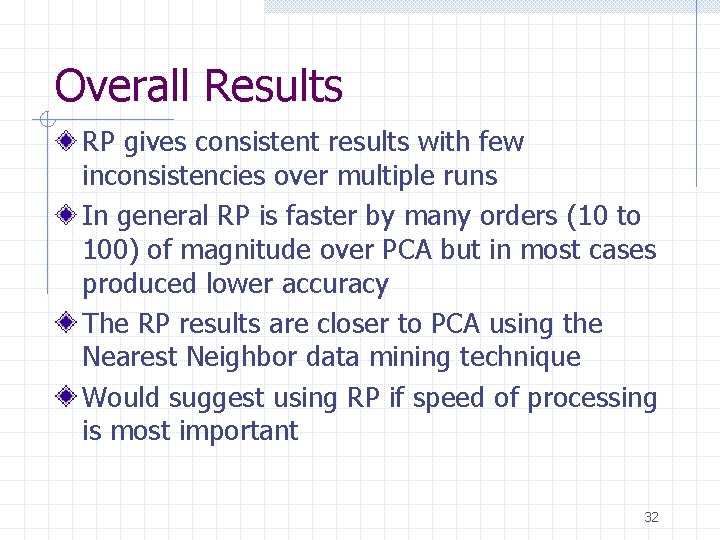
Overall Results RP gives consistent results with few inconsistencies over multiple runs In general RP is faster by many orders (10 to 100) of magnitude over PCA but in most cases produced lower accuracy The RP results are closer to PCA using the Nearest Neighbor data mining technique Would suggest using RP if speed of processing is most important 32
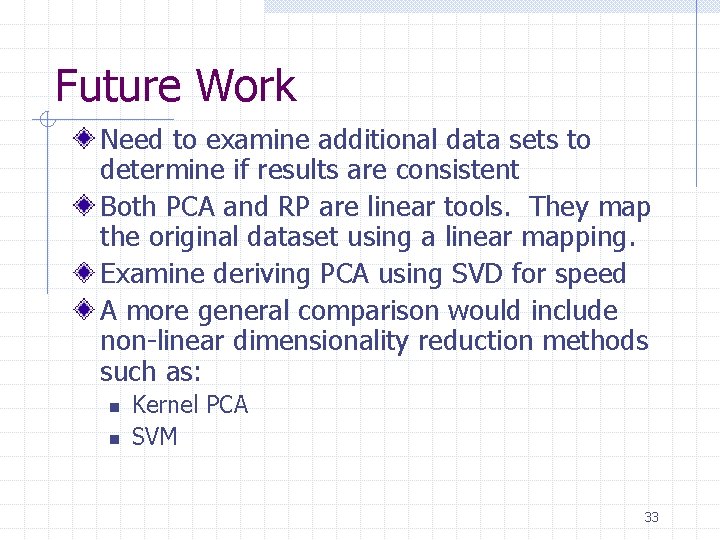
Future Work Need to examine additional data sets to determine if results are consistent Both PCA and RP are linear tools. They map the original dataset using a linear mapping. Examine deriving PCA using SVD for speed A more general comparison would include non-linear dimensionality reduction methods such as: n n Kernel PCA SVM 33
References E. Bingham and H. Mannila, “Random projection in dimensionality reduction: Applications to image and text data”, KDD 2001 D. Fradkin and D. Madigan, “Experiments with Random Projections for Machine Learning”, SOGLDD ’ 03, August 2003 J. Lin and D. Gunopulos, “Dimensionality Reduction by Random Projection and Latent Semantic Indexing”, Proceedings of the Text Mining Workshop, at the 3 rd SIAM International Conference on Data Mining, May 2003 K. Torkkola, “Linear Discriminant Analysis in Document Classification”, IEEE Workshop on Text Mining (Text. DM’ 2001), November 2001 34
Questions? 35