
Infrastructure vs infrastructureless networks Cellular WLANs rely on


- Slides: 22
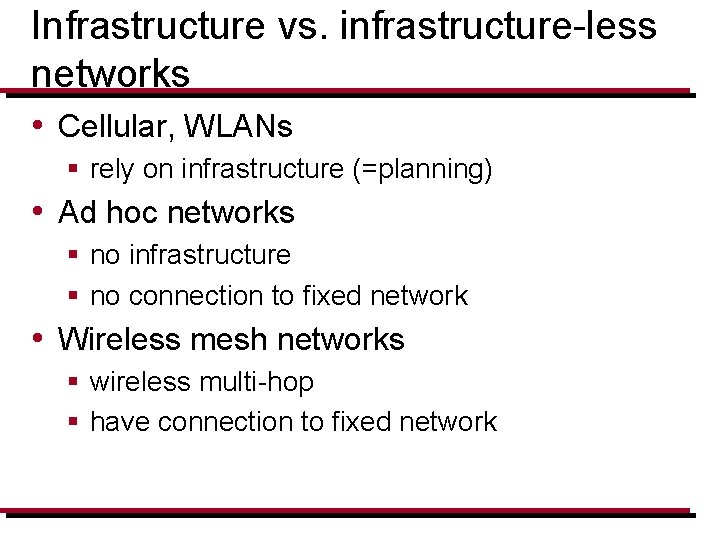
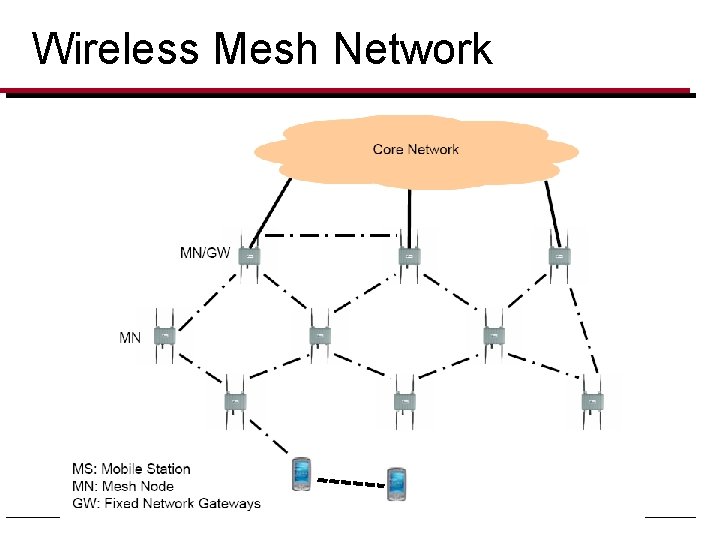
Infrastructure vs. infrastructure-less networks • Cellular, WLANs § rely on infrastructure (=planning) • Ad hoc networks § no infrastructure § no connection to fixed network • Wireless mesh networks § wireless multi-hop § have connection to fixed network
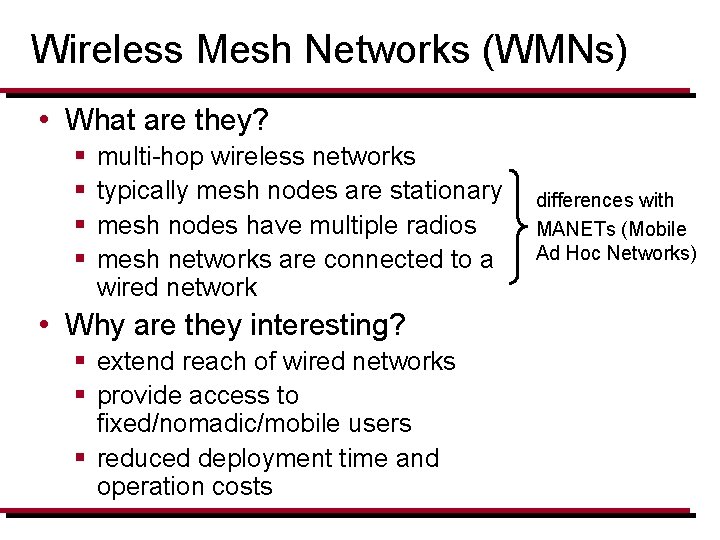
Wireless Mesh Networks (WMNs) • What are they? § § multi-hop wireless networks typically mesh nodes are stationary mesh nodes have multiple radios mesh networks are connected to a wired network • Why are they interesting? § extend reach of wired networks § provide access to fixed/nomadic/mobile users § reduced deployment time and operation costs differences with MANETs (Mobile Ad Hoc Networks)
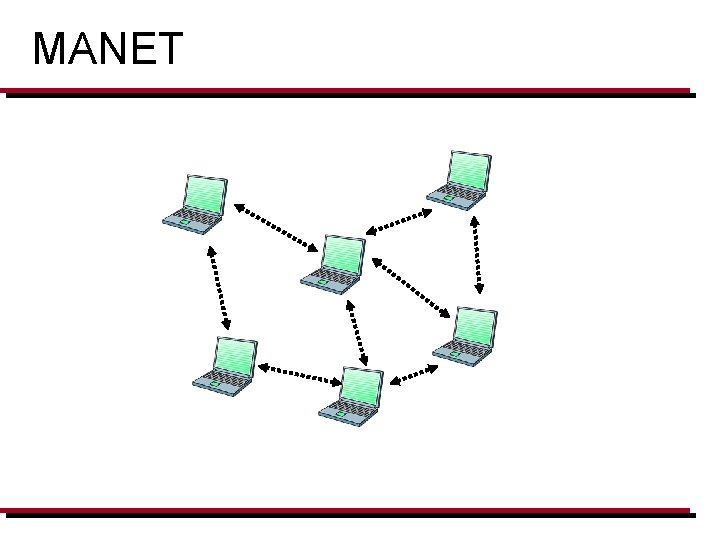
MANET
Wireless Mesh Network
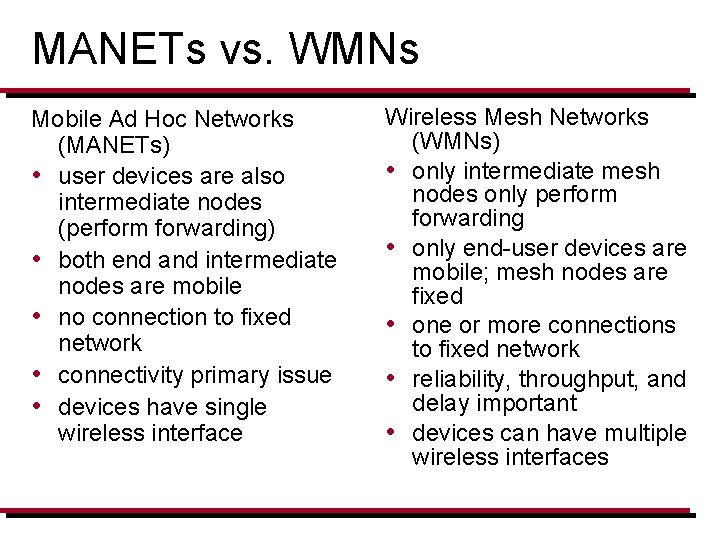
MANETs vs. WMNs Mobile Ad Hoc Networks (MANETs) • user devices are also intermediate nodes (perform forwarding) • both end and intermediate nodes are mobile • no connection to fixed network • connectivity primary issue • devices have single wireless interface Wireless Mesh Networks (WMNs) • only intermediate mesh nodes only perform forwarding • only end-user devices are mobile; mesh nodes are fixed • one or more connections to fixed network • reliability, throughput, and delay important • devices can have multiple wireless interfaces
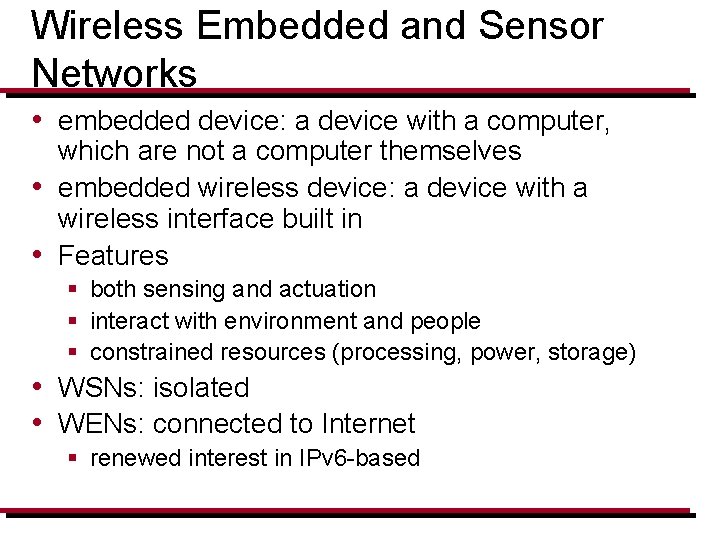
Wireless Embedded and Sensor Networks • embedded device: a device with a computer, which are not a computer themselves • embedded wireless device: a device with a wireless interface built in • Features § both sensing and actuation § interact with environment and people § constrained resources (processing, power, storage) • WSNs: isolated • WENs: connected to Internet § renewed interest in IPv 6 -based
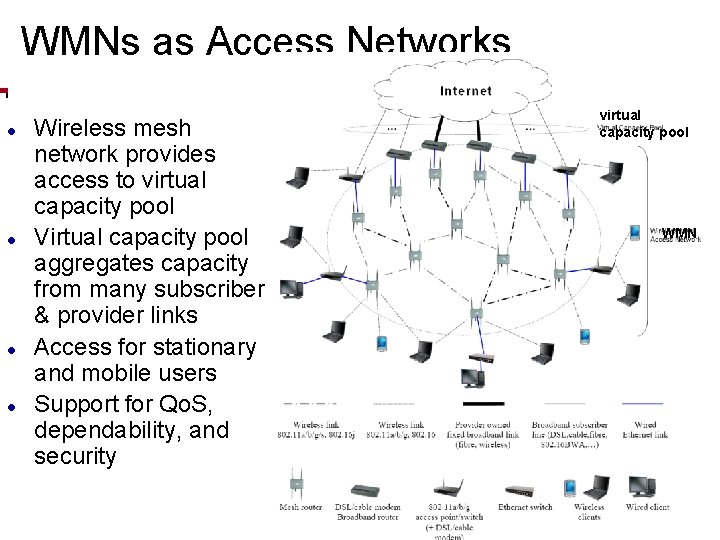
WMNs as Access Networks l l Wireless mesh network provides access to virtual capacity pool Virtual capacity pool aggregates capacity from many subscriber & provider links Access for stationary and mobile users Support for Qo. S, dependability, and security virtual capacity pool WMN
Neighborhood/Community Mesh
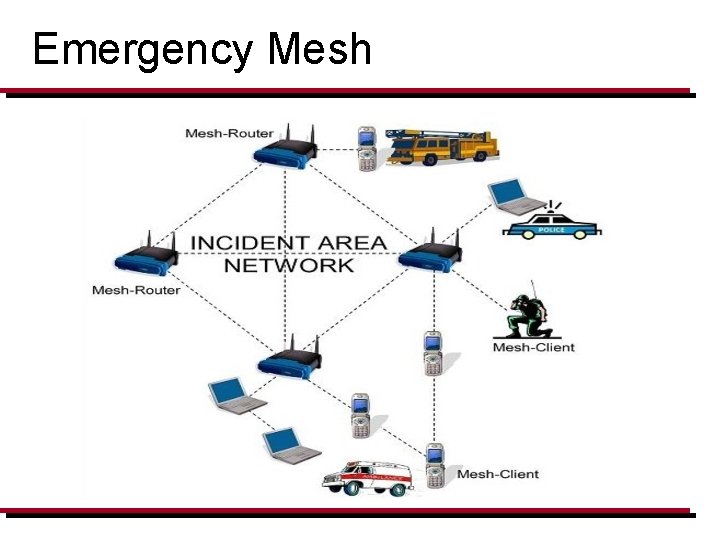
Emergency Mesh
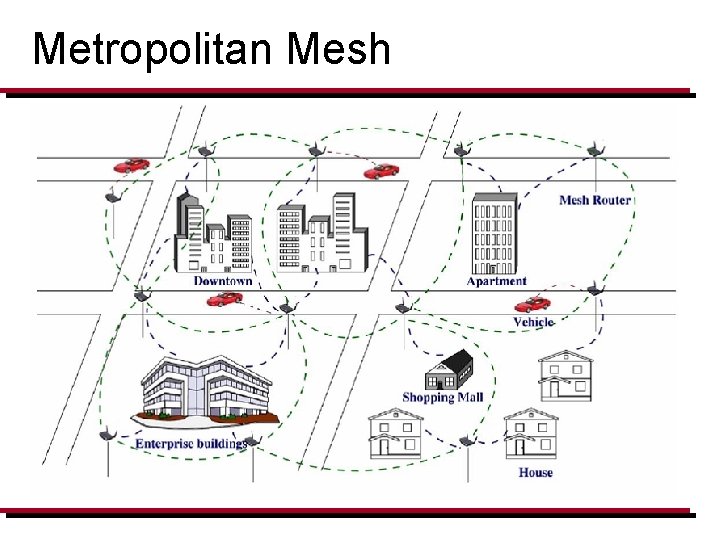
Metropolitan Mesh
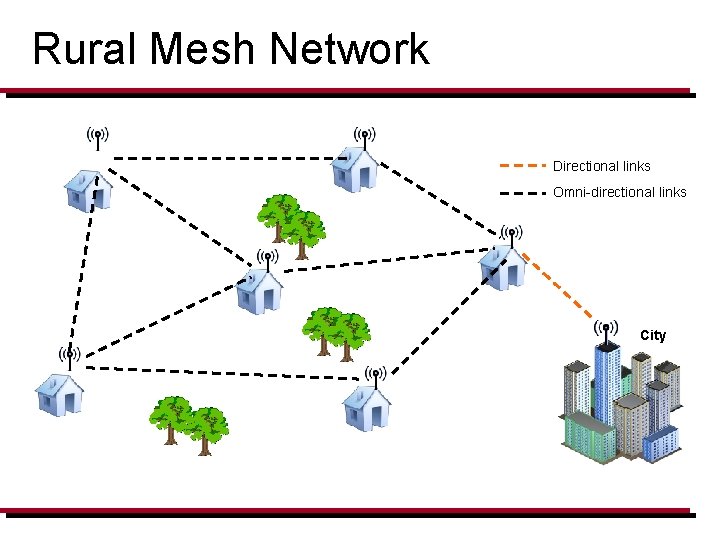
Rural Mesh Network Directional links Omni-directional links City
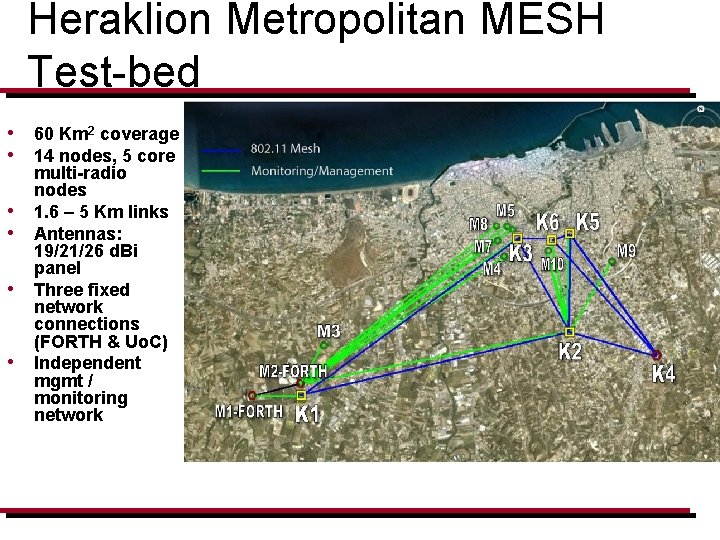
Heraklion Metropolitan MESH Test-bed • 60 Km 2 coverage • 14 nodes, 5 core • • multi-radio nodes 1. 6 – 5 Km links Antennas: 19/21/26 d. Bi panel Three fixed network connections (FORTH & Uo. C) Independent mgmt / monitoring network
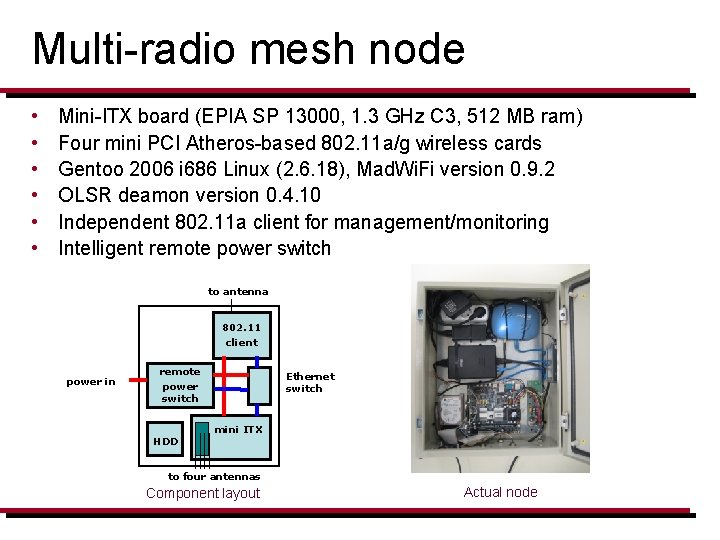
Multi-radio mesh node • • • Mini-ITX board (EPIA SP 13000, 1. 3 GHz C 3, 512 MB ram) Four mini PCI Atheros-based 802. 11 a/g wireless cards Gentoo 2006 i 686 Linux (2. 6. 18), Mad. Wi. Fi version 0. 9. 2 OLSR deamon version 0. 4. 10 Independent 802. 11 a client for management/monitoring Intelligent remote power switch to antenna 802. 11 client power in remote power switch HDD Ethernet switch mini ITX to four antennas Component layout Actual node
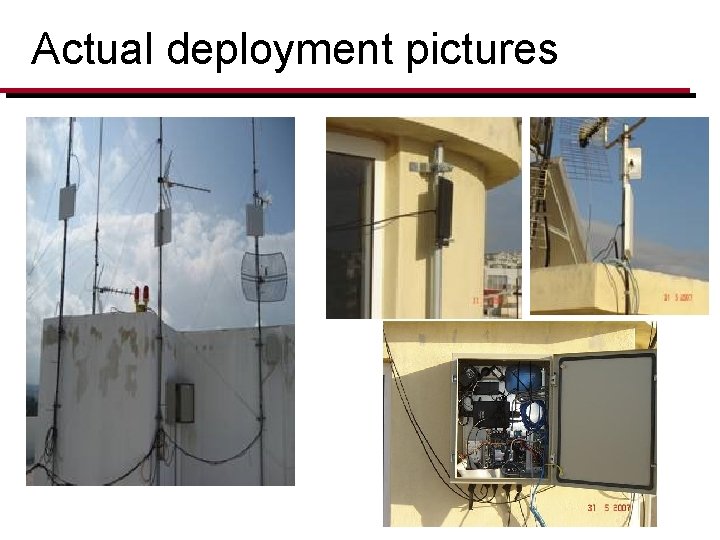
Actual deployment pictures
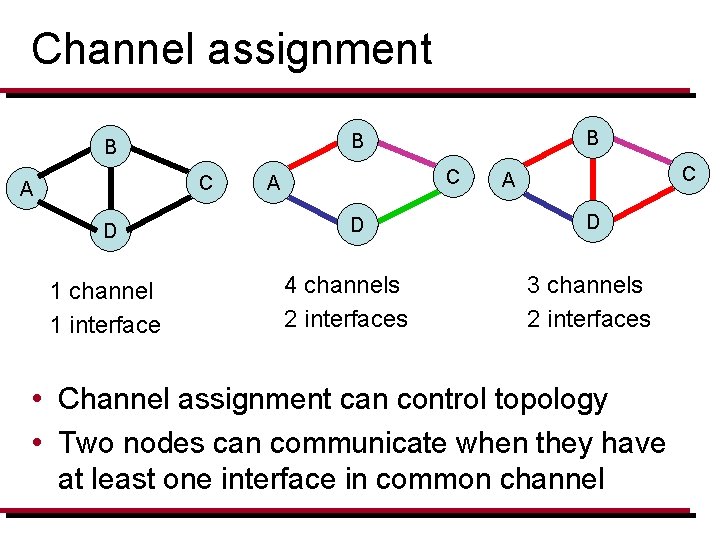
Channel assignment C A D 1 channel 1 interface B B B C A D 4 channels 2 interfaces C A D 3 channels 2 interfaces • Channel assignment can control topology • Two nodes can communicate when they have at least one interface in common channel
Channel assignment (cont. ) • Similar to a graph coloring problem, except that § We are given some number of colors (channels) § We are looking for coloring with least conflicts • Need to model interference • Channel assignment can be addressed jointly with routing
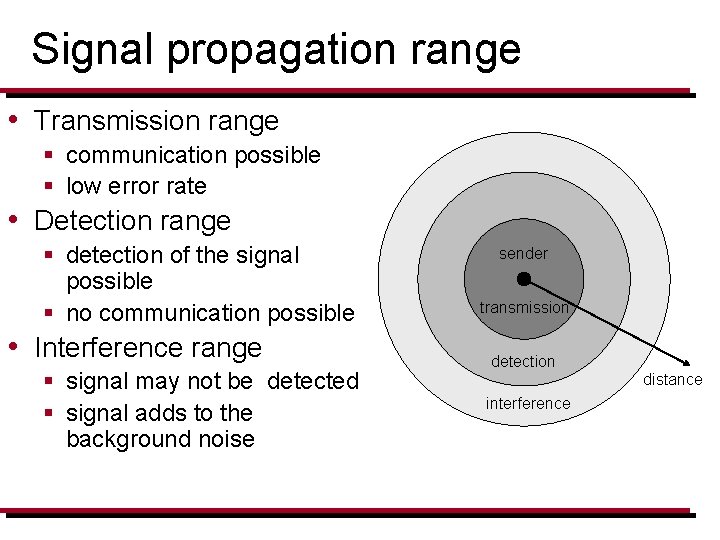
Signal propagation range • Transmission range § communication possible § low error rate • Detection range § detection of the signal possible § no communication possible • Interference range § signal may not be detected § signal adds to the background noise sender transmission detection distance interference
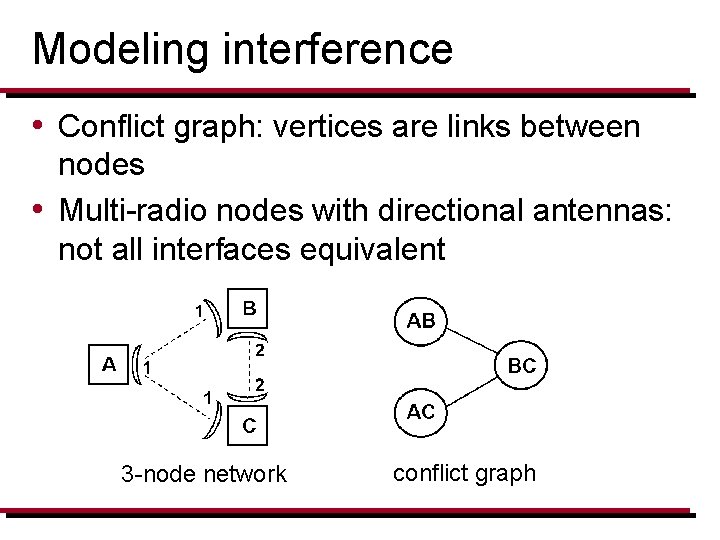
Modeling interference • Conflict graph: vertices are links between nodes • Multi-radio nodes with directional antennas: not all interfaces equivalent 3 -node network conflict graph
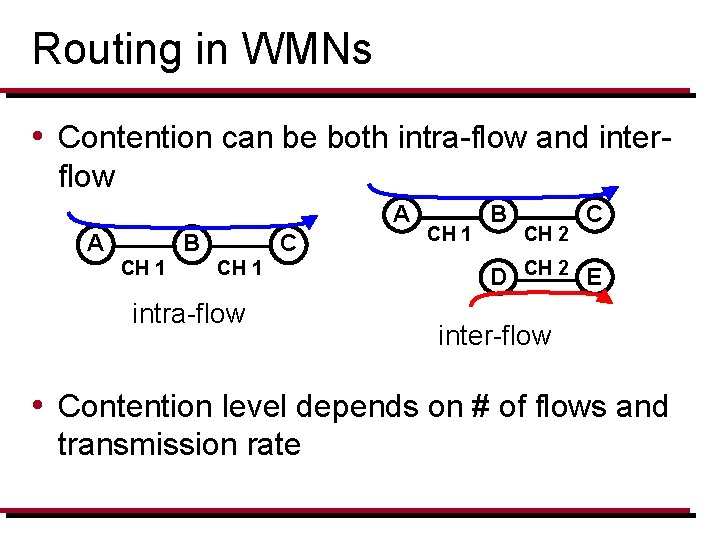
Routing in WMNs • Contention can be both intra-flow and interflow A A B CH 1 C CH 1 intra-flow CH 1 B CH 2 C D CH 2 E inter-flow • Contention level depends on # of flows and transmission rate