
Infrastructure Security Challenges for the Defense Industrial Base
Infrastructure Security Challenges for the Defense Industrial Base NDIA Homeland Security Symposium Capt Bob Magee OUSD (IP) June 17, 2003
Overview • Critical Infrastructure Protection (CIP) – Defense Industrial Base Linkage • Industrial Policy • Defense Industrial Base (DIB) – Current Activities – Initiatives − Outreach/Awareness – Lessons Learned • Discussion 2
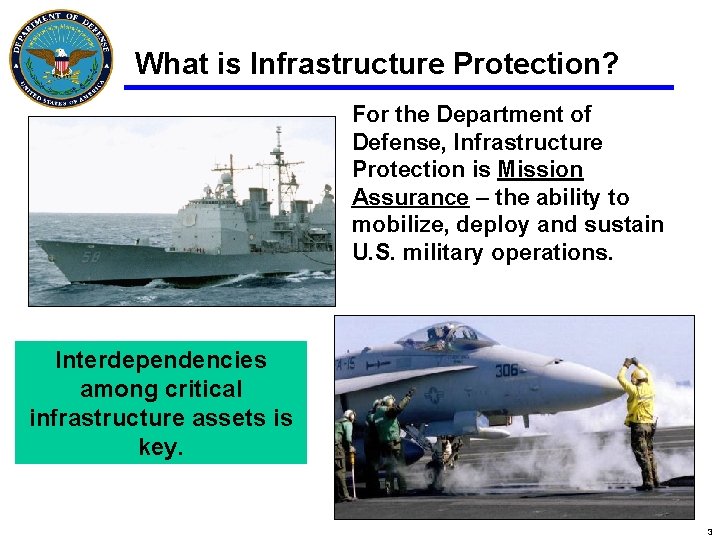
What is Infrastructure Protection? For the Department of Defense, Infrastructure Protection is Mission Assurance – the ability to mobilize, deploy and sustain U. S. military operations. Interdependencies among critical infrastructure assets is key. 3
Why Infrastructure Protection? • Lessons of History • Changing Battlespace – Asymmetric Threat – Transformation of Industrial Base • Failure of infrastructure assets that are critical will degrade or disrupt Do. D operations – “Our challenge in the 21 st century is to defend our cities and our infrastructure from new forms of attack while projecting force over long distances to fight new and perhaps distant adversaries. ” Secretary Rumsfeld Speaks on "21 st Century Transformation" of U. S. Armed Forces 4
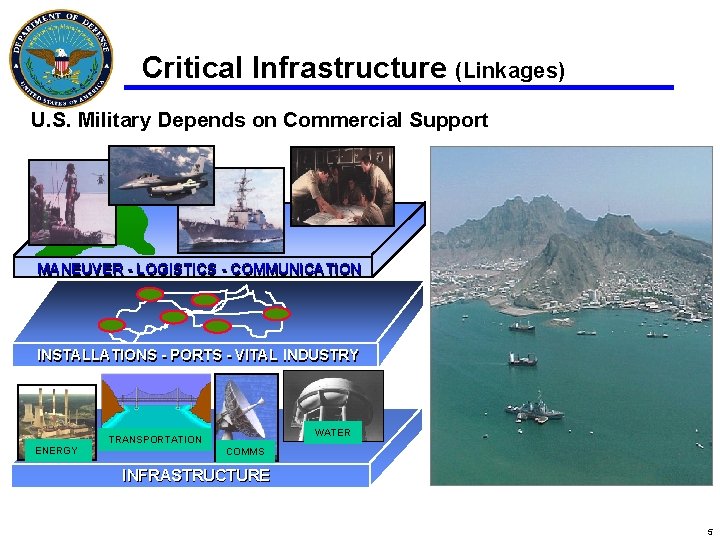
Critical Infrastructure (Linkages) U. S. Military Depends on Commercial Support MANEUVER - LOGISTICS - COMMUNICATION INSTALLATIONS - PORTS - VITAL INDUSTRY WATER TRANSPORTATION ENERGY COMMS INFRASTRUCTURE 5
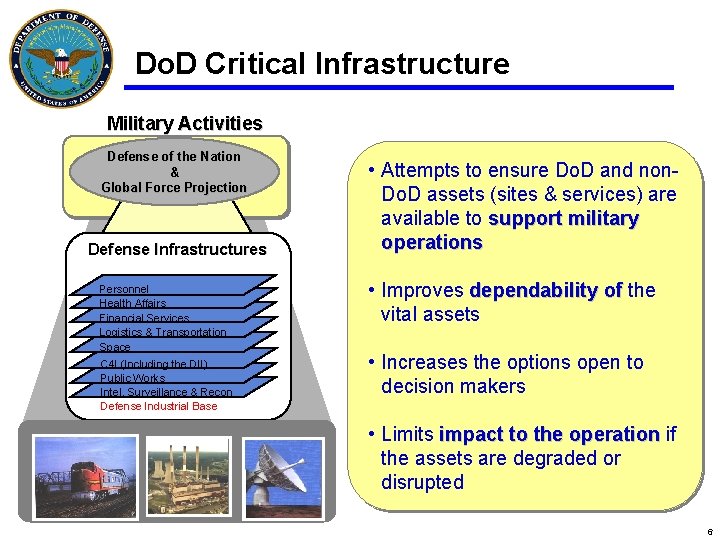
Do. D Critical Infrastructure Military Activities Defense of the Nation & Global Force Projection Defense Infrastructures Personnel Health Affairs Financial Services Logistics & Transportation Space C 4 I (Including the DII) Public Works Intel, Surveillance & Recon Defense Industrial Base • Attempts to ensure Do. D and non. Do. D assets (sites & services) are available to support military operations • Improves dependability of the vital assets • Increases the options open to decision makers • Limits impact to the operation if the assets are degraded or disrupted 6
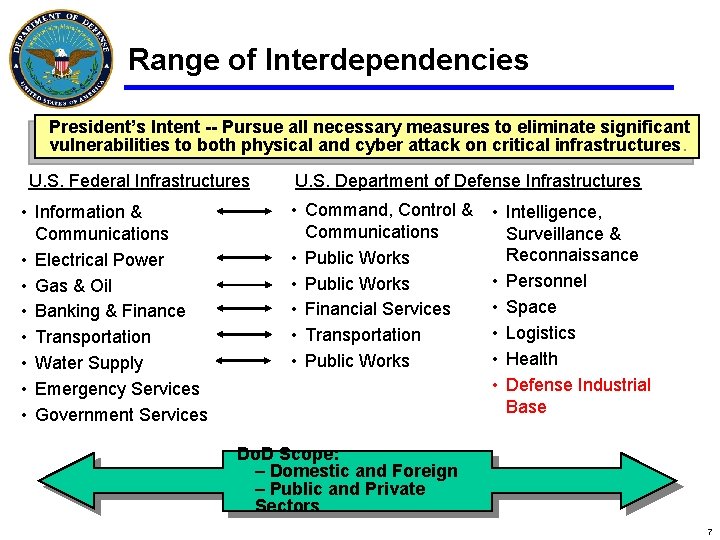
Range of Interdependencies President’s Intent -- Pursue all necessary measures to eliminate significant vulnerabilities to both physical and cyber attack on critical infrastructures. U. S. Federal Infrastructures • Information & Communications • Electrical Power • Gas & Oil • Banking & Finance • Transportation • Water Supply • Emergency Services • Government Services U. S. Department of Defense Infrastructures • Command, Control & Communications • Public Works • Financial Services • Transportation • Public Works • Intelligence, Surveillance & Reconnaissance • Personnel • Space • Logistics • Health • Defense Industrial Base Do. D Scope: – Domestic and Foreign – Public and Private Sectors 7
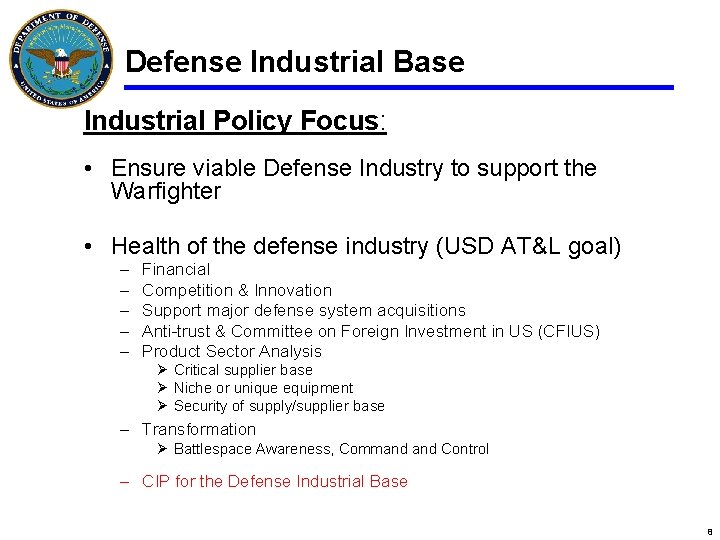
Defense Industrial Base Industrial Policy Focus: • Ensure viable Defense Industry to support the Warfighter • Health of the defense industry (USD AT&L goal) – – – Financial Competition & Innovation Support major defense system acquisitions Anti-trust & Committee on Foreign Investment in US (CFIUS) Product Sector Analysis Ø Critical supplier base Ø Niche or unique equipment Ø Security of supply/supplier base – Transformation Ø Battlespace Awareness, Command Control – CIP for the Defense Industrial Base 8
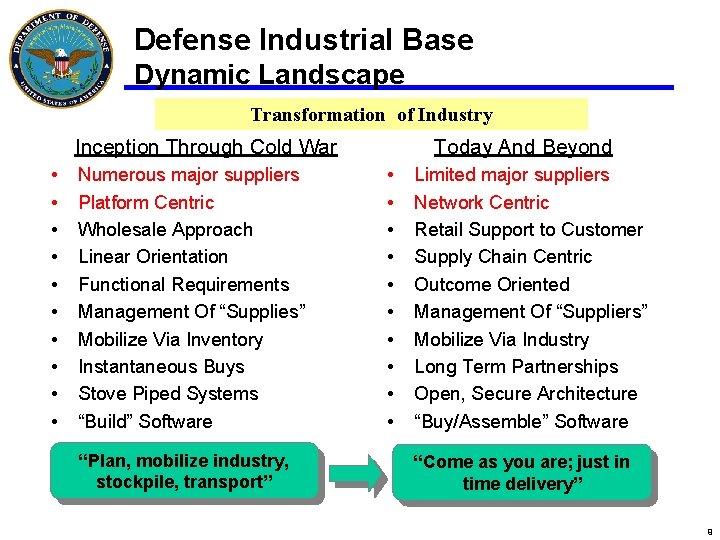
Defense Industrial Base Dynamic Landscape Transformation of Industry Inception Through Cold War • • • Numerous major suppliers Platform Centric Wholesale Approach Linear Orientation Functional Requirements Management Of “Supplies” Mobilize Via Inventory Instantaneous Buys Stove Piped Systems “Build” Software “Plan, mobilize industry, stockpile, transport” Today And Beyond • • • Limited major suppliers Network Centric Retail Support to Customer Supply Chain Centric Outcome Oriented Management Of “Suppliers” Mobilize Via Industry Long Term Partnerships Open, Secure Architecture “Buy/Assemble” Software “Come as you are; just in time delivery” 9
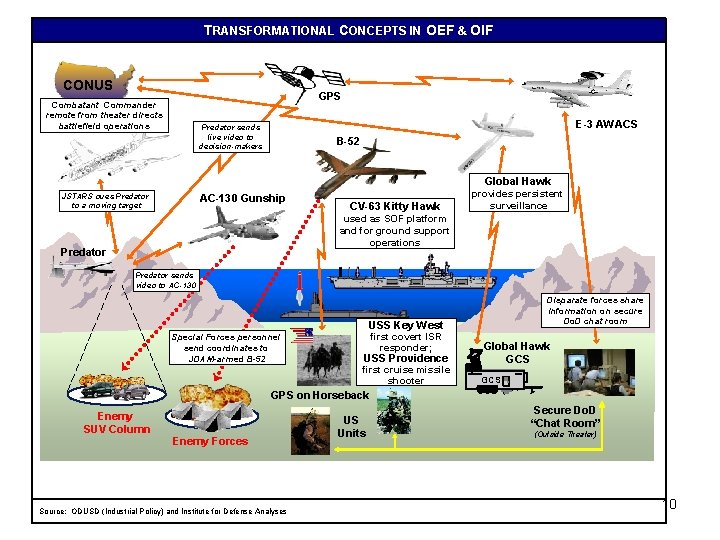
TRANSFORMATIONAL CONCEPTS IN OEF & OIF CONUS JSTARS GPS Combatant Commander remote from theater directs battlefield operations E-3 AWACS Predator sends live video to decision-makers B-52 Global Hawk JSTARS cues Predator to a moving target AC-130 Gunship CV-63 Kitty Hawk provides persistent surveillance used as SOF platform and for ground support operations Predator sends video to AC-130 Disparate forces share information on secure Do. D chat room USS Key West Special Forces personnel send coordinates to JDAM-armed B-52 first covert ISR responder; USS Providence first cruise missile shooter Global Hawk GCS GPS on Horseback Enemy SUV Column Enemy Forces Source: ODUSD (Industrial Policy) and Institute for Defense Analyses US Units Secure Do. D “Chat Room” (Outside Theater) 10
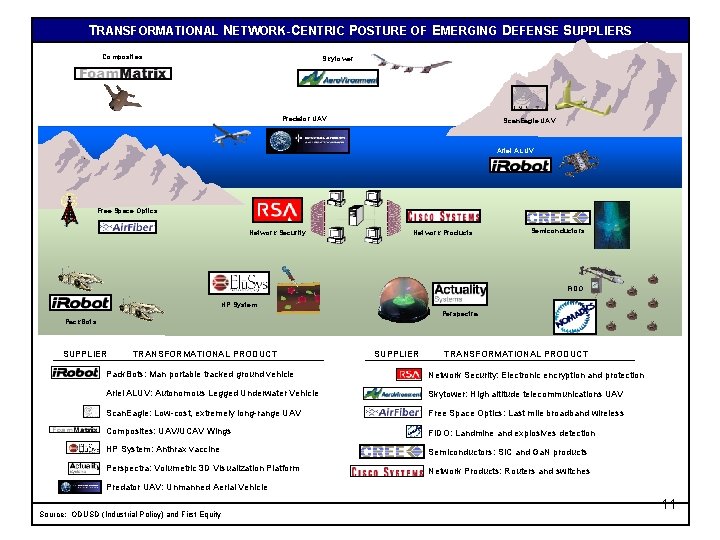
TRANSFORMATIONAL NETWORK-CENTRIC POSTURE OF EMERGING DEFENSE SUPPLIERS Composites Skytower Predator UAV Scan. Eagle UAV Ariel ALUV Free Space Optics Network Security Network Products Semiconductors FIDO HP System Perspectra Pack. Bots SUPPLIER TRANSFORMATIONAL PRODUCT Pack. Bots: Man portable tracked ground vehicle Network Security: Electronic encryption and protection Ariel ALUV: Autonomous Legged Underwater Vehicle Skytower: High altitude telecommunications UAV Scan. Eagle: Low-cost, extremely long-range UAV Free Space Optics: Last mile broadband wireless Composites: UAV/UCAV Wings FIDO: Landmine and explosives detection HP System: Anthrax vaccine Semiconductors: Si. C and Ga. N products Perspectra: Volumetric 3 D Visualization Platform Network Products: Routers and switches Predator UAV: Unmanned Aerial Vehicle Source: ODUSD (Industrial Policy) and First Equity 11
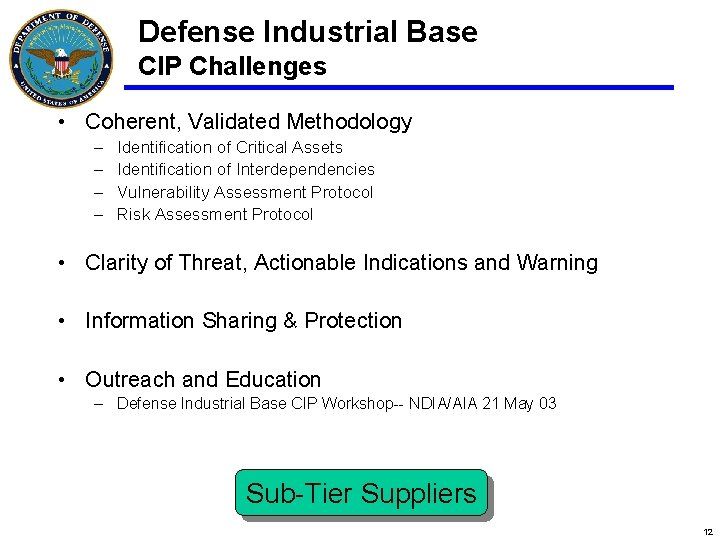
Defense Industrial Base CIP Challenges • Coherent, Validated Methodology – – Identification of Critical Assets Identification of Interdependencies Vulnerability Assessment Protocol Risk Assessment Protocol • Clarity of Threat, Actionable Indications and Warning • Information Sharing & Protection • Outreach and Education – Defense Industrial Base CIP Workshop-- NDIA/AIA 21 May 03 Sub-Tier Suppliers 12
Defense Industrial Base CIP Challenges (cont’d) • Do. D is lead for Defense Industrial Base (DIB) – Element of President’s National Strategy – Information Coordination – NOT the deployment of troops to industry facilities • Coordination with Critical Suppliers • Threat and warning information sharing • Support for vulnerability assessments – Three DIB sites funded – Supplemental – Self-assessment COTS software 13
Defense Industrial Base CIP Initiatives • Updated Database of Critical Facilities – List provided to OASD C 3 I (CIP) and DSS. Database forwarded to Homeland Security and FBI. • Connectivity and reporting enhanced – FBI outreach campaign – Joint Counter Intelligence Field Activity (CIFA) & Joint Counter Intelligence Assessment Group (JCAG) stood up by OASD C 3 I. – Linked with Joint Staff reporting system (TALON) – Local DSS and DCMA reps linkage for expediting reporting “suspicious activity” to chain of command local law enforcement. • CIP directive and instruction awaiting Dep. Sec. Def signature. – Increased emphasis on infrastructure security for defense contractors. Outlines general guidance for both classified and unclassified programs. 14
Defense Industrial Base CIP Awareness • Outreach and Education Continuing – Industry Association Security reps regularly attend monthly CIP meetings. – Coordinating with OASD (C 3 I) and Industry Associations (NDIA, AIA) for Defense Industrial Base CIP workshops – Do. D CIP Awareness CD-ROM containing CIP-related policies, documents, studies, and information briefings Ø FY 2002 Do. D CIP Annual Report Ø COTS CD self assessment tool for CIP under review – Information Sharing Advisory Committee (ISAC) for Defense Industrial Base at National Level (DHS). – Stress Continuity of Business Operations and liaison with local law enforcement to corporate leadership Ø DSS/DCMA reps key Ø Reinforce through numerous industry forums. Shareholder Equity 15
Lessons Learned • Identification – Supporting direct military ops/sensitive work – Key sub-tier suppliers (Domestic and Foreign) • Security – Beyond perimeter – Supporting Commercial infrastructure • Continuity of Operations – Minimize impact • Communication – Local, State, National agencies – Alert inform key suppliers – Ex. FBI field offices http: //www. fbi. gov/contact/fo/info. htm 16
Industry ISACs Established ISACs • Energy (Oil & Natural Gas) (www. energyisac. com) • Financial Services (www. fsisac. com) • Telecommunications (www. ncs. gov/informationportal/portal. html) • Electric Power (www. nerc. com/~filez/cipfiles. html/) • Information Technology (https: //www. it-isac. org/) • Water Supply (www. amwa. net/isac/) • Surface Transportation (www. surfacetransportationisac. org/) • Emergency Fire Services (www. usfa. fema. gov/dhtml/fireservice/cipc. cfm) • Food (www. fmi. org/) • Chemicals Industry (http: //chemicalisac. chemtrec. com) • Emergency Law Enforcement (www. nipc. gov/infosharing 5. htm) • Interstate (www. nascio. org) 17
Information Sharing and Analysis Centers (ISAC) • Value added features for members – – – – Early Notification of Threats Relevant Information Industry-wide Vigilance Subject Matter Expertise Anonymous Information Sharing Trending, Metrics, Benchmark Data Secure database and analytic tools Exposure 18
Summary • Critical Infrastructure Protection (CIP) – Defense Industrial Base Linkage • Defense Industrial Base (DIB) – Challenges − Initiatives / Outreach / Awareness – Lessons Learned 19
Questions • Captain Bob Magee (703) 607 -4045 – robert. magee@osd. mil 20
- Slides: 20