
Infrastructure Design for IPTV Services IPTV Asia November
Infrastructure Design for IPTV Services IPTV Asia November 8 -9, 2006 Grand Copthorne Waterfront Hotel, Singapore Sue Moon Joint Work with Meeyoung Cha (KAIST) W. Art Chaovalitwongse (Rutgers/DIMACS) Gagan Choudhury, Zihui Ge, Aman Shaikh, Jenniver Yates (AT&T)
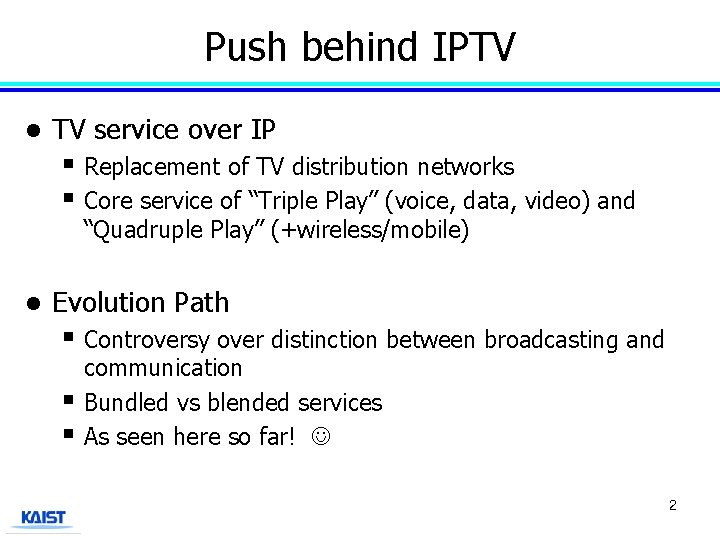
Push behind IPTV l TV service over IP § Replacement of TV distribution networks § Core service of “Triple Play” (voice, data, video) and “Quadruple Play” (+wireless/mobile) l Evolution Path § Controversy over distinction between broadcasting and § § communication Bundled vs blended services As seen here so far! 2
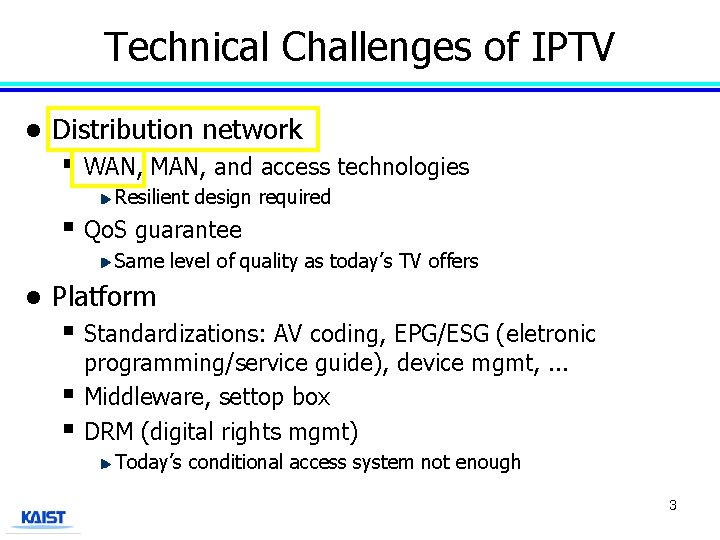
Technical Challenges of IPTV l Distribution network § WAN, MAN, and access technologies Resilient design required § Qo. S guarantee Same level of quality as today’s TV offers l Platform § Standardizations: AV coding, EPG/ESG (eletronic § § programming/service guide), device mgmt, . . . Middleware, settop box DRM (digital rights mgmt) Today’s conditional access system not enough 3
![Talk Outline l Service Architecture Overview Comparison of Design Choices [Cha 06 -1] l](http://slidetodoc.com/presentation_image_h/bb0af63487383efca7641075d5c90089/image-4.jpg "Talk Outline l Service Architecture Overview Comparison of Design Choices [Cha 06 -1] l")
Talk Outline l Service Architecture Overview Comparison of Design Choices [Cha 06 -1] l Path Protection Routing in WDM Mesh Networks [Cha 06 -2] l Efficient and Scalable Algorithms [Cha 06 -3] l 4

Service Architecture of IPTV Super Hub Offices (SHO) SHO Backbone Distribution Network VHO How can Regional Network we provide reliable IPTV services TV over the backbone. Broadcast network? Vo. D VHO Video Hub Office (VHO) Regional Network customers 2 SHOs and 40 VHOs across the US 5
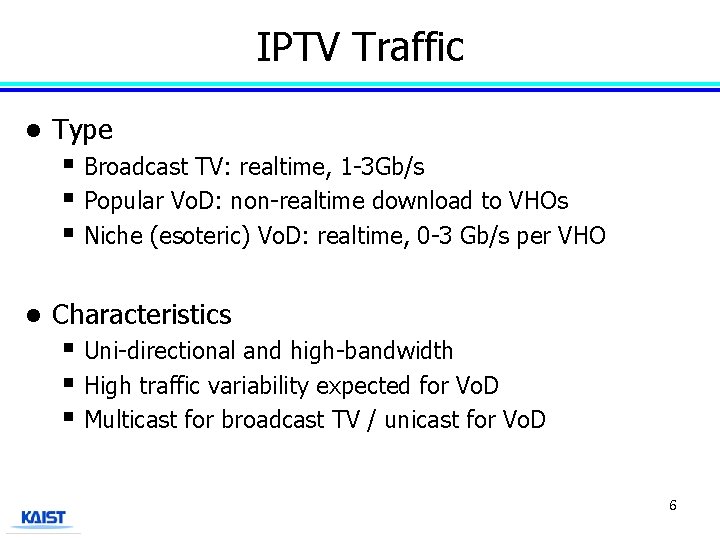
IPTV Traffic l Type § Broadcast TV: realtime, 1 -3 Gb/s § Popular Vo. D: non-realtime download to VHOs § Niche (esoteric) Vo. D: realtime, 0 -3 Gb/s per VHO l Characteristics § Uni-directional and high-bandwidth § High traffic variability expected for Vo. D § Multicast for broadcast TV / unicast for Vo. D 6

Comparison of Design Choices
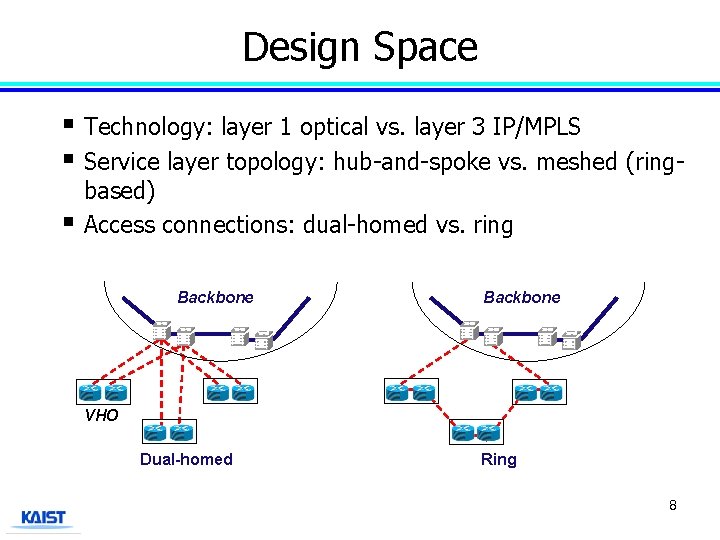
Design Space § Technology: layer 1 optical vs. layer 3 IP/MPLS § Service layer topology: hub-and-spoke vs. meshed (ring§ based) Access connections: dual-homed vs. ring Backbone VHO Dual-homed Ring 8
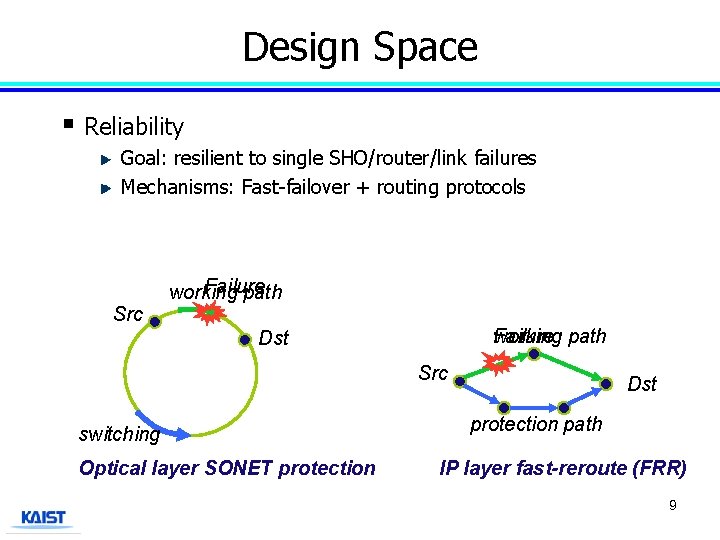
Design Space § Reliability Goal: resilient to single SHO/router/link failures Mechanisms: Fast-failover + routing protocols Src Failure working path Failure Dst Src switching Optical layer SONET protection Dst protection path IP layer fast-reroute (FRR) 9

Potential IPTV Designs IP designs § New dedicated IP backbone for IPTV § Integrating with existing IP backbone § Dedicated overlay over existing IP backbone § Directly inter-connect IP routers (no backbone) § Integrating with existing optical backbone Optical design 10
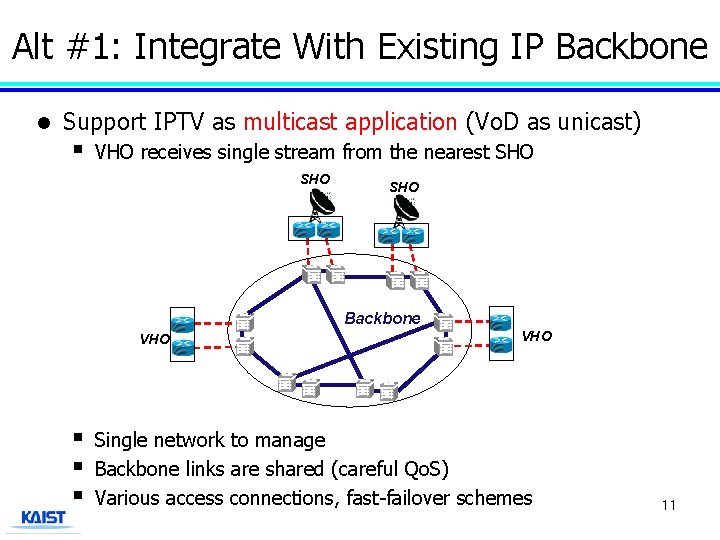
Alt #1: Integrate With Existing IP Backbone l Support IPTV as multicast application (Vo. D as unicast) § VHO receives single stream from the nearest SHO SHO Backbone VHO § § § VHO Single network to manage Backbone links are shared (careful Qo. S) Various access connections, fast-failover schemes 11
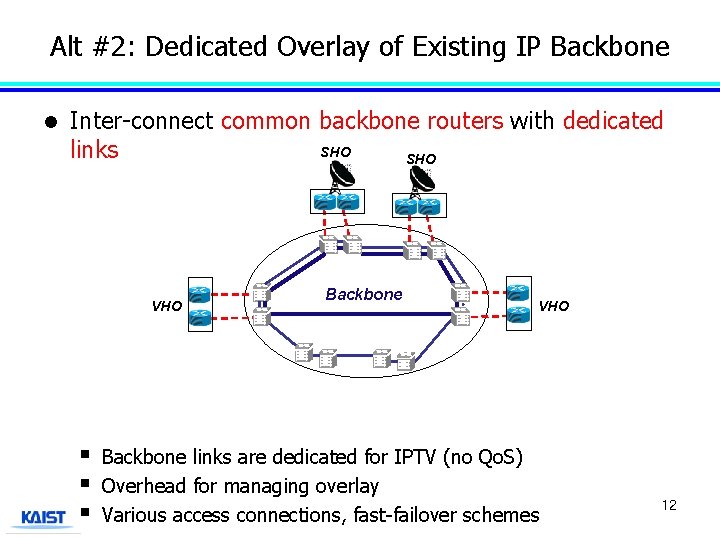
Alt #2: Dedicated Overlay of Existing IP Backbone l Inter-connect common backbone routers with dedicated SHO links SHO VHO § § § Backbone VHO Backbone links are dedicated for IPTV (no Qo. S) Overhead for managing overlay Various access connections, fast-failover schemes 12
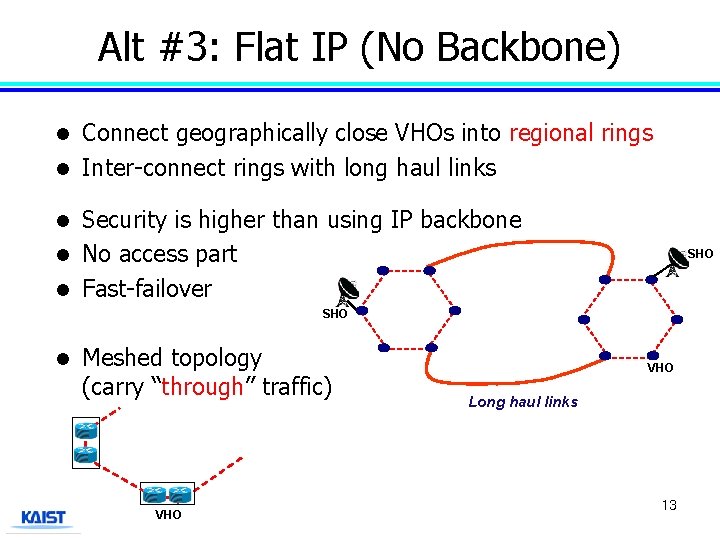
Alt #3: Flat IP (No Backbone) Connect geographically close VHOs into regional rings l Inter-connect rings with long haul links l Security is higher than using IP backbone l No access part l Fast-failover l SHO l Meshed topology (carry “through” traffic) VHO Long haul links 13
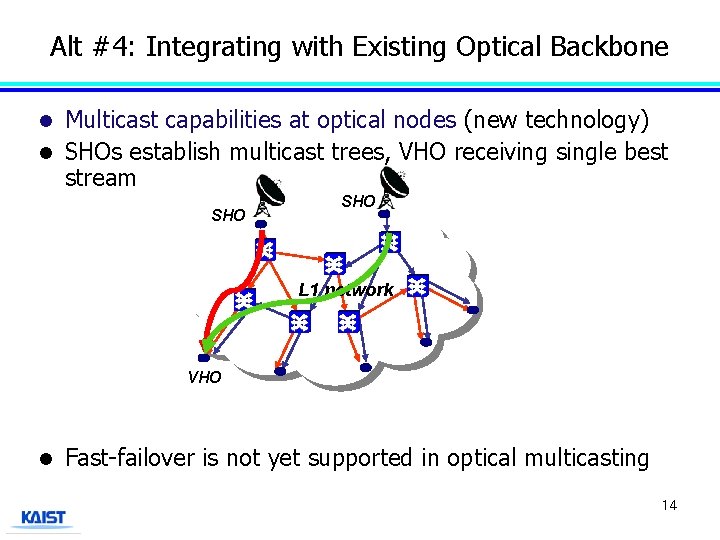
Alt #4: Integrating with Existing Optical Backbone Multicast capabilities at optical nodes (new technology) l SHOs establish multicast trees, VHO receiving single best stream l SHO L 1 network VHO l Fast-failover is not yet supported in optical multicasting 14
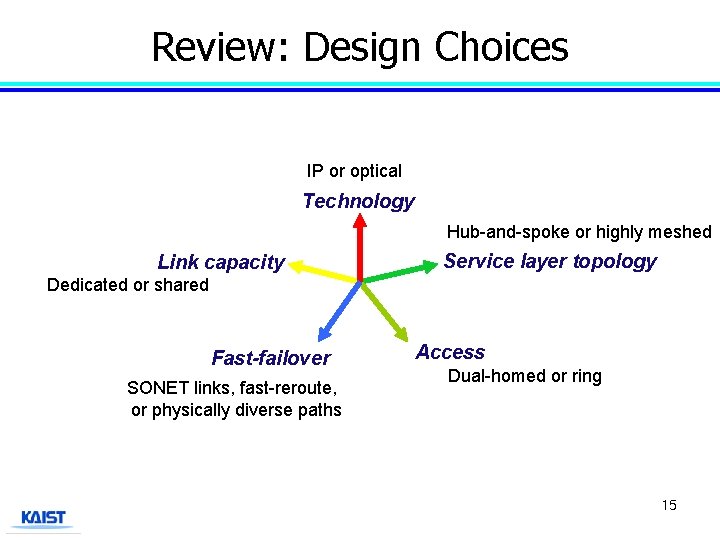
Review: Design Choices IP or optical Technology Hub-and-spoke or highly meshed Link capacity Service layer topology Dedicated or shared Fast-failover SONET links, fast-reroute, or physically diverse paths Access Dual-homed or ring 15
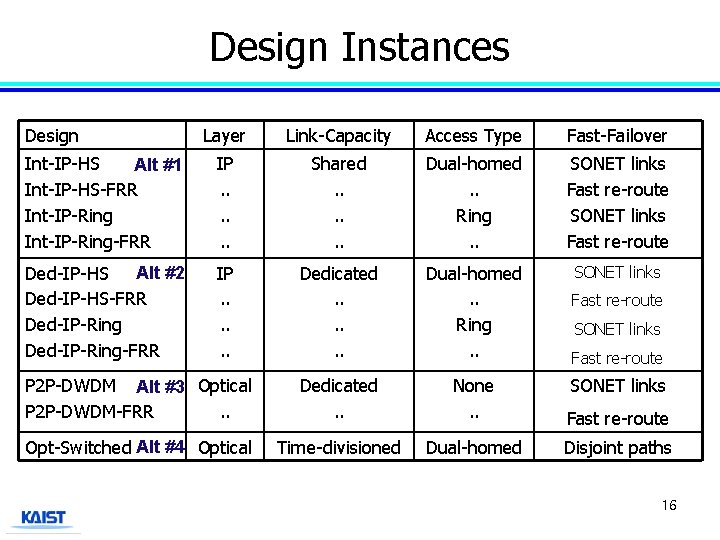
Design Instances Design Layer Link-Capacity Access Type Fast-Failover Int-IP-HS Alt #1 Int-IP-HS-FRR Int-IP-Ring-FRR IP. . . Shared. . . Dual-homed. . Ring. . SONET links Fast re-route Ded-IP-HS Alt #2 Ded-IP-HS-FRR Ded-IP-Ring-FRR IP. . . Dedicated. . . Dual-homed. . Ring. . SONET links P 2 P-DWDM Alt #3 Optical P 2 P-DWDM-FRR. . Dedicated. . None. . Fast re-route Opt-Switched Alt #4 Optical Time-divisioned Dual-homed Disjoint paths Fast re-route SONET links 16
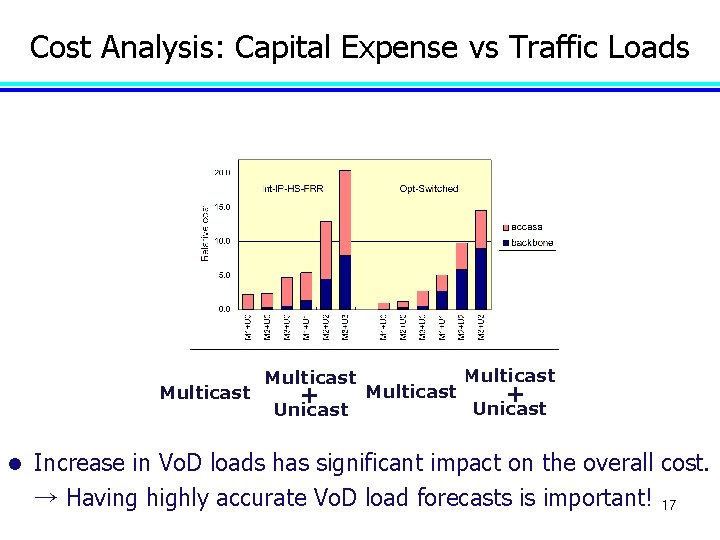
Cost Analysis: Capital Expense vs Traffic Loads Ma+Ub: multicast a Gb/s + unicast b Gb/s Multicast l Multicast + Unicast Increase in Vo. D loads has significant impact on the overall cost. → Having highly accurate Vo. D load forecasts is important! 17
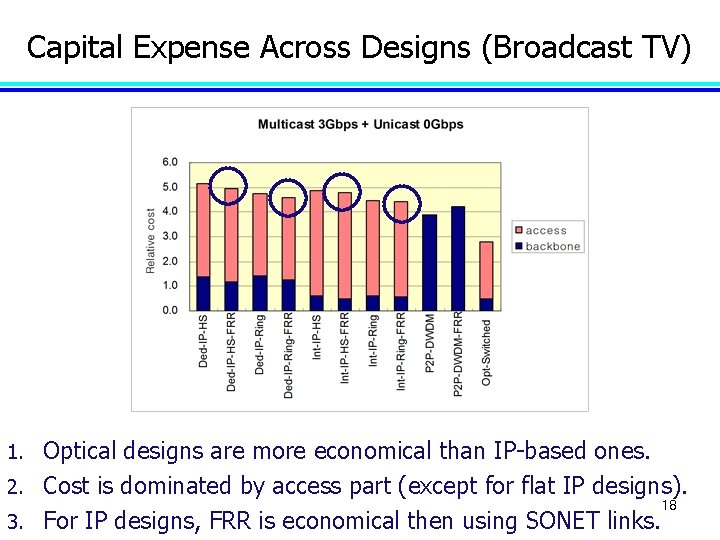
Capital Expense Across Designs (Broadcast TV) Optical designs are more economical than IP-based ones. 2. Cost is dominated by access part (except for flat IP designs). 18 3. For IP designs, FRR is economical then using SONET links. 1.
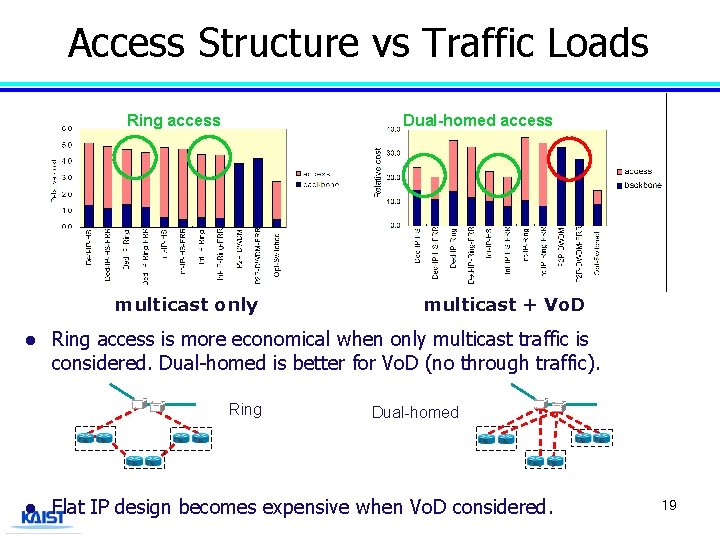
Access Structure vs Traffic Loads multicast only Ring access multicast only l Dual-homed access multicast + Vo. D Ring access is more economical when only multicast traffic is considered. Dual-homed is better for Vo. D (no through traffic). Ring l multicast + Vo. D Dual-homed Flat IP design becomes expensive when Vo. D considered. 19
Summary § Explore potential IPTV designs in backbone network § Comparison across different architectural alternatives § (use realistic capital cost model) Design instances generated based on real topologies § Significant benefits of using multicast for broadcast TV § Optical design more economical than IP designs § Ring access attractive for broadcast TV § Dual-homed access attractive for Vo. D 20
Path Protection Routing in WDM Mesh Networks
![Motivation Optical design known most economical [cha 06 -01] l Fast fail-over not yet](http://slidetodoc.com/presentation_image_h/bb0af63487383efca7641075d5c90089/image-22.jpg "Motivation Optical design known most economical [cha 06 -01] l Fast fail-over not yet")
Motivation Optical design known most economical [cha 06 -01] l Fast fail-over not yet available in optical multicast l Provisioning approach in optical backbone [SRLG] - Design multicast trees (from SHOs to VHOs) in a failure-resilient and cost-effective manner 22
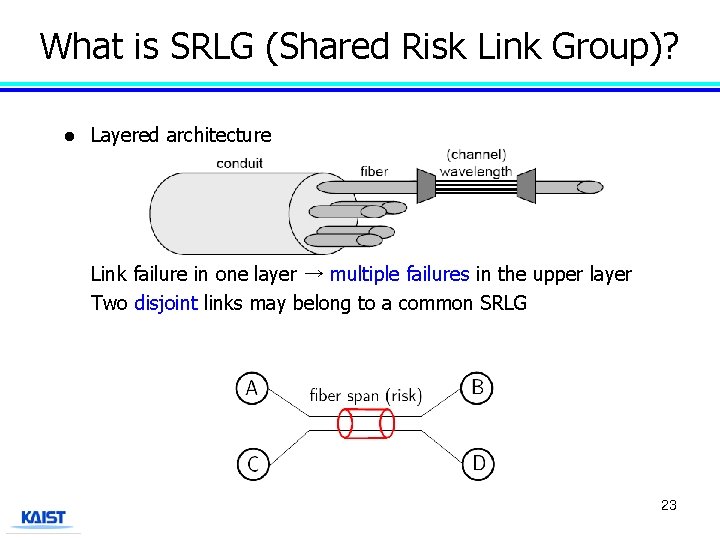
What is SRLG (Shared Risk Link Group)? l Layered architecture Link failure in one layer → multiple failures in the upper layer Two disjoint links may belong to a common SRLG 23
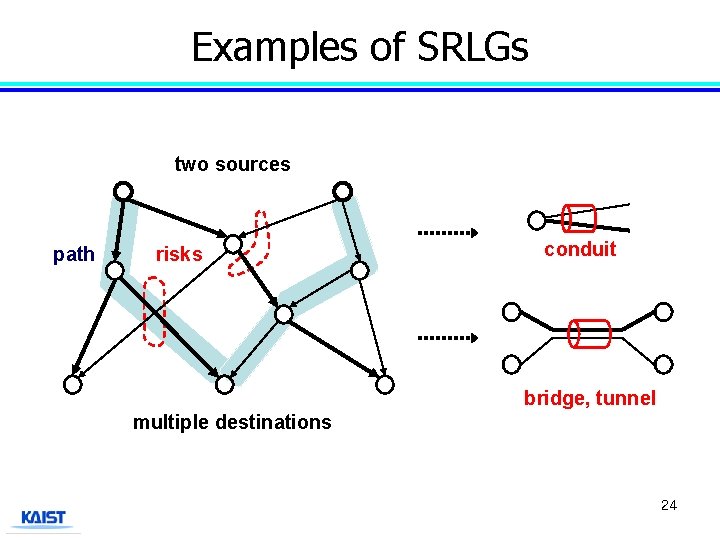
Examples of SRLGs two sources path risks conduit bridge, tunnel multiple destinations 24
Requirements of IPTVService Backbone Design Goals l Fault Tolerance § Customers expect “always-on” service § Resiliency against SRLG failures Use redundant SRLG diverse paths from SHOs to VHOs l Low Cost § To be competitive in the market § Each link associated with port / transport cost Find minimum cost multicast trees 25
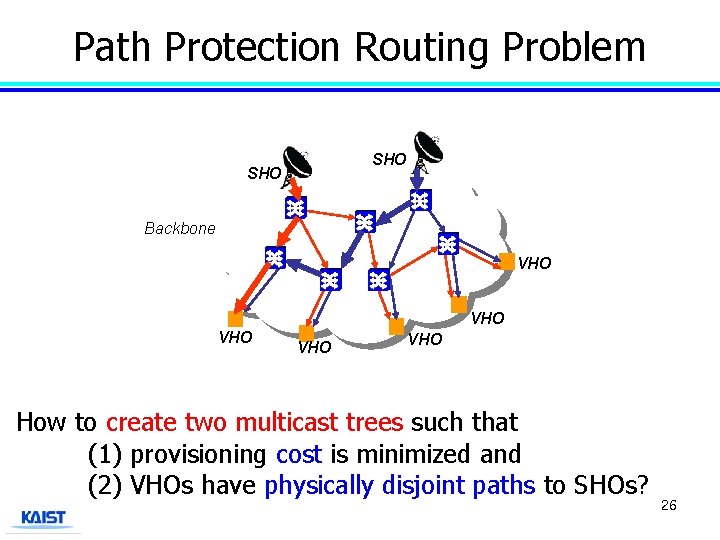
Protection Routing Problem Path Protection Problem SHO Backbone VHO VHO VHO How to create two multicast trees such that (1) provisioning cost is minimized and (2) VHOs have physically disjoint paths to SHOs? 26
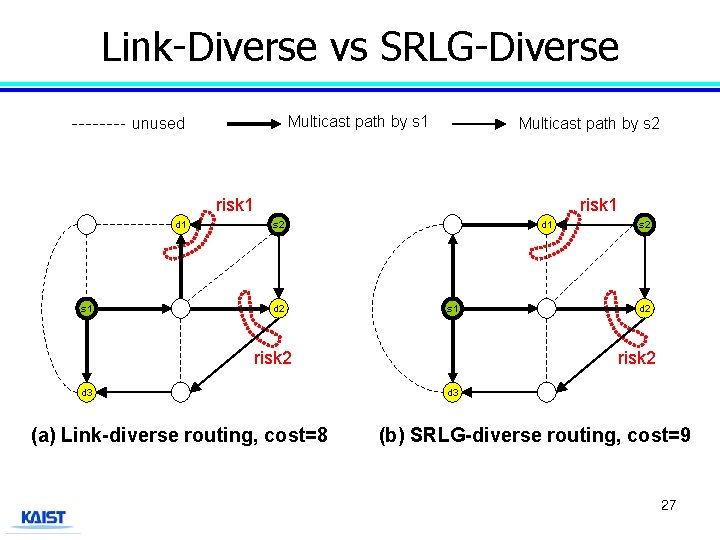
Link-Diverse vs SRLG-Diverse Multicast path by s 1 unused Multicast path by s 2 risk 1 d 1 s 1 risk 1 s 2 d 1 s 1 risk 2 d 3 (a) Link-diverse routing, cost=8 s 2 d 2 risk 2 d 3 (b) SRLG-diverse routing, cost=9 27
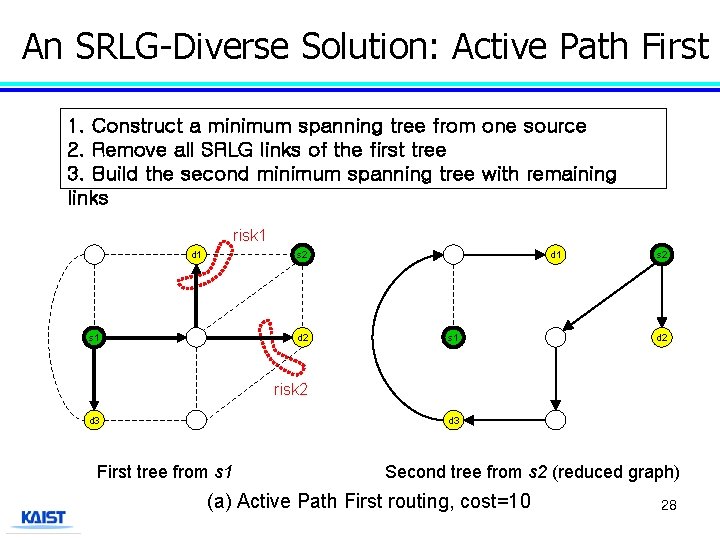
An SRLG-Diverse Solution: Active Path First 1. Construct a minimum spanning tree from one source 2. Remove all SRLG links of the first tree 3. Build the second minimum spanning tree with remaining links risk 1 d 1 s 2 s 1 d 2 d 1 s 2 d 2 risk 2 d 3 First tree from s 1 Second tree from s 2 (reduced graph) (a) Active Path First routing, cost=10 28
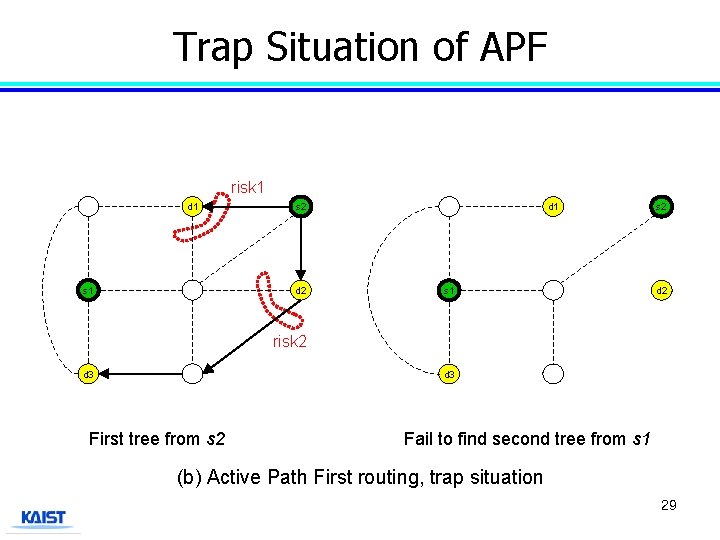
Trap Situation of APF risk 1 d 1 s 1 s 2 d 2 risk 2 d 3 First tree from s 2 Fail to find second tree from s 1 (b) Active Path First routing, trap situation 29
Our Provisioning Approach l Include SRLG-diverse constraints and solve the problem thru Integer Programming (IP) l Compare against § APF (Active Path First) heuristic § Less resilient source-diverse design § Less resilient link-diverse design 30
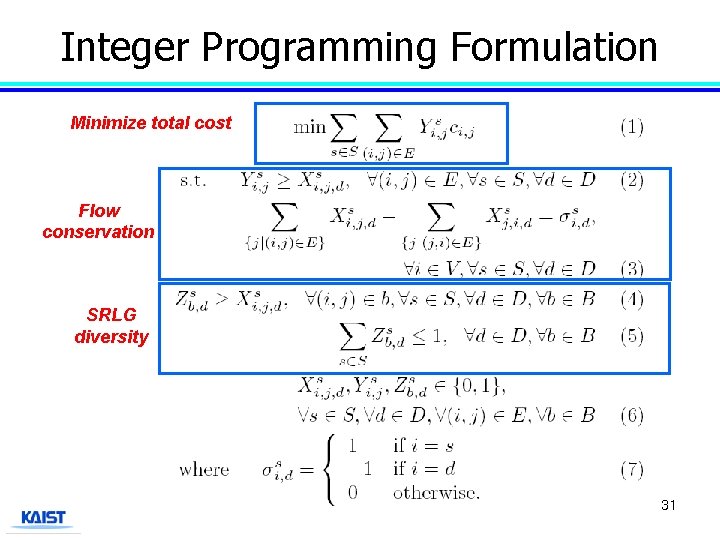
Integer Programming Formulation Minimize total cost Flow conservation SRLG diversity 31
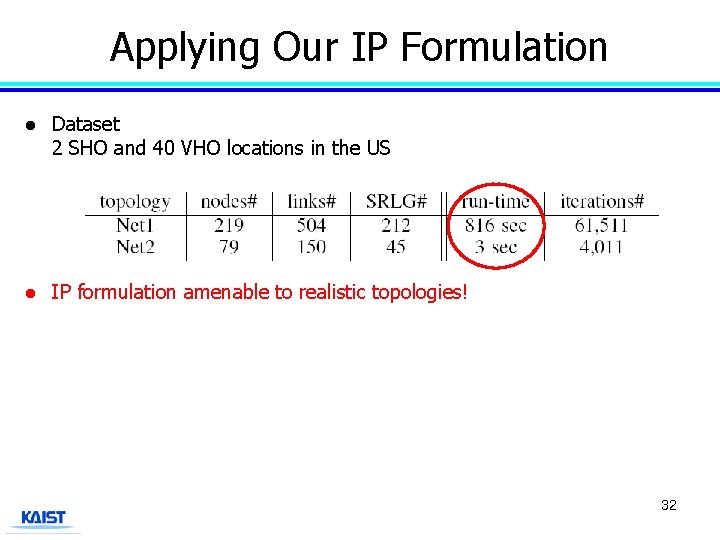
Applying Our IP Formulation l Dataset 2 SHO and 40 VHO locations in the US l IP formulation amenable to realistic topologies! 32
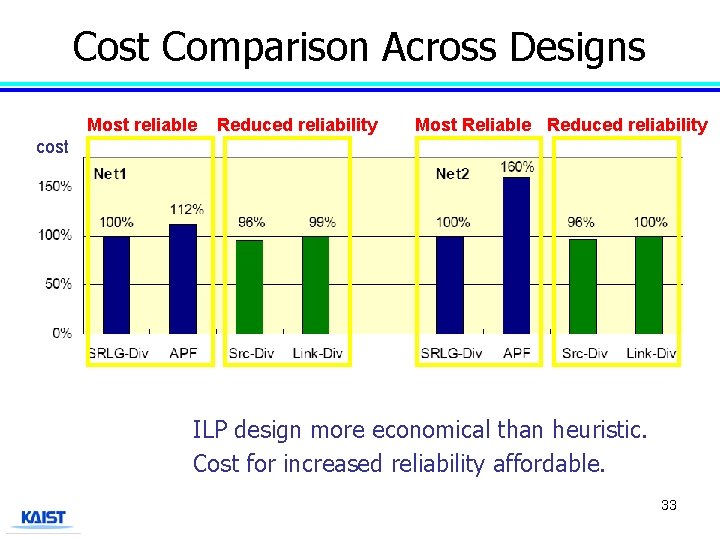
Cost Comparison Across Designs Most reliable Reduced reliability Most Reliable Reduced reliability cost ILP design more economical than heuristic. Cost for increased reliability affordable. 33
Summary l First work on supporting IPTV on optical mesh network with SRLG constraints l Compact Integer Programming formulation § Minimum design cost § SRLG-diversity shown affordable 34
Efficient and Scalable Algorithms for Large Network Topologies
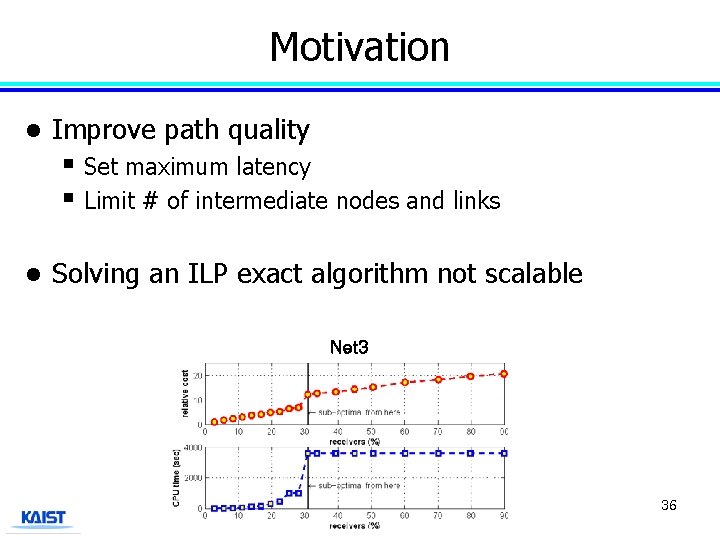
Motivation l Improve path quality § Set maximum latency § Limit # of intermediate nodes and links l Solving an ILP exact algorithm not scalable Net 3 36
New Heuristic Approach l Divide-and-Conquer technique for large network topologies: § Partition the problem into smaller ones § Solve each small problem § Integrate the solutions “well” 37
Proposed Heuristics l Greedy Local (GL) § § l Improved Greedy Local (IGL) § § l Do GL and find the minimum cost graph Fix the shorter of the two paths and solve the rest Adaptive Search § § l Divide into subgraphs with two sources and a destination Solve for each graph, and consolidate solutions Use any routing algorithm to find initial tree Find SRLG-diverse paths; for those w/o such, run baseline ILP. Modified Active Path First § § Build one MST first; then for each destination, check if a SRLGdiverse path exists. If yes, then fix the path; otherwise, run baseline ILP. 38
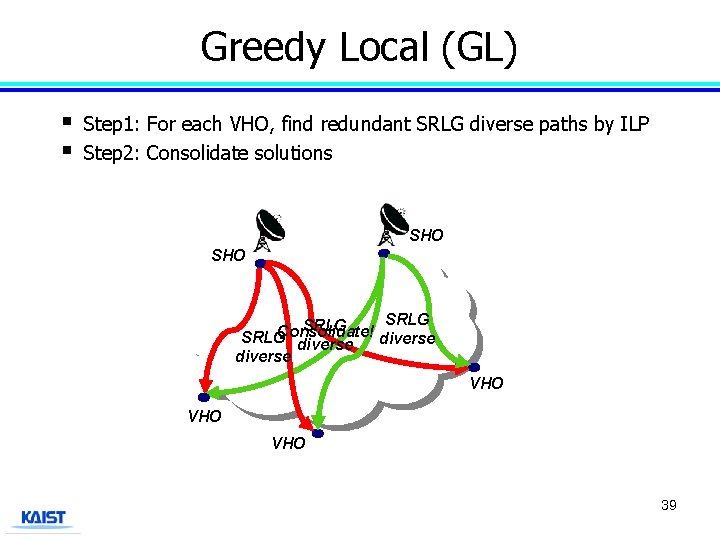
Greedy Local (GL) § § Step 1: For each VHO, find redundant SRLG diverse paths by ILP Step 2: Consolidate solutions SHO SRLG Consolidate! SRLG diverse VHO VHO 39
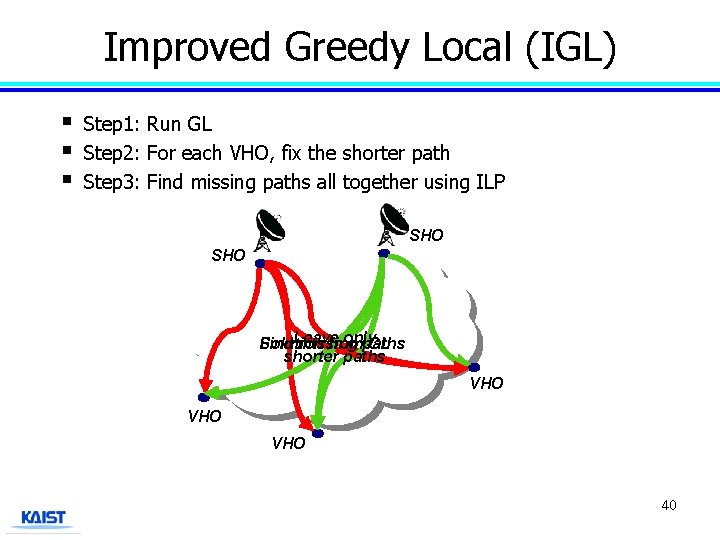
Improved Greedy Local (IGL) § § § Step 1: Run GL Step 2: For each VHO, fix the shorter path Step 3: Find missing paths all together using ILP SHO Leave only Find Solution missing from paths GL shorter paths VHO VHO 40
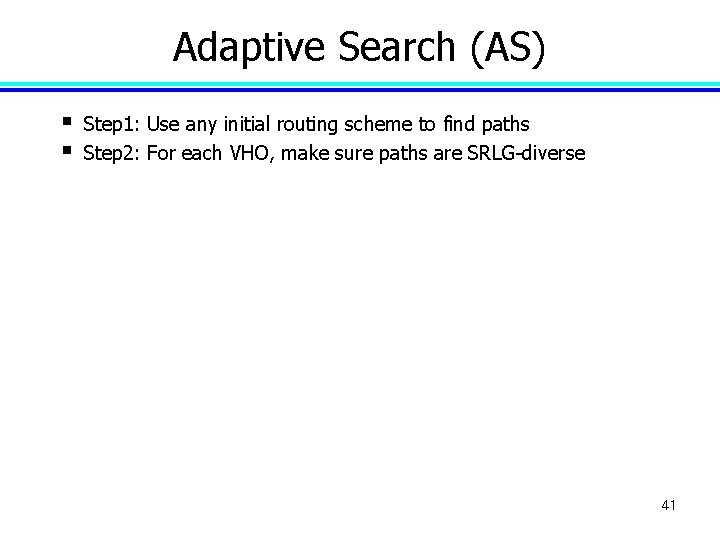
Adaptive Search (AS) § § Step 1: Use any initial routing scheme to find paths Step 2: For each VHO, make sure paths are SRLG-diverse SHO Initial routing paths SRLG-diverse? VHO Yes! Then, fix as solution. VHO SRLG-diverse? No! Then, replace with SRLG diverse paths. 41
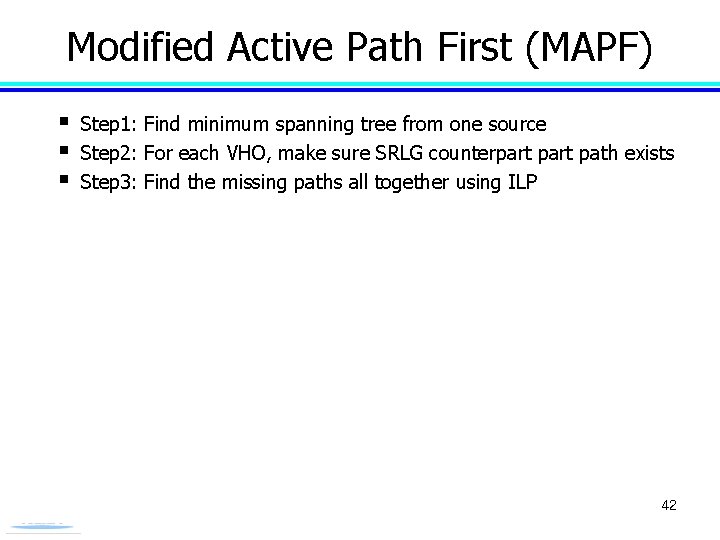
Modified Active Path First (MAPF) § § § Step 1: Find minimum spanning tree from one source Step 2: For each VHO, make sure SRLG counterpart path exists Step 3: Find the missing paths all together using ILP SHO Not possible! Find missing Minimum paths w/ ILP SRLG spanning diverse tree. SRLG VHO Does SRLG-diverse counterpart path exist? VHO Yes! VHO Then, fix as solution. Does SRLG-diverse counterpart path exist? No! Then, replace with SRLG diverse paths. 42
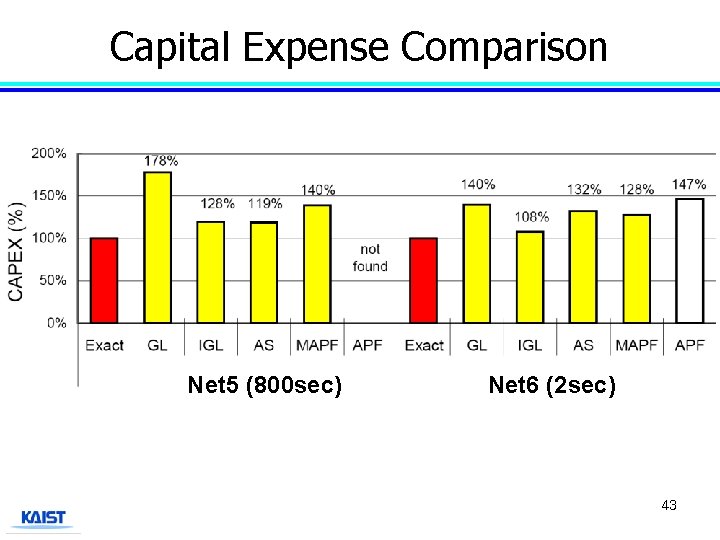
Capital Expense Comparison Net 5 (800 sec) Net 6 (2 sec) 43
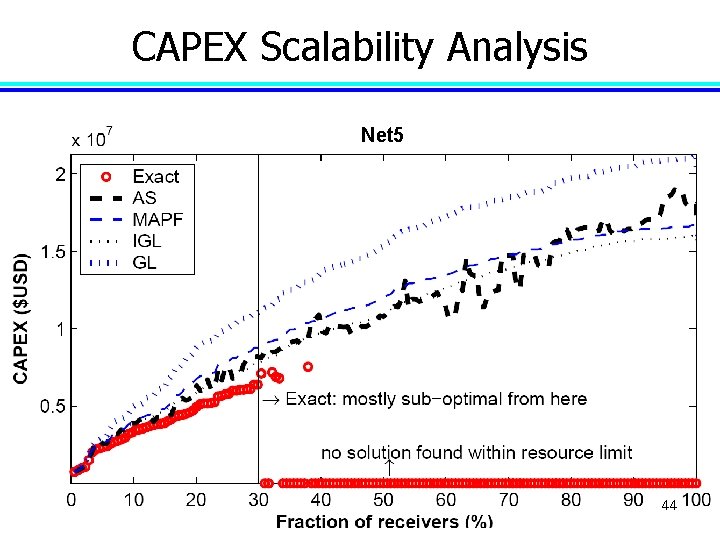
CAPEX Scalability Analysis Net 5 44
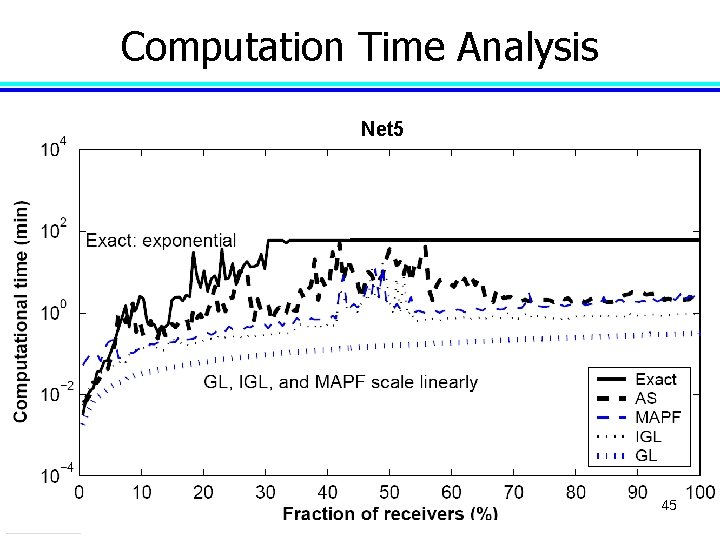
Computation Time Analysis Net 5 45
Summary l Additional quality improvements of SRLG-diverse paths § latency limits § # of intermediate nodes and links § per-path upper bound of SRLGs l Efficient and scalable solutions for realistic network topologies 46
Implications for Other Networks l Cross-layer optimization § Optical + IP layer info combined l Topological constraints § Mesh vs star § WAN vs MAN l Cost constraints § OXC port vs router port 47
![IPTV Service Monitoring [Kerpez] l Elements of IPTV Service Assurance § Subscriber management Billing,](http://slidetodoc.com/presentation_image_h/bb0af63487383efca7641075d5c90089/image-48.jpg "IPTV Service Monitoring [Kerpez] l Elements of IPTV Service Assurance § Subscriber management Billing,")
IPTV Service Monitoring [Kerpez] l Elements of IPTV Service Assurance § Subscriber management Billing, subscriptions, AAA, DRM § Video headend Converged services, Vo. D, Broadcast § Transport network IP/MPLS, Ethernet, DSLAM/OLT, Gateways 48
![References [Cha 06 -1] Cha et al. , “Case study: resilient backbone design for](http://slidetodoc.com/presentation_image_h/bb0af63487383efca7641075d5c90089/image-49.jpg "References [Cha 06 -1] Cha et al. , “Case study: resilient backbone design for")
References [Cha 06 -1] Cha et al. , “Case study: resilient backbone design for IPTV services, ” IPTV Workshop (WWW 2006), Edinburgh, May, 2006. [Cha 06 -2] Cha et al. , “Path protection routing with SRLG constraints to support IPTV in WDM mesh networks, ” 9 th IEEE Global Internet Symposium, Barcelona, April, 2006. [Cha 06 -3] Cha et al. , “Efficient and scalable provisioning solutions for always-on multicast streaming services, ” (in submission). [SRLG] Sebos et al. , “Auto-discovery of shared risk link groups, ” IEEE OFC, March 2001. [APF] Xu et al. , “On the complexity of and algorithms for finding the shortest path with a disjoint counterpart, ” IEEE/ACM To. N, 14(1): 147 -158, 2006. [Kerpez] K. Kerpez et al. , “IPTV Service Assurance, ” IEEE Communications, September, 206 49
- Slides: 49