
Infrastructure and Economic Growth The Philippine Experience Epictetus


- Slides: 22
Infrastructure and Economic Growth: The Philippine Experience Epictetus E. Patalinghug Professor Emeritus of Economics and Finance University of the Philippines Diliman, Quezon City Stratbase – ADRI Roundtable Discussion Tower Club, Philam Life Tower, Makati City April 5, 2017
Infrastructure – Growth Debate � Improving infrastructure services increases factor productivity and lowers production costs. � The increased profitability encourages investment and increases potential GDP growth. Increased growth in turn increases income. � There is no consensus on how infrastructure is defined: should it be limited to core infrastructure or should it include social capital.
Infrastructure – Growth Debate � In countries where the efficacy of capital is low, investment in maintenance may actually have a higher rate of return than new investment. � The efficiency of infrastructure investments depends on the differences in the nature and efficiency of the regulatory framework, the quality of contracts, the political economy of the process, the quality of the local bureaucracy, and the level of corruption.
Infrastructure – Growth Debate � The consensus is that the effects of public investment in infrastructures are positively but substantially smaller than earlier estimates. � The magnitude of the effects tends to be substantially higher for less developed countries.
Capital and Cross-Country Differences � Output per worker in industrialized countries today is 10 times larger than it was 100 years ago. For a share of capital of 1/3, this requires differences in capital per worker of a factor of 1000. � There is no evidence of such differences in capital stocks. � Capital-output � In ratios are roughly constant over time. sum, differences in capital per worker are far smaller than those needed to account for the differences in output per worker.
Econometric Issues on Infrastructure – Growth Link � Endogeneity (e. g. reverse causality) � Unobserved effects � Output definition (level vs growth)
PH Infrastructure Governance � � Projects must be approved by the NEDA Board before they could be funded in the budget process. – Infrastructure Committee (NEDA as Chair) – Development Budget Coordination Committee (DBM as Chair) – Investment Coordination Committee (DOF as Chair) The NEDA Board committees conduct a vetting process, decide on the annual program of expenditures, and approve all major government projects, including those with foreign assistance.
PH Infrastructure Governance � The major infrastructure projects that have to go through the ICC process takes a while to get approved (e. g. it suggests lack of project readiness at entry). � On the other hand, small locally-funded projects that do not pass through the rigorous ICC process will simply go through the test of whether these projects contribute significantly to the agencies’ major final outputs as contained in DBM’s Organizational Performance Indicator Framework (OPIF).
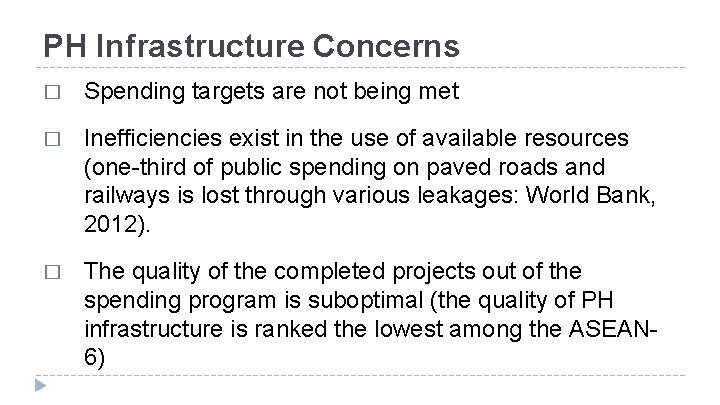
PH Infrastructure Concerns � Spending targets are not being met � Inefficiencies exist in the use of available resources (one-third of public spending on paved roads and railways is lost through various leakages: World Bank, 2012). � The quality of the completed projects out of the spending program is suboptimal (the quality of PH infrastructure is ranked the lowest among the ASEAN 6)
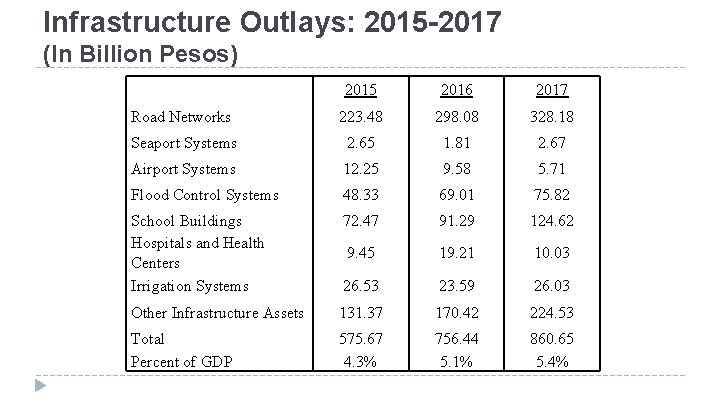
Infrastructure Outlays: 2015 -2017 (In Billion Pesos) 2015 2016 2017 Road Networks 223. 48 298. 08 328. 18 Seaport Systems 2. 65 1. 81 2. 67 Airport Systems 12. 25 9. 58 5. 71 Flood Control Systems 48. 33 69. 01 75. 82 School Buildings Hospitals and Health Centers Irrigation Systems 72. 47 91. 29 124. 62 9. 45 19. 21 10. 03 26. 53 23. 59 26. 03 Other Infrastructure Assets 131. 37 170. 42 224. 53 Total Percent of GDP 575. 67 4. 3% 756. 44 5. 1% 860. 65 5. 4%
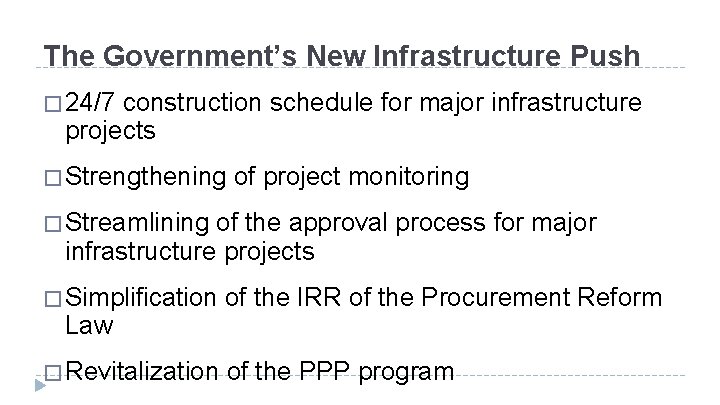
The Government’s New Infrastructure Push � 24/7 construction schedule for major infrastructure projects � Strengthening of project monitoring � Streamlining of the approval process for major infrastructure projects � Simplification of the IRR of the Procurement Reform � Revitalization of the PPP program Law
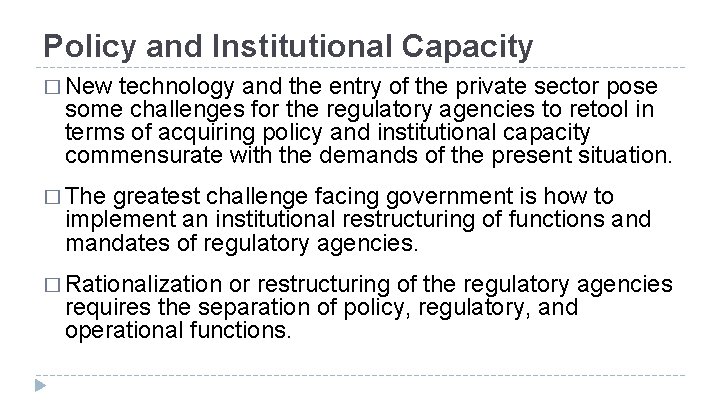
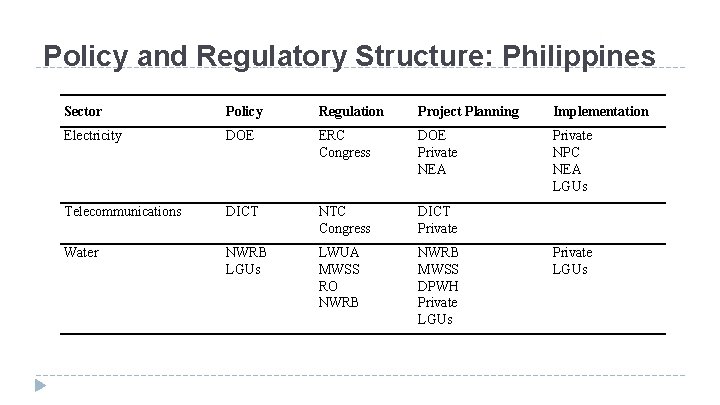
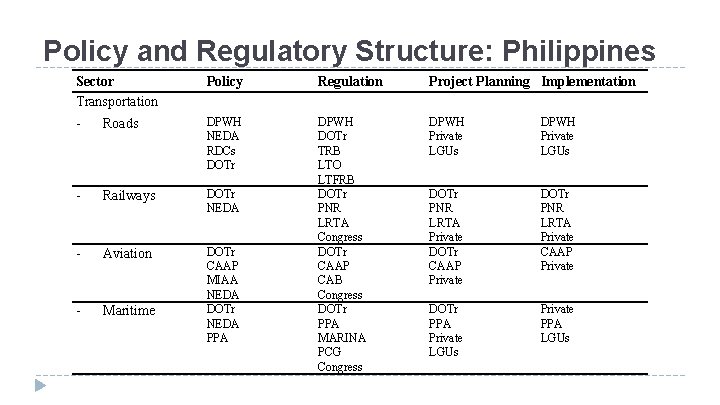
Policy and Institutional Capacity � New technology and the entry of the private sector pose some challenges for the regulatory agencies to retool in terms of acquiring policy and institutional capacity commensurate with the demands of the present situation. � The greatest challenge facing government is how to implement an institutional restructuring of functions and mandates of regulatory agencies. � Rationalization or restructuring of the regulatory agencies requires the separation of policy, regulatory, and operational functions.
Policy and Regulatory Structure: Philippines Sector Policy Regulation Project Planning Implementation Electricity DOE ERC Congress DOE Private NEA Private NPC NEA LGUs Telecommunications DICT NTC Congress DICT Private Water NWRB LGUs LWUA MWSS RO NWRB MWSS DPWH Private LGUs
Policy and Regulatory Structure: Philippines Sector Transportation Policy Regulation Project Planning Implementation - Roads DPWH NEDA RDCs DOTr DPWH Private LGUs - Railways DOTr NEDA - Aviation DOTr PNR LRTA Private DOTr CAAP Private DOTr PNR LRTA Private CAAP Private - Maritime DOTr CAAP MIAA NEDA DOTr NEDA PPA DPWH DOTr TRB LTO LTFRB DOTr PNR LRTA Congress DOTr CAAP CAB Congress DOTr PPA MARINA PCG Congress DOTr PPA Private LGUs Private PPA LGUs
Public – Private Partnership (PPP) � PPP is an agreement between a government and a private firm under which the private firm delivers an asset, a service, or both, in return for payments contingent on the long-term quality or other characteristics of outputs delivered. � PPP covers a broad scope which may range from management or service contracts to privatization.
Public – Private Partnership (PPP) � Governments usually employ PPPs to address weaknesses in their processes and requirements. � Private sector pursue the PPP strategy because of the presence of incentives that may result in profit if decisions on the PPP components are made in ways that are commercially viable. � The value-for-money benefit of PPP is validated by a comparison of private sector bids with detailed public sector comparator (PSC). � The PSC describes the options as to what it would cost the public sector to provide the outputs it is requesting from the private sector.
The Philippine PPP Experience � The BOT Law (RA 6957) was passed in July 1990 and later repealed by Congress (RA 7718) in May 1994. � Its IRR was only finalized in October 2012. � Llanto (2010) recommends that unsolicited proposals should not be part of the approach to infrastructure provision because they create incentives for nontransparent and dubious “back-of-the-room” negotiations and cutting deals between the proponent and potential implementing agency. � Unsolicited proposals in major projects (e. g. NLEX-SLEX Connector Road, new Manila International Airport, Clark International Airport) are being allowed in the Duterte government; competitive bidding was preferred in the Aquino government.
The Philippine PPP Experience � The influence of big business groups in the PPP projects (e. g. SMC, Ayala, and Metro Pacific) is evident. � Connectivity to the hinterland is not assured because financial viability for PPPs are concentrated in the richer regions (NCR, CALABARZON, and Region III). � The current PPP strategy may only build the most profitable projects, not the most necessary projects. � The Board of Airline Representatives expressed its concern to the Philippine Competition Commission that the privatization of airports transforms airports into monopolies that could lead to airlines being forced to pay exorbitant prices for the use of newly privatized facilities or be forced to avail of the concessionaire’s service providers.
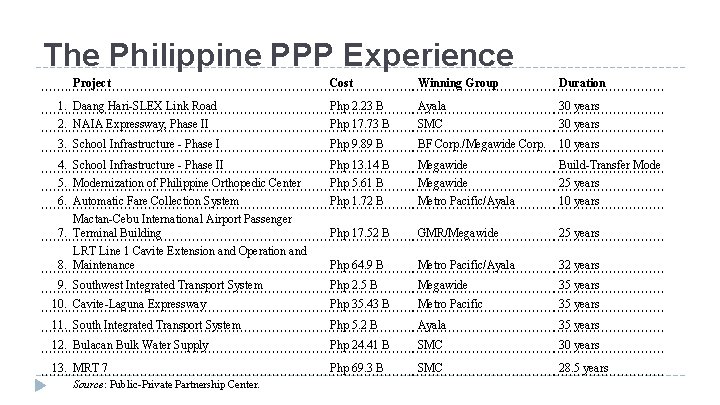
The Philippine PPP Experience Project Cost Winning Group Duration 1. Daang Hari-SLEX Link Road Php 2. 23 B Ayala 30 years 2. NAIA Expressway, Phase II Php 17. 73 B SMC 30 years 3. School Infrastructure - Phase I Php 9. 89 B BF Corp. /Megawide Corp. 10 years 4. School Infrastructure - Phase II Php 13. 14 B Megawide Build-Transfer Mode 5. Modernization of Philippine Orthopedic Center 6. Automatic Fare Collection System Mactan-Cebu International Airport Passenger 7. Terminal Building LRT Line 1 Cavite Extension and Operation and 8. Maintenance Php 5. 61 B Php 1. 72 B Megawide Metro Pacific/Ayala 25 years 10 years Php 17. 52 B GMR/Megawide 25 years Php 64. 9 B Metro Pacific/Ayala 32 years 9. Southwest Integrated Transport System Php 2. 5 B Megawide 35 years 10. Cavite-Laguna Expressway Php 35. 43 B Metro Pacific 35 years 11. South Integrated Transport System Php 5. 2 B Ayala 35 years 12. Bulacan Bulk Water Supply Php 24. 41 B SMC 30 years 13. MRT 7 Php 69. 3 B SMC 28. 5 years Source: Public-Private Partnership Center.
The Philippine PPP Experience � DBM Sec. Diokno’s early pronouncement to give preference to “hybrid PPP” is worth pursuing. � This infrastructure strategy assigns the task of building the projects to the government because of its capacity to negotiate ROW and access to concessional low-interest funds. And to bid the O & M of the completed project to the private sector which has a comparative advantage in efficiently performing these tasks.
Conclusions � The impact of infrastructure on growth depends on the type of infrastructure, the state of the country’s development path, and the region/location. � In situations when the efficacy of capital is low, investment in maintenance may actually have a higher rate of return than new investment. � Given the uncertainty and problems connected with PPP modes that transfer the design and build components to the private partners, the appropriate PPP mode is the O & M type which strengthens government’s capacity to build projects on time complemented by private sector’s efficiency in managing, operating, maintaining, and marketing the project.
Thank You