
Infrasound Detection Using NanoResolution Barometers Features Measurement Results
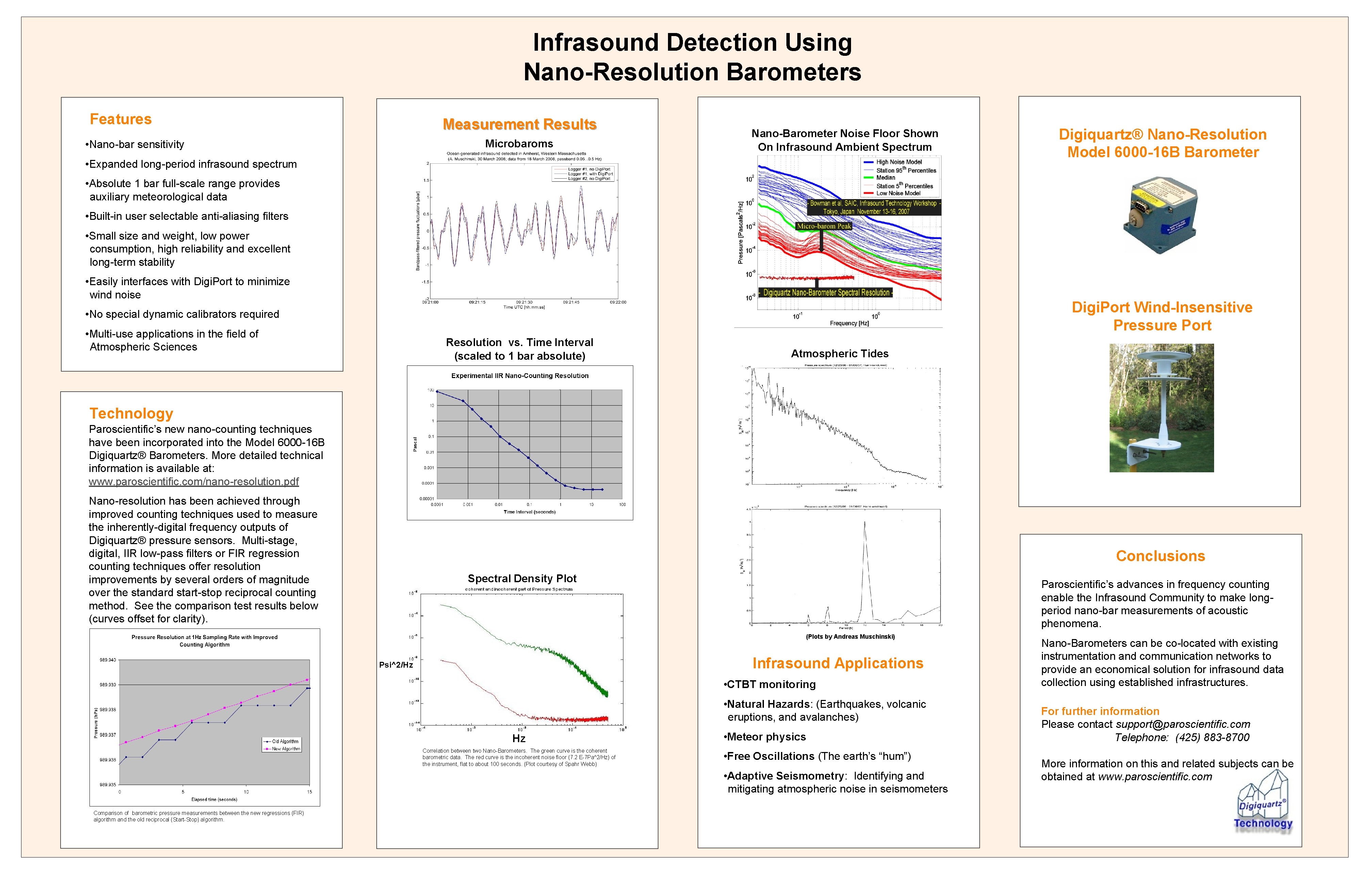
Infrasound Detection Using Nano-Resolution Barometers Features Measurement Results Microbaroms • Nano-bar sensitivity Nano-Barometer Noise Floor Shown On Infrasound Ambient Spectrum • Expanded long-period infrasound spectrum Digiquartz® Nano-Resolution Model 6000 -16 B Barometer • Absolute 1 bar full-scale range provides auxiliary meteorological data • Built-in user selectable anti-aliasing filters • Small size and weight, low power consumption, high reliability and excellent long-term stability • Easily interfaces with Digi. Port to minimize wind noise Digi. Port Wind-Insensitive Pressure Port • No special dynamic calibrators required • Multi-use applications in the field of Atmospheric Sciences Resolution vs. Time Interval (scaled to 1 bar absolute) Atmospheric Tides Technology Paroscientific’s new nano-counting techniques have been incorporated into the Model 6000 -16 B Digiquartz® Barometers. More detailed technical information is available at: www. paroscientific. com/nano-resolution. pdf Nano-resolution has been achieved through improved counting techniques used to measure the inherently-digital frequency outputs of Digiquartz® pressure sensors. Multi-stage, digital, IIR low-pass filters or FIR regression counting techniques offer resolution improvements by several orders of magnitude over the standard start-stop reciprocal counting method. See the comparison test results below (curves offset for clarity). Conclusions Spectral Density Plot Paroscientific’s advances in frequency counting enable the Infrasound Community to make longperiod nano-bar measurements of acoustic phenomena. (Plots by Andreas Muschinski) Infrasound Applications Psi^2/Hz • CTBT monitoring • Natural Hazards: (Earthquakes, volcanic eruptions, and avalanches) Hz Correlation between two Nano-Barometers. The green curve is the coherent barometric data. The red curve is the incoherent noise floor (7. 2 E-7 Pa^2/Hz) of the instrument, flat to about 100 seconds. (Plot courtesy of Spahr Webb) • Meteor physics • Free Oscillations (The earth’s “hum”) • Adaptive Seismometry: Identifying and mitigating atmospheric noise in seismometers Comparison of barometric pressure measurements between the new regressions (FIR) algorithm and the old reciprocal (Start-Stop) algorithm. Nano-Barometers can be co-located with existing instrumentation and communication networks to provide an economical solution for infrasound data collection using established infrastructures. For further information Please contact support@paroscientific. com Telephone: (425) 883 -8700 More information on this and related subjects can be obtained at www. paroscientific. com
- Slides: 1