
Infrared Spectroscopy Annenberg World of Chemistry 10 Signals
Infrared Spectroscopy
![Annenberg World of Chemistry #10 Signals from Within [8: 55 -20: 29] Infrared Spectroscopy](http://slidetodoc.com/presentation_image_h2/d50d8b86fe7a67cac7d0f952c97cce0f/image-2.jpg "Annenberg World of Chemistry #10 Signals from Within [8: 55 -20: 29] Infrared Spectroscopy")
Annenberg World of Chemistry #10 Signals from Within [8: 55 -20: 29] Infrared Spectroscopy http: //www. learner. org/resources/series 61. html
Infrared Spectroscopy region of infrared that is most useful lies between 2. 5 -16 mm (4000 -625 cm-1) depends on transitions between vibrational energy states Stretching: higher energy / higher wave number (cm-1) Bending: lower energy / lower wave number (cm-1)
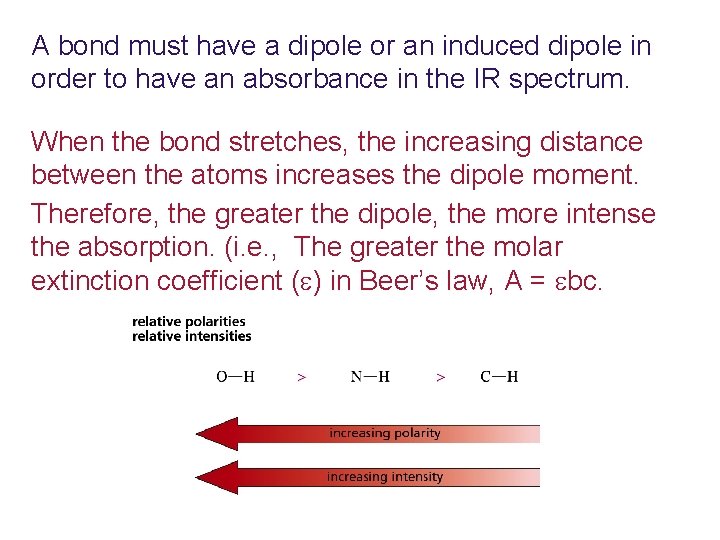
A bond must have a dipole or an induced dipole in order to have an absorbance in the IR spectrum. When the bond stretches, the increasing distance between the atoms increases the dipole moment. Therefore, the greater the dipole, the more intense the absorption. (i. e. , The greater the molar extinction coefficient ( ) in Beer’s law, A = bc.
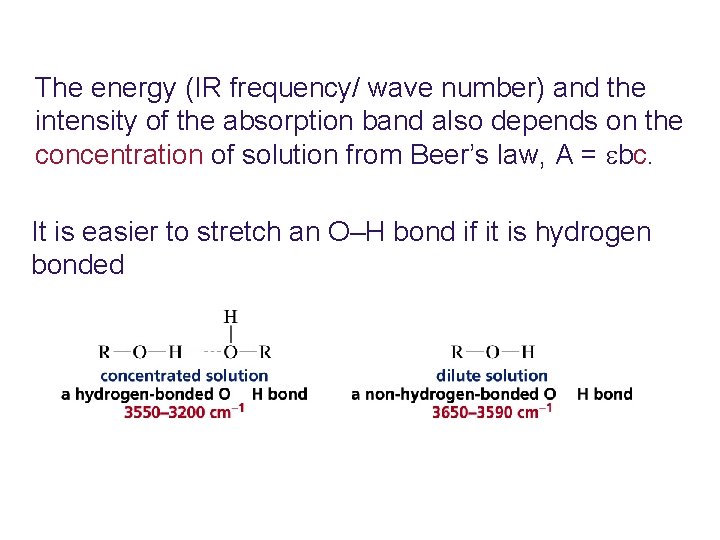
The energy (IR frequency/ wave number) and the intensity of the absorption band also depends on the concentration of solution from Beer’s law, A = bc. It is easier to stretch an O–H bond if it is hydrogen bonded
Analyzing Structure: Functions & Infrared Spectra The molecular formula is a critical piece of information, which limits the functional possibilities. The presence & absence of absorption bands must be considered in identifying a possible structure in IR spectroscopy. Empiricism is critical to successful identification. NOTE: Bonds which lack dipole moments are not detected.
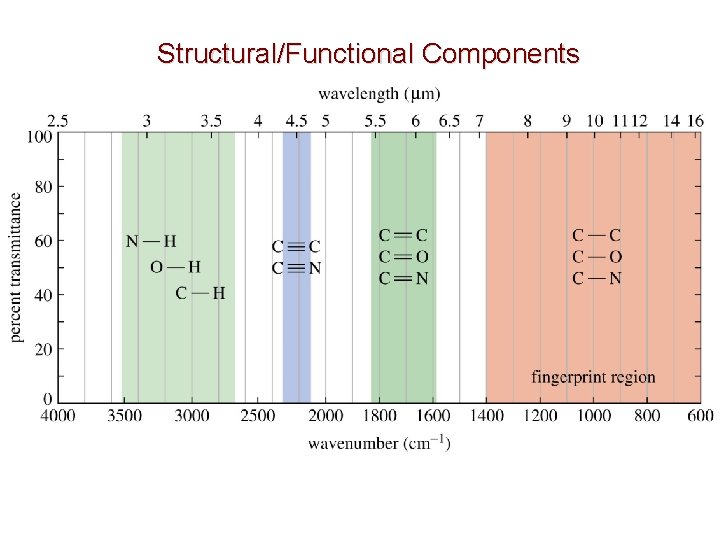
Structural/Functional Components
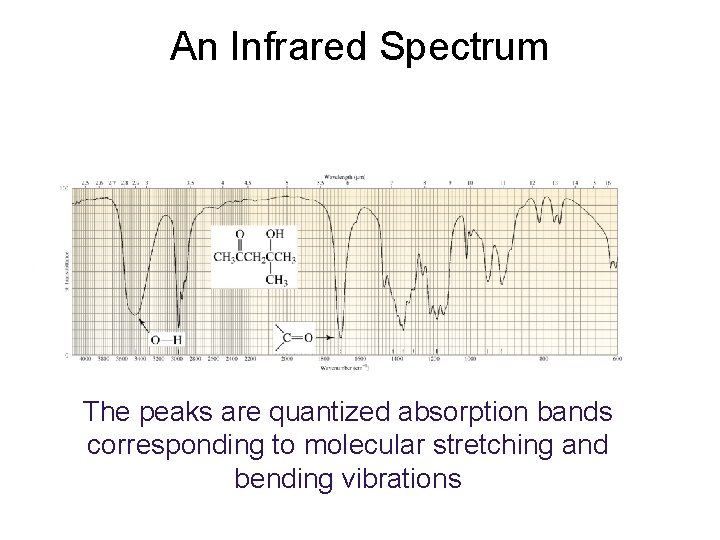
An Infrared Spectrum The peaks are quantized absorption bands corresponding to molecular stretching and bending vibrations
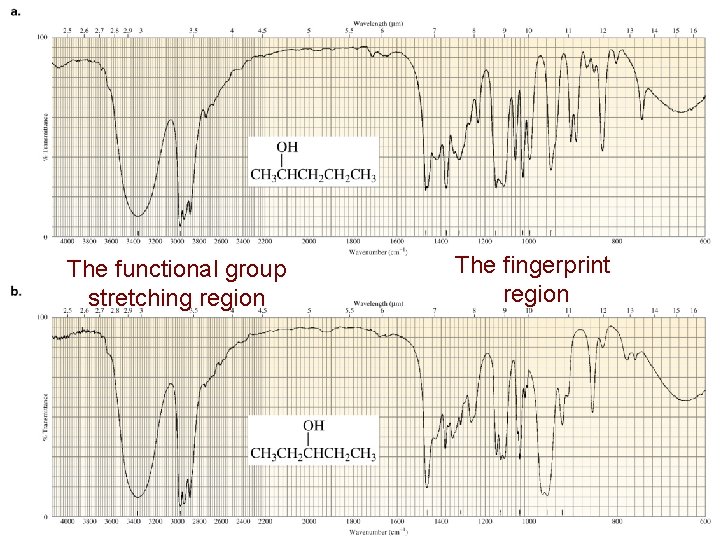
The functional group stretching region The fingerprint region
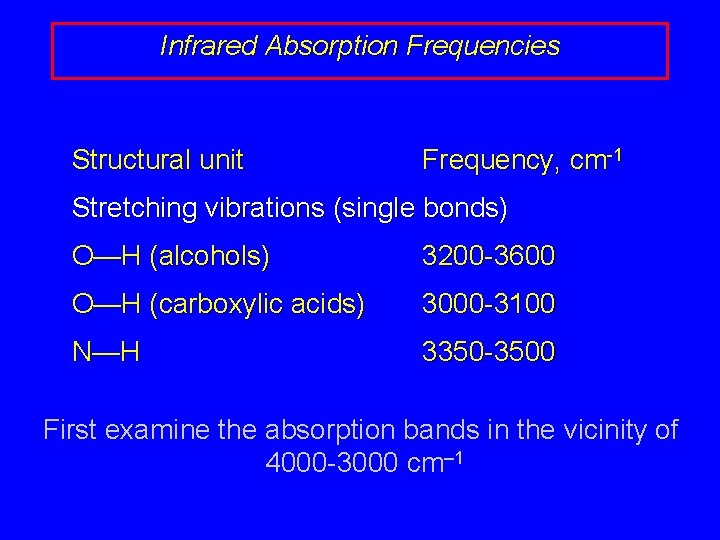
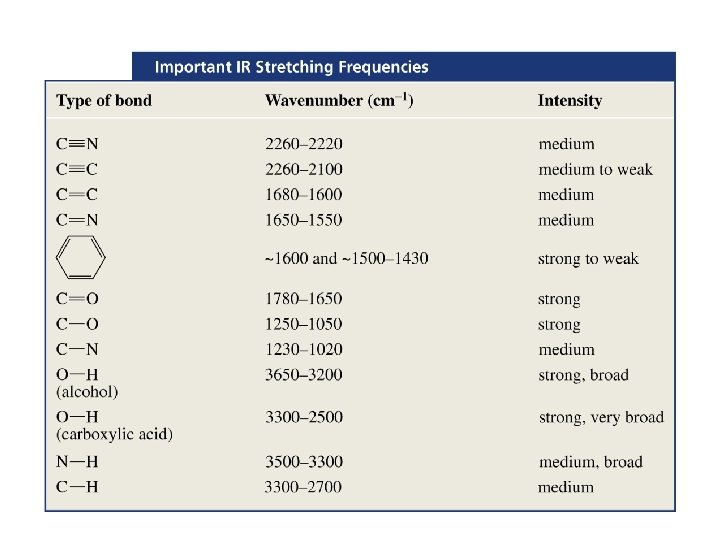
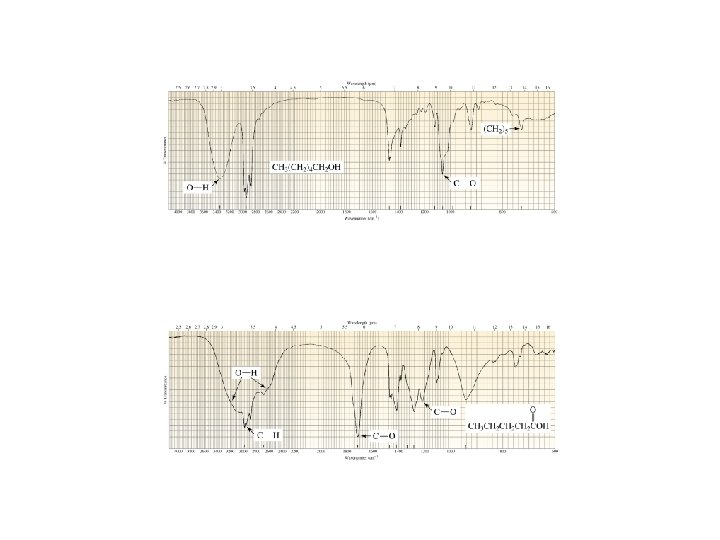
Infrared Absorption Frequencies Structural unit Frequency, cm-1 Stretching vibrations (single bonds) O—H (alcohols) 3200 -3600 O—H (carboxylic acids) 3000 -3100 N—H 3350 -3500 First examine the absorption bands in the vicinity of 4000 -3000 cm– 1
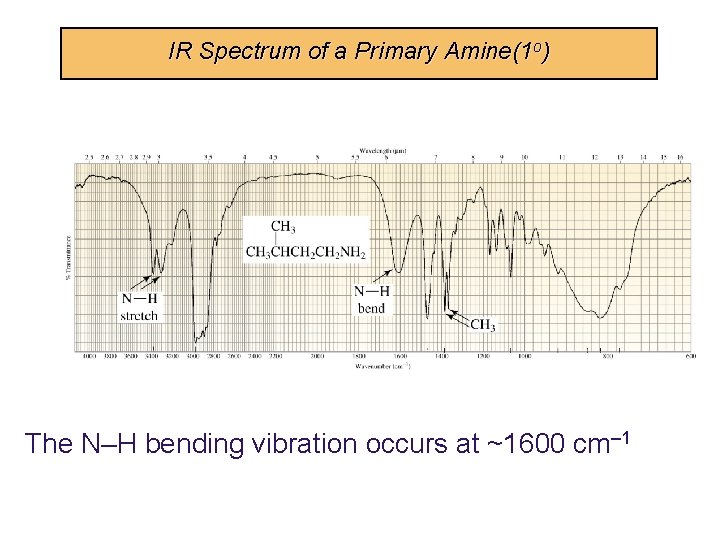
IR Spectrum of a Primary Amine(1 o) The N–H bending vibration occurs at ~1600 cm– 1
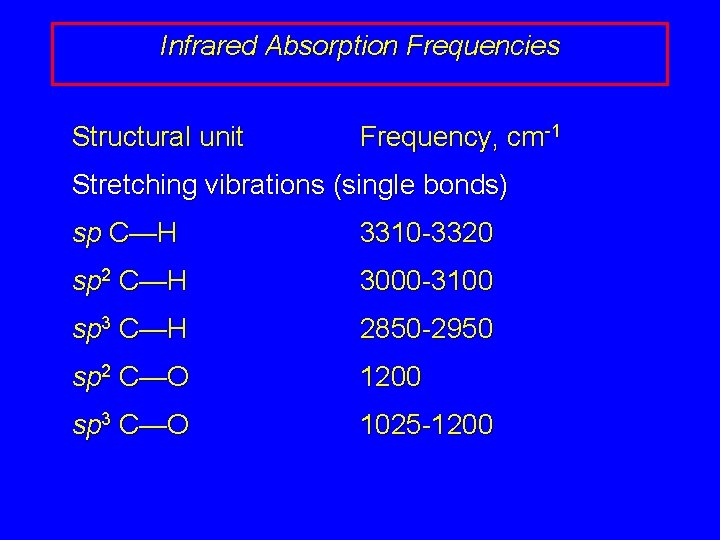
Infrared Absorption Frequencies Structural unit Frequency, cm-1 Stretching vibrations (single bonds) sp C—H 3310 -3320 sp 2 C—H 3000 -3100 sp 3 C—H 2850 -2950 sp 2 C—O 1200 sp 3 C—O 1025 -1200
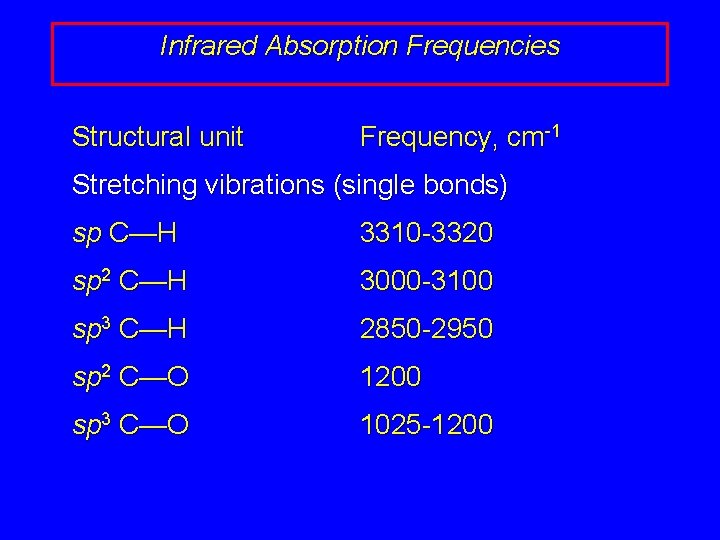
Infrared Absorption Frequencies Structural unit Frequency, cm-1 Stretching vibrations (single bonds) sp C—H 3310 -3320 sp 2 C—H 3000 -3100 sp 3 C—H 2850 -2950 sp 2 C—O 1200 sp 3 C—O 1025 -1200
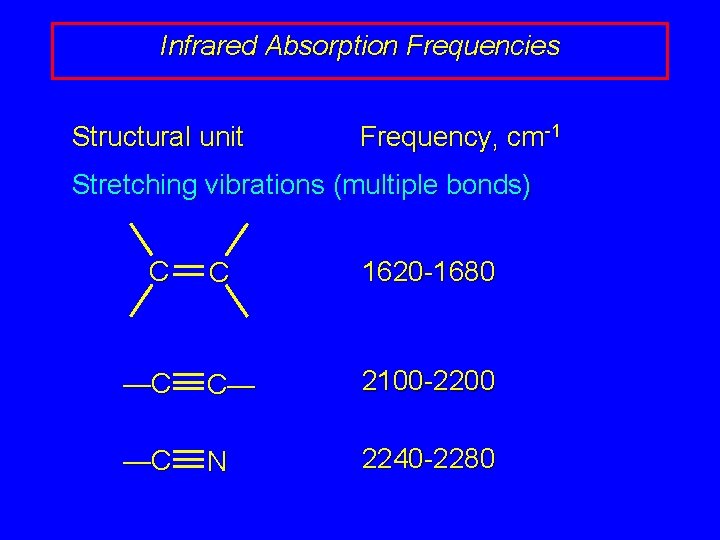
Infrared Absorption Frequencies Structural unit Frequency, cm-1 Stretching vibrations (multiple bonds) C C 1620 -1680 —C C— 2100 -2200 —C N 2240 -2280
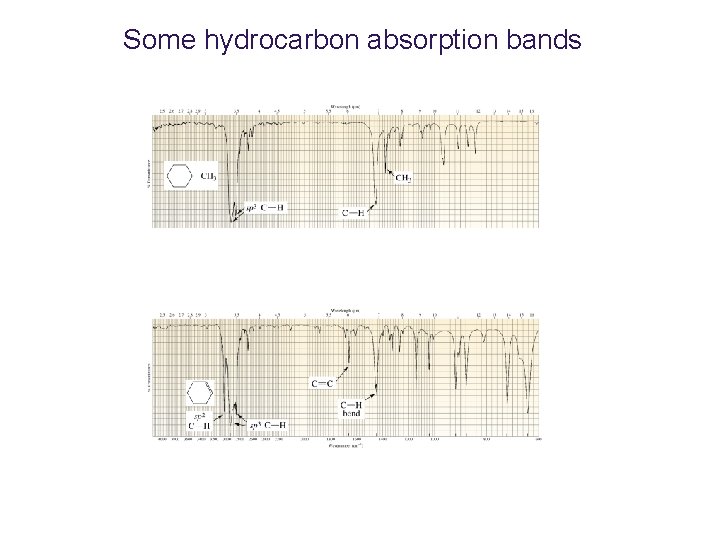
Some hydrocarbon absorption bands
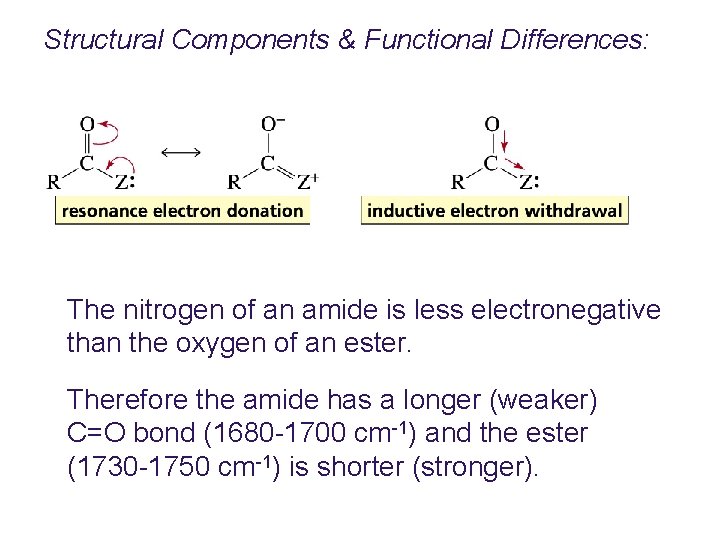
Structural Components & Functional Differences: The nitrogen of an amide is less electronegative than the oxygen of an ester. Therefore the amide has a longer (weaker) C=O bond (1680 -1700 cm-1) and the ester (1730 -1750 cm-1) is shorter (stronger).
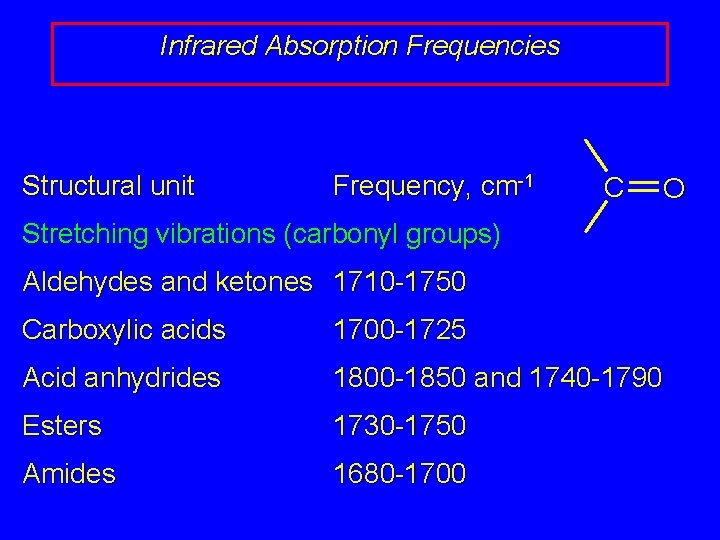
Infrared Absorption Frequencies Structural unit Frequency, cm-1 C O Stretching vibrations (carbonyl groups) Aldehydes and ketones 1710 -1750 Carboxylic acids 1700 -1725 Acid anhydrides 1800 -1850 and 1740 -1790 Esters 1730 -1750 Amides 1680 -1700
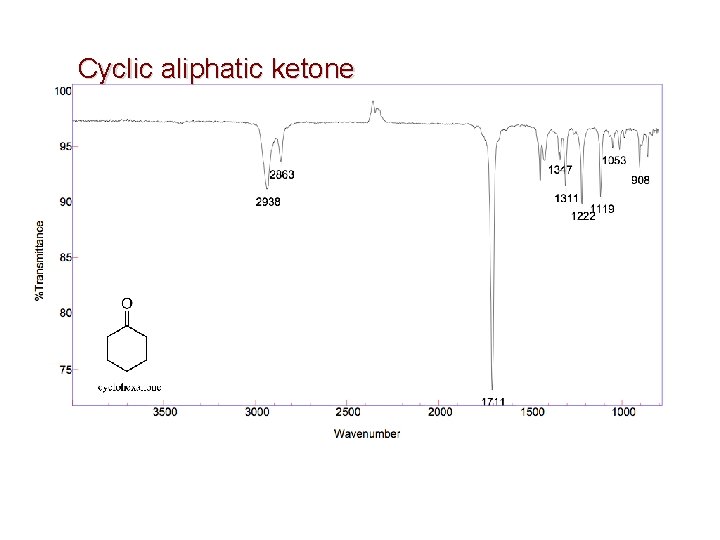
Cyclic aliphatic ketone
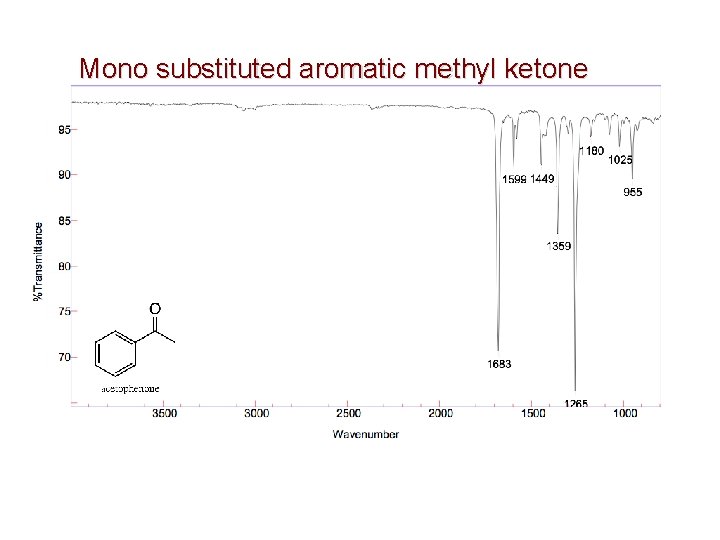
Mono substituted aromatic methyl ketone
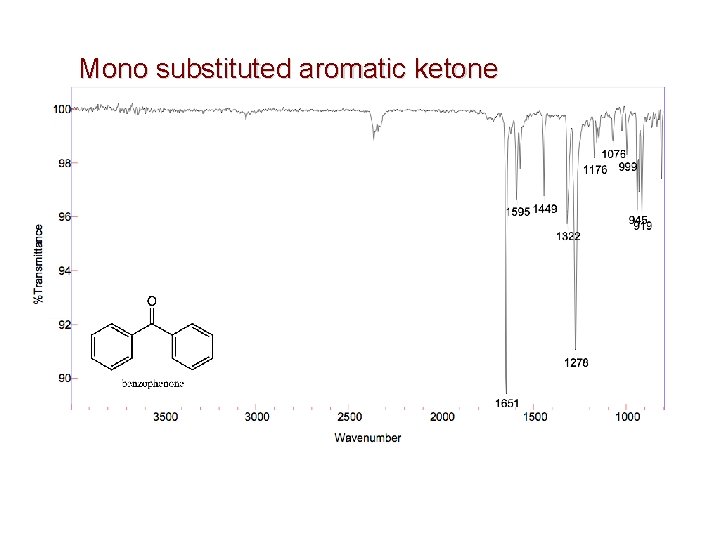
Mono substituted aromatic ketone
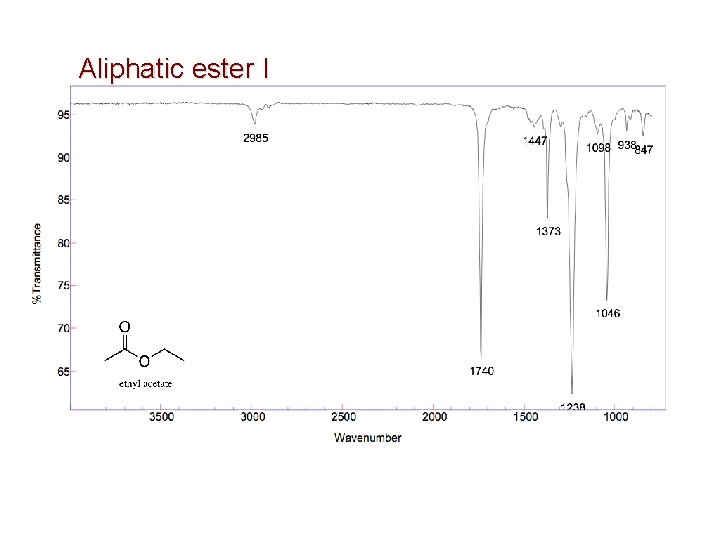
Aliphatic ester I
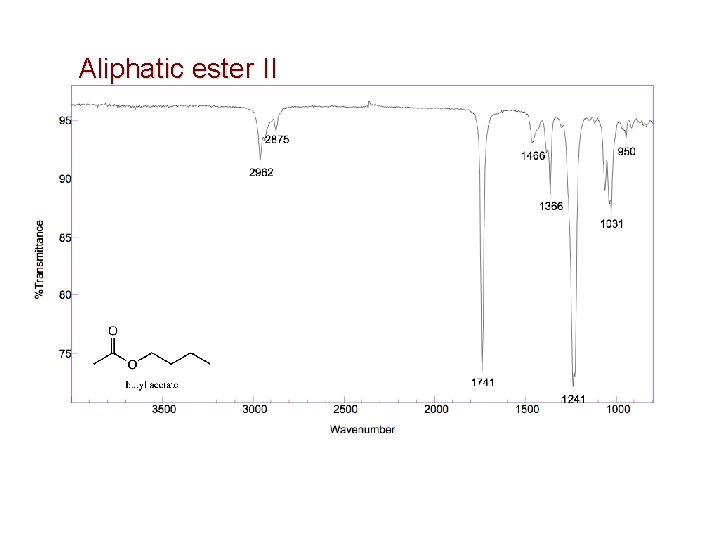
Aliphatic ester II
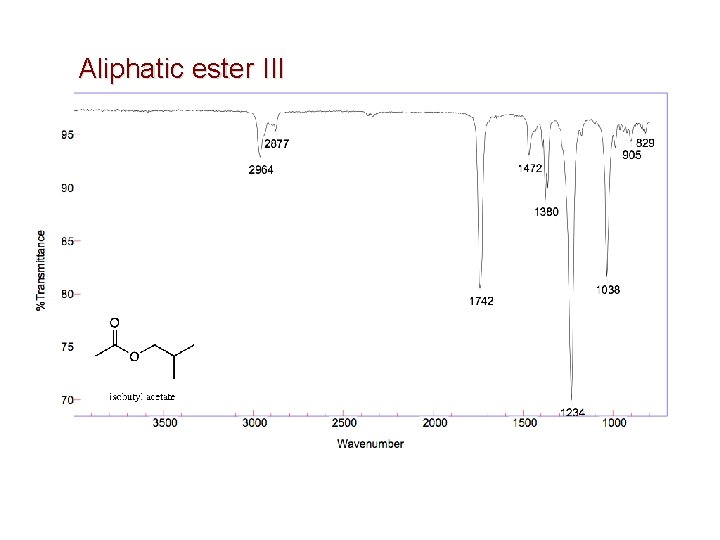
Aliphatic ester III
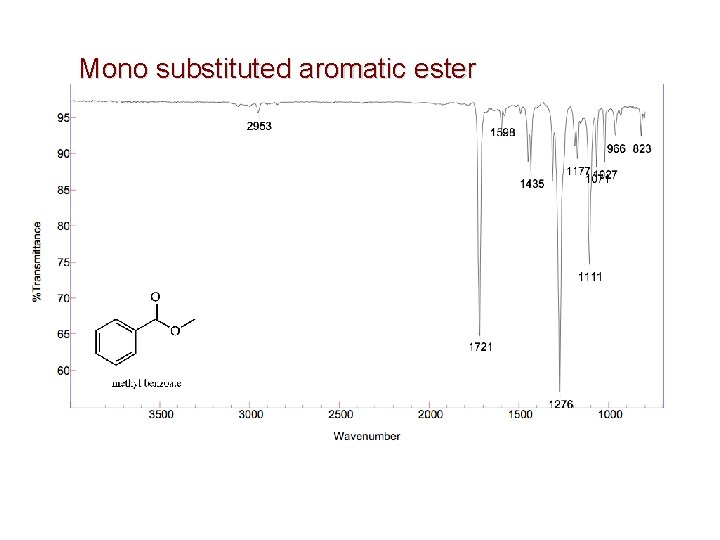
Mono substituted aromatic ester
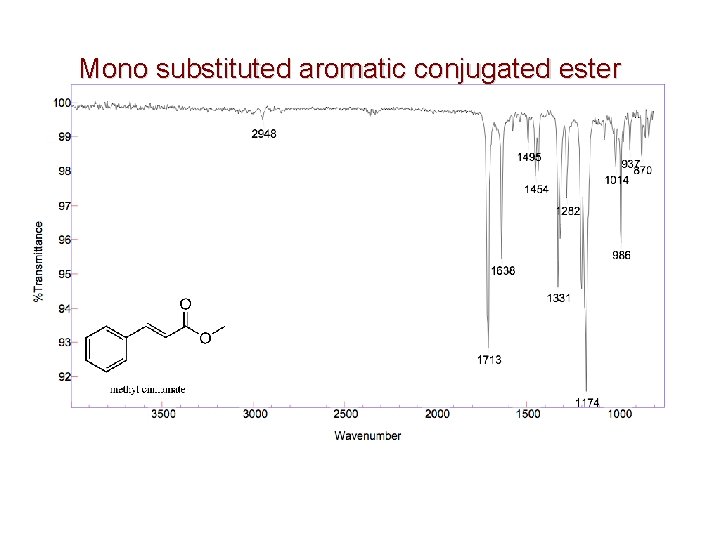
Mono substituted aromatic conjugated ester
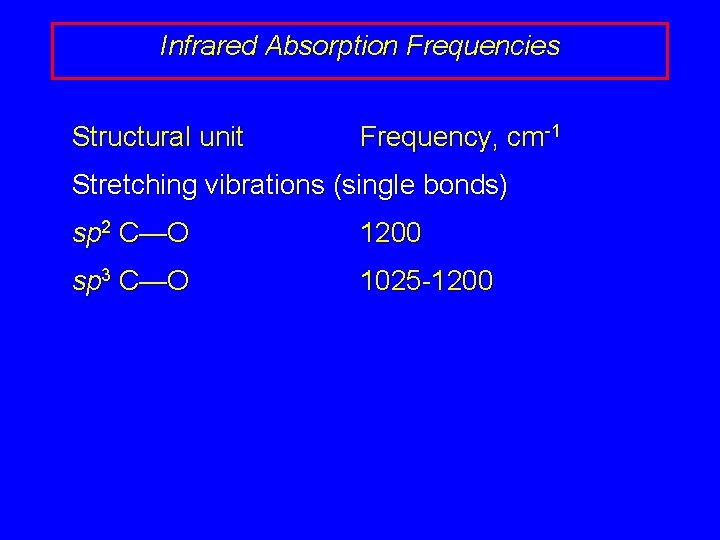
Infrared Absorption Frequencies Structural unit Frequency, cm-1 Stretching vibrations (single bonds) sp 2 C—O 1200 sp 3 C—O 1025 -1200
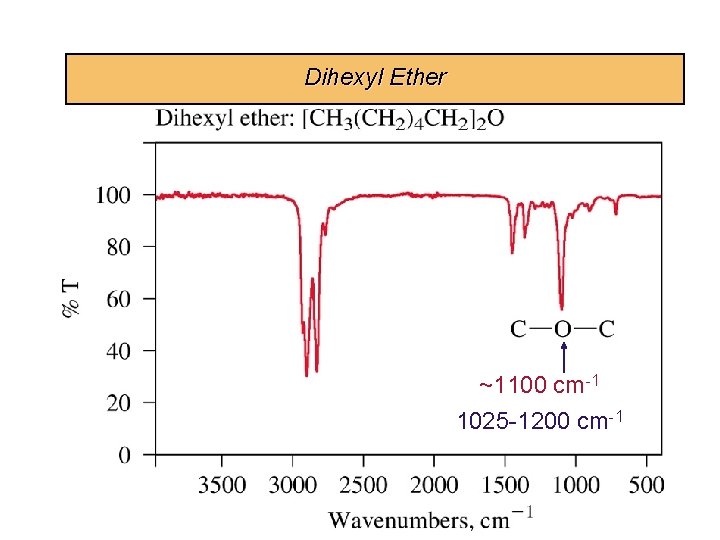
Dihexyl Ether ~1100 cm-1 1025 -1200 cm-1
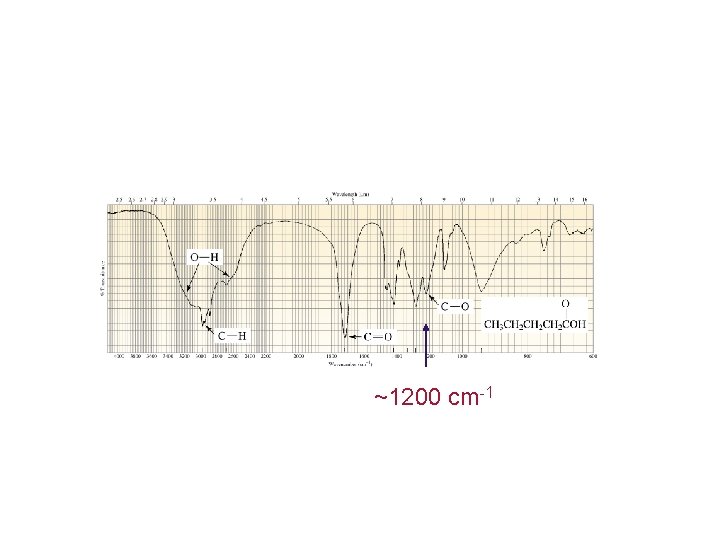
~1200 cm-1
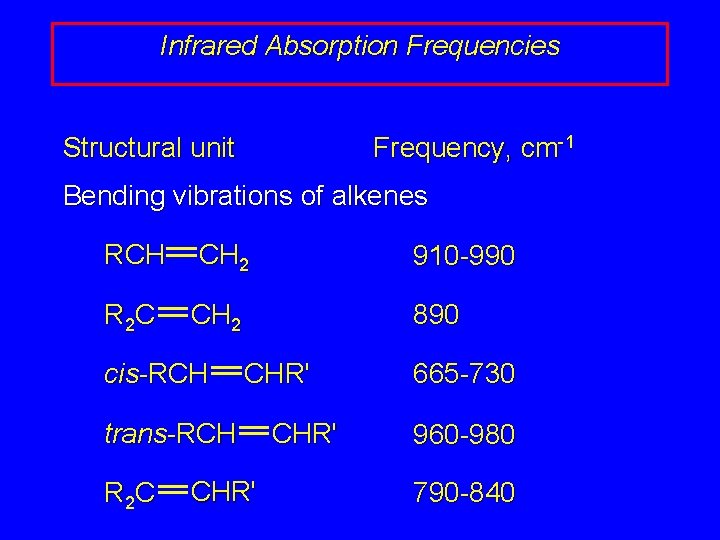
Infrared Absorption Frequencies Structural unit Frequency, cm-1 Bending vibrations of alkenes RCH CH 2 910 -990 R 2 C CH 2 890 cis-RCH CHR' trans-RCH R 2 C CHR' 665 -730 960 -980 790 -840
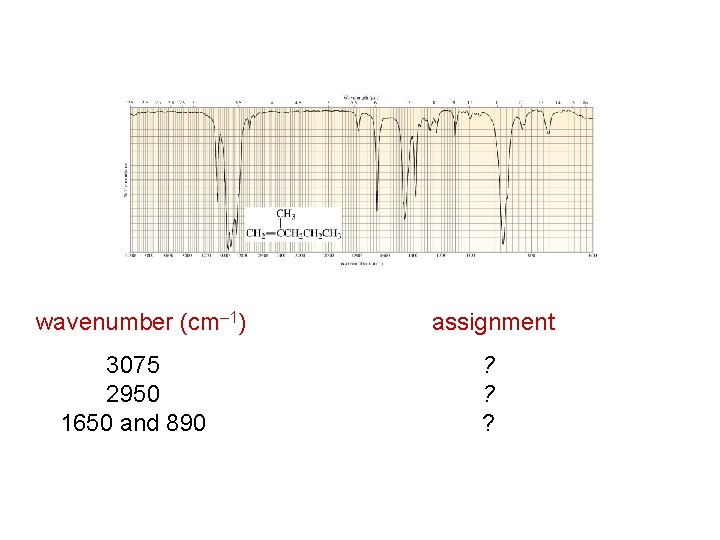
wavenumber (cm– 1) 3075 2950 1650 and 890 assignment ? ? ?
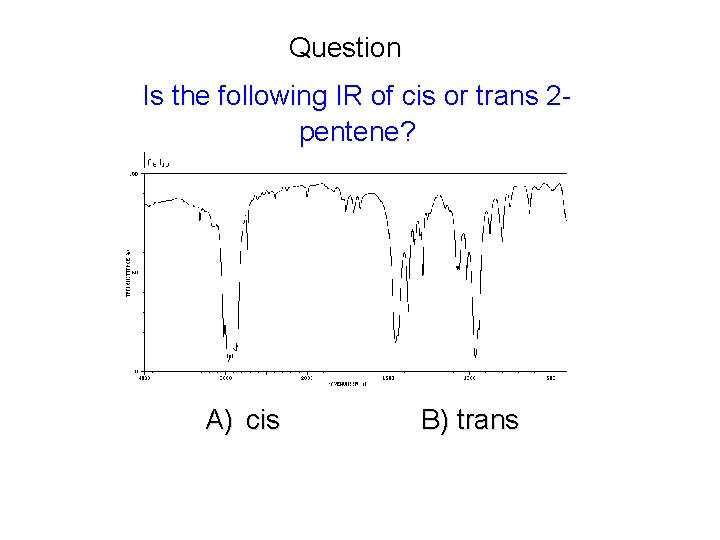
Question Is the following IR of cis or trans 2 pentene? A) cis B) trans
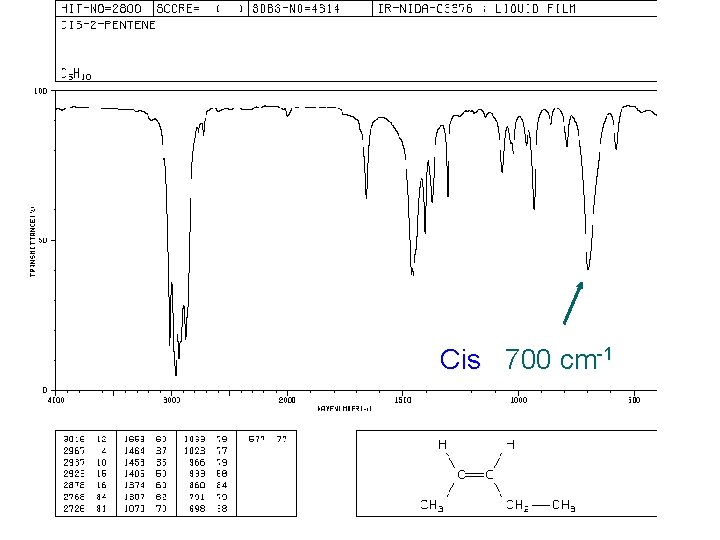
Cis 700 cm-1
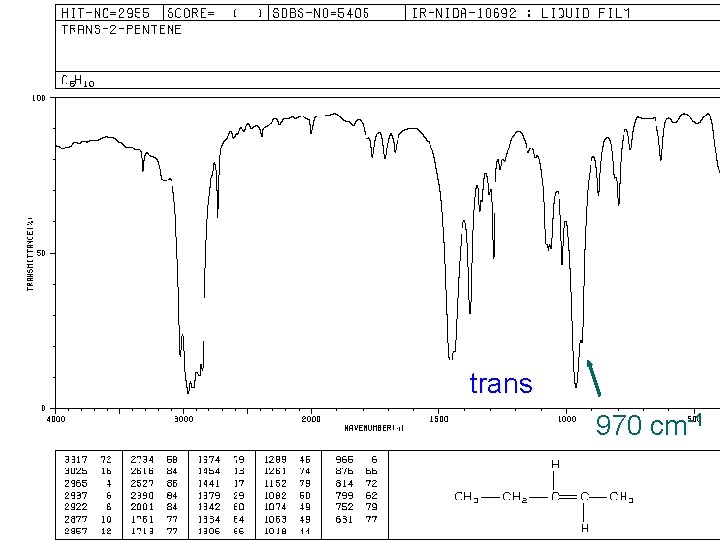
trans 970 cm-1
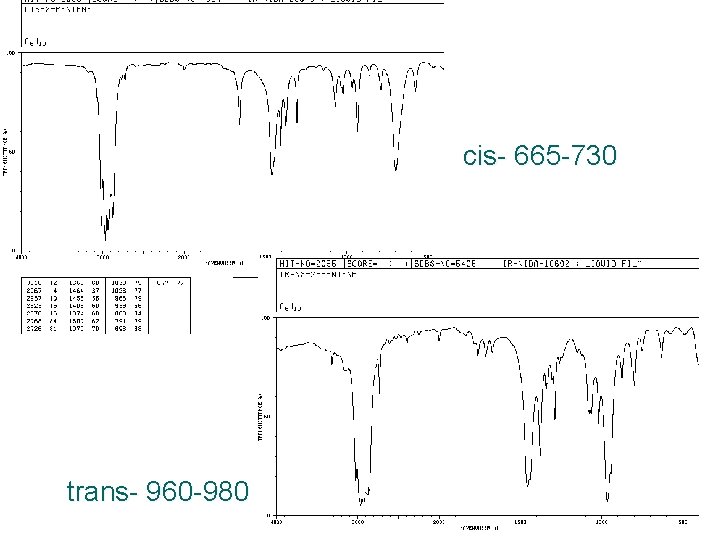
cis- 665 -730 trans- 960 -980
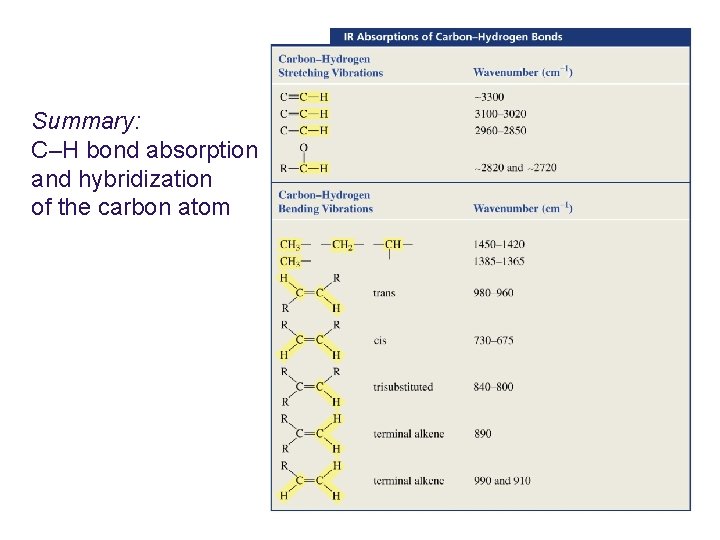
Summary: C–H bond absorption and hybridization of the carbon atom
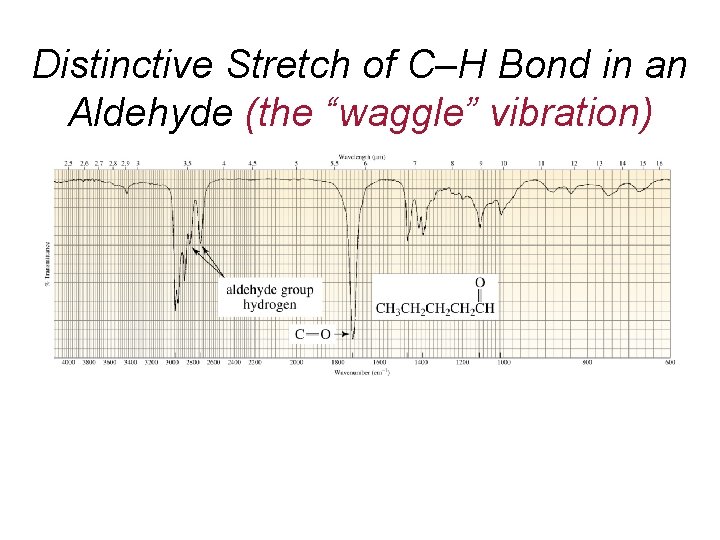
Distinctive Stretch of C–H Bond in an Aldehyde (the “waggle” vibration)
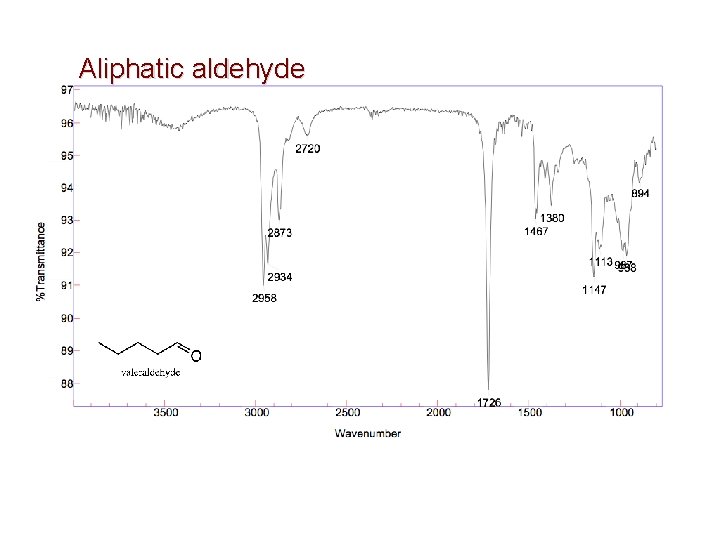
Aliphatic aldehyde
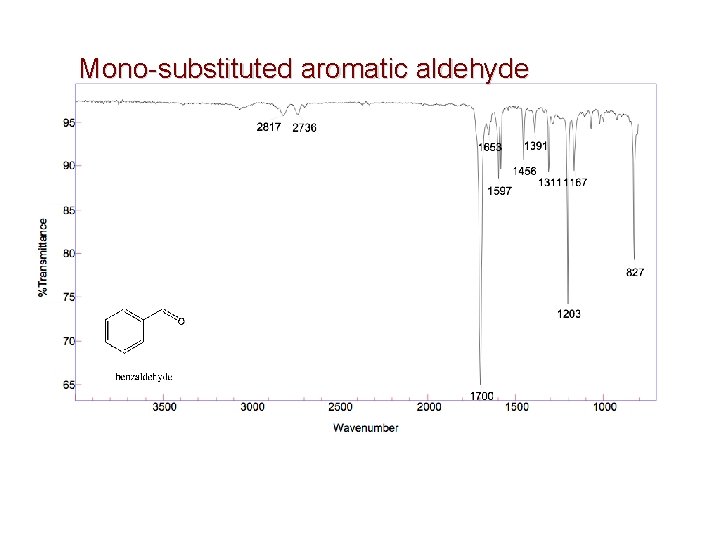
Mono-substituted aromatic aldehyde
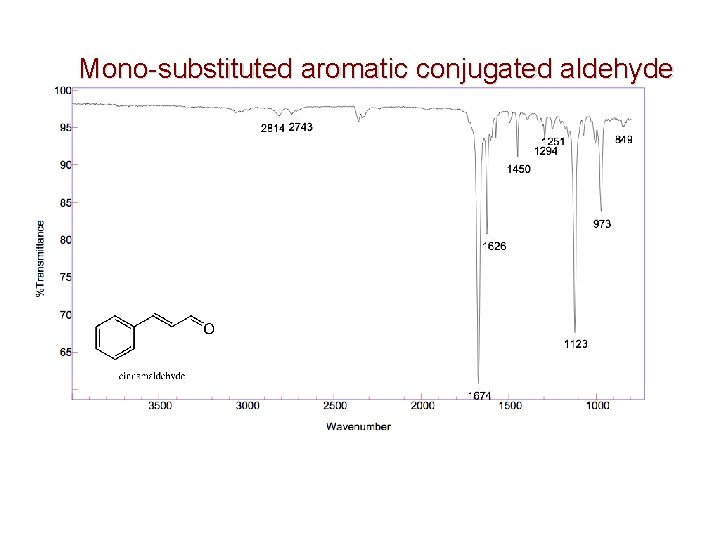
Mono-substituted aromatic conjugated aldehyde
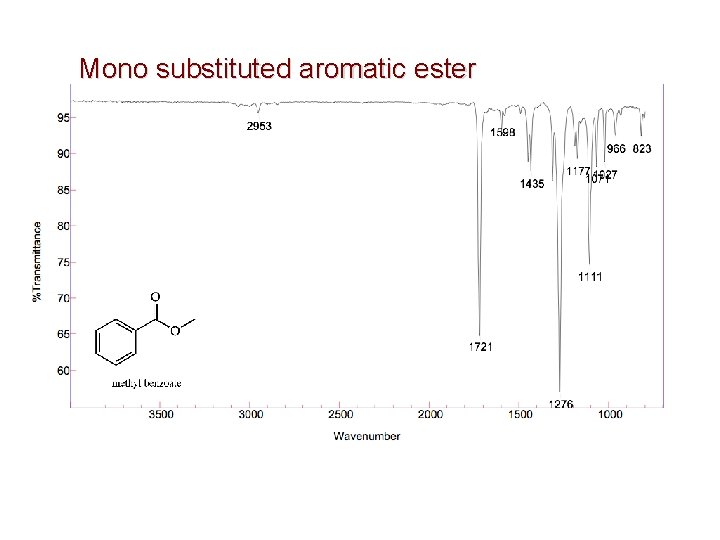
Mono substituted aromatic ester
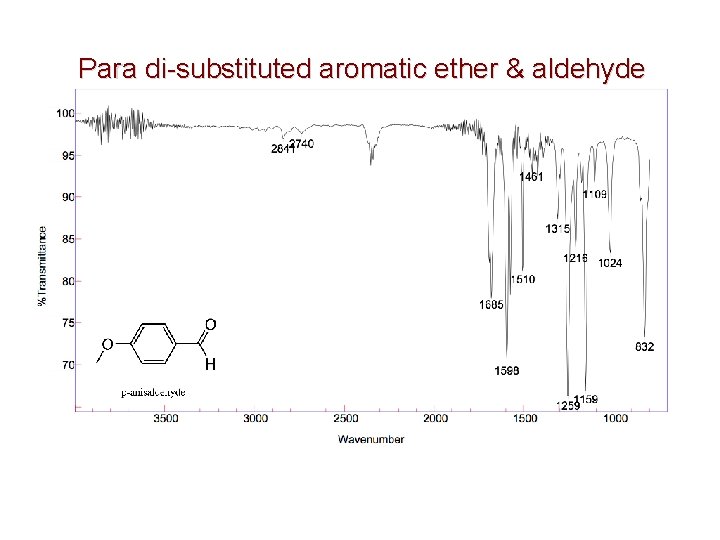
Para di-substituted aromatic ether & aldehyde
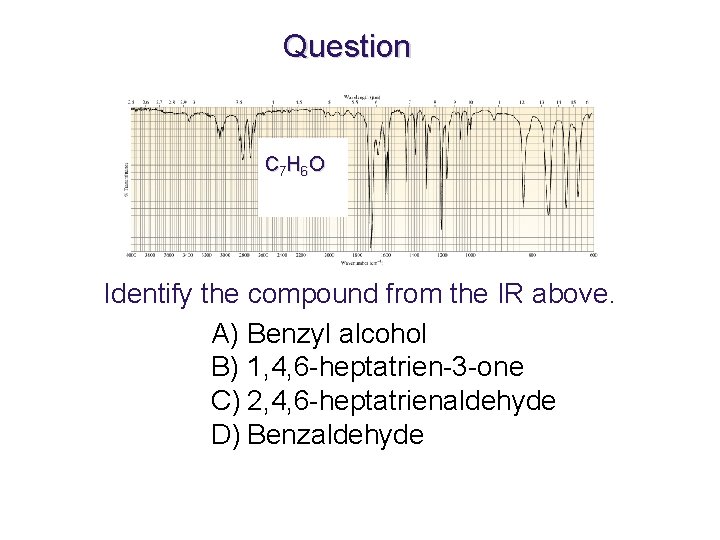
Question C 7 H 6 O Identify the compound from the IR above. A) Benzyl alcohol B) 1, 4, 6 -heptatrien-3 -one C) 2, 4, 6 -heptatrienaldehyde D) Benzaldehyde
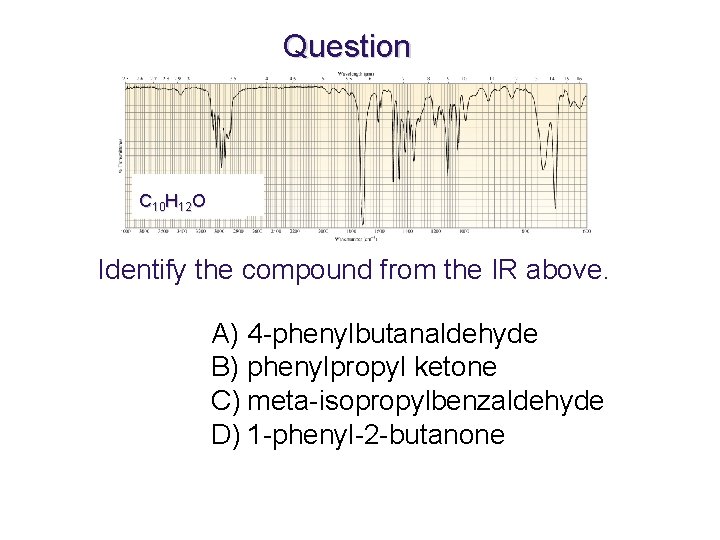
Question C 10 H 12 O Identify the compound from the IR above. A) 4 -phenylbutanaldehyde B) phenylpropyl ketone C) meta-isopropylbenzaldehyde D) 1 -phenyl-2 -butanone
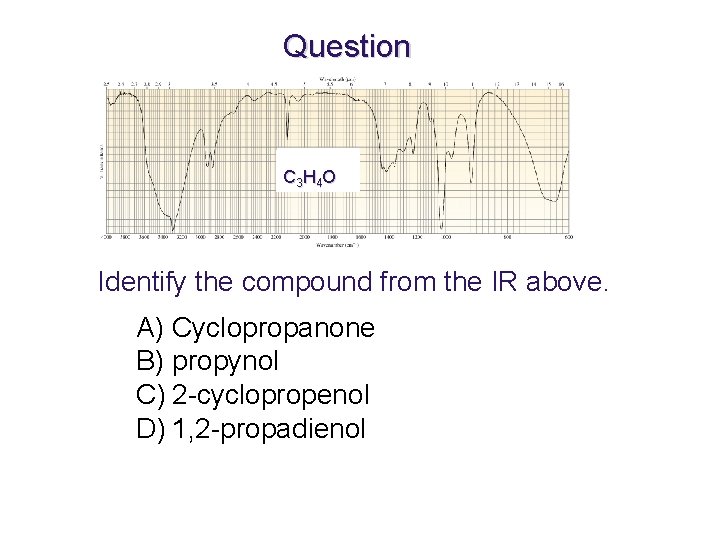
Question C 3 H 4 O Identify the compound from the IR above. A) Cyclopropanone B) propynol C) 2 -cyclopropenol D) 1, 2 -propadienol
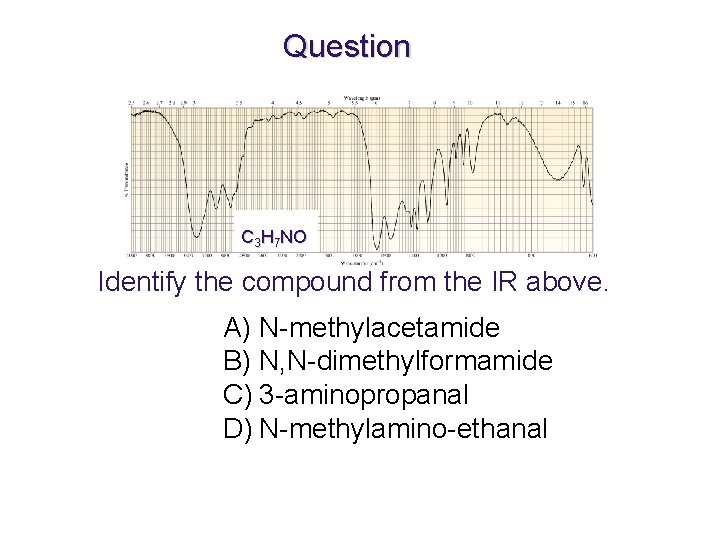
Question C 3 H 7 NO Identify the compound from the IR above. A) N-methylacetamide B) N, N-dimethylformamide C) 3 -aminopropanal D) N-methylamino-ethanal
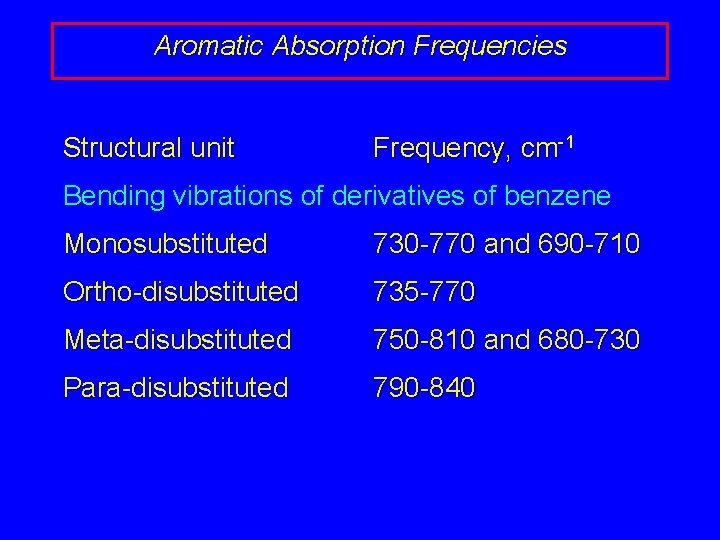
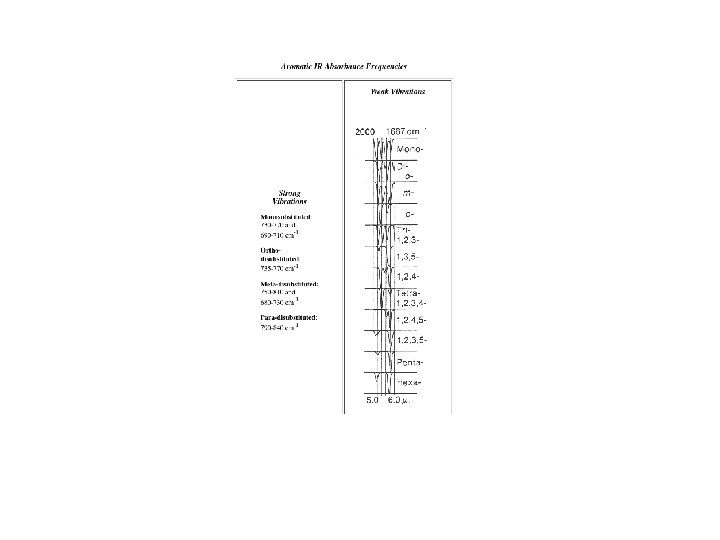
Aromatic Absorption Frequencies Structural unit Frequency, cm-1 Bending vibrations of derivatives of benzene Monosubstituted 730 -770 and 690 -710 Ortho-disubstituted 735 -770 Meta-disubstituted 750 -810 and 680 -730 Para-disubstituted 790 -840
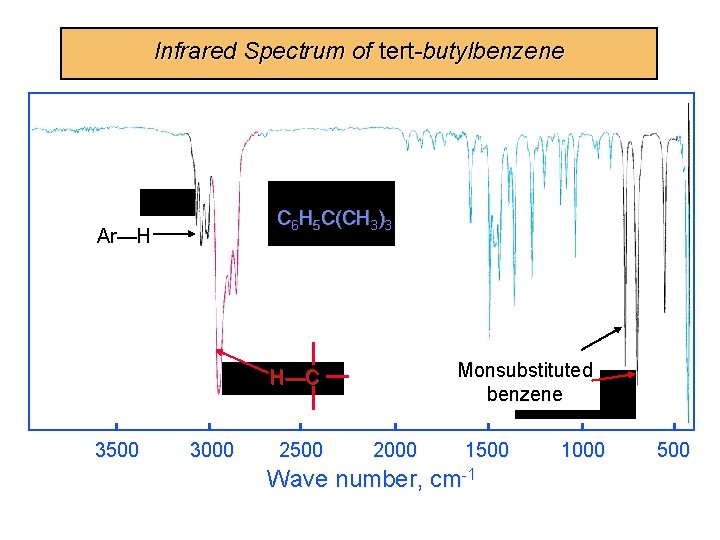
Infrared Spectrum of tert-butylbenzene C 6 H 5 C(CH 3)3 Ar—H Monsubstituted benzene H—C 3500 3000 2500 2000 1500 Wave number, cm-1 1000 500
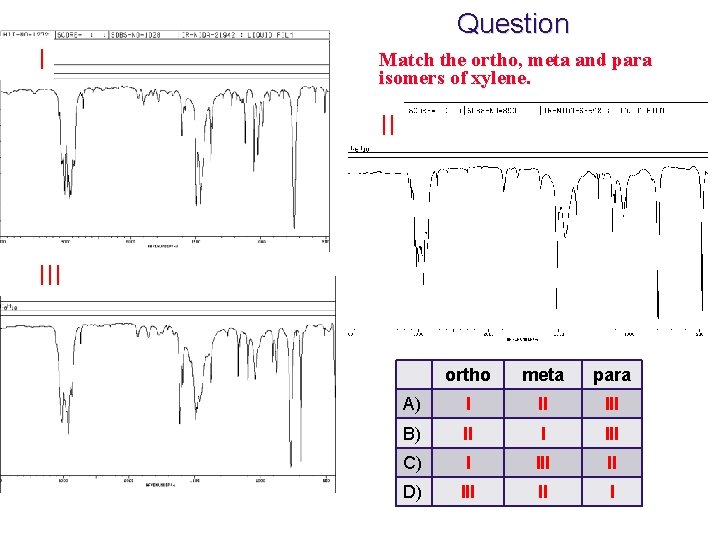
Question I Match the ortho, meta and para isomers of xylene. II III ortho meta para A) I II III B) II I III C) I II D) III II I
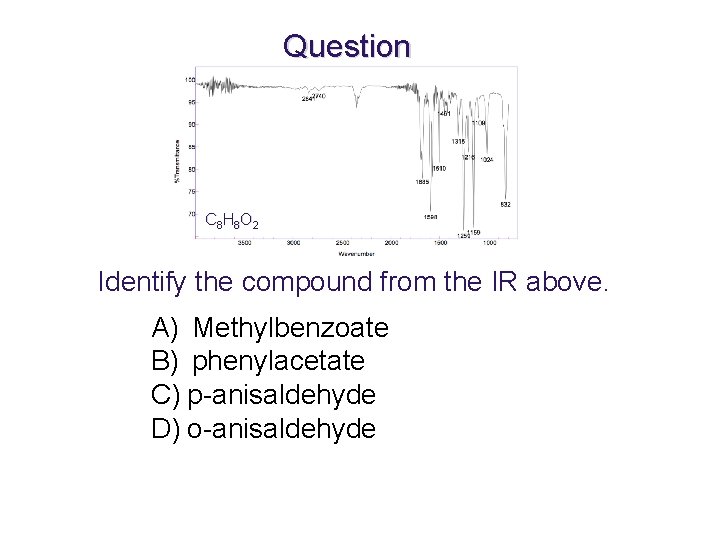
Question C 8 H 8 O 2 Identify the compound from the IR above. A) Methylbenzoate B) phenylacetate C) p-anisaldehyde D) o-anisaldehyde
Annenberg World of Chemistry #10 Signals from Within http: //www. learner. org/resources/series 61. html Pheromone Synthesis [20: 40 -23: 51]
- Slides: 53