
Infrared Spectroscopy and Extensions FTIR Raman VCD The

- Slides: 21
Infrared Spectroscopy and Extensions: (FT)IR, Raman, VCD
The Harmonic Approximation revision Any molecule – vibrational energy: Wavefunction:
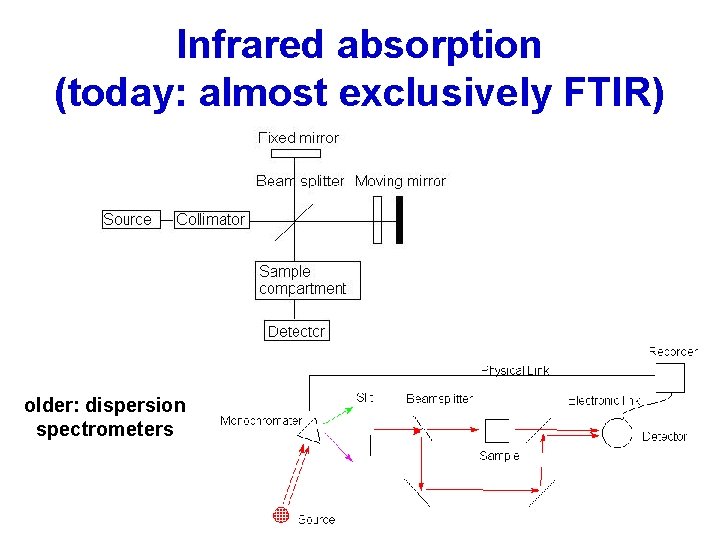
Infrared absorption (today: almost exclusively FTIR) older: dispersion spectrometers
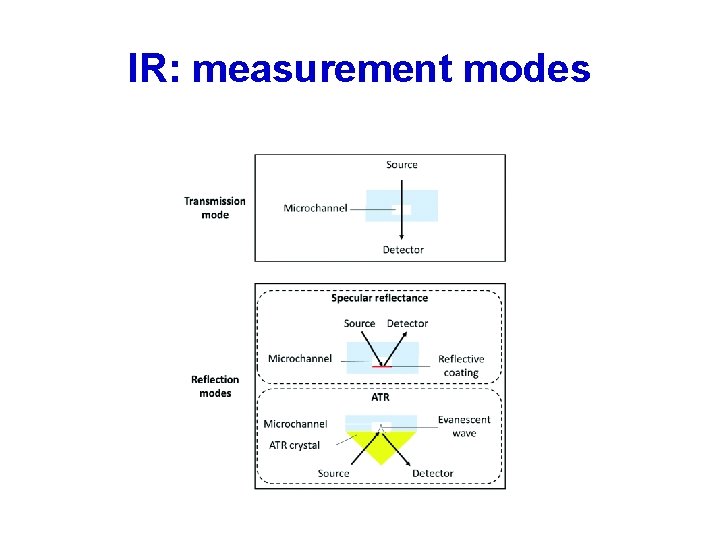
IR: measurement modes
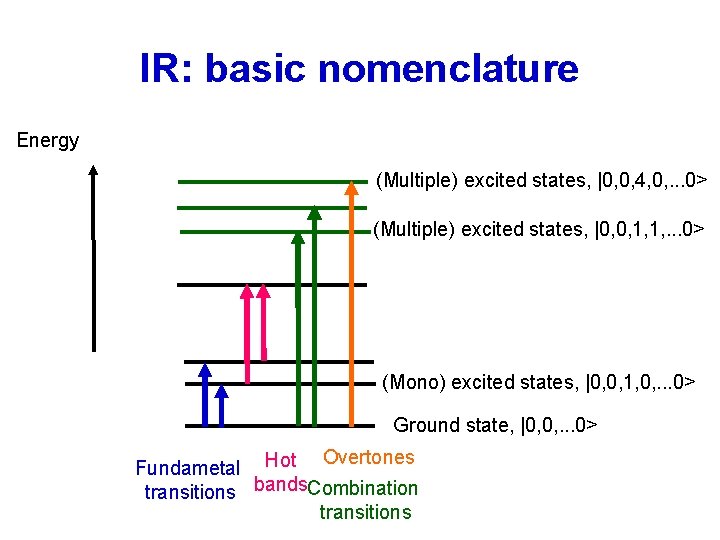
IR: basic nomenclature Energy (Multiple) excited states, |0, 0, 4, 0, . . . 0> (Multiple) excited states, |0, 0, 1, 1, . . . 0> (Mono) excited states, |0, 0, 1, 0, . . . 0> Ground state, |0, 0, . . . 0> Overtones Fundametal Hot transitions bands. Combination transitions
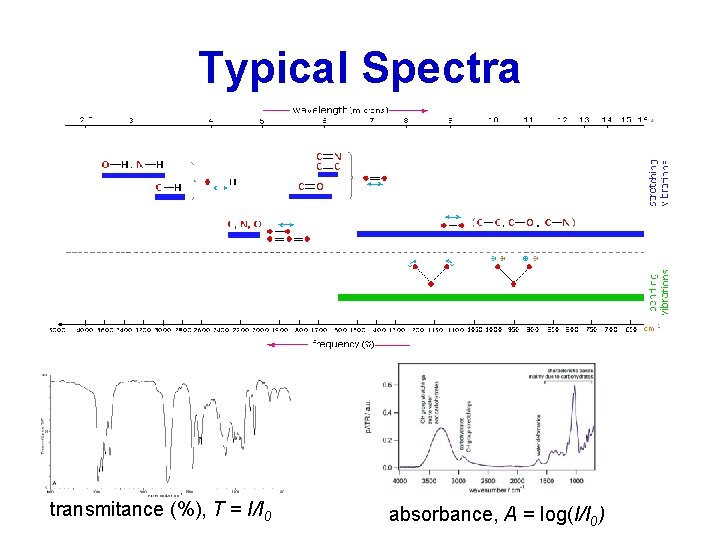
Typical Spectra transmitance (%), T = I/I 0 absorbance, A = log(I/I 0)
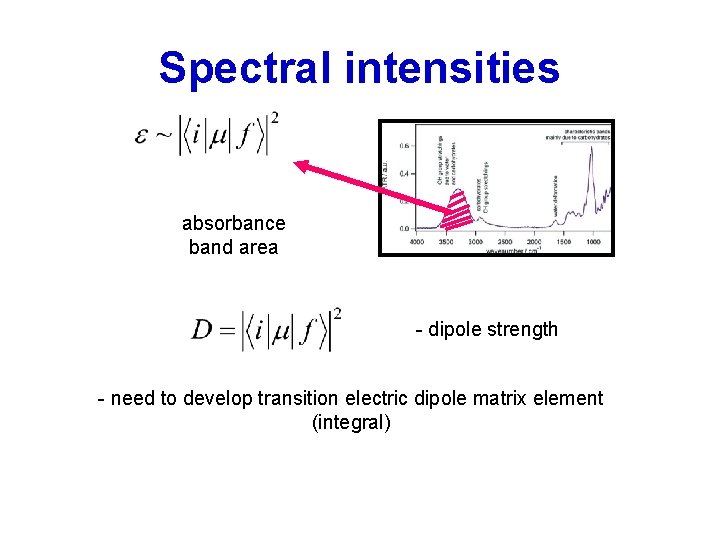
Spectral intensities absorbance band area - dipole strength - need to develop transition electric dipole matrix element (integral)
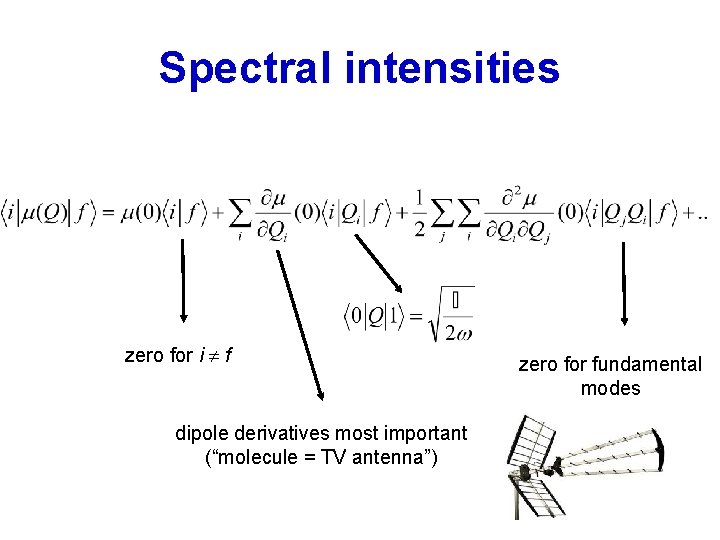
Spectral intensities zero for i f dipole derivatives most important (“molecule = TV antenna”) zero for fundamental modes
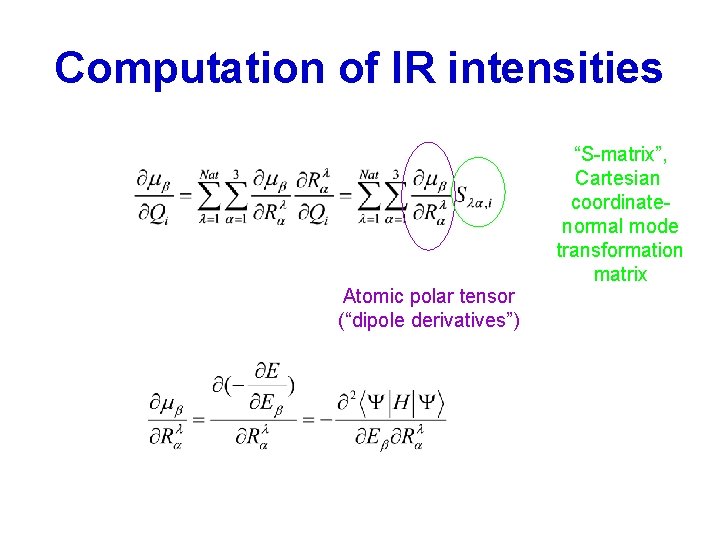
Computation of IR intensities Atomic polar tensor (“dipole derivatives”) “S-matrix”, Cartesian coordinatenormal mode transformation matrix
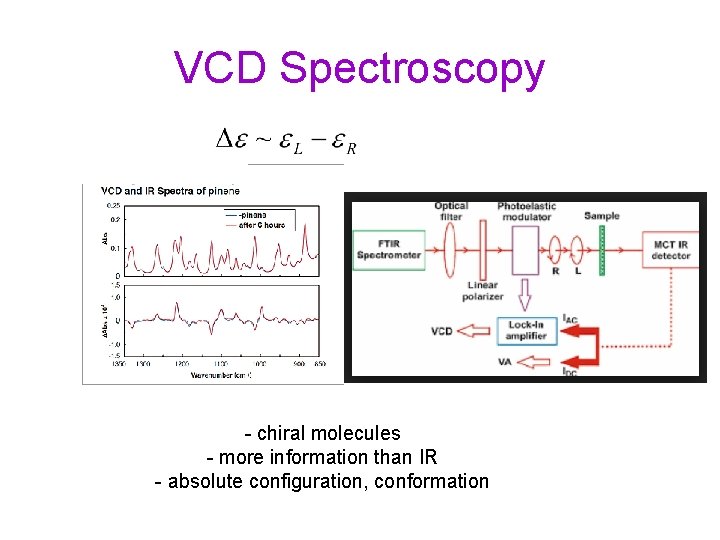
VCD Spectroscopy - chiral molecules - more information than IR - absolute configuration, conformation
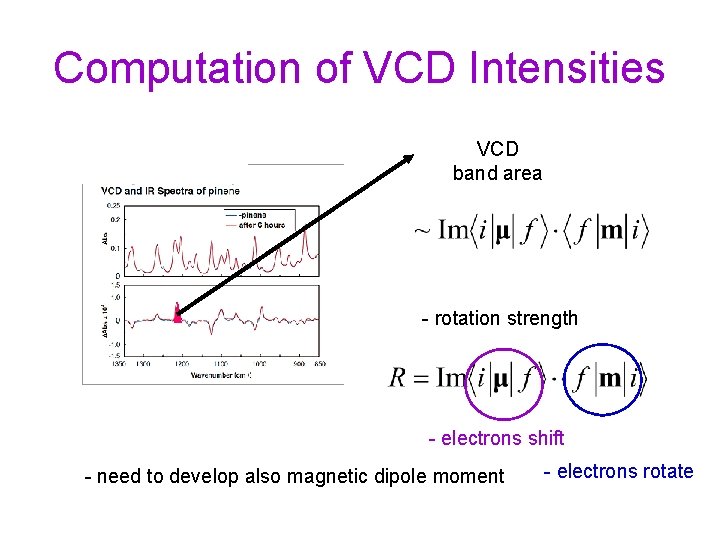
Computation of VCD Intensities VCD band area - rotation strength - electrons shift - need to develop also magnetic dipole moment - electrons rotate
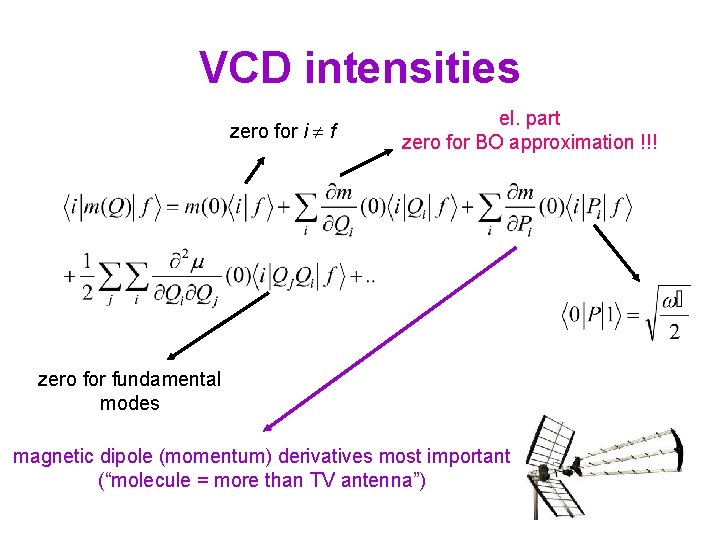
VCD intensities zero for i f el. part zero for BO approximation !!! zero for fundamental modes magnetic dipole (momentum) derivatives most important (“molecule = more than TV antenna”)
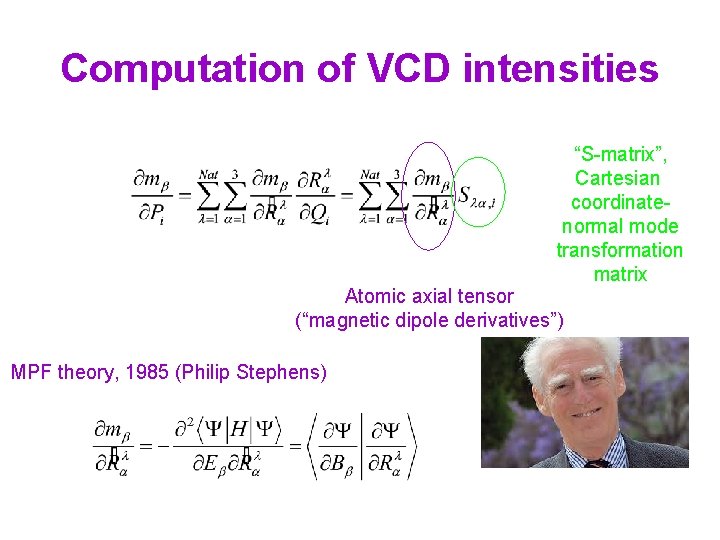
Computation of VCD intensities “S-matrix”, Cartesian coordinatenormal mode transformation matrix Atomic axial tensor (“magnetic dipole derivatives”) MPF theory, 1985 (Philip Stephens)
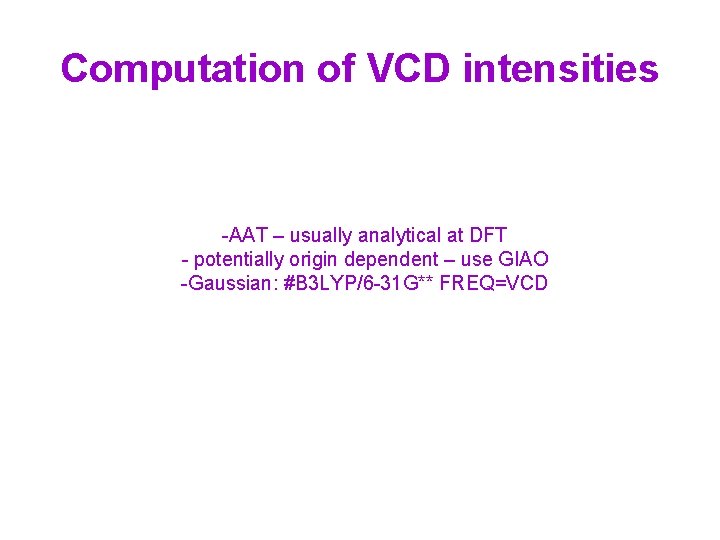
Computation of VCD intensities -AAT – usually analytical at DFT - potentially origin dependent – use GIAO -Gaussian: #B 3 LYP/6 -31 G** FREQ=VCD
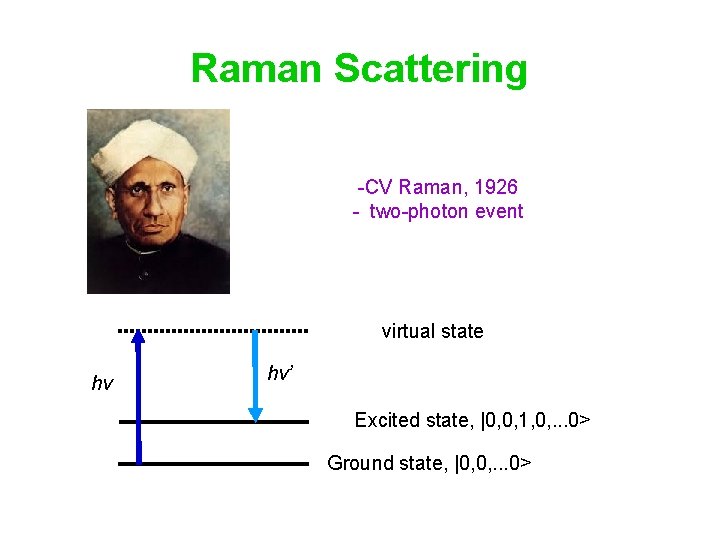
Raman Scattering -CV Raman, 1926 - two-photon event virtual state hv hv’ Excited state, |0, 0, 1, 0, . . . 0> Ground state, |0, 0, . . . 0>
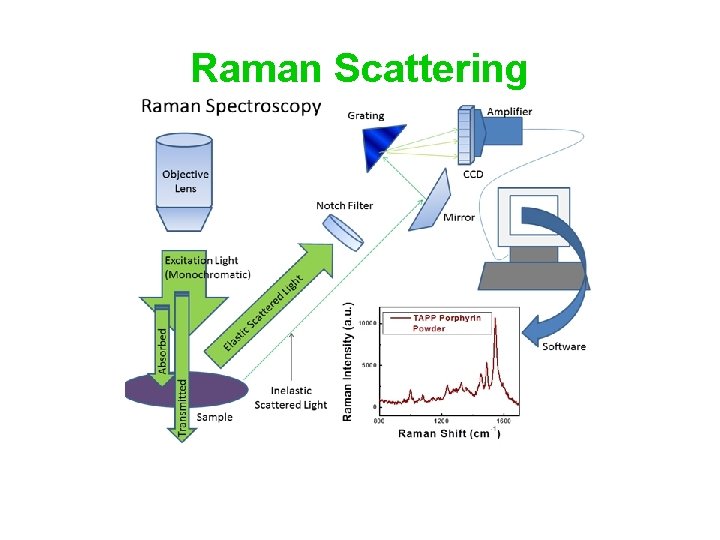
Raman Scattering
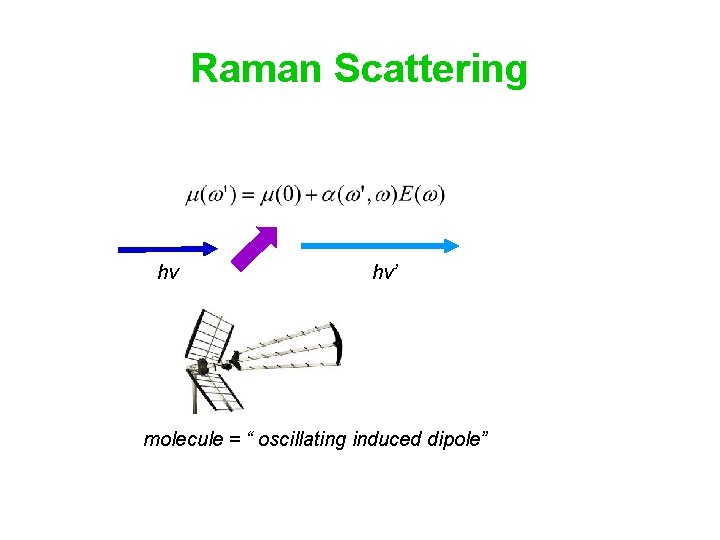
Raman Scattering hv hv’ molecule = “ oscillating induced dipole”
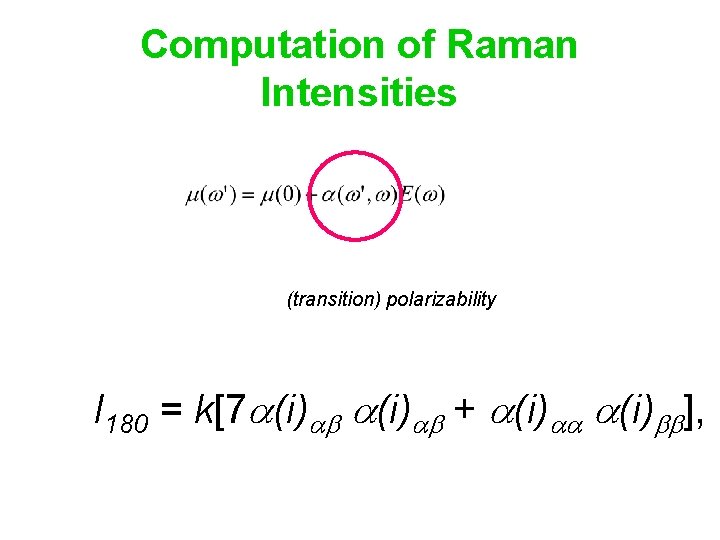
Computation of Raman Intensities (transition) polarizability I 180 = k[7 (i) + (i) ],
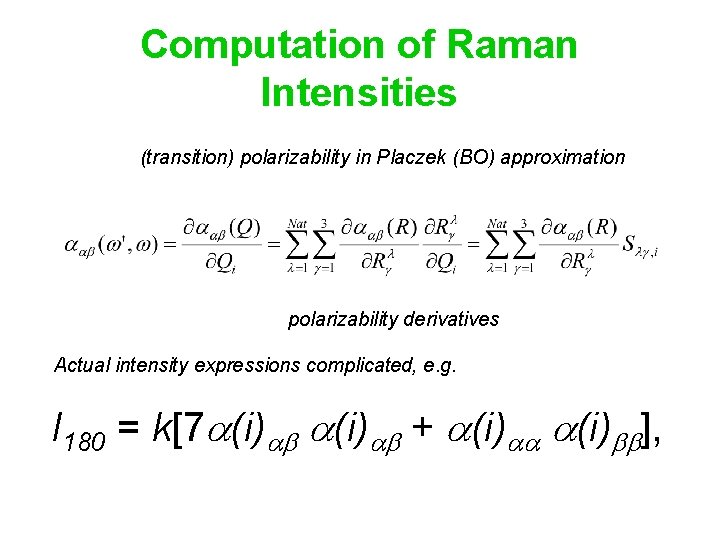
Computation of Raman Intensities (transition) polarizability in Placzek (BO) approximation polarizability derivatives Actual intensity expressions complicated, e. g. I 180 = k[7 (i) + (i) ],
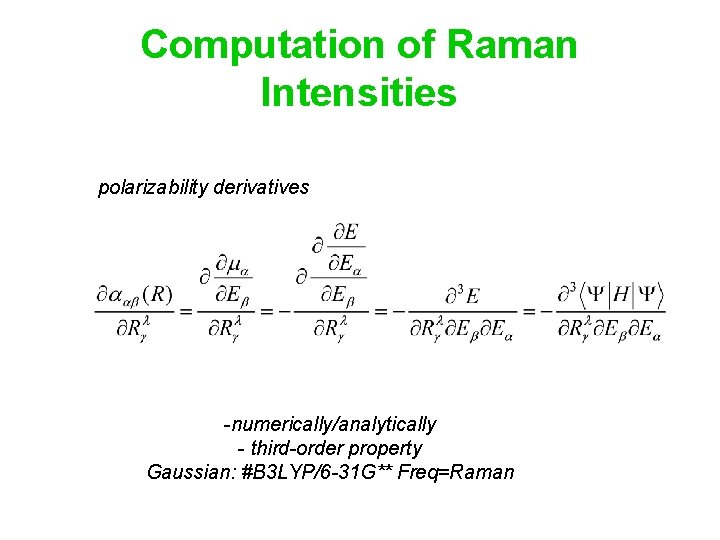
Computation of Raman Intensities polarizability derivatives -numerically/analytically - third-order property Gaussian: #B 3 LYP/6 -31 G** Freq=Raman
• Uveřejněné materiály jsou určeny studentům Vysoké školy chemickotechnologické v Praze jako studijní materiál. Některá textová i obrazová data v nich obsažená jsou převzataz veřejných zdrojů. V případě nedostatečných citací nebylo cílem autora/ů záměrně poškodit event. autora/y původního díla. • S eventuálními výhradami se prosím obracejte na autora/y konkrétního výukového materiálu, aby bylo možné zjednat nápravu. • The published materials are intended for students of the University of Chemistry and Technology, Prague as a study material. Some text and image data contained therein are taken from public sources. In the case of insufficient quotations, the author's intention was not to intentionally infringe the possible author(s) rights to the original work. • If you have any reservations, please contact the author(s) of the specific teaching material in order to remedy the situation.