
Infrared Spectroscopy 5 Unsaturated Systems substitution patterns The
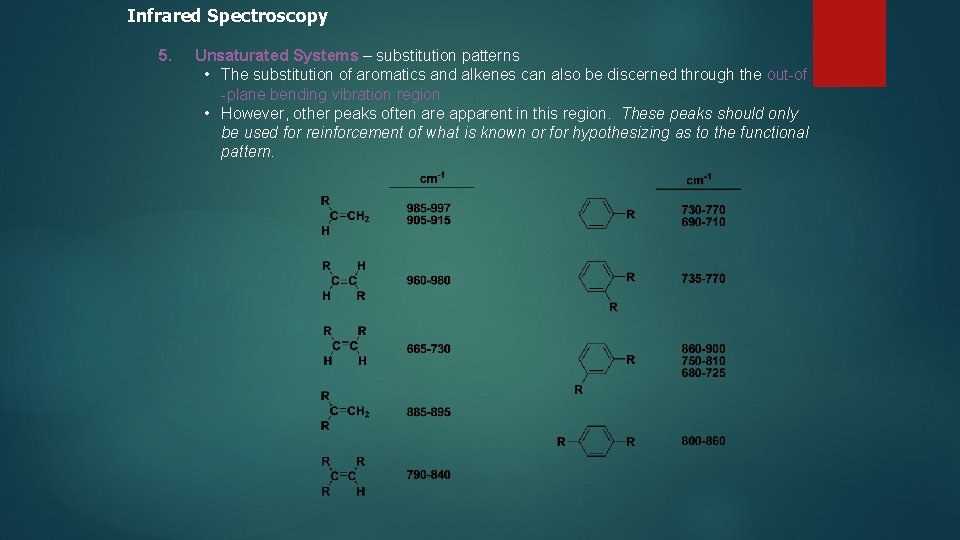
Infrared Spectroscopy 5. Unsaturated Systems – substitution patterns • The substitution of aromatics and alkenes can also be discerned through the out-of -plane bending vibration region • However, other peaks often are apparent in this region. These peaks should only be used for reinforcement of what is known or for hypothesizing as to the functional pattern.
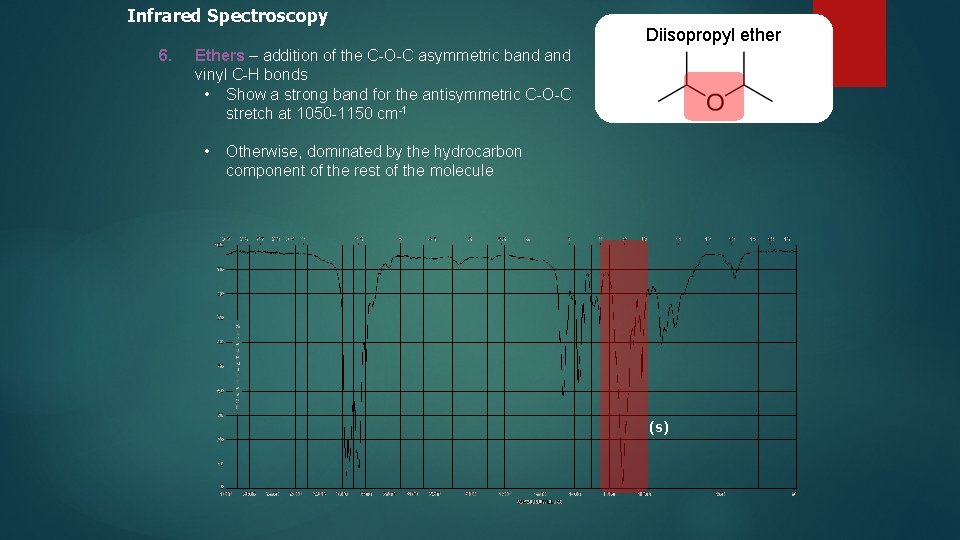
Infrared Spectroscopy 6. Diisopropyl ether Ethers – addition of the C-O-C asymmetric band vinyl C-H bonds • Show a strong band for the antisymmetric C-O-C stretch at 1050 -1150 cm-1 • Otherwise, dominated by the hydrocarbon component of the rest of the molecule (s)
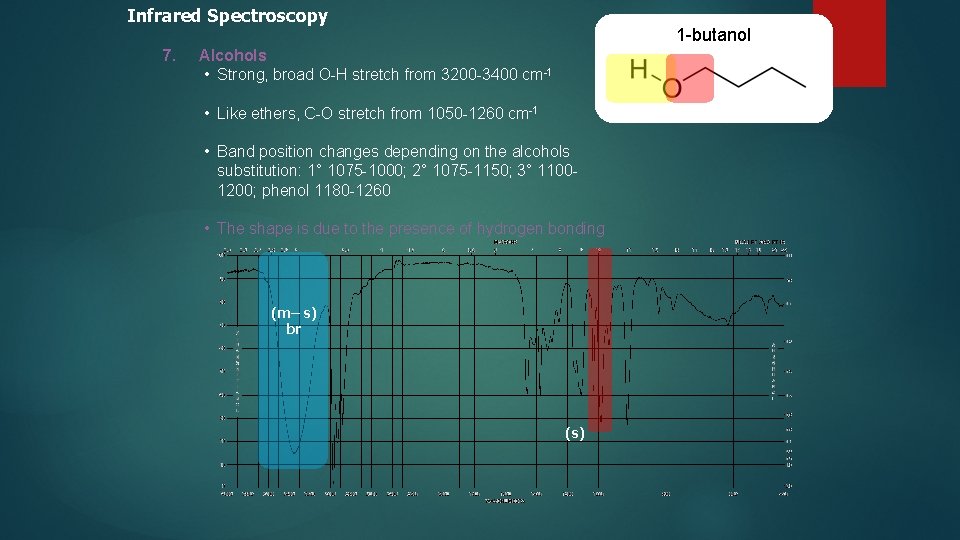
Infrared Spectroscopy 7. 1 -butanol Alcohols • Strong, broad O-H stretch from 3200 -3400 cm-1 • Like ethers, C-O stretch from 1050 -1260 cm-1 • Band position changes depending on the alcohols substitution: 1° 1075 -1000; 2° 1075 -1150; 3° 11001200; phenol 1180 -1260 • The shape is due to the presence of hydrogen bonding (m– s) br (s)
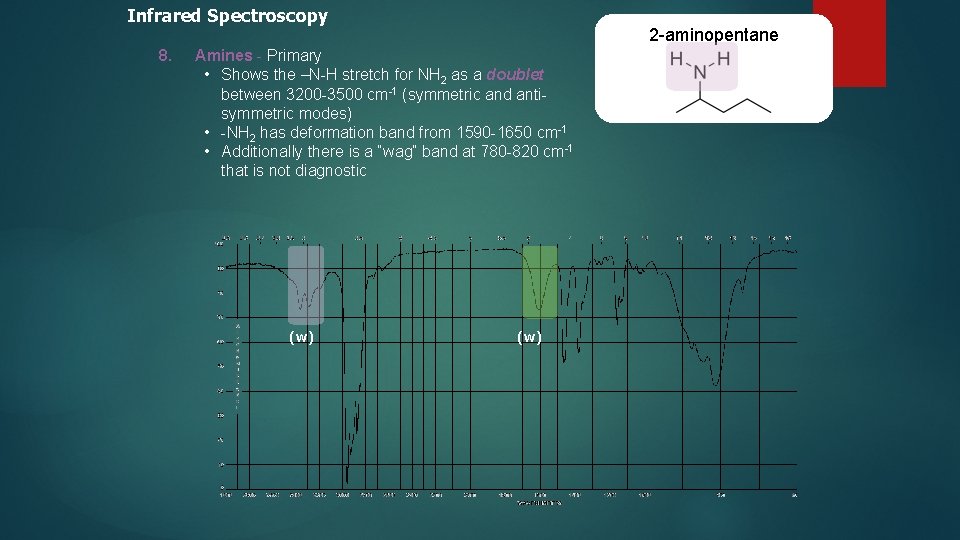
Infrared Spectroscopy 8. 2 -aminopentane Amines - Primary • Shows the –N-H stretch for NH 2 as a doublet between 3200 -3500 cm-1 (symmetric and antisymmetric modes) • -NH 2 has deformation band from 1590 -1650 cm-1 • Additionally there is a “wag” band at 780 -820 cm-1 that is not diagnostic (w)
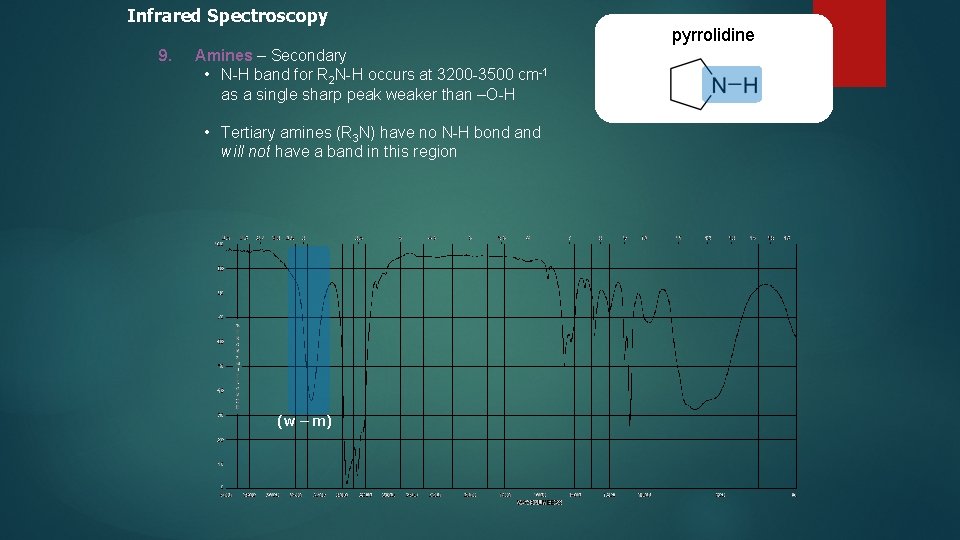
Infrared Spectroscopy 9. Amines – Secondary • N-H band for R 2 N-H occurs at 3200 -3500 cm-1 as a single sharp peak weaker than –O-H • Tertiary amines (R 3 N) have no N-H bond and will not have a band in this region (w – m) pyrrolidine
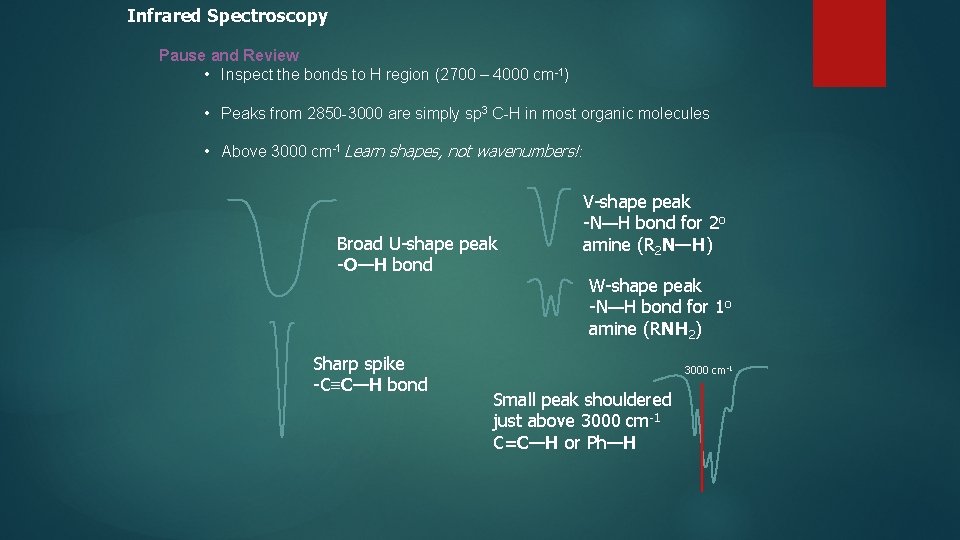
Infrared Spectroscopy Pause and Review • Inspect the bonds to H region (2700 – 4000 cm-1) • Peaks from 2850 -3000 are simply sp 3 C-H in most organic molecules • Above 3000 cm-1 Learn shapes, not wavenumbers!: Broad U-shape peak -O—H bond Sharp spike -C≡C—H bond V-shape peak -N—H bond for 2 o amine (R 2 N—H) W-shape peak -N—H bond for 1 o amine (RNH 2) 3000 cm-1 Small peak shouldered just above 3000 cm-1 C=C—H or Ph—H
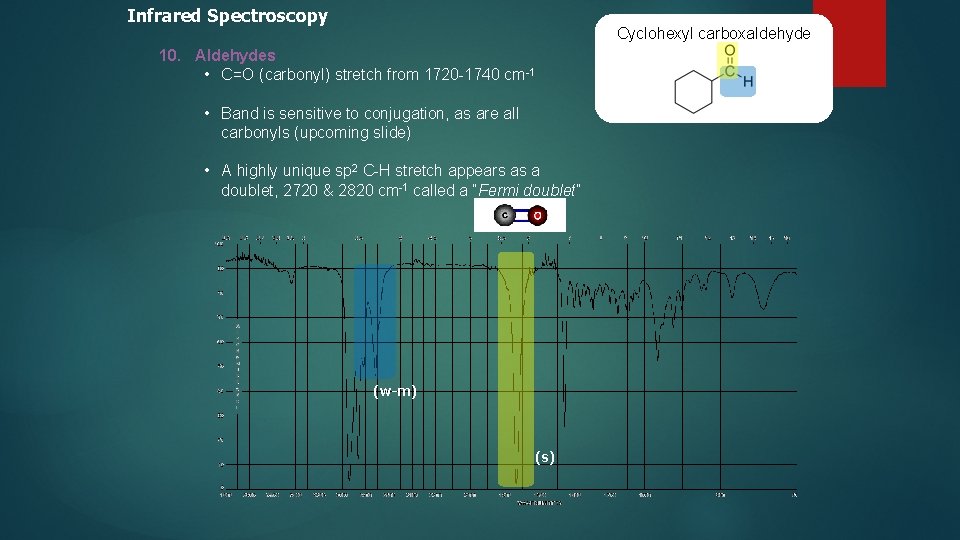
Infrared Spectroscopy Cyclohexyl carboxaldehyde 10. Aldehydes • C=O (carbonyl) stretch from 1720 -1740 cm-1 • Band is sensitive to conjugation, as are all carbonyls (upcoming slide) • A highly unique sp 2 C-H stretch appears as a doublet, 2720 & 2820 cm-1 called a “Fermi doublet” (w-m) (s)
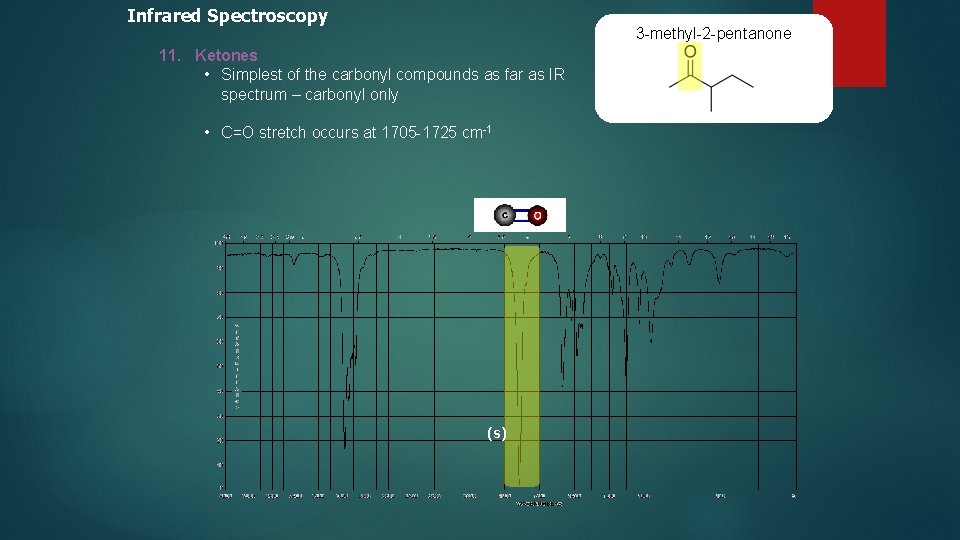
Infrared Spectroscopy 3 -methyl-2 -pentanone 11. Ketones • Simplest of the carbonyl compounds as far as IR spectrum – carbonyl only • C=O stretch occurs at 1705 -1725 cm-1 (s)
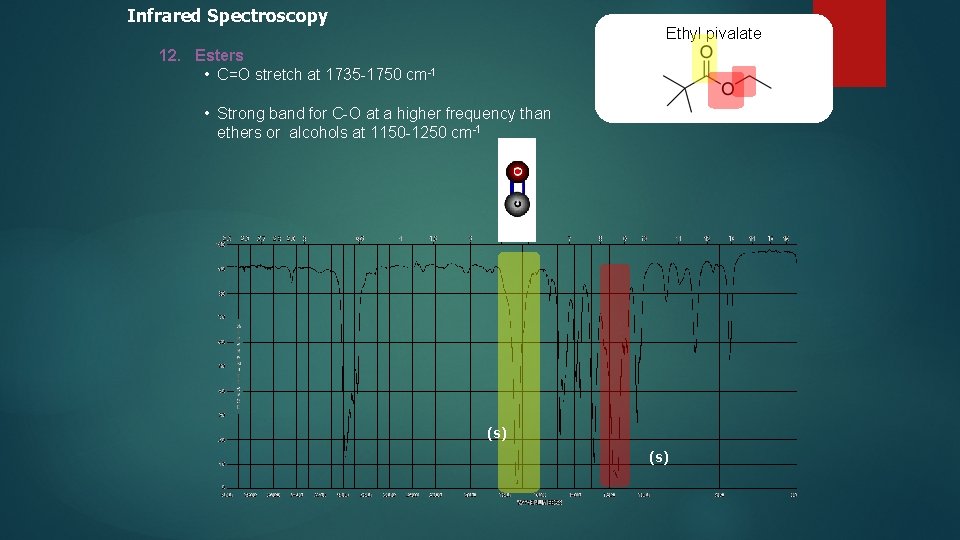
Infrared Spectroscopy Ethyl pivalate 12. Esters • C=O stretch at 1735 -1750 cm-1 • Strong band for C-O at a higher frequency than ethers or alcohols at 1150 -1250 cm-1 (s)
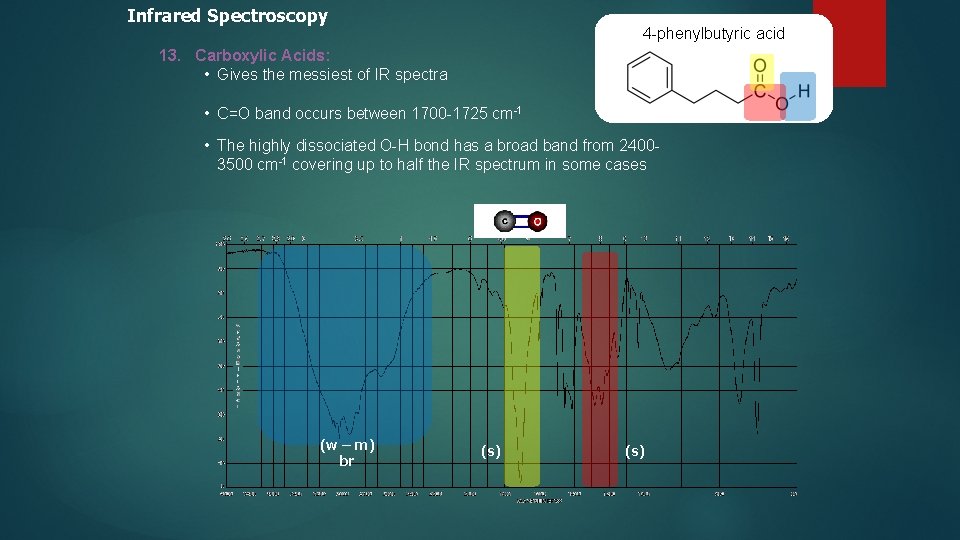
Infrared Spectroscopy 4 -phenylbutyric acid 13. Carboxylic Acids: • Gives the messiest of IR spectra • C=O band occurs between 1700 -1725 cm-1 • The highly dissociated O-H bond has a broad band from 24003500 cm-1 covering up to half the IR spectrum in some cases (w – m) br (s)
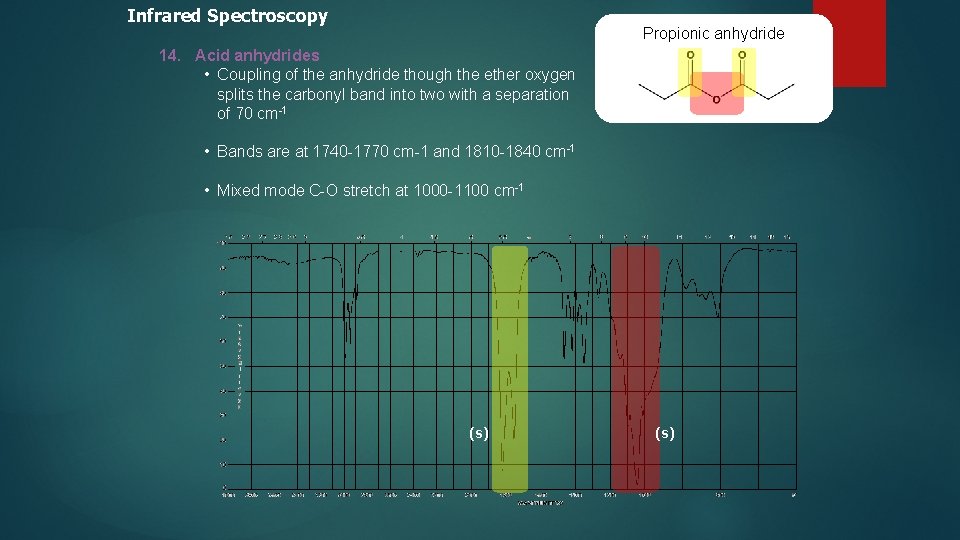
Infrared Spectroscopy Propionic anhydride 14. Acid anhydrides • Coupling of the anhydride though the ether oxygen splits the carbonyl band into two with a separation of 70 cm-1 • Bands are at 1740 -1770 cm-1 and 1810 -1840 cm-1 • Mixed mode C-O stretch at 1000 -1100 cm-1 (s)
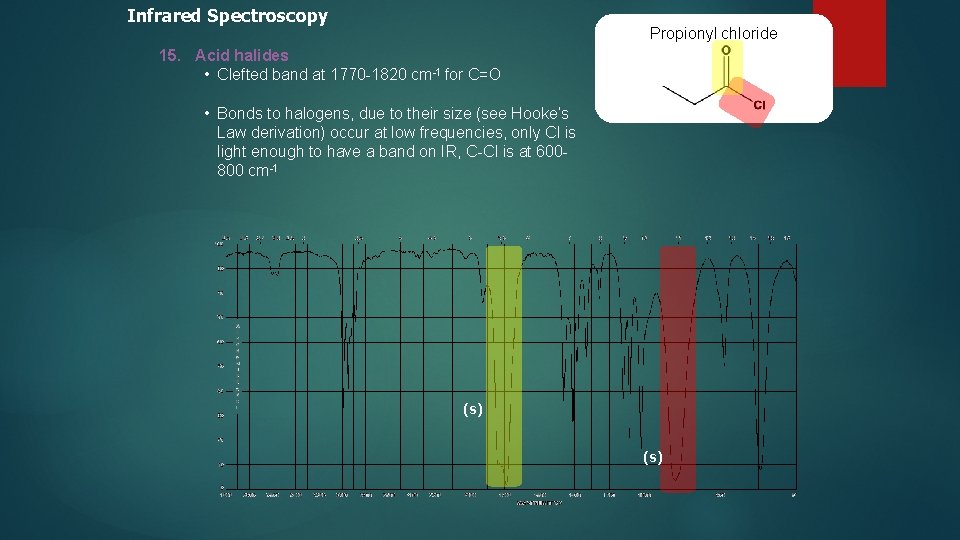
Infrared Spectroscopy Propionyl chloride 15. Acid halides • Clefted band at 1770 -1820 cm-1 for C=O • Bonds to halogens, due to their size (see Hooke’s Law derivation) occur at low frequencies, only Cl is light enough to have a band on IR, C-Cl is at 600800 cm-1 (s)
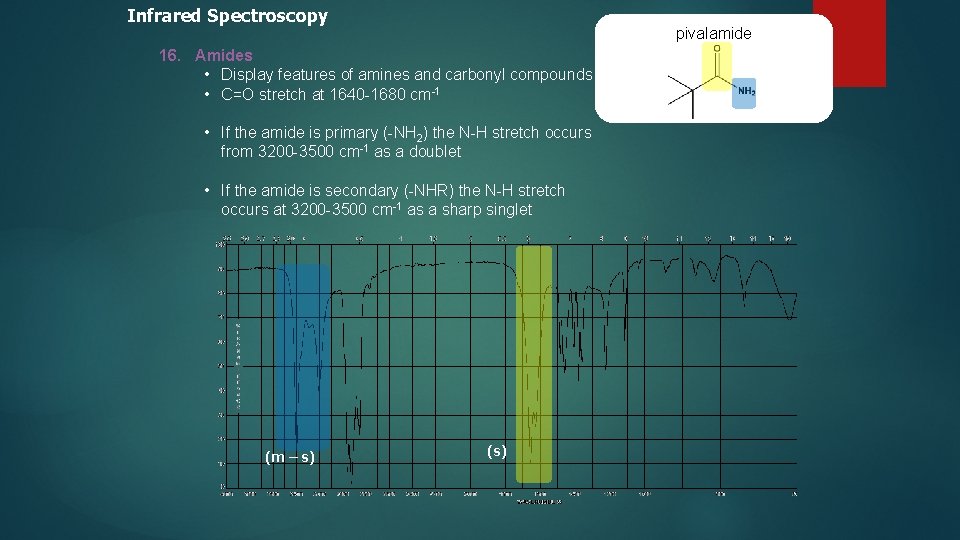
Infrared Spectroscopy pivalamide 16. Amides • Display features of amines and carbonyl compounds • C=O stretch at 1640 -1680 cm-1 • If the amide is primary (-NH 2) the N-H stretch occurs from 3200 -3500 cm-1 as a doublet • If the amide is secondary (-NHR) the N-H stretch occurs at 3200 -3500 cm-1 as a sharp singlet (m – s) (s)
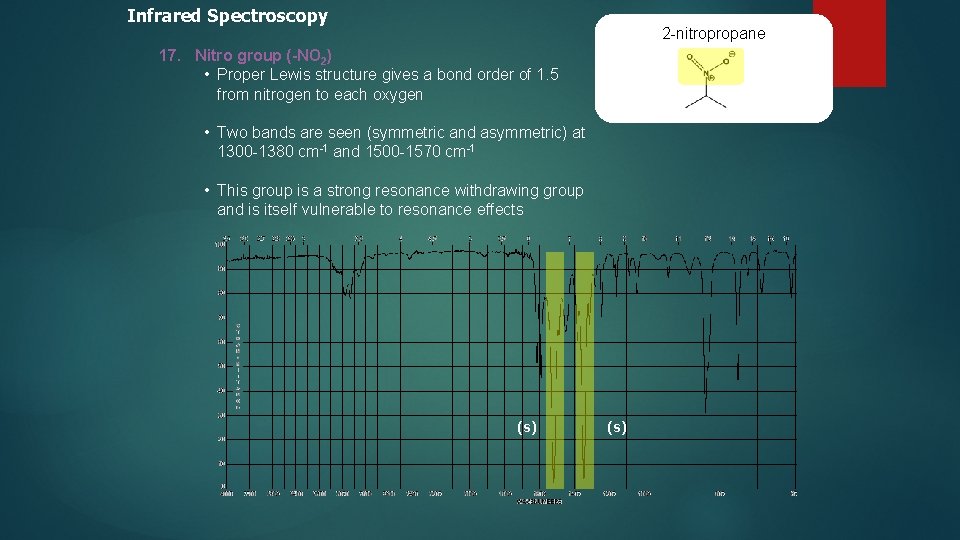
Infrared Spectroscopy 2 -nitropropane 17. Nitro group (-NO 2) • Proper Lewis structure gives a bond order of 1. 5 from nitrogen to each oxygen • Two bands are seen (symmetric and asymmetric) at 1300 -1380 cm-1 and 1500 -1570 cm-1 • This group is a strong resonance withdrawing group and is itself vulnerable to resonance effects (s)
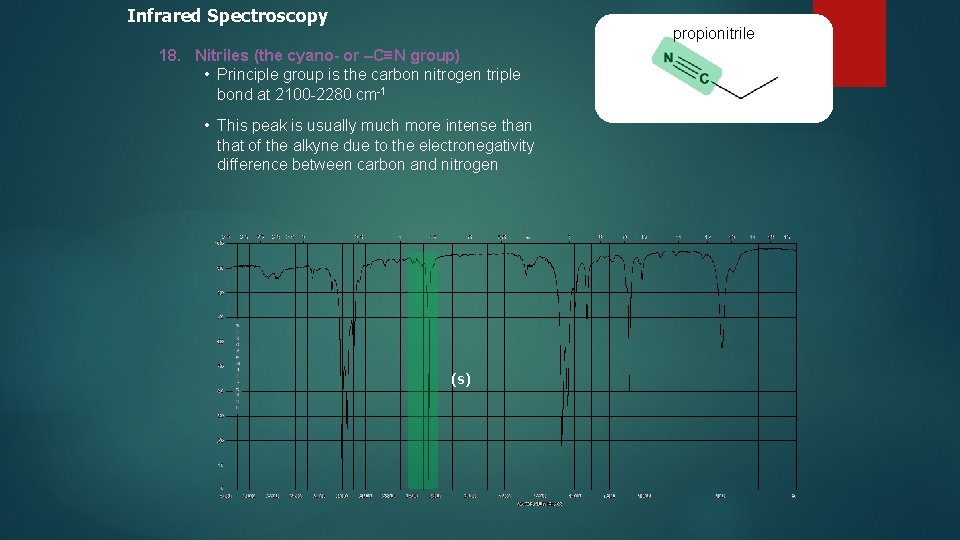
Infrared Spectroscopy propionitrile 18. Nitriles (the cyano- or –C≡N group) • Principle group is the carbon nitrogen triple bond at 2100 -2280 cm-1 • This peak is usually much more intense than that of the alkyne due to the electronegativity difference between carbon and nitrogen (s)
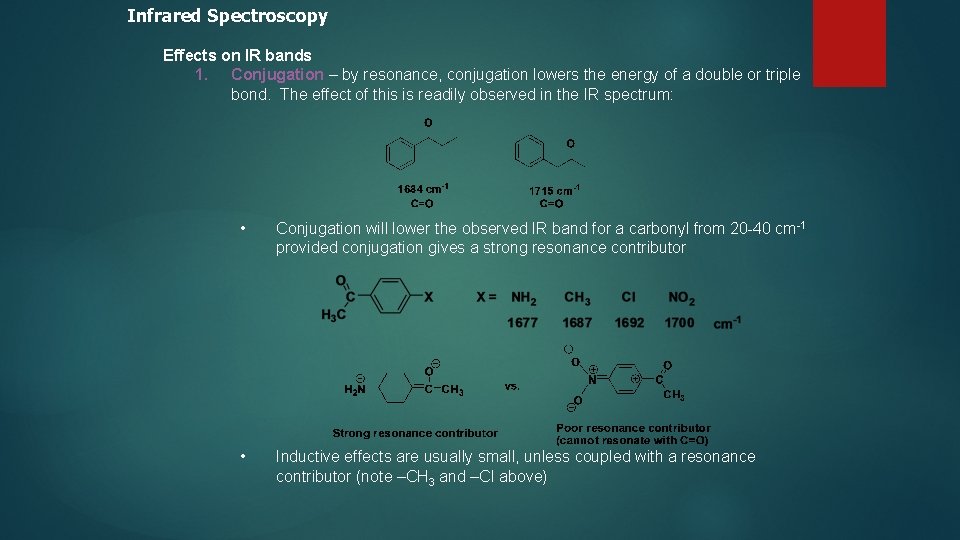
Infrared Spectroscopy Effects on IR bands 1. Conjugation – by resonance, conjugation lowers the energy of a double or triple bond. The effect of this is readily observed in the IR spectrum: • Conjugation will lower the observed IR band for a carbonyl from 20 -40 cm-1 provided conjugation gives a strong resonance contributor • Inductive effects are usually small, unless coupled with a resonance contributor (note –CH 3 and –Cl above)
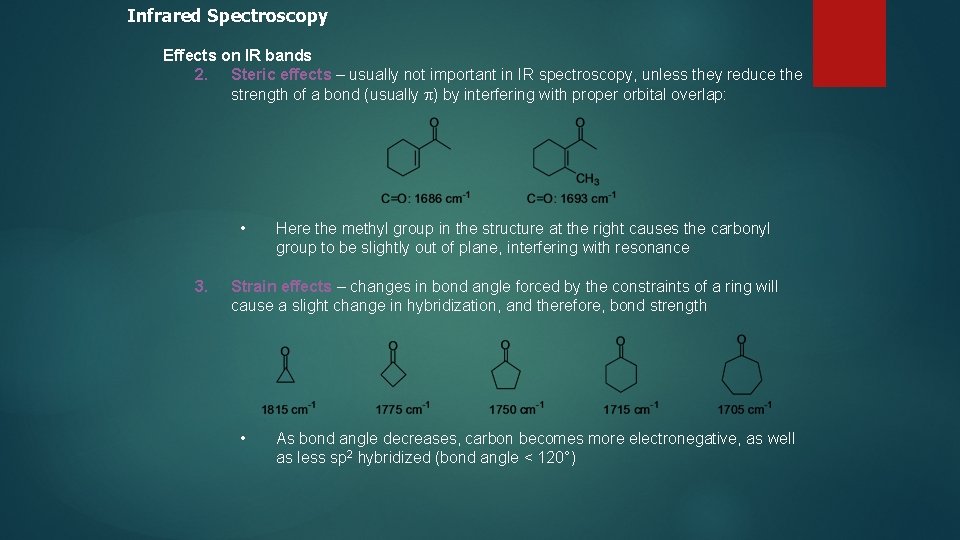
Infrared Spectroscopy Effects on IR bands 2. Steric effects – usually not important in IR spectroscopy, unless they reduce the strength of a bond (usually p) by interfering with proper orbital overlap: • 3. Here the methyl group in the structure at the right causes the carbonyl group to be slightly out of plane, interfering with resonance Strain effects – changes in bond angle forced by the constraints of a ring will cause a slight change in hybridization, and therefore, bond strength • As bond angle decreases, carbon becomes more electronegative, as well as less sp 2 hybridized (bond angle < 120°)
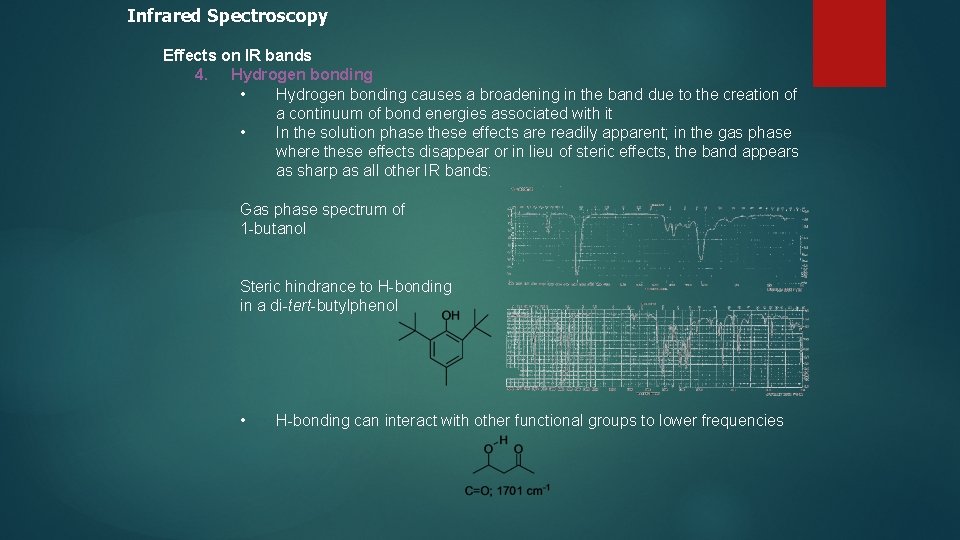
Infrared Spectroscopy Effects on IR bands 4. Hydrogen bonding • Hydrogen bonding causes a broadening in the band due to the creation of a continuum of bond energies associated with it • In the solution phase these effects are readily apparent; in the gas phase where these effects disappear or in lieu of steric effects, the band appears as sharp as all other IR bands: Gas phase spectrum of 1 -butanol Steric hindrance to H-bonding in a di-tert-butylphenol • H-bonding can interact with other functional groups to lower frequencies
- Slides: 18