
Infrared Observations of Novae with SubaruCOMICS and GeminiTRe
Infrared Observations of Novae with Subaru/COMICS and Gemini/TRe. CS Sakon, I. , Sako, S. , Shimonishi, T. , Onaka, T. (Univ. of Tokyo) Takahashi, H. (Gunma Observatory) Yamashita, T. , Fujiyoshi, T. (NAOJ) Rodomski, J. (Gemini Observatory)
Infrared Observations of Novae Mid-infrared Imaging and Spectroscopic monitoring observations of Galactic dust forming novae unique laboratories to study the process of dust formation and to understand the mass-loss history of the CO white dwarves from the chemical point of view Infrared Spectral Evolution of CO Novae and ONe. Mg Novae - Hot ejecta gas is initially seen as an expanding photosphere or “fireball” - When the expanding material becomes optically thin, free-free and line emission dominate 1). CO Novae; - Thermonuclear runaway (TNR) on the surface of relatively low-mass CO white dwarves (e. g. , MWD<1. 1 M☉) -Dust formation after the free-free phase is reported for several CO novae [e. g. , V 2362 CYGNI (Lynch et al. 2008), V 705 Cas (Evans et al. 1997), etc. ] - Complicated dust compositions (both Silicates and Carbonaceous dust) 2). ONe. Mg Novae; - Thermonuclear runaway (TNR) on the surface of relatively higher-mass ONe. Mg white dwarves (e. g. , MWD>1. 1 M☉) - coronal emission-lines phase comes after the free-free phase - No or little evidence of dust formation (cf. , V 1974 CYGNI; Woodward et al. 1995 ) chemical evolution of the Nova ejecta over various physical phases is not fully understood
V 1280 Scorpii -Discovered on 2007 Feb 4. 86 by Y. Nakamura and Y. Sakurai (Yamaoka et al. 2007) - d = 1. 6± 0. 4 kpc (Chesneau et al. 2008) -Dust formation occurred at d~23 days after discovery (Das et al. 2007) VLTI/AMBER and MIDI observations between t=23 d and 145 d (Chesneau et al. 2008) -An apparent linear expansion rate for the dust shell; 0. 35± 0. 03 mas day -1 -Expansion velocity of the nova ejecta; 500± 100 km/s -Dust production rate; 2 -8 x 10 -9 Msun day-1 (a probable peak in production at t=36 -46 days) -The amount of dust in the shell; 2. 2 x 10 -7 Msun Late-epoch Observations of Dust Forming Nova V 1280 Sco - July 7, 2007 (epoch ~150 days) Subaru/COMICS; N-band spectroscopy (8 -13. 4 mm) N- & Q-band photometry (8. 8 mm, 11. 7 mm, 18. 8 mm, 24. 5 mm) Kanata/TRISPEC (June 26, 2007; epoch ~140 days); Ks-band photometry (2. 15 mm) - September 8, 2009 (epoch ~940 days) AKARI/IRC; near-infrared spectroscopy (2. 5 -5 mm) - August 1, 2010 (epoch ~1270 days) Gemini-S/TRe. CS; N-band spectroscopy (7. 7 -13. 2 mm) N- & Q-band photometry (7. 8 mm, 9. 7 mm, 11. 7 mm, 18. 8 mm, 24. 5 mm) Gunma (Aug 26, 2010; epoch ~1300 days); J, H, Ks-band photometry (1. 24, 1. 66, 2. 15 mm)
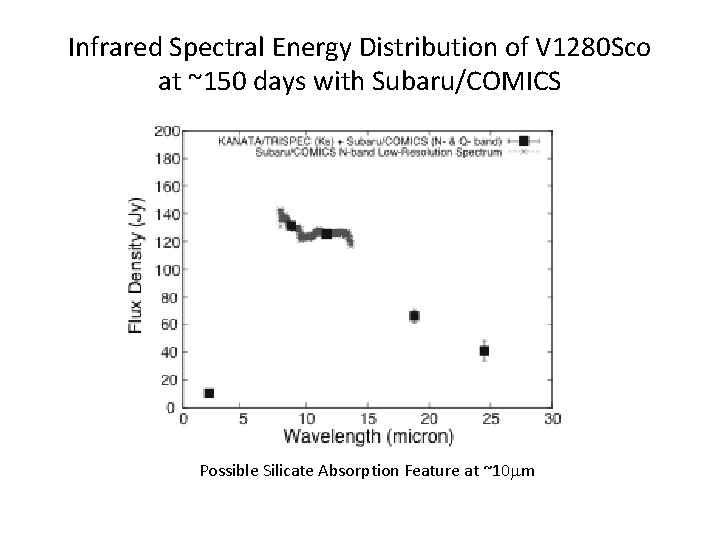
Infrared Spectral Energy Distribution of V 1280 Sco at ~150 days with Subaru/COMICS Possible Silicate Absorption Feature at ~10 mm
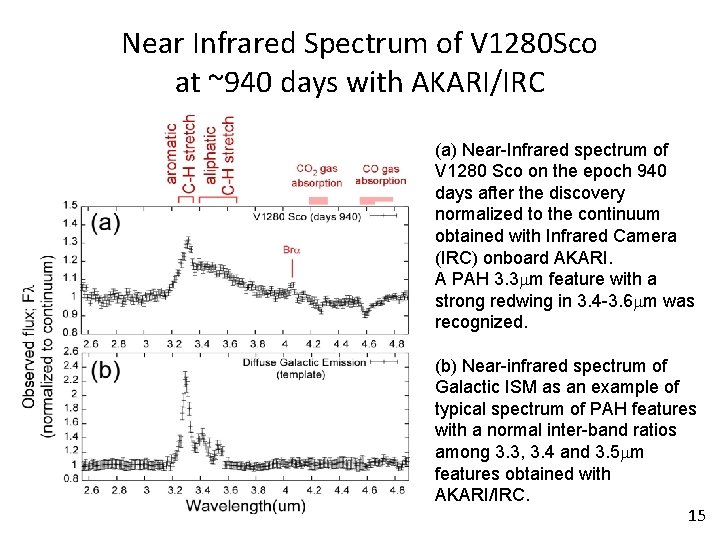
Near Infrared Spectrum of V 1280 Sco at ~940 days with AKARI/IRC (a) Near-Infrared spectrum of V 1280 Sco on the epoch 940 days after the discovery normalized to the continuum obtained with Infrared Camera (IRC) onboard AKARI. A PAH 3. 3 mm feature with a strong redwing in 3. 4 -3. 6 mm was recognized. (b) Near-infrared spectrum of Galactic ISM as an example of typical spectrum of PAH features with a normal inter-band ratios among 3. 3, 3. 4 and 3. 5 mm features obtained with AKARI/IRC. 15
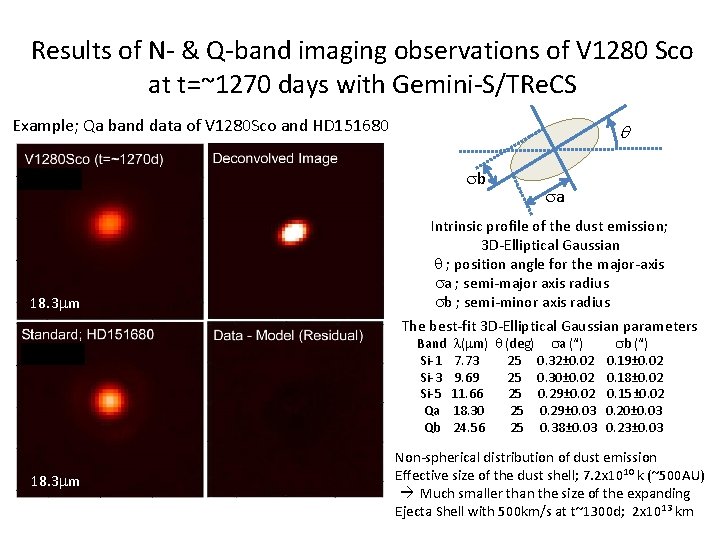
Results of N- & Q-band imaging observations of V 1280 Sco at t=~1270 days with Gemini-S/TRe. CS Example; Qa band data of V 1280 Sco and HD 151680 q sb 18. 3 mm Intrinsic profile of the dust emission; 3 D-Elliptical Gaussian q ; position angle for the major-axis sa ; semi-major axis radius sb ; semi-minor axis radius The best-fit 3 D-Elliptical Gaussian parameters Band Si-1 Si-3 Si-5 Qa Qb 18. 3 mm sa l(mm) q (deg) sa (“) 7. 73 25 0. 32± 0. 02 9. 69 25 0. 30± 0. 02 11. 66 25 0. 29± 0. 02 18. 30 25 0. 29± 0. 03 24. 56 25 0. 38± 0. 03 sb (“) 0. 19± 0. 02 0. 18± 0. 02 0. 15± 0. 02 0. 20± 0. 03 0. 23± 0. 03 Non-spherical distribution of dust emission Effective size of the dust shell; 7. 2 x 10¹⁰ k (~500 AU) Much smaller than the size of the expanding Ejecta Shell with 500 km/s at t~1300 d; 2 x 10¹³ km
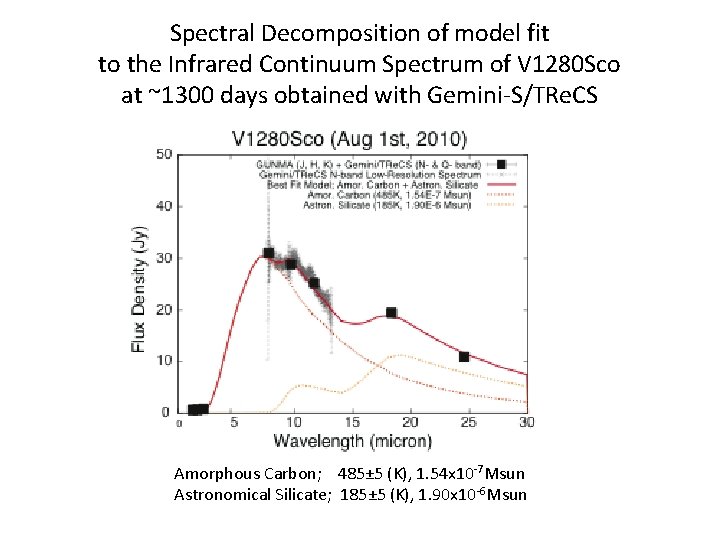
Spectral Decomposition of model fit to the Infrared Continuum Spectrum of V 1280 Sco at ~1300 days obtained with Gemini-S/TRe. CS Amorphous Carbon; 485± 5 (K), 1. 54 x 10 -7 Msun Astronomical Silicate; 185± 5 (K), 1. 90 x 10 -6 Msun
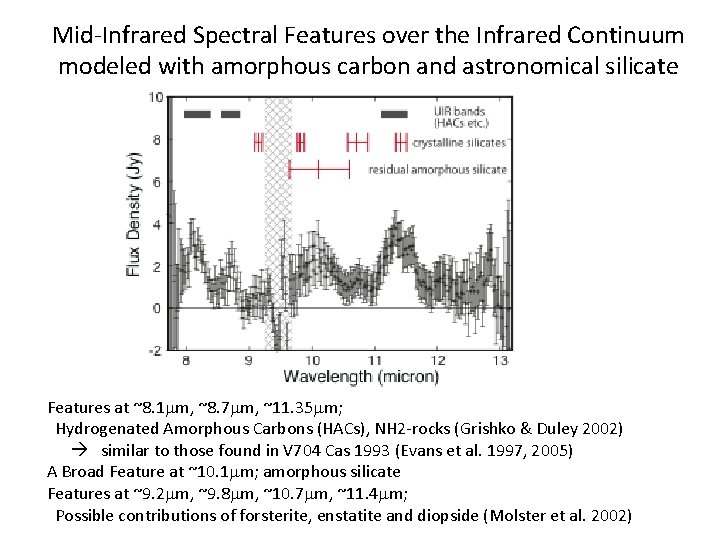
Mid-Infrared Spectral Features over the Infrared Continuum modeled with amorphous carbon and astronomical silicate Features at ~8. 1 mm, ~8. 7 mm, ~11. 35 mm; Hydrogenated Amorphous Carbons (HACs), NH 2 -rocks (Grishko & Duley 2002) similar to those found in V 704 Cas 1993 (Evans et al. 1997, 2005) A Broad Feature at ~10. 1 mm; amorphous silicate Features at ~9. 2 mm, ~9. 8 mm, ~10. 7 mm, ~11. 4 mm; Possible contributions of forsterite, enstatite and diopside (Molster et al. 2002)
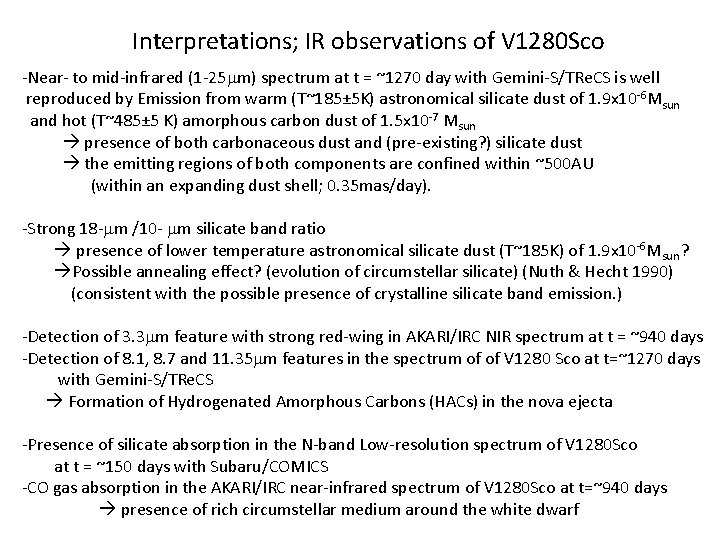
Interpretations; IR observations of V 1280 Sco -Near- to mid-infrared (1 -25 mm) spectrum at t = ~1270 day with Gemini-S/TRe. CS is well reproduced by Emission from warm (T~185± 5 K) astronomical silicate dust of 1. 9 x 10 -6 Msun and hot (T~485± 5 K) amorphous carbon dust of 1. 5 x 10 -7 Msun presence of both carbonaceous dust and (pre-existing? ) silicate dust the emitting regions of both components are confined within ~500 AU (within an expanding dust shell; 0. 35 mas/day). -Strong 18 -mm /10 - mm silicate band ratio presence of lower temperature astronomical silicate dust (T~185 K) of 1. 9 x 10 -6 Msun ? Possible annealing effect? (evolution of circumstellar silicate) (Nuth & Hecht 1990) (consistent with the possible presence of crystalline silicate band emission. ) -Detection of 3. 3 mm feature with strong red-wing in AKARI/IRC NIR spectrum at t = ~940 days -Detection of 8. 1, 8. 7 and 11. 35 mm features in the spectrum of of V 1280 Sco at t=~1270 days with Gemini-S/TRe. CS Formation of Hydrogenated Amorphous Carbons (HACs) in the nova ejecta -Presence of silicate absorption in the N-band Low-resolution spectrum of V 1280 Sco at t = ~150 days with Subaru/COMICS -CO gas absorption in the AKARI/IRC near-infrared spectrum of V 1280 Sco at t=~940 days presence of rich circumstellar medium around the white dwarf
Summary Mid-infrared Imaging and Spectroscopic monitoring of Galactic dust forming novae unique laboratories to study the process of dust formation and to understand the mass-loss history of the CO white dwarves from the chemical point of view - Late epoch observations t>1000 days are important to examine the chemical evolution of dust grains formed around novae in harsh UV radiation environment -High spatial resolution achieved by 8 -10 m class telescopes in the mid-infrared is indispensable to resolve the dust shell structures at those late epochs Excellent Performance of Gemini-S/TRe. CS, not just in N-band, but also in Q-band Subaru/COMICS; Useful N-band, Q-band Spectroscopic capability with slit viewer crucial to examine the distribution of each dust component by means of the spectral decomposition of the spatially resolved spectra Whole sky coverage achieved by Subaru/COMICS and Gemini-S/TRe. CS - Strong advantages in the chemical understanding of dust formation around evolved stars - Good collaboration with Space Infrared missions (AKARI, SPICA, etc. ) - Observations of time varying phenomena with a timescale of several years; (novae, Wolf-Rayet +O-type binary stars, nearby supernovae, optical transients etc. ) - Continuous multi-epoch observations are indispensable

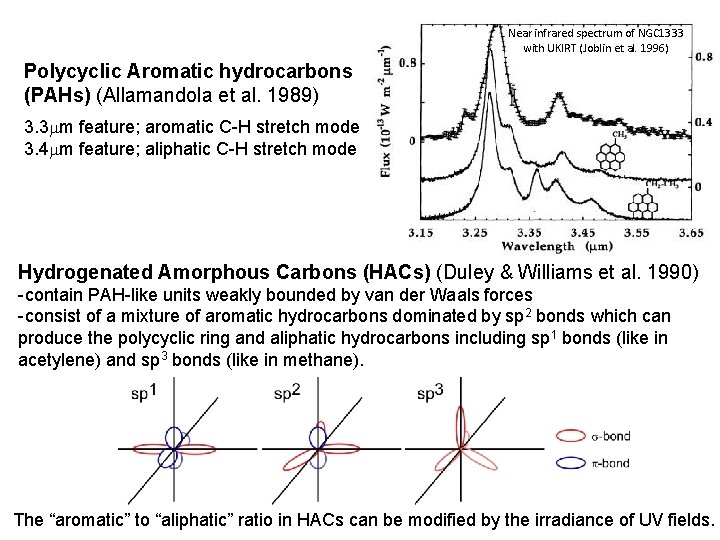
Near infrared spectrum of NGC 1333 with UKIRT (Joblin et al. 1996) Polycyclic Aromatic hydrocarbons (PAHs) (Allamandola et al. 1989) 3. 3 mm feature; aromatic C-H stretch mode 3. 4 mm feature; aliphatic C-H stretch mode Hydrogenated Amorphous Carbons (HACs) (Duley & Williams et al. 1990) -contain PAH-like units weakly bounded by van der Waals forces -consist of a mixture of aromatic hydrocarbons dominated by sp 2 bonds which can produce the polycyclic ring and aliphatic hydrocarbons including sp 1 bonds (like in acetylene) and sp 3 bonds (like in methane). The “aromatic” to “aliphatic” ratio in HACs can be modified by the irradiance of UV fields.
- Slides: 12