
Infrared integral field spectroscopic observations of globules cometary
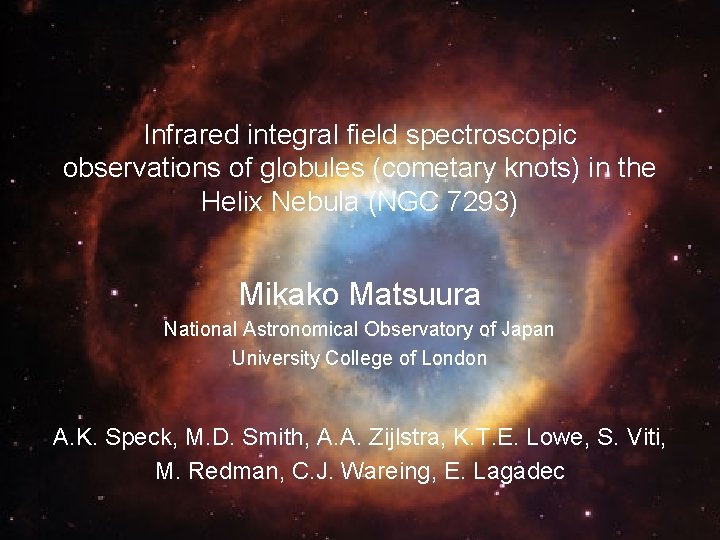
Infrared integral field spectroscopic observations of globules (cometary knots) in the Helix Nebula (NGC 7293) Mikako Matsuura National Astronomical Observatory of Japan University College of London A. K. Speck, M. D. Smith, A. A. Zijlstra, K. T. E. Lowe, S. Viti, M. Redman, C. J. Wareing, E. Lagadec
Contents • Introduction • Observations & Analysis • Discussion – H 2 excitation mechanism – Shaping of the knot
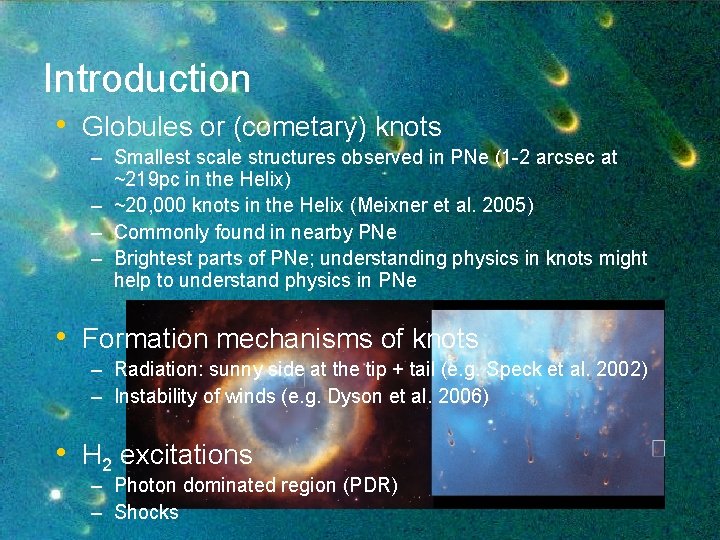
Introduction • Globules or (cometary) knots – Smallest scale structures observed in PNe (1 -2 arcsec at ~219 pc in the Helix) – ~20, 000 knots in the Helix (Meixner et al. 2005) – Commonly found in nearby PNe – Brightest parts of PNe; understanding physics in knots might help to understand physics in PNe • Formation mechanisms of knots – Radiation: sunny side at the tip + tail (e. g. Speck et al. 2002) – Instability of winds (e. g. Dyson et al. 2006) • H 2 excitations – Photon dominated region (PDR) – Shocks
Contents • Introduction • Observations & Analysis • Discussion – H 2 excitation mechanism – Shaping of the knot
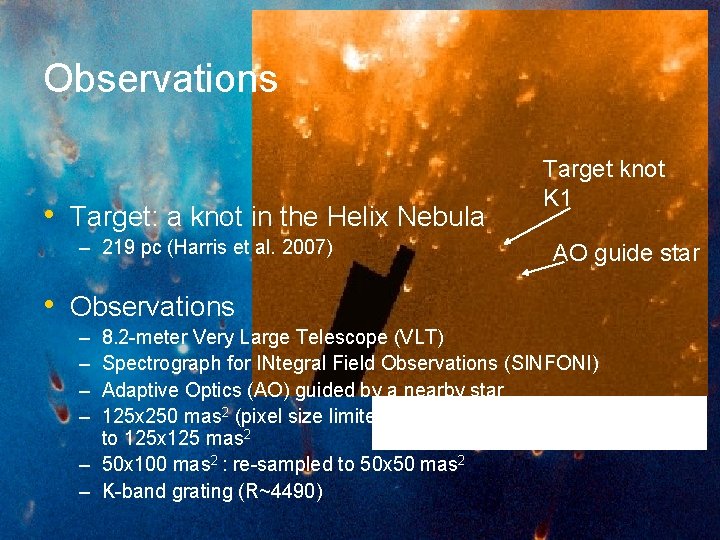
Observations • Target: a knot in the Helix Nebula – 219 pc (Harris et al. 2007) Target knot K 1 AO guide star • Observations – – 8. 2 -meter Very Large Telescope (VLT) Spectrograph for INtegral Field Observations (SINFONI) Adaptive Optics (AO) guided by a nearby star 125 x 250 mas 2 (pixel size limited spatial resolution): re-sampled to 125 x 125 mas 2 – 50 x 100 mas 2 : re-sampled to 50 x 50 mas 2 – K-band grating (R~4490)

Integral field spectrograph SINFONI • Image + spectrum at • each pixel Spectral variation within a knot 2. 12 m image
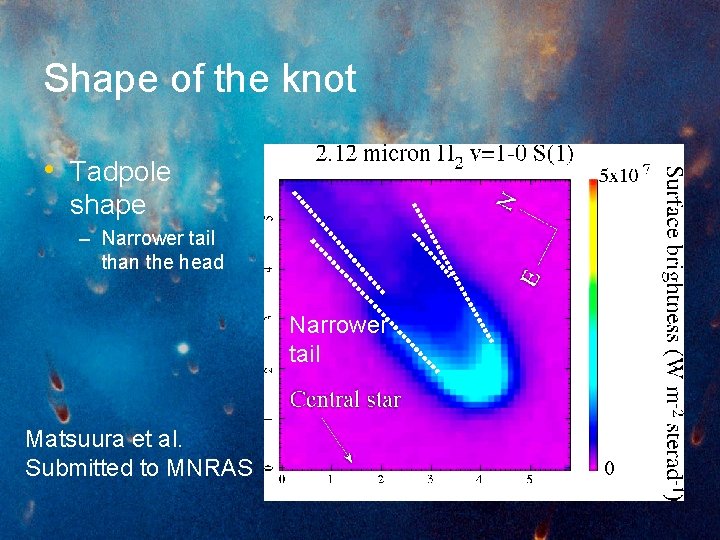
Shape of the knot • Tadpole shape – Narrower tail than the head Narrower tail Matsuura et al. Submitted to MNRAS
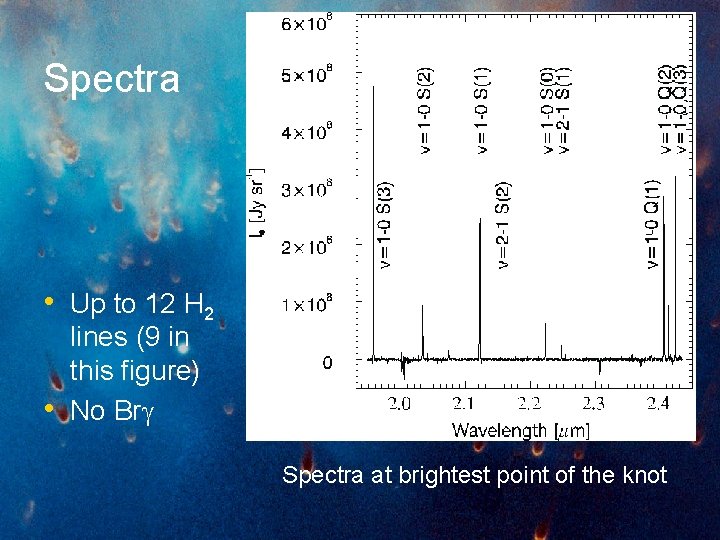
Spectra • Up to 12 H 2 • lines (9 in this figure) No Br Spectra at brightest point of the knot
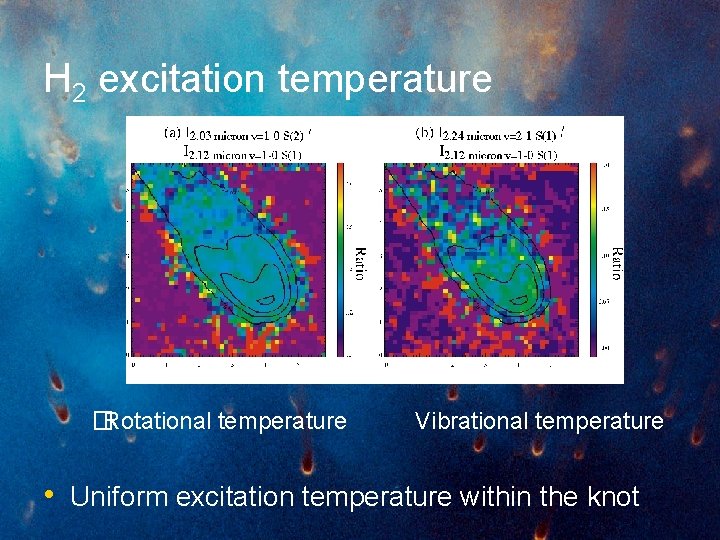
H 2 excitation temperature � Rotational temperature Vibrational temperature • Uniform excitation temperature within the knot
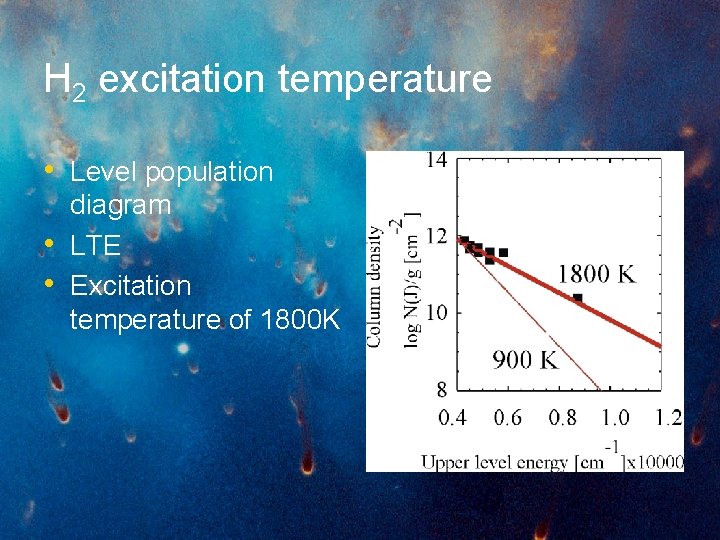
H 2 excitation temperature • Level population • • diagram LTE Excitation temperature of 1800 K
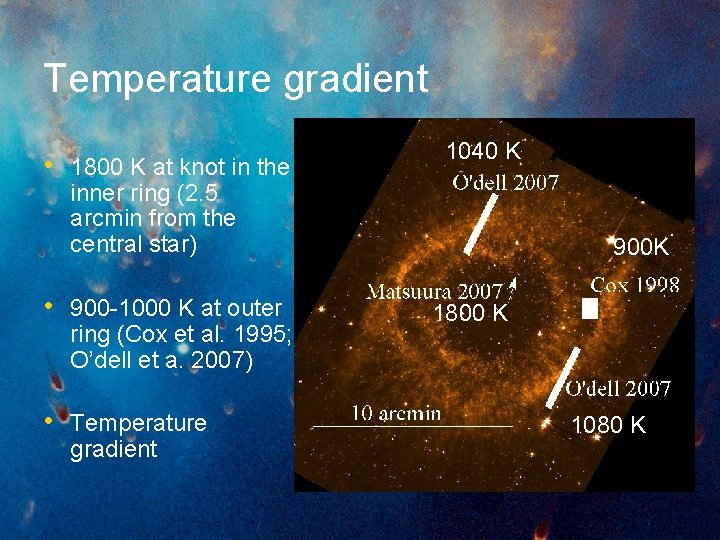
Temperature gradient • 1800 K at knot in the 1040 K inner ring (2. 5 arcmin from the central star) • 900 -1000 K at outer ring (Cox et al. 1995; O’dell et a. 2007) • Temperature gradient 900 K 1800 K 1080 K
Contents • Introduction • Observations & Analysis • Discussion – H 2 excitation mechanism – Shaping of the knot
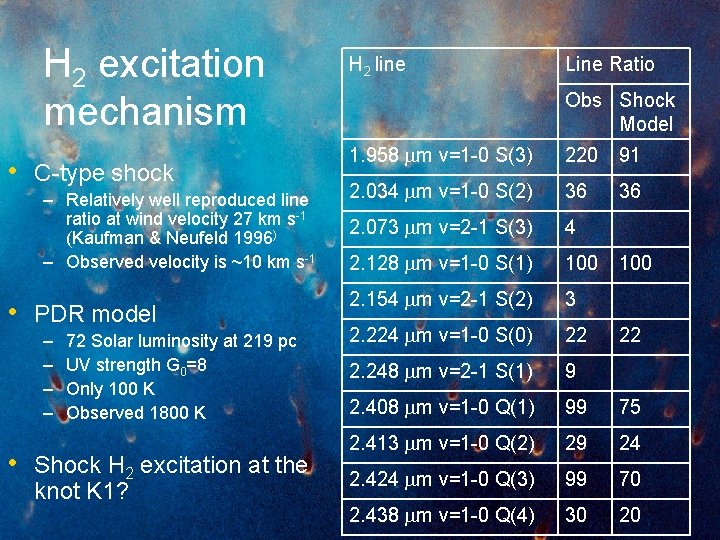
H 2 excitation mechanism • C-type shock – Relatively well reproduced line ratio at wind velocity 27 km s-1 (Kaufman & Neufeld 1996) – Observed velocity is ~10 km s-1 • PDR model – – 72 Solar luminosity at 219 pc UV strength G 0=8 Only 100 K Observed 1800 K • Shock H 2 excitation at the knot K 1? H 2 line Line Ratio Obs Shock Model 1. 958 m v=1 -0 S(3) 220 91 2. 034 m v=1 -0 S(2) 36 36 2. 073 m v=2 -1 S(3) 4 2. 128 m v=1 -0 S(1) 100 2. 154 m v=2 -1 S(2) 3 2. 224 m v=1 -0 S(0) 22 2. 248 m v=2 -1 S(1) 9 2. 408 m v=1 -0 Q(1) 99 75 2. 413 m v=1 -0 Q(2) 29 24 2. 424 m v=1 -0 Q(3) 99 70 2. 438 m v=1 -0 Q(4) 30 20 100 22
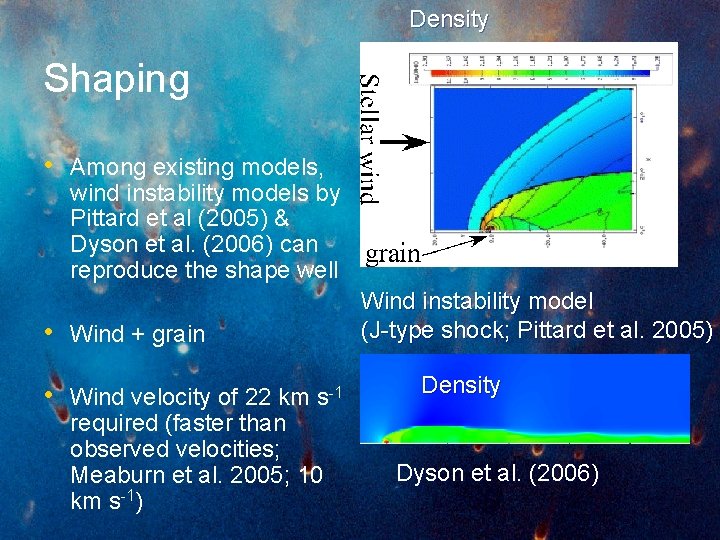
Density Shaping • Among existing models, wind instability models by Pittard et al (2005) & Dyson et al. (2006) can reproduce the shape well • Wind + grain • Wind velocity of 22 km s-1 required (faster than observed velocities; Meaburn et al. 2005; 10 km s-1) Wind instability model (J-type shock; Pittard et al. 2005) Density Dyson et al. (2006)
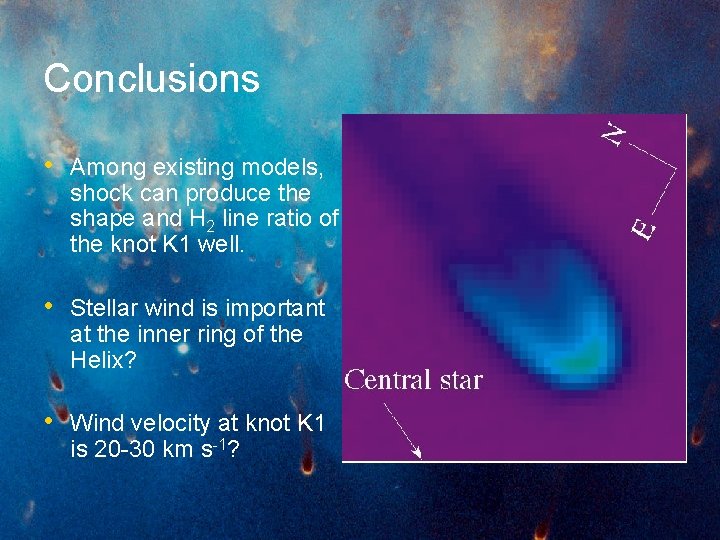
Conclusions • Among existing models, shock can produce the shape and H 2 line ratio of the knot K 1 well. • Stellar wind is important at the inner ring of the Helix? • Wind velocity at knot K 1 is 20 -30 km s-1?
- Slides: 15