
Informix SQL Performance Tuning Tips B 09 September
Informix SQL Performance Tuning Tips B 09 – September 24– 2: 45 pm Jeff Filippi Integrated Data Consulting, LLC jeff. filippi@itdataconsulting. com
Introduction • 29 years of working with Informix products • 25 years as an Informix DBA • Worked for Informix for 5 years 1996 – 2001 • Certified Informix DBA • Started my own company in 2001 specializing in Informix Database Administration consulting • IBM Business Partner • OLTP and Data warehouse systems • Informix 4 thru 14. 10
Overview • Identify Problem SQL Statements • Tracing SQL in Informix • Options Available with Set Explain & Reading sqexplain output with tuning examples • Methods to use for Improving SQL Performance • Subquery Support for Update/Delete • External Tables
Identify Problem SQL Statements • First you have to identify what SQL statements are the culprits in causing performance issues • Use “onstat –g ntt” to identify the last time read/writes occurred • Gather slow SQL statements from onstats, OAT and 3 rd party tools like Server Studio. • Look at how many times SQL statements have been executed using SQL Statement Cache (onstat –g ssc) • Informix tracing feature (SQLTRACE) • Review with developers known problem areas in the application • Verify update statistics are current • Review what tables/indexes have the most reads
Use SQL Statement Cache • onstat –g ssc • Look at SQL's with a large number of executions. • Saving even a second on a SQL statement that is executed 1 million times can make a difference in performance. • New features with 14. 10 for Statement Cache.
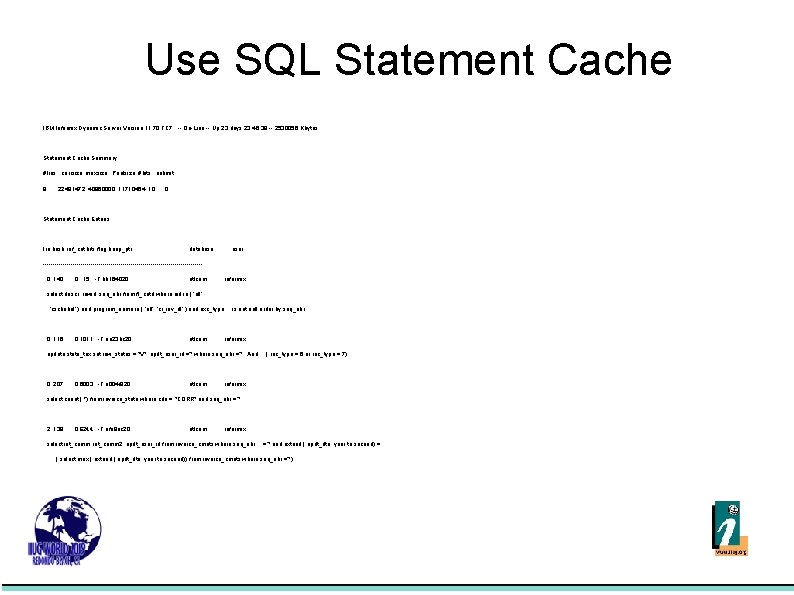
Use SQL Statement Cache IBM Informix Dynamic Server Version 11. 70. FC 7 -- On-Line -- Up 23 days 23: 46: 38 -- 2530056 Kbytes Statement Cache Summary: #lrus currsize maxsize Poolsize #hits nolimit 8 22491472 40960000 11710464 10 0 Statement Cache Entries: lru hash ref_cnt hits flag heap_ptr database user ---------------------------------------- 0 140 0 15 -F bb 164020 ntlcom informix select descr, rowid, seq_nbr from fl_cntrl where uid in ( 'all', 'cschabel' ) and program_name in ( 'all', 'cr_inv_dl' ) and exc_type is not null order by seq_nbr 0 116 0 1011 -F aa 23 bc 20 ntlcom informix update state_tax set row_status = "V", updt_user_id =? where seq_nbr =? And ( rec_type = 6 or rec_type = 7) 0 207 0 6003 -F a 004 f 820 ntlcom informix select count ( *) from invoice_state where cde = "CORR" and seq_nbr =? 2 138 0 6244 -F afa 9 ec 20 ntlcom informix select int_comm, int_comm 2, updt_user_id from invoice_cmnts where seq_nbr =? and extend ( updt_dte, year to second) = ( select max ( extend ( updt_dte, year to second)) from invoice_cmnts where seq_nbr =? )
Use SQL Statement Cache Statement cache enhancements • New sysmaster: syssscelem pseudo table to coincide with onstat -g ssc. For more information, see The sysmaster database. • Invalidate specific statement(s) in the Statement Cache. For more information, see Monitoring usage of the SQL statement cache. • Lock query plan(s) in the Statement Cache. For more information, see Monitoring usage of the SQL statement cache.
Use SQL Statement Cache Dump query plans from Statement Cache • New onconfig parameter STMT_CACHE_QUERY_PLAN • 0 – Disabled • 1 – Enabled • Disabled by Default • WILL consume more of your STMT_CACHE_SIZE • Query plan is viewable in sysaster: syssscelem. queryplan column • LOOK AT Jeff Mc. Mahon’s Presentation on this
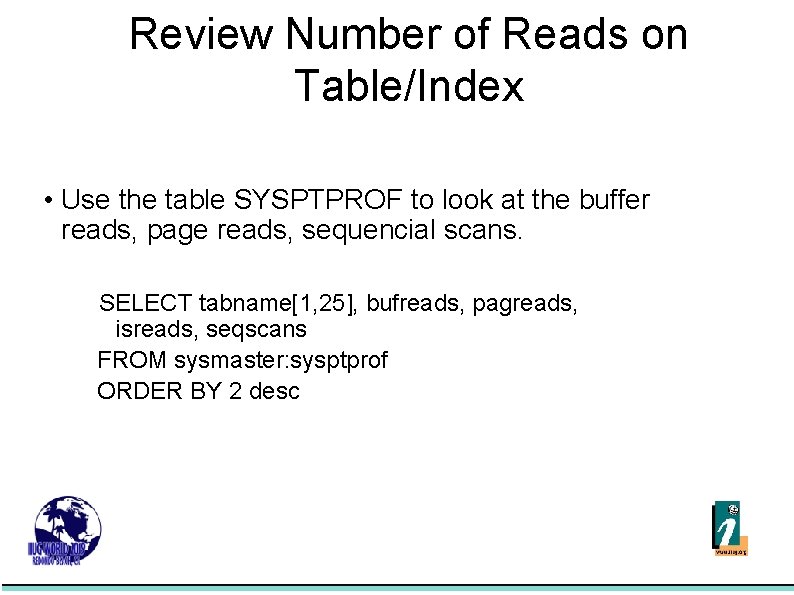
Review Number of Reads on Table/Index • Use the table SYSPTPROF to look at the buffer reads, page reads, sequencial scans. SELECT tabname[1, 25], bufreads, pagreads, isreads, seqscans FROM sysmaster: sysptprof ORDER BY 2 desc
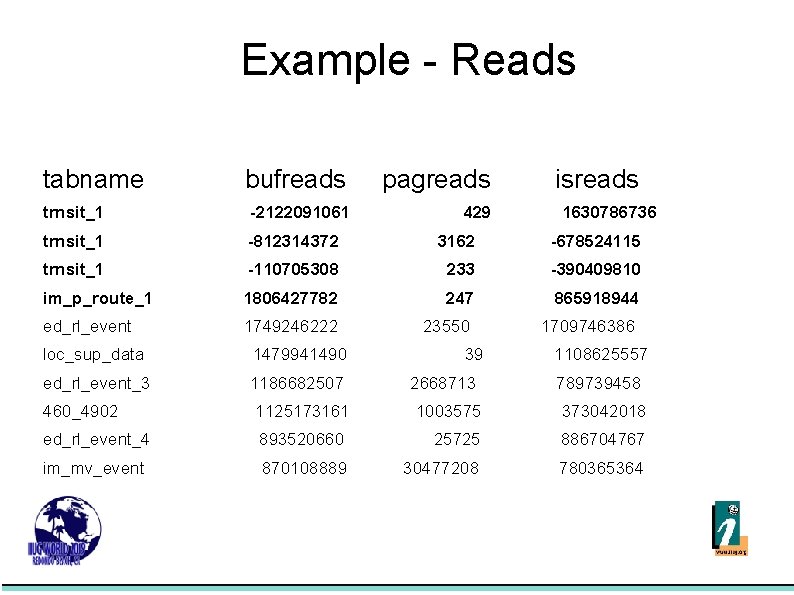
Example - Reads tabname bufreads pagreads isreads trnsit_1 -2122091061 trnsit_1 -812314372 3162 -678524115 trnsit_1 -110705308 233 -390409810 im_p_route_1 1806427782 247 865918944 ed_rl_event 429 1630786736 1749246222 23550 1709746386 loc_sup_data 1479941490 39 1108625557 ed_rl_event_3 1186682507 2668713 789739458 460_4902 1125173161 1003575 373042018 ed_rl_event_4 893520660 25725 886704767 im_mv_event 870108889 30477208 780365364
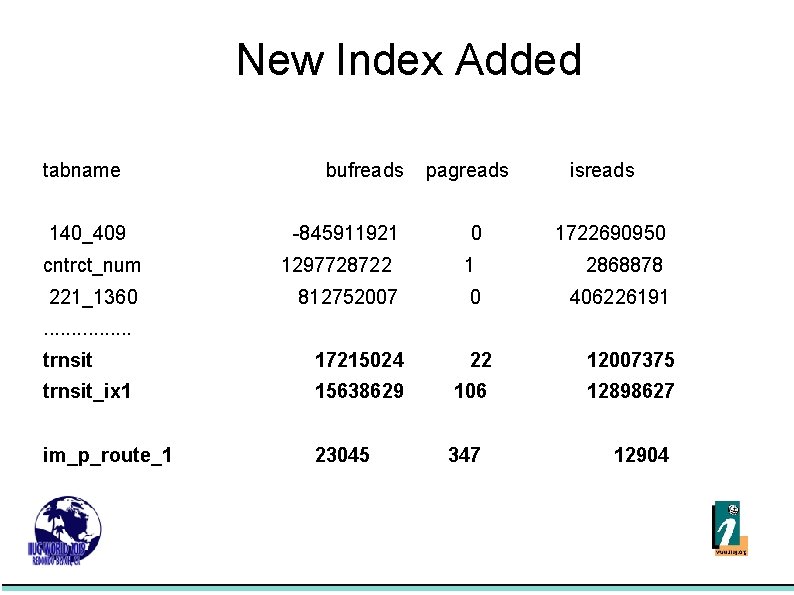
New Index Added tabname bufreads pagreads isreads 140_409 -845911921 0 1722690950 cntrct_num 1297728722 1 2868878 221_1360 812752007 0 406226191. . . . trnsit 17215024 22 12007375 trnsit_ix 1 15638629 106 12898627 im_p_route_1 23045 347 12904
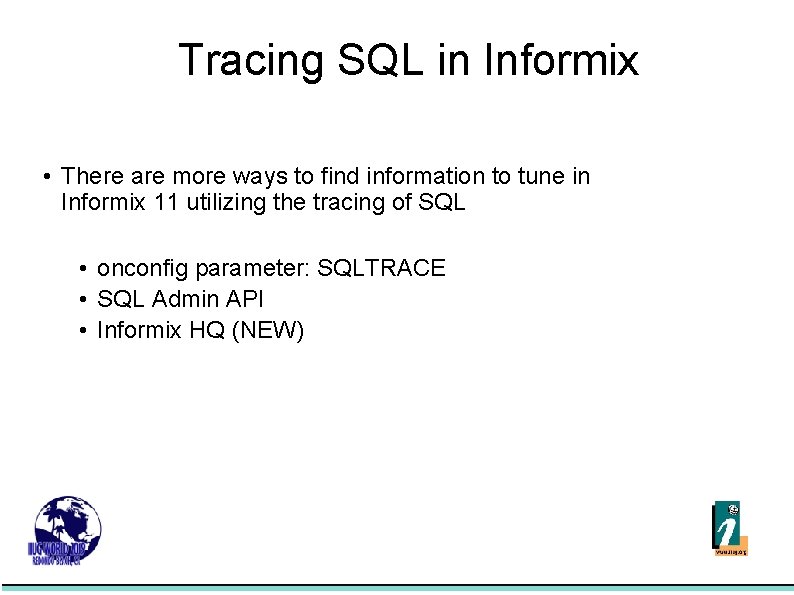
Tracing SQL in Informix • There are more ways to find information to tune in Informix 11 utilizing the tracing of SQL • onconfig parameter: SQLTRACE • SQL Admin API • Informix HQ (NEW)
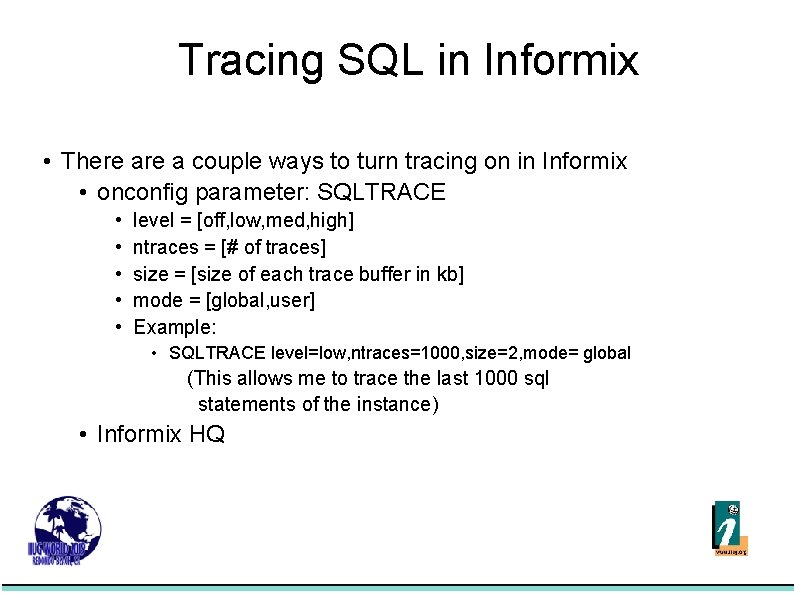
Tracing SQL in Informix • There a couple ways to turn tracing on in Informix • onconfig parameter: SQLTRACE • • • level = [off, low, med, high] ntraces = [# of traces] size = [size of each trace buffer in kb] mode = [global, user] Example: • SQLTRACE level=low, ntraces=1000, size=2, mode= global (This allows me to trace the last 1000 sql statements of the instance) • Informix HQ
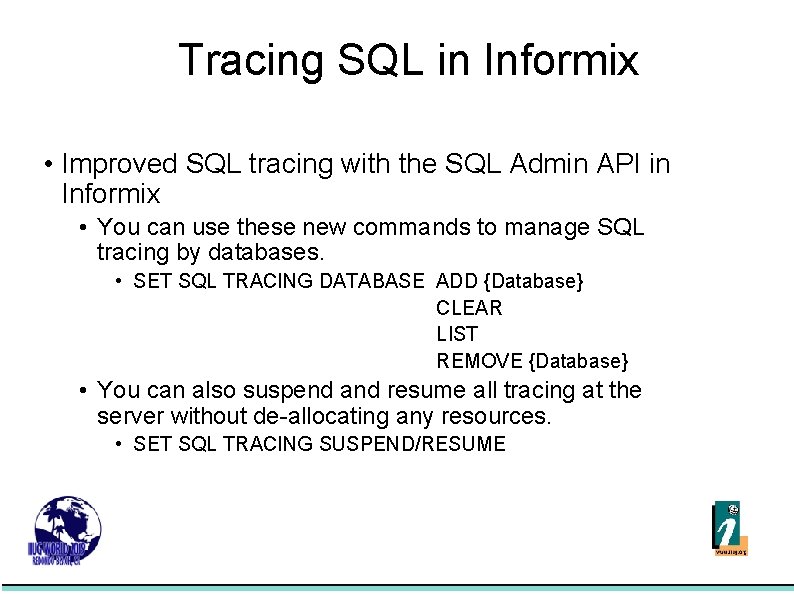
Tracing SQL in Informix • Improved SQL tracing with the SQL Admin API in Informix • You can use these new commands to manage SQL tracing by databases. • SET SQL TRACING DATABASE ADD {Database} CLEAR LIST REMOVE {Database} • You can also suspend and resume all tracing at the server without de-allocating any resources. • SET SQL TRACING SUSPEND/RESUME
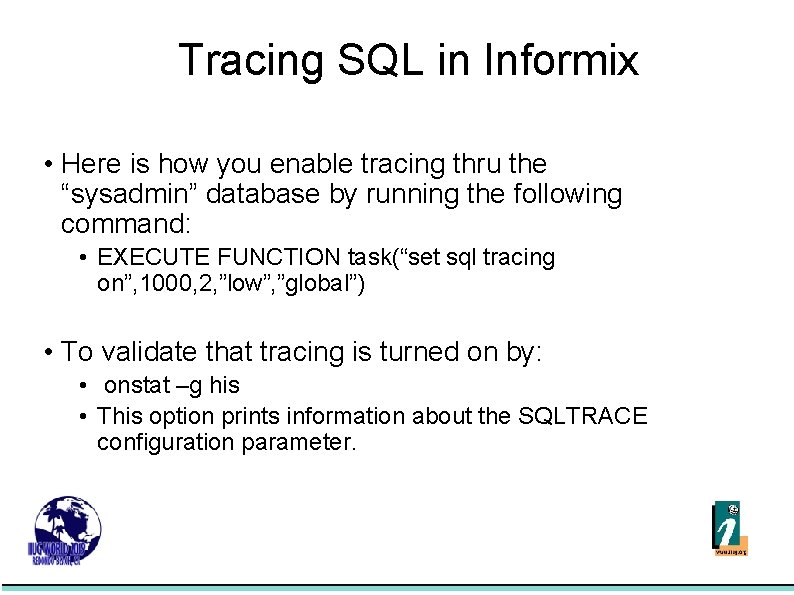
Tracing SQL in Informix • Here is how you enable tracing thru the “sysadmin” database by running the following command: • EXECUTE FUNCTION task(“set sql tracing on”, 1000, 2, ”low”, ”global”) • To validate that tracing is turned on by: • onstat –g his • This option prints information about the SQLTRACE configuration parameter.
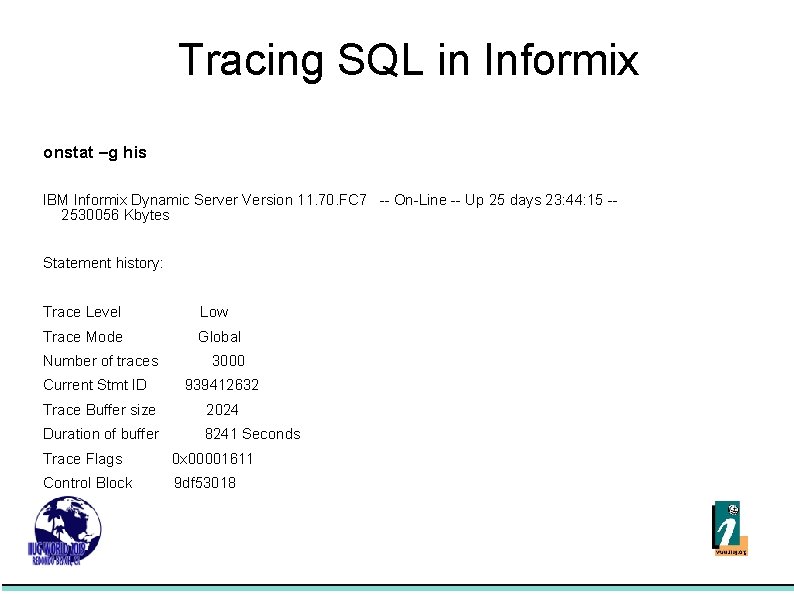
Tracing SQL in Informix onstat –g his IBM Informix Dynamic Server Version 11. 70. FC 7 -- On-Line -- Up 25 days 23: 44: 15 -- 2530056 Kbytes Statement history: Trace Level Low Trace Mode Global Number of traces 3000 Current Stmt ID 939412632 Trace Buffer size 2024 Duration of buffer 8241 Seconds Trace Flags 0 x 00001611 Control Block 9 df 53018
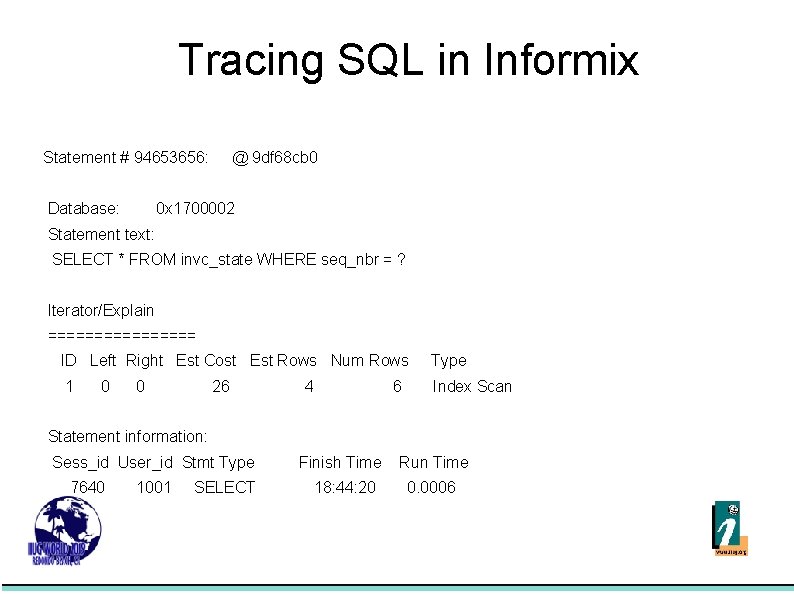
Tracing SQL in Informix Statement # 94653656: @ 9 df 68 cb 0 Database: 0 x 1700002 Statement text: SELECT * FROM invc_state WHERE seq_nbr = ? Iterator/Explain ======== ID Left Right Est Cost Est Rows Num Rows Type 1 0 0 26 4 6 Index Scan Statement information: Sess_id User_id Stmt Type Finish Time Run Time 7640 1001 SELECT 18: 44: 20 0. 0006
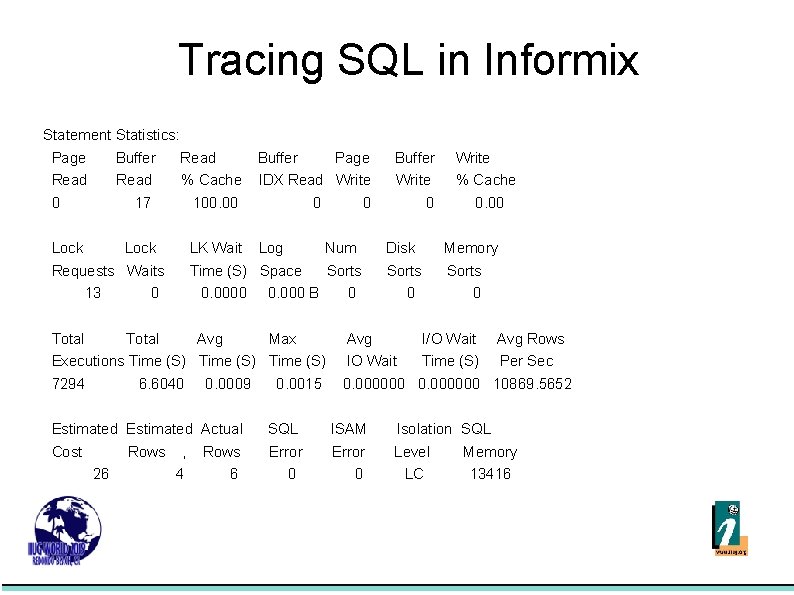
Tracing SQL in Informix Statement Statistics: Page Buffer Read Buffer Page Buffer Write Read % Cache IDX Read Write % Cache 0 17 100. 00 0 0. 00 Lock LK Wait Log Num Disk Memory Requests Waits Time (S) Space Sorts 13 0 0. 0000 0. 000 B 0 0 Total Avg Max Avg I/O Wait Avg Rows Executions Time (S) IO Wait Time (S) Per Sec 7294 6. 6040 0. 0009 0. 0015 0. 000000 10869. 5652 Estimated Actual SQL ISAM Isolation SQL Cost Rows , Rows Error Level Memory 26 4 6 0 LC 13416
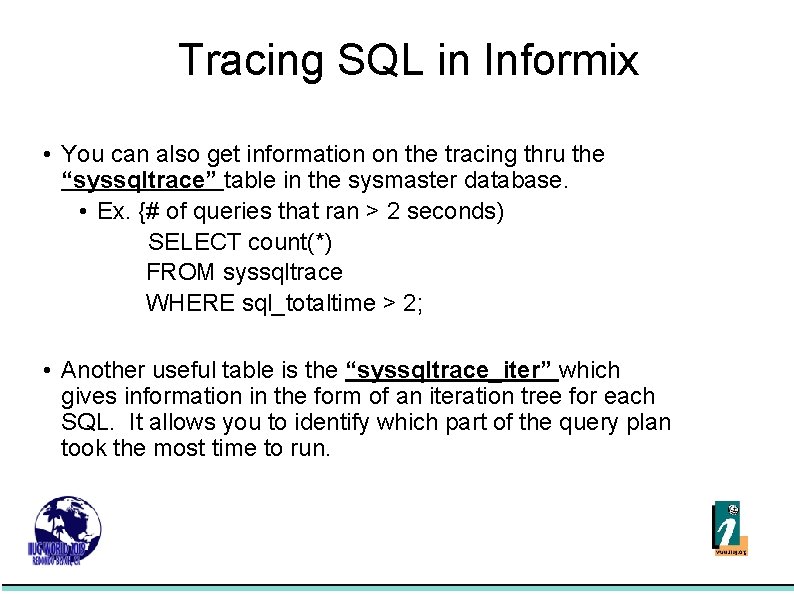
Tracing SQL in Informix • You can also get information on the tracing thru the “syssqltrace” table in the sysmaster database. • Ex. {# of queries that ran > 2 seconds) SELECT count(*) FROM syssqltrace WHERE sql_totaltime > 2; • Another useful table is the “syssqltrace_iter” which gives information in the form of an iteration tree for each SQL. It allows you to identify which part of the query plan took the most time to run.
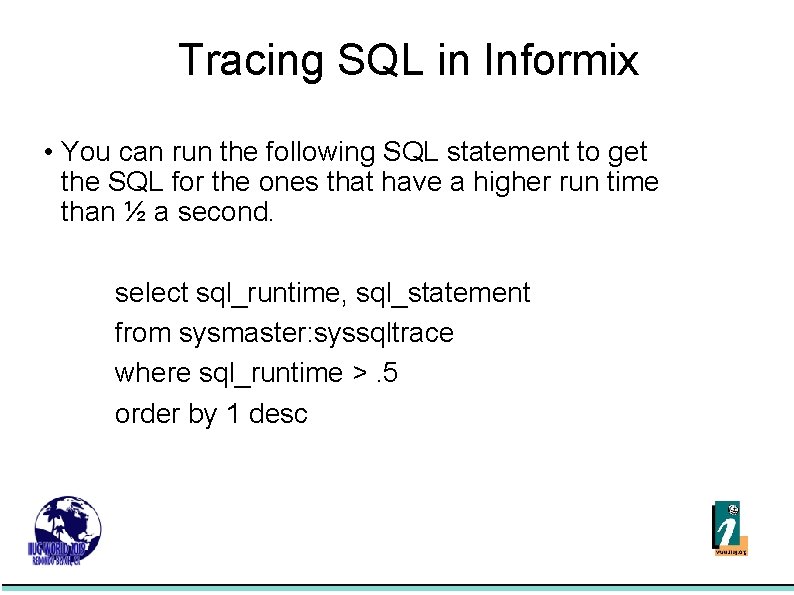
Tracing SQL in Informix • You can run the following SQL statement to get the SQL for the ones that have a higher run time than ½ a second. select sql_runtime, sql_statement from sysmaster: syssqltrace where sql_runtime >. 5 order by 1 desc
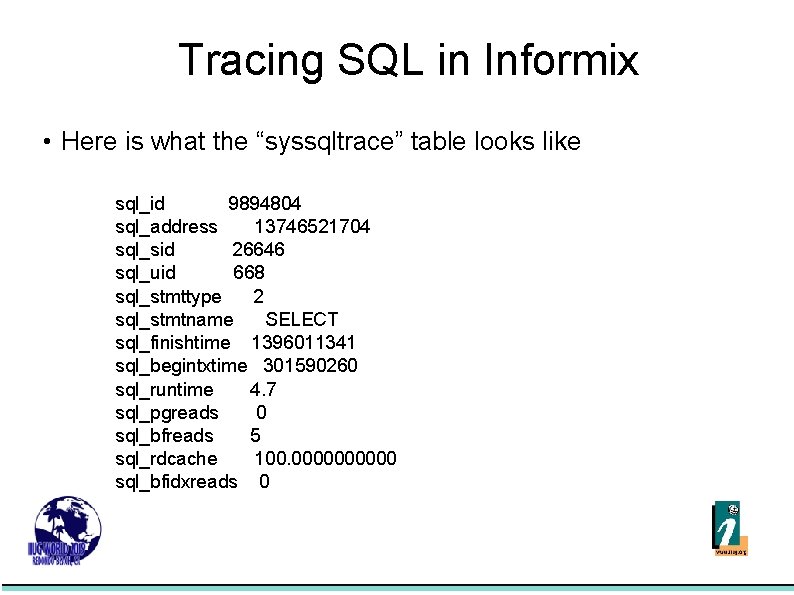
Tracing SQL in Informix • Here is what the “syssqltrace” table looks like sql_id 9894804 sql_address 13746521704 sql_sid 26646 sql_uid 668 sql_stmttype 2 sql_stmtname SELECT sql_finishtime 1396011341 sql_begintxtime 301590260 sql_runtime 4. 7 sql_pgreads 0 sql_bfreads 5 sql_rdcache 100. 00000 sql_bfidxreads 0
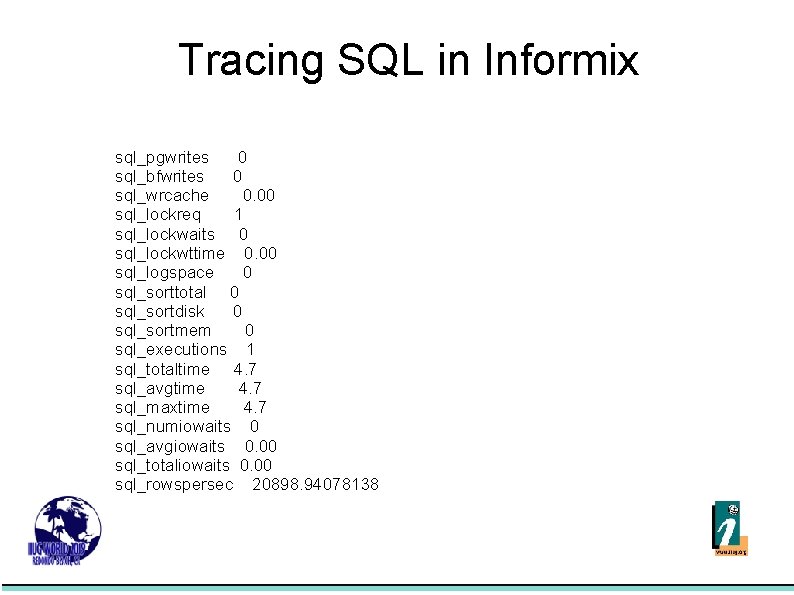
Tracing SQL in Informix sql_pgwrites 0 sql_bfwrites 0 sql_wrcache 0. 00 sql_lockreq 1 sql_lockwaits 0 sql_lockwttime 0. 00 sql_logspace 0 sql_sorttotal 0 sql_sortdisk 0 sql_sortmem 0 sql_executions 1 sql_totaltime 4. 7 sql_avgtime 4. 7 sql_maxtime 4. 7 sql_numiowaits 0 sql_avgiowaits 0. 00 sql_totaliowaits 0. 00 sql_rowspersec 20898. 94078138
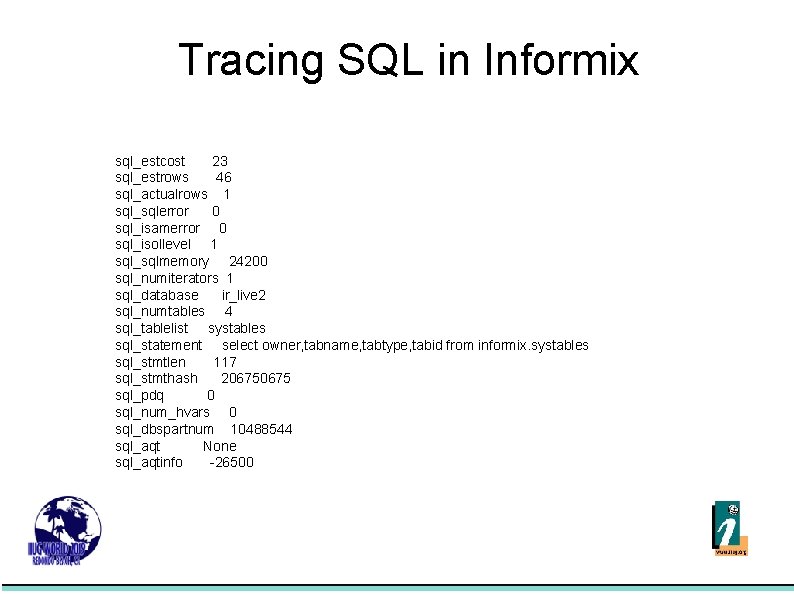
Tracing SQL in Informix sql_estcost 23 sql_estrows 46 sql_actualrows 1 sql_sqlerror 0 sql_isamerror 0 sql_isollevel 1 sql_sqlmemory 24200 sql_numiterators 1 sql_database ir_live 2 sql_numtables 4 sql_tablelist systables sql_statement select owner, tabname, tabtype, tabid from informix. systables sql_stmtlen 117 sql_stmthash 20675 sql_pdq 0 sql_num_hvars 0 sql_dbspartnum 10488544 sql_aqt None sql_aqtinfo -26500
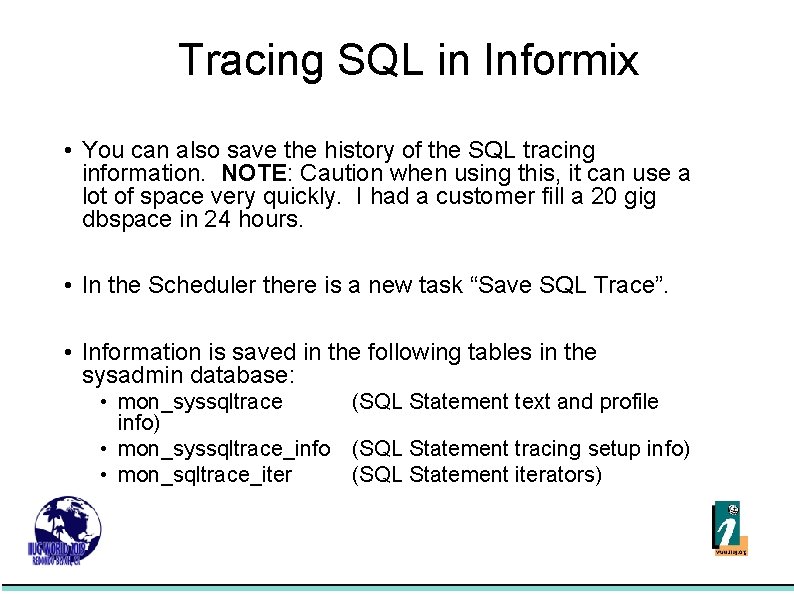
Tracing SQL in Informix • You can also save the history of the SQL tracing information. NOTE: Caution when using this, it can use a lot of space very quickly. I had a customer fill a 20 gig dbspace in 24 hours. • In the Scheduler there is a new task “Save SQL Trace”. • Information is saved in the following tables in the sysadmin database: • mon_syssqltrace (SQL Statement text and profile info) • mon_syssqltrace_info (SQL Statement tracing setup info) • mon_sqltrace_iter (SQL Statement iterators)
Tracing SQL in Informix • Here is an alternative to saving ALL tracing information. • Create a task which saves SQL trace information for SQL’s that have a run time of greater than 10 seconds. • This allows you to still trace SQL statements, but only show you the really long running SQL statements
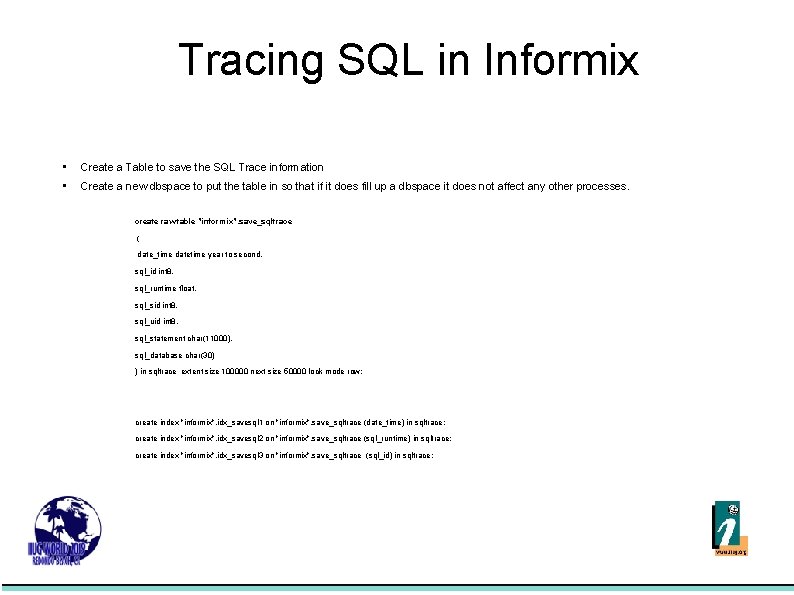
Tracing SQL in Informix • Create a Table to save the SQL Trace information • Create a new dbspace to put the table in so that if it does fill up a dbspace it does not affect any other processes. create raw table "informix". save_sqltrace ( date_time datetime year to second, sql_id int 8, sql_runtime float, sql_sid int 8, sql_uid int 8, sql_statement char(11000), sql_database char(30) ) in sqltrace extent size 100000 next size 50000 lock mode row; create index "informix". idx_savesql 1 on "informix". save_sqltrace (date_time) in sqltrace; create index "informix". idx_savesql 2 on "informix". save_sqltrace (sql_runtime) in sqltrace; create index "informix". idx_savesql 3 on "informix". save_sqltrace (sql_id) in sqltrace;
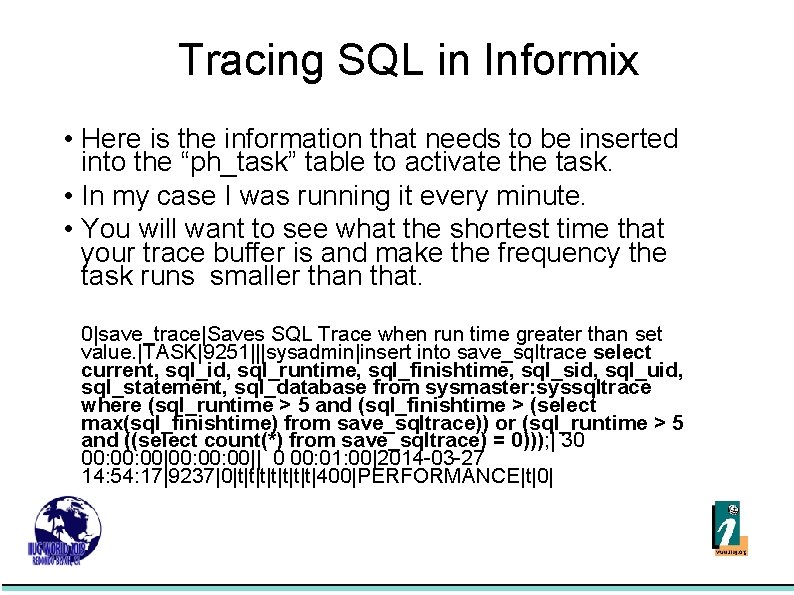
Tracing SQL in Informix • Here is the information that needs to be inserted into the “ph_task” table to activate the task. • In my case I was running it every minute. • You will want to see what the shortest time that your trace buffer is and make the frequency the task runs smaller than that. 0|save_trace|Saves SQL Trace when run time greater than set value. |TASK|9251|||sysadmin|insert into save_sqltrace select current, sql_id, sql_runtime, sql_finishtime, sql_sid, sql_uid, sql_statement, sql_database from sysmaster: syssqltrace where (sql_runtime > 5 and (sql_finishtime > (select max(sql_finishtime) from save_sqltrace)) or (sql_runtime > 5 and ((select count(*) from save_sqltrace) = 0))); | 30 00: 00|00: 00|| 0 00: 01: 00|2014 -03 -27 14: 54: 17|9237|0|t|t|t|t|400|PERFORMANCE|t|0|
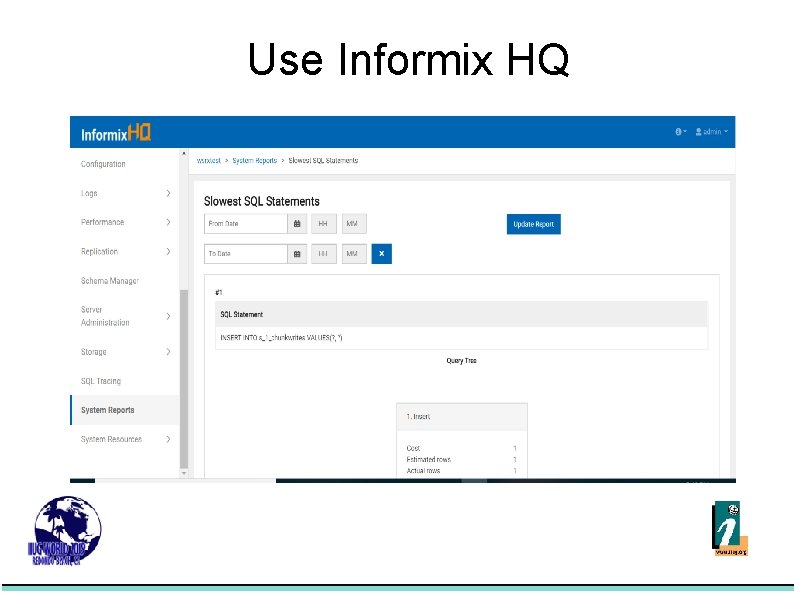
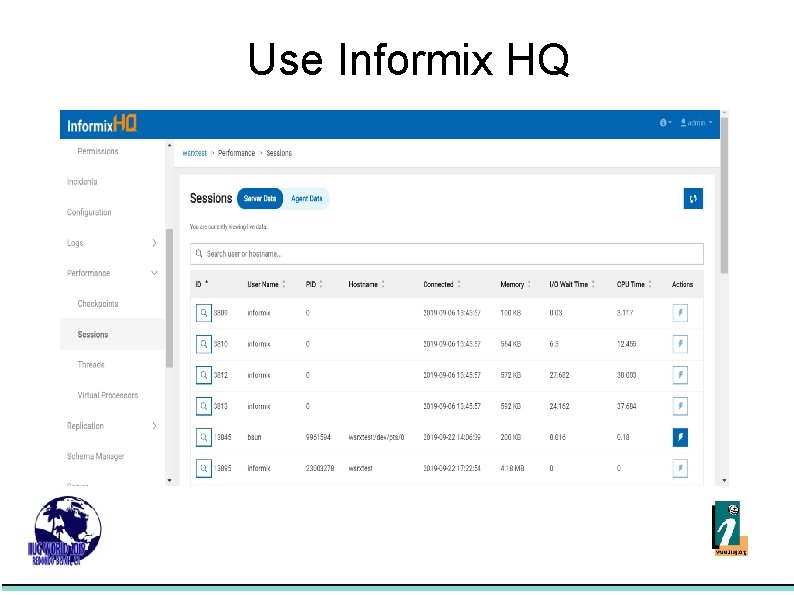
Use Informix HQ • Use Informix HQ to look at session information to see long running SQL.
Use Informix HQ
Use Informix HQ
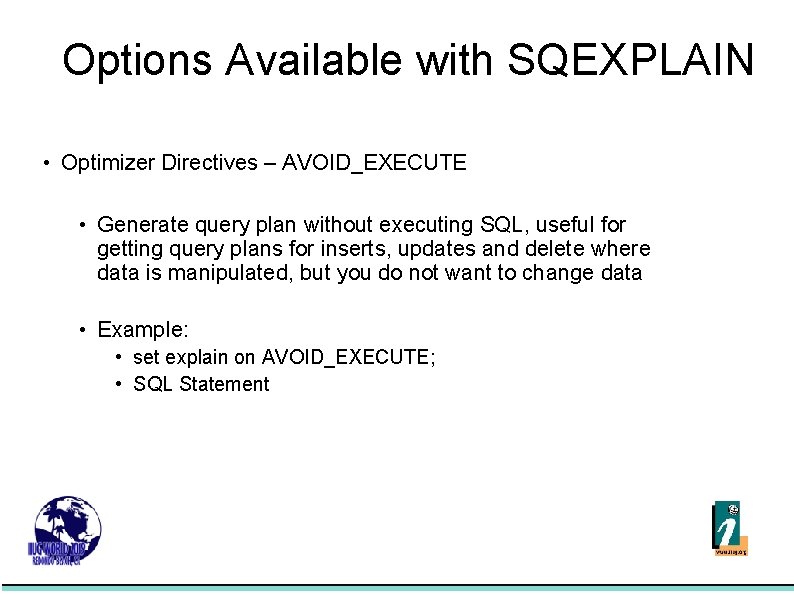
Options Available with SQEXPLAIN • Optimizer Directives – AVOID_EXECUTE • Generate query plan without executing SQL, useful for getting query plans for inserts, updates and delete where data is manipulated, but you do not want to change data • Example: • set explain on AVOID_EXECUTE; • SQL Statement
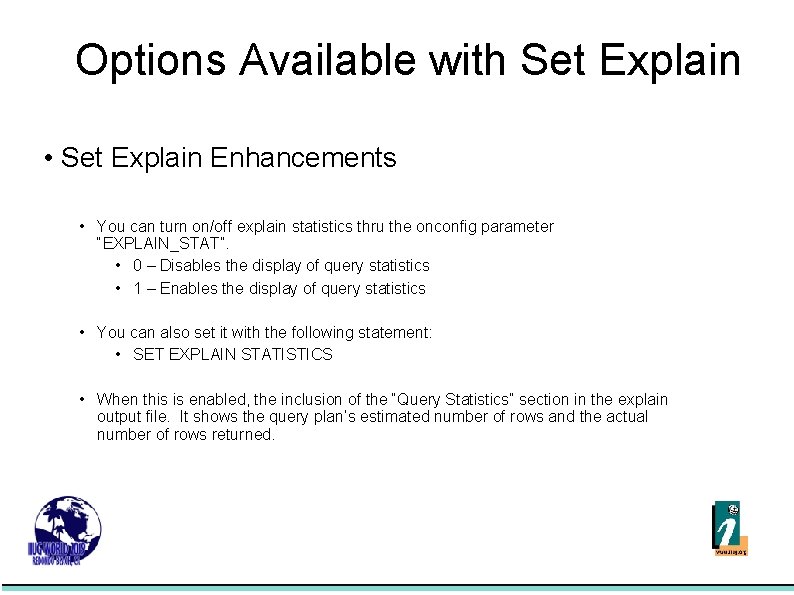
Options Available with Set Explain • Set Explain Enhancements • You can turn on/off explain statistics thru the onconfig parameter “EXPLAIN_STAT”. • 0 – Disables the display of query statistics • 1 – Enables the display of query statistics • You can also set it with the following statement: • SET EXPLAIN STATISTICS • When this is enabled, the inclusion of the “Query Statistics” section in the explain output file. It shows the query plan’s estimated number of rows and the actual number of rows returned.
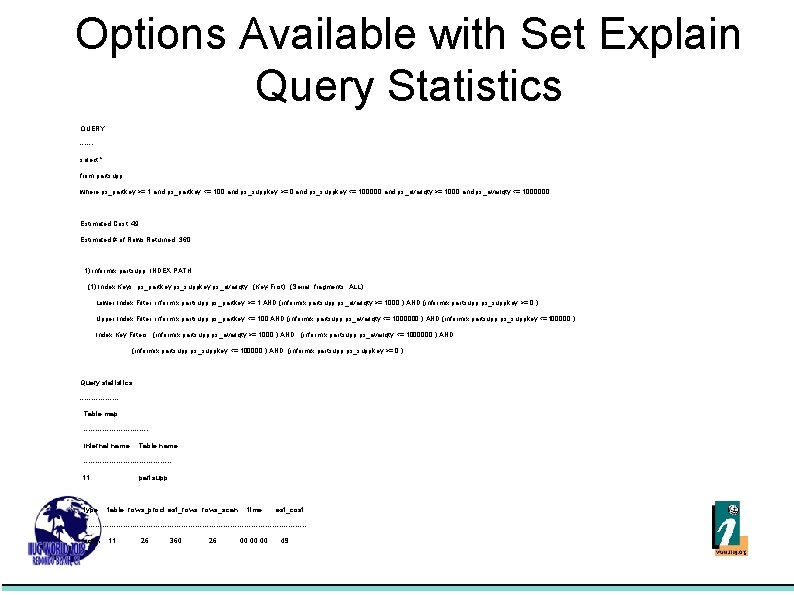
Options Available with Set Explain Query Statistics QUERY: -----select * from partsupp where ps_partkey >= 1 and ps_partkey <= 100 and ps_suppkey >= 0 and ps_suppkey <= 100000 and ps_availqty >= 1000 and ps_availqty <= 1000000 Estimated Cost: 49 Estimated # of Rows Returned: 360 1) informix. partsupp: INDEX PATH (1) Index Keys: ps_partkey ps_suppkey ps_availqty (Key-First) (Serial, fragments: ALL) Lower Index Filter: informix. partsupp. ps_partkey >= 1 AND (informix. partsupp. ps_availqty >= 1000 ) AND (informix. partsupp. ps_suppkey >= 0 ) Upper Index Filter: informix. partsupp. ps_partkey <= 100 AND (informix. partsupp. ps_availqty <= 1000000 ) AND (informix. partsupp. ps_suppkey <=100000 ) Index Key Filters: (informix. partsupp. ps_availqty >= 1000 ) AND (informix. partsupp. ps_availqty <= 1000000 ) AND (informix. partsupp. ps_suppkey <= 100000 ) AND (informix. partsupp. ps_suppkey >= 0 ) Query statistics: --------Table map : --------------Internal name Table name -------------------t 1 type partsupp table rows_prod est_rows_scan time est_cost ------------------------------------------------scan t 1 26 360 26 00: 00 49
Dynamic Set Explain • Dynamically set explain on for a session onmode –Y {session id} {0|1} (0 – Off/1 – On) • Output is to a file “sqexplain. out. {session id} • With Informix 11 there a couple changes: • An additional value “ 2” (explain without statistics for session, displays query plan only) • Also you can specify the file name and directory that you want the explain output to be sent: • onmode –Y {session id} {0|1|2} {filename} • This is a great feature to allow you to see the SQL statements executed and the explain plan for each SQL statement. • NOTE: make sure that you only have this turned on for a short period of time, it creates a large file.
Set Explain Output • Add “set explain on” before the statement you want to examine • You can specify the directory that you want the file to go: • set explain file to “filename” • Review the “set explain” output: • UNIX: The file “sqexplain. out” will be generated in the directory that you run the query from • Windows: Look for a file “username. out” in the directory on the UNIX server %INFORMIXDIR%sqexpln
Set Explain Output • Query – Displays the executed query and indicates whether “set optimization” was set to high or low • Directives Followed – Lists any directives used for the query • Estimated Cost – An estimated of the amount of work for the query. The number does not translate into time. Only compare to same query not others. • Estimated number of rows returned – An estimate of the number of rows returned, number based on information from system catalog tables
Set Explain Output • Numbered List – The order in which tables are accessed, followed by the access method (index or sequential scan) • Index Keys – The columns used as filters or indexes • Query Statistics – Enabled by onconfig parameter “EXPLAIN_STAT”
Examples of Explain Plans • The following slides will show tuning of SQL based on the following scenarios: • • Functions causing index to not be used Criteria from views causing sequential scans Using “in” causes sequential scans Use of Directives Use of substrings in queries Use of functions in queries Using a better index (Creation of new index)
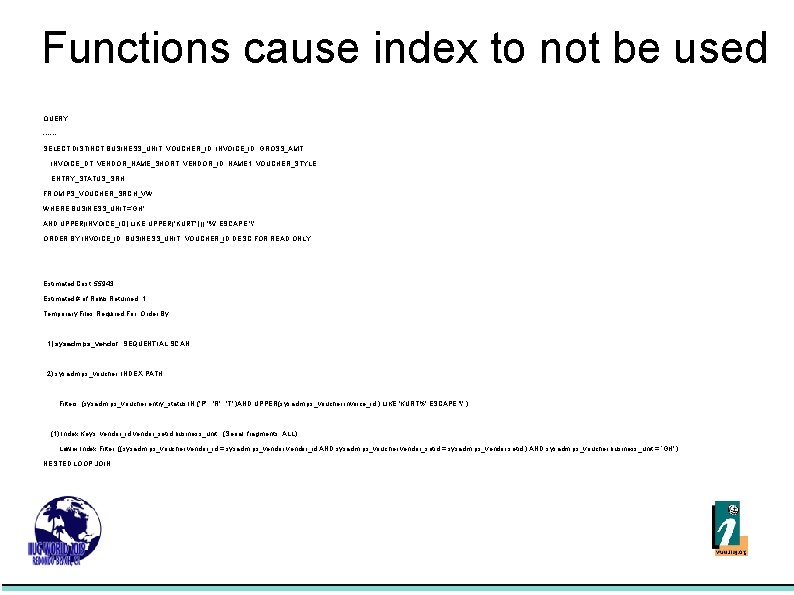
Functions cause index to not be used QUERY: -----SELECT DISTINCT BUSINESS_UNIT, VOUCHER_ID, INVOICE_ID, GROSS_AMT, INVOICE_DT, VENDOR_NAME_SHORT, VENDOR_ID, NAME 1, VOUCHER_STYLE, ENTRY_STATUS_SRH FROM PS_VOUCHER_SRCH_VW WHERE BUSINESS_UNIT=‘GH' AND UPPER(INVOICE_ID) LIKE UPPER('KURT') || '%' ESCAPE '' ORDER BY INVOICE_ID, BUSINESS_UNIT, VOUCHER_ID DESC FOR READ ONLY Estimated Cost: 55943 Estimated # of Rows Returned: 1 Temporary Files Required For: Order By 1) sysadm. ps_vendor: SEQUENTIAL SCAN 2) sysadm. ps_voucher: INDEX PATH Filters: (sysadm. ps_voucher. entry_status IN ('P' , 'R' , 'T' )AND UPPER(sysadm. ps_voucher. invoice_id ) LIKE 'KURT%' ESCAPE '' ) (1) Index Keys: vendor_id vendor_setid business_unit (Serial, fragments: ALL) Lower Index Filter: ((sysadm. ps_voucher. vendor_id = sysadm. ps_vendor_id AND sysadm. ps_voucher. vendor_setid = sysadm. ps_vendor. setid ) AND sysadm. ps_voucher. business_unit = ‘GH' ) NESTED LOOP JOIN
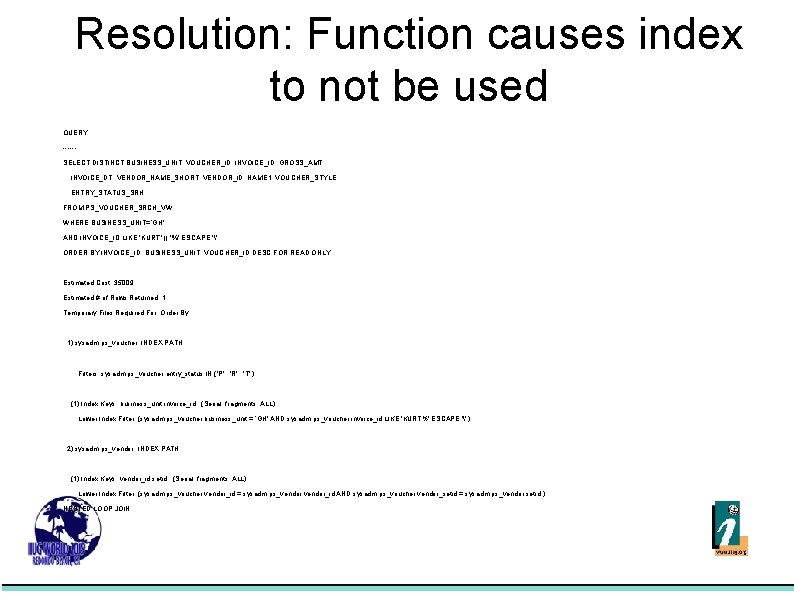
Resolution: Function causes index to not be used QUERY: -----SELECT DISTINCT BUSINESS_UNIT, VOUCHER_ID, INVOICE_ID, GROSS_AMT, INVOICE_DT, VENDOR_NAME_SHORT, VENDOR_ID, NAME 1, VOUCHER_STYLE, ENTRY_STATUS_SRH FROM PS_VOUCHER_SRCH_VW WHERE BUSINESS_UNIT=‘GH' AND INVOICE_ID LIKE 'KURT' || '%' ESCAPE '' ORDER BY INVOICE_ID, BUSINESS_UNIT, VOUCHER_ID DESC FOR READ ONLY Estimated Cost: 35009 Estimated # of Rows Returned: 1 Temporary Files Required For: Order By 1) sysadm. ps_voucher: INDEX PATH Filters: sysadm. ps_voucher. entry_status IN ('P' , 'R' , 'T' ) (1) Index Keys: business_unit invoice_id (Serial, fragments: ALL) Lower Index Filter: (sysadm. ps_voucher. business_unit = ‘GH' AND sysadm. ps_voucher. invoice_id LIKE 'KURT%' ESCAPE '' ) 2) sysadm. ps_vendor: INDEX PATH (1) Index Keys: vendor_id setid (Serial, fragments: ALL) Lower Index Filter: (sysadm. ps_voucher. vendor_id = sysadm. ps_vendor_id AND sysadm. ps_voucher. vendor_setid = sysadm. ps_vendor. setid ) NESTED LOOP JOIN
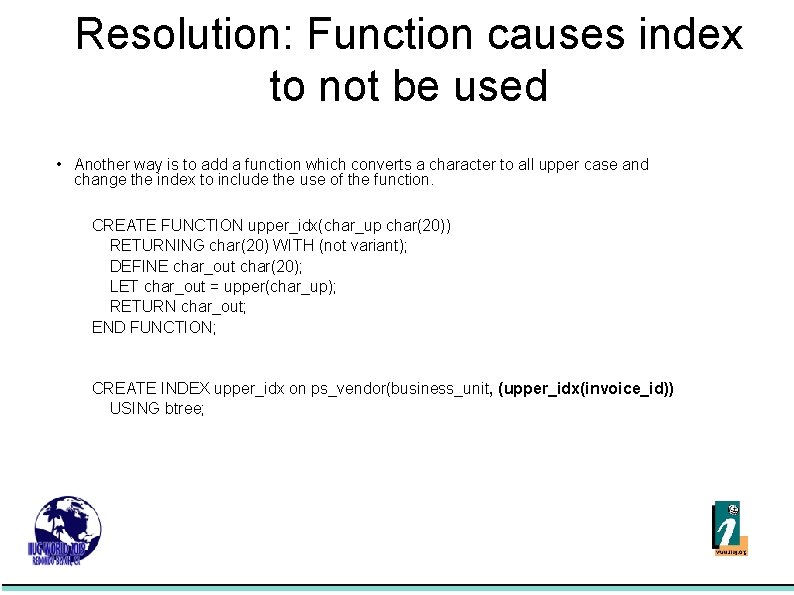
Resolution: Function causes index to not be used • Another way is to add a function which converts a character to all upper case and change the index to include the use of the function. CREATE FUNCTION upper_idx(char_up char(20)) RETURNING char(20) WITH (not variant); DEFINE char_out char(20); LET char_out = upper(char_up); RETURN char_out; END FUNCTION; CREATE INDEX upper_idx on ps_vendor(business_unit, (upper_idx(invoice_id)) USING btree;
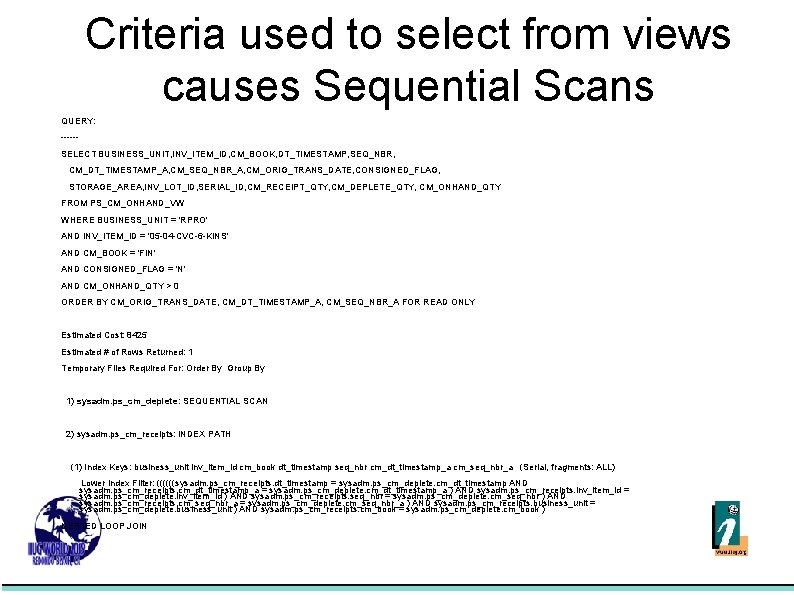
Criteria used to select from views causes Sequential Scans QUERY: -----SELECT BUSINESS_UNIT, INV_ITEM_ID, CM_BOOK, DT_TIMESTAMP, SEQ_NBR, CM_DT_TIMESTAMP_A, CM_SEQ_NBR_A, CM_ORIG_TRANS_DATE, CONSIGNED_FLAG, STORAGE_AREA, INV_LOT_ID, SERIAL_ID, CM_RECEIPT_QTY, CM_DEPLETE_QTY, CM_ONHAND_QTY FROM PS_CM_ONHAND_VW WHERE BUSINESS_UNIT = 'RPRO' AND INV_ITEM_ID = '05 -04 -CVC-6 -KINS' AND CM_BOOK = 'FIN' AND CONSIGNED_FLAG = 'N' AND CM_ONHAND_QTY > 0 ORDER BY CM_ORIG_TRANS_DATE, CM_DT_TIMESTAMP_A, CM_SEQ_NBR_A FOR READ ONLY Estimated Cost: 8425 Estimated # of Rows Returned: 1 Temporary Files Required For: Order By Group By 1) sysadm. ps_cm_deplete: SEQUENTIAL SCAN 2) sysadm. ps_cm_receipts: INDEX PATH (1) Index Keys: business_unit inv_item_id cm_book dt_timestamp seq_nbr cm_dt_timestamp_a cm_seq_nbr_a (Serial, fragments: ALL) Lower Index Filter: ((((((sysadm. ps_cm_receipts. dt_timestamp = sysadm. ps_cm_deplete. cm_dt_timestamp AND sysadm. ps_cm_receipts. cm_dt_timestamp_a = sysadm. ps_cm_deplete. cm_dt_timestamp_a ) AND sysadm. ps_cm_receipts. inv_item_id = sysadm. ps_cm_deplete. inv_item_id ) AND sysadm. ps_cm_receipts. seq_nbr = sysadm. ps_cm_deplete. cm_seq_nbr ) AND sysadm. ps_cm_receipts. cm_seq_nbr_a = sysadm. ps_cm_deplete. cm_seq_nbr_a ) AND sysadm. ps_cm_receipts. business_unit = sysadm. ps_cm_deplete. business_unit ) AND sysadm. ps_cm_receipts. cm_book = sysadm. ps_cm_deplete. cm_book ) NESTED LOOP JOIN
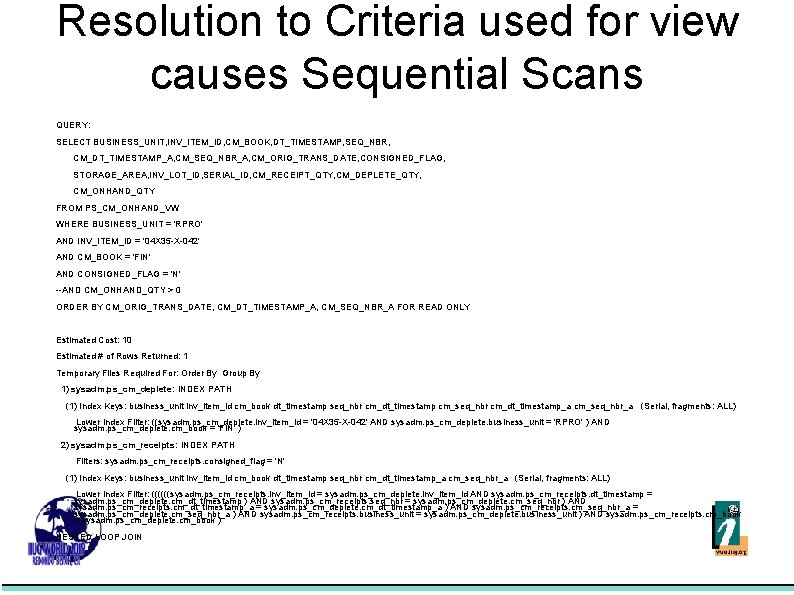
Resolution to Criteria used for view causes Sequential Scans QUERY: SELECT BUSINESS_UNIT, INV_ITEM_ID, CM_BOOK, DT_TIMESTAMP, SEQ_NBR, CM_DT_TIMESTAMP_A, CM_SEQ_NBR_A, CM_ORIG_TRANS_DATE, CONSIGNED_FLAG, STORAGE_AREA, INV_LOT_ID, SERIAL_ID, CM_RECEIPT_QTY, CM_DEPLETE_QTY, CM_ONHAND_QTY FROM PS_CM_ONHAND_VW WHERE BUSINESS_UNIT = 'RPRO' AND INV_ITEM_ID = '04 X 35 -X-042' AND CM_BOOK = 'FIN' AND CONSIGNED_FLAG = 'N' --AND CM_ONHAND_QTY > 0 ORDER BY CM_ORIG_TRANS_DATE, CM_DT_TIMESTAMP_A, CM_SEQ_NBR_A FOR READ ONLY Estimated Cost: 10 Estimated # of Rows Returned: 1 Temporary Files Required For: Order By Group By 1) sysadm. ps_cm_deplete: INDEX PATH (1) Index Keys: business_unit inv_item_id cm_book dt_timestamp seq_nbr cm_dt_timestamp cm_seq_nbr cm_dt_timestamp_a cm_seq_nbr_a (Serial, fragments: ALL) Lower Index Filter: ((sysadm. ps_cm_deplete. inv_item_id = '04 X 35 -X-042' AND sysadm. ps_cm_deplete. business_unit = 'RPRO' ) AND sysadm. ps_cm_deplete. cm_book = 'FIN' ) 2) sysadm. ps_cm_receipts: INDEX PATH Filters: sysadm. ps_cm_receipts. consigned_flag = 'N' (1) Index Keys: business_unit inv_item_id cm_book dt_timestamp seq_nbr cm_dt_timestamp_a cm_seq_nbr_a (Serial, fragments: ALL) Lower Index Filter: ((((((sysadm. ps_cm_receipts. inv_item_id = sysadm. ps_cm_deplete. inv_item_id AND sysadm. ps_cm_receipts. dt_timestamp = sysadm. ps_cm_deplete. cm_dt_timestamp ) AND sysadm. ps_cm_receipts. seq_nbr = sysadm. ps_cm_deplete. cm_seq_nbr ) AND sysadm. ps_cm_receipts. cm_dt_timestamp_a = sysadm. ps_cm_deplete. cm_dt_timestamp_a ) AND sysadm. ps_cm_receipts. cm_seq_nbr_a = sysadm. ps_cm_deplete. cm_seq_nbr_a ) AND sysadm. ps_cm_receipts. business_unit = sysadm. ps_cm_deplete. business_unit ) AND sysadm. ps_cm_receipts. cm_book = sysadm. ps_cm_deplete. cm_book ) NESTED LOOP JOIN
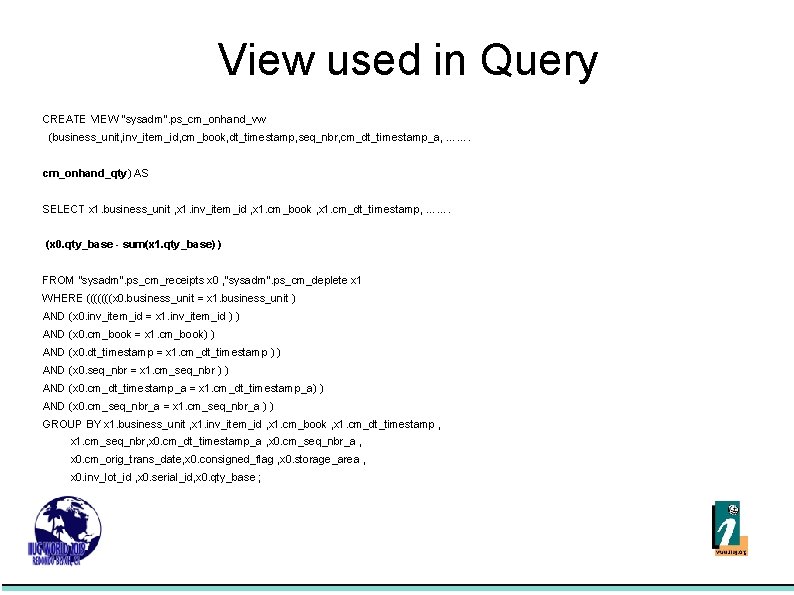
View used in Query CREATE VIEW "sysadm". ps_cm_onhand_vw (business_unit, inv_item_id, cm_book, dt_timestamp, seq_nbr, cm_dt_timestamp_a, ……. cm_onhand_qty) AS SELECT x 1. business_unit , x 1. inv_item_id , x 1. cm_book , x 1. cm_dt_timestamp, ……. (x 0. qty_base - sum(x 1. qty_base) ) FROM "sysadm". ps_cm_receipts x 0 , "sysadm". ps_cm_deplete x 1 WHERE (((((((x 0. business_unit = x 1. business_unit ) AND (x 0. inv_item_id = x 1. inv_item_id ) ) AND (x 0. cm_book = x 1. cm_book) ) AND (x 0. dt_timestamp = x 1. cm_dt_timestamp ) ) AND (x 0. seq_nbr = x 1. cm_seq_nbr ) ) AND (x 0. cm_dt_timestamp_a = x 1. cm_dt_timestamp_a) ) AND (x 0. cm_seq_nbr_a = x 1. cm_seq_nbr_a ) ) GROUP BY x 1. business_unit , x 1. inv_item_id , x 1. cm_book , x 1. cm_dt_timestamp , x 1. cm_seq_nbr, x 0. cm_dt_timestamp_a , x 0. cm_seq_nbr_a , x 0. cm_orig_trans_date, x 0. consigned_flag , x 0. storage_area , x 0. inv_lot_id , x 0. serial_id, x 0. qty_base ;
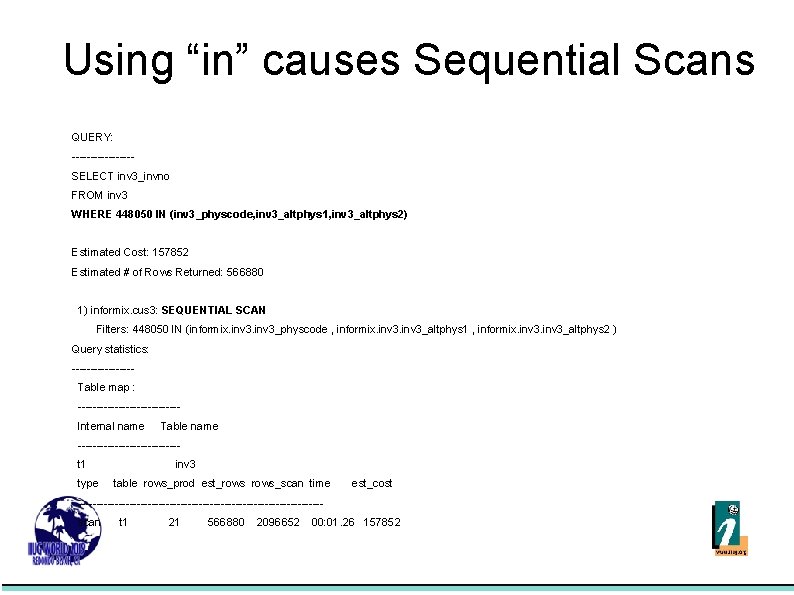
Using “in” causes Sequential Scans QUERY: --------SELECT inv 3_invno FROM inv 3 WHERE 448050 IN (inv 3_physcode, inv 3_altphys 1, inv 3_altphys 2) Estimated Cost: 157852 Estimated # of Rows Returned: 566880 1) informix. cus 3: SEQUENTIAL SCAN Filters: 448050 IN (informix. inv 3_physcode , informix. inv 3_altphys 1 , informix. inv 3_altphys 2 ) Query statistics: -------- Table map : -------------- Internal name Table name -------------- t 1 inv 3 type table rows_prod est_rows_scan time est_cost --------------------------------- scan t 1 21 566880 2096652 00: 01. 26 157852
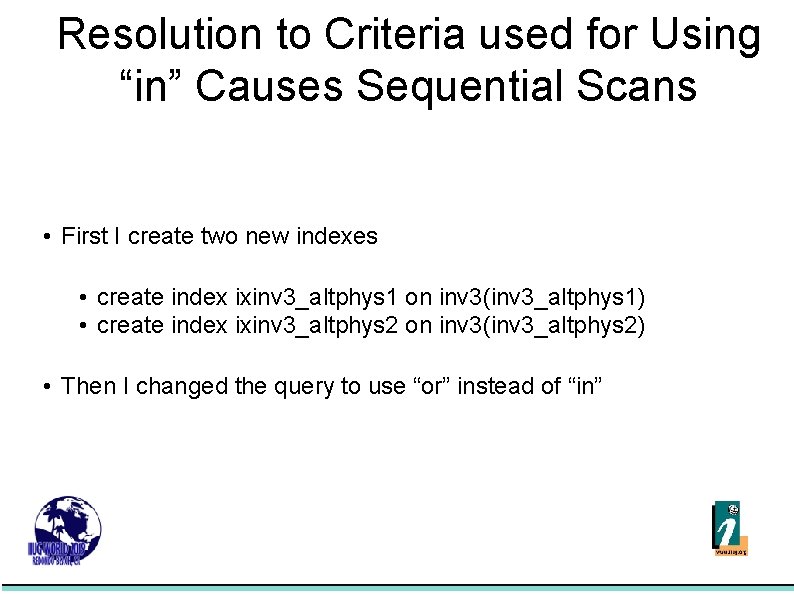
Resolution to Criteria used for Using “in” Causes Sequential Scans • First I create two new indexes • create index ixinv 3_altphys 1 on inv 3(inv 3_altphys 1) • create index ixinv 3_altphys 2 on inv 3(inv 3_altphys 2) • Then I changed the query to use “or” instead of “in”
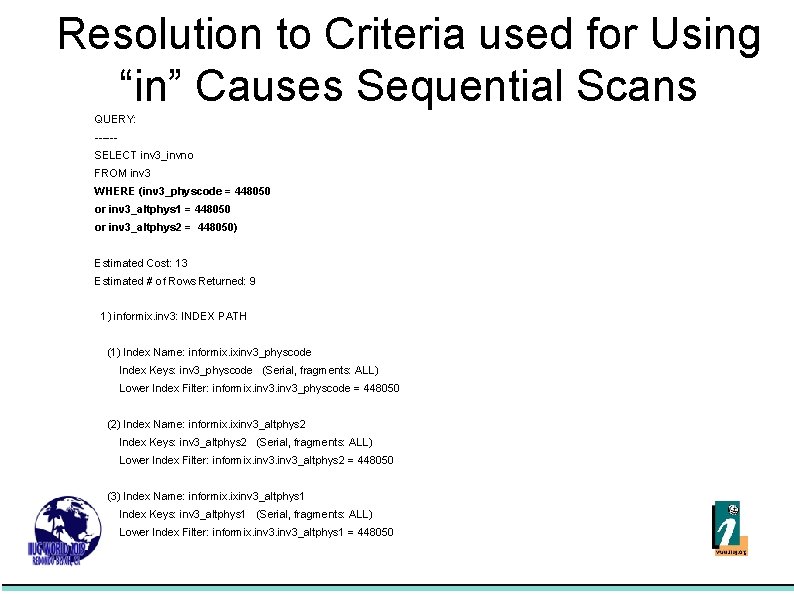
Resolution to Criteria used for Using “in” Causes Sequential Scans QUERY: -----SELECT inv 3_invno FROM inv 3 WHERE (inv 3_physcode = 448050 or inv 3_altphys 1 = 448050 or inv 3_altphys 2 = 448050) Estimated Cost: 13 Estimated # of Rows Returned: 9 1) informix. inv 3: INDEX PATH (1) Index Name: informix. ixinv 3_physcode Index Keys: inv 3_physcode (Serial, fragments: ALL) Lower Index Filter: informix. inv 3_physcode = 448050 (2) Index Name: informix. ixinv 3_altphys 2 Index Keys: inv 3_altphys 2 (Serial, fragments: ALL) Lower Index Filter: informix. inv 3_altphys 2 = 448050 (3) Index Name: informix. ixinv 3_altphys 1 Index Keys: inv 3_altphys 1 (Serial, fragments: ALL) Lower Index Filter: informix. inv 3_altphys 1 = 448050
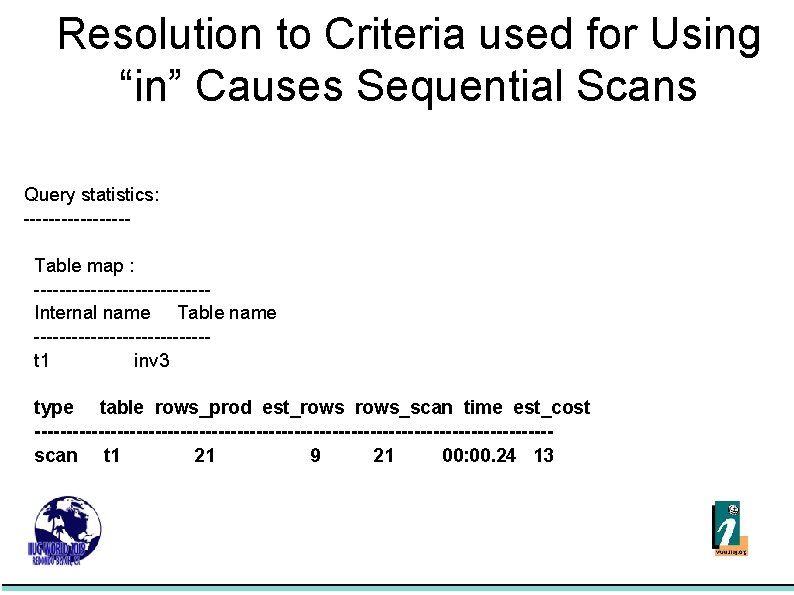
Resolution to Criteria used for Using “in” Causes Sequential Scans Query statistics: -------- Table map : -------------- Internal name Table name -------------- t 1 inv 3 type table rows_prod est_rows_scan time est_cost -----------------------------------------scan t 1 21 9 21 00: 00. 24 13
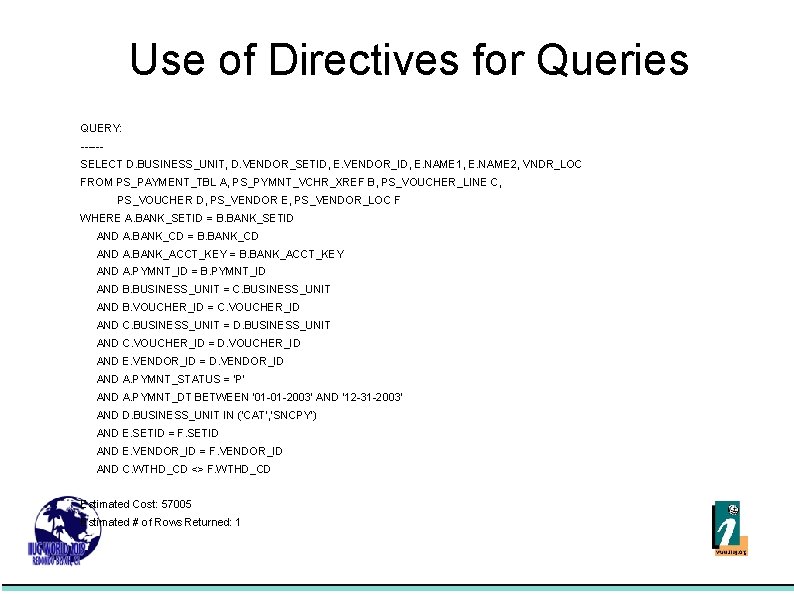
Use of Directives for Queries QUERY: -----SELECT D. BUSINESS_UNIT, D. VENDOR_SETID, E. VENDOR_ID, E. NAME 1, E. NAME 2, VNDR_LOC FROM PS_PAYMENT_TBL A, PS_PYMNT_VCHR_XREF B, PS_VOUCHER_LINE C, PS_VOUCHER D, PS_VENDOR E, PS_VENDOR_LOC F WHERE A. BANK_SETID = B. BANK_SETID AND A. BANK_CD = B. BANK_CD AND A. BANK_ACCT_KEY = B. BANK_ACCT_KEY AND A. PYMNT_ID = B. PYMNT_ID AND B. BUSINESS_UNIT = C. BUSINESS_UNIT AND B. VOUCHER_ID = C. VOUCHER_ID AND C. BUSINESS_UNIT = D. BUSINESS_UNIT AND C. VOUCHER_ID = D. VOUCHER_ID AND E. VENDOR_ID = D. VENDOR_ID AND A. PYMNT_STATUS = 'P' AND A. PYMNT_DT BETWEEN '01 -01 -2003' AND '12 -31 -2003' AND D. BUSINESS_UNIT IN ('CAT', ‘SNCPY') AND E. SETID = F. SETID AND E. VENDOR_ID = F. VENDOR_ID AND C. WTHD_CD <> F. WTHD_CD Estimated Cost: 57005 Estimated # of Rows Returned: 1
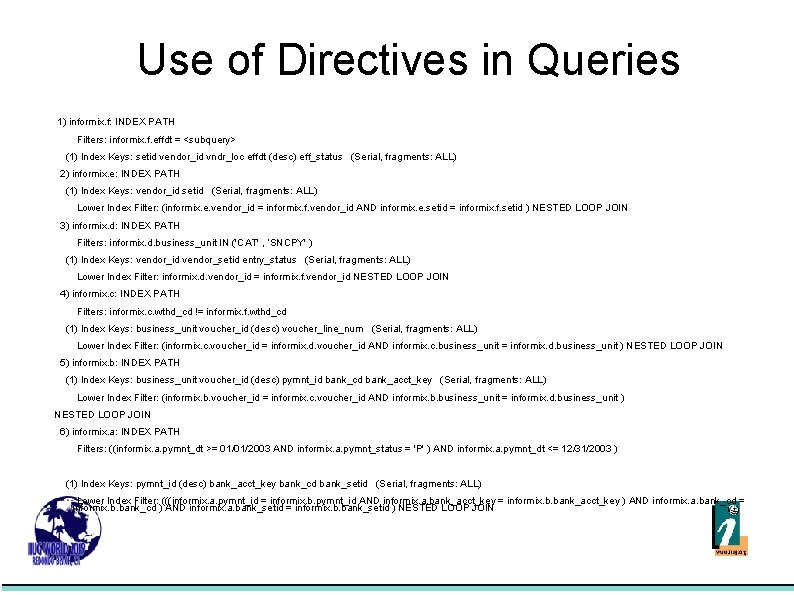
Use of Directives in Queries 1) informix. f: INDEX PATH Filters: informix. f. effdt = <subquery> (1) Index Keys: setid vendor_id vndr_loc effdt (desc) eff_status (Serial, fragments: ALL) 2) informix. e: INDEX PATH (1) Index Keys: vendor_id setid (Serial, fragments: ALL) Lower Index Filter: (informix. e. vendor_id = informix. f. vendor_id AND informix. e. setid = informix. f. setid ) NESTED LOOP JOIN 3) informix. d: INDEX PATH Filters: informix. d. business_unit IN ('CAT' , ‘SNCPY' ) (1) Index Keys: vendor_id vendor_setid entry_status (Serial, fragments: ALL) Lower Index Filter: informix. d. vendor_id = informix. f. vendor_id NESTED LOOP JOIN 4) informix. c: INDEX PATH Filters: informix. c. wthd_cd != informix. f. wthd_cd (1) Index Keys: business_unit voucher_id (desc) voucher_line_num (Serial, fragments: ALL) Lower Index Filter: (informix. c. voucher_id = informix. d. voucher_id AND informix. c. business_unit = informix. d. business_unit ) NESTED LOOP JOIN 5) informix. b: INDEX PATH (1) Index Keys: business_unit voucher_id (desc) pymnt_id bank_cd bank_acct_key (Serial, fragments: ALL) Lower Index Filter: (informix. b. voucher_id = informix. c. voucher_id AND informix. b. business_unit = informix. d. business_unit ) NESTED LOOP JOIN 6) informix. a: INDEX PATH Filters: ((informix. a. pymnt_dt >= 01/01/2003 AND informix. a. pymnt_status = 'P' ) AND informix. a. pymnt_dt <= 12/31/2003 ) (1) Index Keys: pymnt_id (desc) bank_acct_key bank_cd bank_setid (Serial, fragments: ALL) Lower Index Filter: (((informix. a. pymnt_id = informix. b. pymnt_id AND informix. a. bank_acct_key = informix. b. bank_acct_key ) AND informix. a. bank_cd = informix. b. bank_cd ) AND informix. a. bank_setid = informix. b. bank_setid ) NESTED LOOP JOIN
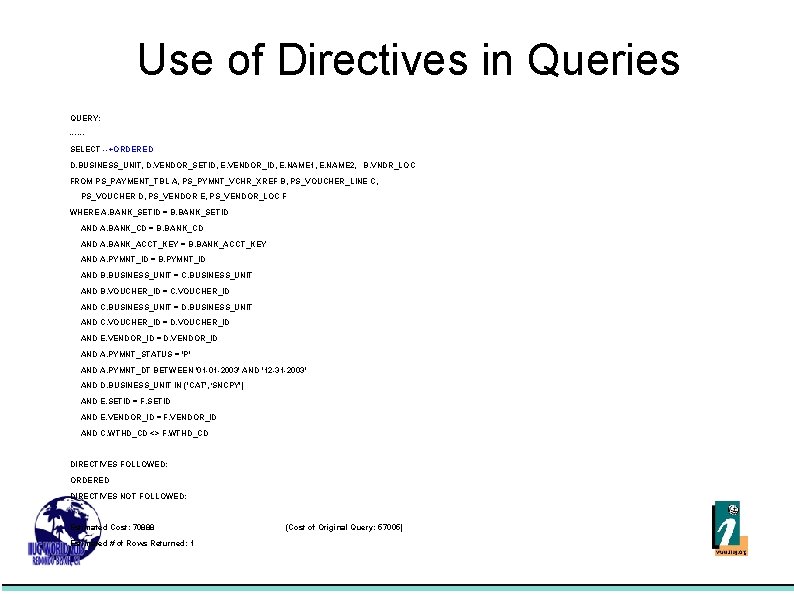
Use of Directives in Queries QUERY: -----SELECT --+ORDERED D. BUSINESS_UNIT, D. VENDOR_SETID, E. VENDOR_ID, E. NAME 1, E. NAME 2, B. VNDR_LOC FROM PS_PAYMENT_TBL A, PS_PYMNT_VCHR_XREF B, PS_VOUCHER_LINE C, PS_VOUCHER D, PS_VENDOR E, PS_VENDOR_LOC F WHERE A. BANK_SETID = B. BANK_SETID AND A. BANK_CD = B. BANK_CD AND A. BANK_ACCT_KEY = B. BANK_ACCT_KEY AND A. PYMNT_ID = B. PYMNT_ID AND B. BUSINESS_UNIT = C. BUSINESS_UNIT AND B. VOUCHER_ID = C. VOUCHER_ID AND C. BUSINESS_UNIT = D. BUSINESS_UNIT AND C. VOUCHER_ID = D. VOUCHER_ID AND E. VENDOR_ID = D. VENDOR_ID AND A. PYMNT_STATUS = 'P' AND A. PYMNT_DT BETWEEN '01 -01 -2003' AND '12 -31 -2003' AND D. BUSINESS_UNIT IN ('CAT', ‘SNCPY') AND E. SETID = F. SETID AND E. VENDOR_ID = F. VENDOR_ID AND C. WTHD_CD <> F. WTHD_CD DIRECTIVES FOLLOWED: ORDERED DIRECTIVES NOT FOLLOWED: Estimated Cost: 70888 Estimated # of Rows Returned: 1 (Cost of Original Query: 57005)
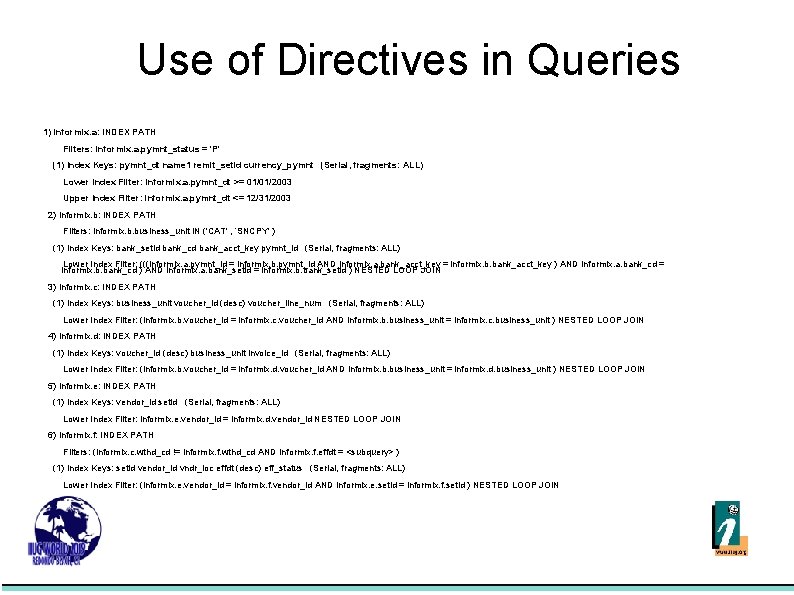
Use of Directives in Queries 1) informix. a: INDEX PATH Filters: informix. a. pymnt_status = 'P' (1) Index Keys: pymnt_dt name 1 remit_setid currency_pymnt (Serial, fragments: ALL) Lower Index Filter: informix. a. pymnt_dt >= 01/01/2003 Upper Index Filter: informix. a. pymnt_dt <= 12/31/2003 2) informix. b: INDEX PATH Filters: informix. b. business_unit IN ('CAT' , ‘SNCPY' ) (1) Index Keys: bank_setid bank_cd bank_acct_key pymnt_id (Serial, fragments: ALL) Lower Index Filter: (((informix. a. pymnt_id = informix. b. pymnt_id AND informix. a. bank_acct_key = informix. b. bank_acct_key ) AND informix. a. bank_cd = informix. b. bank_cd ) AND informix. a. bank_setid = informix. b. bank_setid ) NESTED LOOP JOIN 3) informix. c: INDEX PATH (1) Index Keys: business_unit voucher_id (desc) voucher_line_num (Serial, fragments: ALL) Lower Index Filter: (informix. b. voucher_id = informix. c. voucher_id AND informix. b. business_unit = informix. c. business_unit ) NESTED LOOP JOIN 4) informix. d: INDEX PATH (1) Index Keys: voucher_id (desc) business_unit invoice_id (Serial, fragments: ALL) Lower Index Filter: (informix. b. voucher_id = informix. d. voucher_id AND informix. b. business_unit = informix. d. business_unit ) NESTED LOOP JOIN 5) informix. e: INDEX PATH (1) Index Keys: vendor_id setid (Serial, fragments: ALL) Lower Index Filter: informix. e. vendor_id = informix. d. vendor_id NESTED LOOP JOIN 6) informix. f: INDEX PATH Filters: (informix. c. wthd_cd != informix. f. wthd_cd AND informix. f. effdt = <subquery> ) (1) Index Keys: setid vendor_id vndr_loc effdt (desc) eff_status (Serial, fragments: ALL) Lower Index Filter: (informix. e. vendor_id = informix. f. vendor_id AND informix. e. setid = informix. f. setid ) NESTED LOOP JOIN
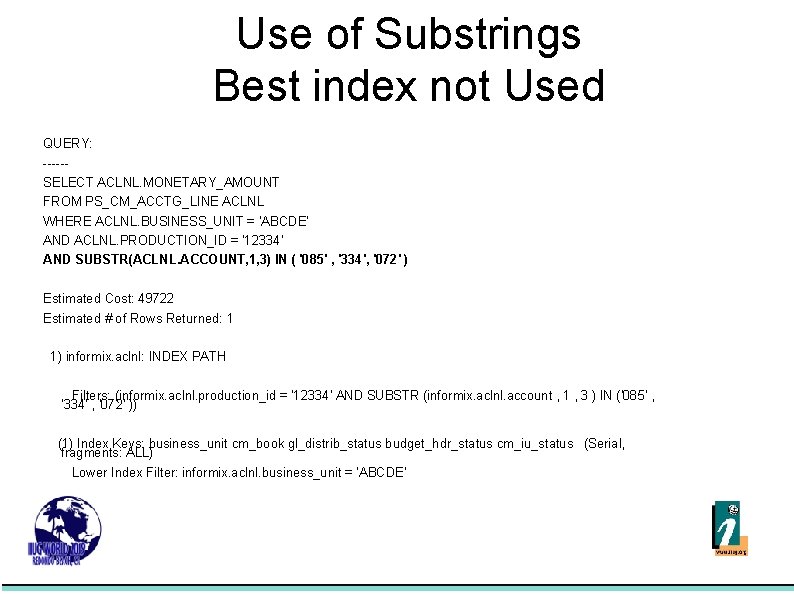
Use of Substrings Best index not Used QUERY: -----SELECT ACLNL. MONETARY_AMOUNT FROM PS_CM_ACCTG_LINE ACLNL WHERE ACLNL. BUSINESS_UNIT = ‘ABCDE' AND ACLNL. PRODUCTION_ID = '12334' AND SUBSTR(ACLNL. ACCOUNT, 1, 3) IN ( '085' , '334', '072' ) Estimated Cost: 49722 Estimated # of Rows Returned: 1 1) informix. aclnl: INDEX PATH Filters: (informix. aclnl. production_id = '12334' AND SUBSTR (informix. aclnl. account , 1 , 3 ) IN ('085' , '334' , '072' )) (1) Index Keys: business_unit cm_book gl_distrib_status budget_hdr_status cm_iu_status (Serial, fragments: ALL) Lower Index Filter: informix. aclnl. business_unit = ‘ABCDE'
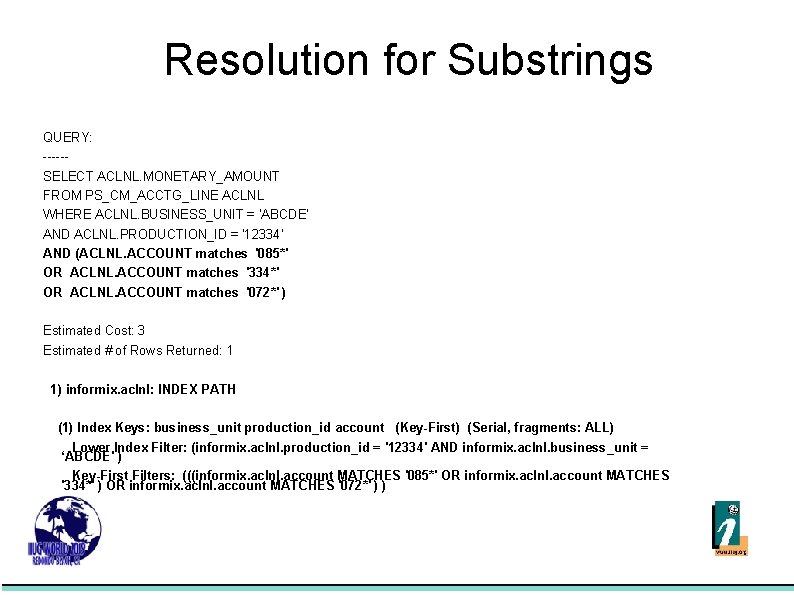
Resolution for Substrings QUERY: -----SELECT ACLNL. MONETARY_AMOUNT FROM PS_CM_ACCTG_LINE ACLNL WHERE ACLNL. BUSINESS_UNIT = ‘ABCDE' AND ACLNL. PRODUCTION_ID = '12334' AND (ACLNL. ACCOUNT matches '085*' OR ACLNL. ACCOUNT matches '334*' OR ACLNL. ACCOUNT matches '072*' ) Estimated Cost: 3 Estimated # of Rows Returned: 1 1) informix. aclnl: INDEX PATH (1) Index Keys: business_unit production_id account (Key-First) (Serial, fragments: ALL) Lower Index Filter: (informix. aclnl. production_id = '12334' AND informix. aclnl. business_unit = ‘ABCDE' ) Key-First Filters: (((informix. aclnl. account MATCHES '085*' OR informix. aclnl. account MATCHES '334*' ) OR informix. aclnl. account MATCHES '072*' ) )
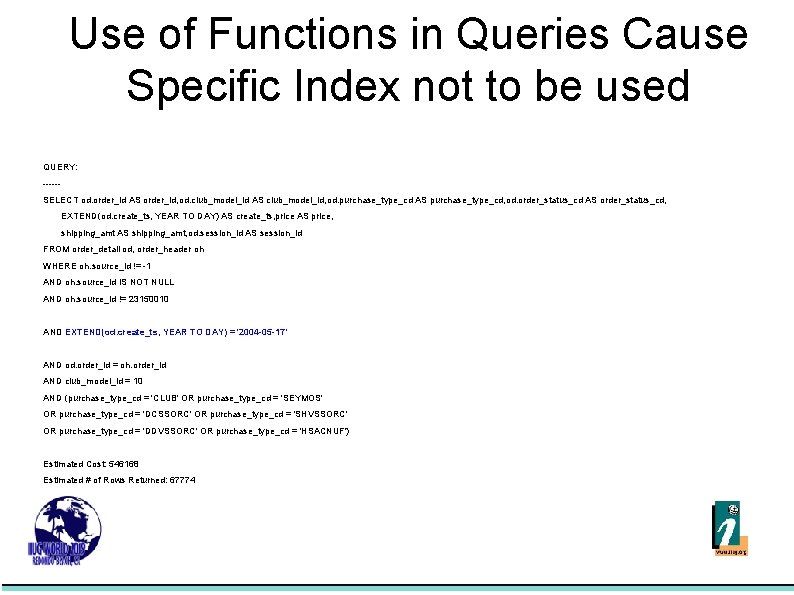
Use of Functions in Queries Cause Specific Index not to be used QUERY: -----SELECT od. order_id AS order_id, od. club_model_id AS club_model_id, od. purchase_type_cd AS purchase_type_cd, od. order_status_cd AS order_status_cd, EXTEND(od. create_ts, YEAR TO DAY) AS create_ts, price AS price, shipping_amt AS shipping_amt, od. session_id AS session_id FROM order_detail od, order_header oh WHERE oh. source_id != -1 AND oh. source_id IS NOT NULL AND oh. source_id != 23150010 AND EXTEND(od. create_ts, YEAR TO DAY) = '2004 -05 -17‘ AND od. order_id = oh. order_id AND club_model_id = 10 AND (purchase_type_cd = 'CLUB' OR purchase_type_cd = 'SEYMOS' OR purchase_type_cd = 'DCSSORC' OR purchase_type_cd = 'SHVSSORC' OR purchase_type_cd = 'DDVSSORC' OR purchase_type_cd = 'HSACNUF') Estimated Cost: 546168 Estimated # of Rows Returned: 67774
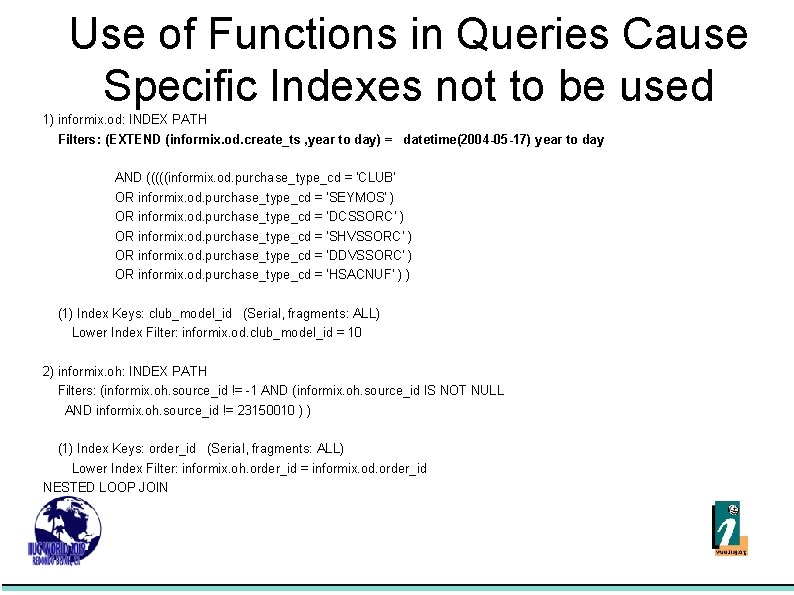
Use of Functions in Queries Cause Specific Indexes not to be used 1) informix. od: INDEX PATH Filters: (EXTEND (informix. od. create_ts , year to day) = datetime(2004 -05 -17) year to day AND (((((informix. od. purchase_type_cd = 'CLUB' OR informix. od. purchase_type_cd = 'SEYMOS' ) OR informix. od. purchase_type_cd = 'DCSSORC' ) OR informix. od. purchase_type_cd = 'SHVSSORC' ) OR informix. od. purchase_type_cd = 'DDVSSORC' ) OR informix. od. purchase_type_cd = 'HSACNUF' ) ) (1) Index Keys: club_model_id (Serial, fragments: ALL) Lower Index Filter: informix. od. club_model_id = 10 2) informix. oh: INDEX PATH Filters: (informix. oh. source_id != -1 AND (informix. oh. source_id IS NOT NULL AND informix. oh. source_id != 23150010 ) ) (1) Index Keys: order_id (Serial, fragments: ALL) Lower Index Filter: informix. oh. order_id = informix. od. order_id NESTED LOOP JOIN
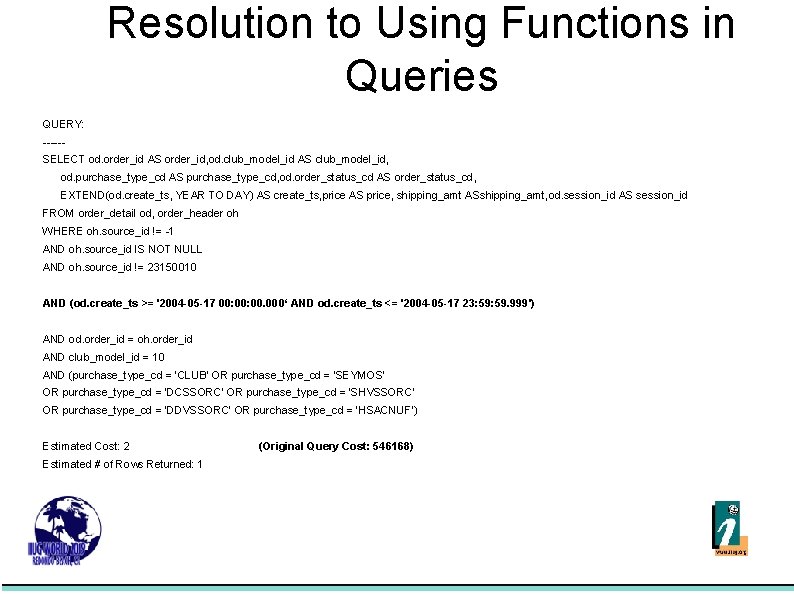
Resolution to Using Functions in Queries QUERY: -----SELECT od. order_id AS order_id, od. club_model_id AS club_model_id, od. purchase_type_cd AS purchase_type_cd, od. order_status_cd AS order_status_cd, EXTEND(od. create_ts, YEAR TO DAY) AS create_ts, price AS price, shipping_amt ASshipping_amt, od. session_id AS session_id FROM order_detail od, order_header oh WHERE oh. source_id != -1 AND oh. source_id IS NOT NULL AND oh. source_id != 23150010 AND (od. create_ts >= '2004 -05 -17 00: 00. 000‘ AND od. create_ts <= '2004 -05 -17 23: 59. 999') AND od. order_id = oh. order_id AND club_model_id = 10 AND (purchase_type_cd = 'CLUB' OR purchase_type_cd = 'SEYMOS' OR purchase_type_cd = 'DCSSORC' OR purchase_type_cd = 'SHVSSORC' OR purchase_type_cd = 'DDVSSORC' OR purchase_type_cd = 'HSACNUF') Estimated Cost: 2 Estimated # of Rows Returned: 1 (Original Query Cost: 546168)
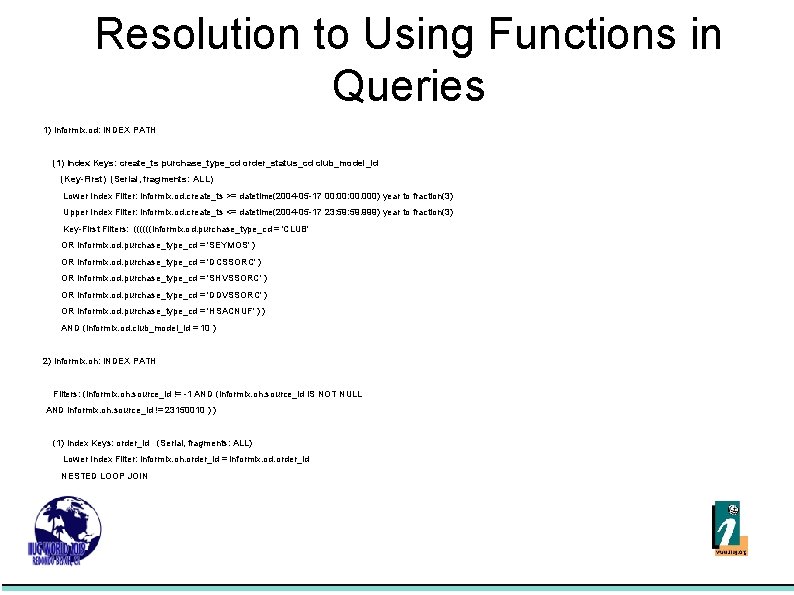
Resolution to Using Functions in Queries 1) informix. od: INDEX PATH (1) Index Keys: create_ts purchase_type_cd order_status_cd club_model_id (Key-First) (Serial, fragments: ALL) Lower Index Filter: informix. od. create_ts >= datetime(2004 -05 -17 00: 00. 000) year to fraction(3) Upper Index Filter: informix. od. create_ts <= datetime(2004 -05 -17 23: 59. 999) year to fraction(3) Key-First Filters: ((((((informix. od. purchase_type_cd = 'CLUB' OR informix. od. purchase_type_cd = 'SEYMOS' ) OR informix. od. purchase_type_cd = 'DCSSORC' ) OR informix. od. purchase_type_cd = 'SHVSSORC' ) OR informix. od. purchase_type_cd = 'DDVSSORC' ) OR informix. od. purchase_type_cd = 'HSACNUF' ) ) AND (informix. od. club_model_id = 10 ) 2) informix. oh: INDEX PATH Filters: (informix. oh. source_id != -1 AND (informix. oh. source_id IS NOT NULL AND informix. oh. source_id != 23150010 ) ) (1) Index Keys: order_id (Serial, fragments: ALL) Lower Index Filter: informix. oh. order_id = informix. od. order_id NESTED LOOP JOIN
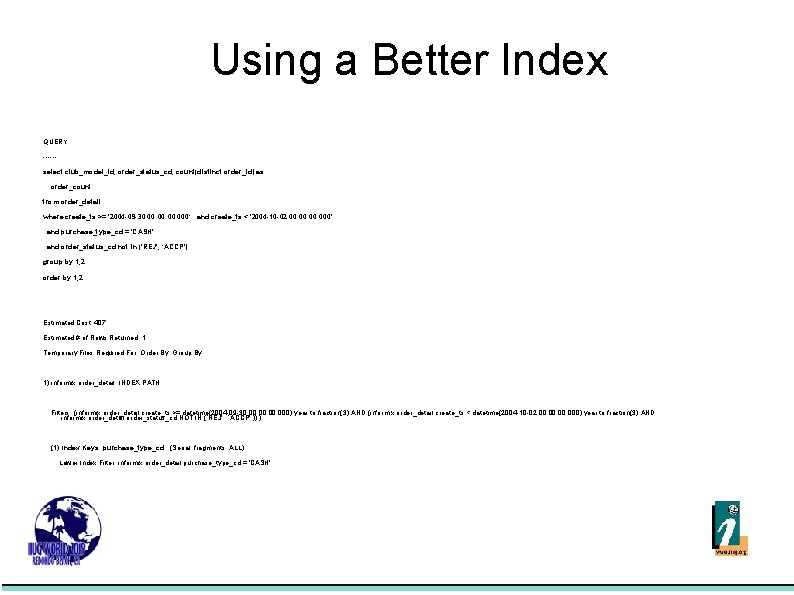
Using a Better Index QUERY: -----select club_model_id, order_status_cd, count(distinct order_id) as order_count from order_detail where create_ts >= '2004 -09 -30 00: 00. 000‘ and create_ts < '2004 -10 -02 00: 00. 000' and purchase_type_cd = 'CASH' and order_status_cd not in ('REJ', ‘ACCP') group by 1, 2 order by 1, 2 Estimated Cost: 407 Estimated # of Rows Returned: 1 Temporary Files Required For: Order By Group By 1) informix. order_detail: INDEX PATH Filters: (informix. order_detail. create_ts >= datetime(2004 -09 -30 00: 00. 000) year to fraction(3) AND (informix. order_detail. create_ts < datetime(2004 -10 -02 00: 00. 000) year to fraction(3) AND informix. order_detail. order_status_cd NOT IN (‘REJ' , ‘ACCP' )) ) (1) Index Keys: purchase_type_cd (Serial, fragments: ALL) Lower Index Filter: informix. order_detail. purchase_type_cd = 'CASH'
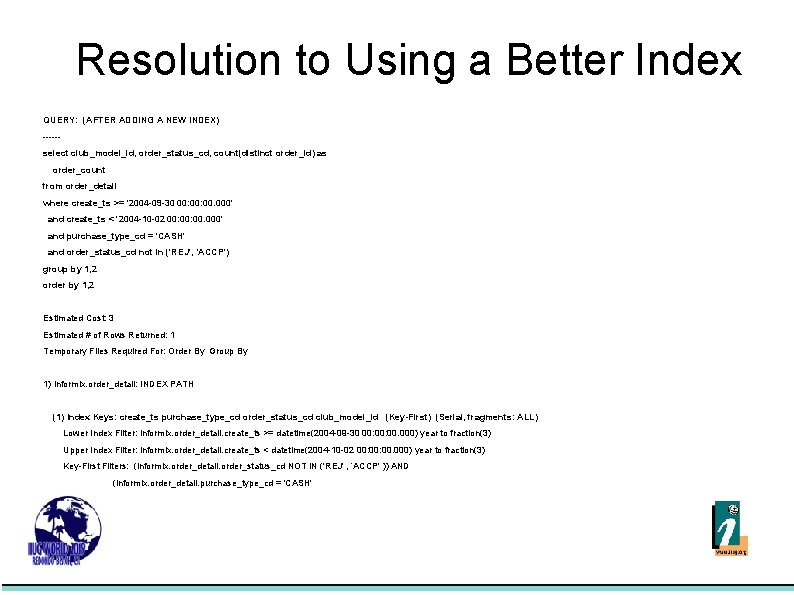
Resolution to Using a Better Index QUERY: (AFTER ADDING A NEW INDEX) -----select club_model_id, order_status_cd, count(distinct order_id) as order_count from order_detail where create_ts >= '2004 -09 -30 00: 00. 000' and create_ts < '2004 -10 -02 00: 00. 000' and purchase_type_cd = 'CASH' and order_status_cd not in ('REJ', ‘ACCP') group by 1, 2 order by 1, 2 Estimated Cost: 3 Estimated # of Rows Returned: 1 Temporary Files Required For: Order By Group By 1) informix. order_detail: INDEX PATH (1) Index Keys: create_ts purchase_type_cd order_status_cd club_model_id (Key-First) (Serial, fragments: ALL) Lower Index Filter: informix. order_detail. create_ts >= datetime(2004 -09 -30 00: 00. 000) year to fraction(3) Upper Index Filter: informix. order_detail. create_ts < datetime(2004 -10 -02 00: 00. 000) year to fraction(3) Key-First Filters: (informix. order_detail. order_status_cd NOT IN ('REJ' , ‘ACCP' )) AND (informix. order_detail. purchase_type_cd = 'CASH'
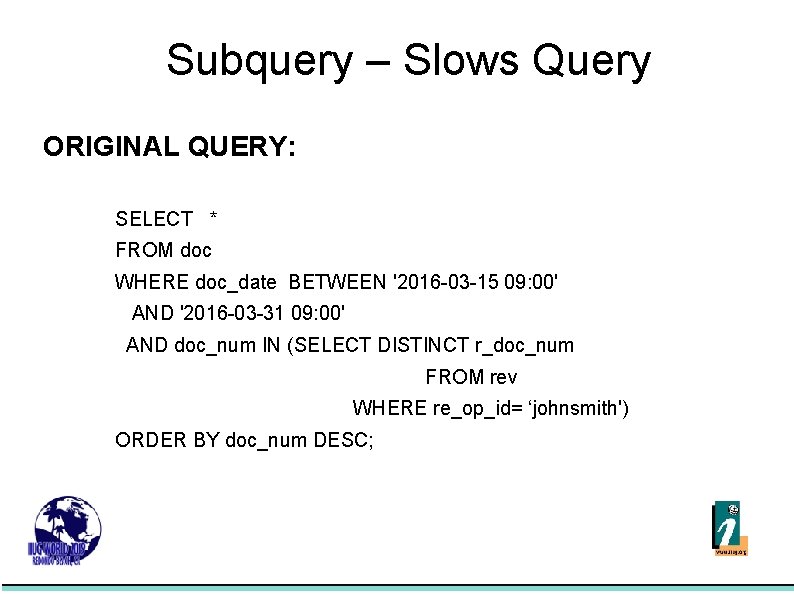
Subquery – Slows Query ORIGINAL QUERY: SELECT * FROM doc WHERE doc_date BETWEEN '2016 -03 -15 09: 00' AND '2016 -03 -31 09: 00' AND doc_num IN (SELECT DISTINCT r_doc_num FROM rev WHERE re_op_id= ‘johnsmith') ORDER BY doc_num DESC;
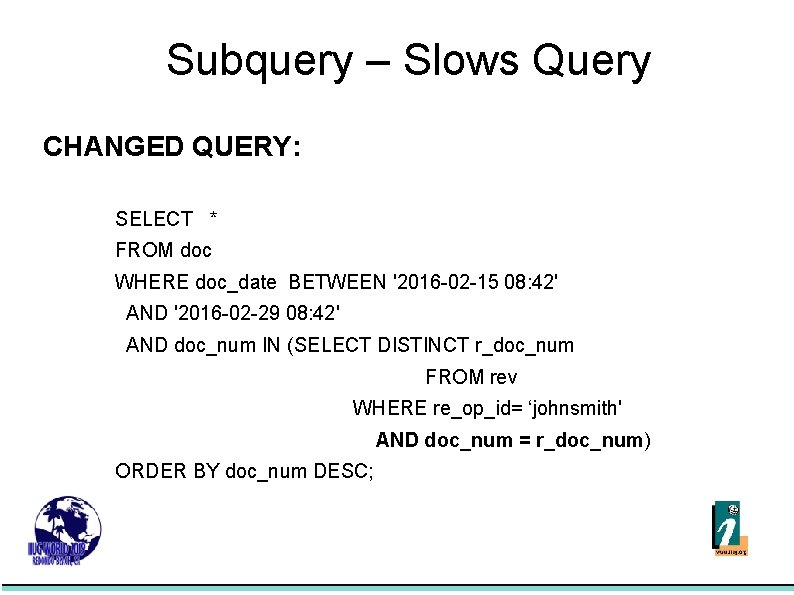
Subquery – Slows Query CHANGED QUERY: SELECT * FROM doc WHERE doc_date BETWEEN '2016 -02 -15 08: 42' AND '2016 -02 -29 08: 42' AND doc_num IN (SELECT DISTINCT r_doc_num FROM rev WHERE re_op_id= ‘johnsmith' AND doc_num = r_doc_num) ORDER BY doc_num DESC;
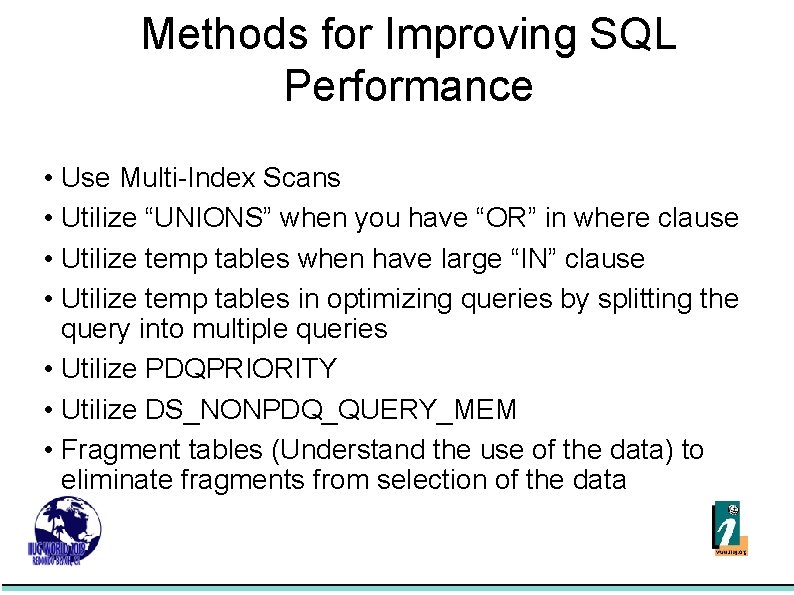
Methods for Improving SQL Performance • Use Multi-Index Scans • Utilize “UNIONS” when you have “OR” in where clause • Utilize temp tables when have large “IN” clause • Utilize temp tables in optimizing queries by splitting the query into multiple queries • Utilize PDQPRIORITY • Utilize DS_NONPDQ_QUERY_MEM • Fragment tables (Understand the use of the data) to eliminate fragments from selection of the data
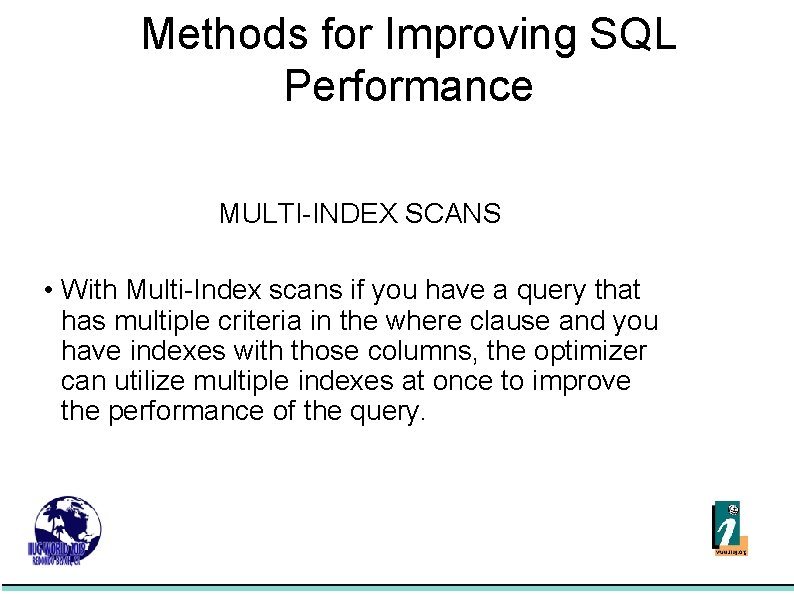
Methods for Improving SQL Performance MULTI-INDEX SCANS • With Multi-Index scans if you have a query that has multiple criteria in the where clause and you have indexes with those columns, the optimizer can utilize multiple indexes at once to improve the performance of the query.
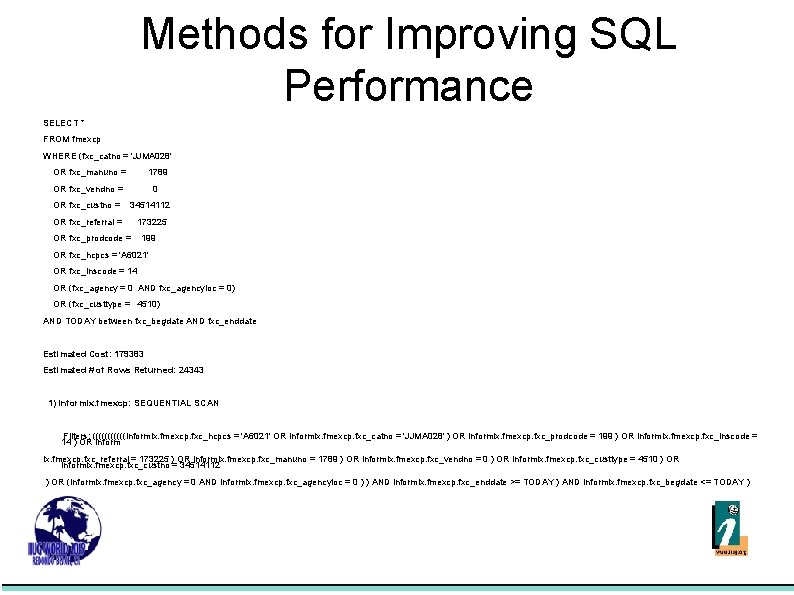
Methods for Improving SQL Performance SELECT * FROM fmexcp WHERE (fxc_catno = 'JJMA 028' OR fxc_manuno = 1789 OR fxc_vendno = 0 OR fxc_custno = 34514112 OR fxc_referral = 173225 OR fxc_prodcode = 199 OR fxc_hcpcs = 'A 6021' OR fxc_inscode = 14 OR (fxc_agency = 0 AND fxc_agencyloc = 0) OR (fxc_custtype = 4510) AND TODAY between fxc_begdate AND fxc_enddate Estimated Cost: 179383 Estimated # of Rows Returned: 24343 1) informix. fmexcp: SEQUENTIAL SCAN Filters: ((((((informix. fmexcp. fxc_hcpcs = 'A 6021' OR informix. fmexcp. fxc_catno = 'JJMA 028' ) OR informix. fmexcp. fxc_prodcode = 199 ) OR informix. fmexcp. fxc_inscode = 14 ) OR inform ix. fmexcp. fxc_referral = 173225 ) OR informix. fmexcp. fxc_manuno = 1789 ) OR informix. fmexcp. fxc_vendno = 0 ) OR informix. fmexcp. fxc_custtype = 4510 ) OR informix. fmexcp. fxc_custno = 34514112 ) OR (informix. fmexcp. fxc_agency = 0 AND informix. fmexcp. fxc_agencyloc = 0 ) ) AND informix. fmexcp. fxc_enddate >= TODAY ) AND informix. fmexcp. fxc_begdate <= TODAY )
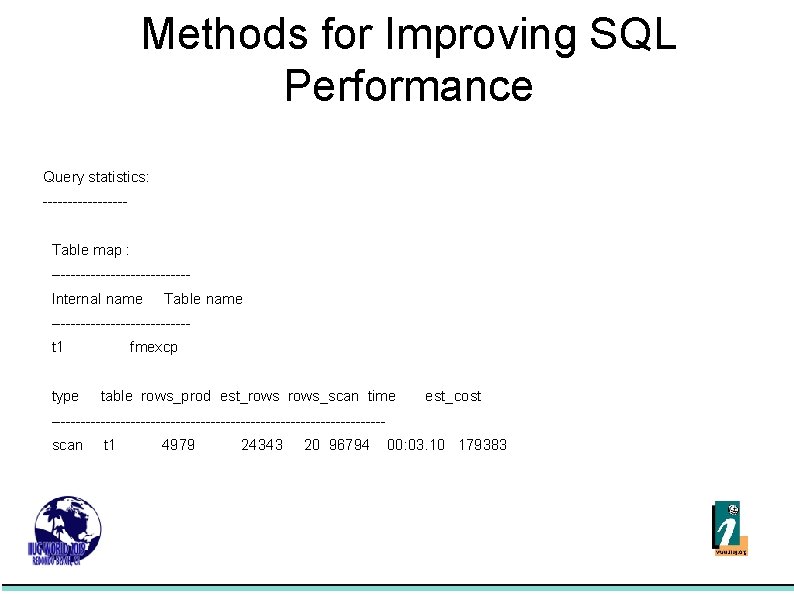
Methods for Improving SQL Performance Query statistics: -------- Table map : -------------- Internal name Table name -------------- t 1 fmexcp type table rows_prod est_rows_scan time est_cost --------------------------------- scan t 1 4979 24343 20 96794 00: 03. 10 179383
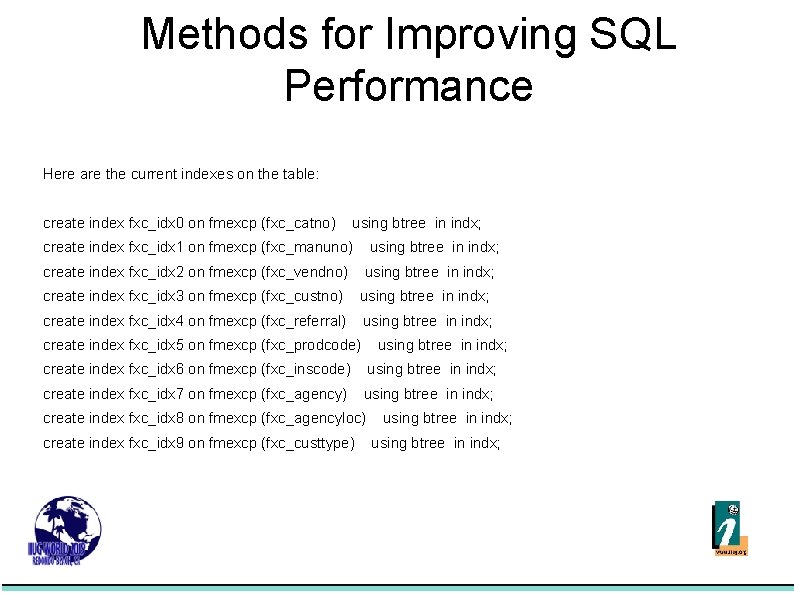
Methods for Improving SQL Performance Here are the current indexes on the table: create index fxc_idx 0 on fmexcp (fxc_catno) using btree in indx; create index fxc_idx 1 on fmexcp (fxc_manuno) using btree in indx; create index fxc_idx 2 on fmexcp (fxc_vendno) using btree in indx; create index fxc_idx 3 on fmexcp (fxc_custno) using btree in indx; create index fxc_idx 4 on fmexcp (fxc_referral) using btree in indx; create index fxc_idx 5 on fmexcp (fxc_prodcode) using btree in indx; create index fxc_idx 6 on fmexcp (fxc_inscode) using btree in indx; create index fxc_idx 7 on fmexcp (fxc_agency) using btree in indx; create index fxc_idx 8 on fmexcp (fxc_agencyloc) using btree in indx; create index fxc_idx 9 on fmexcp (fxc_custtype) using btree in indx;
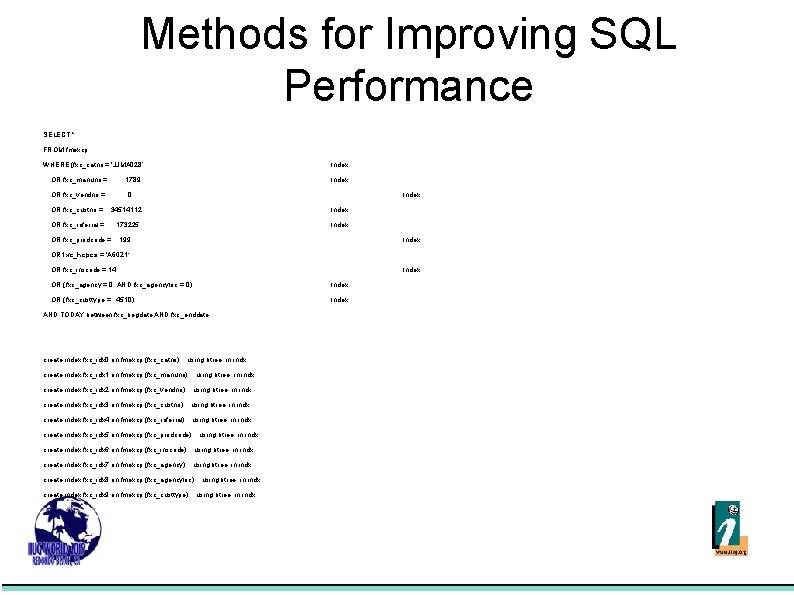
Methods for Improving SQL Performance SELECT * FROM fmexcp WHERE (fxc_catno = 'JJMA 028‘ Index OR fxc_manuno = 1789 Index OR fxc_vendno = 0 Index OR fxc_custno = 34514112 Index OR fxc_referral = 173225 Index OR fxc_prodcode = 199 Index OR fxc_hcpcs = 'A 6021‘ OR fxc_inscode = 14 Index OR (fxc_agency = 0 AND fxc_agencyloc = 0) Index OR (fxc_custtype = 4510) Index AND TODAY between fxc_begdate AND fxc_enddate create index fxc_idx 0 on fmexcp (fxc_catno) using btree in indx; create index fxc_idx 1 on fmexcp (fxc_manuno) using btree in indx; create index fxc_idx 2 on fmexcp (fxc_vendno) using btree in indx; create index fxc_idx 3 on fmexcp (fxc_custno) using btree in indx; create index fxc_idx 4 on fmexcp (fxc_referral) using btree in indx; create index fxc_idx 5 on fmexcp (fxc_prodcode) using btree in indx; create index fxc_idx 6 on fmexcp (fxc_inscode) using btree in indx; create index fxc_idx 7 on fmexcp (fxc_agency) using btree in indx; create index fxc_idx 8 on fmexcp (fxc_agencyloc) using btree in indx; create index fxc_idx 9 on fmexcp (fxc_custtype) using btree in indx;
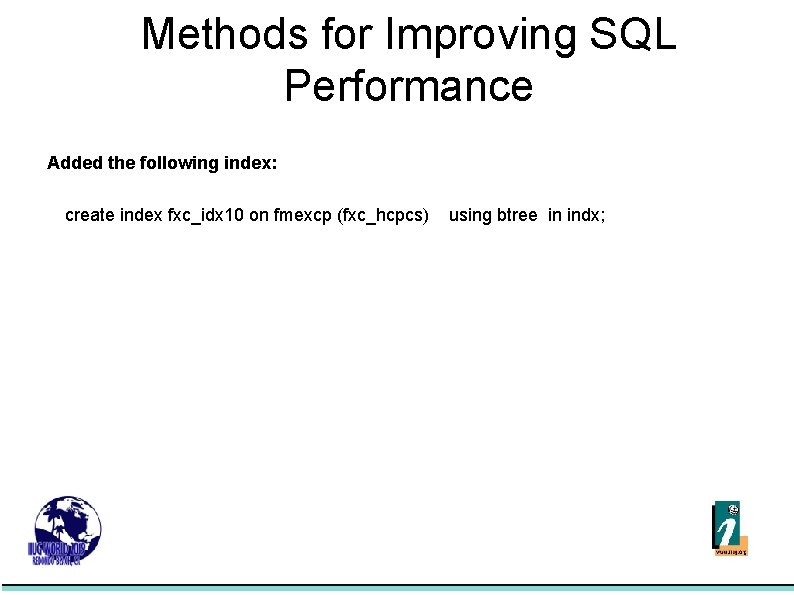
Methods for Improving SQL Performance Added the following index: create index fxc_idx 10 on fmexcp (fxc_hcpcs) using btree in indx;
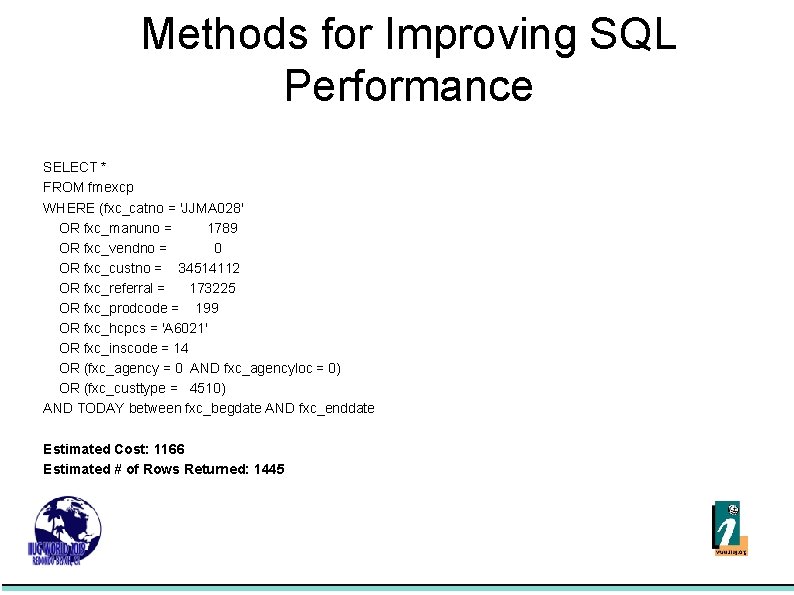
Methods for Improving SQL Performance SELECT * FROM fmexcp WHERE (fxc_catno = 'JJMA 028' OR fxc_manuno = 1789 OR fxc_vendno = 0 OR fxc_custno = 34514112 OR fxc_referral = 173225 OR fxc_prodcode = 199 OR fxc_hcpcs = 'A 6021' OR fxc_inscode = 14 OR (fxc_agency = 0 AND fxc_agencyloc = 0) OR (fxc_custtype = 4510) AND TODAY between fxc_begdate AND fxc_enddate Estimated Cost: 1166 Estimated # of Rows Returned: 1445
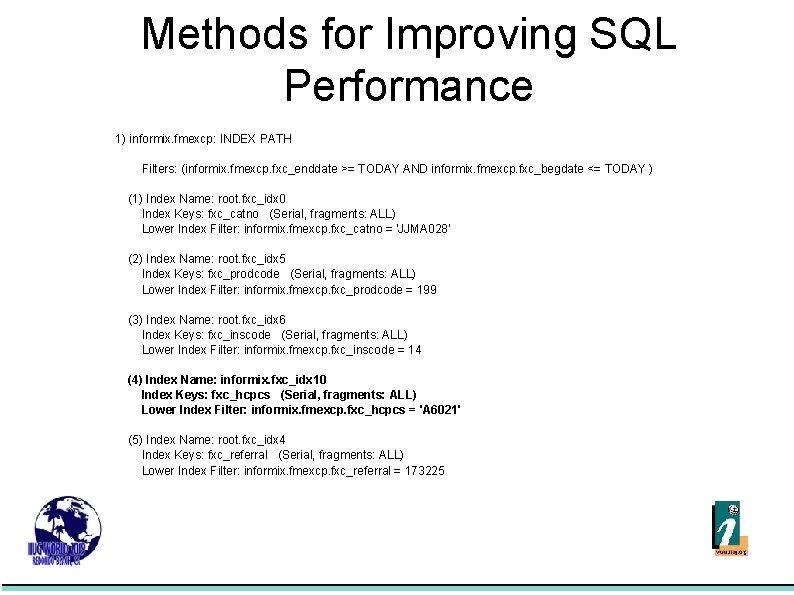
Methods for Improving SQL Performance 1) informix. fmexcp: INDEX PATH Filters: (informix. fmexcp. fxc_enddate >= TODAY AND informix. fmexcp. fxc_begdate <= TODAY ) (1) Index Name: root. fxc_idx 0 Index Keys: fxc_catno (Serial, fragments: ALL) Lower Index Filter: informix. fmexcp. fxc_catno = 'JJMA 028' (2) Index Name: root. fxc_idx 5 Index Keys: fxc_prodcode (Serial, fragments: ALL) Lower Index Filter: informix. fmexcp. fxc_prodcode = 199 (3) Index Name: root. fxc_idx 6 Index Keys: fxc_inscode (Serial, fragments: ALL) Lower Index Filter: informix. fmexcp. fxc_inscode = 14 (4) Index Name: informix. fxc_idx 10 Index Keys: fxc_hcpcs (Serial, fragments: ALL) Lower Index Filter: informix. fmexcp. fxc_hcpcs = 'A 6021' (5) Index Name: root. fxc_idx 4 Index Keys: fxc_referral (Serial, fragments: ALL) Lower Index Filter: informix. fmexcp. fxc_referral = 173225
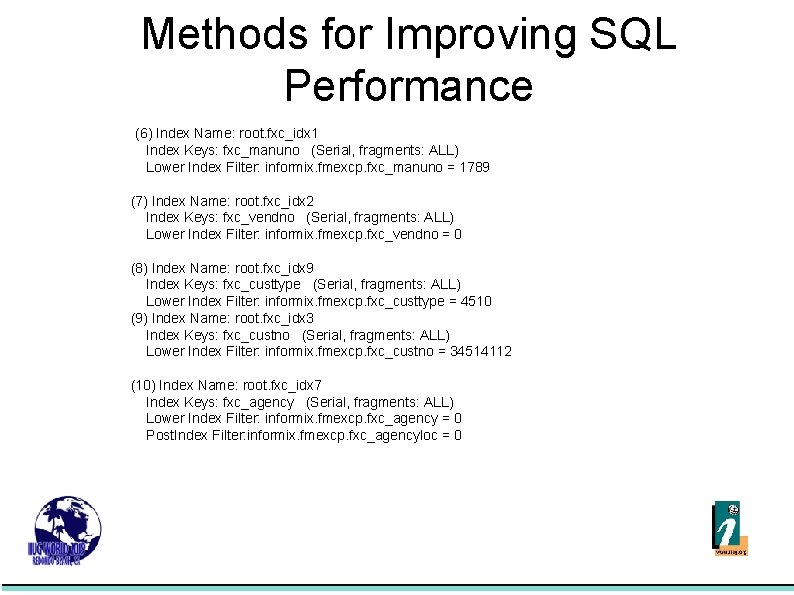
Methods for Improving SQL Performance (6) Index Name: root. fxc_idx 1 Index Keys: fxc_manuno (Serial, fragments: ALL) Lower Index Filter: informix. fmexcp. fxc_manuno = 1789 (7) Index Name: root. fxc_idx 2 Index Keys: fxc_vendno (Serial, fragments: ALL) Lower Index Filter: informix. fmexcp. fxc_vendno = 0 (8) Index Name: root. fxc_idx 9 Index Keys: fxc_custtype (Serial, fragments: ALL) Lower Index Filter: informix. fmexcp. fxc_custtype = 4510 (9) Index Name: root. fxc_idx 3 Index Keys: fxc_custno (Serial, fragments: ALL) Lower Index Filter: informix. fmexcp. fxc_custno = 34514112 (10) Index Name: root. fxc_idx 7 Index Keys: fxc_agency (Serial, fragments: ALL) Lower Index Filter: informix. fmexcp. fxc_agency = 0 Post. Index Filter: informix. fmexcp. fxc_agencyloc = 0
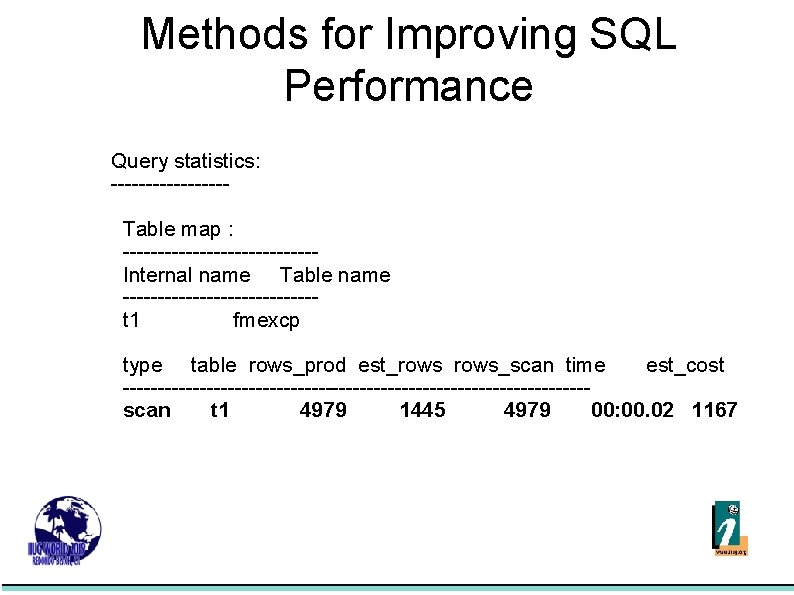
Methods for Improving SQL Performance Query statistics: -------- Table map : -------------- Internal name Table name -------------- t 1 fmexcp type table rows_prod est_rows_scan time est_cost --------------------------------- scan t 1 4979 1445 4979 00: 00. 02 1167
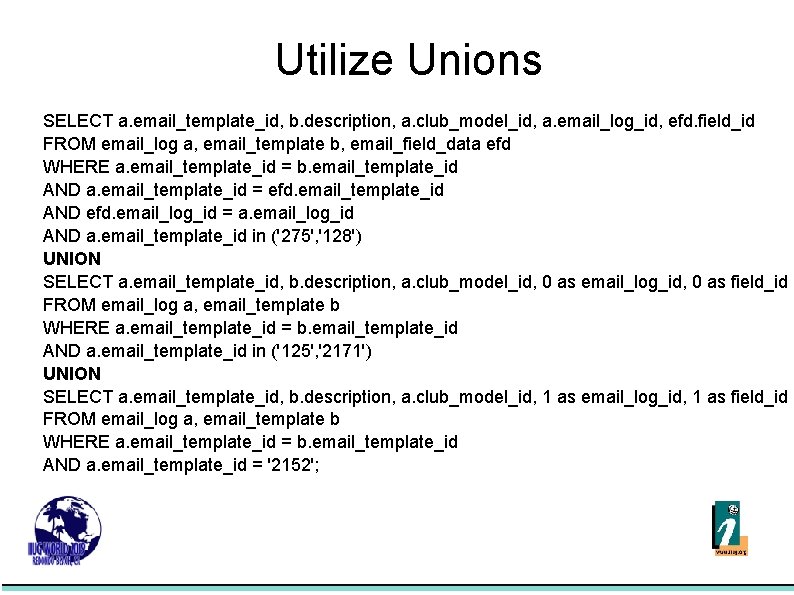
Utilize Unions SELECT a. email_template_id, b. description, a. club_model_id, a. email_log_id, efd. field_id FROM email_log a, email_template b, email_field_data efd WHERE a. email_template_id = b. email_template_id AND a. email_template_id = efd. email_template_id AND efd. email_log_id = a. email_log_id AND a. email_template_id in ('275', '128') UNION SELECT a. email_template_id, b. description, a. club_model_id, 0 as email_log_id, 0 as field_id FROM email_log a, email_template b WHERE a. email_template_id = b. email_template_id AND a. email_template_id in ('125', '2171') UNION SELECT a. email_template_id, b. description, a. club_model_id, 1 as email_log_id, 1 as field_id FROM email_log a, email_template b WHERE a. email_template_id = b. email_template_id AND a. email_template_id = '2152';
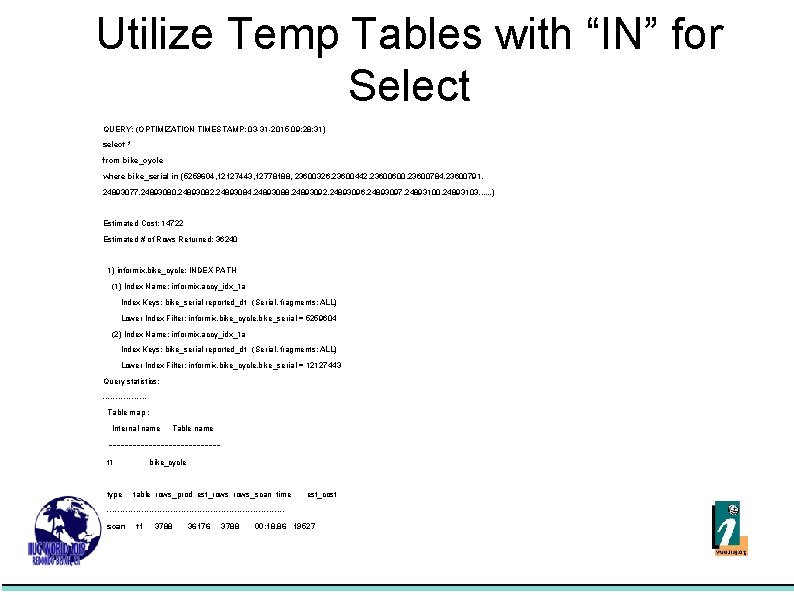
Utilize Temp Tables with “IN” for Select QUERY: (OPTIMIZATION TIMESTAMP: 03 -31 -2015 09: 28: 31) select * from bike_cycle where bike_serial in (5259604, 12127443, 12778188, 23600326, 23600442, 23600600, 23600784, 23600791, 24893077, 24893080, 24893082, 24893084, 24893088, 24893092, 24893096, 24893097, 24893100, 24893103, . . . ) Estimated Cost: 14722 Estimated # of Rows Returned: 36240 1) informix. bike_cycle: INDEX PATH (1) Index Name: informix. accy_idx_1 a Index Keys: bike_serial reported_dt (Serial, fragments: ALL) Lower Index Filter: informix. bike_cycle. bike_serial = 5259604 (2) Index Name: informix. accy_idx_1 a Index Keys: bike_serial reported_dt (Serial, fragments: ALL) Lower Index Filter: informix. bike_cycle. bike_serial = 12127443 Query statistics: -------- Table map : Internal name Table name -------------- t 1 bike_cycle type table rows_prod est_rows_scan time est_cost ---------------------------------scan t 1 3788 36176 3788 00: 18. 86 19527
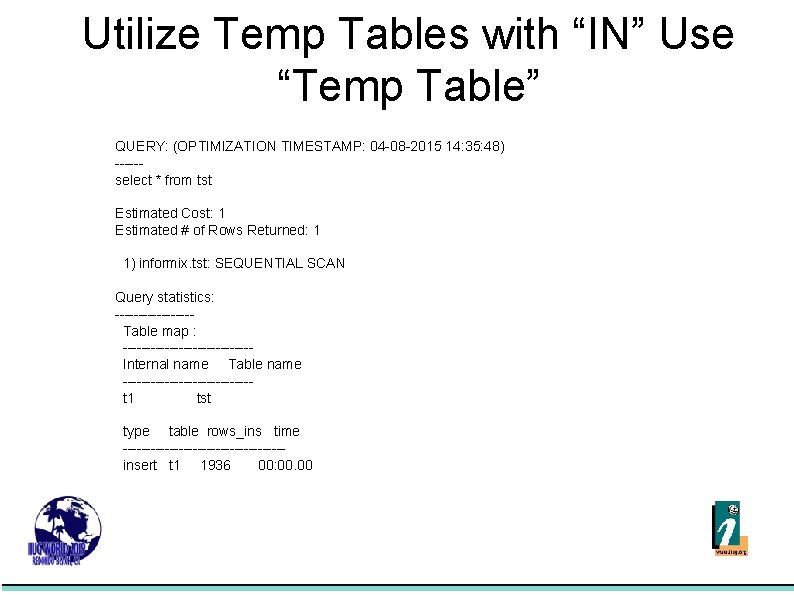
Utilize Temp Tables with “IN” Use “Temp Table” QUERY: (OPTIMIZATION TIMESTAMP: 04 -08 -2015 14: 35: 48) -----select * from tst Estimated Cost: 1 Estimated # of Rows Returned: 1 1) informix. tst: SEQUENTIAL SCAN Query statistics: -------- Table map : -------------- Internal name Table name -------------- t 1 tst type table rows_ins time ----------------- insert t 1 1936 00: 00. 00
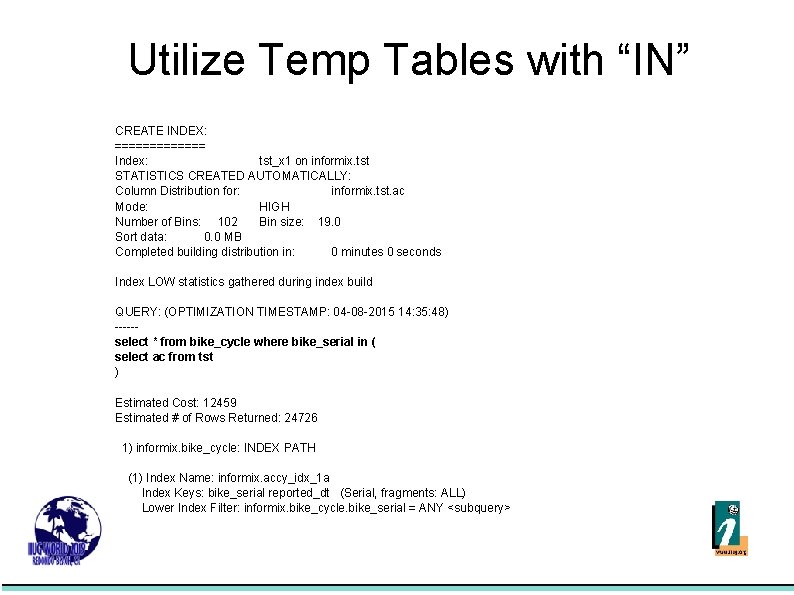
Utilize Temp Tables with “IN” CREATE INDEX: ======= Index: tst_x 1 on informix. tst STATISTICS CREATED AUTOMATICALLY: Column Distribution for: informix. tst. ac Mode: HIGH Number of Bins: 102 Bin size: 19. 0 Sort data: 0. 0 MB Completed building distribution in: 0 minutes 0 seconds Index LOW statistics gathered during index build QUERY: (OPTIMIZATION TIMESTAMP: 04 -08 -2015 14: 35: 48) -----select * from bike_cycle where bike_serial in ( select ac from tst ) Estimated Cost: 12459 Estimated # of Rows Returned: 24726 1) informix. bike_cycle: INDEX PATH (1) Index Name: informix. accy_idx_1 a Index Keys: bike_serial reported_dt (Serial, fragments: ALL) Lower Index Filter: informix. bike_cycle. bike_serial = ANY <subquery>
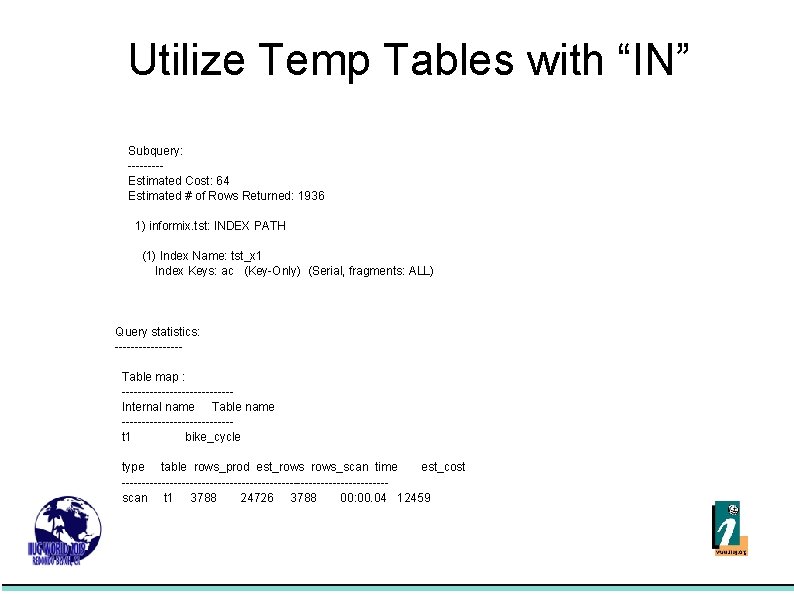
Utilize Temp Tables with “IN” Subquery: ---- Estimated Cost: 64 Estimated # of Rows Returned: 1936 1) informix. tst: INDEX PATH (1) Index Name: tst_x 1 Index Keys: ac (Key-Only) (Serial, fragments: ALL) Query statistics: -------- Table map : -------------- Internal name Table name -------------- t 1 bike_cycle type table rows_prod est_rows_scan time est_cost --------------------------------- scan t 1 3788 24726 3788 00: 00. 04 12459
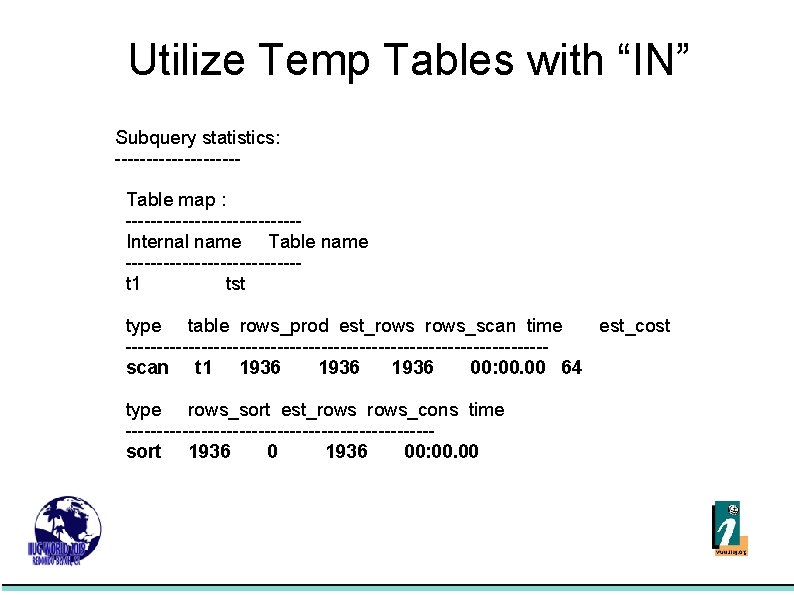
Utilize Temp Tables with “IN” Subquery statistics: ---------- Table map : -------------- Internal name Table name -------------- t 1 tst type table rows_prod est_rows_scan time est_cost ---------------------------------scan t 1 1936 00: 00. 00 64 type rows_sort est_rows_cons time ------------------------sort 1936 00: 00. 00
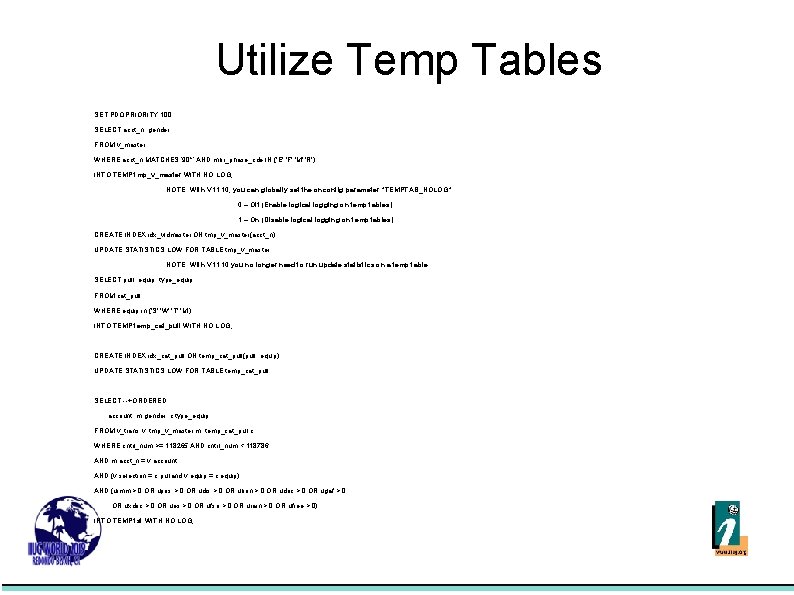
Utilize Temp Tables SET PDQPRIORITY 100; SELECT acct_n, gender FROM v_master WHERE acct_n MATCHES ‘ 90*’ AND mbr_phase_cde IN ('E', 'F', 'M', 'R') INTO TEMP tmp_v_master WITH NO LOG; NOTE: With V 11. 10, you can globally set the onconfig parameter “TEMPTAB_NOLOG” 0 – Off (Enable logical logging on temp tables) 1 – On (Disable logical logging on temp tables) CREATE INDEX idx_vidmaster ON tmp_v_master(acct_n); UPDATE STATISTICS LOW FOR TABLE tmp_v_master; NOTE: With V 11. 10 you no longer need to run update statistics on a temp table SELECT pull, equip, type_equip FROM cat_pull WHERE equip in ('S', 'W', 'T', 'M') INTO TEMP temp_cat_pull WITH NO LOG; CREATE INDEX idx_cat_pull ON temp_cat_pull(pull, equip); UPDATE STATISTICS LOW FOR TABLE temp_cat_pull; SELECT --+ORDERED account, m. gender, c. type_equip, FROM v_trans v, tmp_v_master m, temp_cat_pull c WHERE cntrl_num >= 118265 AND cntrl_num < 118786 AND m. acct_n = v. account AND (v. selection = c. pulland v. equip = c. equip) AND (uimm > 0 OR upos > 0 OR udis > 0 OR ubon > 0 OR udoc > 0 OR ugaf > 0 OR uxdoc > 0 OR ues > 0 OR ufso > 0 OR urain > 0 OR ufree > 0) INTO TEMP tst WITH NO LOG;
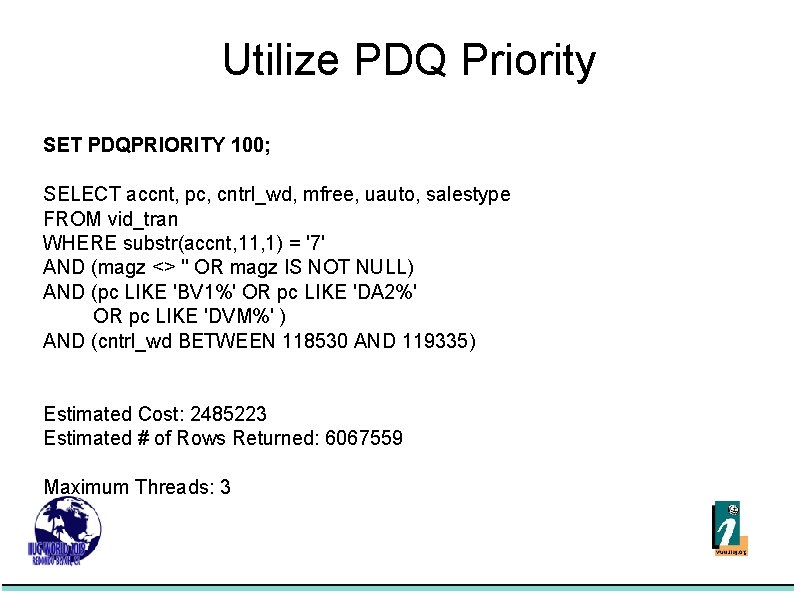
Utilize PDQ Priority SET PDQPRIORITY 100; SELECT accnt, pc, cntrl_wd, mfree, uauto, salestype FROM vid_tran WHERE substr(accnt, 11, 1) = '7' AND (magz <> '' OR magz IS NOT NULL) AND (pc LIKE 'BV 1%' OR pc LIKE 'DA 2%' OR pc LIKE 'DVM%' ) AND (cntrl_wd BETWEEN 118530 AND 119335) Estimated Cost: 2485223 Estimated # of Rows Returned: 6067559 Maximum Threads: 3
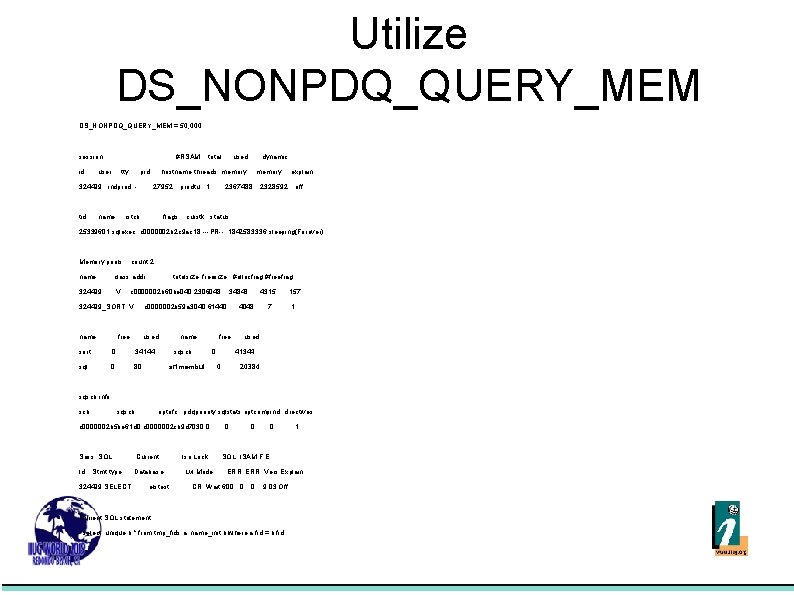
Utilize DS_NONPDQ_QUERY_MEM = 50, 000 session #RSAM total used dynamic id user tty pid hostname threads memory explain 324499 indprod - 27952 prodtu 1 2367488 2328592 off tid name rstcb flags curstk status 25339601 sqlexec c 0000002 b 2 c 9 ac 18 ---PR-- 1842583336 sleeping(Forever) Memory pools count 2 name class addr totalsize freesize #allocfrag #freefrag 324499 V c 0000002 b 60 be 040 2306048 34848 4315 157 324499_SORT V c 0000002 b 59 a 3040 61440 4048 7 1 name free used sort 0 34144 sqscb 0 41344 sql 0 80 srtmembuf 0 20384 sqscb info scb sqscb optofc pdqpriority sqlstats optcompind directives c 0000002 b 5 be 61 d 0 c 0000002 cb 9 d 7030 0 0 1 Sess SQL Current Iso Lock SQL ISAM F. E. Id Stmt type Database Lvl Mode ERR Vers Explain 324499 SELECT elstest CR Wait 600 0 0 9. 03 Off Current SQL statement : select unique b. * from tmp_fids a, name_init b where a. fid = b. fid
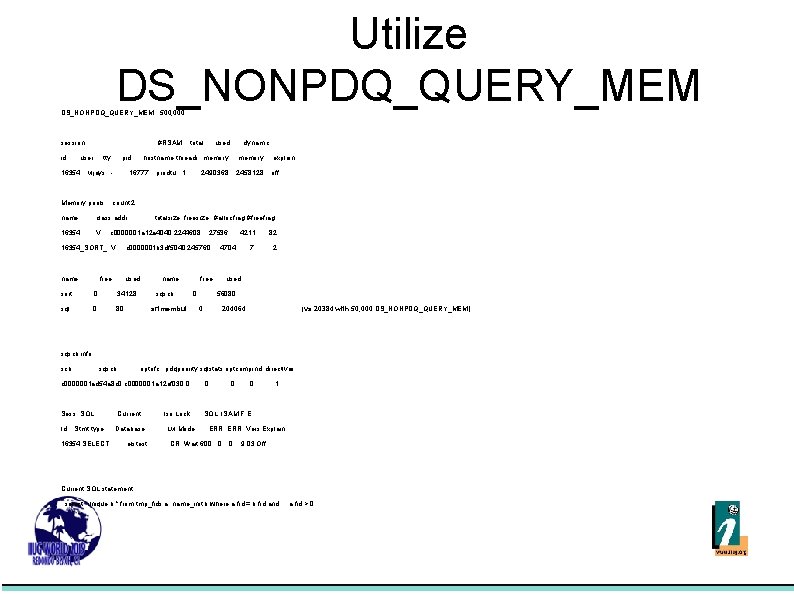
Utilize DS_NONPDQ_QUERY_MEM 500, 000 session #RSAM total used dynamic id user tty pid hostname threads memory explain 16354 vijays - 16777 prodtu 1 2490368 2458128 off Memory pools count 2 name class addr totalsize freesize #allocfrag #freefrag 16354 V c 0000001 a 12 a 4040 2244608 27536 4211 82 16354_SORT_ V c 0000001 b 3 df 5040 245760 4704 7 2 name free used sort 0 34128 sqscb 0 56080 sql 0 80 srtmembuf 0 204064 (vs 20384 with 50, 000 DS_NONPDQ_QUERY_MEM) sqscb info scb sqscb optofc pdqpriority sqlstats optcompind directives c 0000001 ad 54 a 8 c 0 c 0000001 a 12 af 030 0 0 1 Sess SQL Current Iso Lock SQL ISAM F. E. Id Stmt type Database Lvl Mode ERR Vers Explain 16354 SELECT elstest CR Wait 600 0 0 9. 03 Off Current SQL statement : select unique b. * from tmp_fids a, name_init b where a. fid = b. fid and a. fid > 0
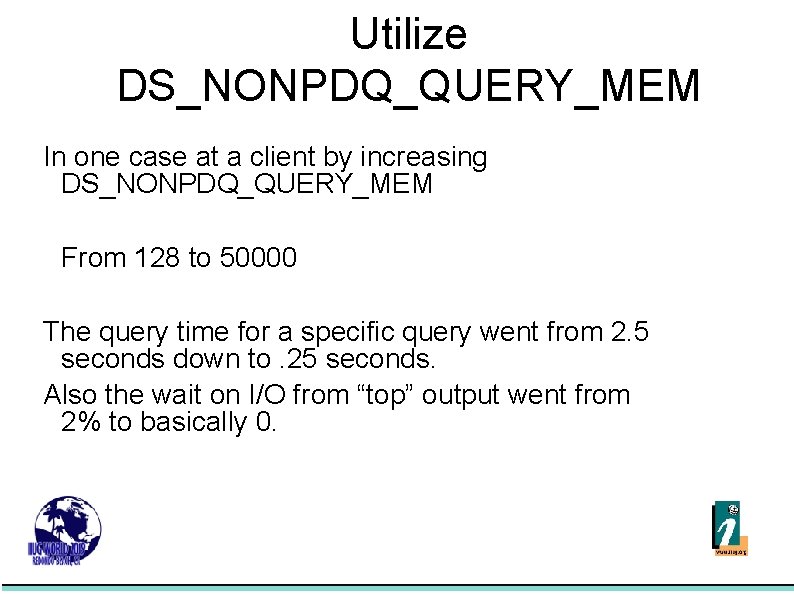
Utilize DS_NONPDQ_QUERY_MEM In one case at a client by increasing DS_NONPDQ_QUERY_MEM From 128 to 50000 The query time for a specific query went from 2. 5 seconds down to. 25 seconds. Also the wait on I/O from “top” output went from 2% to basically 0.
Subquery Support (Update/Delete) • The FROM clause of a subquery in the WHERE clause of the UPDATE statement can specify as a data source the same table or view that the Table Options clause of the UPDATE statement specifies. • UPDATE operations with subqueries that reference the same table object are supported only if all of the following conditions are true: • The subquery either returns a single row, • Has no correlated column references. • No SPL routine in the subquery can reference the same table that UPDATE is modifying.
Subquery Support (Update/Delete) • Example: Updates the stock table by reducing the unit_price value by 5% for a subset of prices. The WHERE clause specifies which prices to reduce by applying the IN operator to the rows returned by a subquery that selects only the rows of the stock table where the unit_price value is greater than 50: UPDATE stock SET unit_price = unit_price * 0. 95 WHERE unit_price IN (SELECT unit_price FROM stock WHERE unit_price > 50);
Summary • Identify Problem SQL Statements • Tracing SQL in Informix • Options Available with Set Explain & Reading sqexplain output with tuning examples • Methods to use for Improving SQL performance • Subquery Support for Update/Delete

Questions? Jeff Filippi Integrated Data Consulting, LLC jeff. filippi@itdataconsulting. com www. itdataconsulting. com
- Slides: 88