
Informed consent What if I get it wrong
- Slides: 20
Informed consent: What if I get it wrong? Greg Hill ACLCA – 17 February 2011
Disclaimer • This presentation has been prepared for the purpose of awareness raising and general discussion • The EPA strongly recommends that consultants and auditors, before undertaking sampling on a persons land, obtain legal advice on the risk to themselves in undertaking the work, including in the areas discussed in this presentation. • The contents of this presentation should not be relied up on for the purpose of assessing this risk.
Introduction • There are various circumstances in which sampling may be undertaken • Certain information must be brought to the attention of the EPA • The EPA can gain information by other means • What will the EPA do with the information that you provide to it? • EPA public register and Section 7 obligations • What does this mean for the consultant? • What does the EPA do if it needs to sample in these circumstances?
Types of sampling • Onsite – the client’s property • Offsite – public land (typically council, DTEI) • Offsite – private land • • Soil Groundwater Soil vapour Ambient or indoor air • Found something………. .
Duty to notify • s 83 A – site contamination that affects or threatens groundwater • Auditor – significant hazardous circumstances (see audit guidelines) • s 83 – serious or material harm
How might the EPA gain information? • The EPA may receive a copy of consultant’s report as a result of: – Development application – Request to an owner/occupier for information about site contamination or the environmental condition of the land – Submission to the EPA as a requirement of licence condition – Information discovery order – s 83 A Duty to notify (from others reviewing the work)
How might the EPA gain information? • The EPA may receive a copy of consultant’s report as a result of: – Voluntary proposal for site contamination assessment or remediation – Issuing of site contamination assessment order or site remediation order – Appendix to an audit report – Transfer of liability agreement (s 103 E) – Client/potential owner decides discuss the issue voluntarily – Fell off the back of a truck?
How might the EPA gain information? • Information comes to the attention of the EPA in a variety of ways…. . You should assume that the EPA will receive a copy of the report at some stage in the future! • Note the ‘honesty in reporting’ provisions (s 103 ZA and 103 ZB)
EPA assessment of information For all information that the EPA receives, it is required to make certain determinations: 1. Does the information constitute serious or material environmental harm: • actual or potential harm to human health or the environment that is not trivial • environmental nuisance of a high impact or on a wide scale • results in potential loss or property damage, including the cost of assessment or remediation, in excess of $5 k in aggregate
EPA assessment of information 2. If the information is submitted in accordance with s 83 A, is it a valid notification? 3. For information that is submitted in accordance with s 103 E, does it support a valid agreement?
EPA Public Register • The EPA must record: – s 109(3)(h), details of serious or material environmental harm – s 109(3)(i), details of site contamination notified to the Authority under section 83 A (actual or potential harm to groundwater) – s 109(3)(ia), reports relating to orders – well, almost all orders (EPO, CUA, SCAO, SRO)
EPA Public Register • The EPA must record: – s 109(3)(ib), details of agreements under S 103 E – including supporting environmental reports that document the site contamination that the agreement relates to – s 109(3)(if), site contamination audit reports – other information - as prescribed • So if you find site contamination, and the information finds its way to the EPA, which it probably will, it’s likely to end up on the Public Register
EPA obligations • Land & Business (Sales & Conveyancing) Act: – Property interest report required by law to be provided at the time of sale of land under the LABSAC – Information required to be disclosed in the property interest report is prescribed by regulations – The EPA is required to answer a number of questions in relation to this for every property that is sold in South Australia – Everything that is on the Public Register will be brought to the attention of a prospective purchaser. The purchaser can then choose to access the information via the public register.
Land owner v’s consultant • The owner may not be aware that work you have done can (or must) be added to the Public Register • The owner may not be aware that the EPA has a mandatory duty to disclose this information under certain routine circumstances • This disclosure could really annoy a land owner if it reduces (or is perceived to reduce) the value of their property and they weren’t aware that the information would be made available to prospective purchasers!
LABSAC – Vendor questions • The vendor of property is also obliged to answer a number of questions. • In particular, they must disclose the existence of any reports about the environmental condition of the land • they must disclose whether any potentially contaminating activities have previously been undertaken on the land
So in Summary…. • You sampled on someone else’s land • You found something that must be reported to the EPA (s 83 A? ) • The EPA assessed the information and placed it on the Public Register • The person whose land you sampled receives a letter from the EPA - that the EPA has details of groundwater contamination, or serious or material environmental harm, and that this information has been placed on the Public Register
So in Summary…. • The person whose land you sampled on decides to sell their property • The Property Interest Report shows the EPA has flagged the property for serious or material environmental harm • The person whose land you sampled rings you and wants to be compensated because they weren’t aware that this could happen when you knocked on their door requesting permission to sample on their land they agreed…. .
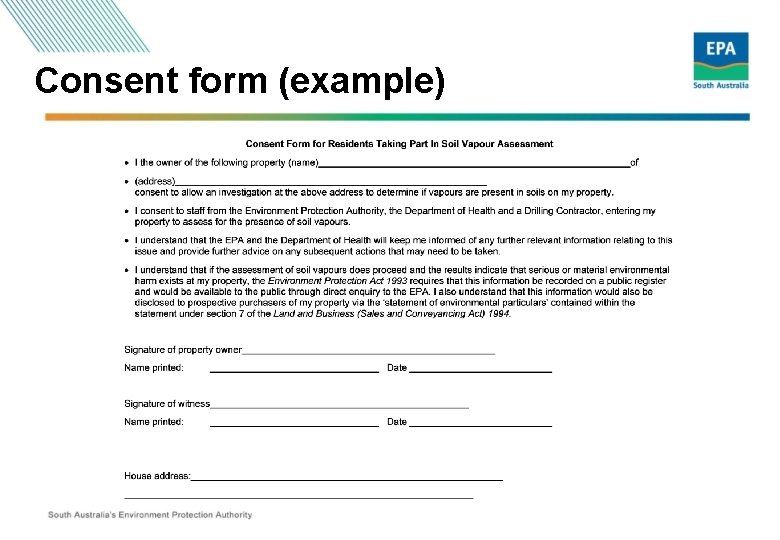
Risk mitigation • Informed consent……. • Inform the landowner of the risks that may result to them from the sampling • Receive signoff from the landowner of acceptance of those risks • Seek specific legal advice when relevant
Consent form (example)
Questions?