
Informed Consent Health Screen Questionnaire PAR Q Medical
- Slides: 33
º Informed Consent º Health Screen Questionnaire º PAR Q º Medical Referral SHMD 139 18/2/2013
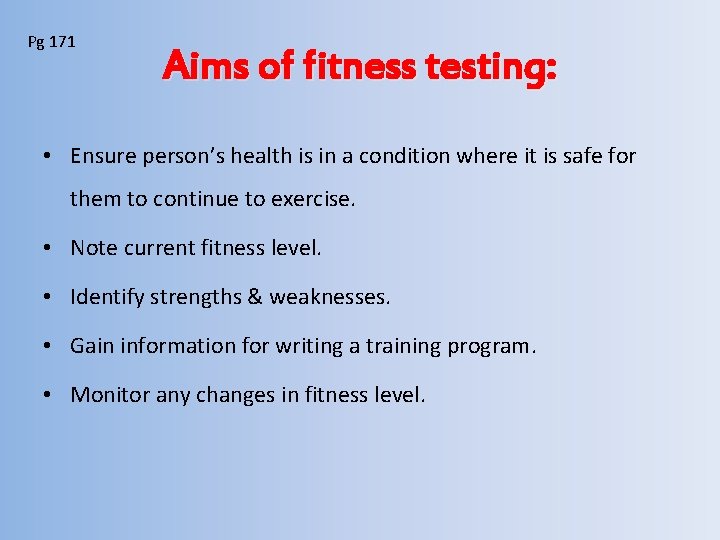
Pg 171 Aims of fitness testing: • Ensure person’s health is in a condition where it is safe for them to continue to exercise. • Note current fitness level. • Identify strengths & weaknesses. • Gain information for writing a training program. • Monitor any changes in fitness level.
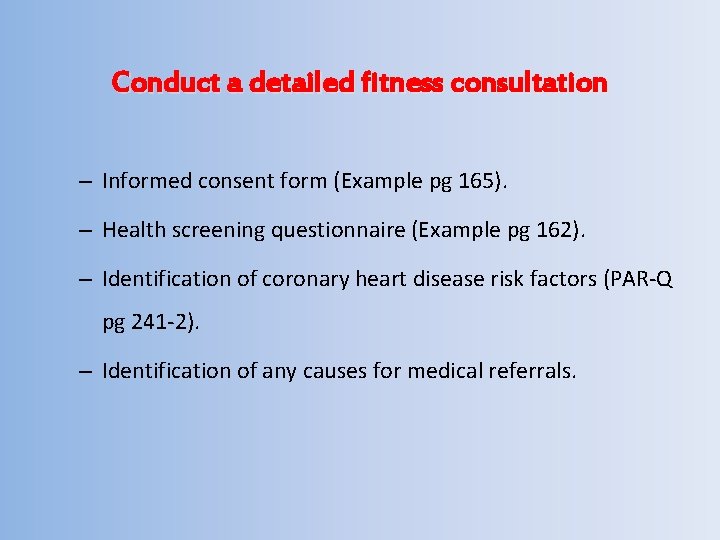
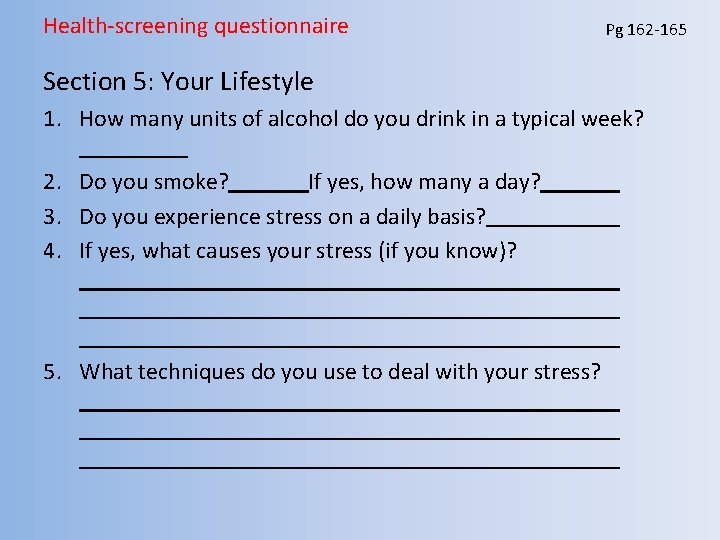
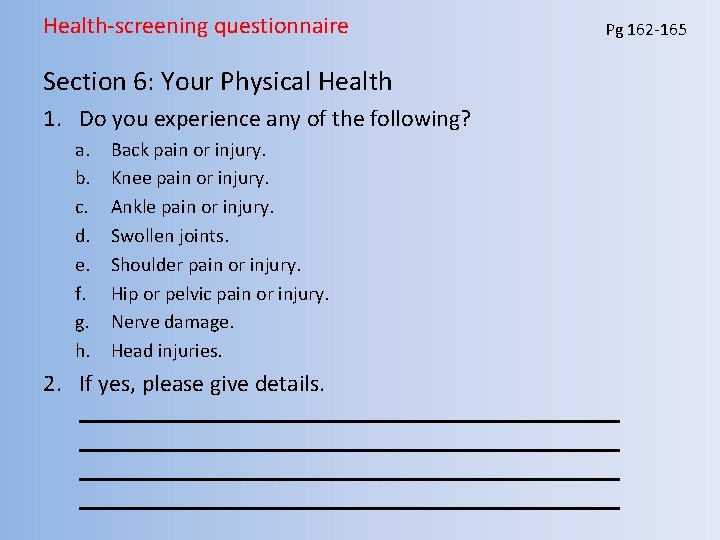
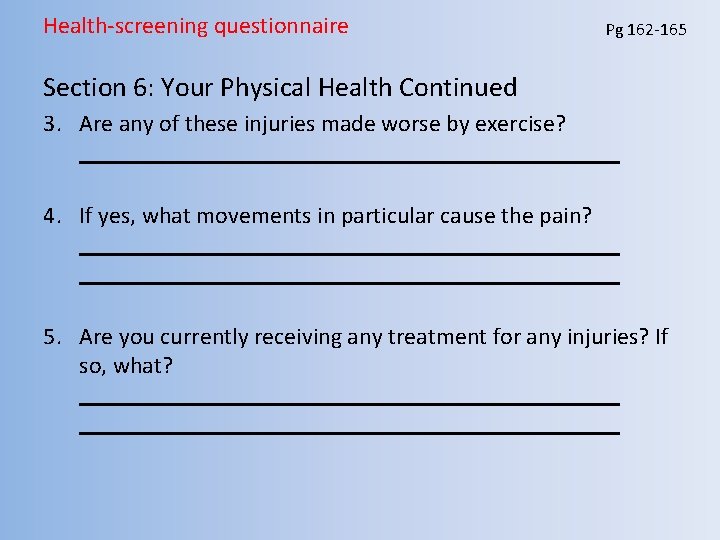
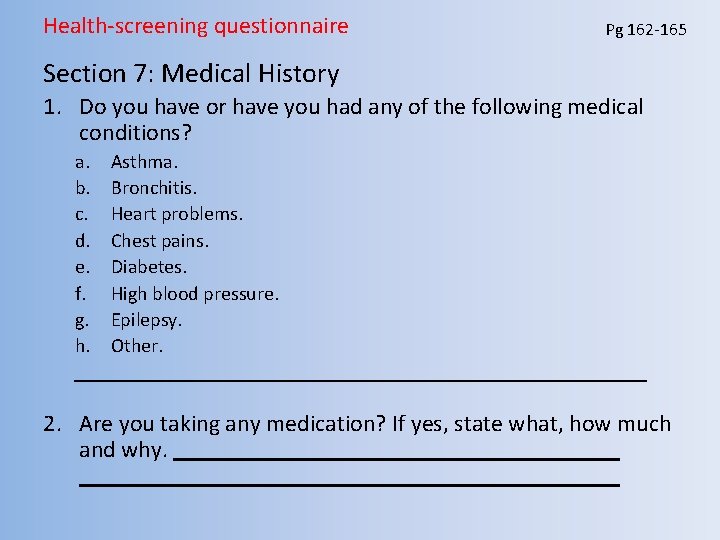
Conduct a detailed fitness consultation – Informed consent form (Example pg 165). – Health screening questionnaire (Example pg 162). – Identification of coronary heart disease risk factors (PAR-Q pg 241 -2). – Identification of any causes for medical referrals.
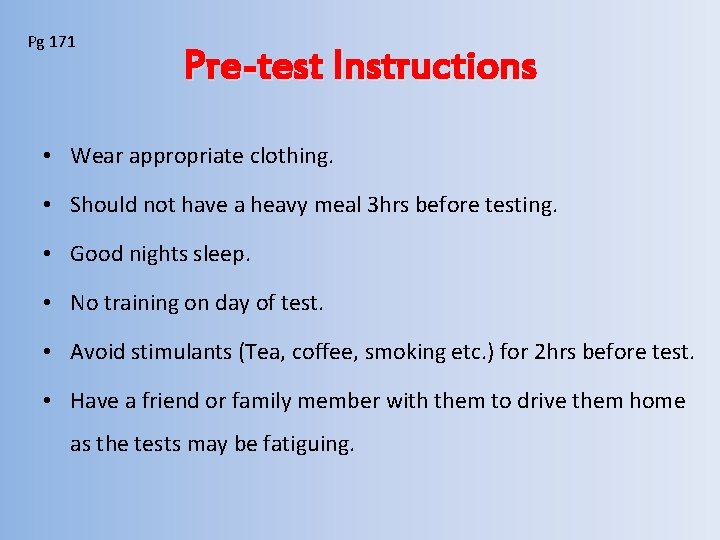
Pg 171 Pre-test Instructions • Wear appropriate clothing. • Should not have a heavy meal 3 hrs before testing. • Good nights sleep. • No training on day of test. • Avoid stimulants (Tea, coffee, smoking etc. ) for 2 hrs before test. • Have a friend or family member with them to drive them home as the tests may be fatiguing.
Informed Consent Form Pg 165 An informed consent form is a document that has been signed to show that your subjects have been informed of the test (told what is going to happen) and have given their consent (agreed to undertake the test).
Informed Consent Form Pg 165 1. Explanation of the tests. You will perform a series of tests which will vary in their demands on your body. Your progress will be observed during the tests and stopped if you show signs of undue fatigue. You may stop the tests at any time if you feel unduly uncomfortable.
Informed Consent Form Pg 165 2. Risks of exercise testing. During exercise certain changes can occur, such as raised blood pressure, fainting, raised heart rate, and in a very small number of cases, heart attacks or even death. Every effort is made through screening to minimize the risk of these occurring during testing. Emergency equipment and relevantly trained personnel are available to deal with any extreme situation that occurs.
Informed Consent Form Pg 165 3. Responsibility of the patient. You must disclose all information in your possession regarding the state of your health or previous experiences of exercise, as this will affect the safety of the tests. If you experience any discomfort or unusual sensations, it is your responsibility to inform your trainer.
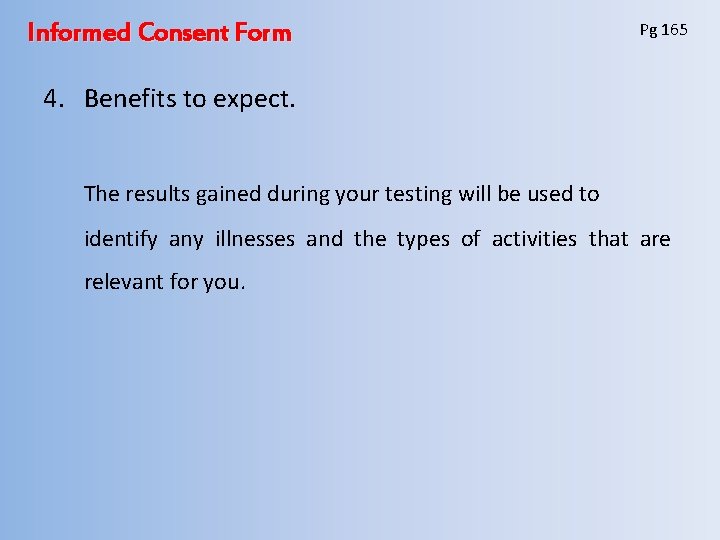
Informed Consent Form Pg 165 4. Benefits to expect. The results gained during your testing will be used to identify any illnesses and the types of activities that are relevant for you.
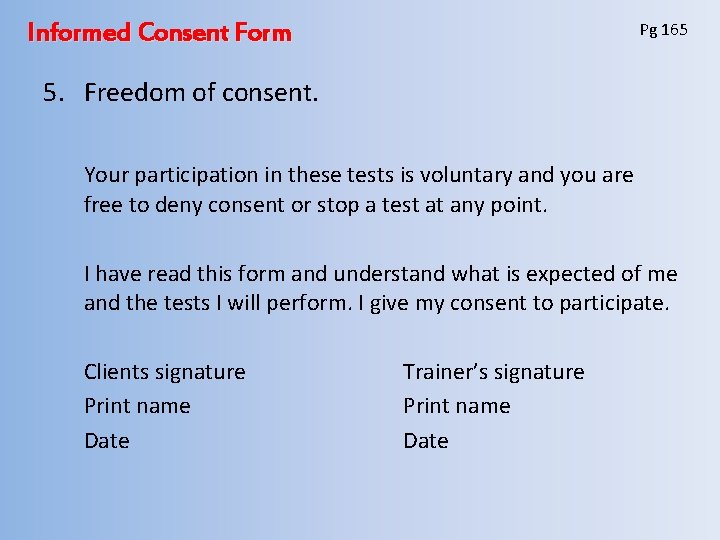
Informed Consent Form Pg 165 5. Freedom of consent. Your participation in these tests is voluntary and you are free to deny consent or stop a test at any point. I have read this form and understand what is expected of me and the tests I will perform. I give my consent to participate. Clients signature Print name Date Trainer’s signature Print name Date
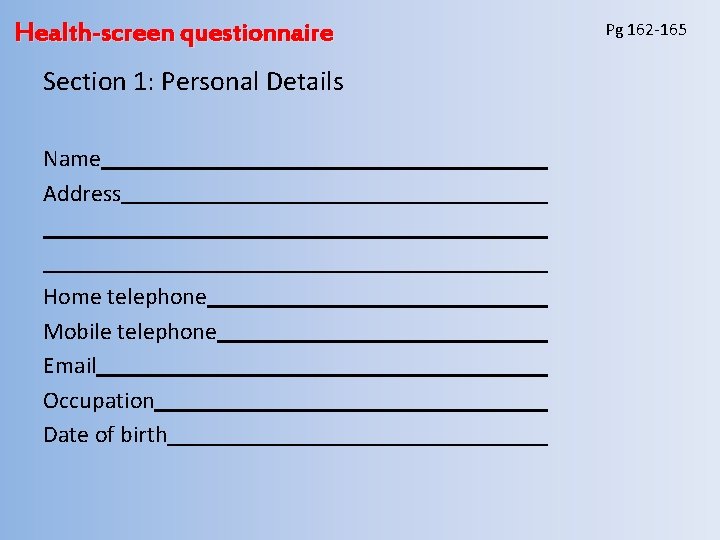
Health-screen questionnaire Section 1: Personal Details Name Address Home telephone Mobile telephone Email Occupation Date of birth Pg 162 -165
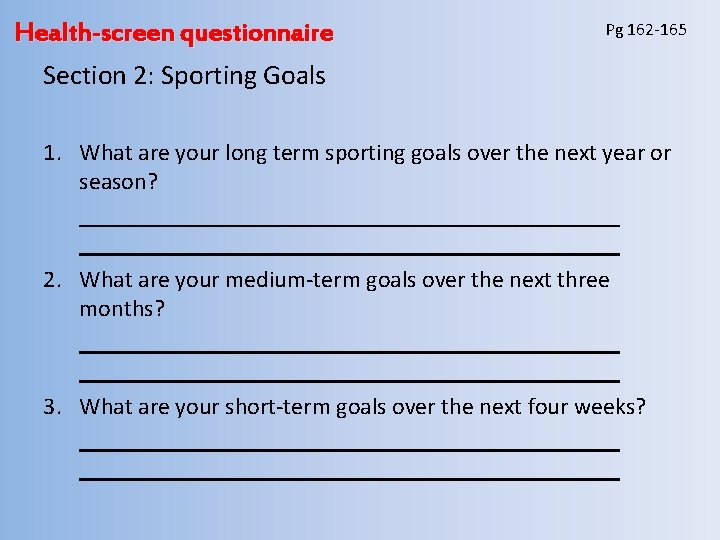
Health-screen questionnaire Pg 162 -165 Section 2: Sporting Goals 1. What are your long term sporting goals over the next year or season? 2. What are your medium-term goals over the next three months? 3. What are your short-term goals over the next four weeks?
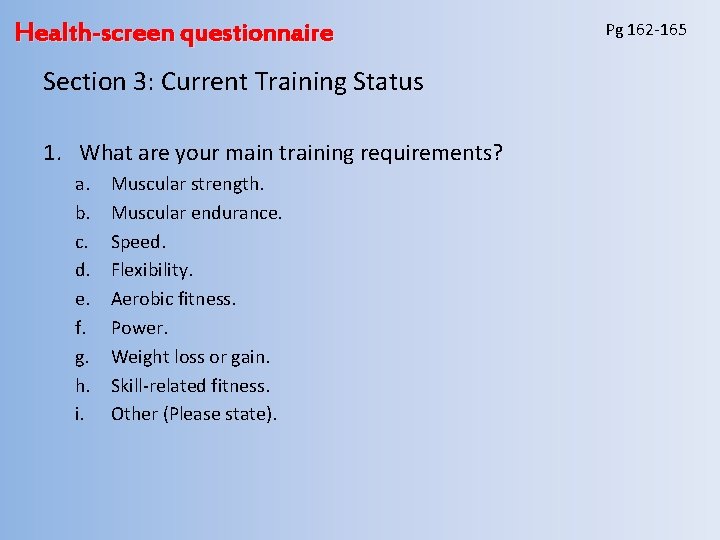
Health-screen questionnaire Section 3: Current Training Status 1. What are your main training requirements? a. b. c. d. e. f. g. h. i. Muscular strength. Muscular endurance. Speed. Flexibility. Aerobic fitness. Power. Weight loss or gain. Skill-related fitness. Other (Please state). Pg 162 -165
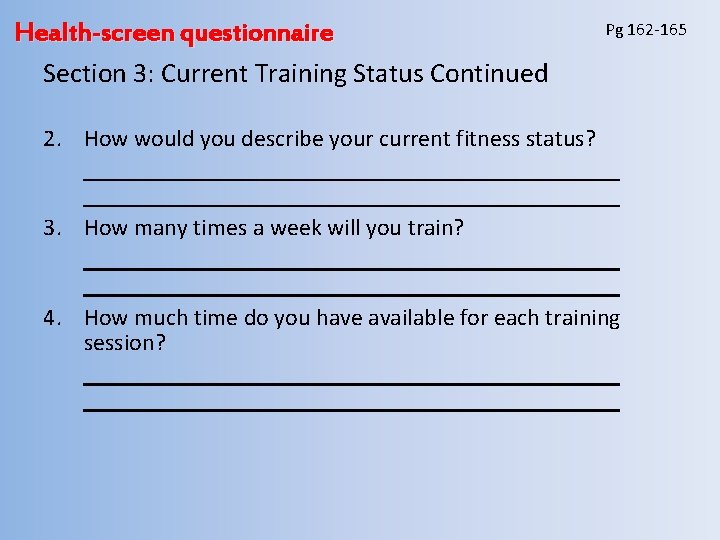
Health-screen questionnaire Section 3: Current Training Status Continued Pg 162 -165 2. How would you describe your current fitness status? 3. How many times a week will you train? 4. How much time do you have available for each training session?
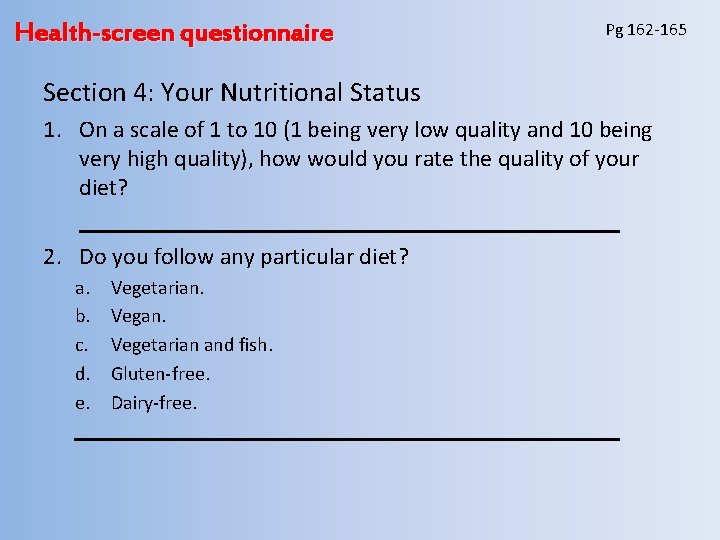
Health-screen questionnaire Pg 162 -165 Section 4: Your Nutritional Status 1. On a scale of 1 to 10 (1 being very low quality and 10 being very high quality), how would you rate the quality of your diet? 2. Do you follow any particular diet? a. b. c. d. e. Vegetarian and fish. Gluten-free. Dairy-free.
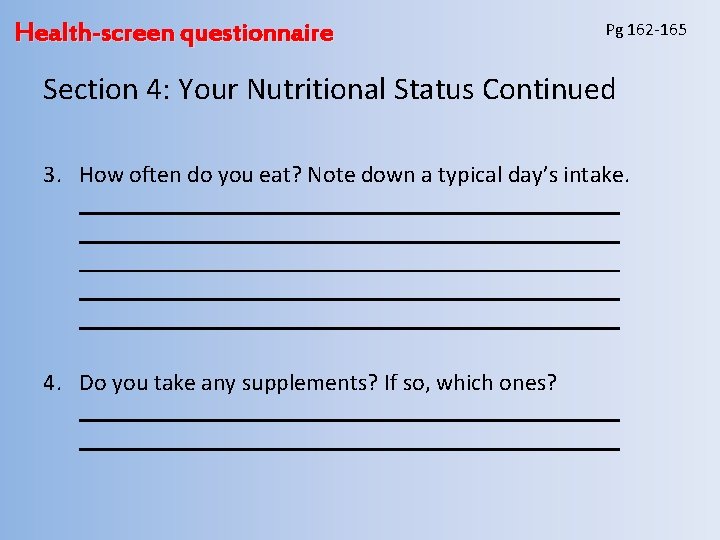
Health-screen questionnaire Pg 162 -165 Section 4: Your Nutritional Status Continued 3. How often do you eat? Note down a typical day’s intake. 4. Do you take any supplements? If so, which ones?
Health-screening questionnaire Pg 162 -165 Section 5: Your Lifestyle 1. How many units of alcohol do you drink in a typical week? 2. Do you smoke? If yes, how many a day? 3. Do you experience stress on a daily basis? 4. If yes, what causes your stress (if you know)? 5. What techniques do you use to deal with your stress?
Health-screening questionnaire Section 6: Your Physical Health 1. Do you experience any of the following? a. b. c. d. e. f. g. h. Back pain or injury. Knee pain or injury. Ankle pain or injury. Swollen joints. Shoulder pain or injury. Hip or pelvic pain or injury. Nerve damage. Head injuries. 2. If yes, please give details. Pg 162 -165
Health-screening questionnaire Pg 162 -165 Section 6: Your Physical Health Continued 3. Are any of these injuries made worse by exercise? 4. If yes, what movements in particular cause the pain? 5. Are you currently receiving any treatment for any injuries? If so, what?
Health-screening questionnaire Pg 162 -165 Section 7: Medical History 1. Do you have or have you had any of the following medical conditions? a. b. c. d. e. f. g. h. Asthma. Bronchitis. Heart problems. Chest pains. Diabetes. High blood pressure. Epilepsy. Other. 2. Are you taking any medication? If yes, state what, how much and why.
• • Eat 5 small meals a day. Reduce high fat intake. Reduce alcohol intake. Reduce salt intake. Drink 2 L of water a day. Stop smoking. Exercise to manage stress. Exercise at least 3 x per week, for 45 minutes at a moderate intensity to improve health.
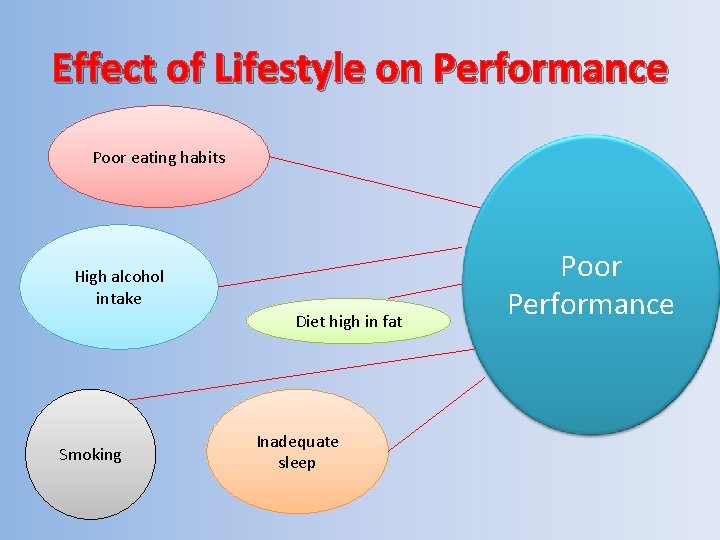
Effect of Lifestyle on Performance Poor eating habits High alcohol intake Diet high in fat Smoking Inadequate sleep Poor Performance
PAR-Q Pg 241 -242 Physical Activity Readiness Questionnaire Aim of PAR Q & initial consultation: Identify any potential contraindications and then decide what needs to be done about them to minimize their chances of being a risk.
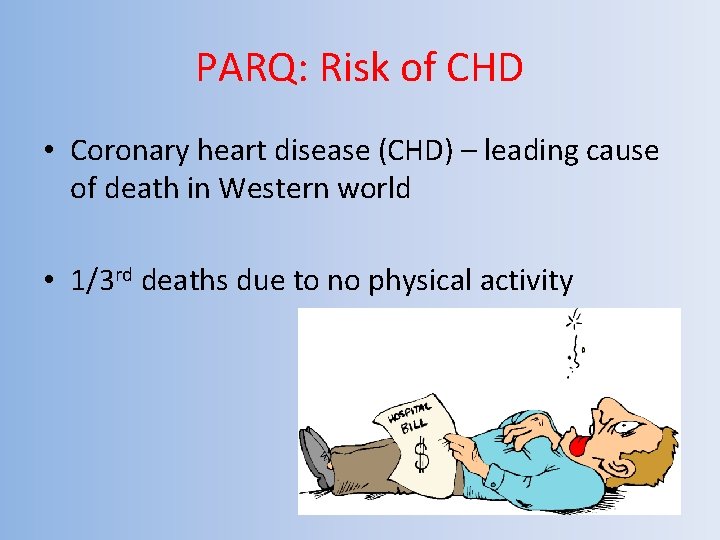
PARQ: Risk of CHD • Coronary heart disease (CHD) – leading cause of death in Western world • 1/3 rd deaths due to no physical activity
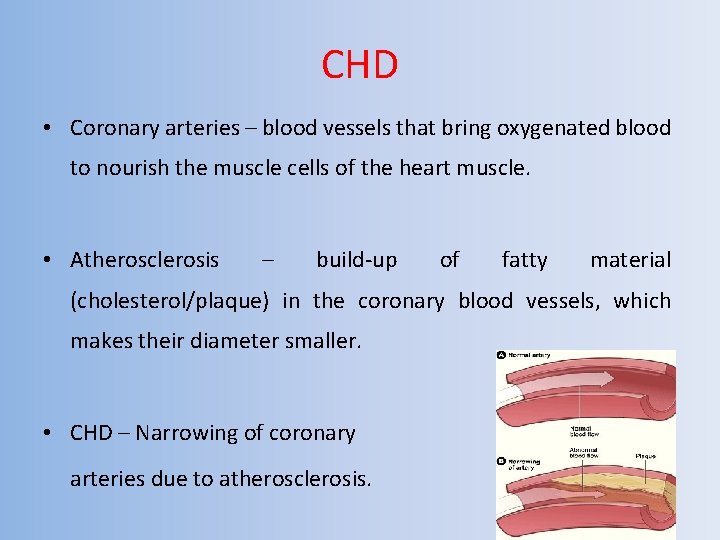
CHD • Coronary arteries – blood vessels that bring oxygenated blood to nourish the muscle cells of the heart muscle. • Atherosclerosis – build-up of fatty material (cholesterol/plaque) in the coronary blood vessels, which makes their diameter smaller. • CHD – Narrowing of coronary arteries due to atherosclerosis.
Implications of CHD to exercise • Physically demanding task. • Coronary arteries may not be able to supply heart muscle with enough blood to keep up oxygen demand. • Leads to pain in chest – angina. • Coronary artery completely blocked – heart muscle will die - heart attack.
Pg 166 PARQ: Risk of CHD • Lifestyle Factors that increase risk of CHD: – Diet high in fat & table salt – Obesity – Smoking – Excess alcohol consumption – High blood pressure – Type two diabetes – Older age (Non-modifiable) – Male gender (Non-modifiable)
CHD REGULAR EXERCISE REDUCES THE RISK OF HEART DISEASE
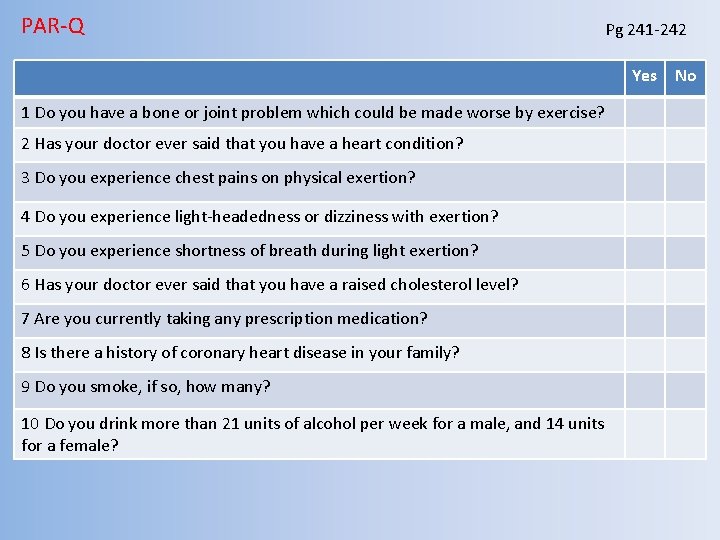
PAR-Q Pg 241 -242 Yes No 1 Do you have a bone or joint problem which could be made worse by exercise? 2 Has your doctor ever said that you have a heart condition? 3 Do you experience chest pains on physical exertion? 4 Do you experience light-headedness or dizziness with exertion? 5 Do you experience shortness of breath during light exertion? 6 Has your doctor ever said that you have a raised cholesterol level? 7 Are you currently taking any prescription medication? 8 Is there a history of coronary heart disease in your family? 9 Do you smoke, if so, how many? 10 Do you drink more than 21 units of alcohol per week for a male, and 14 units for a female?
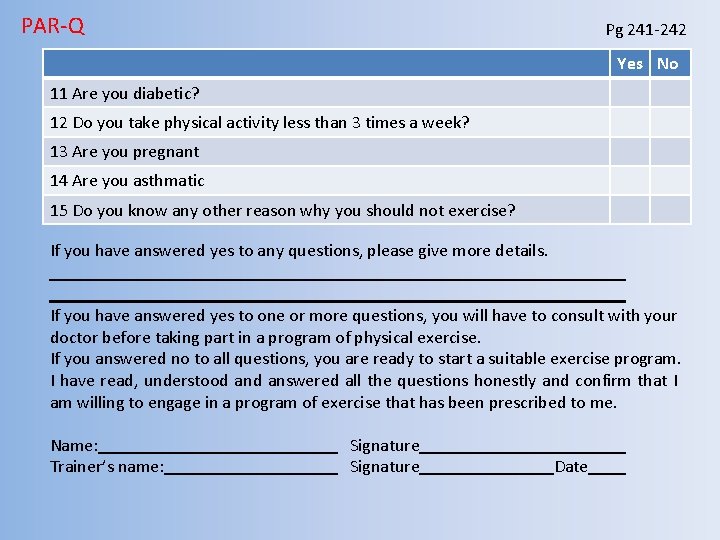
PAR-Q Pg 241 -242 Yes No 11 Are you diabetic? 12 Do you take physical activity less than 3 times a week? 13 Are you pregnant 14 Are you asthmatic 15 Do you know any other reason why you should not exercise? If you have answered yes to any questions, please give more details. If you have answered yes to one or more questions, you will have to consult with your doctor before taking part in a program of physical exercise. If you answered no to all questions, you are ready to start a suitable exercise program. I have read, understood answered all the questions honestly and confirm that I am willing to engage in a program of exercise that has been prescribed to me. Name: Trainer’s name: Signature Date
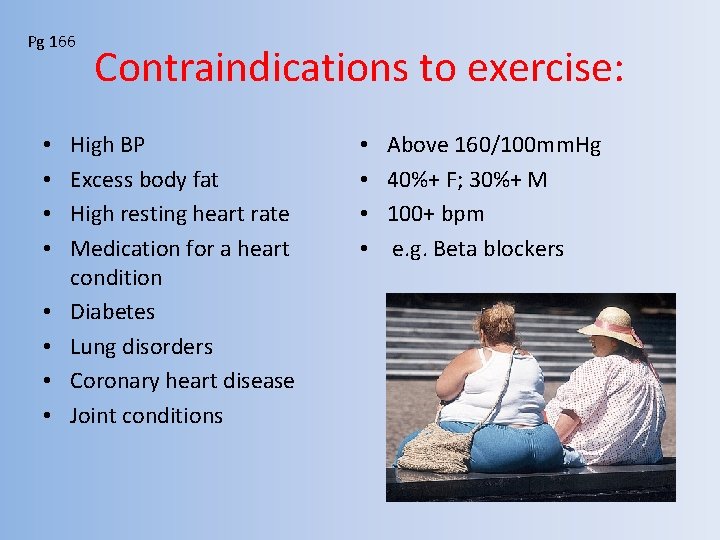
Pg 166 • • Contraindications to exercise: High BP Excess body fat High resting heart rate Medication for a heart condition Diabetes Lung disorders Coronary heart disease Joint conditions • • Above 160/100 mm. Hg 40%+ F; 30%+ M 100+ bpm e. g. Beta blockers
Pg 166 Medical Referral If the person has a high risk for CHD, or you have any doubt regarding their safety to exercise, it is best to refer to a GP/Doctor for clearance before you test/train them.
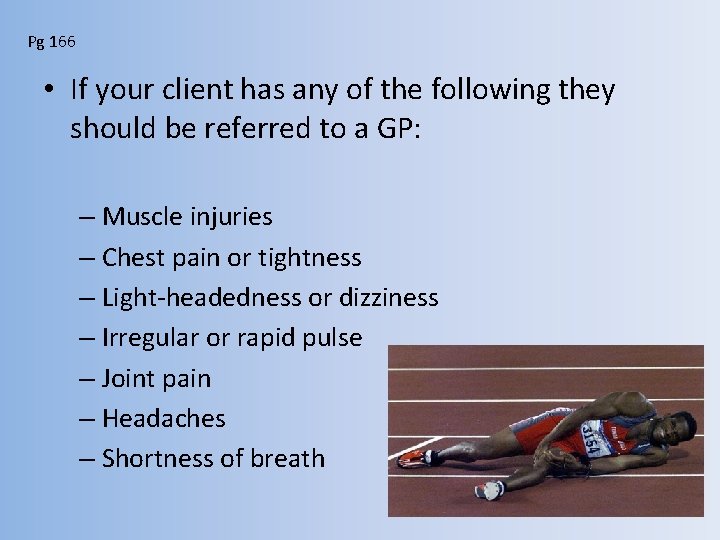
Pg 166 • If your client has any of the following they should be referred to a GP: – Muscle injuries – Chest pain or tightness – Light-headedness or dizziness – Irregular or rapid pulse – Joint pain – Headaches – Shortness of breath