
Informationsmanagement Prof T Kudra HTWK Leipzig Konzepte des
- Slides: 13
Informationsmanagement
© Prof. T. Kudraß, HTWK Leipzig Konzepte des Informationsmanagements l l l Problemorientierte Ansätze Aufgabenorientierte Ansätze Prozessorientierte Ansätze Ebenenmodell Architekturmodelle Alle sind Sichten auf das gleiche Problem „Informationsmanagement“
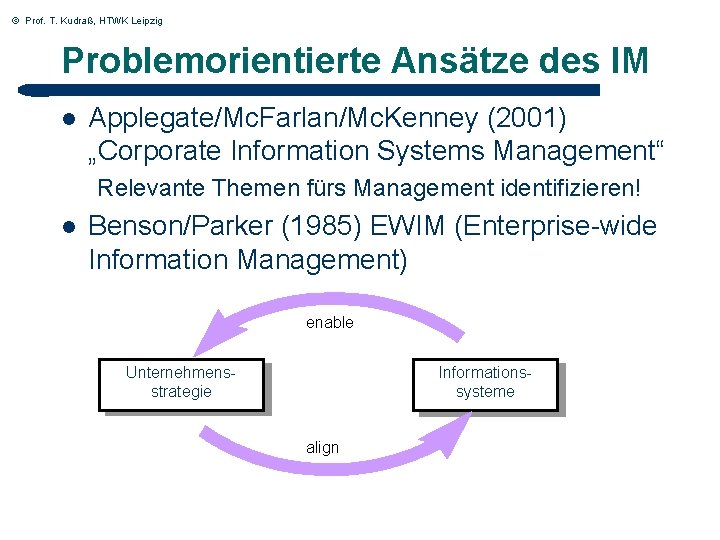
© Prof. T. Kudraß, HTWK Leipzig Problemorientierte Ansätze des IM l Applegate/Mc. Farlan/Mc. Kenney (2001) „Corporate Information Systems Management“ Relevante Themen fürs Management identifizieren! l Benson/Parker (1985) EWIM (Enterprise-wide Information Management) enable Unternehmensstrategie Informationssysteme align
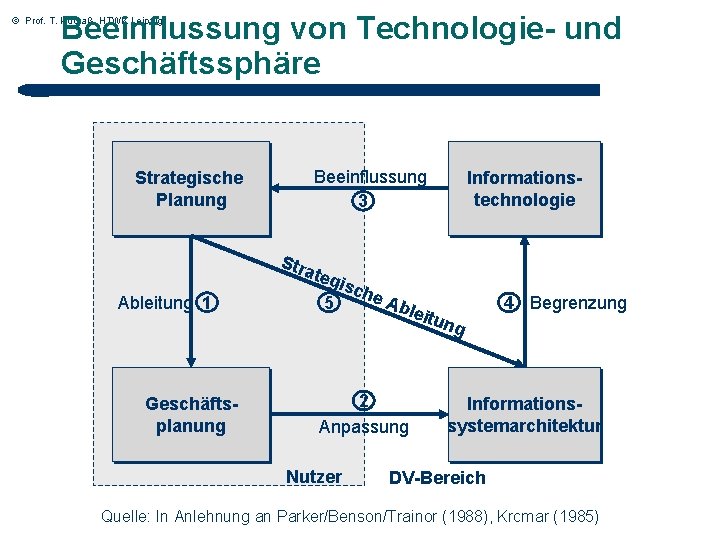
Beeinflussung von Technologie- und Geschäftssphäre © Prof. T. Kudraß, HTWK Leipzig Beeinflussung 3 Strategische Planung Stra teg Ableitung 1 Geschäftsplanung 5 isch e. A ble 2 Anpassung Nutzer Informationstechnologie itun g 4 Begrenzung Informationssystemarchitektur DV-Bereich Quelle: In Anlehnung an Parker/Benson/Trainor (1988), Krcmar (1985)
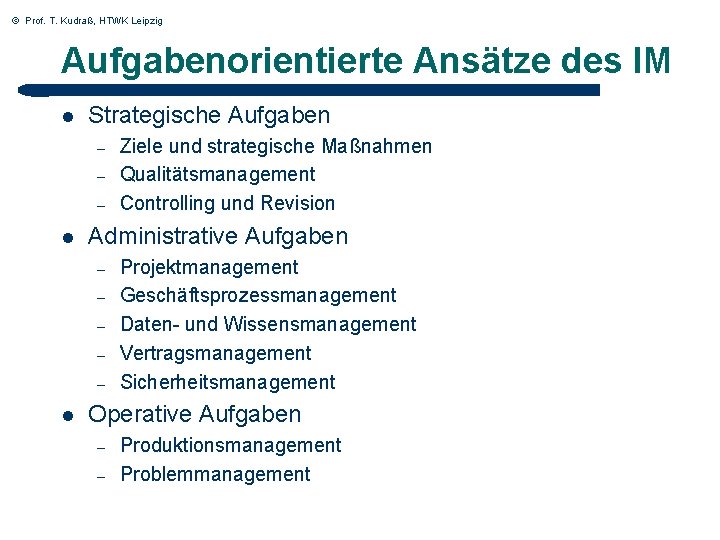
© Prof. T. Kudraß, HTWK Leipzig Aufgabenorientierte Ansätze des IM l Strategische Aufgaben – – – l Administrative Aufgaben – – – l Ziele und strategische Maßnahmen Qualitätsmanagement Controlling und Revision Projektmanagement Geschäftsprozessmanagement Daten- und Wissensmanagement Vertragsmanagement Sicherheitsmanagement Operative Aufgaben – – Produktionsmanagement Problemmanagement
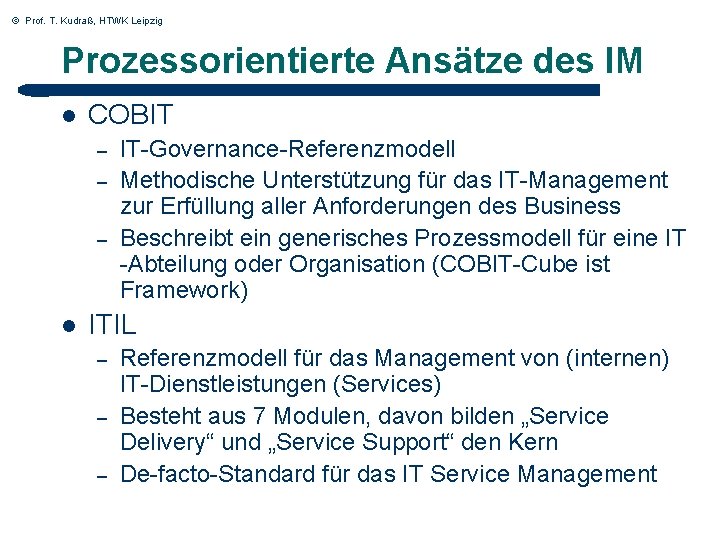
© Prof. T. Kudraß, HTWK Leipzig Prozessorientierte Ansätze des IM l COBIT – – – l IT-Governance-Referenzmodell Methodische Unterstützung für das IT-Management zur Erfüllung aller Anforderungen des Business Beschreibt ein generisches Prozessmodell für eine IT -Abteilung oder Organisation (COBIT-Cube ist Framework) ITIL – – – Referenzmodell für das Management von (internen) IT-Dienstleistungen (Services) Besteht aus 7 Modulen, davon bilden „Service Delivery“ und „Service Support“ den Kern De-facto-Standard für das IT Service Management
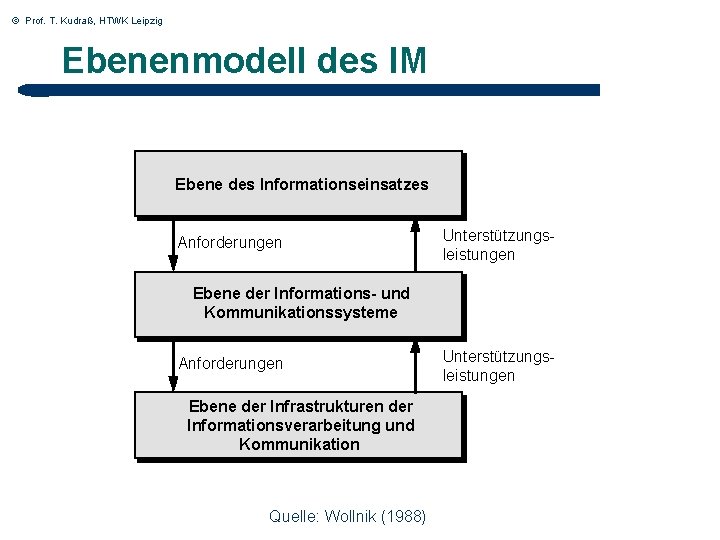
© Prof. T. Kudraß, HTWK Leipzig Ebenenmodell des IM Ebene des Informationseinsatzes Anforderungen Unterstützungsleistungen Ebene der Informations- und Kommunikationssysteme Anforderungen Ebene der Infrastrukturen der Informationsverarbeitung und Kommunikation Quelle: Wollnik (1988) Unterstützungsleistungen
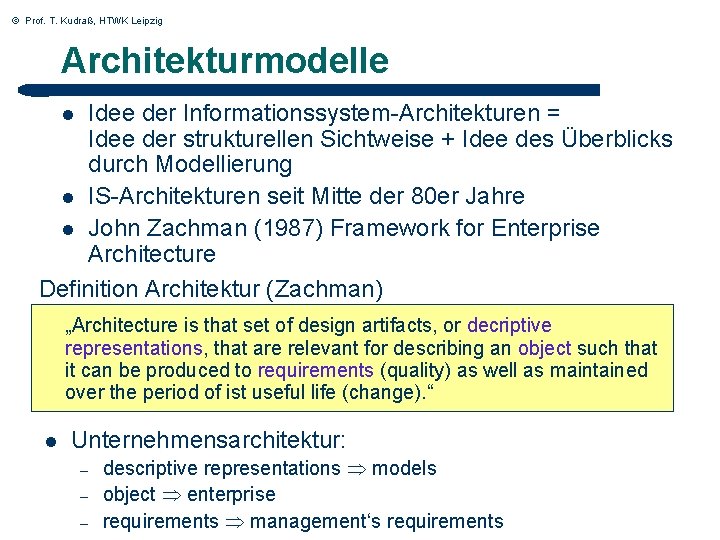
© Prof. T. Kudraß, HTWK Leipzig Architekturmodelle Idee der Informationssystem-Architekturen = Idee der strukturellen Sichtweise + Idee des Überblicks durch Modellierung l IS-Architekturen seit Mitte der 80 er Jahre l John Zachman (1987) Framework for Enterprise Architecture Definition Architektur (Zachman) l „Architecture is that set of design artifacts, or decriptive representations, that are relevant for describing an object such that it can be produced to requirements (quality) as well as maintained over the period of ist useful life (change). “ l Unternehmensarchitektur: – – – descriptive representations models object enterprise requirements management‘s requirements
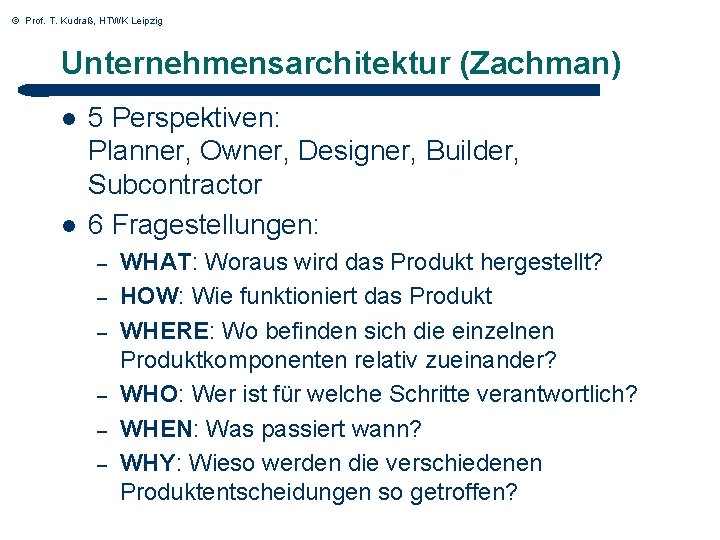
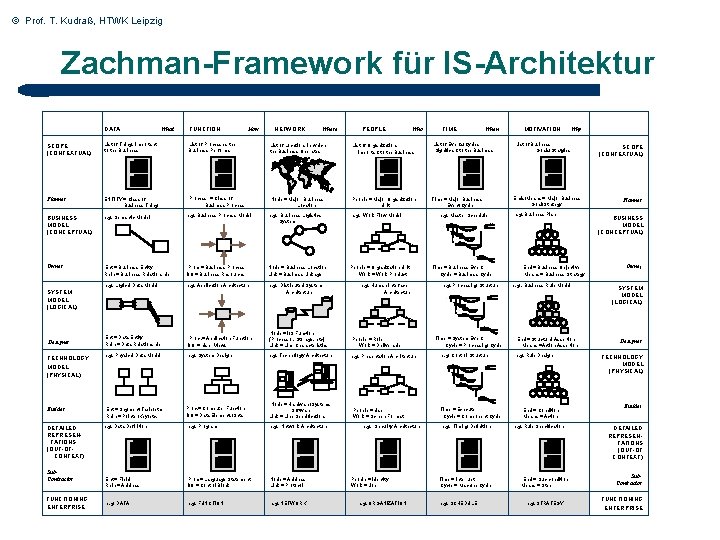
© Prof. T. Kudraß, HTWK Leipzig Unternehmensarchitektur (Zachman) l l 5 Perspektiven: Planner, Owner, Designer, Builder, Subcontractor 6 Fragestellungen: – – – WHAT: Woraus wird das Produkt hergestellt? HOW: Wie funktioniert das Produkt WHERE: Wo befinden sich die einzelnen Produktkomponenten relativ zueinander? WHO: Wer ist für welche Schritte verantwortlich? WHEN: Was passiert wann? WHY: Wieso werden die verschiedenen Produktentscheidungen so getroffen?
© Prof. T. Kudraß, HTWK Leipzig Zachman-Framework für IS-Architektur DATA What FUNCTION How NETWORK Where PEOPLE Who SCOPE (CONTEXTUAL) List of Things Important to the Business List of Processes the Business Performs List of Locations in which the Business Operates List of Organizations Important to the Business Planner ENTITY = Class of Business Thing Process = Class of Business Process Node = Major Business Location People = Major Organization Unit BUSINESS MODEL (CONCEPTUAL) e. g. Semantic Model e. g. Business Process Model e. g. Business Logistics System e. g. Work Flow Model Owner Ent = Business Entity Reln = Business Relationship Proc. = Business Process I/O = Business Resources Node = Business Location Link = Business Linkage e. g. Logical Data Model e. g. Application Architecture e. g. Distributed System Architecture Ent = Data Entity Reln = Data Relationship Proc. = Application Function I/O = User Views Node = I/S Function (Processor, Storage, etc) Link = Line Characteristics People = Role Work = Deliverable e. g. Physical Data Model e. g. System Design e. g. Technology Architecture e. g. Presentation Architecture SYSTEM MODEL (LOGICAL) Designer TECHNOLOGY People = Organization Unit Work = Work Product e. g. Human Interface Architecture TIME When List of Events/Cycles Significant to the Business Time = Major Business Event/Cycle e. g. Master Schedule Time = Business Event Cycle = Business Cycle e. g. Processing Structure Time = System Event Cycle = Processing Cycle e. g. Control Structure MOTIVATION List of Business Goals/Stratgies Ends/Means = Major Business Goal/Strategy e. g. Business Plan End = Business Objective Means = Business Strategy e. g. , Business Rule Model End = Structural Assertion Means =Action Assertion e. g. Rule Design MODEL (PHYSICAL) Builder DETAILED REPRESENTATIONS (OUT-OFCONTEXT) Sub. Contractor FUNCTIONING ENTERPRISE Ent = Segment/Table/etc. Reln = Pointer/Key/etc. Proc. = Computer Function I/O = Data Elements/Sets Node = Hardware/Systems Software Link = Line Specifications e. g. Data Definition e. g. Program e. g. Network Architecture Ent = Field Reln = Address Proc. = Language Statement I/O = Control Block Node = Address Link = Protocol e. g. DATA e. g. FUNCTION e. g. NETWORK People = User Work = Screen Format e. g. Security Architecture People = Identity Work = Job e. g. ORGANIZATION Time = Execute Cycle = Component Cycle e. g. Timing Definition Time = Interrupt Cycle = Machine Cycle e. g. SCHEDULE Why End = Condition Means = Action e. g. Rule Specification End = Sub-condition Means = Step e. g. STRATEGY SCOPE (CONTEXTUAL) Planner BUSINESS MODEL (CONCEPTUAL) Owner SYSTEM MODEL (LOGICAL) Designer TECHNOLOGY MODEL (PHYSICAL) Builder DETAILED REPRESENTATIONS (OUT-OF CONTEXT) Sub. Contractor FUNCTIONING ENTERPRISE
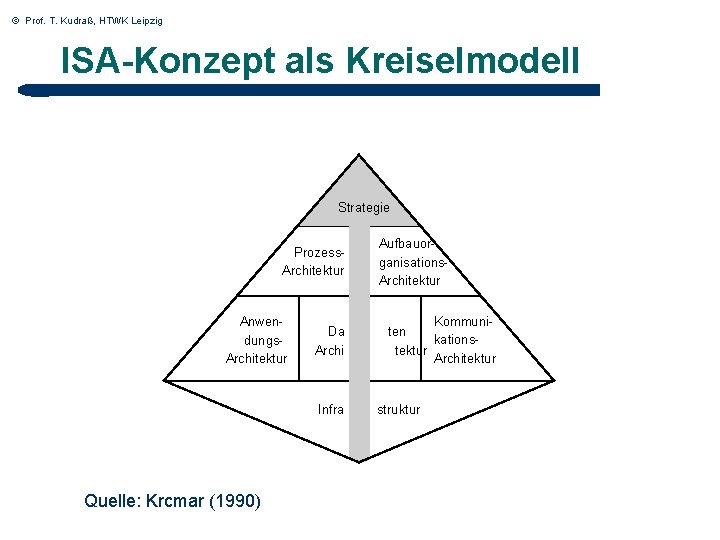
© Prof. T. Kudraß, HTWK Leipzig ISA-Konzept als Kreiselmodell Strategie Prozess. Architektur Anwendungs. Architektur Da Archi Infra Quelle: Krcmar (1990) Aufbauorganisations. Architektur Kommuniten kationstektur Architektur struktur
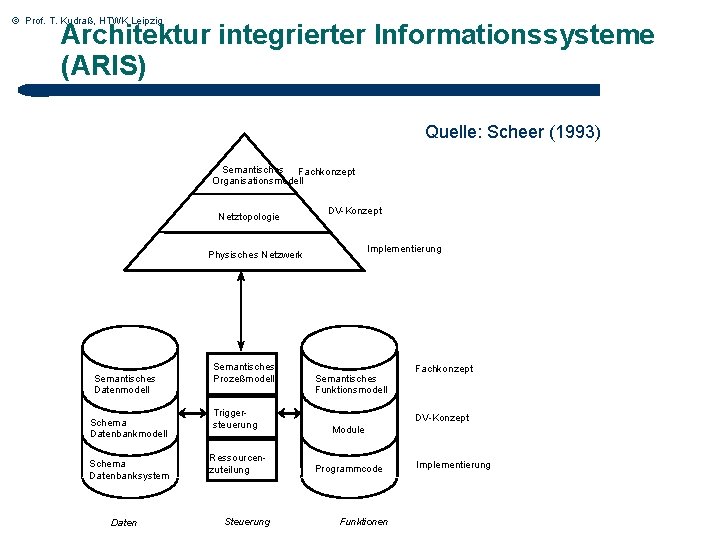
© Prof. T. Kudraß, HTWK Leipzig Architektur integrierter Informationssysteme (ARIS) Quelle: Scheer (1993) Semantisches Fachkonzept Organisationsmodell Netztopologie DV-Konzept Implementierung Physisches Netzwerk Semantisches Datenmodell Schema Datenbanksystem Daten Semantisches Prozeßmodell Semantisches Funktionsmodell Triggersteuerung Module Ressourcenzuteilung Programmcode Steuerung Fachkonzept DV-Konzept Funktionen Implementierung
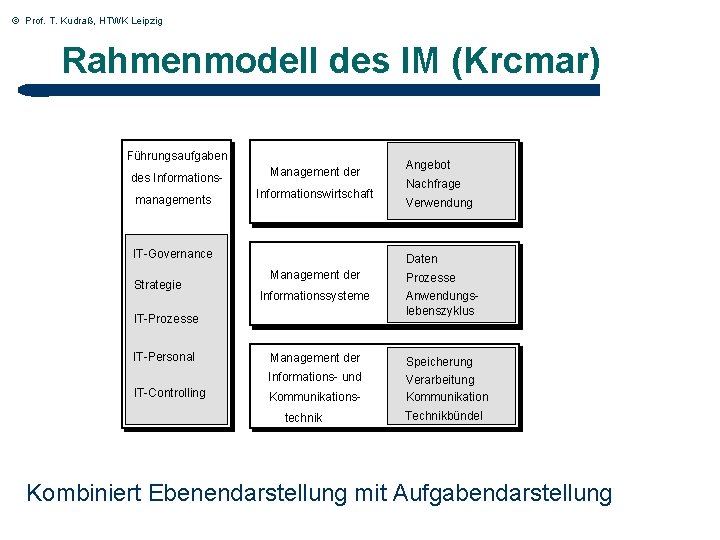
© Prof. T. Kudraß, HTWK Leipzig Rahmenmodell des IM (Krcmar) Führungsaufgaben des Informationsmanagements Management der Informationswirtschaft IT-Governance Strategie Management der Informationssysteme Management der Informations- und IT-Controlling Nachfrage Verwendung Daten IT-Prozesse IT-Personal Angebot Kommunikationstechnik Prozesse Anwendungslebenszyklus Speicherung Verarbeitung Kommunikation Technikbündel Kombiniert Ebenendarstellung mit Aufgabendarstellung