
Information Visualization with Accordion Drawing Tamara Munzner University

- Slides: 48
Information Visualization with Accordion Drawing Tamara Munzner University of British Columbia 1
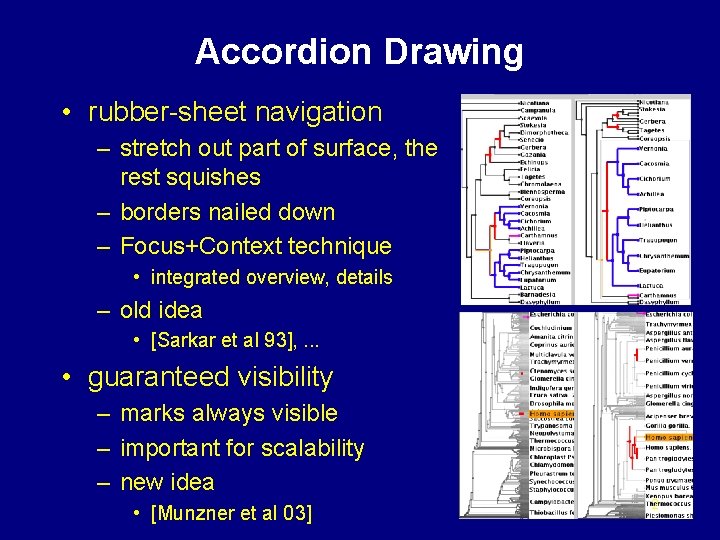
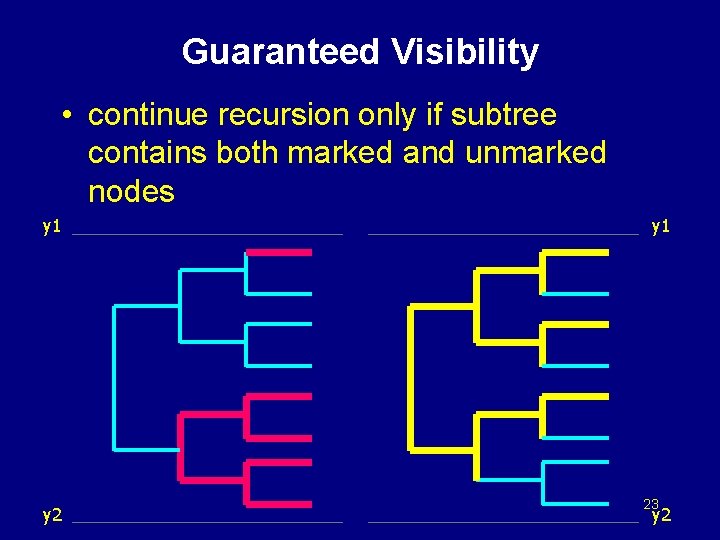
Accordion Drawing • rubber-sheet navigation – stretch out part of surface, the rest squishes – borders nailed down – Focus+Context technique • integrated overview, details – old idea • [Sarkar et al 93], . . . • guaranteed visibility – marks always visible – important for scalability – new idea • [Munzner et al 03] 2
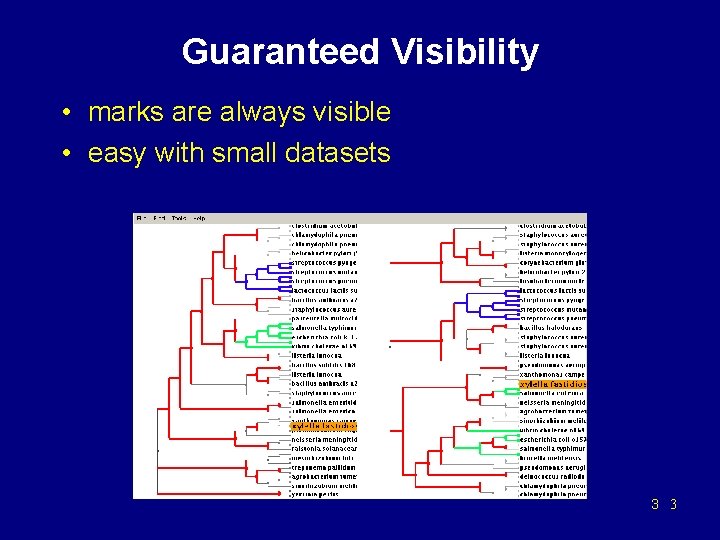
Guaranteed Visibility • marks are always visible • easy with small datasets 3 3
Guaranteed Visibility Challenges • hard with larger datasets • reasons a mark could be invisible – outside the window • AD solution: constrained navigation – underneath other marks • AD solution: avoid 3 D – smaller than a pixel • AD solution: smart culling 4
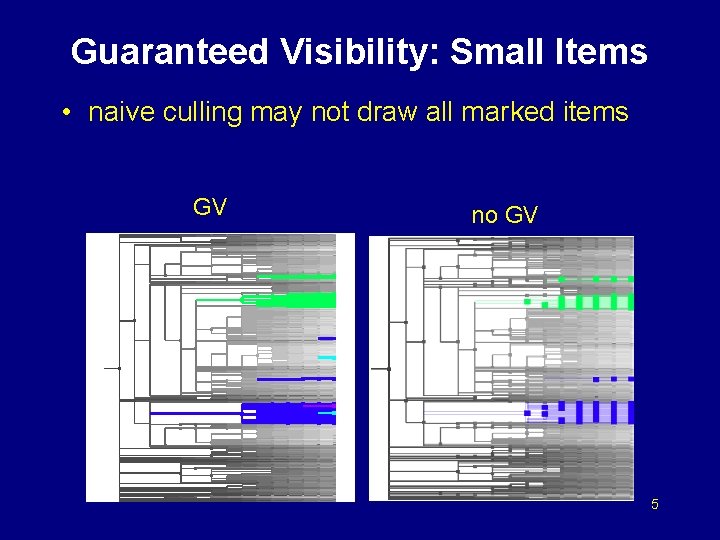
Guaranteed Visibility: Small Items • naive culling may not draw all marked items GV no GV 5
Outline • trees – Tree. Juxtaposer • sequences – Sequence. Juxtaposer • scaling up trees – TJC • general AD framework – PRISAD • power sets – Power. Set. Viewer • evaluation 6
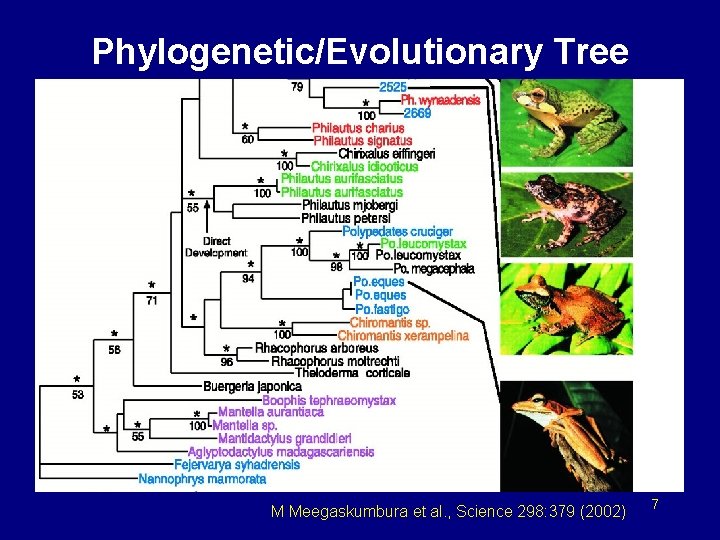
Phylogenetic/Evolutionary Tree M Meegaskumbura et al. , Science 298: 379 (2002) 7
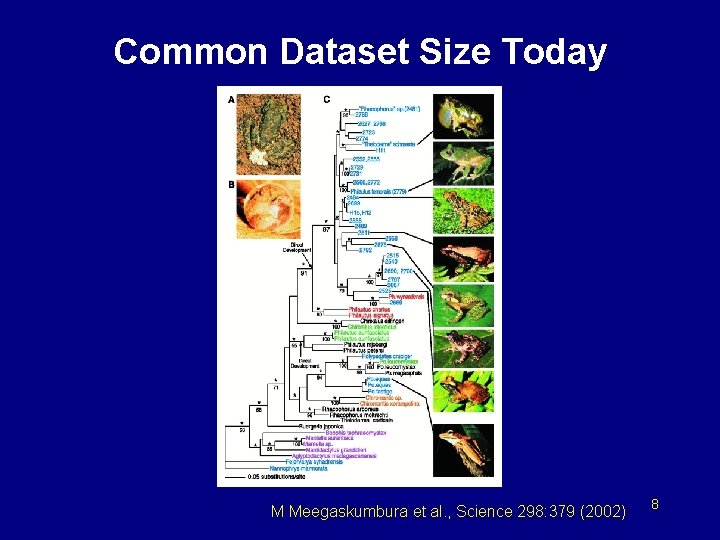
Common Dataset Size Today M Meegaskumbura et al. , Science 298: 379 (2002) 8
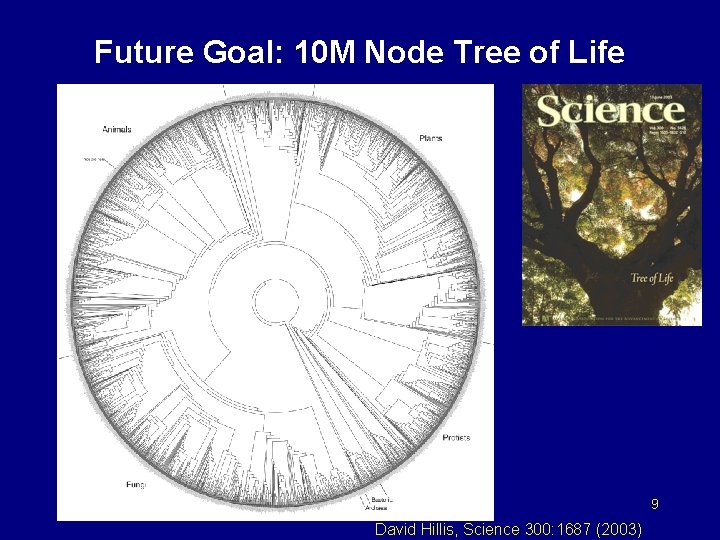
Future Goal: 10 M Node Tree of Life 9 David Hillis, Science 300: 1687 (2003)
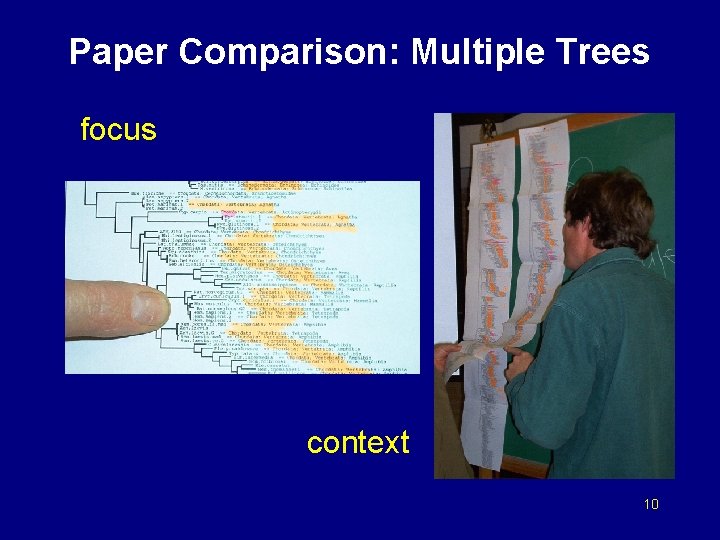
Paper Comparison: Multiple Trees focus context 10
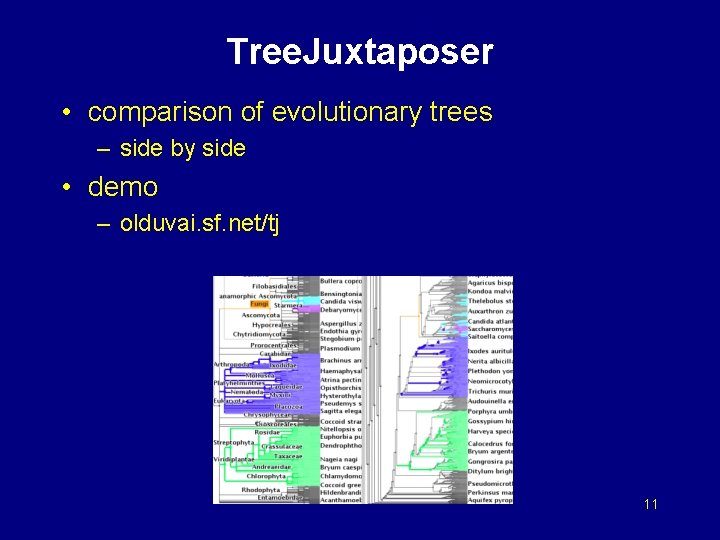
Tree. Juxtaposer • comparison of evolutionary trees – side by side • demo – olduvai. sf. net/tj 11
TJ Contributions • first interactive tree comparison system – automatic structural difference computation – guaranteed visibility of marked areas • scalable to large datasets – 250, 000 to 500, 000 total nodes – all preprocessing subquadratic – all realtime rendering sublinear • introduced accordion drawing (AD) • introduced guaranteed visibility (GV) 12
Joint Work: TJ Credits Tamara Munzner, Francois Guimbretiere, Serdar Tasiran, Li Zhang, and Yunhong Zhou. Tree. Juxtaposer: Scalable Tree Comparison using Focus+Context with Guaranteed Visibility. SIGGRAPH 2003 www. cs. ubc. ca/~tmm/papers/tj James Slack, Tamara Munzner, and Francois Guimbretiere. Tree. Juxtaposer: Info. Vis 03 Contest Entry. (Overall Winner) Info. Vis 2003 Contest www. cs. ubc. ca/~tmm/papers/contest 03 13
Outline • trees – Tree. Juxtaposer • sequences – Sequence. Juxtaposer • scaling up trees – TJC • general AD framework – PRISAD • power sets – Power. Set. Viewer • evaluation 14
Genomic Sequences • multiple aligned sequences of DNA • now commonly browsed with web apps – zoom and pan with abrupt jumps • check benefits of accordion drawing – smooth transitions between states – guaranteed visibility for globally visible landmarks 15
Sequence. Juxtaposer • dense grid, following conventions – rows of sequences partially correlated – columns of aligned nucleotides – videos 16
SJ Contributions • accordion drawing for gene sequences • paper results: 1. 7 M nucleotides – current with PRISAD: 40 M nucleotides • joint work: SJ credits James Slack, Kristian Hildebrand, Tamara Munzner, and Katherine St. John. Sequence. Juxtaposer: Fluid Navigation For Large-Scale Sequence Comparison In Context. Proc. German Conference on Bioinformatics 2004 www. cs. ubc. ca/~tmm/papers/sj 17
Outline • trees – Tree. Juxtaposer • sequences – Sequence. Juxtaposer • scaling up trees – TJC • general AD framework – PRISAD • power sets – Power. Set. Viewer • evaluation 18
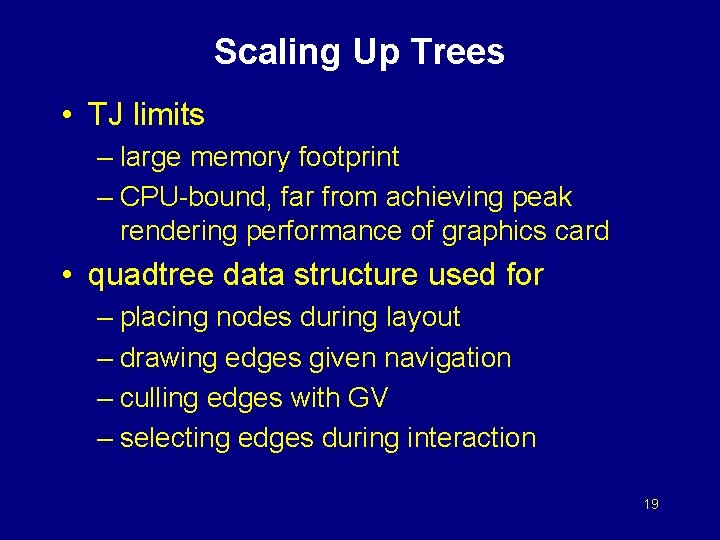
Scaling Up Trees • TJ limits – large memory footprint – CPU-bound, far from achieving peak rendering performance of graphics card • quadtree data structure used for – placing nodes during layout – drawing edges given navigation – culling edges with GV – selecting edges during interaction 19
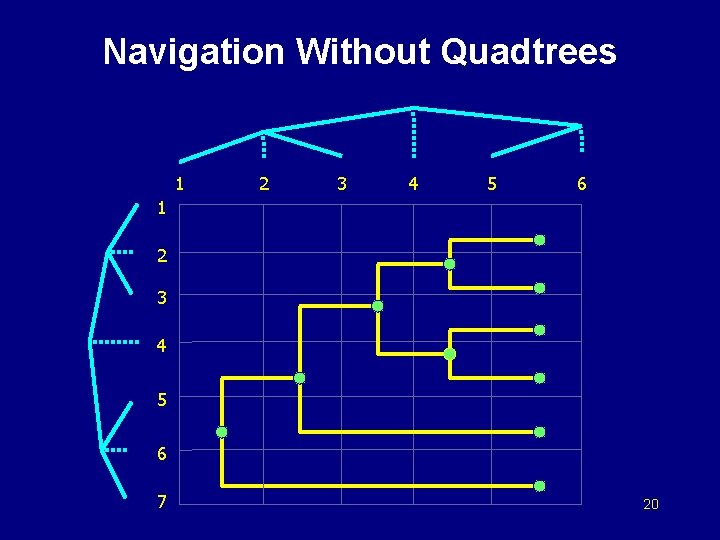
Navigation Without Quadtrees 1 2 3 4 5 6 7 20
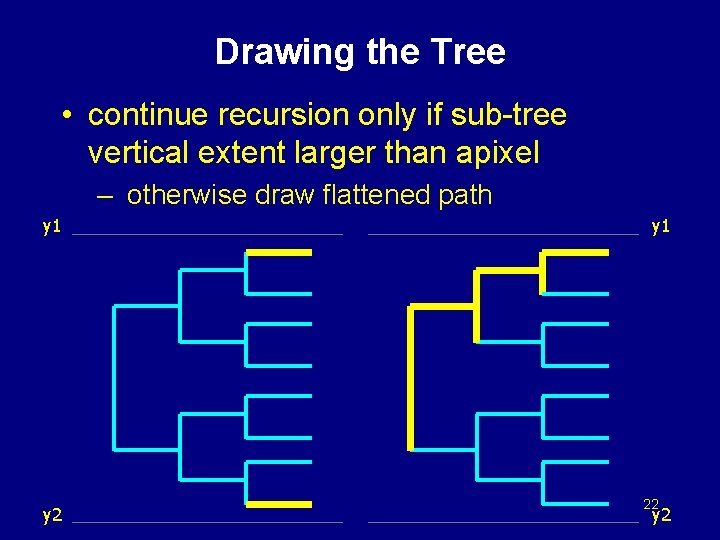
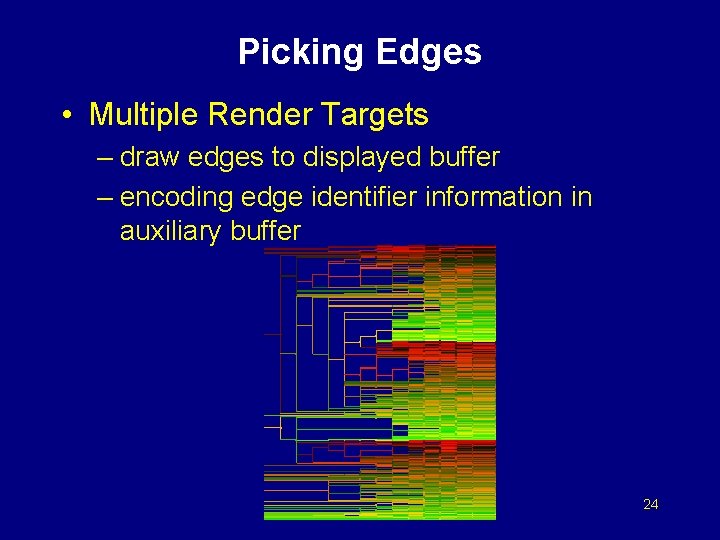
Eliminating the Quadtree • new drawing algorithm – addresses both ordering and culling • new way to pick edges – uses advances in recent graphics hardware • find a different way to place nodes – modification of O-buffer for interaction 21
Drawing the Tree • continue recursion only if sub-tree vertical extent larger than apixel – otherwise draw flattened path y 1 y 2 y 1 22 y 2
Guaranteed Visibility • continue recursion only if subtree contains both marked and unmarked nodes y 1 y 2 y 1 23 y 2
Picking Edges • Multiple Render Targets – draw edges to displayed buffer – encoding edge identifier information in auxiliary buffer 24
TJC/TJC-Q Results • TJC – no quadtree – requires HW multiple render target support – 15 M nodes • TJC-Q – lightweight quadtree – 5 M nodes • both support tree browsing only – no comparison data structures 25
Joint Work: TJC, TJC-Q Credits Dale Beermann, Tamara Munzner, and Greg Humphreys. Scalable, Robust Visualization of Large Trees. Proc. Euro. Vis 2005 www. cs. virginia. edu/~gfx/pubs/TJC 26
Outline • trees – Tree. Juxtaposer • sequences – Sequence. Juxtaposer • scaling up trees – TJC • general AD framework – PRISAD • power sets – Power. Set. Viewer • evaluation 27
PRISAD • generic accordion drawing infrastructure – handles many application types • efficient – guarantees of correctness: no overculling – tight bounds on overdrawing • handles dense regions efficiently – new algorithms for rendering, culling, picking • exploit application dataset characteristics instead of requiring expensive additional data structures 28
PRISAD vs Application Interplay 29
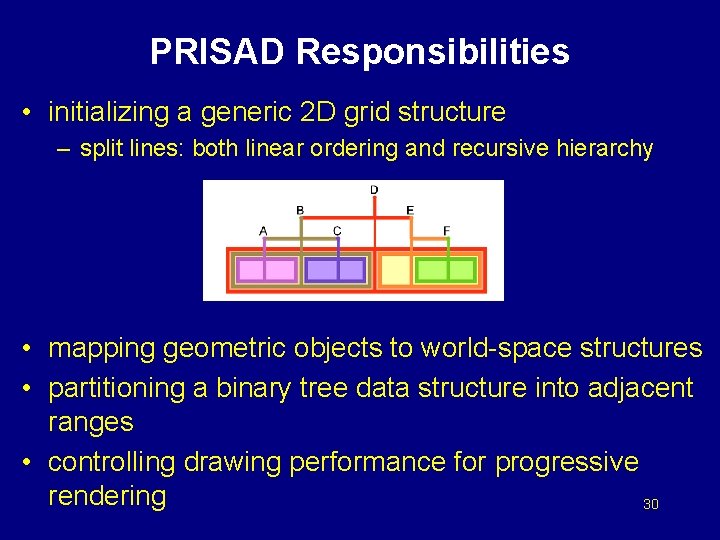
PRISAD Responsibilities • initializing a generic 2 D grid structure – split lines: both linear ordering and recursive hierarchy • mapping geometric objects to world-space structures • partitioning a binary tree data structure into adjacent ranges • controlling drawing performance for progressive rendering 30
Application Responsibilities • calculating the size of underlying PRISAD structures • assigning dataset components to PRISAD structures • initiating a rendering action with two partitioning parameters • ordering the drawing of geometric objects through seeding • drawing individual geometric objects 31
Example: PRITree • rendering with generic infrastructure – partitioning • rendering requires sub-pixel segments • partition split lines into leaf ranges – seeding • 1 st: roots of marked sub-trees, marked nodes • 2 nd: interaction box, remainder of leaf ranges – drawing • ascent rendering from leaves to root 32
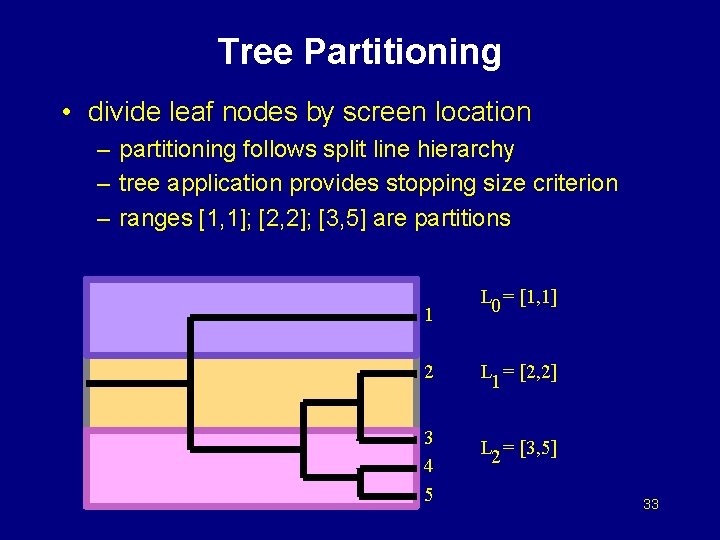
Tree Partitioning • divide leaf nodes by screen location – partitioning follows split line hierarchy – tree application provides stopping size criterion – ranges [1, 1]; [2, 2]; [3, 5] are partitions 1 L 0 = [1, 1] 2 L 1 = [2, 2] 3 4 5 L 2 = [3, 5] 33
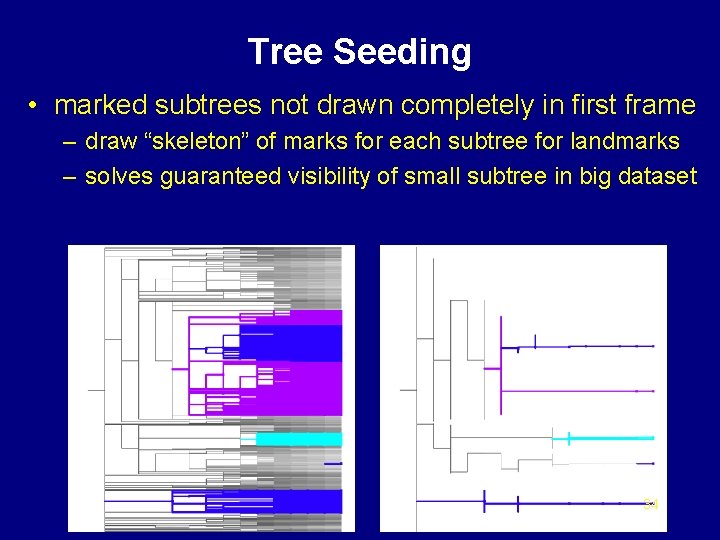
Tree Seeding • marked subtrees not drawn completely in first frame – draw “skeleton” of marks for each subtree for landmarks – solves guaranteed visibility of small subtree in big dataset 34
Tree Drawing Traversal • ascent-based drawing – partition into leaf ranges before drawing • Tree. Juxtaposer partitions during drawing – start from 1 leaf per range, draw path to root – carefully choose starting leaf • 3 categories of misleading gaps eliminated – leaf-range gaps – horizontal tree edge gaps – ascent path gaps 35
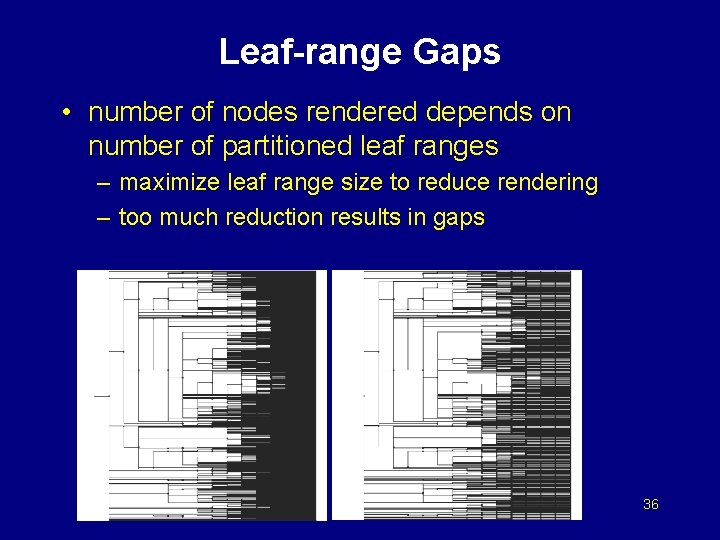
Leaf-range Gaps • number of nodes rendered depends on number of partitioned leaf ranges – maximize leaf range size to reduce rendering – too much reduction results in gaps 36
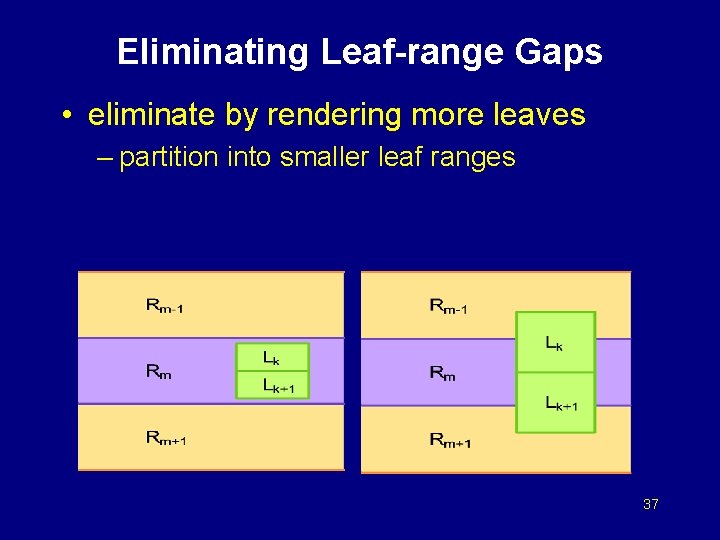
Eliminating Leaf-range Gaps • eliminate by rendering more leaves – partition into smaller leaf ranges 37
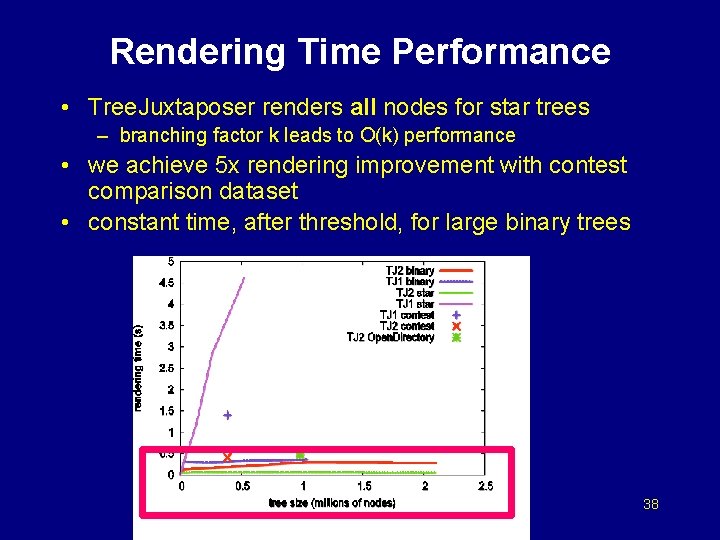
Rendering Time Performance • Tree. Juxtaposer renders all nodes for star trees – branching factor k leads to O(k) performance • we achieve 5 x rendering improvement with contest comparison dataset • constant time, after threshold, for large binary trees 38
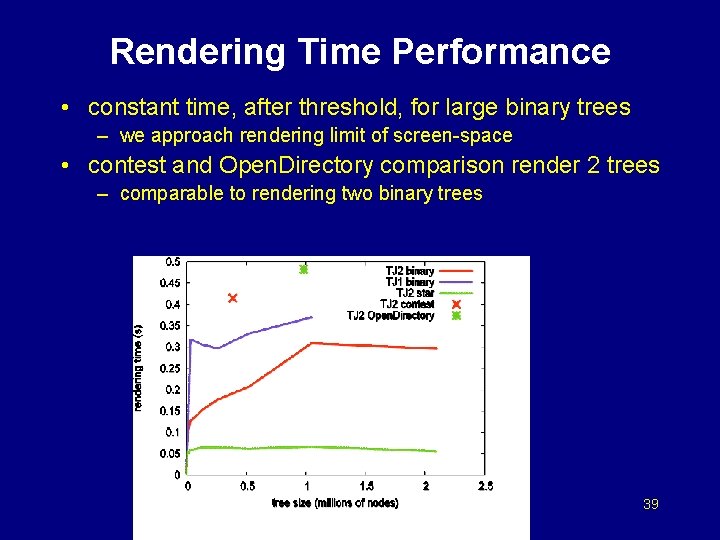
Rendering Time Performance • constant time, after threshold, for large binary trees – we approach rendering limit of screen-space • contest and Open. Directory comparison render 2 trees – comparable to rendering two binary trees 39
Memory Performance • linear memory usage for both – generic AD approach 5 x better • marked range storage changes improve scalability – 1 GB difference for contest comparison 40
PRISAD Results • video • joint work: PRISAD credits James Slack, Kristian Hildebrand, and Tamara Munzner. PRISAD: A Partitioned Rendering Infrastructure for Scalable Accordion Drawing. Proc. Info. Vis 2005, to appear 41
Outline • trees – Tree. Juxtaposer • sequences – Sequence. Juxtaposer • scaling up trees – TJC • general AD framework – PRISAD • power sets – Power. Set. Viewer • evaluation 42
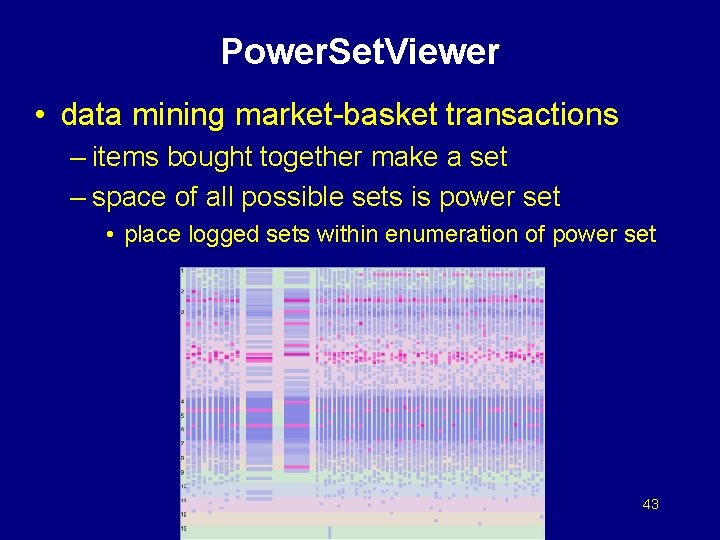
Power. Set. Viewer • data mining market-basket transactions – items bought together make a set – space of all possible sets is power set • place logged sets within enumeration of power set 43
PSV Results • dynamic data – show progress of steerable data mining system with constraints – all other AD applications had static data • handles alphabets of up to 40, 000 • handles log files of 1. 5 to 7 million items • joint work in progress with – Qiang Kong, Raymond Ng 44
Outline • trees – Tree. Juxtaposer • sequences – Sequence. Juxtaposer • scaling up trees – TJC • general AD framework – PRISAD • power sets – Power. Set. Viewer • evaluation 45
Evaluation • how focus and context are used with – rubber sheet navigation vs. pan and zoom – integrated scene vs. separate overview • user studies of TJ – tasks based on biologist interviews • joint work in progress, with – Adam Bodnar, Dmitry Nekrasovski, Joanna Mc. Grenere 46
Conclusion • accordion drawing effective for variety of application datasets – trees, sequences, sets • guaranteed visibility is powerful technique – computational expense can be handled by generic algorithms 47
More Information • papers, videos, images – www. cs. ubc. ca/~tmm • free software – olduvai. sourceforge. net/tj – olduvai. sourceforge. net/sj 48