
Information Theory of Wireless Networks David Tse Wireless
- Slides: 63
Information Theory of Wireless Networks David Tse Wireless Foundations U. C. Berkeley Information Theory Summer School Penn State June 3, 2008
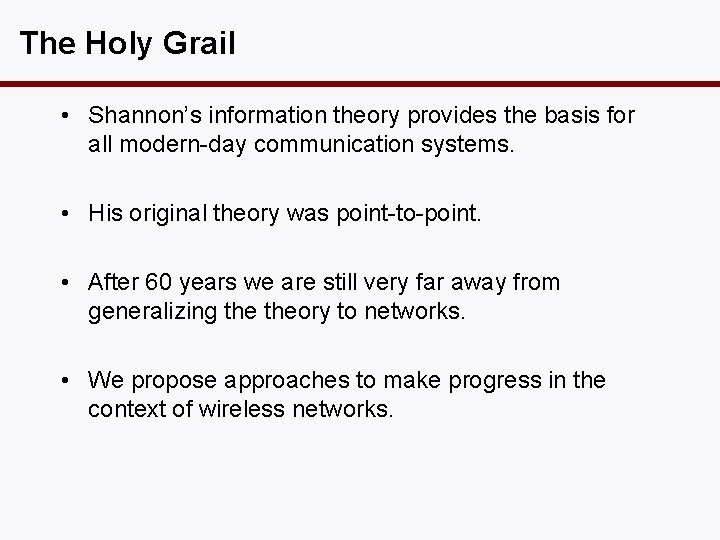
The Holy Grail • Shannon’s information theory provides the basis for all modern-day communication systems. • His original theory was point-to-point. • After 60 years we are still very far away from generalizing theory to networks. • We propose approaches to make progress in the context of wireless networks.
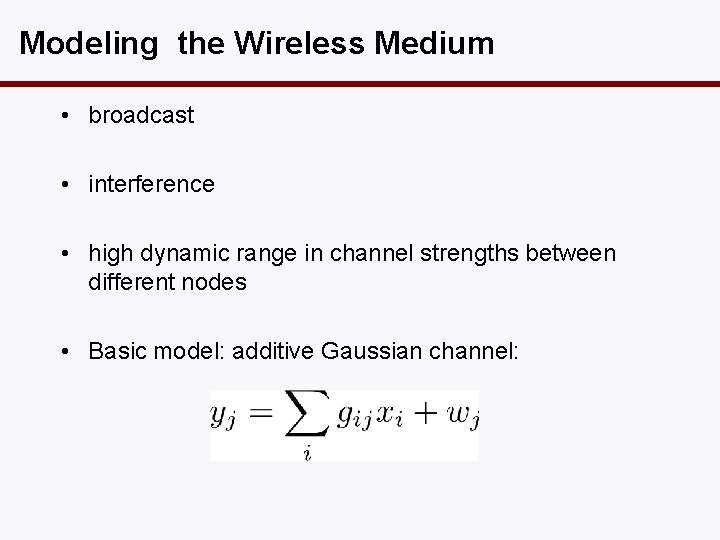
Modeling the Wireless Medium • broadcast • interference • high dynamic range in channel strengths between different nodes • Basic model: additive Gaussian channel:
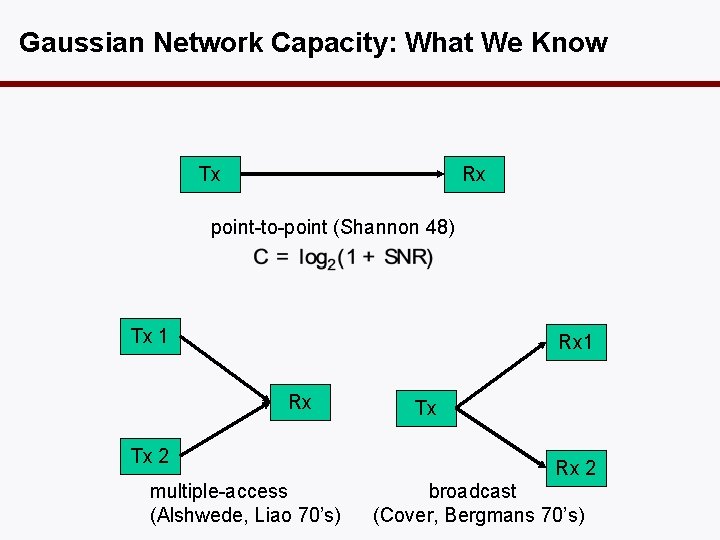
Gaussian Network Capacity: What We Know Tx Rx point-to-point (Shannon 48) Tx 1 Rx Tx 2 multiple-access (Alshwede, Liao 70’s) Tx Rx 2 broadcast (Cover, Bergmans 70’s)
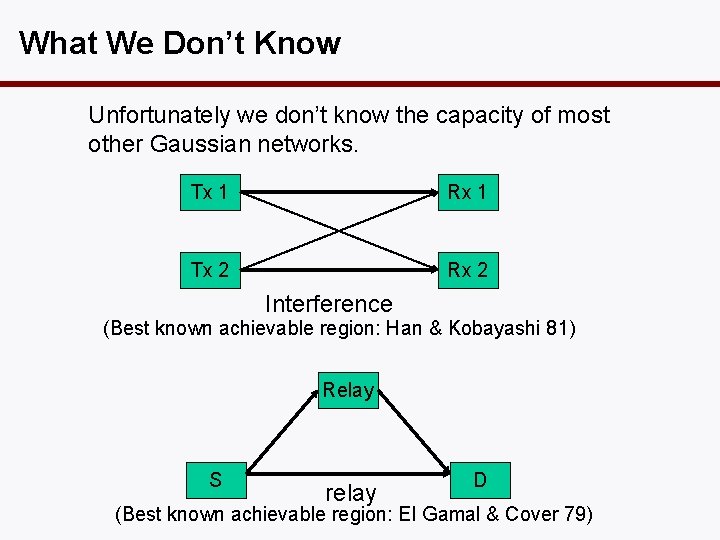
What We Don’t Know Unfortunately we don’t know the capacity of most other Gaussian networks. Tx 1 Rx 1 Tx 2 Rx 2 Interference (Best known achievable region: Han & Kobayashi 81) Relay S relay D (Best known achievable region: El Gamal & Cover 79)
Recent Progress • Approximate. • Similar evolution has happened in other fields: – fluid and heavy-traffic approximation in queueing networks – approximation algorithms in CS theory • Approximation should be good in engineering-relevant regimes.
Two Regimes • Interference-limited regime: – noise is small compared to signals. – focuses on interactions between signals rather than the stochastic noise • Large-network regime: – networks with large number of nodes – focuses on macroscopic scaling laws
Overview • Lecture 1: interference channels – 2 -user interference channel capacity to within 1 bit/s/Hz – Deeper insight via a deterministic channel model – Generalization to some many-user interference channels. • Lecture 2: relay networks – relay channel capacity to within 1 bit/s/Hz – single-source-single-destination relay network capacity to within constant gap
Overview • Lecture 3: Large networks – Networks with many source-destination pairs – Information theoretic optimal scaling laws and architectures
Lecture 1: Interference Channels
Interference • Interference management is an central problem in wireless system design. • Within same system (eg. adjacent cells in a cellular system) or across different systems (eg. multiple Wi. Fi networks) • Two basic approaches: – orthogonalize into different bands – full sharing of spectrum but treating interference as noise • What does information theory have to say about the optimal thing to do?
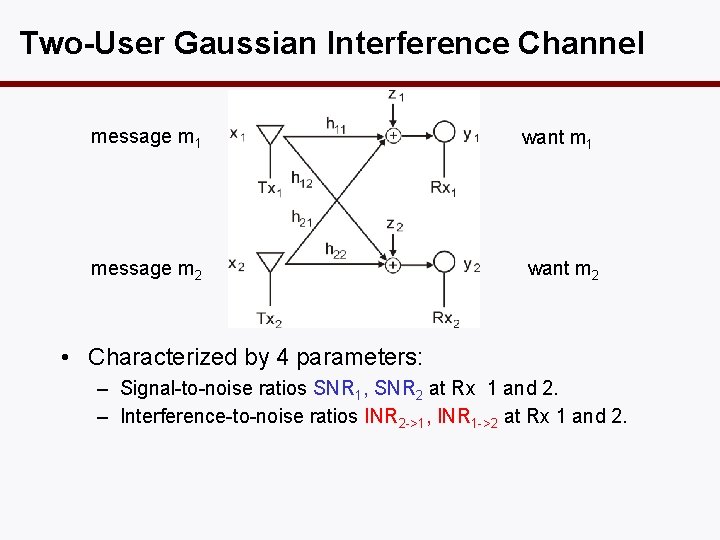
Two-User Gaussian Interference Channel message m 1 want m 1 message m 2 want m 2 • Characterized by 4 parameters: – Signal-to-noise ratios SNR 1, SNR 2 at Rx 1 and 2. – Interference-to-noise ratios INR 2 ->1, INR 1 ->2 at Rx 1 and 2.
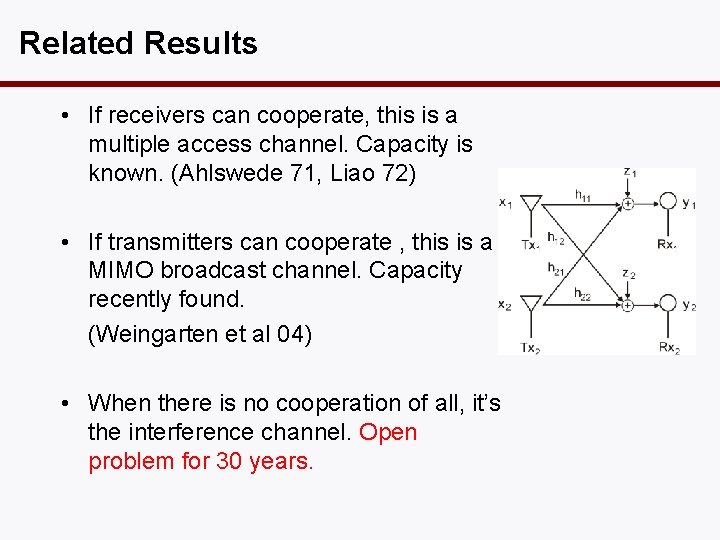
Related Results • If receivers can cooperate, this is a multiple access channel. Capacity is known. (Ahlswede 71, Liao 72) • If transmitters can cooperate , this is a MIMO broadcast channel. Capacity recently found. (Weingarten et al 04) • When there is no cooperation of all, it’s the interference channel. Open problem for 30 years.
State-of-the-Art in 2006 • If INR 1 ->2 > SNR 1 and INR 2 ->1 > SNR 2, then capacity region Cint is known (strong interference, Han. Kobayashi 1981, Sato 81) • Capacity is unknown for any other parameter ranges. • Best known achievable region is due to Han. Kobayashi (1981). • Hard to compute explicitly. • Unclear if it is optimal or even how far from capacity. • Some outer bounds exist but unclear how tight (Sato 78, Costa 85, Kramer 04).
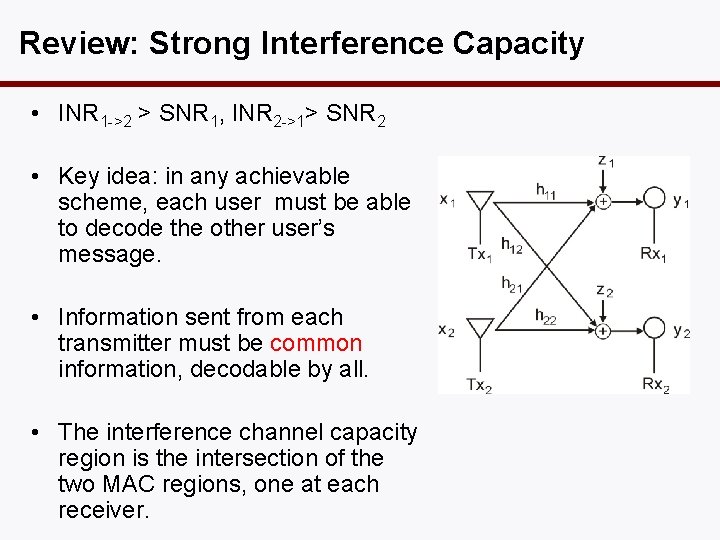
Review: Strong Interference Capacity • INR 1 ->2 > SNR 1, INR 2 ->1> SNR 2 • Key idea: in any achievable scheme, each user must be able to decode the other user’s message. • Information sent from each transmitter must be common information, decodable by all. • The interference channel capacity region is the intersection of the two MAC regions, one at each receiver.
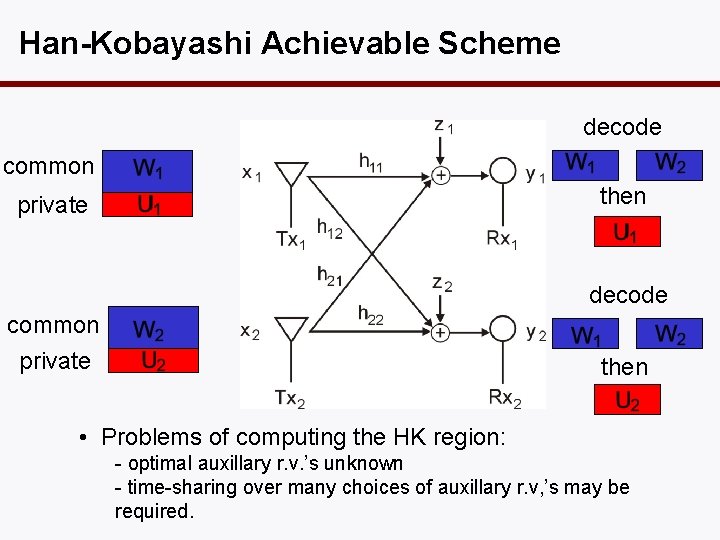
Han-Kobayashi Achievable Scheme decode common then private decode common private then • Problems of computing the HK region: - optimal auxillary r. v. ’s unknown - time-sharing over many choices of auxillary r. v, ’s may be required.
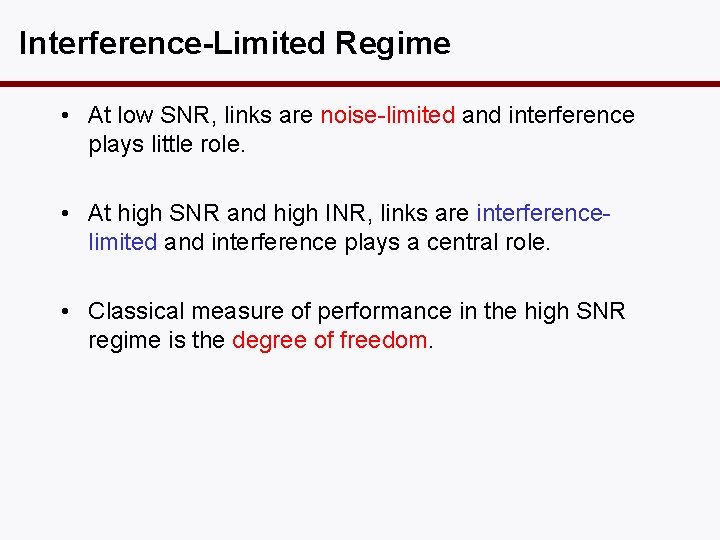
Interference-Limited Regime • At low SNR, links are noise-limited and interference plays little role. • At high SNR and high INR, links are interferencelimited and interference plays a central role. • Classical measure of performance in the high SNR regime is the degree of freedom.
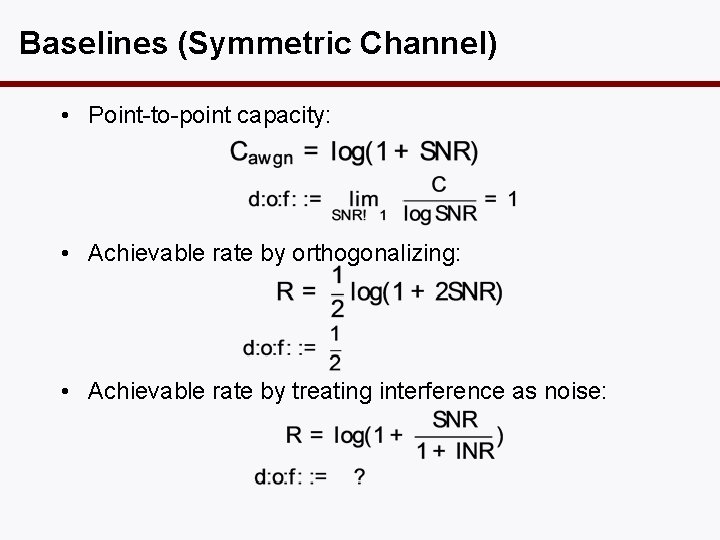
Baselines (Symmetric Channel) • Point-to-point capacity: • Achievable rate by orthogonalizing: • Achievable rate by treating interference as noise:
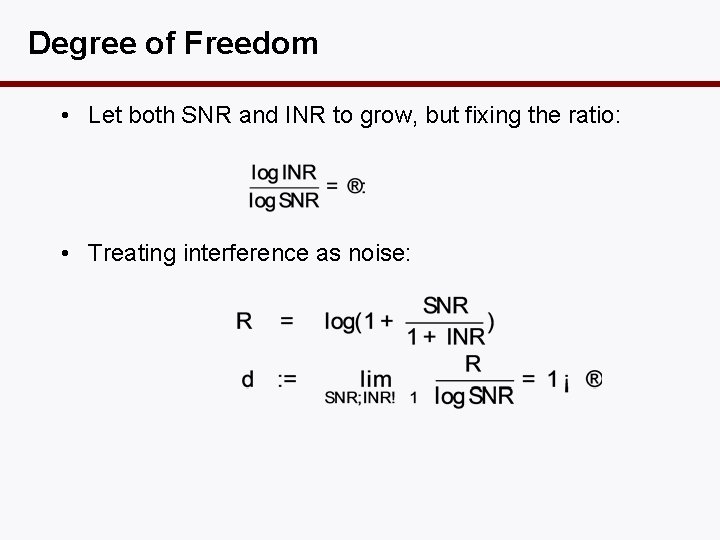
Degree of Freedom • Let both SNR and INR to grow, but fixing the ratio: • Treating interference as noise:
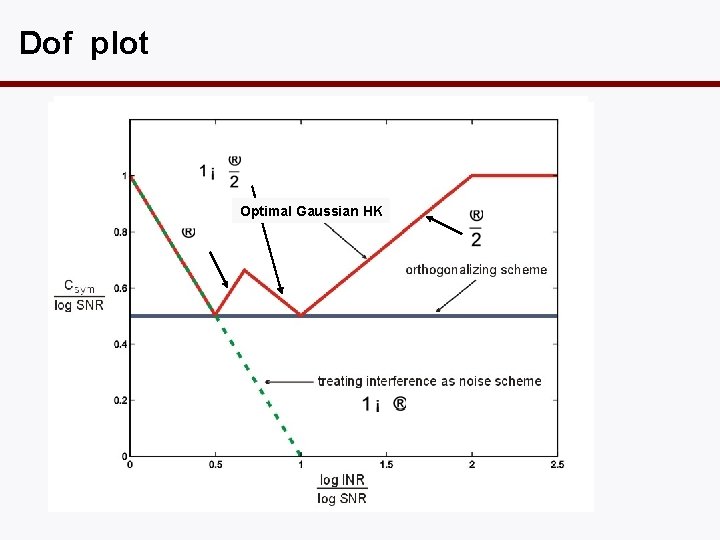
Dof plot Optimal Gaussian HK
Dof-Optimal Han-Kobayashi • Only a single split: no time-sharing. • Private power set so that interference is received at noise level at the other receiver.
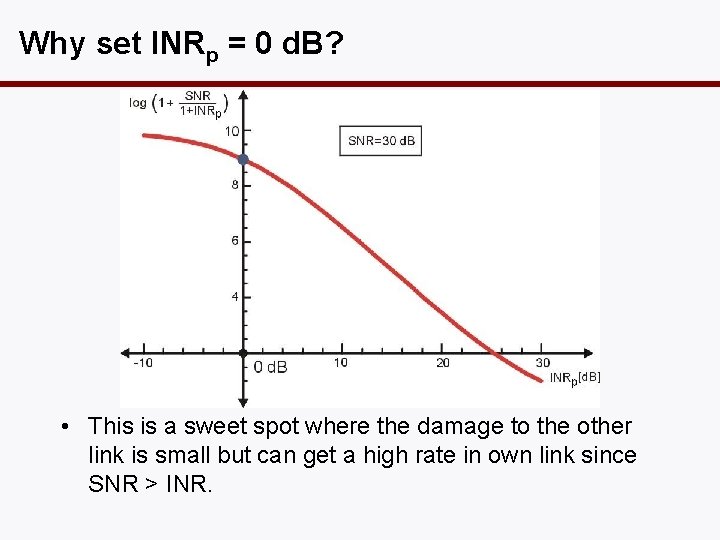
Why set INRp = 0 d. B? • This is a sweet spot where the damage to the other link is small but can get a high rate in own link since SNR > INR.
Can we do Better? • We identified the Gaussian HK scheme that achieves optimal dof. • But can one do better by using non-Gaussian inputs or a scheme other than HK? • Answer turns out to be no. • The dof achieved by the simple HK scheme is the dof of the interference channel. • To prove this, we need outer bounds.
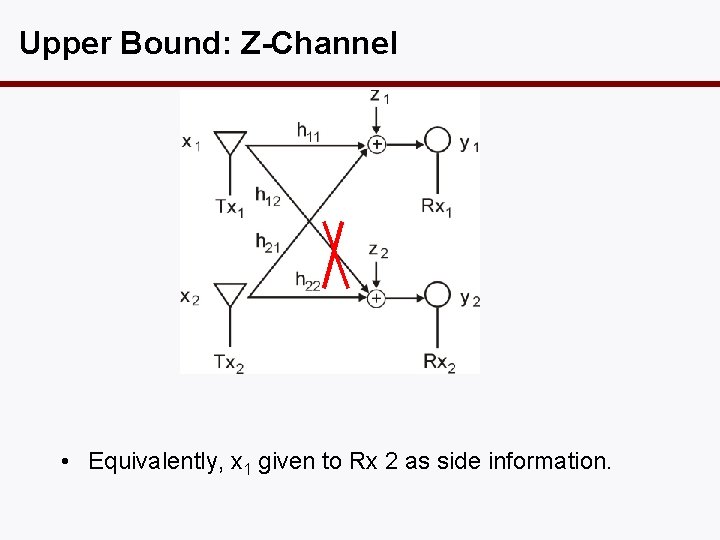
Upper Bound: Z-Channel • Equivalently, x 1 given to Rx 2 as side information.
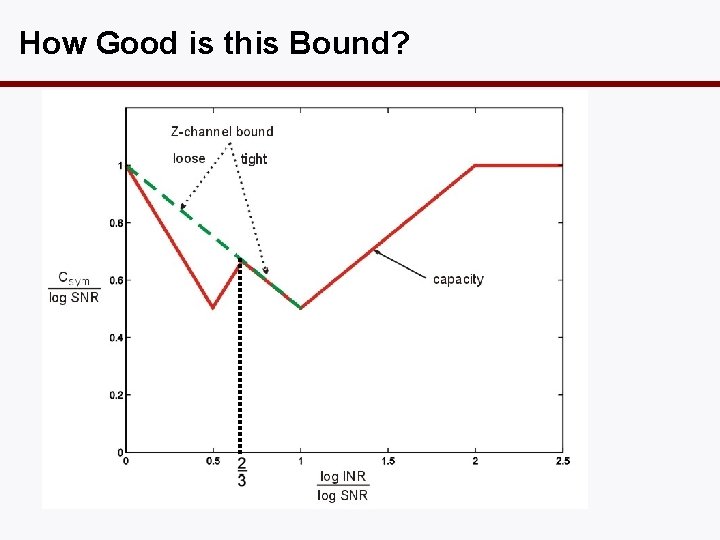
How Good is this Bound?
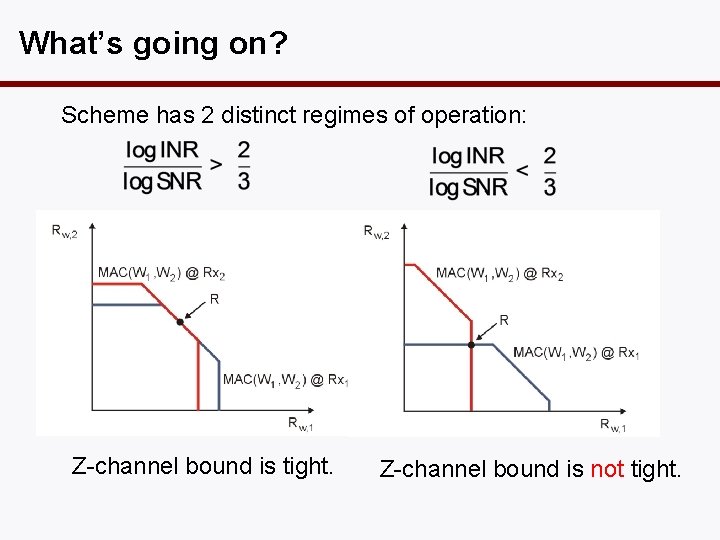
What’s going on? Scheme has 2 distinct regimes of operation: Z-channel bound is tight. Z-channel bound is not tight.
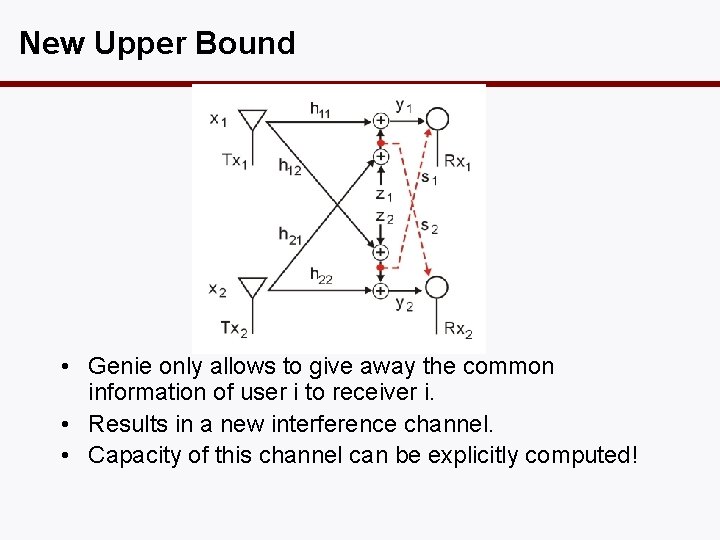
New Upper Bound • Genie only allows to give away the common information of user i to receiver i. • Results in a new interference channel. • Capacity of this channel can be explicitly computed!
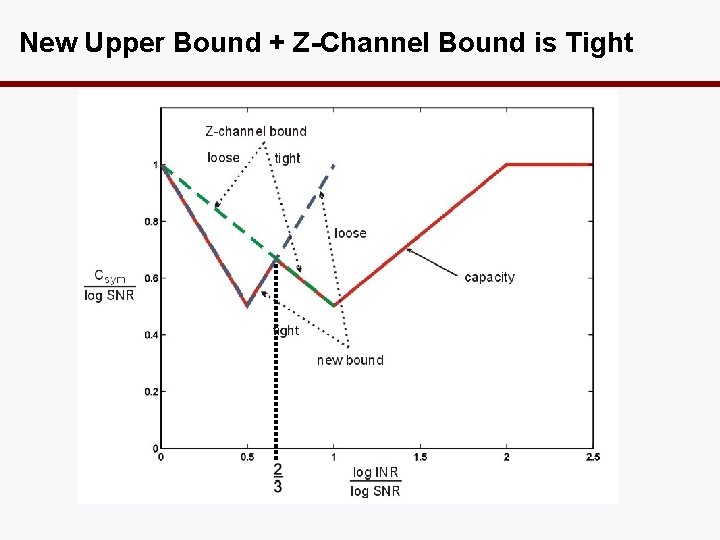
New Upper Bound + Z-Channel Bound is Tight
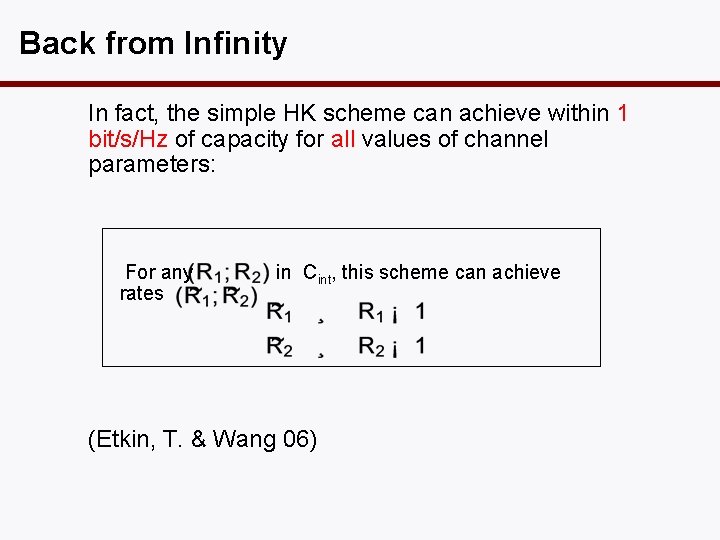
Back from Infinity In fact, the simple HK scheme can achieve within 1 bit/s/Hz of capacity for all values of channel parameters: For any rates in Cint, this scheme can achieve (Etkin, T. & Wang 06)
From 1 -Bit to 0 -Bit The new upper bound can further be sharpened to get exact results in the low-interference regime ( < 1/3). (Shang, Kramer, Chen 07, Annaprueddy & Veeravalli 08, Motahari&Khandani 07)
From Low-Noise to No-Noise • The 1 -bit result was obtained by first analyzing the dof of the Gaussian interference channel in the lownoise regime. • Turns out there is a deterministic interference channel which captures exactly the behavior of the interference-limited Gaussian channel. • Identifying this underlying deterministic structure allows us to generalize the approach.
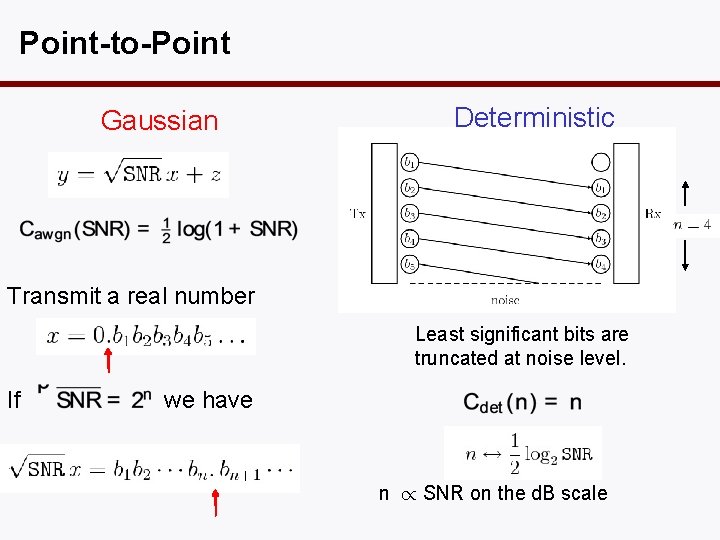
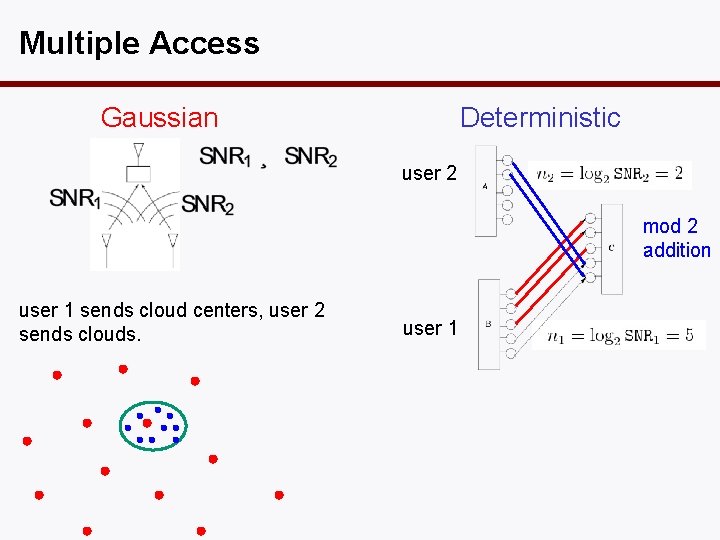
Point-to-Point Gaussian Deterministic Transmit a real number Least significant bits are truncated at noise level. If we have n / SNR on the d. B scale
Multiple Access Gaussian Deterministic user 2 mod 2 addition user 1 sends cloud centers, user 2 sends clouds. user 1
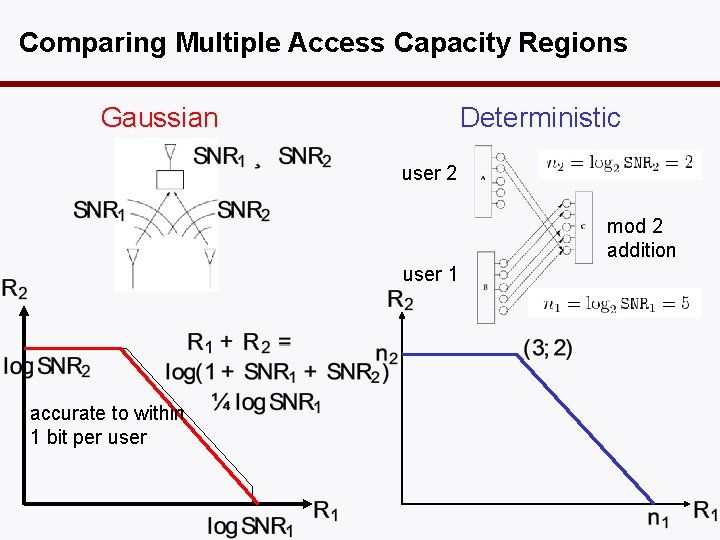
Comparing Multiple Access Capacity Regions Gaussian Deterministic user 2 mod 2 addition user 1 accurate to within 1 bit per user
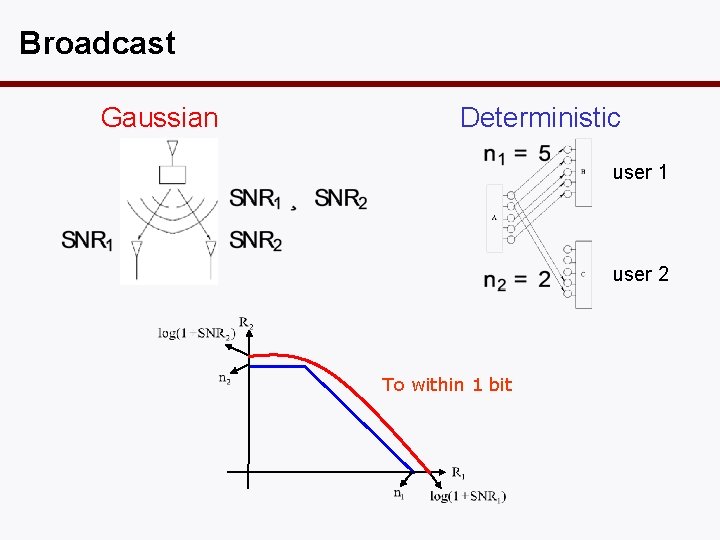
Broadcast Gaussian Deterministic user 1 user 2 To within 1 bit
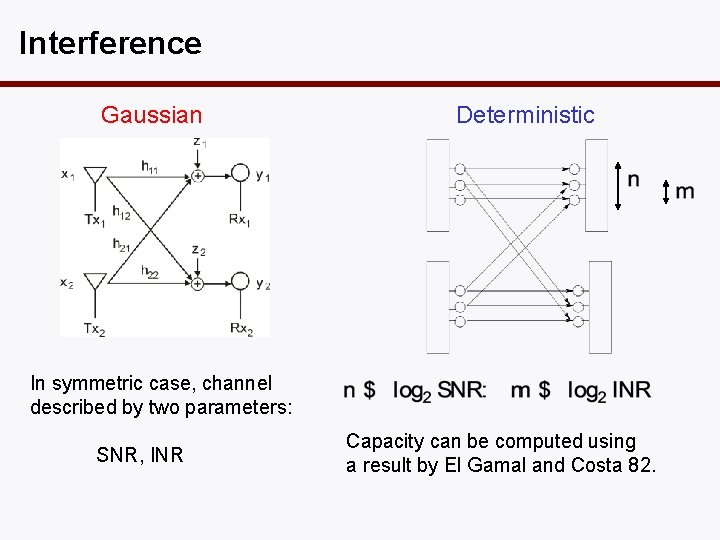
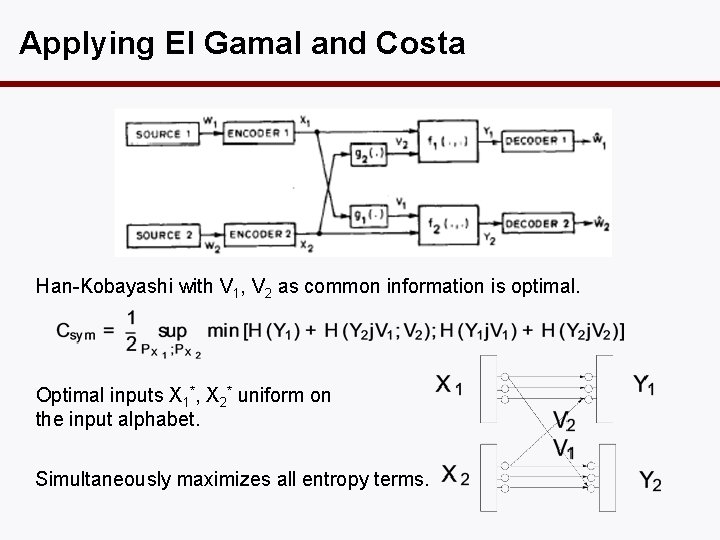
Interference Gaussian Deterministic In symmetric case, channel described by two parameters: SNR, INR Capacity can be computed using a result by El Gamal and Costa 82.
Applying El Gamal and Costa Han-Kobayashi with V 1, V 2 as common information is optimal. Optimal inputs X 1*, X 2* uniform on the input alphabet. Simultaneously maximizes all entropy terms.
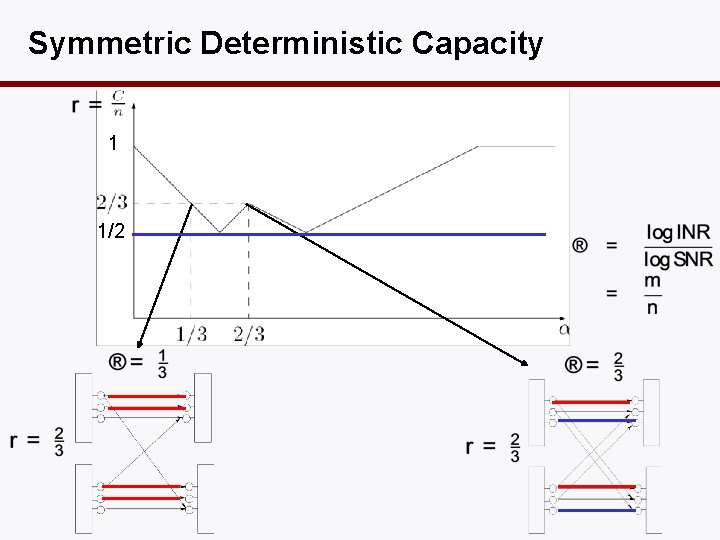
Symmetric Deterministic Capacity 1 1/2
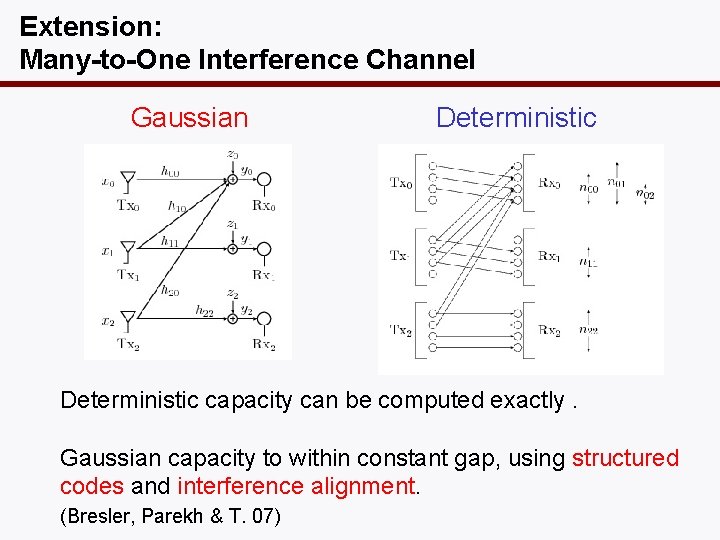
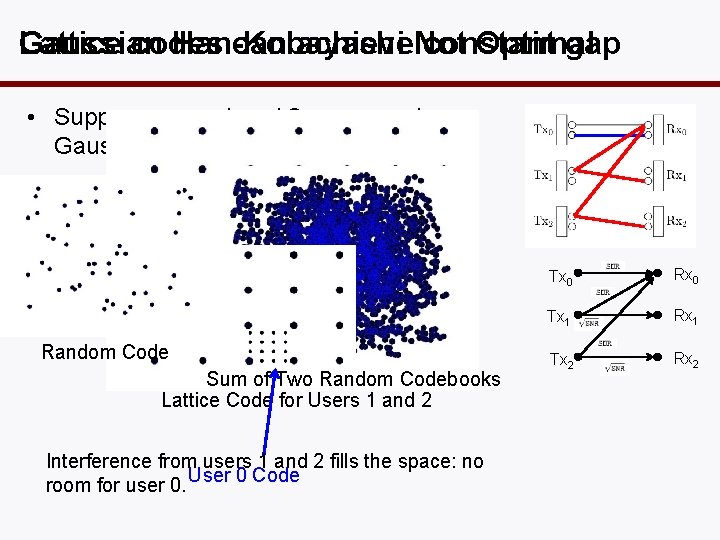
Extension: Many-to-One Interference Channel Gaussian Deterministic capacity can be computed exactly. Gaussian capacity to within constant gap, using structured codes and interference alignment. (Bresler, Parekh & T. 07)
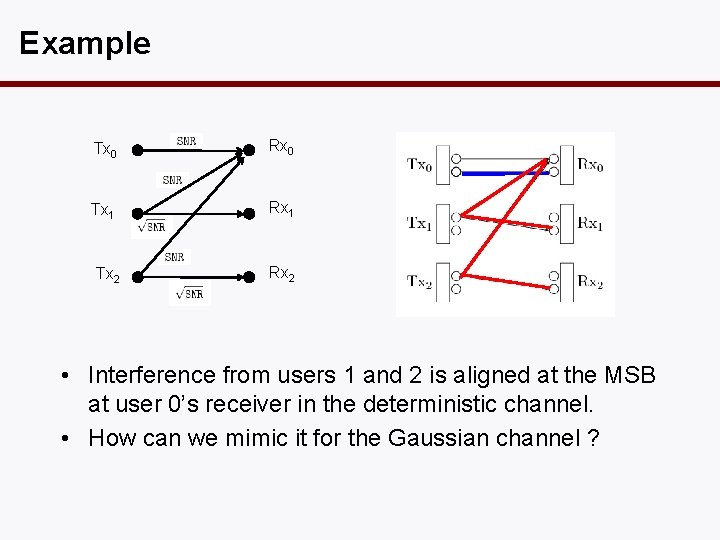
Example Tx 0 Rx 0 Tx 1 Rx 1 Tx 2 Rx 2 • Interference from users 1 and 2 is aligned at the MSB at user 0’s receiver in the deterministic channel. • How can we mimic it for the Gaussian channel ?
Gaussian Lattice codes Han-Kobayashi can achieve. Not constant Optimal gap • Suppose users 1 and 2 use a random Gaussian codebook: Random Code Sum of Two Random Codebooks Lattice Code for Users 1 and 2 Interference from users 1 and 2 fills the space: no room for user 0. User 0 Code Tx 0 Rx 0 Tx 1 Rx 1 Tx 2 Rx 2
Interference Channels: Recap • In two-user case, we showed that an existing strategy can achieve within 1 bit to optimality. • In many-to-one case, we showed that a new strategy can do much better. • General K-user interference channel still open.
Lecture 2: Relay Networks
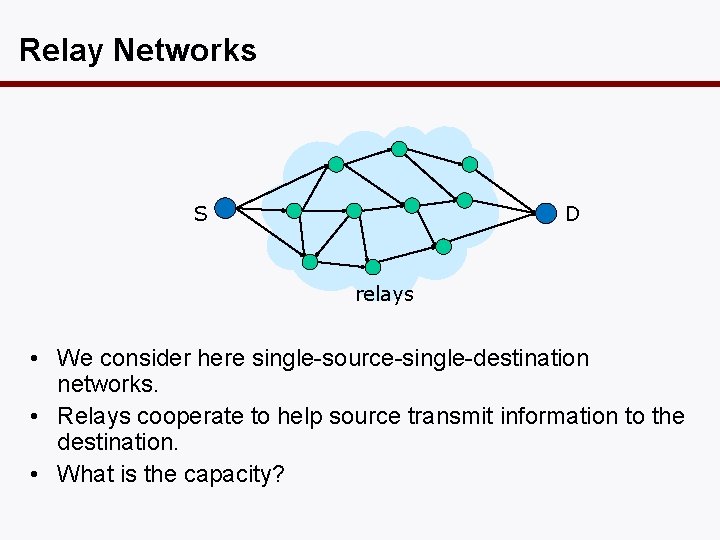
Relay Networks D S relays • We consider here single-source-single-destination networks. • Relays cooperate to help source transmit information to the destination. • What is the capacity?
History • The (single) relay channel was first proposed by Van der Meulen in 1971. • Cover and El Gamal (1979) provided a whole array of achievable strategies: – decode-and-forward – Partial-decode-and-forward – Compress-and-forward • Recent generalization of these techniques to more than 1 relay (Gupta & Kumar, Xie & Kumar, Kramer, Gastpar and Gupta). • Performance of these schemes on general networks not easily characterizable.
Approach • General upper bound: cutset bound. • Are any of these schemes within a constant gap of optimality for general networks? • If not, find a scheme which is. • We approach the problem via the deterministic model. (Avestimehr, Diggavi & T. 07)
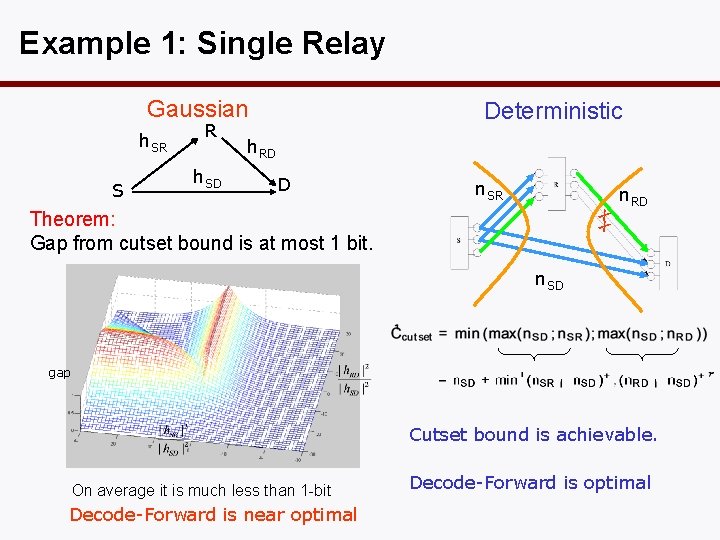
Example 1: Single Relay Gaussian h. SR S R h. SD Deterministic h. RD D n. SR x x Theorem: Gap from cutset bound is at most 1 bit. n. RD n. SD gap Cutset bound is achievable. On average it is much less than 1 -bit Decode-Forward is near optimal Decode-Forward is optimal
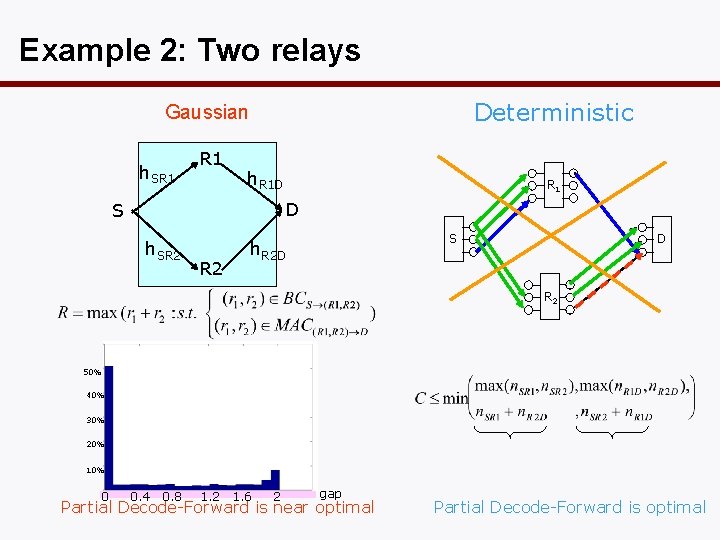
Example 2: Two relays Deterministic Gaussian h. SR 1 h. R 1 D R 1 D S h. SR 2 S h. R 2 D D R 2 50% 40% 30% 20% 10% 0 0. 4 0. 8 1. 2 1. 6 2 gap Partial Decode-Forward is near optimal Partial Decode-Forward is optimal
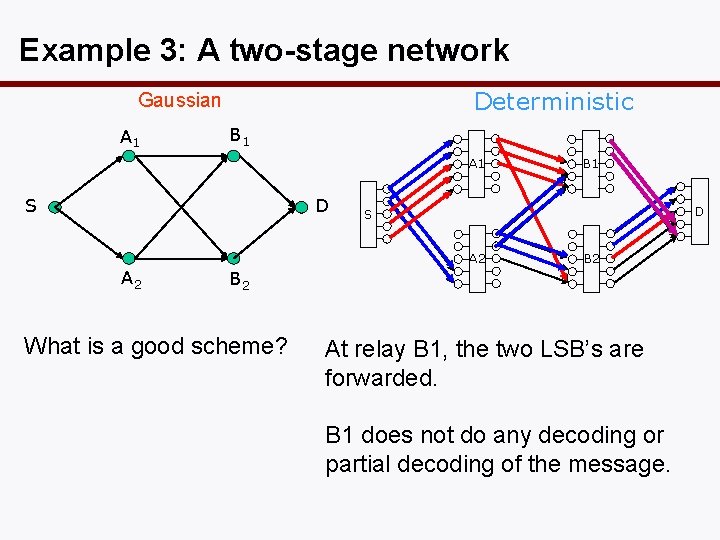
Example 3: A two-stage network Deterministic Gaussian A 1 B 1 A 1 S D D S A 2 B 1 B 2 What is a good scheme? At relay B 1, the two LSB’s are forwarded. B 1 does not do any decoding or partial decoding of the message.
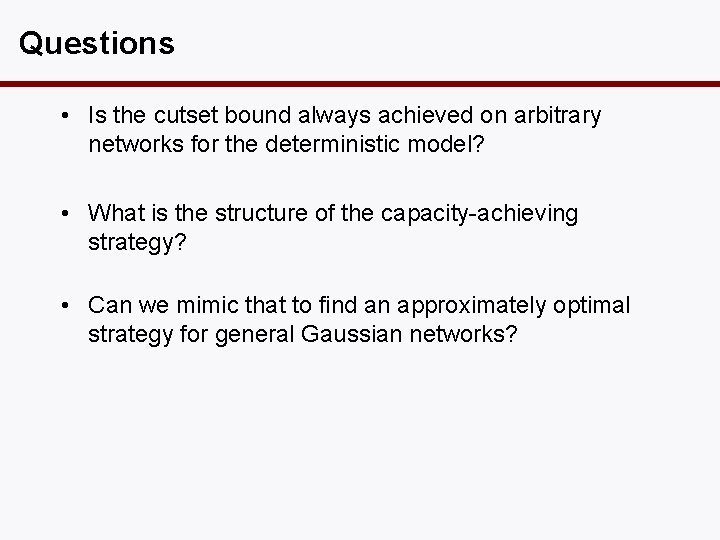
Questions • Is the cutset bound always achieved on arbitrary networks for the deterministic model? • What is the structure of the capacity-achieving strategy? • Can we mimic that to find an approximately optimal strategy for general Gaussian networks?
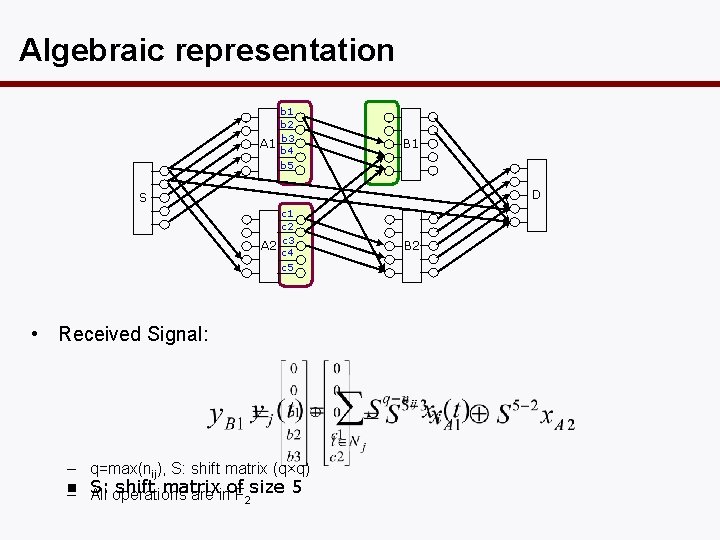
Algebraic representation A 1 b 2 b 3 b 4 b 5 B 1 D S A 2 c 1 c 2 c 3 c 4 c 5 • Received Signal: – q=max(nij), S: shift matrix (q×q) n shift matrix – S: All operations are inof F 2 size 5 B 2
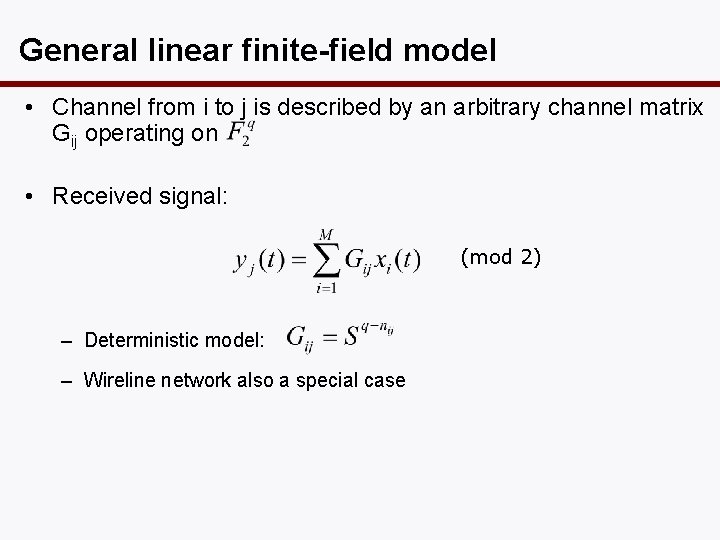
General linear finite-field model • Channel from i to j is described by an arbitrary channel matrix Gij operating on • Received signal: (mod 2) – Deterministic model: – Wireline network also a special case
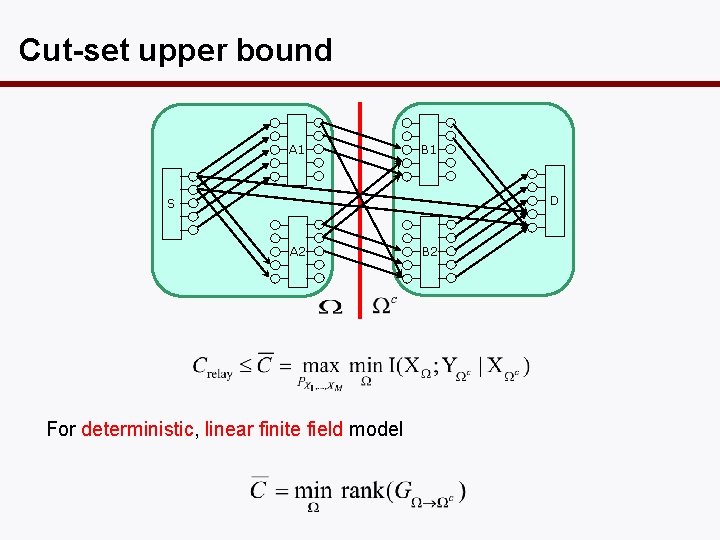
Cut-set upper bound A 1 B 1 D S A 2 For deterministic, linear finite field model B 2
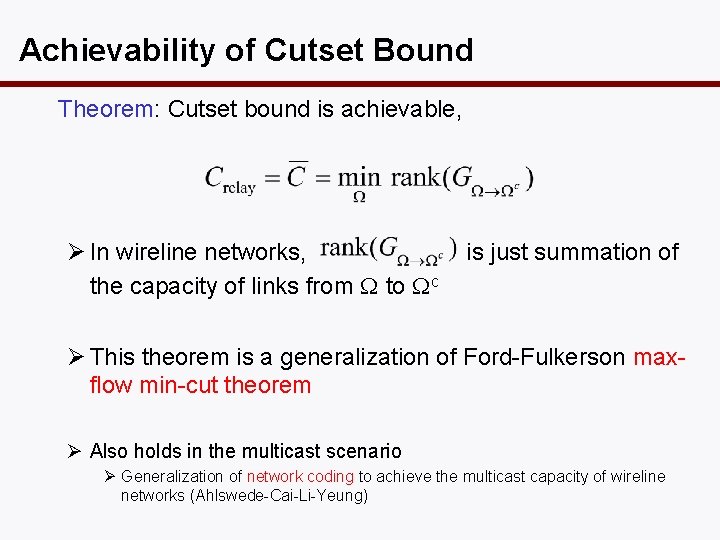
Achievability of Cutset Bound Theorem: Cutset bound is achievable, Ø In wireline networks, the capacity of links from W to Wc is just summation of Ø This theorem is a generalization of Ford-Fulkerson maxflow min-cut theorem Ø Also holds in the multicast scenario Ø Generalization of network coding to achieve the multicast capacity of wireline networks (Ahlswede-Cai-Li-Yeung)
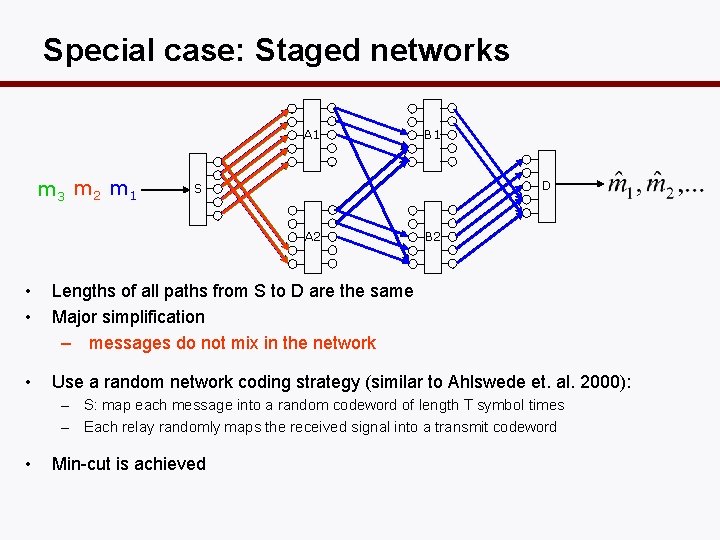
Special case: Staged networks A 1 m 3 m 2 m 1 B 1 D S A 2 B 2 • • Lengths of all paths from S to D are the same Major simplification – messages do not mix in the network • Use a random network coding strategy (similar to Ahlswede et. al. 2000): – S: map each message into a random codeword of length T symbol times – Each relay randomly maps the received signal into a transmit codeword • Min-cut is achieved
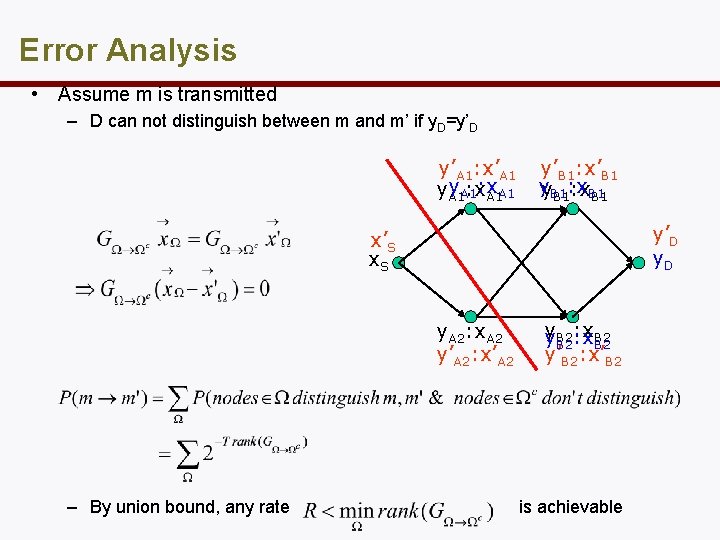
Error Analysis • Assume m is transmitted – D can not distinguish between m and m’ if y. D=y’D y’A 1: x’A 1 y. A 1 : x: x A 1 A 1 y’B 1: x’B 1 yy. B 1 : x B 1: x. B 1 y’D y. D x’S x. S y. A 2: x. A 2 y’A 2: x’A 2 – By union bound, any rate y : x. B 2 y. B 2: x. B 2 y’B 2: x’B 2 is achievable
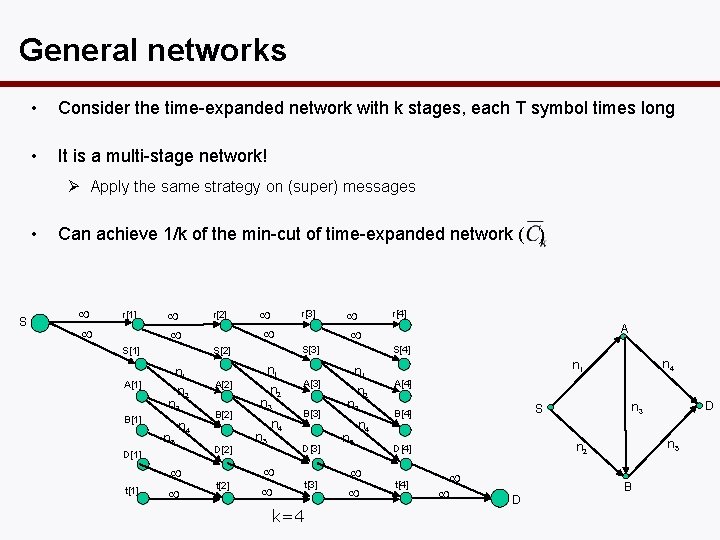
General networks • Consider the time-expanded network with k stages, each T symbol times long • It is a multi-stage network! Ø Apply the same strategy on (super) messages • S Can achieve 1/k of the min-cut of time-expanded network ( ) r[1] S[1] n 1 n 2 n 3 B[1] n 5 t[1] n 4 n 1 A[2] B[2] D[2] t[2] r[3] S[2] A[1] D[1] r[2] n 2 n 3 n 5 n 4 A[3] B[3] D[3] t[3] k=4 n 1 n 2 n 3 n 5 n 4 r[4] A S[4] n 4 n 1 A[4] D D n 5 n 2 D[4] t[4] n 3 S B[4] B
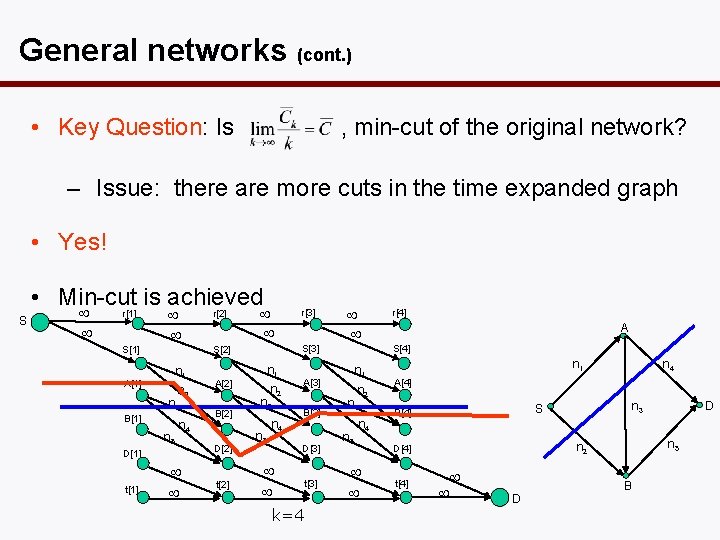
General networks (cont. ) • Key Question: Is , min-cut of the original network? – Issue: there are more cuts in the time expanded graph • Yes! S • Min-cut is achieved r[1] r[2] S[1] A[1] n 2 n 3 B[1] n 5 D[1] t[1] S[3] S[2] n 1 n 4 n 1 A[2] B[2] D[2] t[2] r[3] n 2 n 3 n 5 n 4 A[3] B[3] D[3] t[3] k=4 n 1 n 2 n 3 n 5 n 4 r[4] A S[4] n 4 n 1 A[4] D D n 5 n 2 D[4] t[4] n 3 S B[4] B
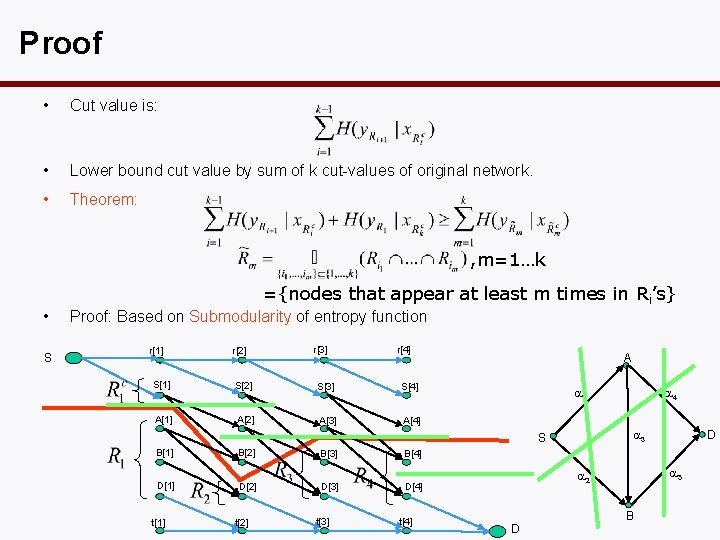
Proof • Cut value is: • Lower bound cut value by sum of k cut-values of original network. • Theorem: , m=1…k ={nodes that appear at least m times in Ri’s} • S Proof: Based on Submodularity of entropy function r[1] r[2] r[3] r[4] S[1] S[2] S[3] S[4] A[1] A[2] A[3] A[4] A 3 S B[1] B[2] B[3] B[4] D[1] D[2] D[3] D[4] t[1] t[2] t[3] t[4] 4 1 5 2 D D B
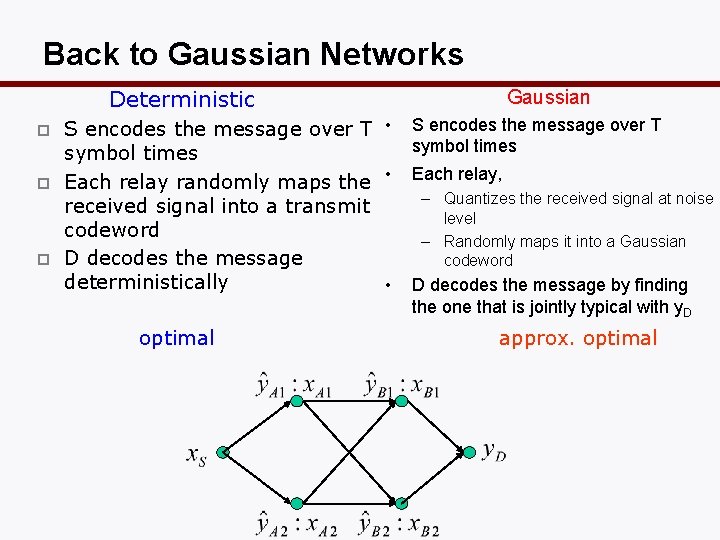
Back to Gaussian Networks Deterministic p p p S encodes the message over T • symbol times Each relay randomly maps the • received signal into a transmit codeword D decodes the message deterministically • optimal Gaussian S encodes the message over T symbol times Each relay, – Quantizes the received signal at noise level – Randomly maps it into a Gaussian codeword D decodes the message by finding the one that is jointly typical with y. D approx. optimal
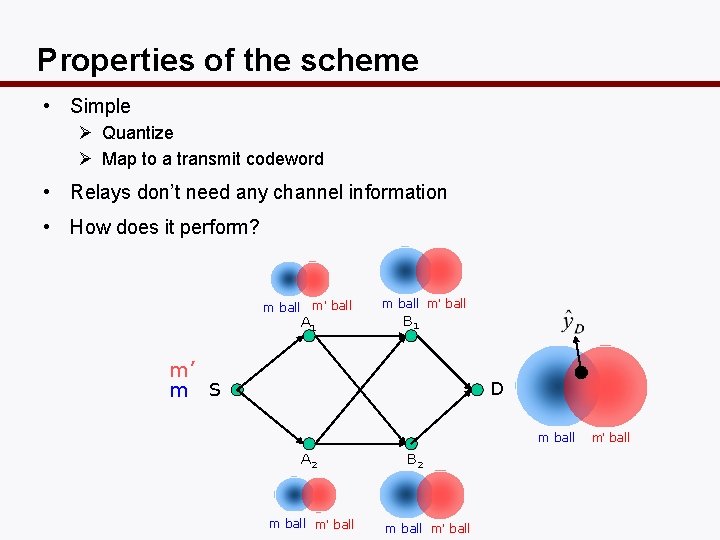
Properties of the scheme • Simple Ø Quantize Ø Map to a transmit codeword • Relays don’t need any channel information • How does it perform? m ball m’ ball A 1 m ball m’ ball B 1 m’ m S D m ball A 2 m ball m’ ball B 2 m ball m’ ball
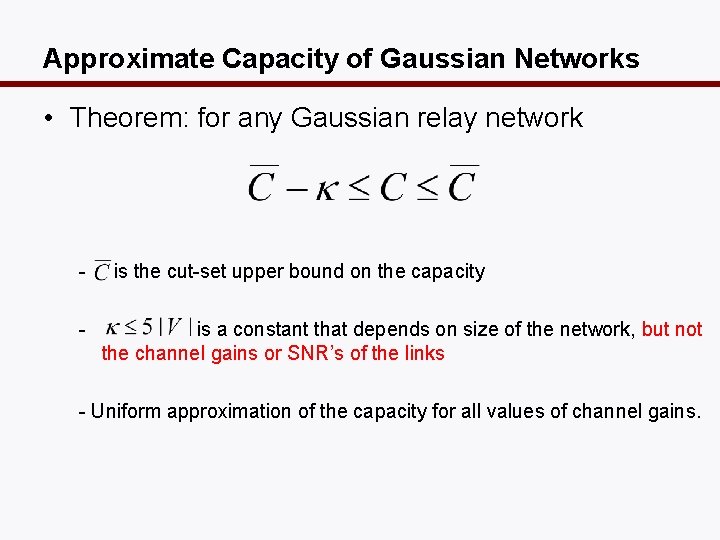
Approximate Capacity of Gaussian Networks • Theorem: for any Gaussian relay network - is the cut-set upper bound on the capacity is a constant that depends on size of the network, but not the channel gains or SNR’s of the links - Uniform approximation of the capacity for all values of channel gains.
Earlier Work on Deterministic Relay Networks • Single-relay semi-deterministic channel (El Gamal & Aref 79) • Aref’s relay network with general deterministic broadcast but no interference (Aref 80, Ratnakar & Kramer 06) • But connection to Gaussian networks missing.