
Information Theory of Wireless Networks A Deterministic Approach
- Slides: 32
Information Theory of Wireless Networks: A Deterministic Approach David Tse Wireless Foundations U. C. Berkeley CISS 2008 March 21, 2008 Joint work with Salman Avestimehr, Guy Bresler, Suhas Diggavi, Abhay Parekh.
The Holy Grail • Shannon’s information theory provides the basis for all modern-day communication systems. • His original theory was point-to-point. • After 60 years we are still very far away from generalizing theory to networks. • We propose an approach to make progress in the context of wireless networks.
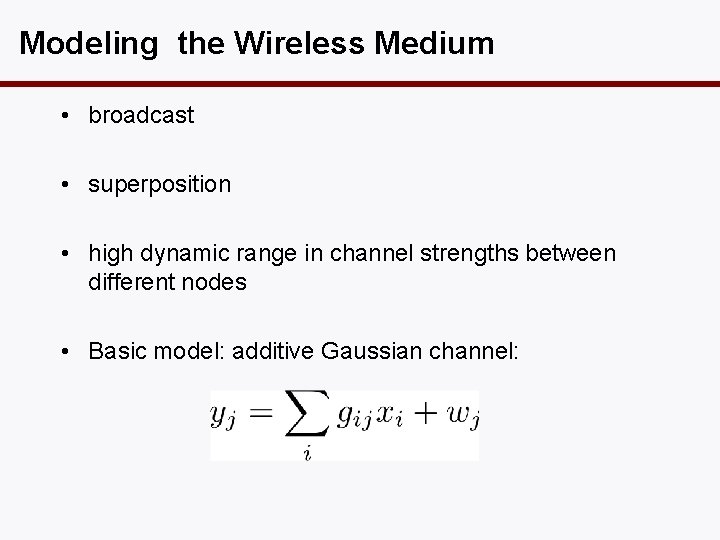
Modeling the Wireless Medium • broadcast • superposition • high dynamic range in channel strengths between different nodes • Basic model: additive Gaussian channel:
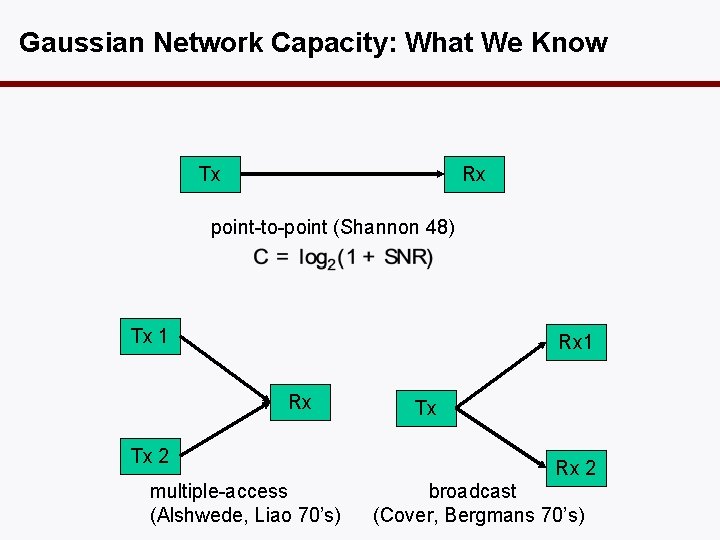
Gaussian Network Capacity: What We Know Tx Rx point-to-point (Shannon 48) Tx 1 Rx Tx 2 multiple-access (Alshwede, Liao 70’s) Tx Rx 2 broadcast (Cover, Bergmans 70’s)
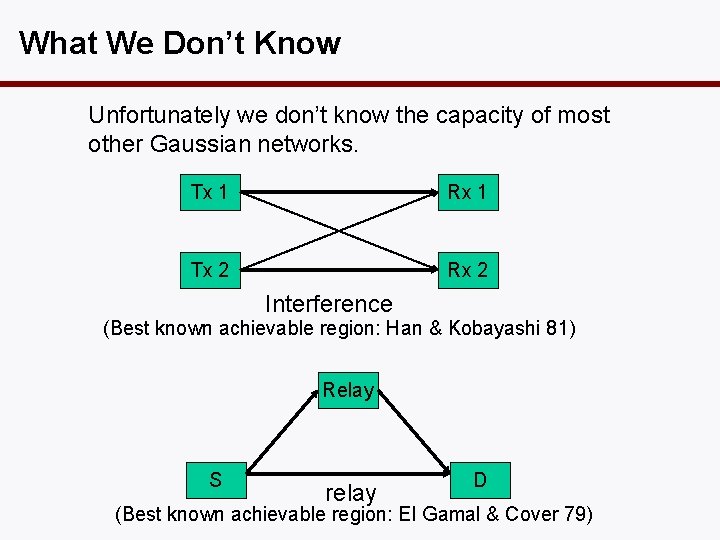
What We Don’t Know Unfortunately we don’t know the capacity of most other Gaussian networks. Tx 1 Rx 1 Tx 2 Rx 2 Interference (Best known achievable region: Han & Kobayashi 81) Relay S relay D (Best known achievable region: El Gamal & Cover 79)
30 Years Have Gone by…. . We are still stuck. How to make progress?
It’s the model. • Shannon focused on noise in point-to-point communication. • But many wireless networks are interference rather than noise-limited. • We propose a deterministic channel model emphasizing interaction between users’ signals rather than on background noise. • Far more analytically tractable and can be used to determine approximate Gaussian capacity
Agenda Warmup: • point-to-point channel • multiple access channel • broadcast channel The meat: • relay networks (Avestimehr, Diggavi & T. 07) • interference channels (Bresler &T. 08, Bresler, Parekh & T. 08)
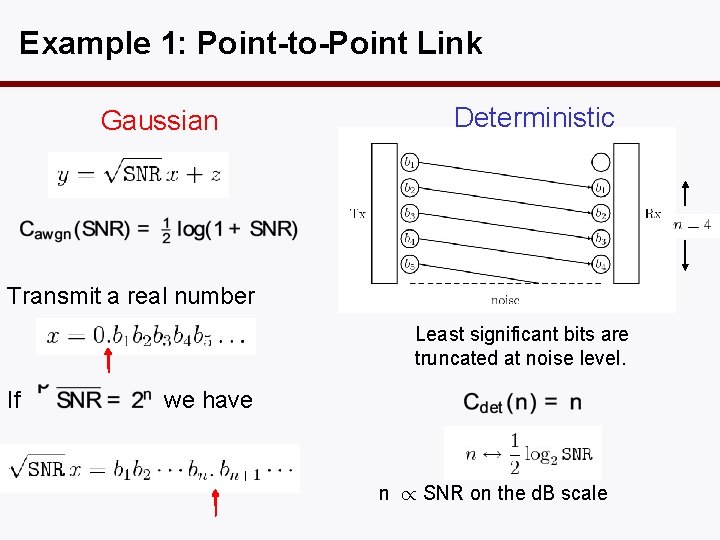
Example 1: Point-to-Point Link Gaussian Deterministic Transmit a real number Least significant bits are truncated at noise level. If we have n / SNR on the d. B scale
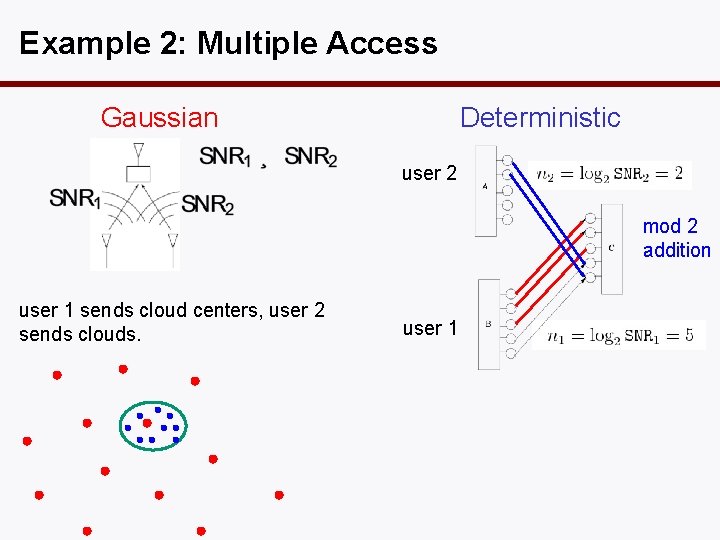
Example 2: Multiple Access Gaussian Deterministic user 2 mod 2 addition user 1 sends cloud centers, user 2 sends clouds. user 1
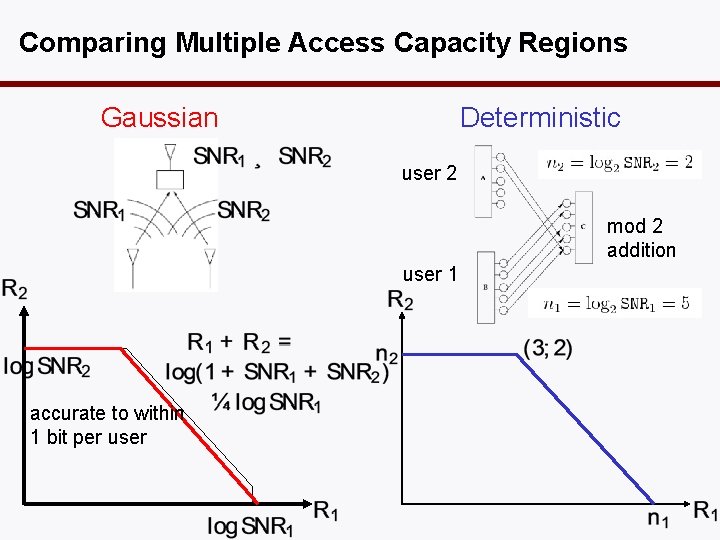
Comparing Multiple Access Capacity Regions Gaussian Deterministic user 2 mod 2 addition user 1 accurate to within 1 bit per user
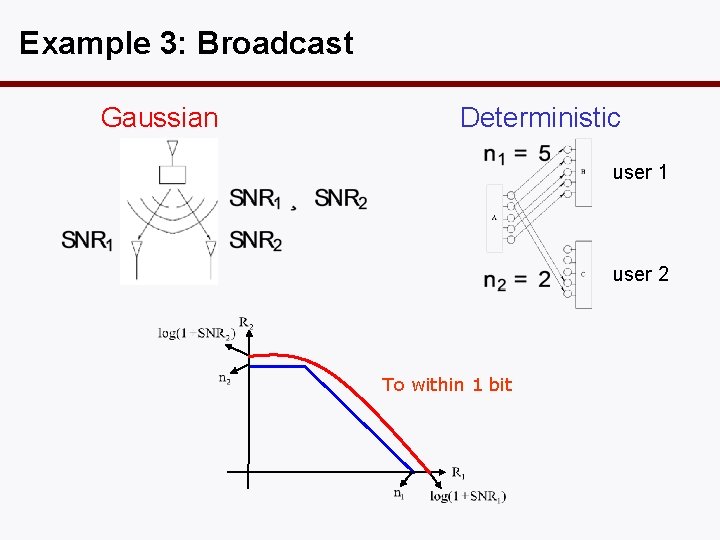
Example 3: Broadcast Gaussian Deterministic user 1 user 2 To within 1 bit
Agenda Warmup: • point-to-point channel • multiple access channel • broadcast channel The meat: • relay networks • interference channels
History • The (single) relay channel was first proposed by Van der Meulen in 1971. • Cover and El Gamal (1979) provided a whole array of achievable strategies. • Recent generalization of these techniques to more than 1 relay. • Do not know how far they are from optimal • General upper bound: cutset bound
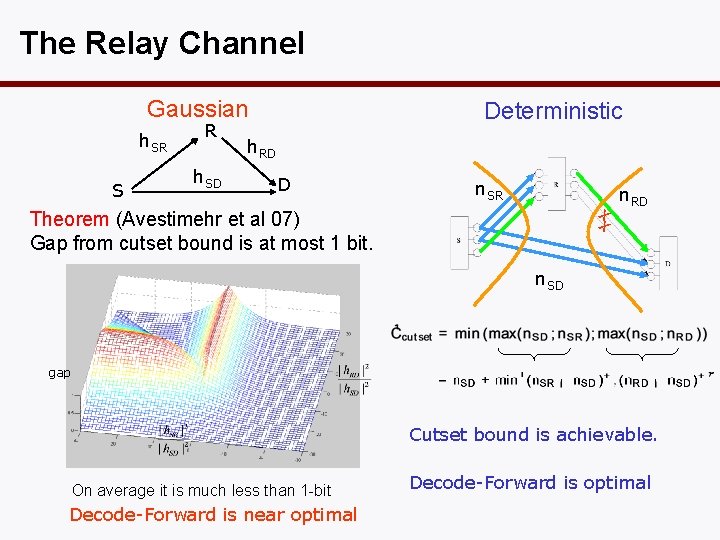
The Relay Channel Gaussian h. SR S R h. SD Deterministic h. RD D n. SR x x Theorem (Avestimehr et al 07) Gap from cutset bound is at most 1 bit. n. RD n. SD gap Cutset bound is achievable. On average it is much less than 1 -bit Decode-Forward is near optimal Decode-Forward is optimal
Generalization to Relay Networks • Can the cutset bound be achievable in the deterministic model? • Can one always achieve to within a contant gap of the cutset bound in the Gaussian case?
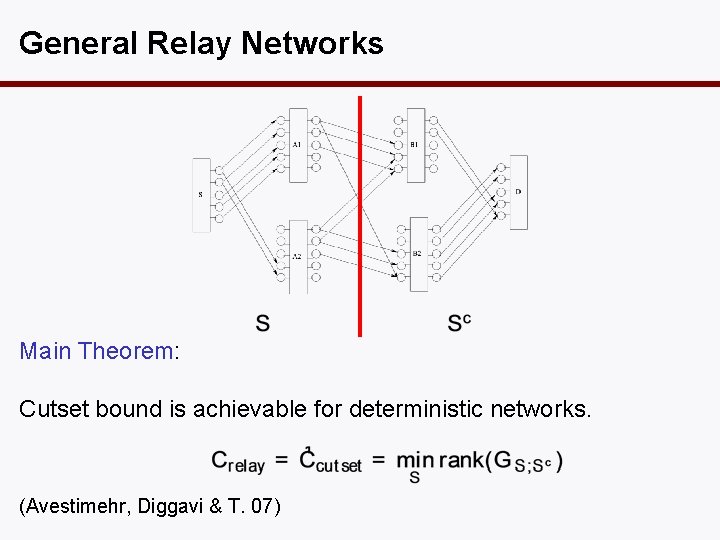
General Relay Networks Main Theorem: Cutset bound is achievable for deterministic networks. (Avestimehr, Diggavi & T. 07)
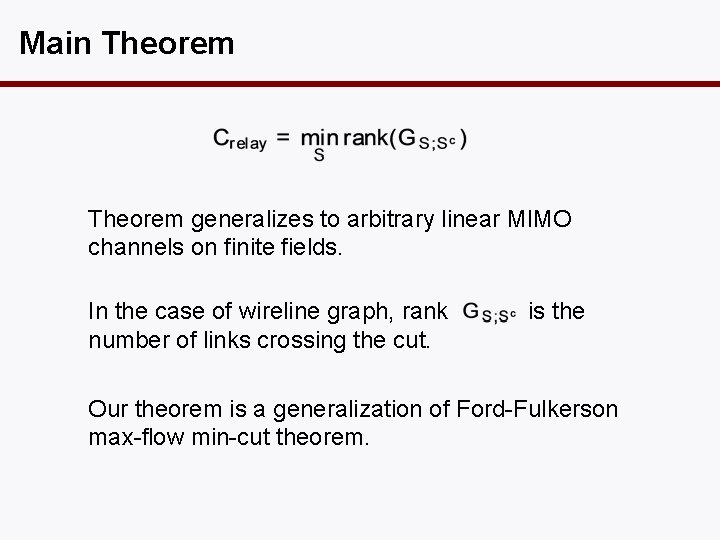
Main Theorem generalizes to arbitrary linear MIMO channels on finite fields. In the case of wireline graph, rank number of links crossing the cut. is the Our theorem is a generalization of Ford-Fulkerson max-flow min-cut theorem.
Connections to Network Coding • Achievability: random linear coding at relays • Proof style: similar to Ahlswede et al 2000 for wireline networks. • Technical innovation: dealing with “inter-symbol interference” between signals arriving along paths of different lengths.
Back to Gaussian Relay Networks Approximation Theorem: There is a scheme that achieves within a constant gap to the cutset bound, independent of the SNR’s of the links. (Avestimehr, Diggavi and T. 2008)
Agenda Warmup: • point-to-point channel • multiple access channel • broadcast channel The meat: • relay networks • interference channels
Interference • So far we have looked at single source, single destination networks. • All the signals received is useful. • With multiple sources and multiple destinations, interference is the central phenomenon. • Simplest interference network is the two-user interference channel.
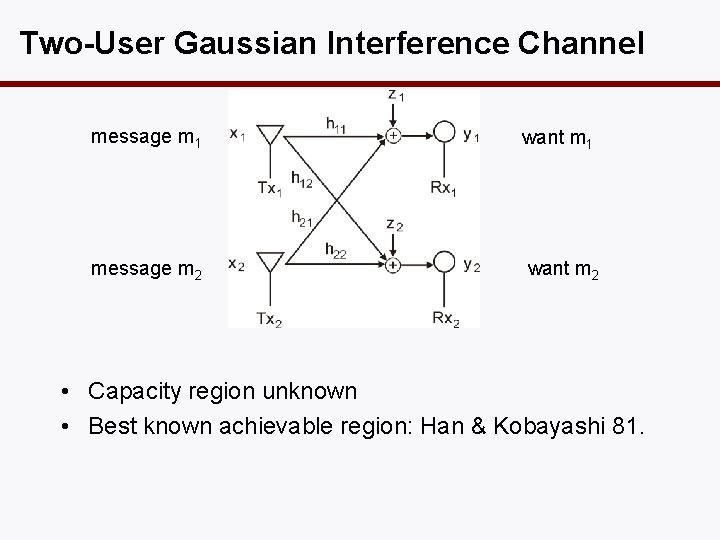
Two-User Gaussian Interference Channel message m 1 want m 1 message m 2 want m 2 • Capacity region unknown • Best known achievable region: Han & Kobayashi 81.
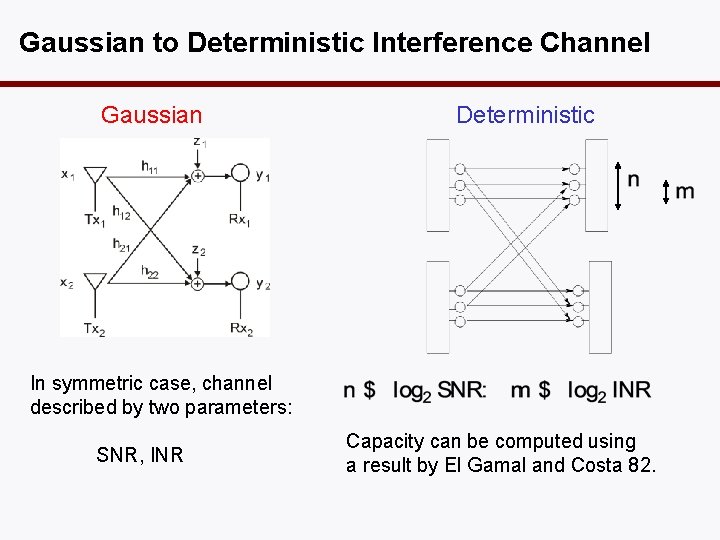
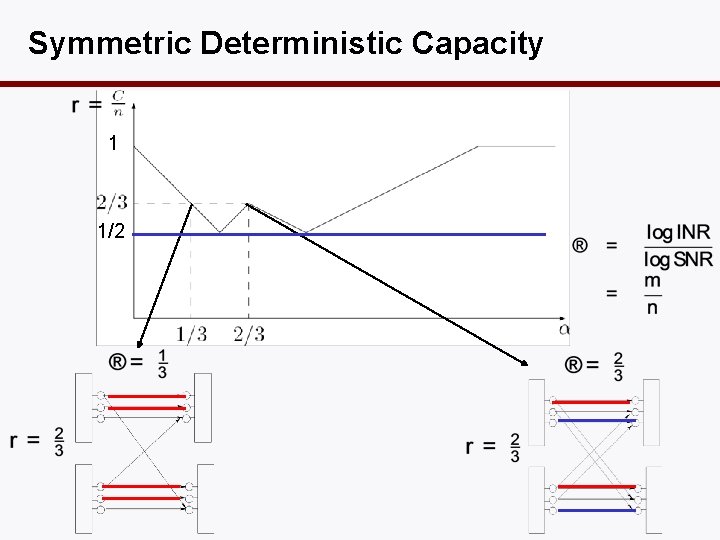
Gaussian to Deterministic Interference Channel Gaussian Deterministic In symmetric case, channel described by two parameters: SNR, INR Capacity can be computed using a result by El Gamal and Costa 82.
Symmetric Deterministic Capacity 1 1/2
Back to Gaussian • Theorem: Constant gap between capacity regions of the twouser deterministic and Gaussian interference channels. (Bresler & T. 08) • A deeper view of earlier 1 -bit gap result on two-user Gaussian interference channel (Etkin, T. & Wang 06). • Bounds further sharpened to get exact results in the low-interference regime ( < 1/3) (Shang et al 07, Annaprueddy&Veeravalli 08, Motahari&Khandani 07)
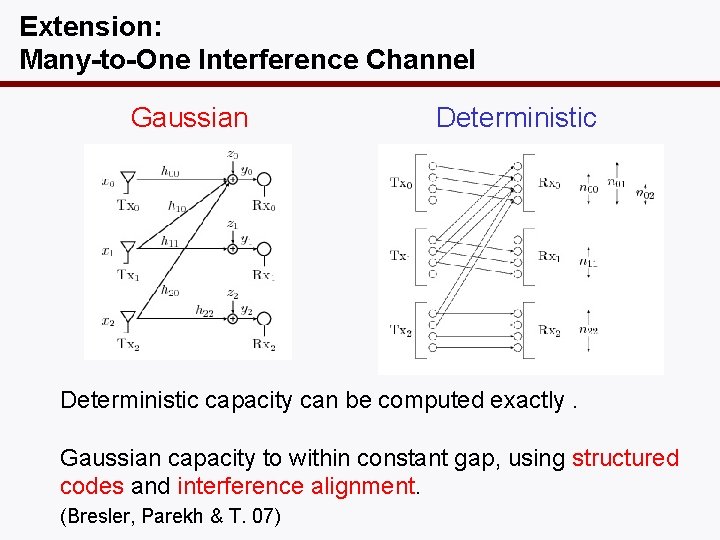
Extension: Many-to-One Interference Channel Gaussian Deterministic capacity can be computed exactly. Gaussian capacity to within constant gap, using structured codes and interference alignment. (Bresler, Parekh & T. 07)
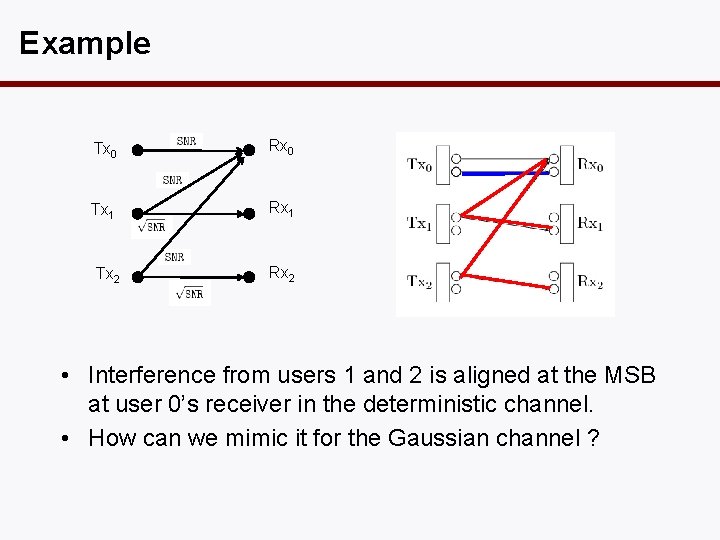
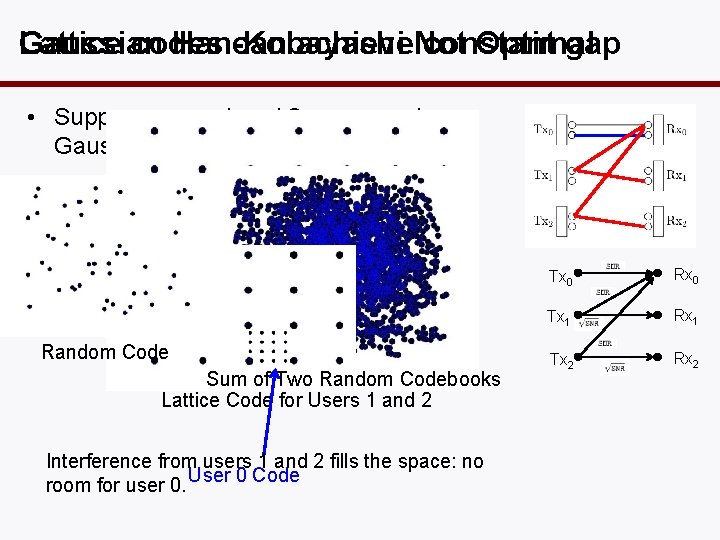
Example Tx 0 Rx 0 Tx 1 Rx 1 Tx 2 Rx 2 • Interference from users 1 and 2 is aligned at the MSB at user 0’s receiver in the deterministic channel. • How can we mimic it for the Gaussian channel ?
Gaussian Lattice codes Han-Kobayashi can achieve. Not constant Optimal gap • Suppose users 1 and 2 use a random Gaussian codebook: Random Code Sum of Two Random Codebooks Lattice Code for Users 1 and 2 Interference from users 1 and 2 fills the space: no room for user 0. User 0 Code Tx 0 Rx 0 Tx 1 Rx 1 Tx 2 Rx 2
Interference Channels: Recap • In two-user case, we showed that an existing strategy can achieve within 1 bit to optimality. • In many-to-one case, we showed that a new strategy can do much better. • General K-user interference channel still open.
Evolution of Ideas • deterministic network capacity in 1980’s: – broadcast channels (Marton 78, Pinsker 79) – 2 -user interference channel (El Gamal & Costa 82) – single-relay channel (El Gamal & Aref 82) – relay networks with broadcast but no interference (Aref 79) • inspired by network coding in early 2000’s: – finite-field model with erasures (Gupta et al 06) but connection to Gaussian networks missing. • 2 -user Gaussian interference channel capacity to within 1 bit (Etkin, T & Wang 06) • Linear deterministic model (Avestimehr, Diggavi & T 07) and applied to relay networks.
Parting Words • Main message: If something can’t be computed exactly, approximate. • Similar evolution has happened in other fields: – fluid and heavy-traffic approximation in queueing networks – approximation algorithms in CS theory • Approximation should be good in engineering-relevant regimes.