
Information Technology Centralization and Modernization Efforts and the
- Slides: 15
Information Technology Centralization and Modernization Efforts and the Impact on Organizational Culture at a Federal Statistical Agency By Joseph L. Parsons & Brandon W. Duxbury Presented by Joseph L. Parsons United States Department of Agriculture National Agricultural Statistics Service
Key Points • IT projects are often the tools and face of change • Significant change always creates conflict • This leaves us with challenges, opportunities, and risks to manage • Leveraging a framework to consider sources of conflict may help us successfully manage change
Introduction • Formerly a decentralized organization • Modernization effort to centralize NASS’s: – Business processes – Network, applications, and databases • Architectural transformations affect: – How employees work and interact – Staff resource costs – Quality of statistical products – The overall culture of the organization
Organizational Culture & IT • Leidner and Kayworth – Culture is: • Fundamental aspect of how an organization operates • Coherent set of beliefs, basic assumptions, shared sets of core values, important understandings, and collective will • Manifested through artifacts and creations (i. e. technology) – Three types of cultural IT conflict • System • Contribution • Vision
Types of Conflict - System • System - group values are in conflict with values assumed by a particular technology – The greater the cultural difference between the champion group and the user group, the greater the system conflict – The greater the breadth of IT implementation across groups, the greater the system conflict – The greater the system conflict: • The less likely the group is to be a forerunner in adopting the IT • The greater the modification of use to support the user’s values
Types of Conflict - Contribution • Contribution - group values conflict with the values associated with IT – Do key players in an organization see IT as a strategic asset? – If key players see IT as a strategic asset, then those aspiring to be key players probably will too – The greater the contribution conflict experienced by a group: • The less strategic a role that IT will play in that group • The less likely the innovative uses of IT by the group
Types of Conflict - Vision • Vision - group values conflict with the values embedded within a specific technology – The greater the difference between the champion group’s and user group’s values, the greater the vision conflict – The lesser the involvement of the most powerful people within a group, the greater the vision conflict – The greater the vision conflict: • The lower the adoption rate of the IT • The greater the potential change to the group’s IT values
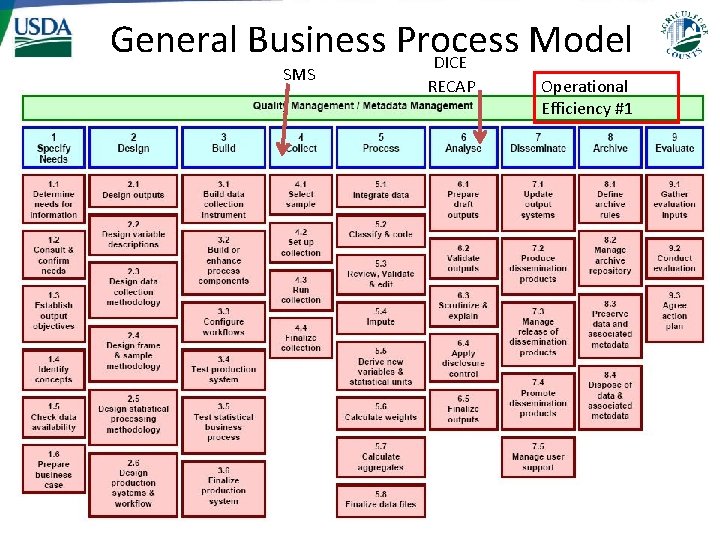
NASS IT Projects • Review, Estimates, Comments, Approval, and Publish (RECAP) • Database Integrated County Estimates (DICE) • Centralized Survey Management System (c. SMS) • Centralize and Virtualize Network (OE 1)
General Business Process Model DICE SMS RECAP Operational Efficiency #1
System Conflict • Experience with legacy systems (DICE) • Fears that a new system would not support user needs (RECAP & DICE) • System - group values are in conflict with values assumed by a particular technology – The greater the cultural difference between the champion group and the user group, the greater the system conflict – The greater the breadth of IT implementation across groups, the greater the system conflict – The greater the system conflict: • The less likely the group is to be a forerunner in adopting the IT • The greater the modification of use to support the user’s values
Contribution Conflict • Single project manager (RECAP & c. SMS) • Existing system administrators not heavily involved in project design (OE 1) • Contribution - group values conflict with the values associated with IT – Do key players in an organization see IT as a strategic asset? – If key players see IT as a strategic asset, then those aspiring to be key players probably will too – The greater the contribution conflict experienced by a group: • The less strategic a role that IT will play in that group • The less likely the innovative uses of IT by the group
Vision Conflict • Business needs versus IT resources (RECAP) • Unrealistic schedule (c. SMS) • Transfer of responsibilities (OE 1) • Vision - group values conflict with the values embedded within a specific technology – The greater the difference between the champion group’s and user group’s values, the greater the vision conflict – The lesser the involvement of the most powerful people within a group, the greater the vision conflict – The greater the vision conflict: • The lower the adoption rate of the IT • The greater the potential change to the group’s IT values
Lessons Learned • Users are reluctant to transition to new applications • Fears are alleviated with a cohesive champion group • A business-side and IT-side project manager should be assigned • Project managers should garner feedback from users and IT personnel • Use of a multi criteria decision making process was incorporated
Conclusions • Pilot tests • Scaled development and deployment • Agile development • Getting key players involved early • Communication • Education
IT projects are not just the implementation of technology. They are the tools and manifestation of organizational cultural change. Change Conflict Challenges & Opportunities to Anticipate and Manage