
Information Systems Strategic Planning Why plan To obtain
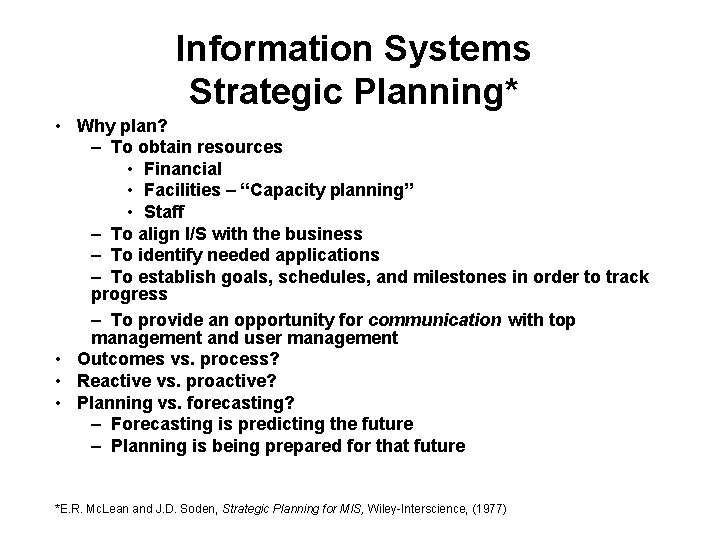
Information Systems Strategic Planning* • Why plan? – To obtain resources • Financial • Facilities – “Capacity planning” • Staff – To align I/S with the business – To identify needed applications – To establish goals, schedules, and milestones in order to track progress – To provide an opportunity for communication with top management and user management • Outcomes vs. process? • Reactive vs. proactive? • Planning vs. forecasting? – Forecasting is predicting the future – Planning is being prepared for that future *E. R. Mc. Lean and J. D. Soden, Strategic Planning for MIS, Wiley-Interscience, (1977)
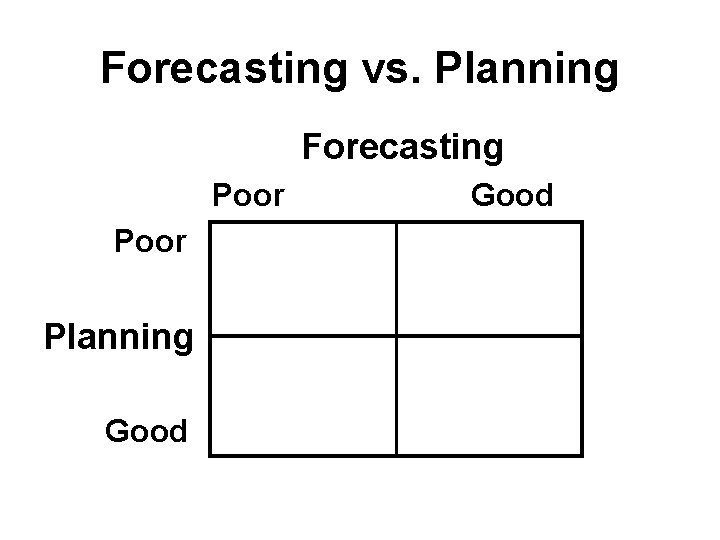
Forecasting vs. Planning Forecasting Poor Planning Good
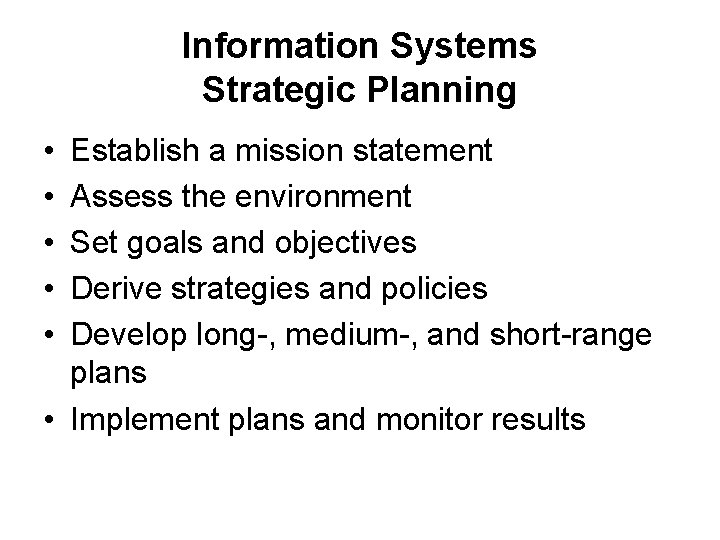
Information Systems Strategic Planning • • • Establish a mission statement Assess the environment Set goals and objectives Derive strategies and policies Develop long-, medium-, and short-range plans • Implement plans and monitor results
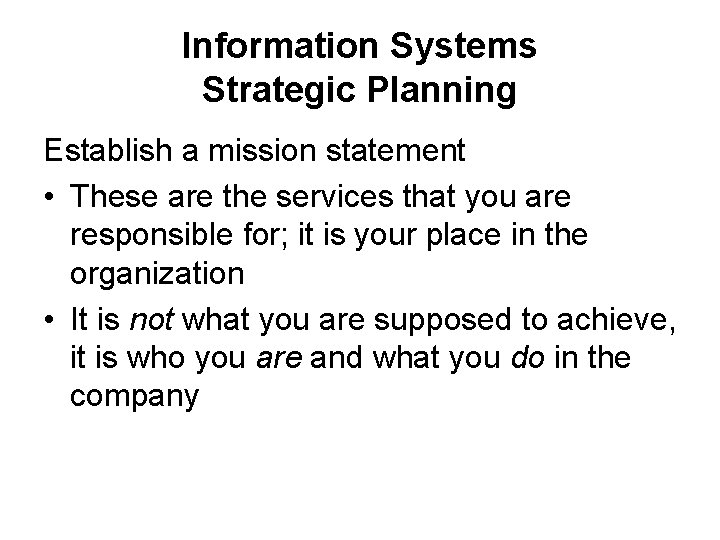
Information Systems Strategic Planning Establish a mission statement • These are the services that you are responsible for; it is your place in the organization • It is not what you are supposed to achieve, it is who you are and what you do in the company

Information Systems Strategic Planning Assess the environment(s). . . 1. The capabilities of the IT department 2. The readiness of the company to use IT 3. The status of our customers, our industry 4. The status of the economy, government regulations, environment, society, etc. 5. Technology This is similar to a SWOT analysis – Strengths and Weakness – items no. 1 & 2; and Opportunities and Threats – items no. 3, 4, & 5
Information Systems Strategic Planning Goals and Objectives • Set goals – what do you want to achieve? • Set objectives – what are your specific, measurable targets?
Information Systems Strategic Planning Derive strategies and policies • Strategies for – – • Technology focus Personnel and career development Aligning with the company Others. . . Policies for – – – Funding criteria; how much to spend on IT? Allocation criteria; priority setting Organizational arrangements Use of outside IT services, outsourcing Selling IT services to outside organizations Others. . .
Information Systems Strategic Planning Short-, medium-, and long-range plans • Short-range – the next year, the next budget period; developing and operating current systems • Medium-range – committing to development efforts for applications that will take more than one year to complete; meeting management’s current information needs, projected into the future for as many years as needed to complete them. This is what most organizations call “Long-Range Planning. ” • Long-range planning – preparing for management’s future information needs. These are not application specific; they are investments in infrastructure; it is creating an information architecture.
Information Systems Strategic Planning And finally, implement plans and monitor results!
- Slides: 9