
Information Systems Project Management A Process Approach C

- Slides: 46
Information Systems Project Management: A Process Approach C. Schneider, M. A. Fuller, J. S. Valacich, J. F. George Chapter 5—Managing Project Scope © Prospect Press 5 -
Chapter 5 Managing Project Scope 5 -2
Learning Objectives 1. Describe the project identification and selection process 2. Describe the project initiation processes, including how to establish the project charter and the project management plan 3. Explain project scope planning, including how to define, validate, and control project scope 5 -3
Chapter Outline • • • Introduction Project Identification and Selection Project Initiation Project Scope Planning, Verification, and Change Control Managing Project Scope and PMBOK Chapter Summary 5 -4
Introduction 5 -5
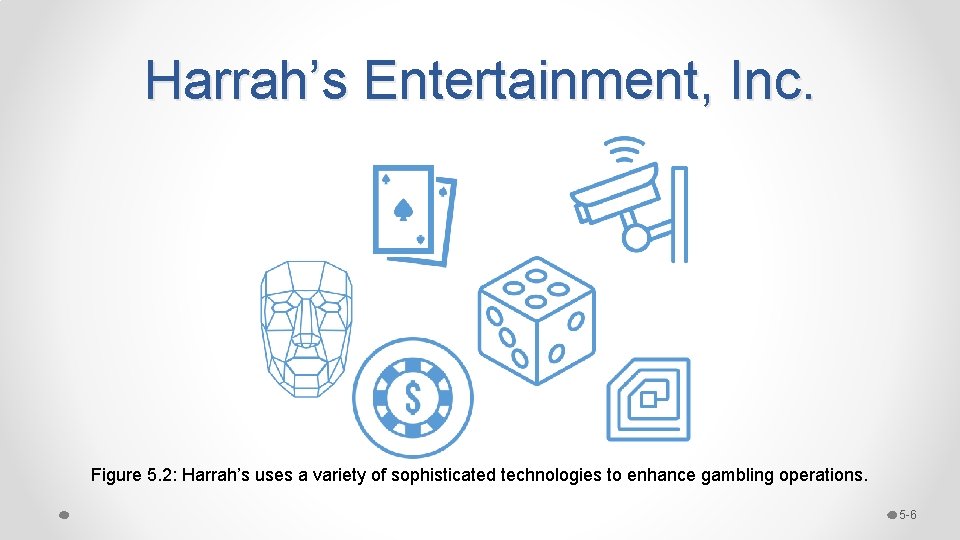
Harrah’s Entertainment, Inc. Figure 5. 2: Harrah’s uses a variety of sophisticated technologies to enhance gambling operations. 5 -6
Project Identification and Selection 5 -7
Three Activities 1. Identifying information systems projects 2. Assessing project feasibility 3. Comparing alternative projects 5 -8
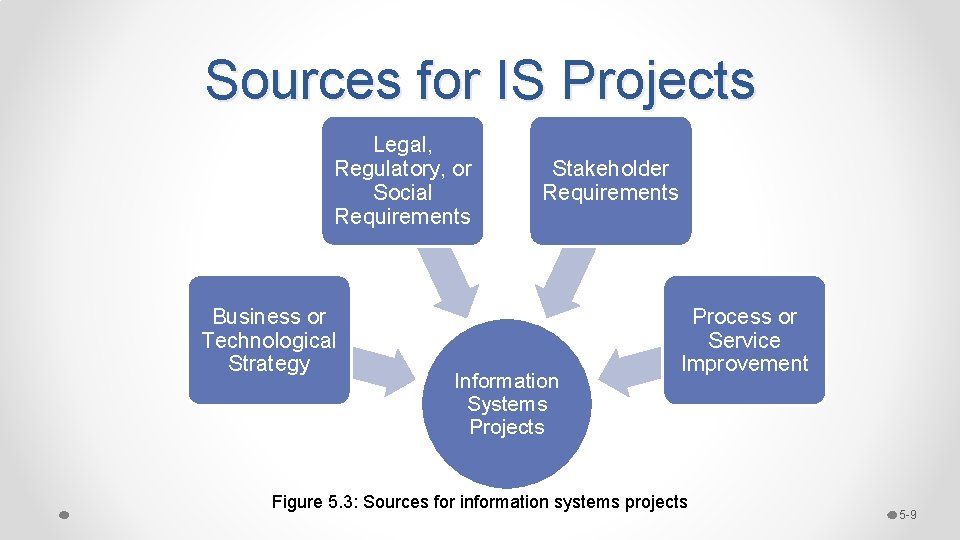
Sources for IS Projects Legal, Regulatory, or Social Requirements Business or Technological Strategy Stakeholder Requirements Information Systems Projects Process or Service Improvement Figure 5. 3: Sources for information systems projects 5 -9
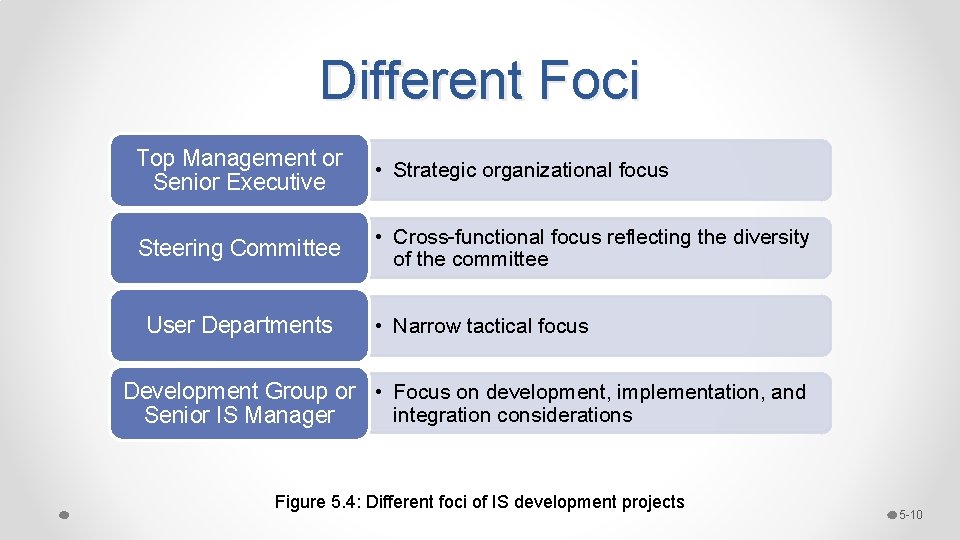
Different Foci Top Management or Senior Executive • Strategic organizational focus Steering Committee • Cross-functional focus reflecting the diversity of the committee User Departments • Narrow tactical focus Development Group or • Focus on development, implementation, and integration considerations Senior IS Manager Figure 5. 4: Different foci of IS development projects 5 -10
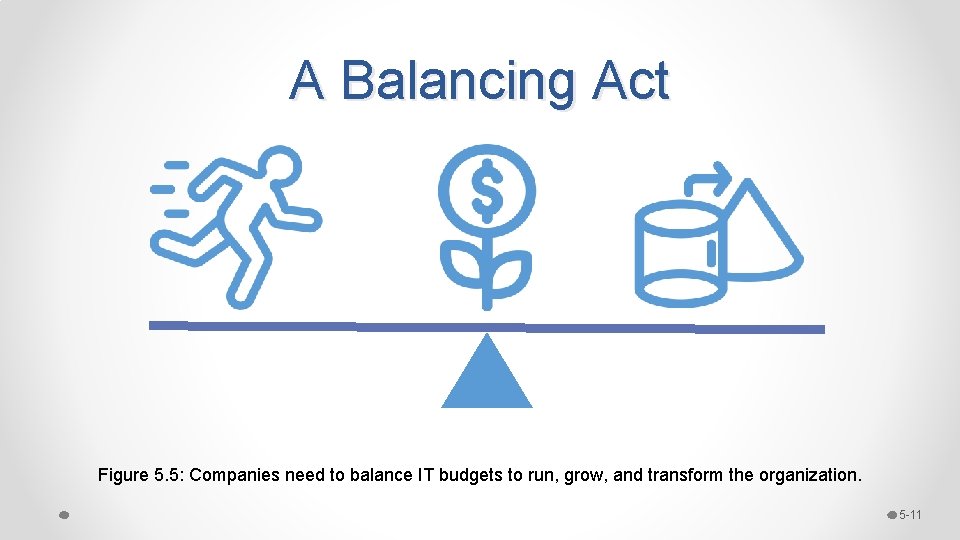
A Balancing Act Figure 5. 5: Companies need to balance IT budgets to run, grow, and transform the organization. 5 -11
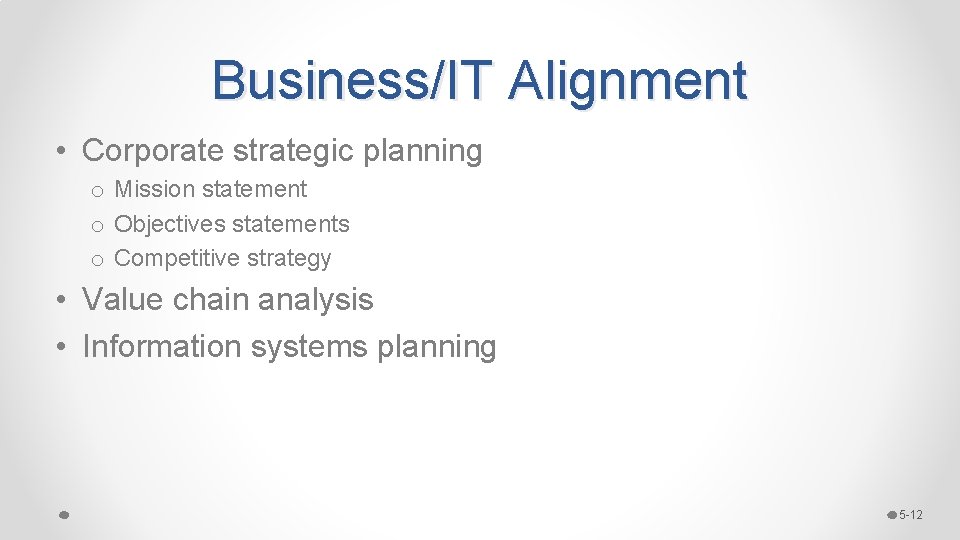
Business/IT Alignment • Corporate strategic planning o Mission statement o Objectives statements o Competitive strategy • Value chain analysis • Information systems planning 5 -12
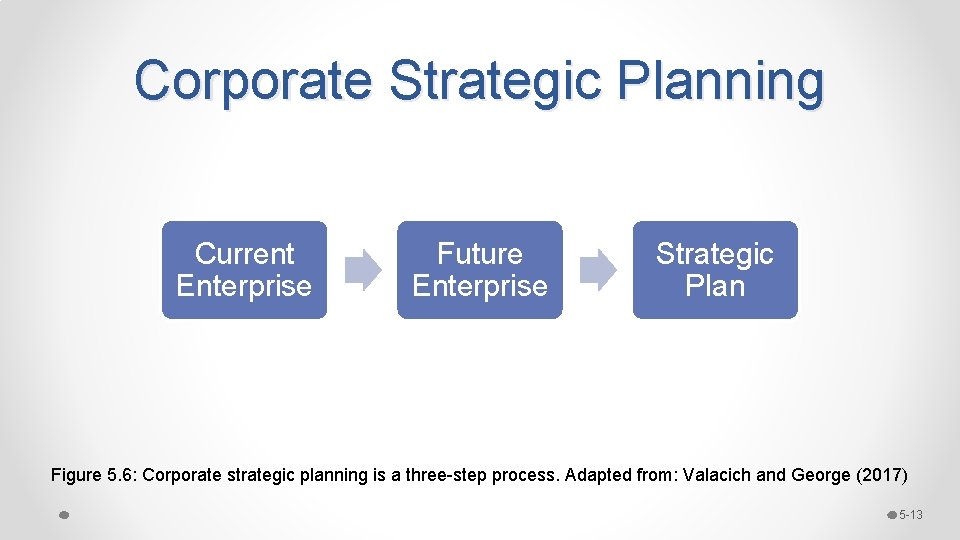
Corporate Strategic Planning Current Enterprise Future Enterprise Strategic Plan Figure 5. 6: Corporate strategic planning is a three-step process. Adapted from: Valacich and George (2017) 5 -13
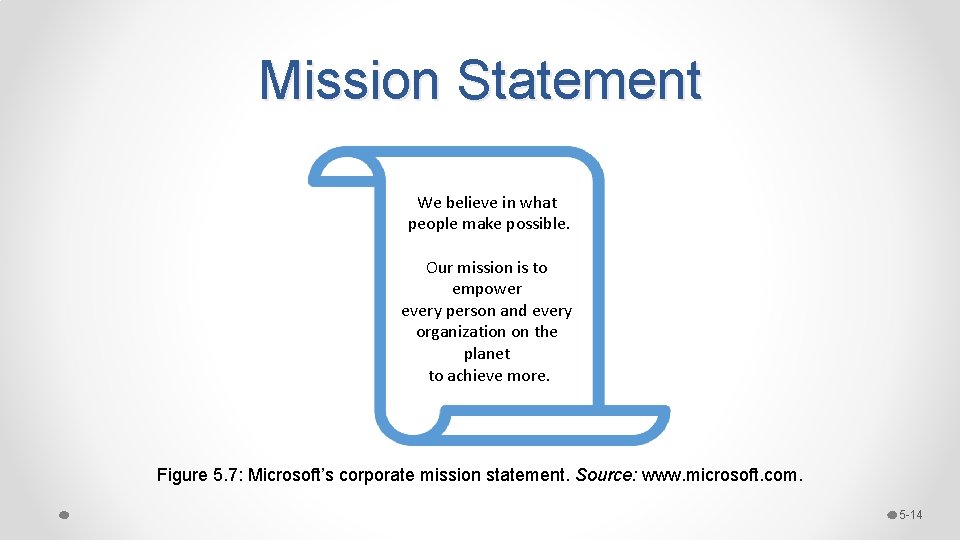
Mission Statement We believe in what people make possible. Our mission is to empower every person and every organization on the planet to achieve more. Figure 5. 7: Microsoft’s corporate mission statement. Source: www. microsoft. com. 5 -14
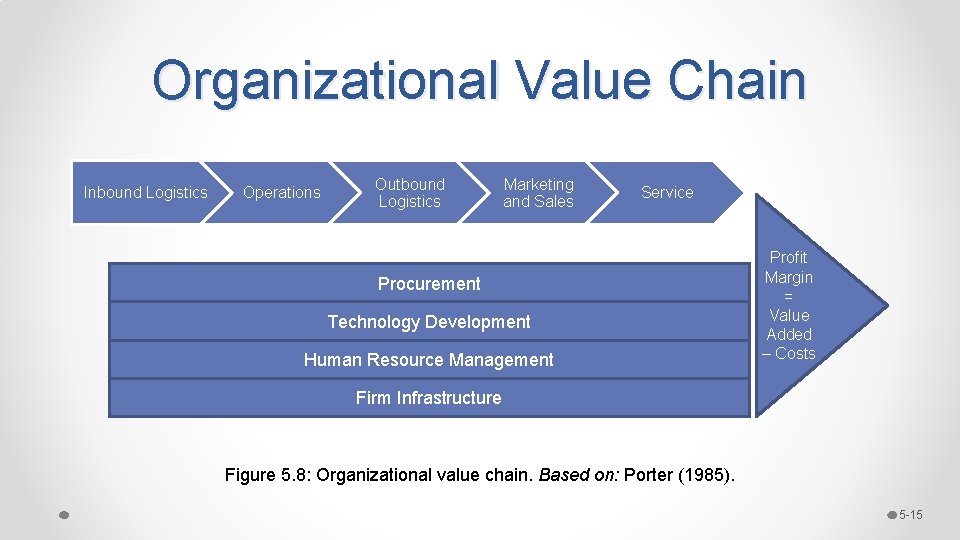
Organizational Value Chain Inbound Logistics Operations Outbound Logistics Marketing and Sales Service Procurement Technology Development Human Resource Management Profit Margin = Value Added – Costs Firm Infrastructure Figure 5. 8: Organizational value chain. Based on: Porter (1985). 5 -15
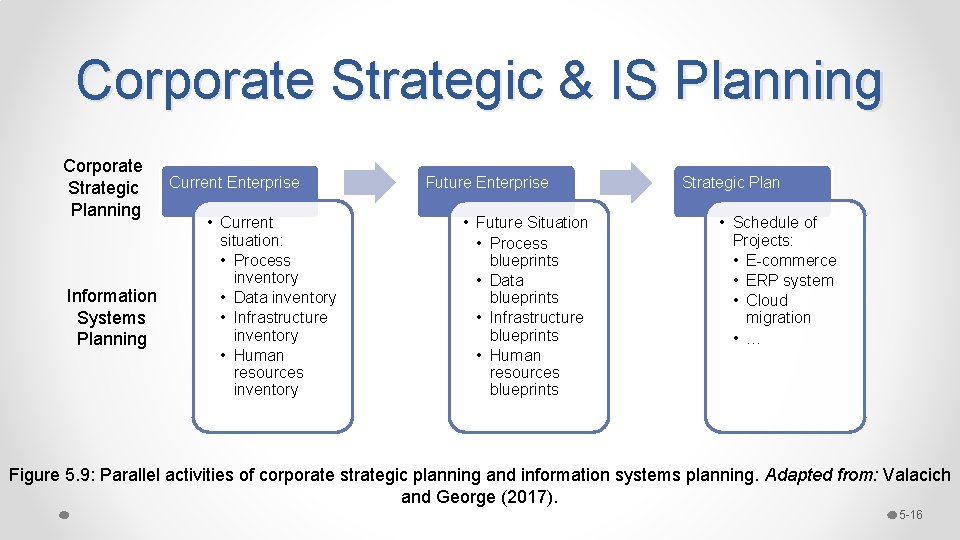
Corporate Strategic & IS Planning Corporate Strategic Planning Information Systems Planning Current Enterprise • Current situation: • Process inventory • Data inventory • Infrastructure inventory • Human resources inventory Future Enterprise • Future Situation • Process blueprints • Data blueprints • Infrastructure blueprints • Human resources blueprints Strategic Plan • Schedule of Projects: • E-commerce • ERP system • Cloud migration • … Figure 5. 9: Parallel activities of corporate strategic planning and information systems planning. Adapted from: Valacich and George (2017). 5 -16
Three IS Planning Activities 1. Describe the current situation 2. Describe the target situation, trends, and constraints 3. Develop a transition strategy and plan 5 -17
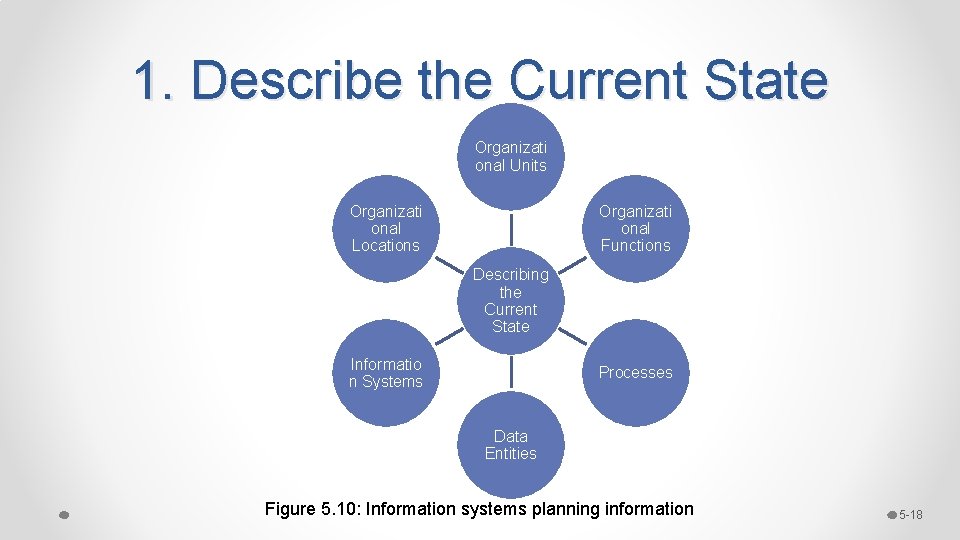
1. Describe the Current State Organizati onal Units Organizati onal Locations Organizati onal Functions Describing the Current State Informatio n Systems Processes Data Entities Figure 5. 10: Information systems planning information 5 -18
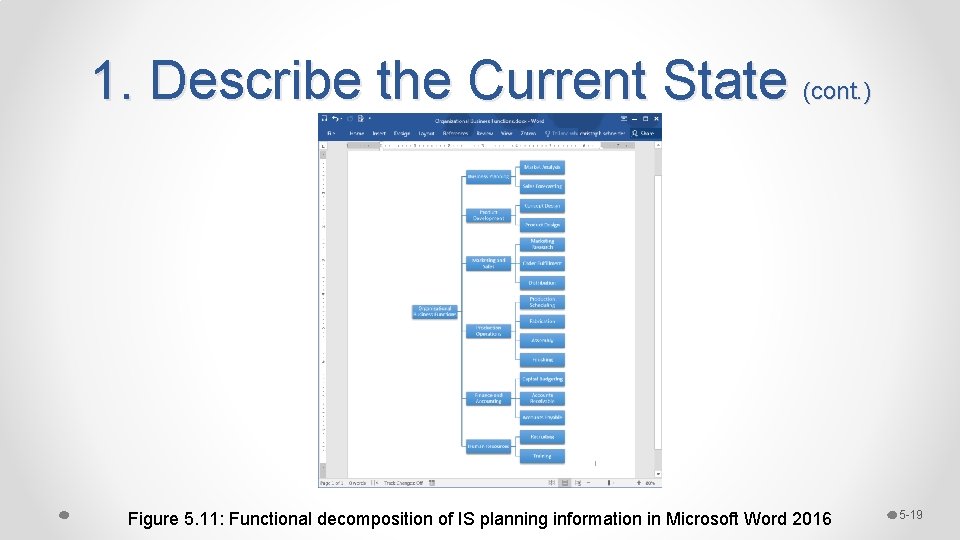
1. Describe the Current State (cont. ) Figure 5. 11: Functional decomposition of IS planning information in Microsoft Word 2016 5 -19
1. Describe the Current State(cont. ) Figure 5. 12: Data entity-to-business function matrix 5 -20
2. Describe the Target Situation • What is the target situation? o Desired state of the business functions, units, locations, processes, data, and information systems • Planning team updates the matrices to reflect these changes • Organizational constraints, technological and business trends are likely to influence the target situation. 5 -21
3. Develop a Transition Strategy & Plan Figure 5. 13: Outline of an information systems plan. Adapted from: Valacich and George (2017) 5 -22
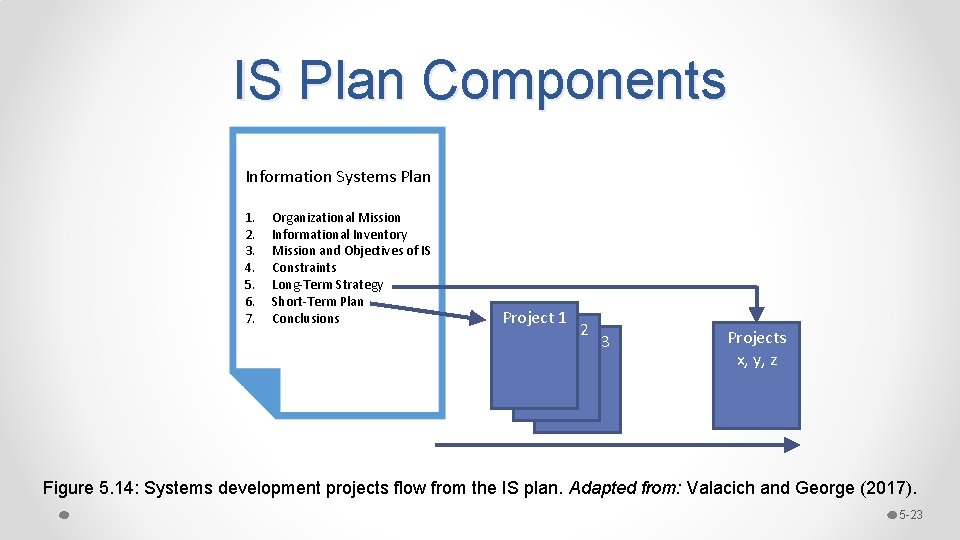
IS Plan Components Information Systems Plan 1. 2. 3. 4. 5. 6. 7. Organizational Mission Informational Inventory Mission and Objectives of IS Constraints Long-Term Strategy Short-Term Plan Conclusions Project 1 Project 2 Project 3 Projects x, y, z Figure 5. 14: Systems development projects flow from the IS plan. Adapted from: Valacich and George (2017). 5 -23
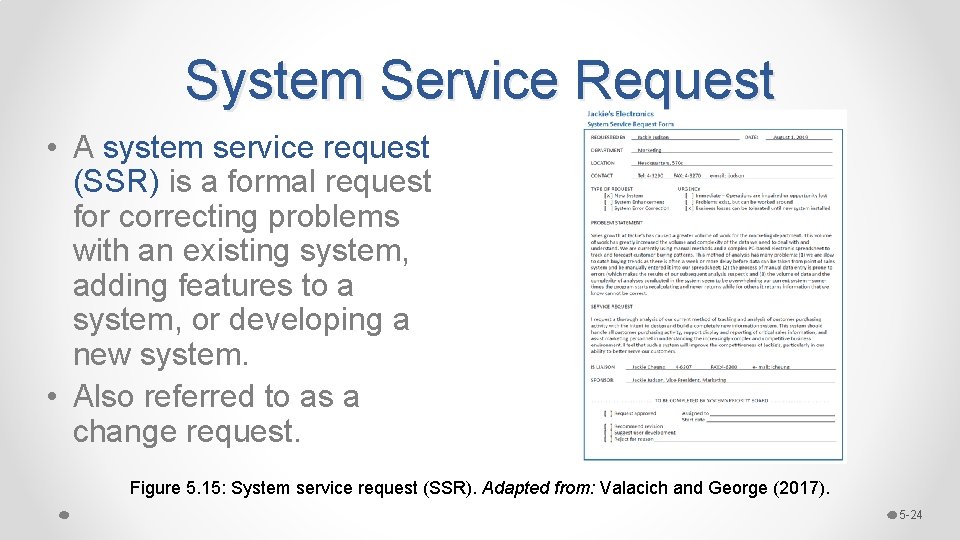
System Service Request • A system service request (SSR) is a formal request for correcting problems with an existing system, adding features to a system, or developing a new system. • Also referred to as a change request. Figure 5. 15: System service request (SSR). Adapted from: Valacich and George (2017). 5 -24
Assessing Project Feasibility • Feasibility factors: o o o Economic feasibility Technical feasibility Operational feasibility Schedule feasibility Legal and contractual feasibility Political feasibility • Combined, these factors help to build the business case that is used to justify investing resources in the project. 5 -25
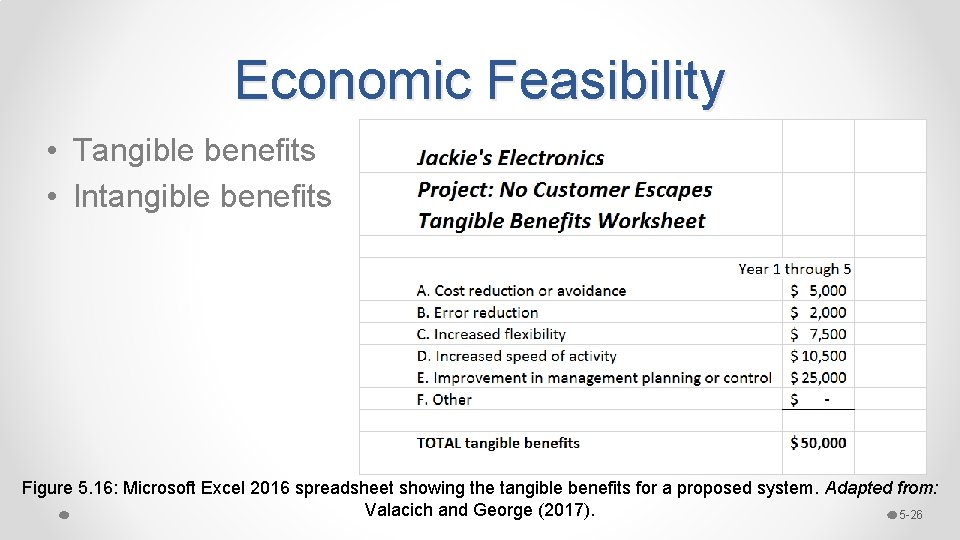
Economic Feasibility • Tangible benefits • Intangible benefits Figure 5. 16: Microsoft Excel 2016 spreadsheet showing the tangible benefits for a proposed system. Adapted from: Valacich and George (2017). 5 -26
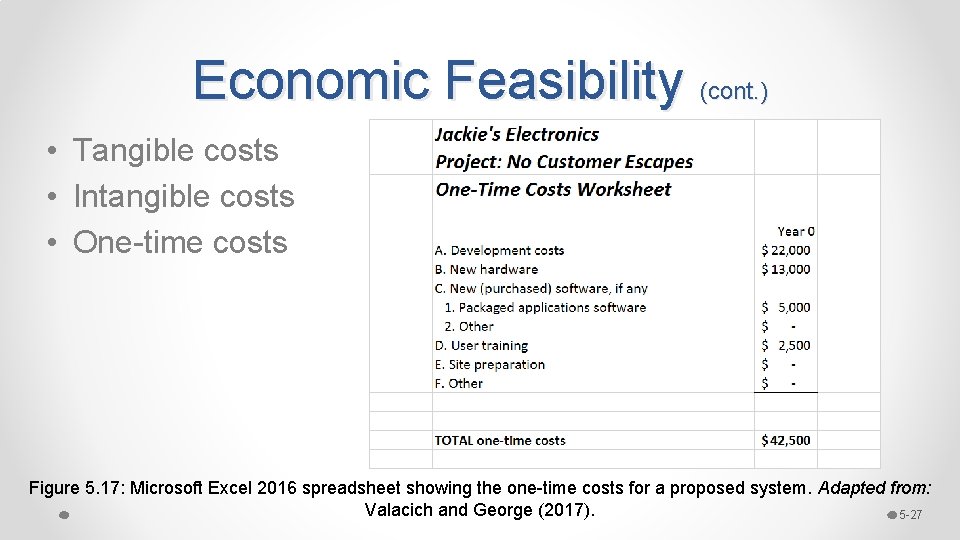
Economic Feasibility (cont. ) • Tangible costs • Intangible costs • One-time costs Figure 5. 17: Microsoft Excel 2016 spreadsheet showing the one-time costs for a proposed system. Adapted from: Valacich and George (2017). 5 -27
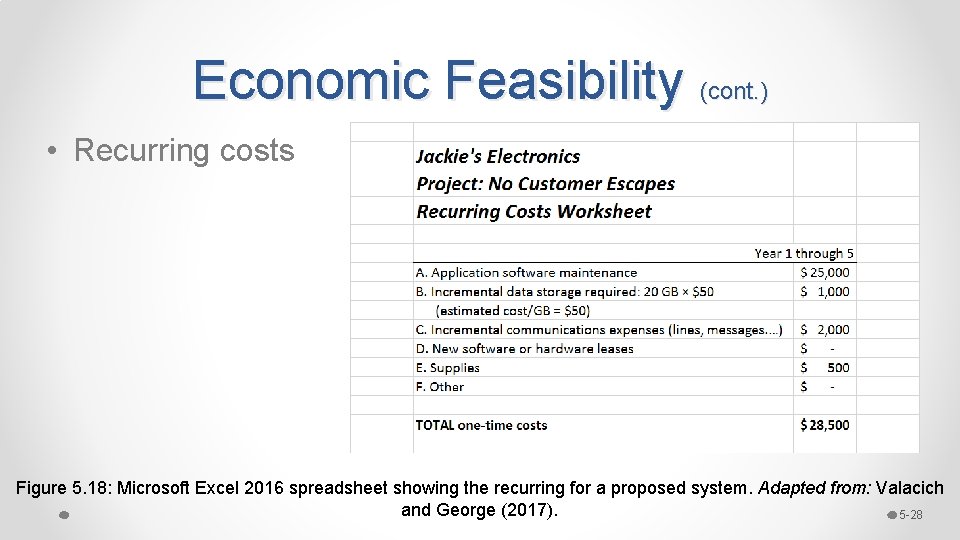
Economic Feasibility (cont. ) • Recurring costs Figure 5. 18: Microsoft Excel 2016 spreadsheet showing the recurring for a proposed system. Adapted from: Valacich and George (2017). 5 -28
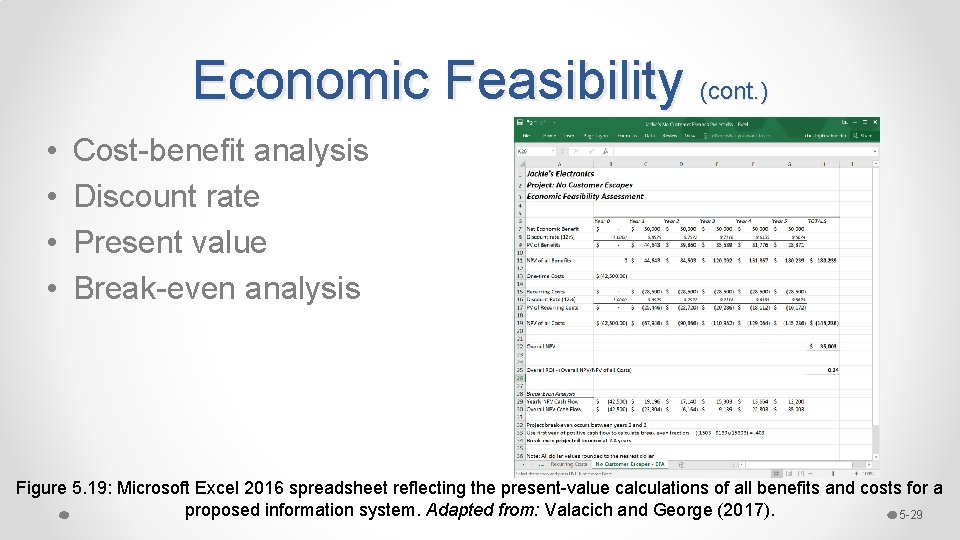
Economic Feasibility (cont. ) • • Cost-benefit analysis Discount rate Present value Break-even analysis Figure 5. 19: Microsoft Excel 2016 spreadsheet reflecting the present-value calculations of all benefits and costs for a proposed information system. Adapted from: Valacich and George (2017). 5 -29
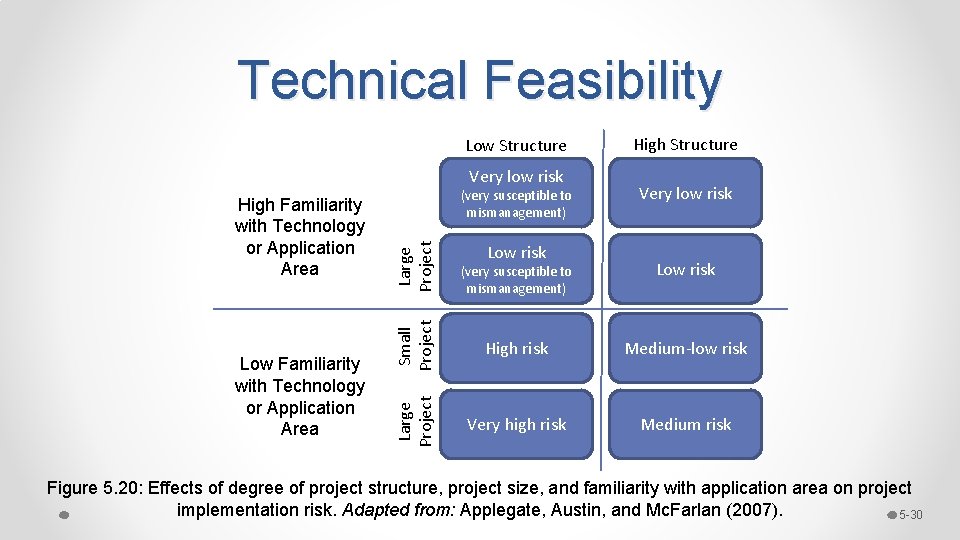
Technical Feasibility Low Structure Very low risk Large Project Low risk Very low risk (very susceptible to mismanagement) Low risk Small Project Low Familiarity with Technology or Application Area (very susceptible to mismanagement) High risk Medium-low risk Large Project High Familiarity with Technology or Application Area High Structure Very high risk Medium risk Figure 5. 20: Effects of degree of project structure, project size, and familiarity with application area on project implementation risk. Adapted from: Applegate, Austin, and Mc. Farlan (2007). 5 -30
Other Feasibility Concerns • • Operational feasibility Schedule feasibility Legal and contractual feasibility Political feasibility 5 -31
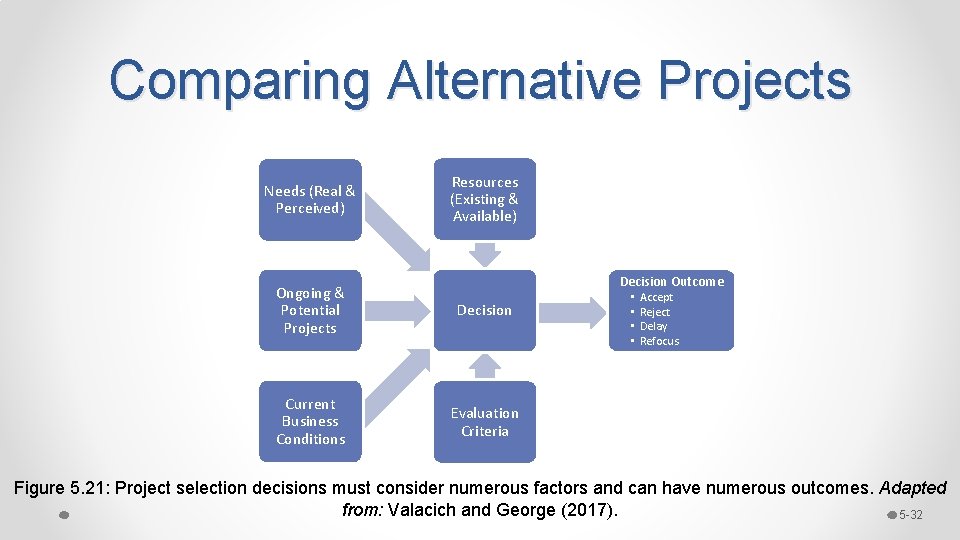
Comparing Alternative Projects Needs (Real & Perceived) Resources (Existing & Available) Decision Outcome Ongoing & Potential Projects Decision Current Business Conditions Evaluation Criteria • • Accept Reject Delay Refocus Figure 5. 21: Project selection decisions must consider numerous factors and can have numerous outcomes. Adapted from: Valacich and George (2017). 5 -32
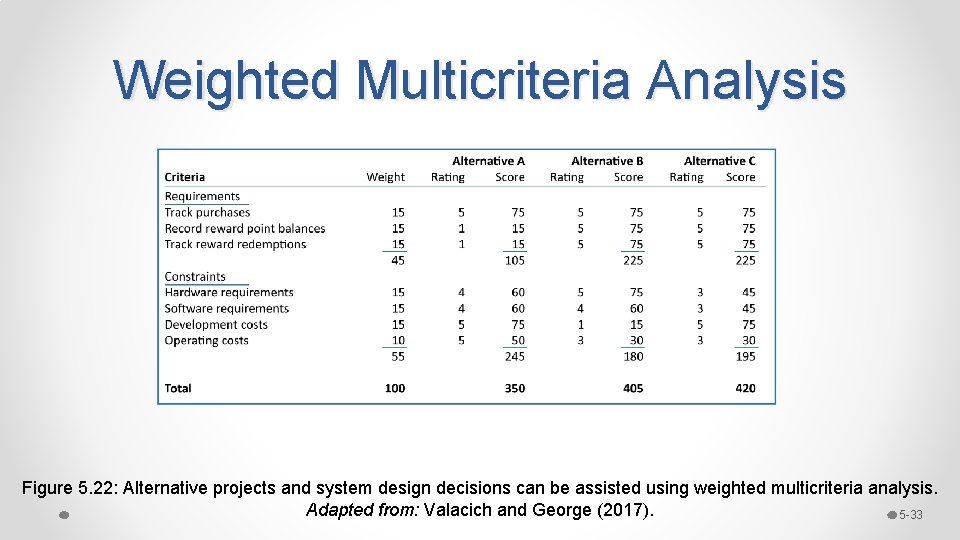
Weighted Multicriteria Analysis Figure 5. 22: Alternative projects and system design decisions can be assisted using weighted multicriteria analysis. Adapted from: Valacich and George (2017). 5 -33
Project Initiation 5 -34
Key Terms • • • Project initiation Project charter Assumption log Project management plan Baseline Project management information system 5 -35
Project Initiation • Developing the project charter • Developing the project management plan • Establishing the project management information system 5 -36
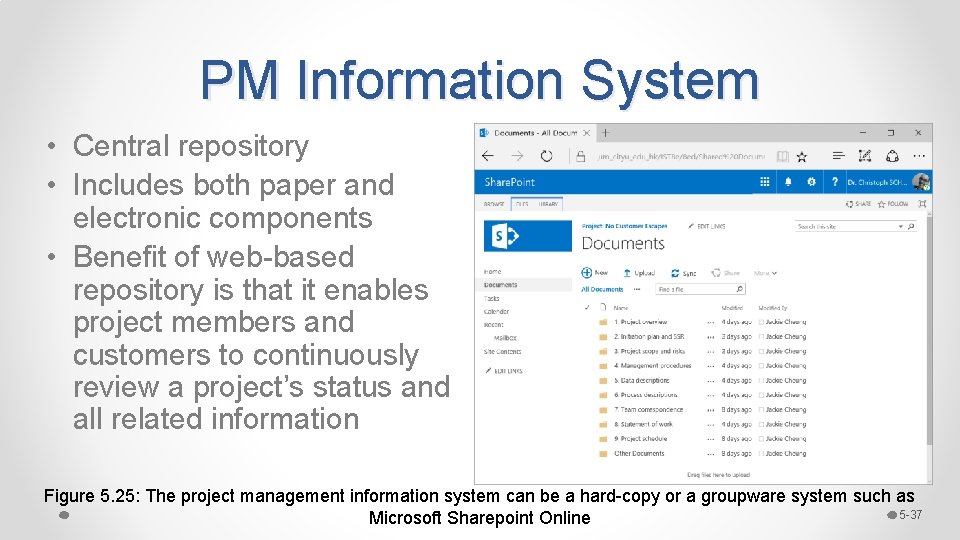
PM Information System • Central repository • Includes both paper and electronic components • Benefit of web-based repository is that it enables project members and customers to continuously review a project’s status and all related information Figure 5. 25: The project management information system can be a hard-copy or a groupware system such as 5 -37 Microsoft Sharepoint Online
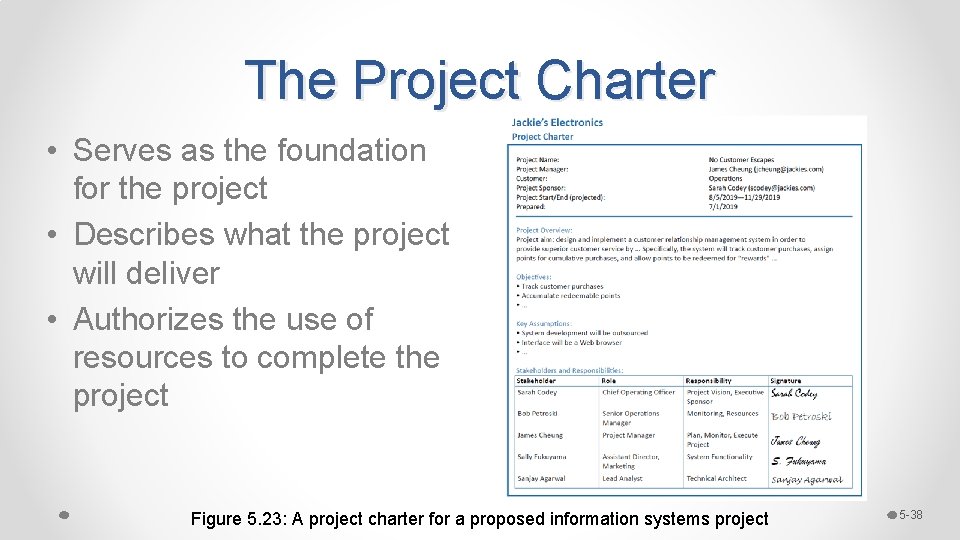
The Project Charter • Serves as the foundation for the project • Describes what the project will deliver • Authorizes the use of resources to complete the project Figure 5. 23: A project charter for a proposed information systems project 5 -38
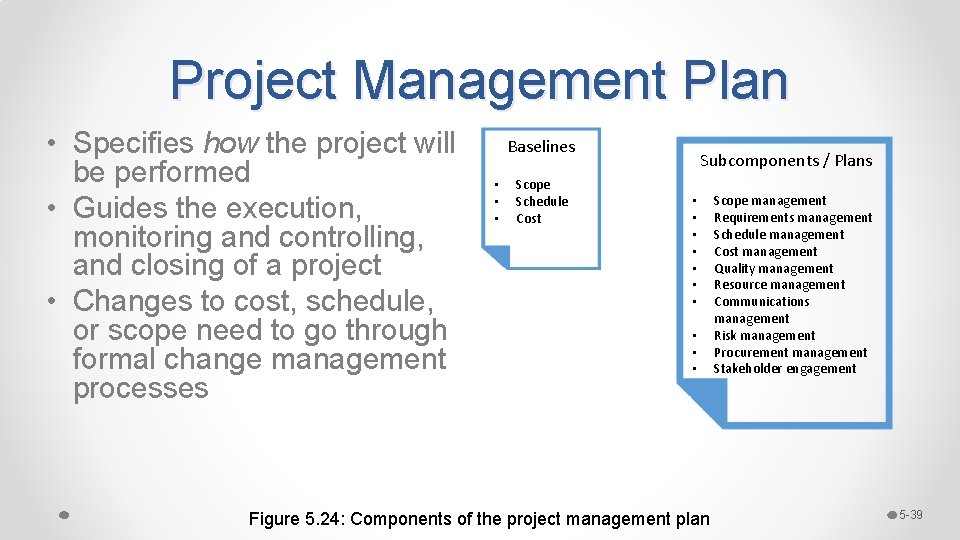
Project Management Plan • Specifies how the project will be performed • Guides the execution, monitoring and controlling, and closing of a project • Changes to cost, schedule, or scope need to go through formal change management processes Baselines • • • Scope Schedule Cost Subcomponents / Plans • • • Figure 5. 24: Components of the project management plan Scope management Requirements management Schedule management Cost management Quality management Resource management Communications management Risk management Procurement management Stakeholder engagement 5 -39
Project Scope Planning, Verification, and Change Control 5 -40
Key Terms • • • Project scope Product scope Project scope statement Validate scope Control scope Scope creep 5 -41
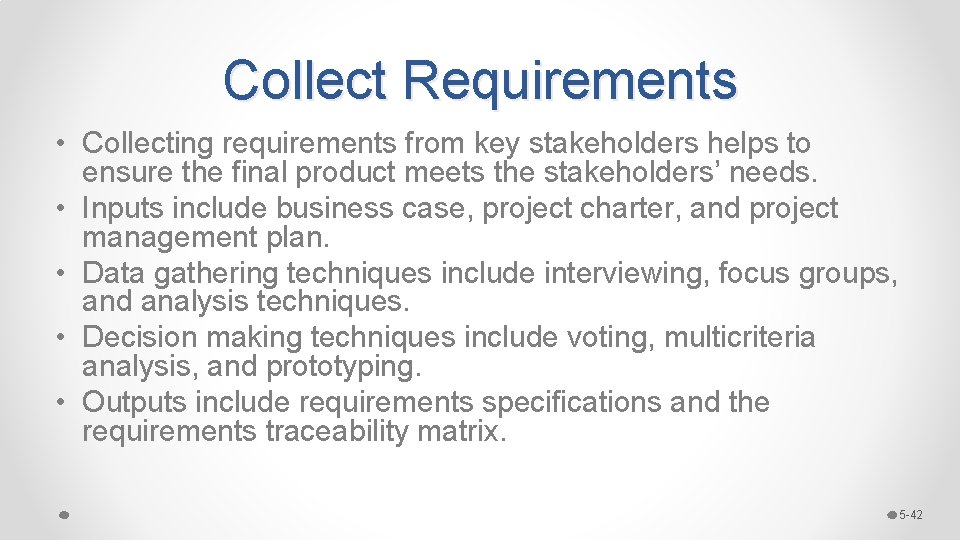
Collect Requirements • Collecting requirements from key stakeholders helps to ensure the final product meets the stakeholders’ needs. • Inputs include business case, project charter, and project management plan. • Data gathering techniques include interviewing, focus groups, and analysis techniques. • Decision making techniques include voting, multicriteria analysis, and prototyping. • Outputs include requirements specifications and the requirements traceability matrix. 5 -42
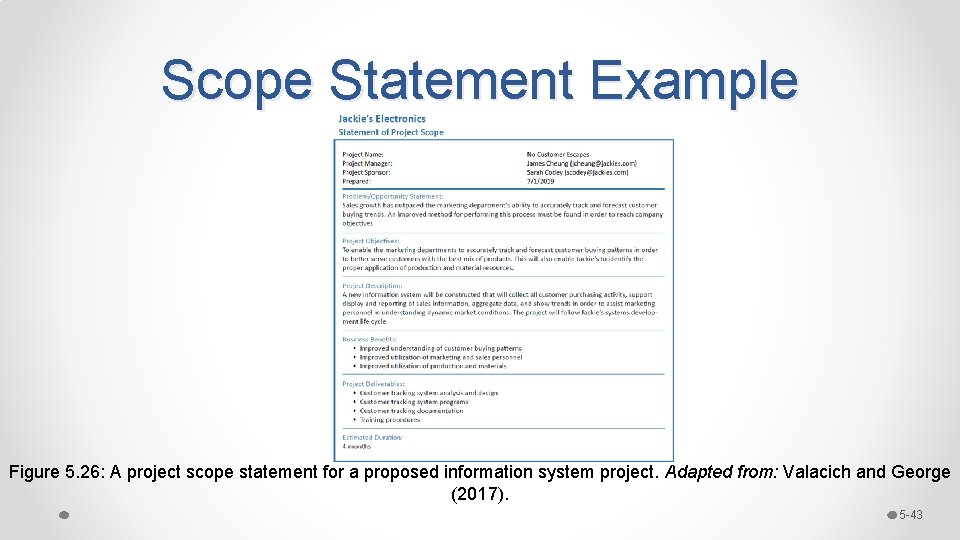
Scope Statement Example Figure 5. 26: A project scope statement for a proposed information system project. Adapted from: Valacich and George (2017). 5 -43
Managing Project Scope and PMBOK 5 -44
Chapter Summary 5 -45
Let’s Review • Project Identification and Selection Process o Three activities including: Identifying information systems projects, Assessing project feasibility, and comparing alternative projects o Important to assess feasibility issues including economic, technical, operational, schedule, legal and contractual, and political • Project Initiation Process • Project Scope Planning o Process of progressively elaborating and documenting the project management plan o Collecting requirements from key stakeholders o Project scope statement o Work breakdown structure (WBS) o Scope validation o Scope control o Includes three key activities: developing the project charter, developing the project management plan, and establishing the project management information system 5 -46