
Information Systems Ninth Edition Chapter 14 The Personal
- Slides: 58
Information Systems, Ninth Edition Chapter 14 The Personal and Social Impact of Computers
Principles and Learning Objectives • Policies and procedures must be established to avoid waste and mistakes associated with computer usage – Describe some examples of waste and mistakes in an IS environment, their causes, and possible solutions – Identify policies and procedures useful in eliminating waste and mistakes – Discuss the principles and limits of an individual’s right to privacy Principles of Information Systems, Ninth Edition 2
Principles and Learning Objectives (continued) • Computer crime is a serious and rapidly growing area of concern requiring management attention – Explain the types of computer crime and impacts – Identify specific measures to prevent computer crime Principles of Information Systems, Ninth Edition 3
Principles and Learning Objectives (continued) • Jobs, equipment, and working conditions must be designed to avoid negative health effects from computers – List the important negative effects of computers on the work environment – Identify specific actions that must be taken to ensure the health and safety of employees Principles of Information Systems, Ninth Edition 4
Principles and Learning Objectives (continued) • Practitioners in many professions subscribe to a code of ethics that states the principles and core values that are essential to their work – Outline criteria for the ethical use of information systems Principles of Information Systems, Ninth Edition
Computer Waste and Mistakes • Computer waste – Inappropriate use of computer technology and resources • Computer-related mistakes – Errors, failures, and other computer problems that make computer output incorrect or not useful Principles of Information Systems, Ninth Edition 6
Computer Waste • Spam filter – Software that attempts to block unwanted e-mail – Some might require first-time e-mailers to be verified before their e-mails are accepted • Image-based spam – New tactic spammers use to circumvent spamfiltering software Principles of Information Systems, Ninth Edition 7
Computer-Related Mistakes • Common causes: – Unclear expectations and a lack of feedback – Program development that contains errors – Incorrect data entry by data-entry clerk Principles of Information Systems, Ninth Edition 8
Preventing Computer-Related Waste and Mistakes • Preventing waste and mistakes involves: – Establishing, implementing, monitoring, and reviewing effective policies and procedures Principles of Information Systems, Ninth Edition 9
Establishing Policies and Procedures • Types of computer-related mistakes: – – Data-entry or data-capture errors Errors in computer programs Mishandling of computer output Inadequate planning for and control of equipment malfunctions – Inadequate planning for and control of environmental difficulties Principles of Information Systems, Ninth Edition 10
Implementing Policies and Procedures • Policies to minimize waste and mistakes: – Changes to critical tables, HTML, and URLs should be tightly controlled – User manual should be available covering operating procedures – Each system report should indicate its general content in its title – System should have controls to prevent invalid and unreasonable data entry Principles of Information Systems, Ninth Edition 11
Monitoring Policies and Procedures • Monitor routine practices and take corrective action if necessary • Implement internal audits to measure actual results against established goals Principles of Information Systems, Ninth Edition 12
Reviewing Policies and Procedures • Questions to be answered: – Do current policies cover existing practices adequately? – Does the organization plan any new activities in the future? – Are contingencies and disasters covered? Principles of Information Systems, Ninth Edition 13
Computer Crime • Highlights of the 2007 Computer Crime and Security Survey: – Financial fraud, followed by virus attacks, is the leading cause of financial loss from computer incidents – Average annual loss from computer incidents was $350, 424 – A full 46 percent of the respondents said they had suffered a security incident Principles of Information Systems, Ninth Edition 14
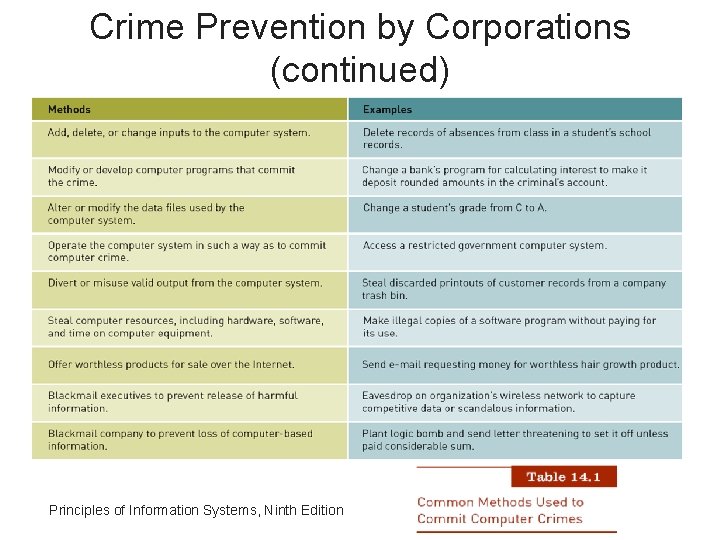
The Computer as a Tool to Commit Crime • Social engineering – Using social skills to get computer users to provide information to access an information system • Dumpster diving – Going through trash cans to find secret or confidential information Principles of Information Systems, Ninth Edition 15
Cyberterrorism • Homeland Security Department’s Information Analysis and Infrastructure Protection Directorate – Serves as a focal point for threat assessment, warning, investigation, and response for threats or attacks against the country’s critical infrastructure • Cyberterrorist – Intimidates or coerces a government or organization to advance his political or social objectives Principles of Information Systems, Ninth Edition 16
Identity Theft • Imposter obtains personal identification information in order to impersonate someone else – To obtain credit, merchandise, and services in the name of the victim – To have false credentials • Identity Theft and Assumption Deterrence Act of 1998 – Passed to fight identity theft Principles of Information Systems, Ninth Edition 17
Internet Gambling • Revenues generated by Internet gambling represent a major untapped source of income for the state and federal governments • Study prepared by Pricewaterhouse. Coopers estimates that taxation of Internet gambling would yield between $8. 7 billion and $42. 8 billion Principles of Information Systems, Ninth Edition
The Computer as the Object of Crime • Crimes fall into several categories – – – Illegal access and use Data alteration and destruction Information and equipment theft Software and Internet piracy Computer-related scams International computer crime Principles of Information Systems, Ninth Edition 19
Illegal Access and Use • Hacker – Learns about and uses computer systems • Criminal hacker – Gains unauthorized use or illegal access to computer systems • Script bunny – Automates the job of crackers • Insider – Employee who comprises corporate systems Principles of Information Systems, Ninth Edition 20
Illegal Access and Use (continued) • Virus – Program file capable of attaching to disks or other files and replicating itself repeatedly • Worm – Parasitic computer programs that replicate but, unlike viruses, do not infect other computer program files • Trojan horse – Malicious program that disguises itself as a useful application or game and purposefully does something the user does not expect Principles of Information Systems, Ninth Edition 21
Illegal Access and Use (continued) • Rootkit – Set of programs that enable its user to gain administrator level access to a computer or network • Logic bomb – Type of Trojan horse that executes when specific conditions occur • Variant – Modified version of a virus that is produced by virus’s author or another person Principles of Information Systems, Ninth Edition 22
Using Antivirus Programs • Antivirus program – Runs in the background to protect your computer from dangers lurking on the Internet • Tips on using antivirus software: – Run and update antivirus software often – Scan all removable media – Install software only from a sealed package or secure, well-known Web site – Follow careful downloading practices Principles of Information Systems, Ninth Edition 23
Spyware • Software installed on a personal computer to: – Intercept or take partial control over user’s interaction with the computer without knowledge or permission of the user • Number of personal computers infected with spyware has become epidemic Principles of Information Systems, Ninth Edition
Information and Equipment Theft • Password sniffer – Small program hidden in a network that records identification numbers and passwords • Measures to protect the data on laptops – Have clear guidelines on what kind of data can be stored on vulnerable laptops – Data stored should be encrypted – Laptops should be secured using a lock and chain device Principles of Information Systems, Ninth Edition 25
Safe Disposal of Personal Computers • Deleting files and emptying the Recycle Bin does not make it impossible for determined individuals to view the data • Use disk-wiping software utilities that overwrite all sectors of your disk drive making all data unrecoverable Principles of Information Systems, Ninth Edition
Patent and Copyright Violations • Software piracy – Act of unauthorized copying or distribution of copyrighted software – Penalties can be severe • Patent infringement – Occurs when someone makes unauthorized use of another’s patent Principles of Information Systems, Ninth Edition
Computer-Related Scams • Tips to help you avoid becoming a scam victim: – – – Do not agree to anything in a high-pressure meeting Do not judge a company based on appearances Beware of shills Do your homework Get in writing the refund, buy-back, and cancellation policies of any company you deal with Principles of Information Systems, Ninth Edition 28
International Computer Crime • Clever. Path software – Used by customers in the finance, banking, and insurance industries to eliminate money laundering and fraud – Automates manual tracking and auditing processes required by regulatory agencies – Helps companies handle frequently changing reporting regulations Principles of Information Systems, Ninth Edition 29
Preventing Computer-Related Crime • Efforts to curb computer crime is being made by: – – Private users Companies Employees Public officials Principles of Information Systems, Ninth Edition 30
Crime Prevention by State and Federal Agencies • Computer Fraud and Abuse Act of 1986 – Punishment based on the victim’s dollar loss • Computer Emergency Response Team (CERT) – Responds to network security breaches – Monitors systems for emerging threats Principles of Information Systems, Ninth Edition 31
Crime Prevention by Corporations • Guidelines to protect your computer from criminal hackers: – Install strong user authentication and encryption capabilities on your firewall – Install the latest security patches – Disable guest accounts and null user accounts – Turn audit trails on – Consider installing caller ID – Install a corporate firewall between your corporate network and the Internet Principles of Information Systems, Ninth Edition 32
Crime Prevention by Corporations (continued) Principles of Information Systems, Ninth Edition
Using Intrusion Detection Software • Intrusion detection system (IDS) – Monitors system and network resources – Notifies network security personnel when it senses a possible intrusion – Can provide false alarms Principles of Information Systems, Ninth Edition 34
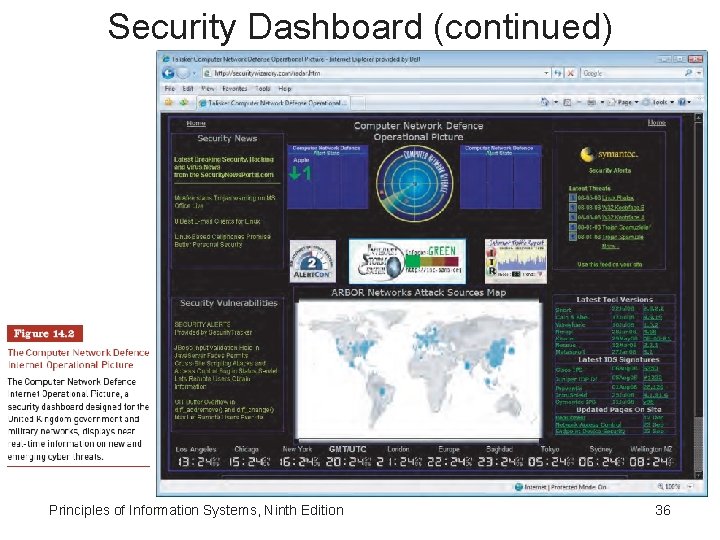
Security Dashboard • Provides comprehensive display on a single computer screen of: – All the vital data related to an organization’s security defenses including threats, exposures, policy compliance, and incident alerts Principles of Information Systems, Ninth Edition
Security Dashboard (continued) Principles of Information Systems, Ninth Edition 36
Using Managed Security Service Providers (MSSPs) • Many are outsourcing their network security operations to: – Managed security service providers (MSSPs) such as Counterpane, Guardent, Internet Security Services, Riptech, and Symantec Principles of Information Systems, Ninth Edition 37
Filtering and Classifying Internet Content • Filtering software – Help screen Internet content • Internet Content Rating Association (ICRA) – Goals are to protect children from potentially harmful material, while also safeguarding free speech on the Internet Principles of Information Systems, Ninth Edition
Internet Libel Concerns • Geolocation tools – Match user’s IP address with outside information to determine actual geographic location • Internet publishers – Can limit the reach of their published speech to avoid potential legal risks • Individuals – Must be careful what they post on the Internet to avoid libel charges Principles of Information Systems, Ninth Edition
Preventing Crime on the Internet • To help prevent crime on the Internet: – Develop effective Internet usage and security policies – Use a stand-alone firewall with network monitoring capabilities – Deploy intrusion detection systems, monitor them, and follow up on their alarms – Use Internet security specialists to perform audits of all Internet and network activities Principles of Information Systems, Ninth Edition 40
Privacy Issues • Issue of privacy – Deals with the right to be left alone or to be withdrawn from public view • Data is constantly being collected and stored on each of us Principles of Information Systems, Ninth Edition 41
Privacy and the Federal Government • Data collectors – U. S. federal government – State and local governments – Commercial and nonprofit organizations • European Union – Has data-protection directive that requires firms transporting data across national boundaries to have certain privacy procedures in place Principles of Information Systems, Ninth Edition 42
Privacy at Work • Recent poll s – 78 percent of companies monitor their employees while at work in one form or another • Survey – Nearly one-third of companies have fired an employee for violating corporate e-mail policies Principles of Information Systems, Ninth Edition 43
E-Mail Privacy • Federal law – Permits employers to monitor e-mail sent and received by employees • E-mail messages that have been erased from hard disks can be retrieved and used in lawsuits • Use of e-mail among public officials might violate “open meeting” laws Principles of Information Systems, Ninth Edition 44
Instant Messaging Privacy • Do not send personal or private IMs at work • Choose a nonrevealing, nongender-specific, unprovocative IM screen name • Do not open files or click links in messages from people you do not know • Never send sensitive personal data such as credit card numbers via IM Principles of Information Systems, Ninth Edition
Privacy and Personal Sensing Devices • RFID tags – Microchips with antenna – Embedded in many of the products we buy • Medicine containers, clothing, computer printers, car keys, library books, tires – Generate radio transmissions that if appropriate measures are not taken, can lead to potential privacy concerns Principles of Information Systems, Ninth Edition
Privacy and the Internet • Huge potential for privacy invasion on the Internet – E-mail messages – Visiting a Web site – Buying products over the Internet • Platform for Privacy Preferences (P 3 P) – Screening technology • Social network services – Parents should discuss potential dangers, check their children’s profiles, and monitor their activities Principles of Information Systems, Ninth Edition 47
Fairness in Information Use • The Privacy Act of 1974 – Provides privacy protection from federal agencies • Gramm-Leach-Bliley Act – Requires financial institutions to protect customers’ nonpublic data • USA Patriot Act – Internet service providers and telephone companies must turn over customer information • Other federal privacy laws – Federal law passed in 1992 bans unsolicited fax advertisements Principles of Information Systems, Ninth Edition 48
Corporate Privacy Policies • Should address: – Customer’s knowledge, control, notice, and consent over storage and use of information • 1999 Gramm-Leach-Bliley Financial Services Modernization Act – Requires all financial service institutions to communicate their data privacy rules and honor customer preferences Principles of Information Systems, Ninth Edition 49
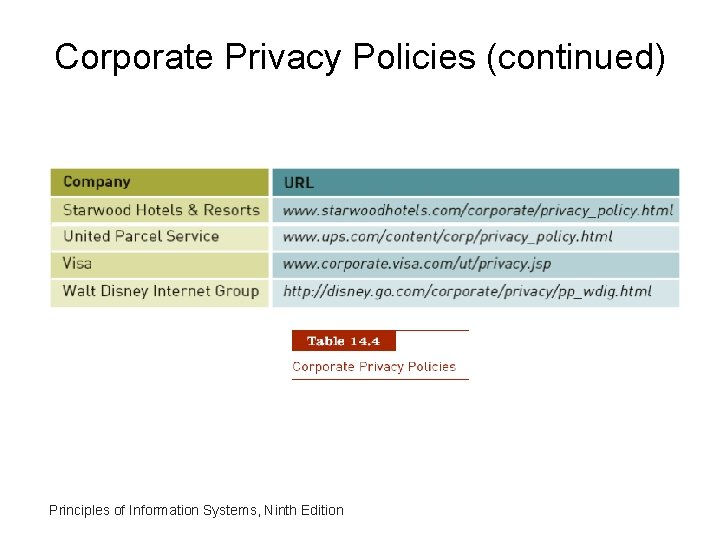
Corporate Privacy Policies (continued) Principles of Information Systems, Ninth Edition
Individual Efforts to Protect Privacy • To protect personal privacy: – Find out what is stored about you in existing databases – Be careful when you share information about yourself – Be proactive to protect your privacy – When purchasing anything from a Web site, make sure that you safeguard your credit card numbers, passwords, and personal information Principles of Information Systems, Ninth Edition 51
The Work Environment • Use of computer-based information systems has changed the workforce – Jobs that require IS literacy have increased – Less-skilled positions have decreased • Enhanced telecommunications: – Has been the impetus for new types of business – Has created global markets in industries once limited to domestic markets Principles of Information Systems, Ninth Edition 52
Health Concerns • • Occupational stress Seated immobility thromboembolism (SIT) Carpal tunnel syndrome (CTS) Video display terminal (VDT) bill – Employees who spend at least four hours a day working with computer screens should be given 15 minute breaks every two hours Principles of Information Systems, Ninth Edition 53
Avoiding Health and Environment Problems • Work stressors – Hazardous activities associated with unfavorable conditions of a poorly designed work environment • Ergonomics – Science of designing machines, products, and systems to maximize safety, comfort, and efficiency of people who use them Principles of Information Systems, Ninth Edition 54
Ethical Issues in Information Systems • Code of ethics – States the principles and core values essential to a set of people and, therefore, govern their behavior – Can become a reference point for weighing what is legal and what is ethical Principles of Information Systems, Ninth Edition 55
Summary • Computer waste – The inappropriate use of computer technology and resources in both the public and private sectors • Preventing waste and mistakes involves: – Establishing, implementing, monitoring, and reviewing effective policies and procedures • Some crimes use computers as tools • Cyberterrorist – Intimidates or coerces a government or organization to advance his political or social objectives Principles of Information Systems, Ninth Edition 56
Summary (continued) • Prevention and detection of computer crime – Antivirus software – Intrusion detection system (IDS) • Privacy issues – A concern with government agencies, e-mail use, corporations, and the Internet • Businesses – Should develop a clear and thorough policy about privacy rights for customers, including database access Principles of Information Systems, Ninth Edition 57
Summary (continued) • Computers have: – Changed the makeup of the workforce – Eliminated some jobs – Expanded and enriched employment opportunities • Ergonomics – The study of designing and positioning computer equipment • Ethics – Determine generally accepted and discouraged activities within a company and society at large Principles of Information Systems, Ninth Edition 58