
Information Systems IS Capability Requirements JCIDS Warfighter Information
Information Systems (IS) Capability Requirements: JCIDS Warfighter Information Technology (IT-Box) & Defense Business Systems Sources: • CJCSI 3170. 01 I, 23 Jan 2015 • JCIDS Manual, 12 Feb 2015 with errata, 18 Dec 2015 • DODI 5000. 02, 7 Jan 2015, through Change 2, 2 Feb 2017 • DODI 5000. 75, 2 Feb 2017 Eric Jefferies Professor, Requirements Management Defense Systems Management College Defense Acquisition University February 2017
IT Box Topics • • • IT Box Background Assumptions Applicability Information Systems Initial Capabilities Document (IS ICD) Information Systems Capability Development Document (ISCDD) Governance Successor Documents and the Acquisition Process Converting Existing ICDs and CDD Defense Business System/Business Capability Acquisition Cycle 2
Learning Objectives (LO) • Identify the applicability of the JCIDS IT-Box • Identify the IT-Box boundaries • Identify the Defense Business System Documents that contain requirements for business IT/IS development 3
Terms Of Reference • Initial Capability Document (ICD): Specifies the operational capability gap – IS-ICD: Narrowly focused variant for software development efforts ØIT-Box: Model (Maneuver space) via fewer validation iterations – Requirements Definition Package (RDP): Further refined rqmts – Capability Drop (CD): Smaller increment of refined rqmts • Capability Development Document (CDD) – Specifies capability requirements (in terms of developmental attributes, etc. ) – IS-CDD: Narrowly focused variants for software development efforts • Capability Production Document (CPD) - Specifies capability requirements (in terms of production attributes, etc. ) 4
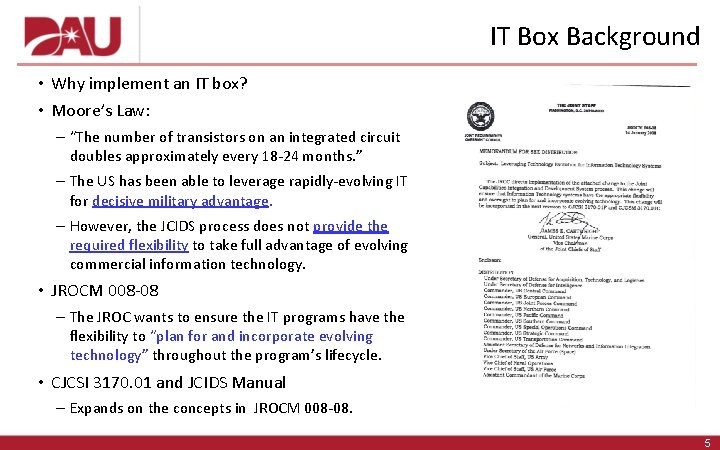
IT Box Background • Why implement an IT box? • Moore’s Law: – “The number of transistors on an integrated circuit doubles approximately every 18 -24 months. ” – The US has been able to leverage rapidly-evolving IT for decisive military advantage. – However, the JCIDS process does not provide the required flexibility to take full advantage of evolving commercial information technology. • JROCM 008 -08 – The JROC wants to ensure the IT programs have the flexibility to “plan for and incorporate evolving technology” throughout the program’s lifecycle. • CJCSI 3170. 01 and JCIDS Manual – Expands on the concepts in JROCM 008 -08. 5
Assumptions • The Acquisition and Programming communities agree that IS development is different from weapon systems – Modification of processes and documentation are appropriate • The Test communities (DT/OT) can deliver on more responsive testing to enable more rapid delivery of capabilities – Necessitates incremental/iterative development and testing • Validation Authority for managing IS requirements can be pushed down to the lowest level to allow for rapid changes/decisions 6
Reasons for Changes • Traditional JCIDS and documents are not supportive of the rapid pace of development necessary with IS systems/capabilities • In conjunction with changes in the acquisition process*, the JCIDS process flex to meet the needs of the operational user so that new capabilities can be delivered rapidly, and adapted as to changes in the operational environment • Desired Outcome - Provide agile and responsive capability requirements process for rapid development of IS capabilities *DODD 5000. 02 provides some software intensive program models 7
![The IT Box Requirements Organization & Oversight IS-ICD Flag-level oversight through [describe oversight body]](http://slidetodoc.com/presentation_image/58a9cbcd7ee9b5b43357f190886bd62c/image-8.jpg "The IT Box Requirements Organization & Oversight IS-ICD Flag-level oversight through [describe oversight body]")
The IT Box Requirements Organization & Oversight IS-ICD Flag-level oversight through [describe oversight body] • Chair • Members (list) Capabilities & Initial Minimum Values List Capabilities & initial values List Operational Attributes & initial values IS-CDD Key Performance Parameters List KPPs JROC Approved IS-ICD or IS-CDD Application and System Software Development Cost Controls • Per year = $XXX • Lifecycle cost = $XXX • Rationale Hardware Refresh and System Enhancements & Integration Cost Controls • Per year = $XXX • Lifecycle cost = $XXX • Rationale • No return to the JROC unless new core capabilities added to the IS-ICD/IS-CDD • Further definition of capabilities through Requirements Definition Packages(RDPs)/Capability Drops (CDs) 8
Applicability of the IT Box • IT Box Applies to: Information Systems (IS) with software development only Includes integration onto commercial off-the-shelf hardware Program costs that exceed $15 million • IT Box DOES NOT Apply to: IS with a developmental cost less than $15 million Defense Business Systems (DBS) Software for services (Do. DI 5000. 02 and JCIDS do not apply to acquisition of services) Hardware development efforts or capturing capability requirements which span a broad scope of combined hardware, software, and/or DOTm. LPF-P efforts. 9
Information System ICD (IS-ICD) • IS-ICDs must be used when applicable for capability requirements documents with JSDs of JROC and JCB Interest. Specifically appropriate for: Procurement or modification of Commercial off the Shelf (COTS)/Government off the Shelf (GOTS) IS products Additional production or modification of previously developed U. S and/or Allied or interagency systems or equipment Development, integration, and acquisition of customized application software Approaches where the solution involves research and development and / or acquisition of applications systems software, and the projected life-cycle costs exceed $15 million • Associated hardware must be COTS/GOTS • Capability Development Documents (CDDs) are not required as successor documents for an IS-ICD – the delegated authority may prescribe alternate document formats • IS-ICDs Implement the IT Box Model 10
When an IS-ICD Is Not Appropriate IS-ICDs are NOT Appropriate for: • Software embedded as a subset of a capability solution developed under other validated capability requirement documents. − Software requirements are validated as part of the overall capability solution • Software requiring a host platform, such as a manned or unmanned vehicle, which does not yet have validated capability requirement documents. − Software requirements can be included in the capability requirements of the host platform, or as a separate IS-ICD submitted after validation of the host platform capability requirement documents. • Increases in quantities of previously fielded IS without modification, which are not addressed by an IT Box. − Increased quantities may be addressed by a DCR. Increases in quantity which remain within the scope of a previously validated IT Box, may be accomplished without revalidation. • Requirements for Defense Business System (DBS) capabilities 11
IT Box Components for IS-ICD Organization & Oversight Flag-level Chair & Members Capability Requirements & Attributes List operational attributes / initial minimum values (not threshold & objectives) Net-Ready KPP Added by JCIDS Manual Feb 2015 JROC Approved IS ICD Application and System Software Development Cost Controls Hardware Refresh and System Enhancements & Integration Cost Controls • Per year = $xxx • Life cycle cost = $xxx • Rationale 12
Information Systems CDD (IS-CDD) • IS-CDD – Implements IT Box model used; but is not a follow-on to an IS-ICD – May be used where a validated ICD contains capability requirements which can be addressed by a combination of IS and non-IS solution and the IT Box is applicable to the IS portion – May be used when a validated CDD was generated before the IT Box construct was introduced, and the Sponsor wants to revalidate under the IT Box construct. • IS-CDDs are appropriate in the same situations where the IS-ICD is appropriate, and are NOT appropriate in the same situations where the ISICD is not appropriate. • Capability Production Documents (CPDs) are not required as successor documents for an IS-CDD – the delegated authority may prescribe alternate document formats 13
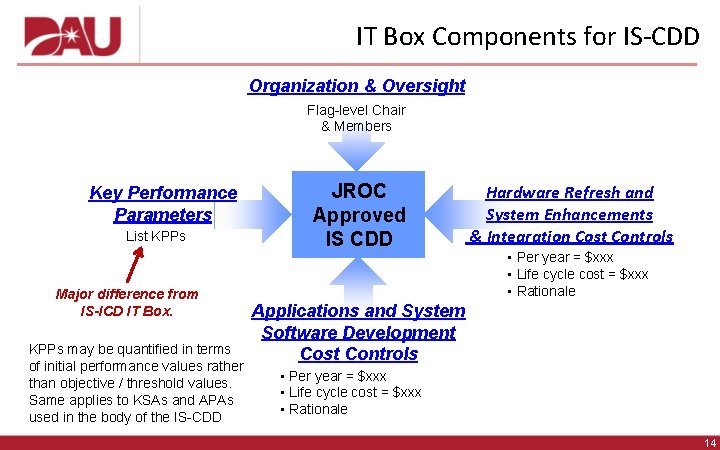
IT Box Components for IS-CDD Organization & Oversight Flag level Chair & Members Key Performance Parameters List KPPs Major difference from IS-ICD IT Box. KPPs may be quantified in terms of initial performance values rather than objective / threshold values. Same applies to KSAs and APAs used in the body of the IS CDD JROC Approved IS CDD Hardware Refresh and System Enhancements & Integration Cost Controls • Per year = $xxx • Life cycle cost = $xxx • Rationale Applications and System Software Development Cost Controls • Per year = $xxx • Life cycle cost = $xxx • Rationale 14
Key Difference In Usage: IS-ICD & IS-CDD • Key difference in usage of IS-ICDs and IS-CDDs is whether the Ao. A takes place before or after delegating authorities under the IT Box. For an IS-ICD to be appropriate, it must be very clear from the CBA that an IS solution is the only viable approach to be considered. The Ao. A conducted in the MSA phase takes place after delegating authorities under the IT Box and will therefore only consider IS alternatives. • An IS-CDD is more appropriate when an IS solution is not presumed at the time the ICD is validated and the Materiel Development Decision (MDD) approved, or other materiel and/or non-materiel solution(s) are expected to be necessary along with the IS solution. The IS-CDD is a result of the Ao. A conducted in the MSA phase and represents an IS solution for part or all of the capability requirements validated in the ICD. 15
Managing an IS Requirement Using the IT Box Construct • As the IS-ICD and IS-CDD only streamline the applicable requirements processes, the Sponsor must still ensure compliance with acquisition policy and processes in Do. DI 5000. 02, and Information Support Plan (ISP) policy and processes in accordance with Do. DI 8330. 01. • Since the standard CDD and CPD are not typically required, an IS-ICD or IS-CDD provides Sponsors the flexibility to manage IS requirements with alternate documents and validation processes as necessary, as long as development efforts remain within the boundaries of the validated IT-Box and any additional guidance provided by the validation authority. 16
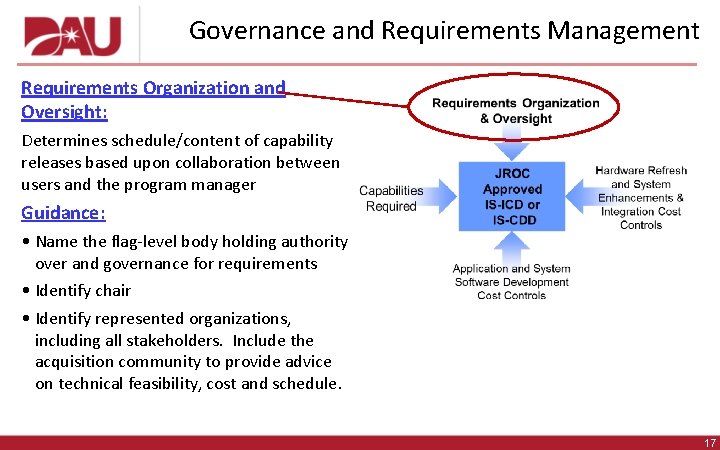
Governance and Requirements Management Requirements Organization and Oversight: Determines schedule/content of capability releases based upon collaboration between users and the program manager Guidance: • Name the flag-level body holding authority over and governance for requirements • Identify chair • Identify represented organizations, including all stakeholders. Include the acquisition community to provide advice on technical feasibility, cost and schedule. 17
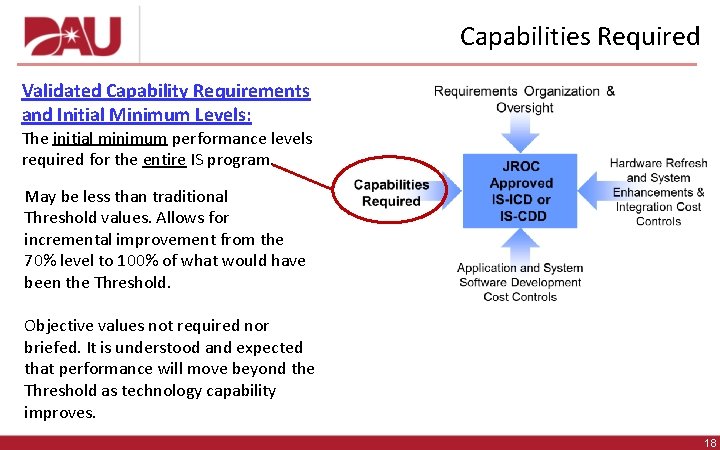
Capabilities Required Validated Capability Requirements and Initial Minimum Levels: The initial minimum performance levels required for the entire IS program. May be less than traditional Threshold values. Allows for incremental improvement from the 70% level to 100% of what would have been the Threshold. Objective values not required nor briefed. It is understood and expected that performance will move beyond the Threshold as technology capability improves. 18
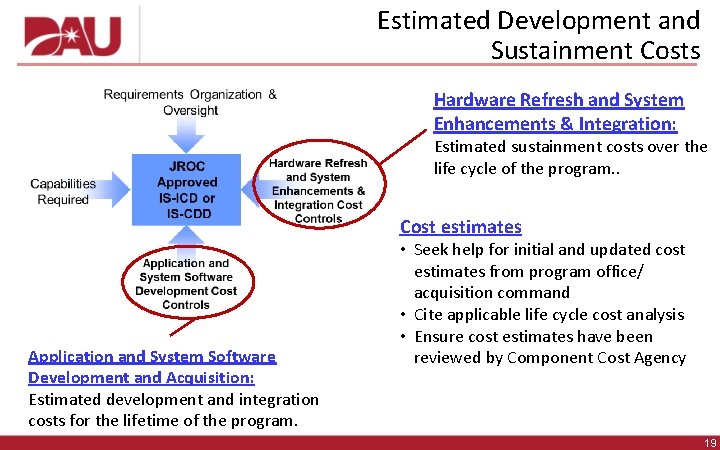
Estimated Development and Sustainment Costs Hardware Refresh and System Enhancements & Integration: Estimated sustainment costs over the life cycle of the program. . Cost estimates Application and System Software Development and Acquisition: Estimated development and integration costs for the lifetime of the program. • Seek help for initial and updated cost estimates from program office/ acquisition command • Cite applicable life cycle cost analysis • Ensure cost estimates have been reviewed by Component Cost Agency 19
Successor Documents for IS-ICDs and IS-CDDs • CDDs are Not required as successor documents for IS-ICDs; CPDs are Not required as successor documents for IS-CDDs. − Sponsors have management flexibility for successor documents − JCIDS Manual provides following examples of potential IS ICD/IS-CDD follow-on documents (actual names, content, and approval determined by the delegated validation authority): Ø Requirements Definition Package (RDP) – identifies KPPs, KSAs, and APAs, and non-materiel changes Ø Capability Drop (CD) – lower level document that specifies the characteristics of a “widget” or “app” for partial deployment of the solution • FCB is briefed Every 2 nd Year after validation on progress toward delivering the solution (FCB may recommend elevating to JROC Oversight) Recommend RDPs and CDs be co-developed by the RM and PM Office 20
Requirements Definition Packages (RDPs) • RDP is an example – It Is Not a JCIDS Document; It identifies performance attributes, it does not contain software specs – Created to show requirements can be broken into deliverable increments – Components define content and approval process • Provides a more detailed definition of capabilities in the IS-ICD – Enables detailed design activity – Enables detailed costing of the requirements • Provides link between the IS-ICD and the acquisition and program budget processes • Approved by the delegated requirements management authority – FO/GO-level body that holds authority over, and provides governance for requirements 21
Capability Drops (CDs) • CD is an Example – It Is Not a JCIDS Document; It describes performance characteristics, it does not contain software specs – Manages delivery of capabilities through more specifically defined subsets of an RDP – The details of how to do this are left to the components and the acquisition process • The RDP is further broken down into CDs to deliver individual “Widgets” or “Slices” of capability • The results of CD development are released incrementally through full deployment decisions as they are ready • Approval may delegated to lowest appropriate level (as determined by the oversight authority) to ensure timely decision making 22
Example of IS-ICD or IS-CDD Successor Documents Illustrative not intended to limit potential flexibilities provided by the IS ICD or IS CDD Although this figure shows RDPs and CDs, actual names, content, and approval process are at the discretion of the delegated oversight authority. 23
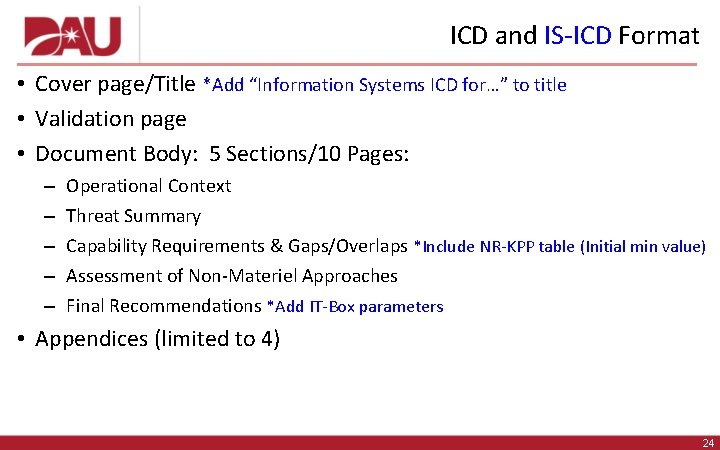
ICD and IS-ICD Format • Cover page/Title *Add “Information Systems ICD for…” to title • Validation page • Document Body: 5 Sections/10 Pages: – – – Operational Context Threat Summary Capability Requirements & Gaps/Overlaps *Include NR-KPP table (Initial min value) Assessment of Non-Materiel Approaches Final Recommendations *Add IT-Box parameters • Appendices (limited to 4) 24
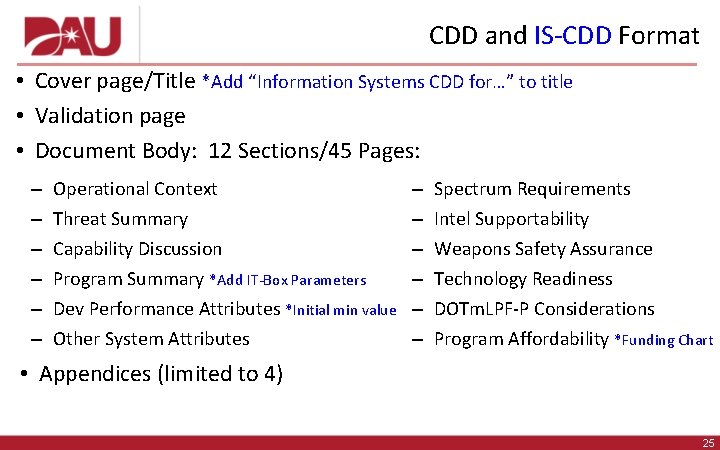
CDD and IS-CDD Format • Cover page/Title *Add “Information Systems CDD for…” to title • Validation page • Document Body: 12 Sections/45 Pages: – – – Operational Context Threat Summary Capability Discussion Program Summary *Add IT-Box Parameters Dev Performance Attributes *Initial min value Other System Attributes – – – Spectrum Requirements Intel Supportability Weapons Safety Assurance Technology Readiness DOTm. LPF-P Considerations Program Affordability *Funding Chart • Appendices (limited to 4) 25
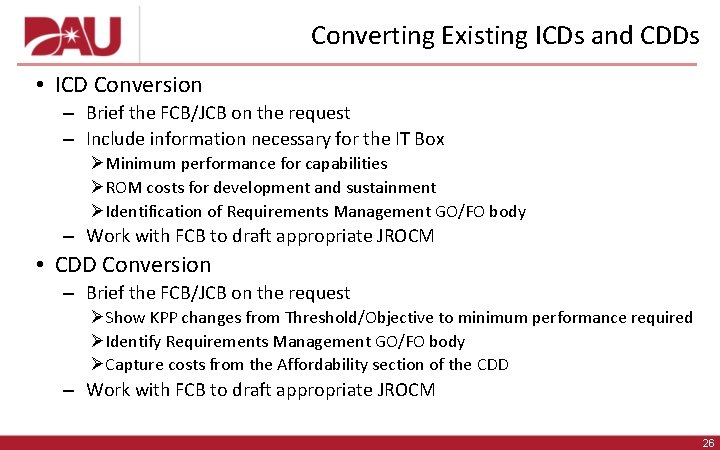
Converting Existing ICDs and CDDs • ICD Conversion – Brief the FCB/JCB on the request – Include information necessary for the IT Box ØMinimum performance for capabilities ØROM costs for development and sustainment ØIdentification of Requirements Management GO/FO body – Work with FCB to draft appropriate JROCM • CDD Conversion – Brief the FCB/JCB on the request ØShow KPP changes from Threshold/Objective to minimum performance required ØIdentify Requirements Management GO/FO body ØCapture costs from the Affordability section of the CDD – Work with FCB to draft appropriate JROCM 26
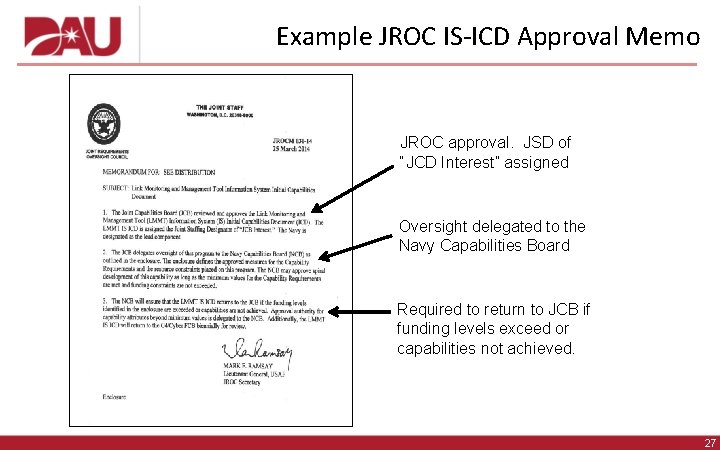
Example JROC IS-ICD Approval Memo JROC approval. JSD of “JCD Interest” assigned Oversight delegated to the Navy Capabilities Board Required to return to JCB if funding levels exceed or capabilities not achieved. 27
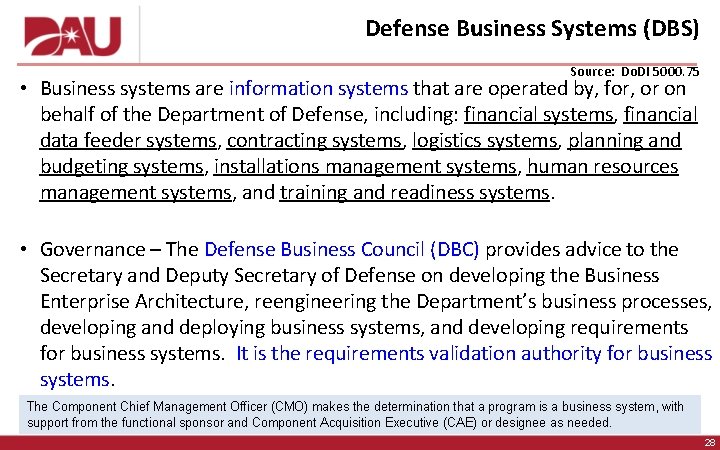
Defense Business Systems (DBS) Source: Do. DI 5000. 75 • Business systems are information systems that are operated by, for, or on behalf of the Department of Defense, including: financial systems, financial data feeder systems, contracting systems, logistics systems, planning and budgeting systems, installations management systems, human resources management systems, and training and readiness systems. • Governance – The Defense Business Council (DBC) provides advice to the Secretary and Deputy Secretary of Defense on developing the Business Enterprise Architecture, reengineering the Department’s business processes, developing and deploying business systems, and developing requirements for business systems. It is the requirements validation authority for business systems. The Component Chief Management Officer (CMO) makes the determination that a program is a business system, with support from the functional sponsor and Component Acquisition Executive (CAE) or designee as needed. 28
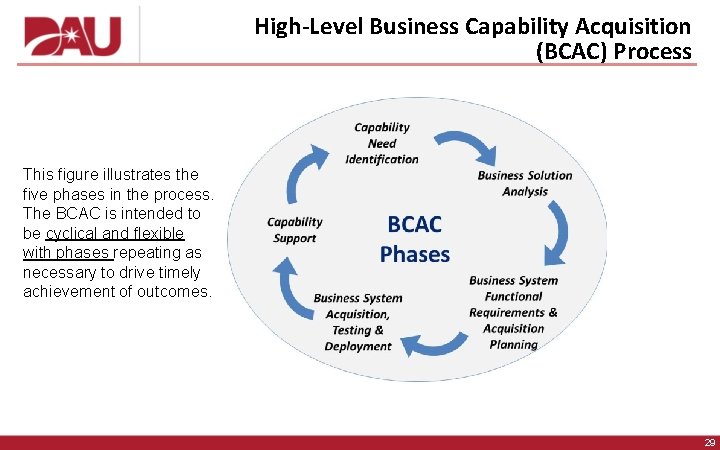
High-Level Business Capability Acquisition (BCAC) Process This figure illustrates the five phases in the process. The BCAC is intended to be cyclical and flexible with phases repeating as necessary to drive timely achievement of outcomes. 29
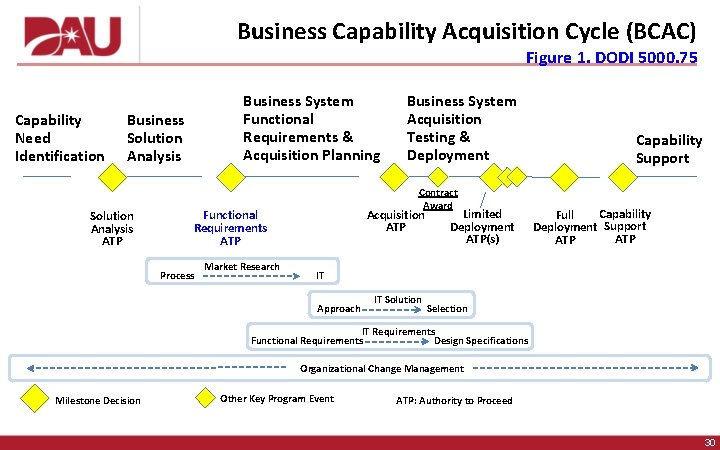
Business Capability Acquisition Cycle (BCAC) Figure 1. DODI 5000. 75 Capability Need Identification Business System Functional Requirements & Acquisition Planning Business Solution Analysis ATP Contract Award Acquisition ATP Functional Requirements ATP Process Market Research Business System Acquisition Testing & Deployment Limited Deployment ATP(s) Capability Support Capability Full Deployment Support ATP IT Approach IT Solution Selection IT Requirements Functional Requirements Design Specifications Organizational Change Management Milestone Decision Other Key Program Event ATP: Authority to Proceed See notes page for additional information 30
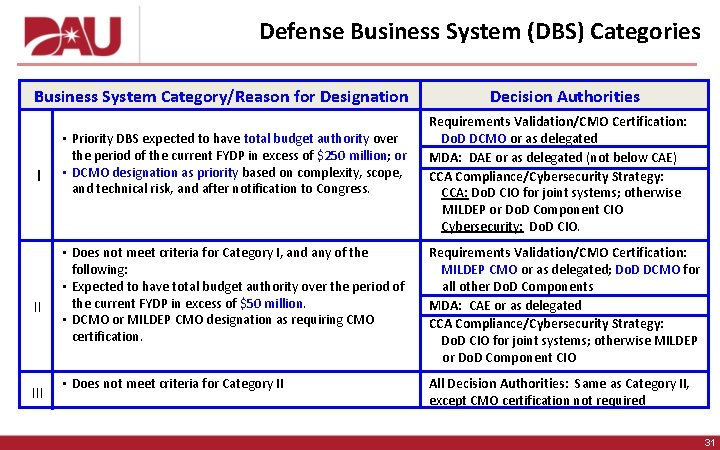
Defense Business System (DBS) Categories Business System Category/Reason for Designation I II III • Priority DBS expected to have total budget authority over the period of the current FYDP in excess of $250 million; or • DCMO designation as priority based on complexity, scope, and technical risk, and after notification to Congress. Decision Authorities Requirements Validation/CMO Certification: Do. D DCMO or as delegated MDA: DAE or as delegated (not below CAE) CCA Compliance/Cybersecurity Strategy: CCA: Do. D CIO for joint systems; otherwise MILDEP or Do. D Component CIO Cybersecurity: Do. D CIO. • Does not meet criteria for Category I, and any of the following: • Expected to have total budget authority over the period of the current FYDP in excess of $50 million. • DCMO or MILDEP CMO designation as requiring CMO certification. Requirements Validation/CMO Certification: MILDEP CMO or as delegated; Do. D DCMO for all other Do. D Components MDA: CAE or as delegated CCA Compliance/Cybersecurity Strategy: Do. D CIO for joint systems; otherwise MILDEP or Do. D Component CIO • Does not meet criteria for Category II All Decision Authorities: Same as Category II, except CMO certification not required See notes page for additional information 31
- Slides: 31