
Information Systems for Value Driven Business LEARNING OBJECTIVES
Information Systems for Value Driven Business
LEARNING OBJECTIVES How business make profit (Value Chain) How IS create added value How business make decision (Organizational Pyramid) How IS help in decision making process

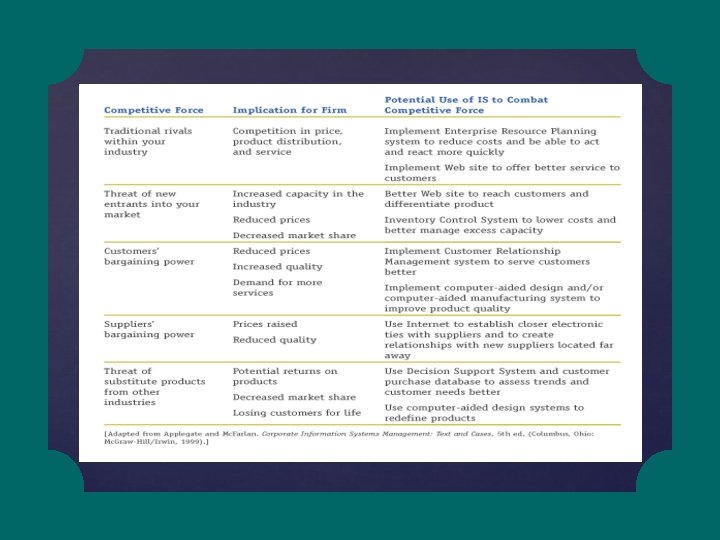
Value Chain & Five Forces Model Revisited

How Business Survive/Make Profit: Value Chain Model VALUE FIRM INFRASTRUCTURE HUMAN RESOURCE MANAGEMENT TECHNOLOGY DEVELOPMENT PROCUREMENT INBOUND LOGISTICS OPERATIONS OUTBOUND LOGISTIC COST MARKETING & SALES LOGISTIC SERVICE MARGIN
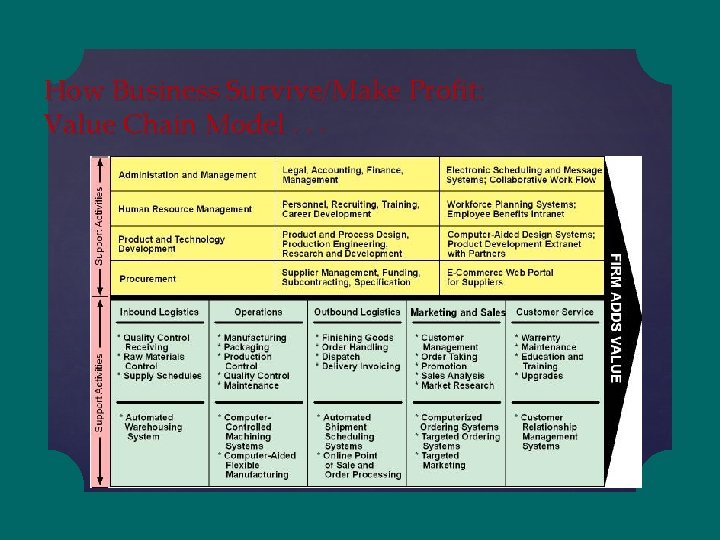
How Business Survive/Make Profit: Value Chain Model. . .
Value-Added Activities Customer-Value-Added Activity (maximize) a business process that a customer is willing to pay for (utility) Business-Value-Added Activity (minimize) a business process that is essential to managing an organization (costs) Non-Value-Added Activity (eliminate) customer will not pay for; business value will not be increased (waste) Goals of a business system: effective(do right thing), efficient(do thing right), competitive (do thing differently).
How Information Systems Add Values ? Automating: doing things faster/cheaper Organizational Learning: doing things better way (from lessons learned) Supporting Strategy: doing things smarter than competitors to meet customer’s needs. Contribute to Value Added Activities in Value Chain
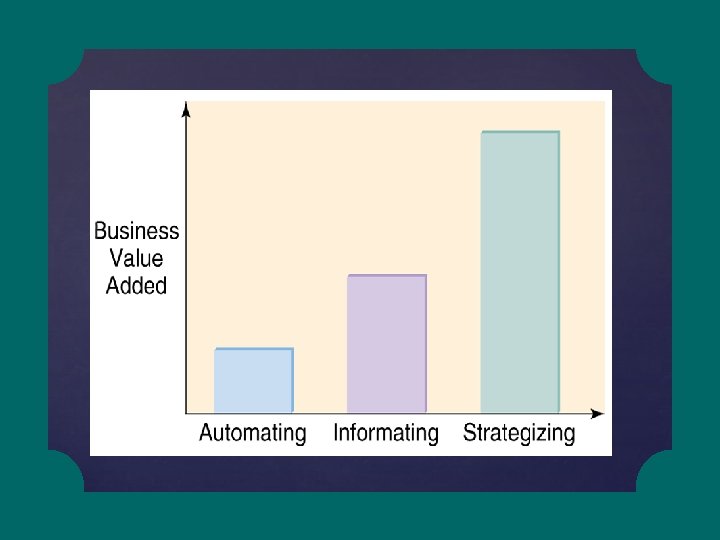
What IT/IS can do IT/IS improves or innovates the use of knowledge in operations of the value chain and value system IT/IS improves products or services by increasing quality, reducing costs, or adding desirable features IT/IS provides timely and reliable information to enhance the decision-making process IT/IS improves communication between internal as well as external business entities to increase efficiency in production and distribution
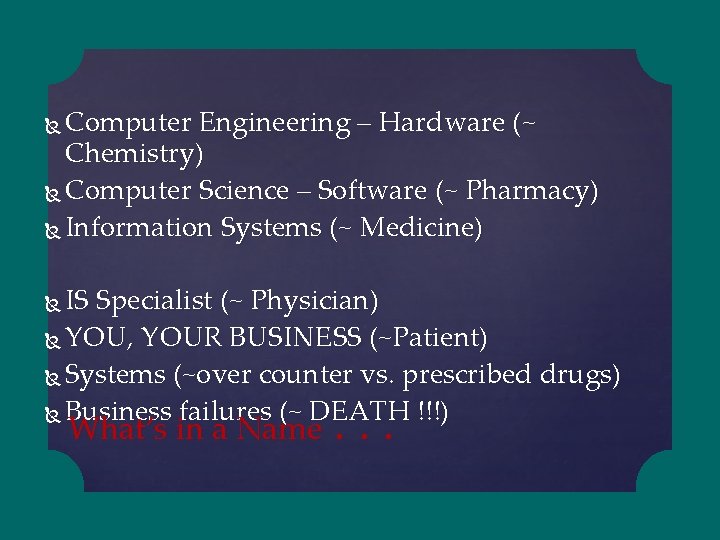
Computer Engineering – Hardware (~ Chemistry) Computer Science – Software (~ Pharmacy) Information Systems (~ Medicine) IS Specialist (~ Physician) YOU, YOUR BUSINESS (~Patient) Systems (~over counter vs. prescribed drugs) Business failures (~ DEATH !!!) What’s in a Name . . .
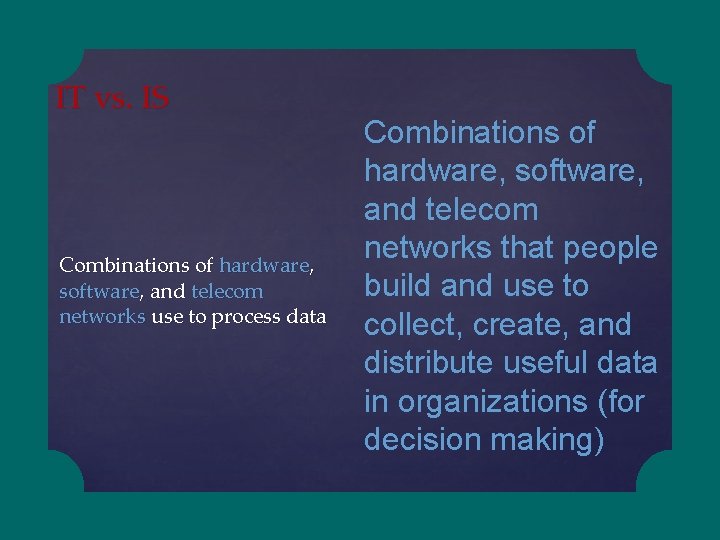
IT vs. IS Combinations of hardware, software, and telecom networks use to process data Combinations of hardware, software, and telecom networks that people build and use to collect, create, and distribute useful data in organizations (for decision making)
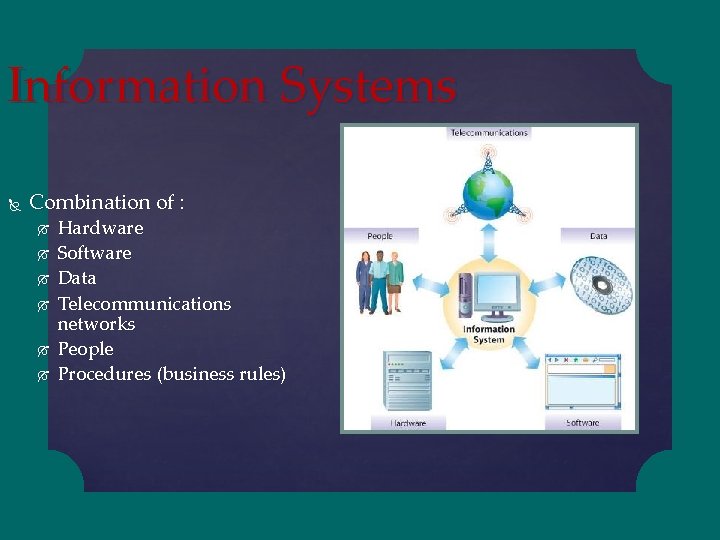
Information Systems Combination of : Hardware Software Data Telecommunications networks People Procedures (business rules)
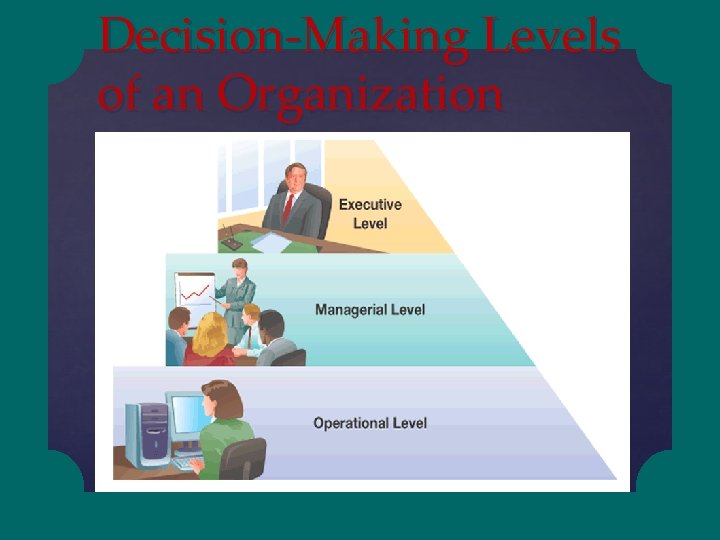
Decision-Making Levels of an Organization
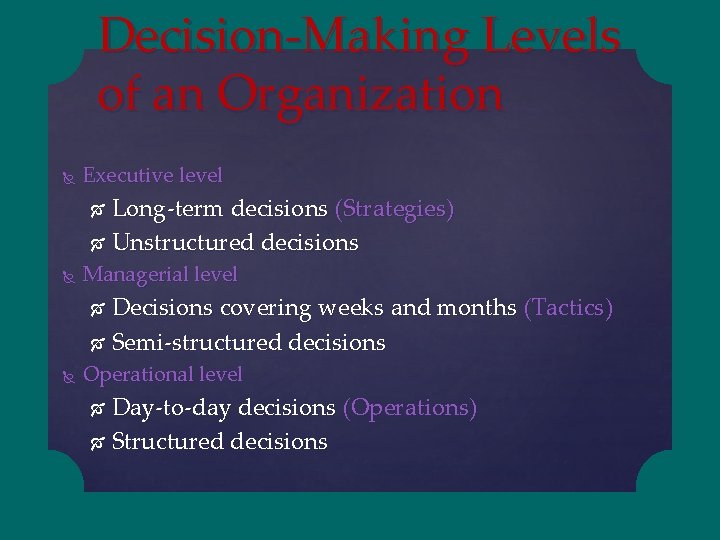
Decision-Making Levels of an Organization Executive level Long-term decisions (Strategies) Unstructured decisions Managerial level Decisions covering weeks and months (Tactics) Semi-structured decisions Operational level Day-to-day decisions (Operations) Structured decisions
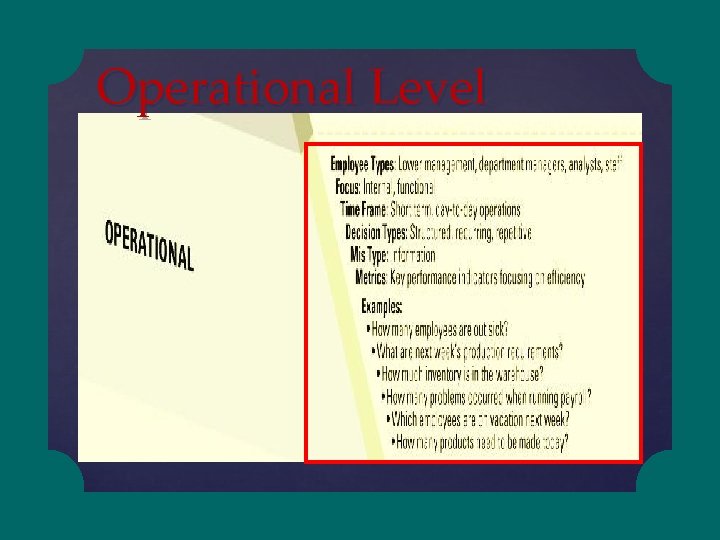
Operational Level
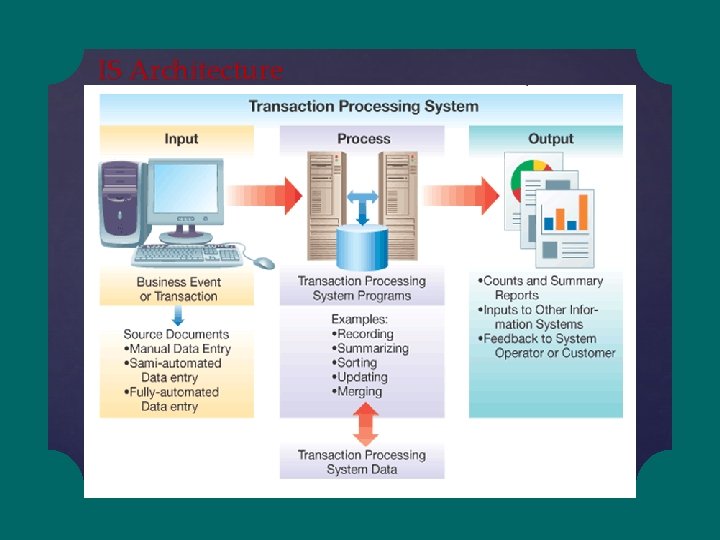
IS Architecture
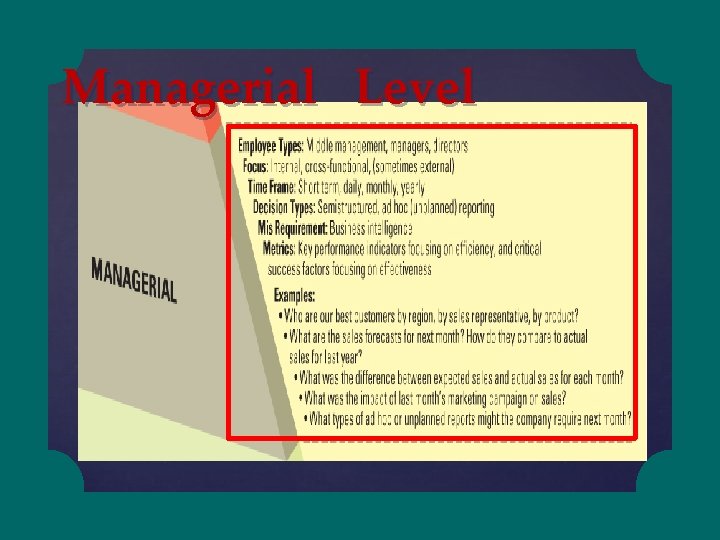
Managerial Level
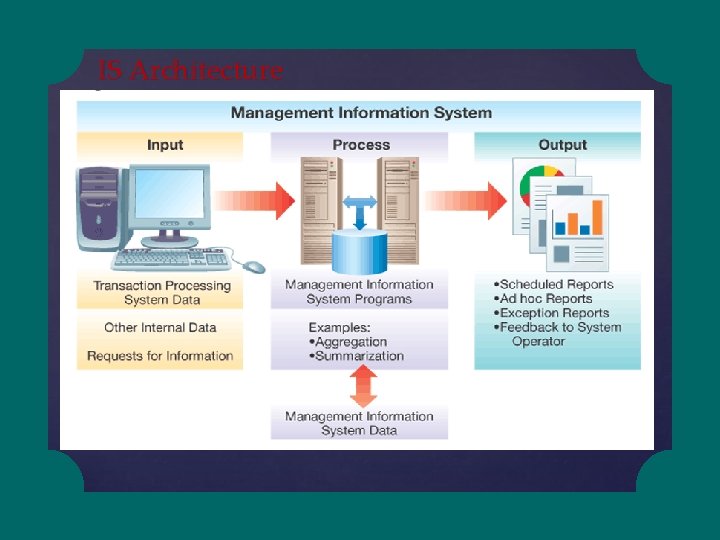
IS Architecture
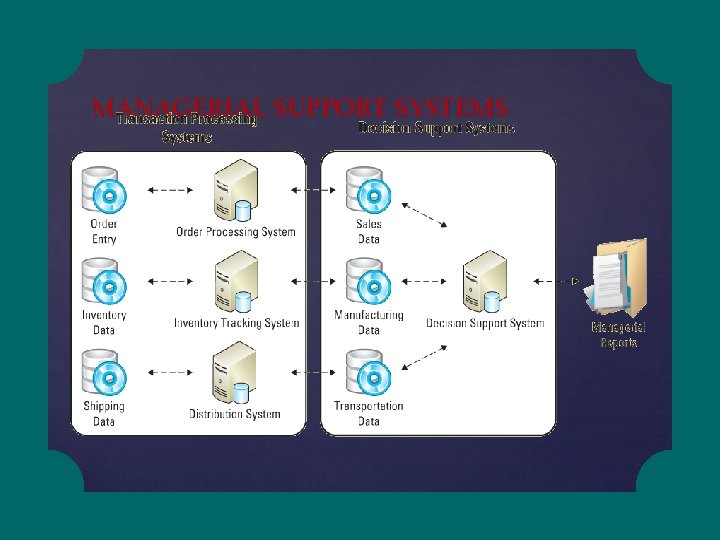
MANAGERIAL SUPPORT SYSTEMS
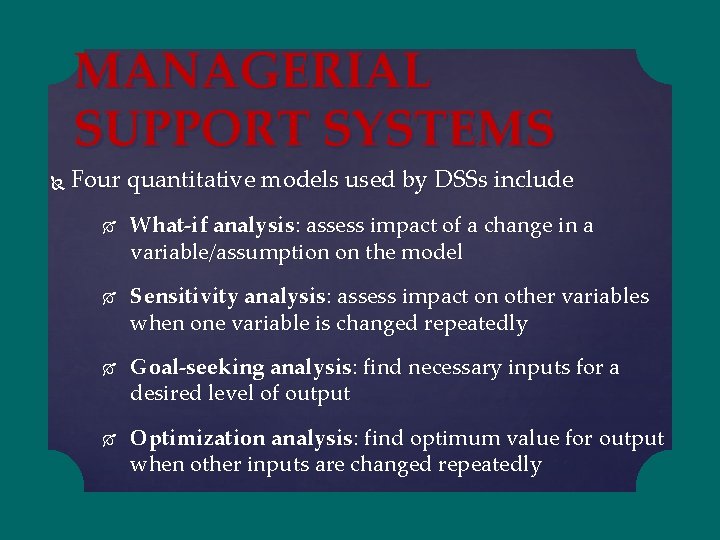
MANAGERIAL SUPPORT SYSTEMS Four quantitative models used by DSSs include What-if analysis: assess impact of a change in a variable/assumption on the model Sensitivity analysis: assess impact on other variables when one variable is changed repeatedly Goal-seeking analysis: find necessary inputs for a desired level of output Optimization analysis: find optimum value for output when other inputs are changed repeatedly
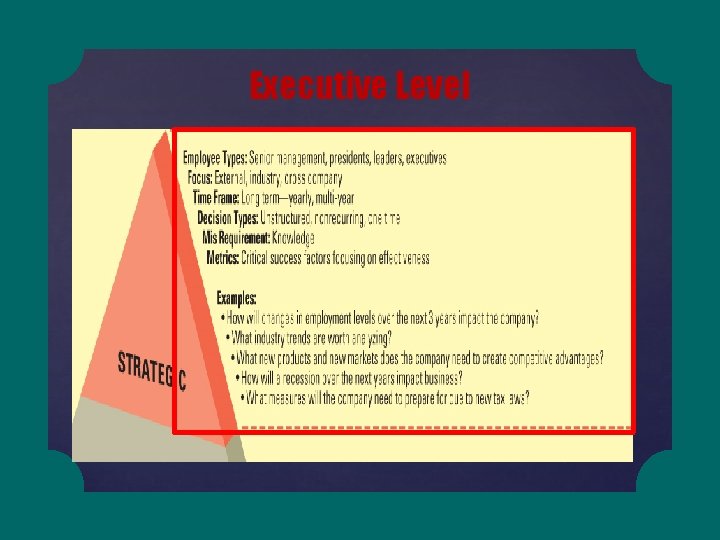
Executive Level
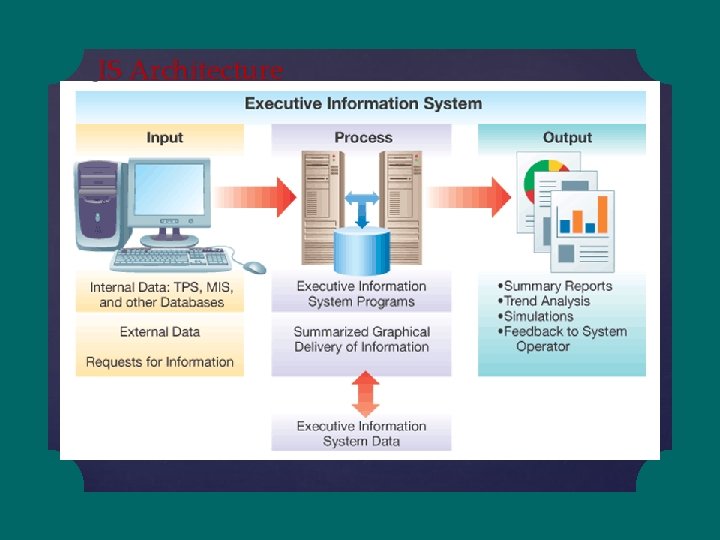
IS Architecture
STRATEGIC SUPPORT SYSTEMS Executive information system (EIS) – A specialized DSS that supports senior level executives within the organization Granularity: level of details in the model/process Visualization: graphical display of patterns/relationships of large amount of data Digital dashboard: visual summary for tracking critical success factors and key performance indicators
STRATEGIC SUPPORT SYSTEMS Most EISs offering the following capabilities Consolidation: aggregation of data Drill-down: ability to view details of data at different levels of aggregation Slice-and-dice: ability to look at information at different perspectives.
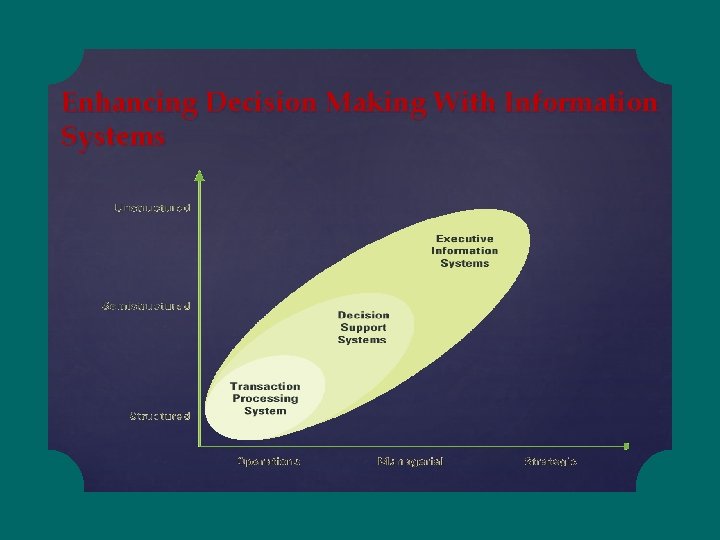
Enhancing Decision Making With Information Systems
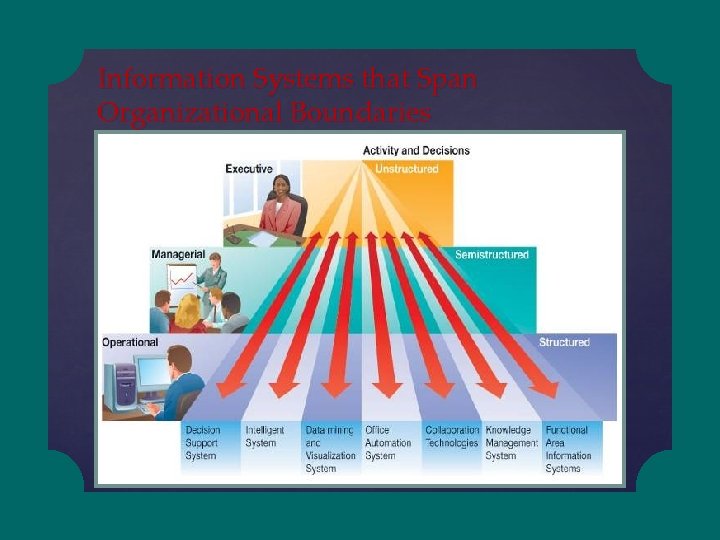
Information Systems that Span Organizational Boundaries
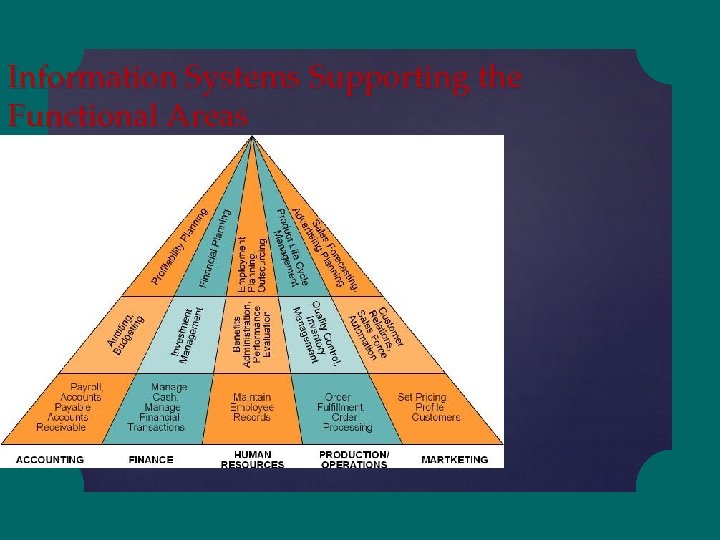
Information Systems Supporting the Functional Areas
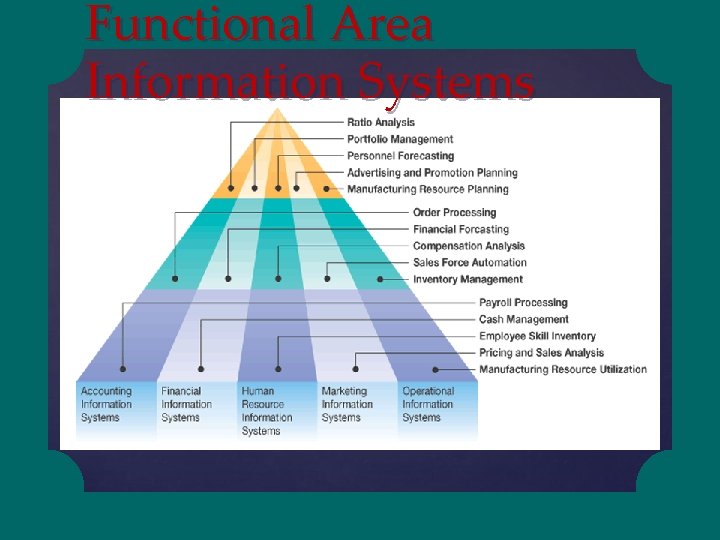
Functional Area Information Systems
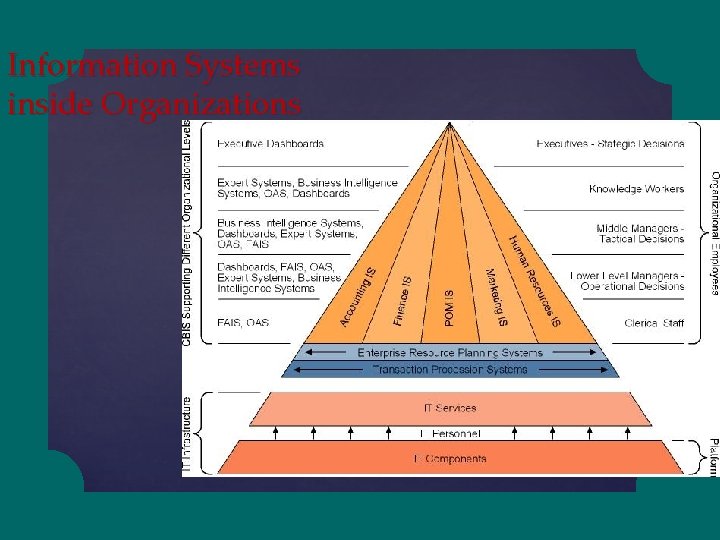
Information Systems inside Organizations
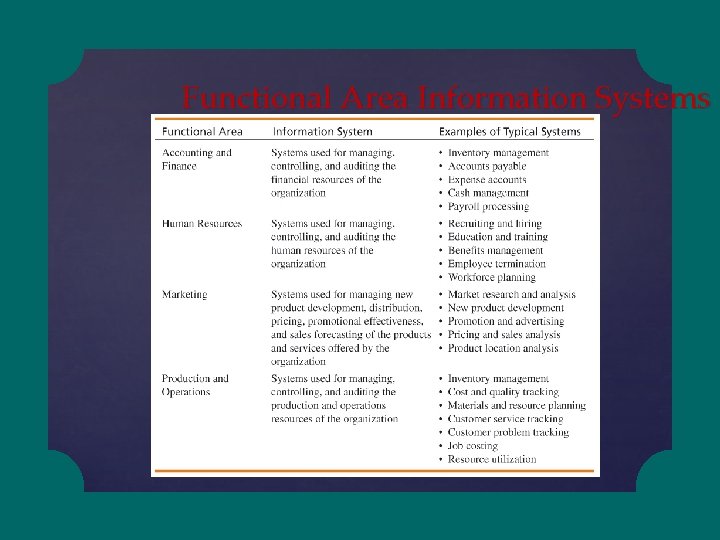
Functional Area Information Systems
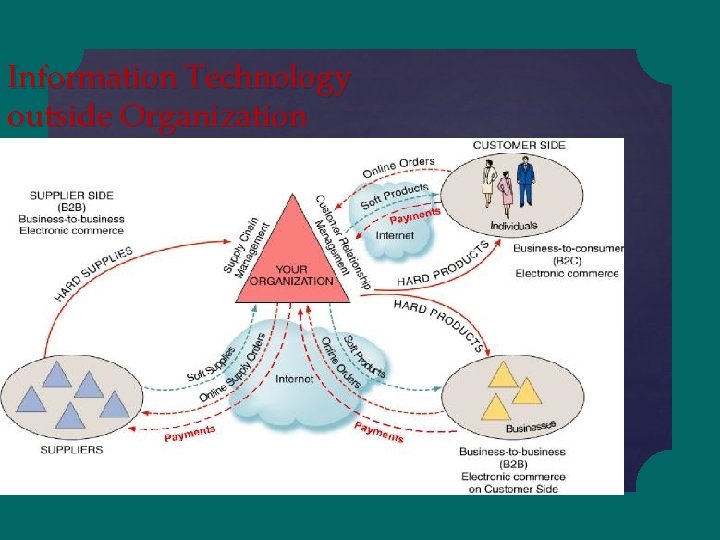
Information Technology outside Organization
Capabilities of Information Systems Perform high-speed, high-volume numerical computations Provide fast, accurate communication and collaboration within and among organizations Store huge amounts of information in small space Allow quick, inexpensive access to vast amounts of information worldwide Interpret vast amounts of data quickly and efficiently Increase effectiveness and efficiency of people working in groups in one place or around the world Automate semiautomatic business process and manual tasks
Why Information Systems Important to Organizations & Society ? IT will reduce the number of middle managers. IT will change the manager’s job. IT impacts employees at work. IT provides quality-of-life improvements.
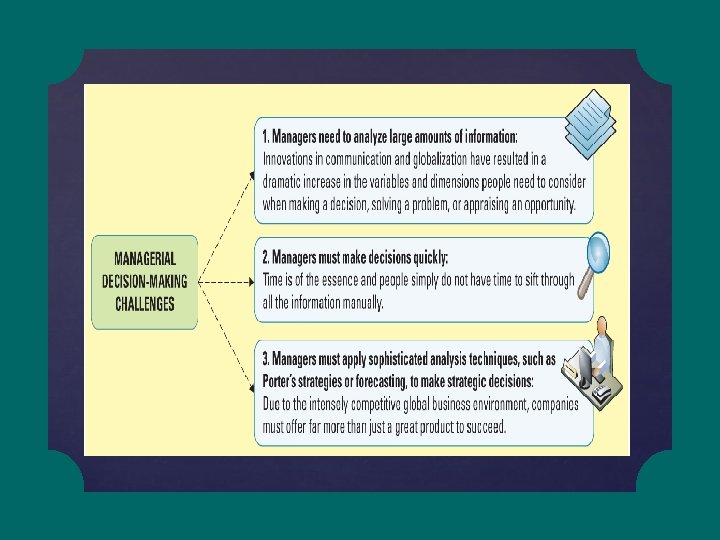
MAKING BUSINESS DECISIONS Managerial decision-making challenges Analyze large amounts of information Apply sophisticated analysis techniques Make decisions quickly
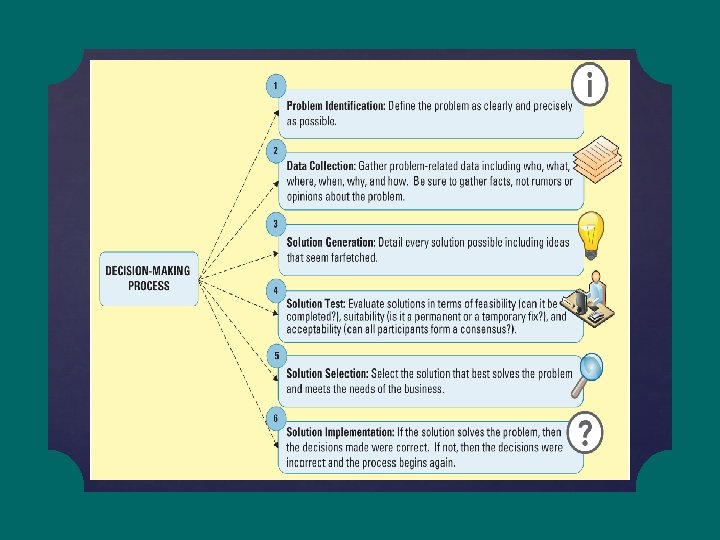
DECISION-MAKING PROCESS The six-step decision-making process 1. Problem identification 2. Data collection 3. Solution generation 4. Solution test 5. Solution selection 6. Solution implementation
METRICS: MEASURING SUCCESS Critical success factors (CSFs) – The crucial steps companies make to perform to achieve their goals and objectives and implement strategies Create high-quality products Retain competitive advantages Reduce product costs Increase customer satisfaction Hire and retain the best professionals
METRICS: MEASURING SUCCESS Key performance indicators (KPIs) – . . . The quantifiable metrics a company uses to evaluate progress toward critical success factors Turnover rates of employees Number of product returns Number of new customers Average customer spending External (e. g. , market share) vs. Internal KPI (e. g. , ROI)
Efficiency and Effectiveness Metrics Efficiency MIS metrics – Measure the performance of MIS itself, such as throughput, transaction speed, and system availability Effectiveness MIS metrics – Measures the impact MIS has on business processes and activities, including customer satisfaction and customer conversation rates
The Interrelationship Between Efficiency And Effectiveness Metrics Benchmark – Baseline values the system seeks to attain Benchmarking – A process of continuously measuring system results, comparing those results to optimal system performance (benchmark values), and identifying steps and procedures to improve system performance
SUPPORT: ENHANCING DECISION MAKING WITH IS Model – A simplified representation or abstraction of reality that helps managers to Calculate risks Understand uncertainty Change variables Manipulate time to make decisions
THE FUTURE: ARTIFICIAL INTELLIGENCE (AI) Artificial intelligence (AI) – Simulates human intelligence such as the ability to reason and learn Intelligent system – Various commercial applications of artificial intelligence
ARTIFICIAL INTELLIGENCE (AI) 1. Expert system – Computerized advisory programs that imitate the reasoning processes of experts in solving difficult problems 2. Neural Network – Attempts to emulate the way the human brain works – Fuzzy logic – A mathematical method of handling imprecise or subjective information
ARTIFICIAL INTELLIGENCE (AI) 3. Genetic algorithm – An artificial intelligent system that mimics the evolutionary, survival-of-the-fittest process to generate increasingly better solutions to a problem - Shopping bot – Software that will search several retailer websites and provide a comparison of each retailer’s offerings including price and availability
ARTIFICIAL INTELLIGENCE (AI) 4. Intelligent agent – Special-purpose knowledge-based information system that accomplishes specific tasks on behalf of its users 5. Virtual reality - A computer-simulated environment that can be a simulation of the real world or an imaginary world
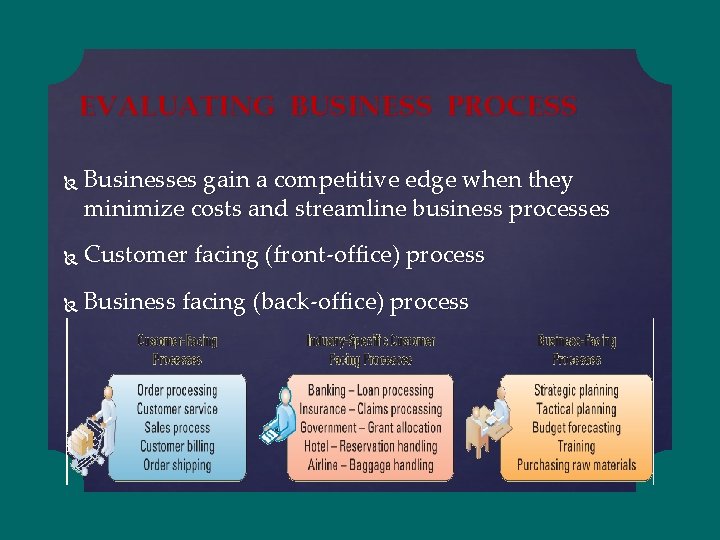
EVALUATING BUSINESS PROCESS Businesses gain a competitive edge when they minimize costs and streamline business processes Customer facing (front-office) process Business facing (back-office) process
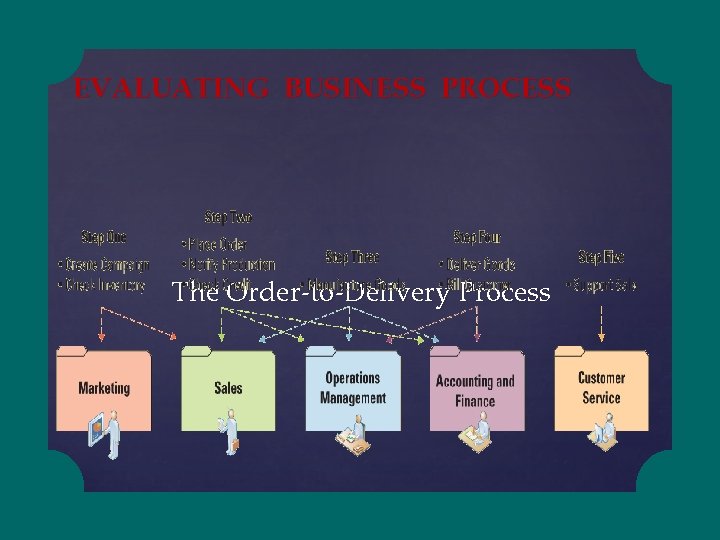
EVALUATING BUSINESS PROCESS The Order-to-Delivery Process
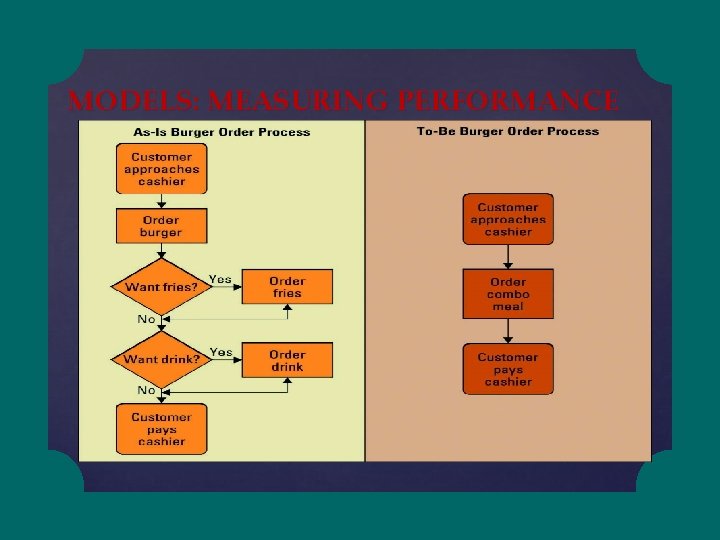
MODELS: MEASURING PERFORMANCE Workflow – Includes the tasks, activities, and responsibilities required to execute each step in a business process Business process modeling (or mapping) - The activity of creating a detailed flow chart or process map of a work process showing its inputs, tasks, and activities, in a structured sequence Business process model - A graphic description of a process, showing the sequence of process tasks, which is developed for a specific “As-is” vs. “to-be” process model
MODELS: MEASURING PERFORMANCE
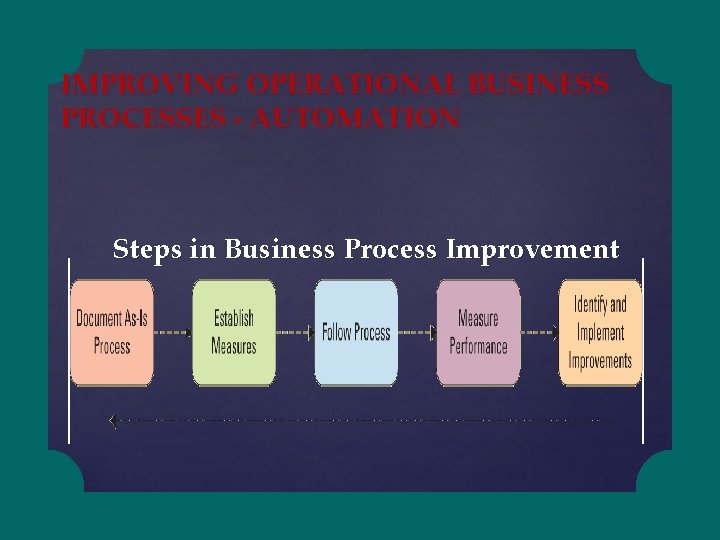
IMPROVING OPERATIONAL BUSINESS PROCESSES - AUTOMATION Steps in Business Process Improvement
IMPROVING OPERATIONAL BUSINESS PROCESSES - AUTOMATION Business process improvement – Attempts to understand measure the current process and make performance improvements accordingly Automation – The process of computerizing manual tasks
IMPROVING MANAGERIAL BUSINESS PROCESSES - STREAMLINING Streamlining – Improves business process efficiencies by simplifying or eliminating unnecessary steps Bottleneck – Occur when resources reach full capacity and cannot handle any additional demands Redundancy – Occurs when a task or activity is unnecessarily repeated
IMPROVING STRATEGIC BUSINESS PROCESSES - REENGINEERING Business process management (BPM) – Focuses on evaluating and improving processes that include both person-to-person workflow and system-to-system communications Business process reengineering (BPR) Analysis and redesign of workflow within and between enterprises

THANKYOU
- Slides: 56