
Information Systems for Human Resources Management Objectives Examine
Information Systems for Human Resources Management
Objectives • Examine the HR processes supported by ERP • Understand the interrelationships among business processes supporting human resource management
Human Resources Problems • • Maintaining accurate employee information Job analysis and design Applicant selection Compensation Benefit administration Training Governmental reporting
Evolution of HR Systems • Traditionally relied upon stand-alone systems – Specialized applications for applicant tracking, compensation, benefits, attendance • – • Redundant data No link to financial systems ERP – – Linked to financial systems “Best practices”
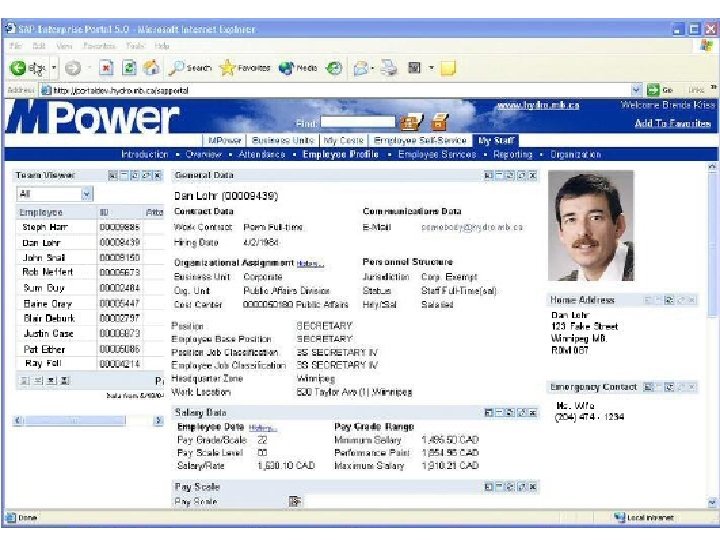
ERP HR Modules • Components – HR Management • – Benefits administration • • – Links employee data to actual benefits Allows selection from group of benefits Payroll • – – Personnel records Paychecks, tax reports, accounting data Time and labor management Employee/Manager self service • • • Travel reimbursement Personnel data and benefits changes Training
HR Modules • Attributes – – – – Integration Common database Scalable and flexible Drill-down capability Workflow management for electronic routing of documents and other document management Process standardization Security User friendly and web-accessible
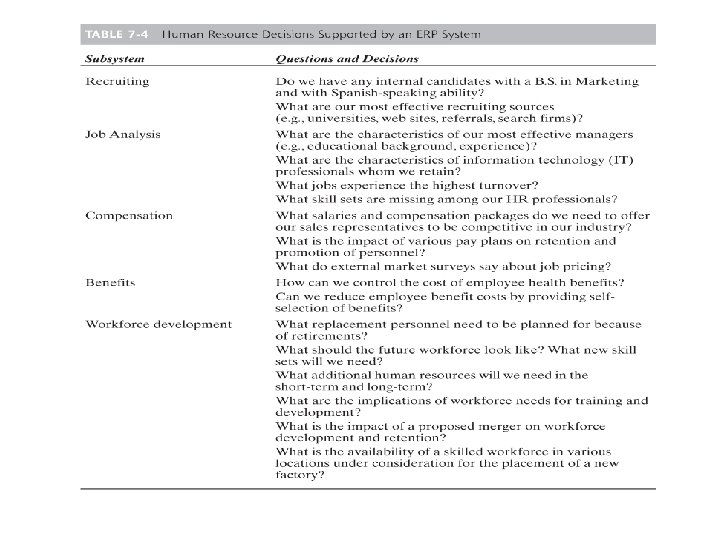
Management Control Modules • HR information enables management of diverse workforce • Supports managerial decision making through query and reporting tools • Operational level controls – – Maintain and update employee files Job analysis files Design files Regulatory files • Strategic level controls – For tracking employees – Labor/management relationships – Business intelligence tools for predicting trends • Module integration is significant benefit

Keep Track of Your Employees • What are the benefits of automated time and attendance records? • What advantages might accrue to employees using these systems?
Keep Track of Your Employees • Employees’ attendance, time at work, and skill levels – – Most companies uncertain If tracked, usually manual Records usually neglected Often piece-meal, no end-to-end solution • Benefits of automating – Eliminates manual process • • Time-consuming Error-prone Better analysis More control
Keep Track of Your Employees • Time- and labor-management • Accessible from web, phone, badge terminals • Information available in real-time – Allows for quick staffing adjustments • Financial benefits to employees, company • People. Soft payroll processing • Web-based employee-relationship management software – Optimized scheduling and tracking of employees – Interfaces with People. Soft applications
Role Of Human Resource Information Systems q Focus on the value of information and its delivery to the primary customer , the line manager q Leverage the web based technologies to optimize the collection, dissemination and processing of HR information q Use Technology to maximize outsourcing opportunities q Help employees manage their own careers and be comfortable in their workplace environment. q Focus on building employee relations by adopting an ‘Internet culture’ q Drive the transformation of an HR organization from an administrative to a strategic management focus
IS for recruitment and selection q a collaborative approach provided by information systems links everyone involved in the hiring and staffing decisions q since hiring is a very costly and time consuming activity, information systems provides the functionality of cumulating job postings by various departments and conducting the recruitment process together q this results in reduction in the hiring time and reduction in costs
Role of IS for Recruitment and Selection q. Resume scanning applications - resumes are submitted via-e-mail or the web or are scanned from hard copies( paper) - the system can be constantly updated to rank candidates with regard to all available positions within the company q. Manage the interview process - manage the interview process, schedule dates and times, prompt interviewers - the results of the interviews are captured, compiled, and distributed to all the respective departments q On-line testing - initial interviewing and assessment
Advantages of IS for Recruitment and Selection q Better talent management q Better quality candidates – faster q Enhanced brand recognition as a candidate-focused organization q Improved processes emphasizing best practices q Optimization of staffing resources - Increased employee retention
IS for Training and Development • • • Extend learning beyond the enterprise—to customers, suppliers, and partners, as well as employees Assign and automate learning in order to develop the workforce—retain knowledge and eliminate skill gaps Improve workforce effectiveness by delivering the right learning at the right time Reducing learning costs by automating and streamlining learning processes Delivering targeted, personalized learning to employees to build a more knowledgeable and effective workforce Synchronizing learning strategies with business strategies to maximize results, analyzing learning effectiveness, and accurately measuring the ROI of learning programmes
Employee Relationship Management Through IS q HR professionals are adopting a one-on-one approach to the employee-employer relationship q Employee self-service is an important component of the e-HR equation, because it frees up HR to play a more strategic role in the organization. q. ERM efforts often will entail re-skilling or even redeploying HR professionals q ERM should enable the flow of programs and policies in a seamless manner to the employees for best results

The ERM Model
IS for Performance Management • Streamline performance management • Replace highly inefficient, disparate processes with one integrated selfservice process • Increase employee success. • Improve talent management. • Facilitate organizational change. • Improve feedback to employees.
Need for Performance Management Systems • Collaboratively plan performance, behaviors, and competencies • Link strategic enterprise objectives to employee performance results and goals • Track performance progress throughout the performance period • Complete assessments for results, behaviors and competencies • Leverage pre-integrated performance and competency content • Track performance review deliverables with alerts and reports • Identify top performers and those needing performance improvement
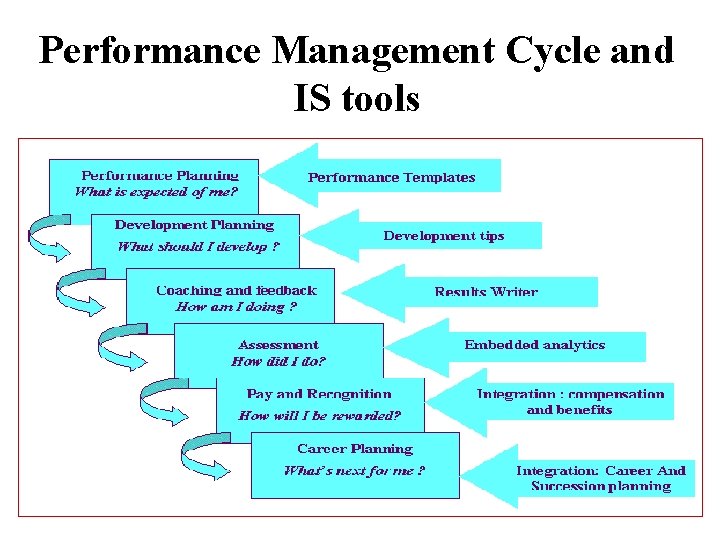
Performance Management Cycle and IS tools
Summary • ERP systems include HR modules that offer records management, benefits administration, and payroll – Offer integrated operational and strategic level controls – Scalable and very flexible
- Slides: 23