
INFORMATION SYSTEM CONCEPTS Education Management Information Systems Objective
INFORMATION SYSTEM CONCEPTS Education Management Information Systems
Objective: Understand types of information systems Introduce IS in Education 2
Types of IS in Organizations By organisational level By function within organisational level Examples in functional areas 3
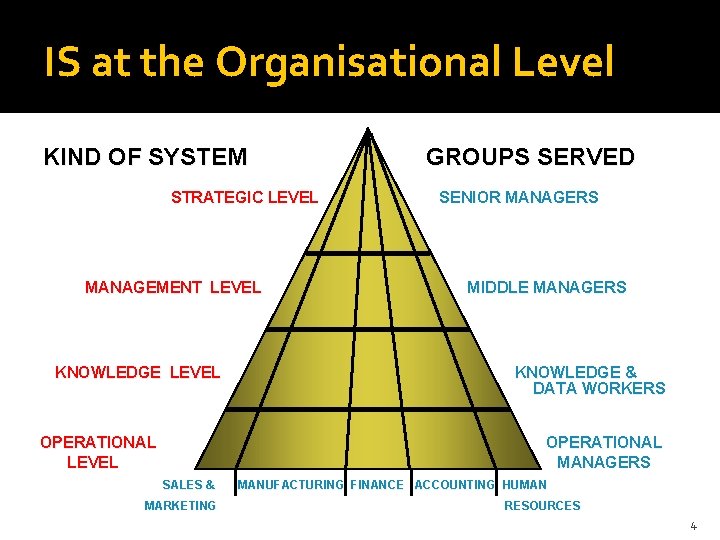
IS at the Organisational Level KIND OF SYSTEM STRATEGIC LEVEL MANAGEMENT LEVEL KNOWLEDGE LEVEL OPERATIONAL LEVEL GROUPS SERVED SENIOR MANAGERS MIDDLE MANAGERS KNOWLEDGE & DATA WORKERS OPERATIONAL MANAGERS SALES & MARKETING MANUFACTURING FINANCE ACCOUNTING HUMAN RESOURCES 4
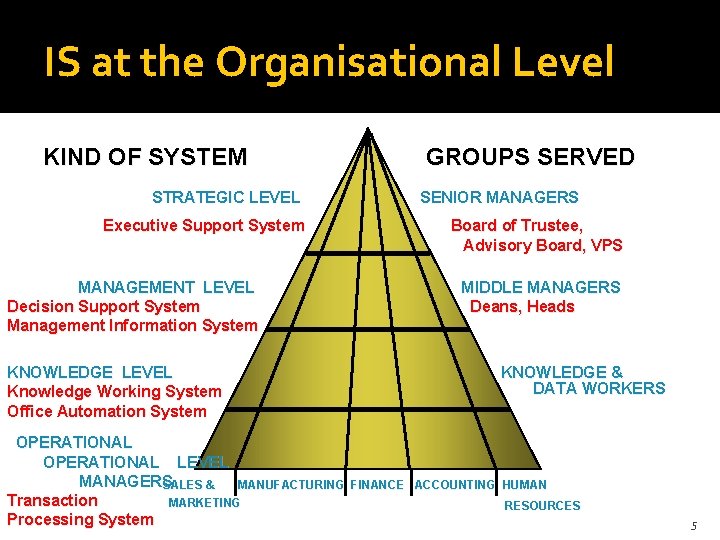
IS at the Organisational Level KIND OF SYSTEM STRATEGIC LEVEL Executive Support System MANAGEMENT LEVEL Decision Support System Management Information System KNOWLEDGE LEVEL Knowledge Working System Office Automation System OPERATIONAL LEVEL MANAGERS SALES & MANUFACTURING Transaction MARKETING Processing System GROUPS SERVED SENIOR MANAGERS Board of Trustee, Advisory Board, VPS MIDDLE MANAGERS Deans, Heads KNOWLEDGE & DATA WORKERS FINANCE ACCOUNTING HUMAN RESOURCES 5
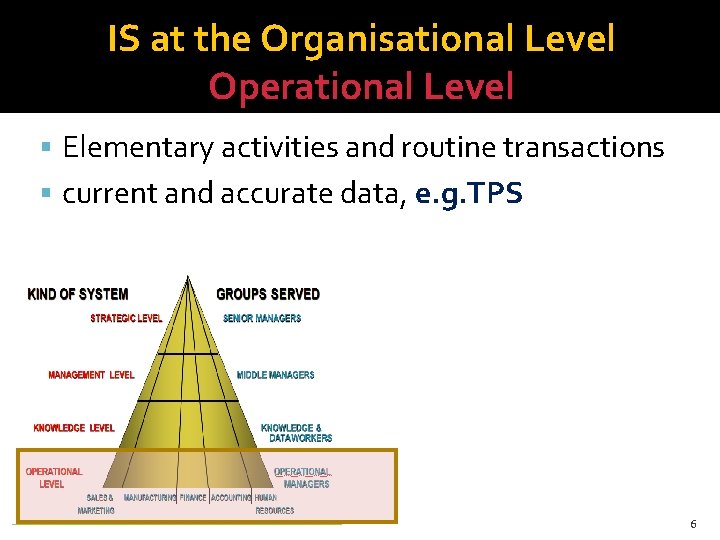
IS at the Organisational Level Operational Level Elementary activities and routine transactions current and accurate data, e. g. TPS 6
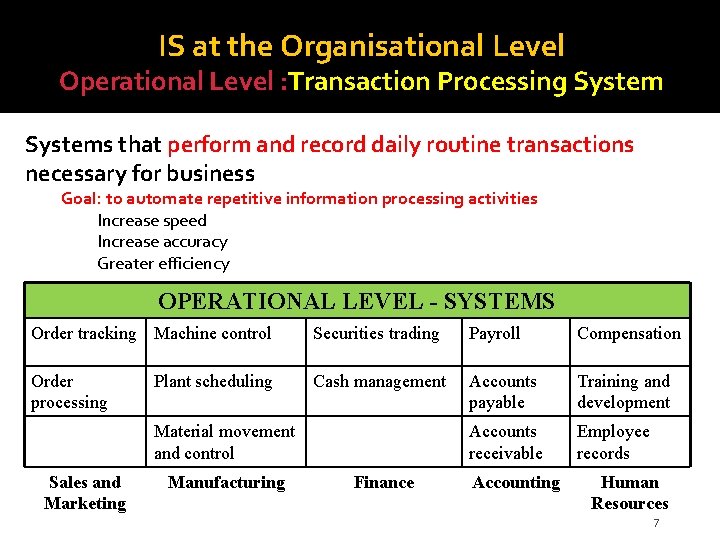
IS at the Organisational Level Operational Level : Transaction Processing Systems that perform and record daily routine transactions necessary for business Goal: to automate repetitive information processing activities Increase speed Increase accuracy Greater efficiency OPERATIONAL LEVEL - SYSTEMS Order tracking Machine control Securities trading Payroll Compensation Order processing Cash management Accounts payable Training and development Accounts receivable Employee records Plant scheduling Material movement and control Sales and Marketing Manufacturing Finance Accounting Human Resources 7
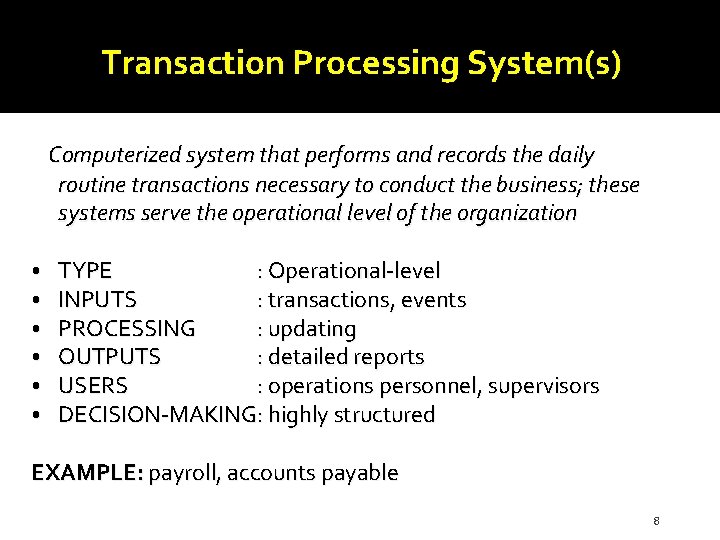
Transaction Processing System(s) Computerized system that performs and records the daily routine transactions necessary to conduct the business; these systems serve the operational level of the organization • • • TYPE : Operational-level INPUTS : transactions, events PROCESSING : updating OUTPUTS : detailed reports USERS : operations personnel, supervisors DECISION-MAKING: highly structured EXAMPLE: payroll, accounts payable 8
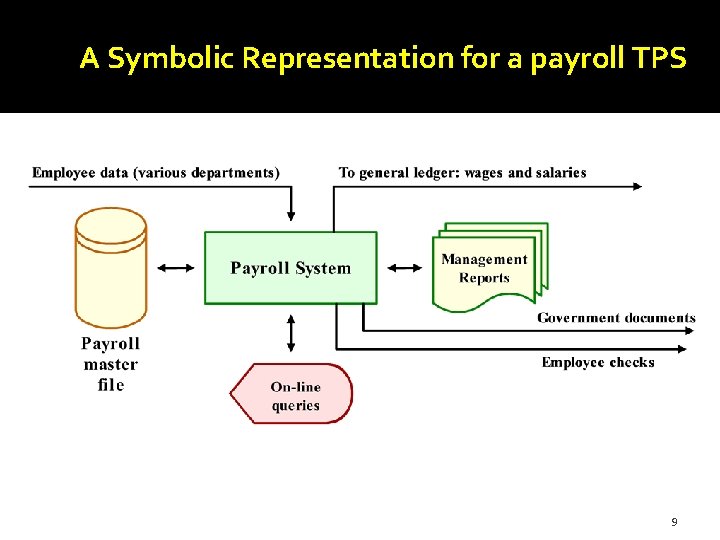
A Symbolic Representation for a payroll TPS 9
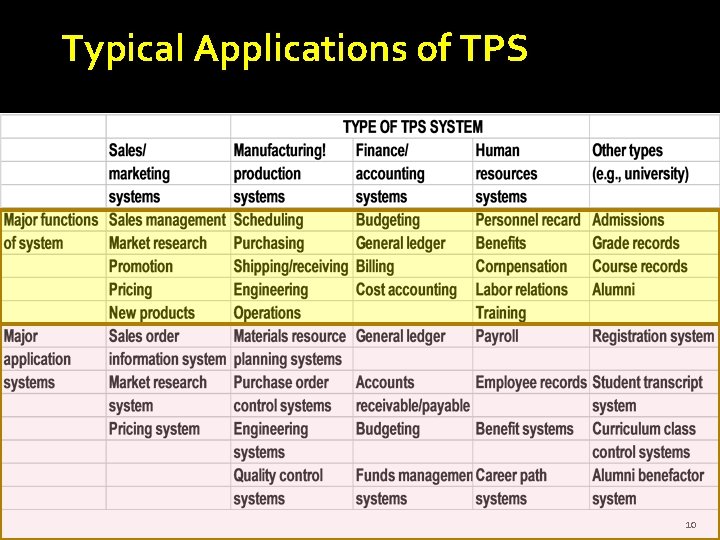
Typical Applications of TPS 10
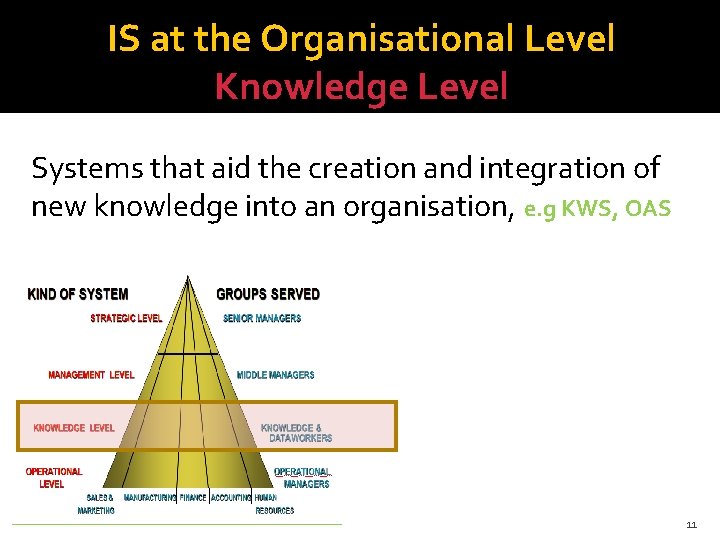
IS at the Organisational Level Knowledge Level Systems that aid the creation and integration of new knowledge into an organisation, e. g KWS, OAS 11

Knowledge Work Systems that aid the creation and integration of new knowledge into an organisation KNOWLEDEGE –LEVEL SYSTEMS Engineering workstations Graphics workstations Managerial workstations 12
Knowledge Work System(s) Information system that aids knowledge workers in the creation and integration of new knowledge in the organization. • TYPE: Knowledge-level • INPUTS: design specifications • PROCESSING: modelling • OUTPUTS: designs, graphics • USERS: technical staff; professionals EXAMPLE: Engineering workstations 13
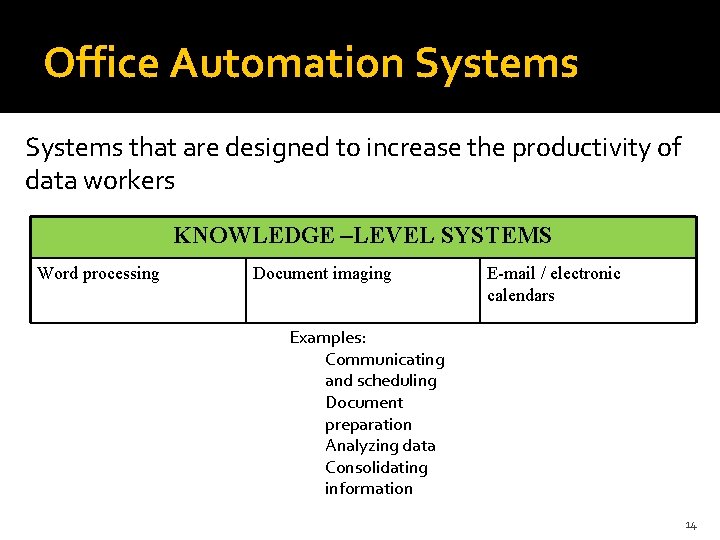
Office Automation Systems that are designed to increase the productivity of data workers KNOWLEDGE –LEVEL SYSTEMS Word processing Document imaging E-mail / electronic calendars Examples: Communicating and scheduling Document preparation Analyzing data Consolidating information 14
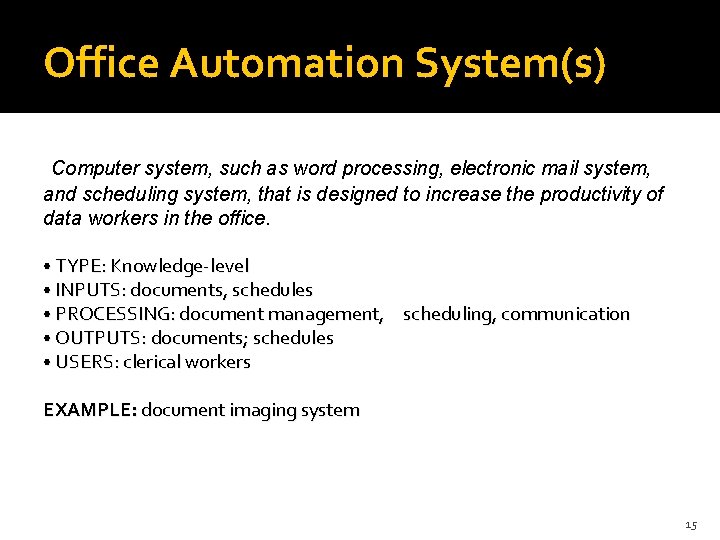
Office Automation System(s) Computer system, such as word processing, electronic mail system, and scheduling system, that is designed to increase the productivity of data workers in the office. • TYPE: Knowledge-level • INPUTS: documents, schedules • PROCESSING: document management, scheduling, communication • OUTPUTS: documents; schedules • USERS: clerical workers EXAMPLE: document imaging system 15
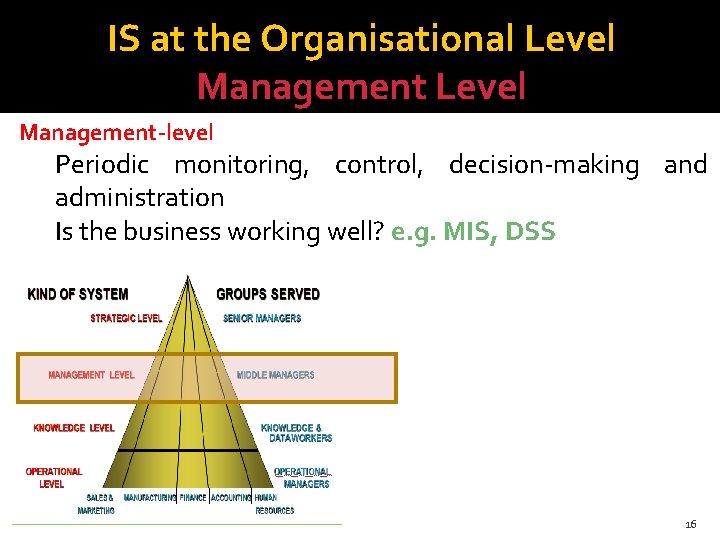
IS at the Organisational Level Management-level Periodic monitoring, control, decision-making and administration Is the business working well? e. g. MIS, DSS 16
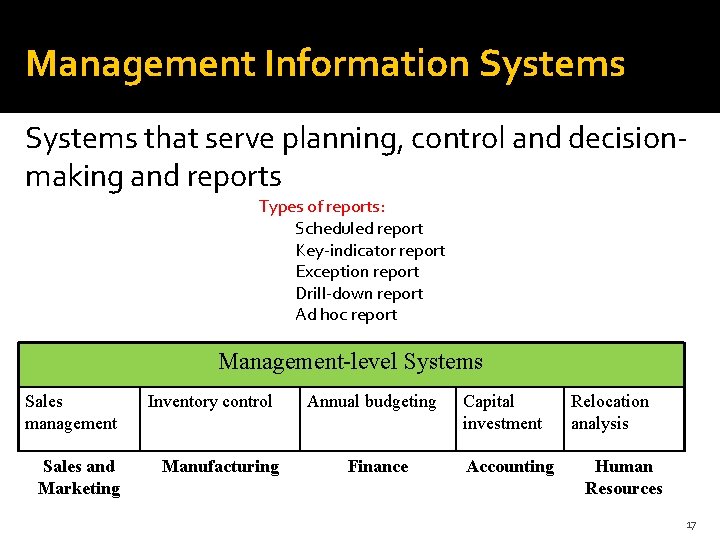
Management Information Systems that serve planning, control and decisionmaking and reports Types of reports: Scheduled report Key-indicator report Exception report Drill-down report Ad hoc report Management-level Systems Sales management Sales and Marketing Inventory control Manufacturing Annual budgeting Finance Capital investment Accounting Relocation analysis Human Resources 17
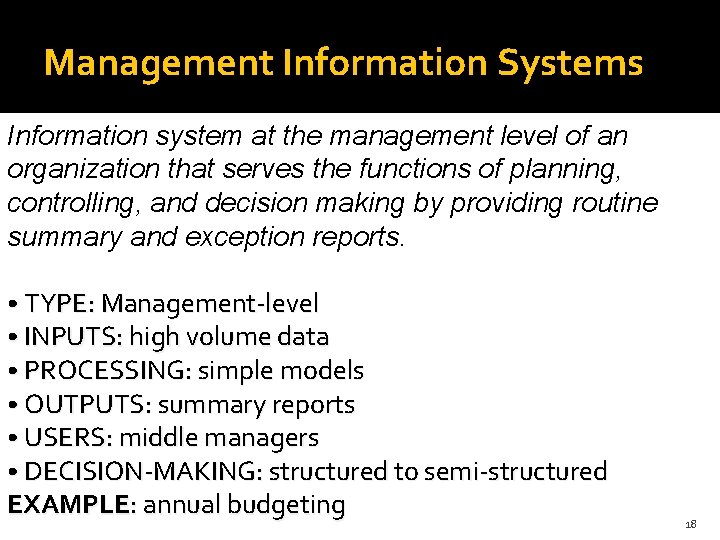
Management Information Systems Information system at the management level of an organization that serves the functions of planning, controlling, and decision making by providing routine summary and exception reports. • TYPE: Management-level • INPUTS: high volume data • PROCESSING: simple models • OUTPUTS: summary reports • USERS: middle managers • DECISION-MAKING: structured to semi-structured EXAMPLE: annual budgeting 18
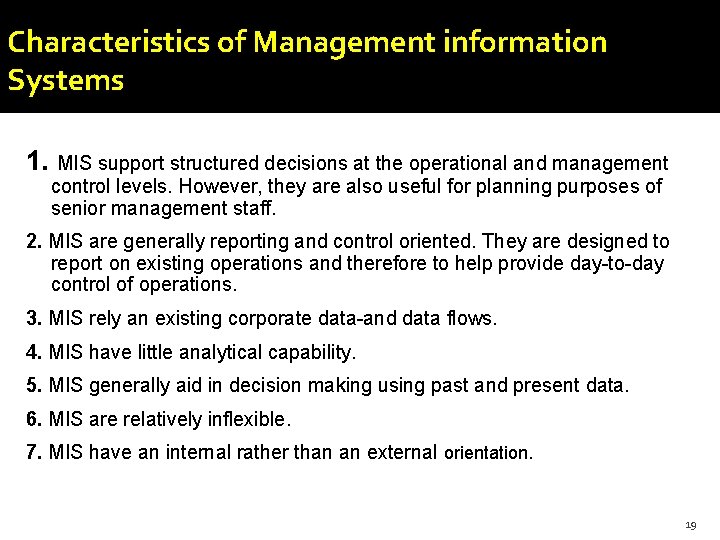
Characteristics of Management information Systems 1. MIS support structured decisions at the operational and management control levels. However, they are also useful for planning purposes of senior management staff. 2. MIS are generally reporting and control oriented. They are designed to report on existing operations and therefore to help provide day-to-day control of operations. 3. MIS rely an existing corporate data-and data flows. 4. MIS have little analytical capability. 5. MIS generally aid in decision making using past and present data. 6. MIS are relatively inflexible. 7. MIS have an internal rather than an external orientation. 19
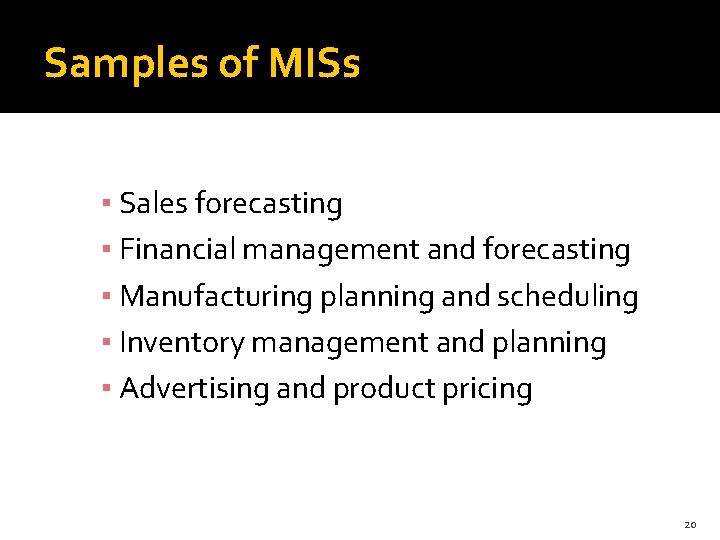
Samples of MISs ▪ Sales forecasting ▪ Financial management and forecasting ▪ Manufacturing planning and scheduling ▪ Inventory management and planning ▪ Advertising and product pricing 20
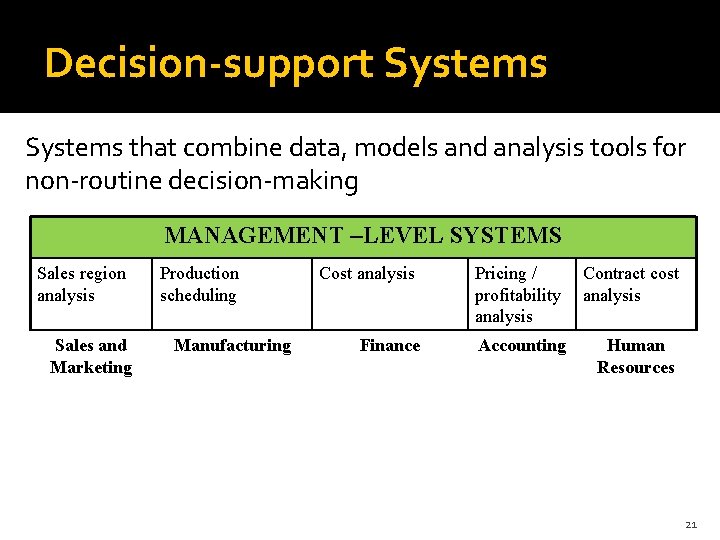
Decision-support Systems that combine data, models and analysis tools for non-routine decision-making MANAGEMENT –LEVEL SYSTEMS Sales region analysis Sales and Marketing Production scheduling Manufacturing Cost analysis Finance Pricing / profitability analysis Contract cost analysis Accounting Human Resources 21
Decision-support Systems Information system at the management level of an organization that combines data and sophisticated analytical models or data analysis tools to support semi-structured and unstructured decision making. • TYPE: Management-level • INPUTS: low volume data • PROCESSING: simulations, analysis • OUTPUTS: decision analysis • USERS: professionals, staff managers • DECISION-MAKING: semi-structured EXAMPLE: sales region analysis 22
Characteristics of Decision-Support Systems 1. DSS offer users flexibility, adaptability, and a quick response. 2. DSS operate with little or no assistance from professional programmers. 3. DSS provide support for decisions and problems whose solutions cannot be specified in advance. 4. DSS use sophisticated data analysis and modelling tools. 23
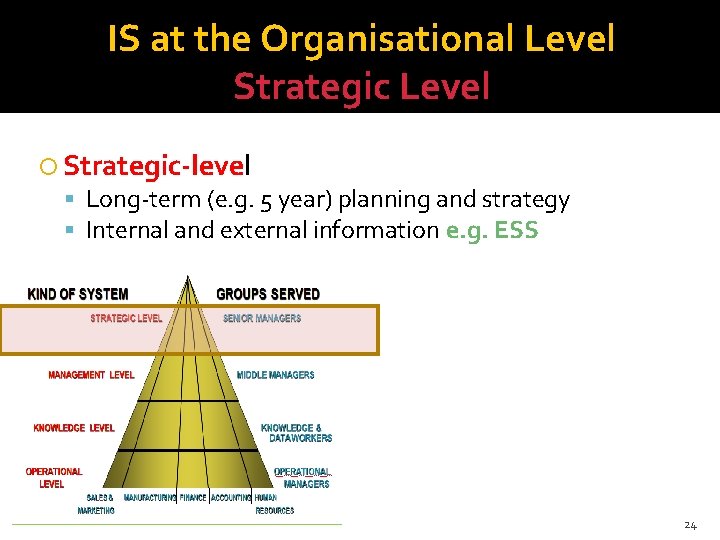
IS at the Organisational Level Strategic Level Strategic-level Long-term (e. g. 5 year) planning and strategy Internal and external information e. g. ESS 24
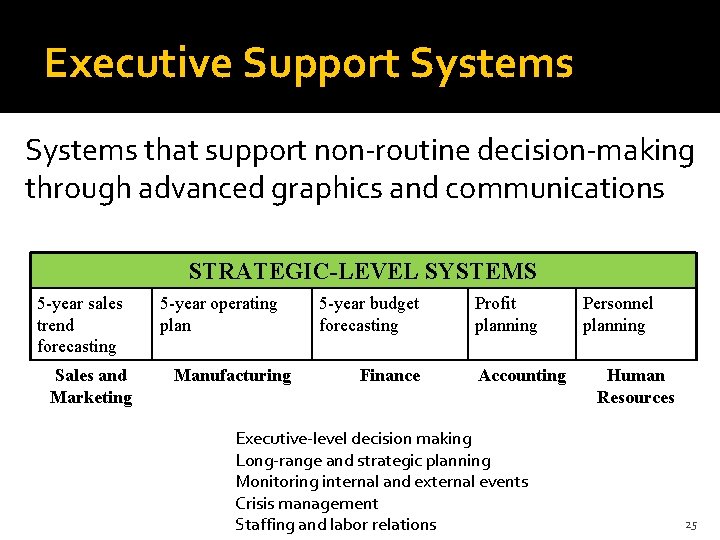
Executive Support Systems that support non-routine decision-making through advanced graphics and communications STRATEGIC-LEVEL SYSTEMS 5 -year sales trend forecasting Sales and Marketing 5 -year operating plan Manufacturing 5 -year budget forecasting Finance Profit planning Accounting Executive-level decision making Long-range and strategic planning Monitoring internal and external events Crisis management Staffing and labor relations Personnel planning Human Resources 25
Executive Support Systems Information system at the strategic level of an organization that address unstructured decision making through advanced graphics and communications. TYPE: Strategic level • INPUTS: aggregate data; internal and external • PROCESSING: interactive • OUTPUTS: projections • USERS: senior managers • DECISION-MAKING: highly unstructured EXAMPLE: 5 year operating plan 26
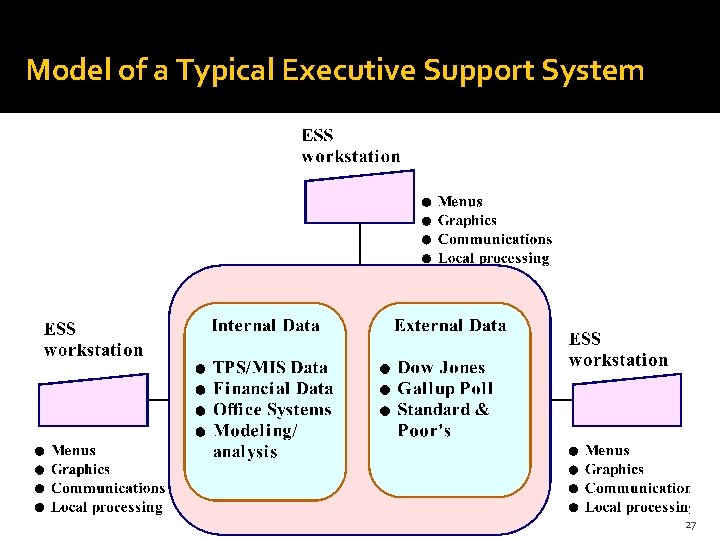
Model of a Typical Executive Support System 27
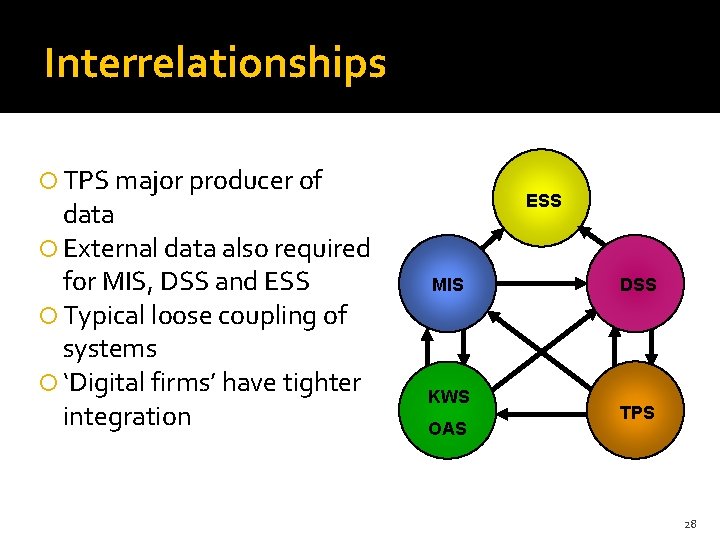
Interrelationships TPS major producer of data External data also required for MIS, DSS and ESS Typical loose coupling of systems ‘Digital firms’ have tighter integration ESS MIS KWS OAS DSS TPS 28
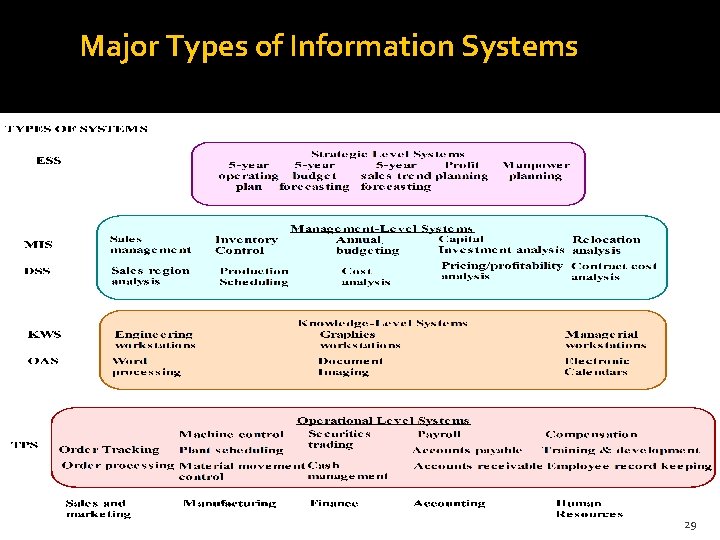
Major Types of Information Systems 29
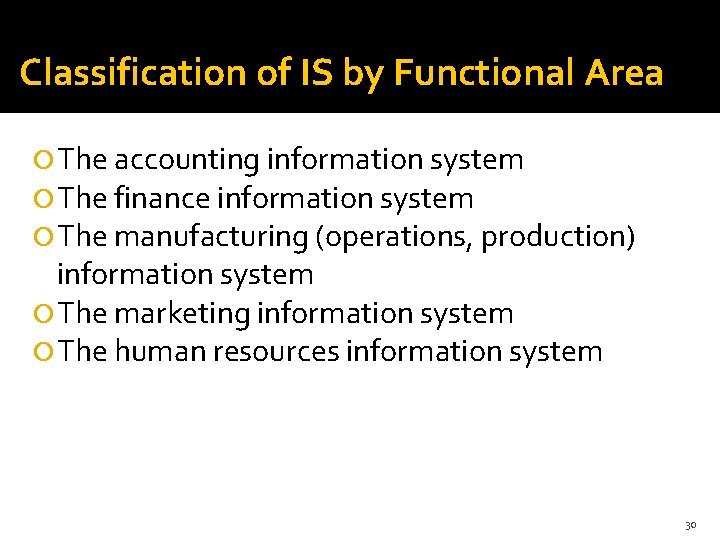
Classification of IS by Functional Area The accounting information system The finance information system The manufacturing (operations, production) information system The marketing information system The human resources information system 30
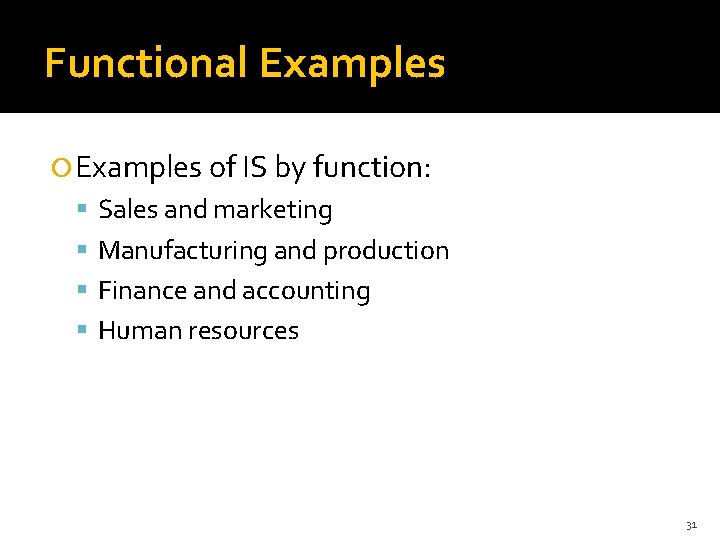
Functional Examples of IS by function: Sales and marketing Manufacturing and production Finance and accounting Human resources 31
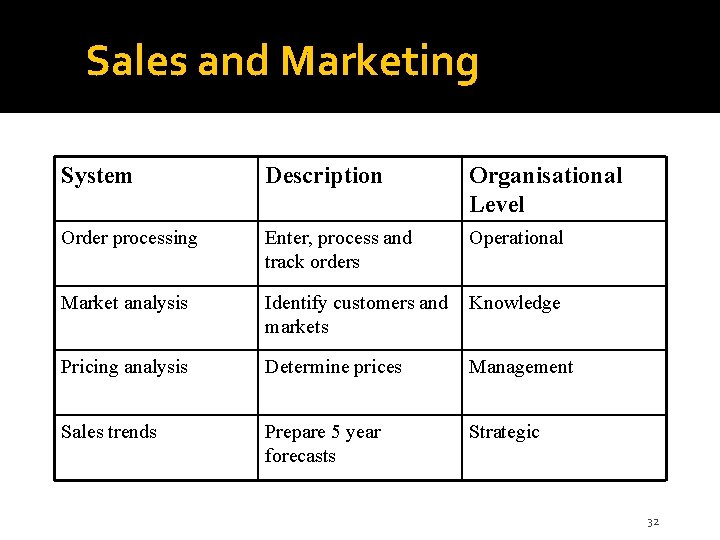
Sales and Marketing System Description Organisational Level Order processing Enter, process and track orders Operational Market analysis Identify customers and markets Knowledge Pricing analysis Determine prices Management Sales trends Prepare 5 year forecasts Strategic 32
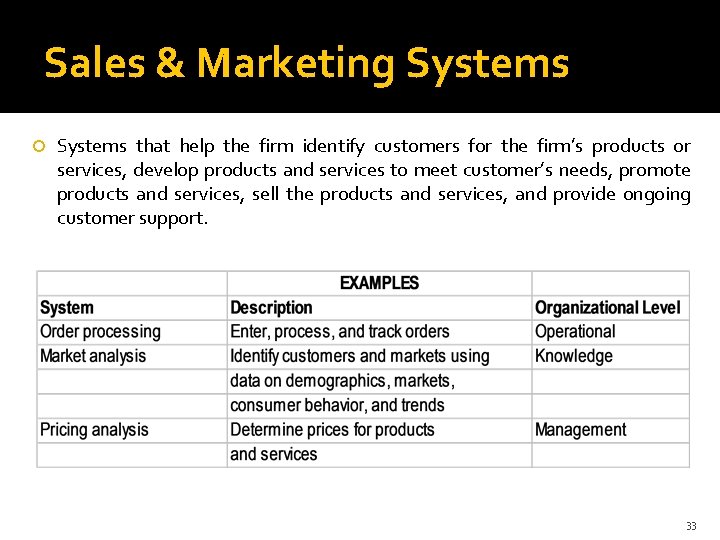
Sales & Marketing Systems that help the firm identify customers for the firm’s products or services, develop products and services to meet customer’s needs, promote products and services, sell the products and services, and provide ongoing customer support. 33
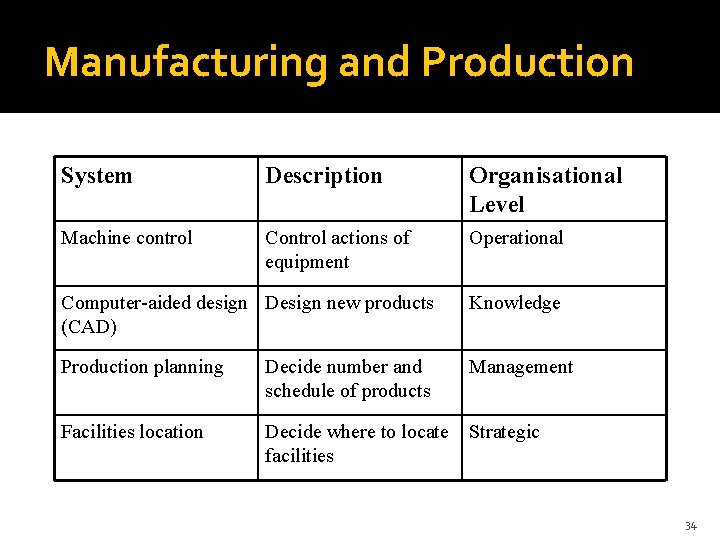
Manufacturing and Production System Description Organisational Level Machine control Control actions of equipment Operational Computer-aided design Design new products (CAD) Knowledge Production planning Decide number and schedule of products Management Facilities location Decide where to locate facilities Strategic 34
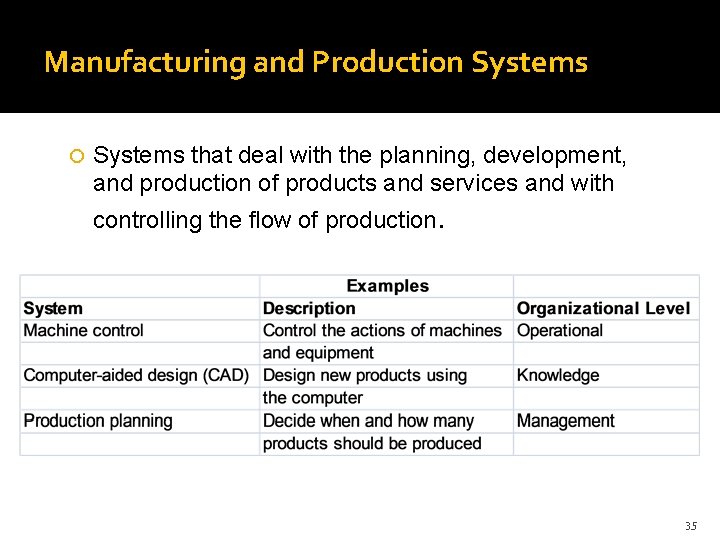
Manufacturing and Production Systems that deal with the planning, development, and production of products and services and with controlling the flow of production. 35
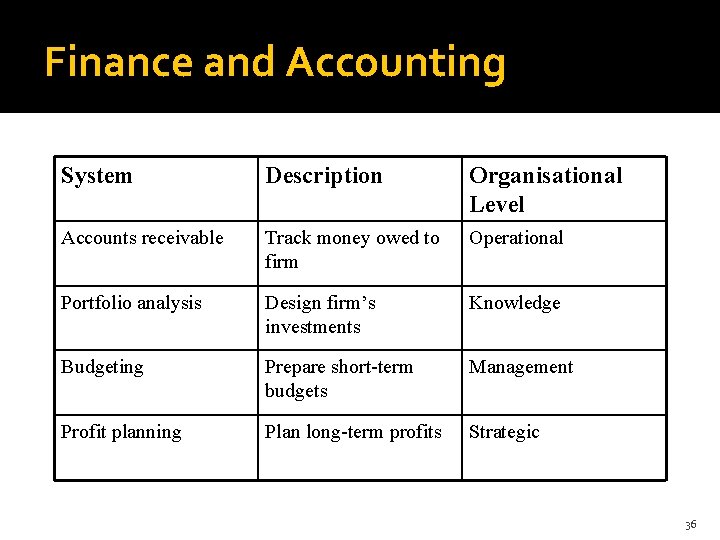
Finance and Accounting System Description Organisational Level Accounts receivable Track money owed to firm Operational Portfolio analysis Design firm’s investments Knowledge Budgeting Prepare short-term budgets Management Profit planning Plan long-term profits Strategic 36
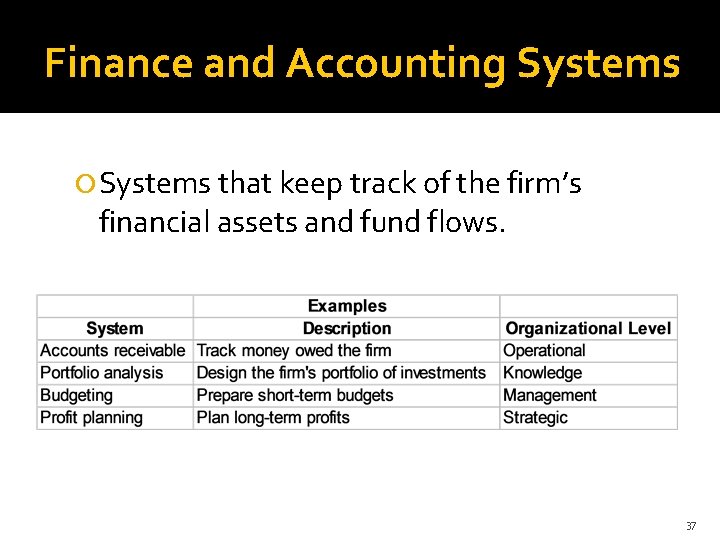
Finance and Accounting Systems that keep track of the firm’s financial assets and fund flows. 37
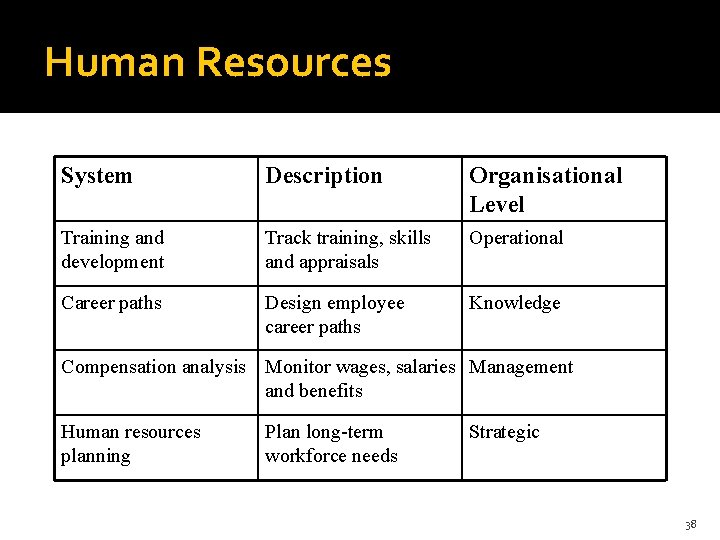
Human Resources System Description Organisational Level Training and development Track training, skills and appraisals Operational Career paths Design employee career paths Knowledge Compensation analysis Monitor wages, salaries Management and benefits Human resources planning Plan long-term workforce needs Strategic 38
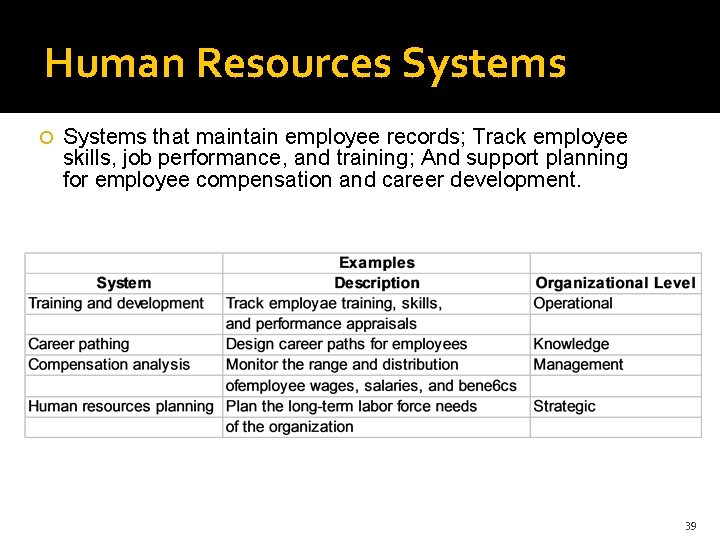
Human Resources Systems that maintain employee records; Track employee skills, job performance, and training; And support planning for employee compensation and career development. 39
- Slides: 39