
Information Sharing in Disasters An Introduction to Guidelines
- Slides: 23
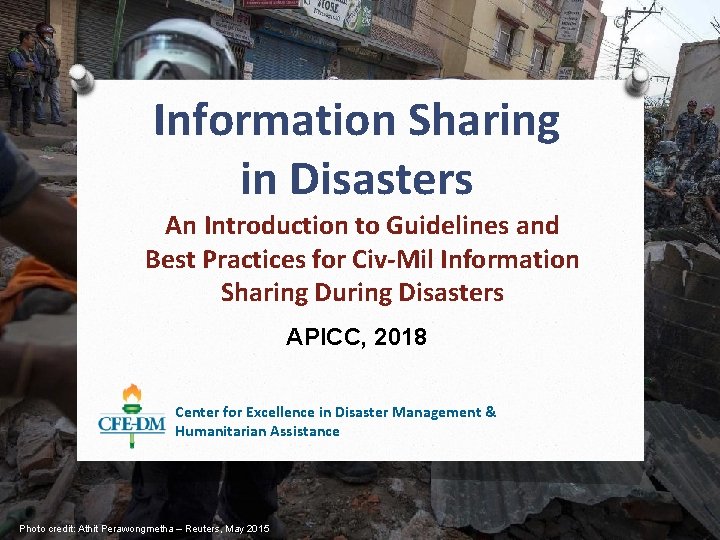
Information Sharing in Disasters An Introduction to Guidelines and Best Practices for Civ-Mil Information Sharing During Disasters APICC, 2018 Center for Excellence in Disaster Management & Humanitarian Assistance Photo credit: Athit Perawongmetha – Reuters, May 2015
Objectives O Intent of this brief is to discuss the importance of information sharing between military and civilian stakeholders during a disaster, and the challenges, planning, and preparation involved. O Provide an overview of information sharing best practices and possible guidelines to utilize, along with select information sharing platforms and information sources for effective civ-mil sharing. O Present historical challenges and opportunities to streamline and improve the effectiveness of information sharing during disaster response. O It is not the intent of this brief to convey how civ-mil information sharing activities should be conducted, but rather to foster ongoing, open discussion.
Introduction • “Information sharing between humanitarians and military actors should contribute to having a common situational awareness as the response operation progresses” – OCHA CMCoord Field Handbook • “The sharing of information in both directions is an essential element of successful Foreign Disaster Relief Operations” – Foreign Disaster Relief Handbook • “The sharing of information is particularly critical because no single responding entity—whether it is an NGO, IGO, assisting country government or host government—can be the source of all of the required data and information” – JP 3 -29 Foreign Humanitarian Assistance
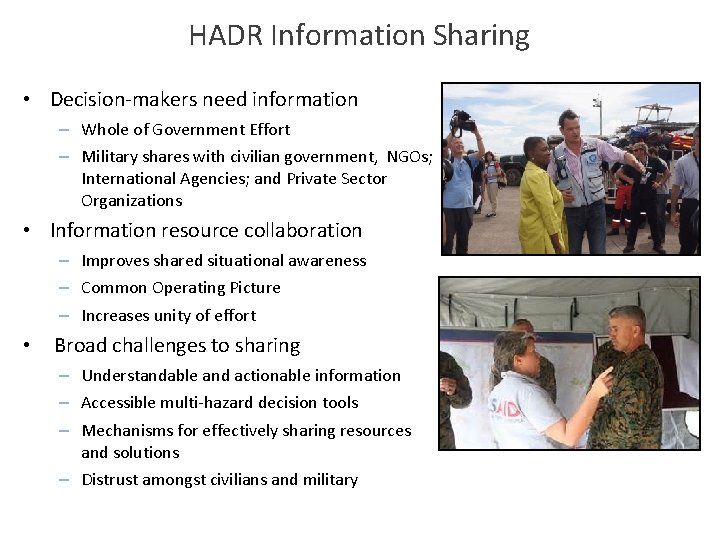
HADR Information Sharing • Decision-makers need information – Whole of Government Effort – Military shares with civilian government, NGOs; International Agencies; and Private Sector Organizations • Information resource collaboration – Improves shared situational awareness – Common Operating Picture – Increases unity of effort • Broad challenges to sharing – Understandable and actionable information – Accessible multi-hazard decision tools – Mechanisms for effectively sharing resources and solutions – Distrust amongst civilians and military
Operational Information Sharing Lessons Learned A brief look at Information Sharing Lessons Learned from major responses: Haiti earthquake, Japan Earthquake and Tsunami, Typhoon Haiyan, Ebola Response, and the 2015 Nepal earthquake, revealed common findings: O Information Flow and Systems were fragmented O Too many different information sharing mechanisms O Some websites for information sharing had some utility for the response but usefulness was limited O Specific information requirements should be developed and shared (preferably a single set) O There was no Common Operational Picture (COP) for all responders for effective coordination and to reduce duplication of effort O Using “secret” networks hindered response
Summary Main findings: O A collective Information Sharing Platform is needed O A shared, reliable, easily accessible information platform is needed to share information between humanitarian and military responders and other actors to ensure timely and effective response O A Common Operational Picture (COP) is also needed O A common situational awareness of who is doing what and where is essential for smooth coordination and to prevent unneeded duplication of efforts O Information should be shared across unclassified networks O Sharing across open, unclassified platforms promotes the sharing of information across the response spectrum and helps ensure speedy and reliable information sharing, thus improving response efforts
Information Sharing Perspectives UN OCHA: The key coordination elements in natural disasters and complex emergencies are information sharing, task division and planning. The scope and modus operandi of these key elements will change with the context and with the focus of the five CMCoord tasks: 1. Establish and sustain dialogue with military forces 2. Establish a mechanism for information exchange and humanitarian action with military forces and other armed groups 3. Support development and dissemination of context-specific guidance for the interaction of the humanitarian community with the military 4. Assist in negotiations in critical areas of humanitarian-military interaction 5. Monitor activity of military forces and ensure positive impact on humanitarian communities
Information Sharing Perspectives UN OCHA Information is exchanged in any case, be it the minimum necessary to deconflict operations, or situational information and analysis required to fulfill each actor’s respective tasks, including security information, or information on threats and population movements relevant for humanitarian assistance and Po. C. Humanitarian and military actors have different reasons and ways to collect, analyze and share information.
Information Sharing Perspectives Multi-National Force SOP Information sharing between all parties is critical to maximizing unity of effort. Foreign military forces must take the initiative to ensure maximum information sharing with the affected state and humanitarian community…Security concerns may preclude the foreign military forces from sharing complete operational information but every effort to maximize sharing should be made. Conversely, some members of the humanitarian community may be reluctant to share some information about their activities for fear of compromising their neutrality and independence…
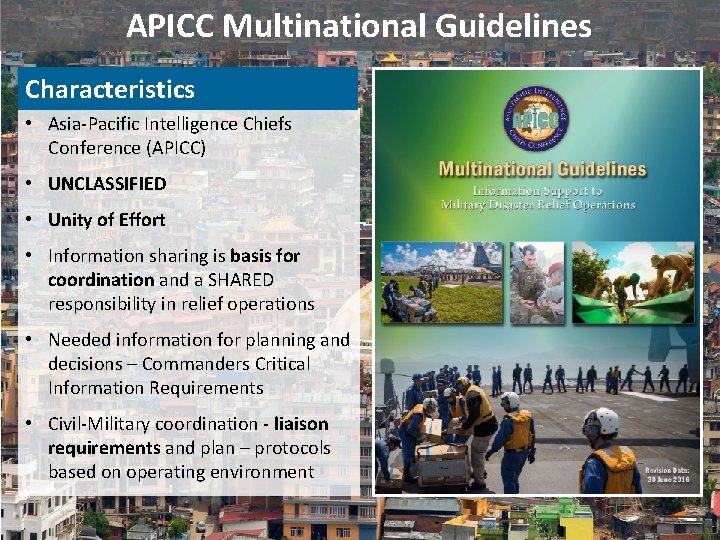
APICC Multinational Guidelines Characteristics • Asia-Pacific Intelligence Chiefs Conference (APICC) • UNCLASSIFIED • Unity of Effort • Information sharing is basis for coordination and a SHARED responsibility in relief operations • Needed information for planning and decisions – Commanders Critical Information Requirements • Civil-Military coordination - liaison requirements and plan – protocols based on operating environment
APICC Multinational Guidelines The nature and scope of the disaster or crisis to include additional hazards caused by the disaster. What is the estimated population at risk? How many affected areas need to be evacuated? What is the status of the evacuation? What is status of the Affected State’s response and have they requested or welcomed international assistance? What is the status of International Aid Agency operations and Assisting Military, International Organizations, and NGO resources? What are their priorities in dealing with the situation? Air/Sea Ports of Disembarkation (APOD/SPOD) operational status and capabilities. The strengths, locations, dispositions, capabilities, and intentions of any individuals, organizations or groups that may pose a threat to the safety and security of the force. Which jurisdictions are within the projected path of the hazard? What are the jurisdictional boundaries of the disaster area?
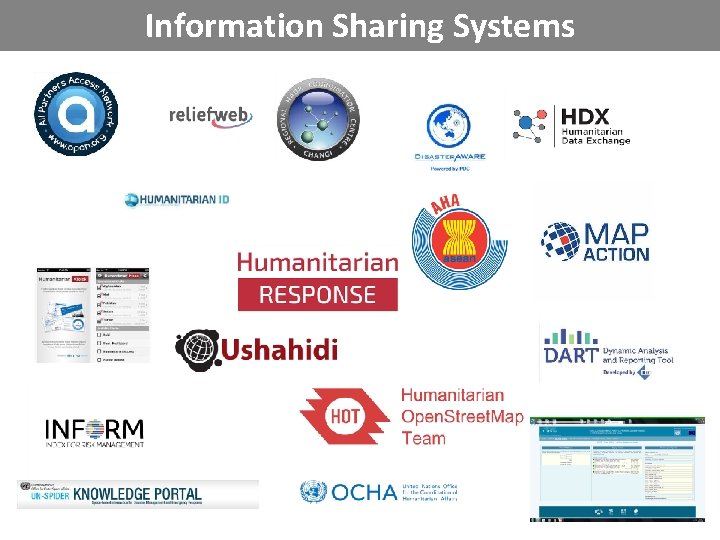
Information Sharing Systems
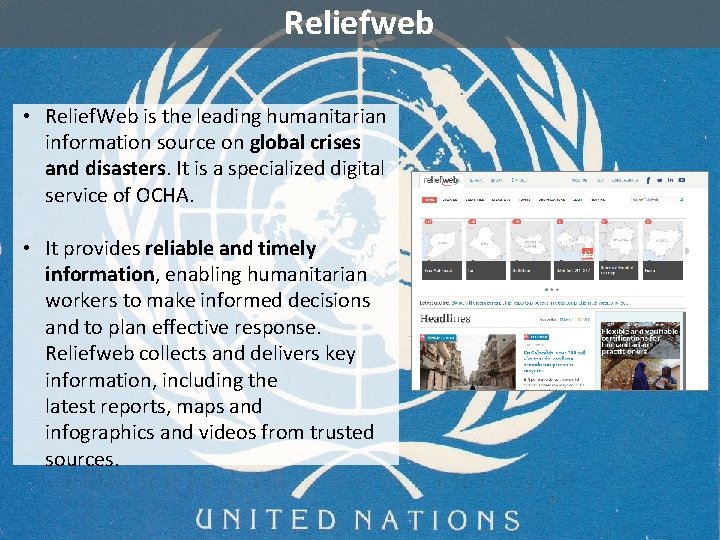
Reliefweb Introduction Characteristics • Relief. Web is the leading humanitarian • Information sharing is a shared responsibility information source on global crises and disasters. It is a specialized digital – JP 3 -29 service of OCHA. • Information sharing between humanitarians and military actors should contribute to having • It provides reliable and timely information, enabling humanitarian a common situational awareness as the workers to make informed decisions response operation progresses and to plan effective response. – OCHA CMCoord Field Handbook Reliefweb collects and delivers key information, including the • The sharing of information in both directions is latest reports, maps and an essential element of successful Foreign infographics and videos from trusted Disaster Relief Operations sources. – Foreign Disaster Relief Handbook
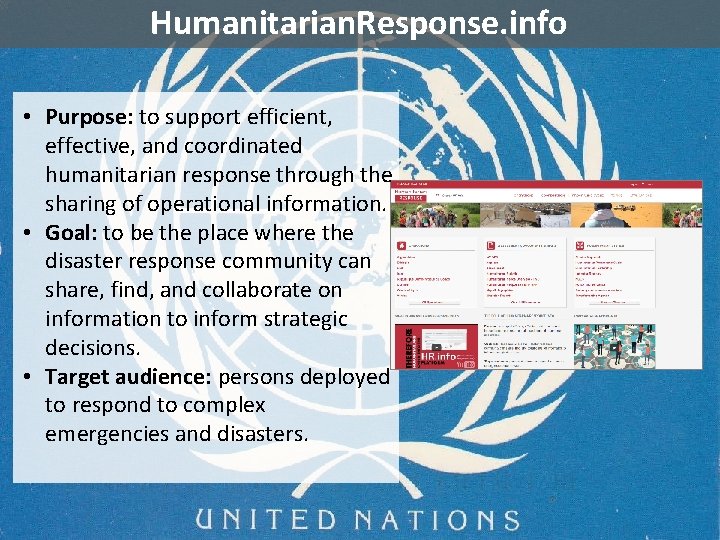
Humanitarian. Response. info Introduction Characteristics • Purpose: to support efficient, • Information sharing is a shared responsibility effective, and coordinated humanitarian response through the – JP 3 -29 sharing of operational information. • Information sharing between humanitarians • Goal: to be the place where the and military actors should contribute to having disaster response community can a common situational awareness as the share, find, and collaborate on response operation progresses information to inform strategic decisions. – OCHA CMCoord Field Handbook • Target audience: persons deployed • The sharing of information in both directions is to respond to complex an essential element of successful Foreign emergencies and disasters. Disaster Relief Operations – Foreign Disaster Relief Handbook
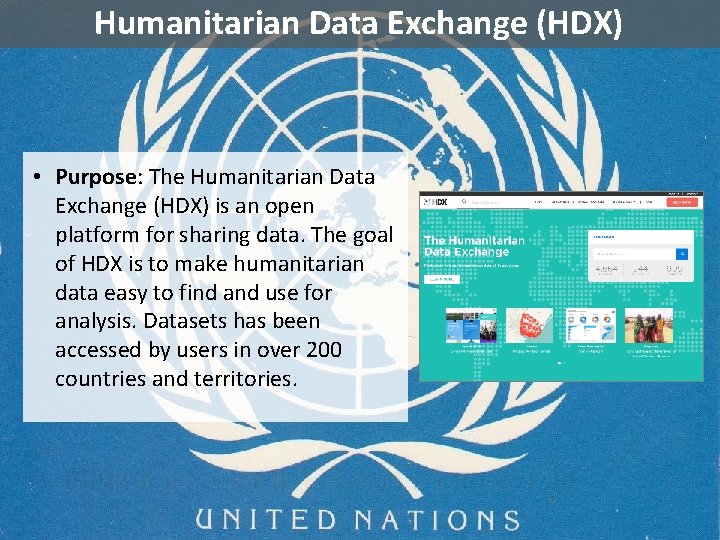
Humanitarian Data Exchange (HDX) Introduction Characteristics • Information sharing is a shared responsibility • Purpose: The Humanitarian Data – JP 3 -29 Exchange (HDX) is an open • Information sharing between humanitarians platform for sharing data. The goal and military actors should contribute to having of HDX is to make humanitarian a common situational awareness as the data easy to find and use for response operation progresses analysis. Datasets has been – OCHA CMCoord Field Handbook accessed by users in over 200 countries and territories. • The sharing of information in both directions is an essential element of successful Foreign Disaster Relief Operations – Foreign Disaster Relief Handbook
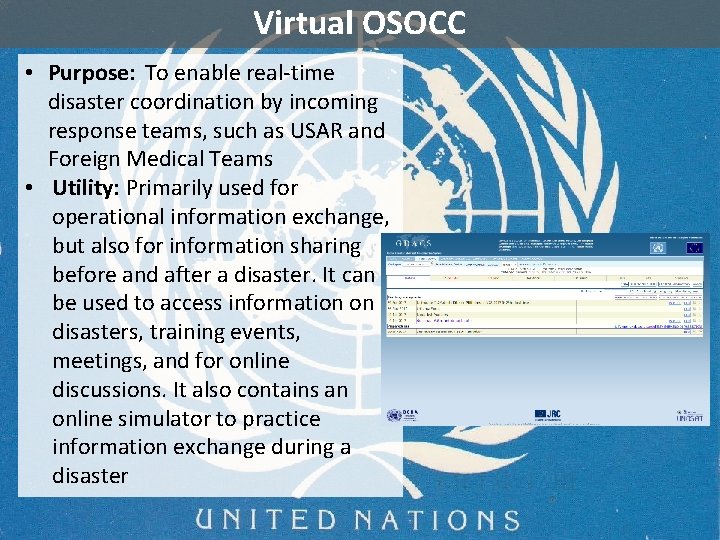
Virtual OSOCC Introduction • Purpose: To enable real-time Characteristics disaster coordination by incoming response teams, such as USAR and • Information sharing is a shared responsibility Foreign Medical Teams – JP 3 -29 • Utility: Primarily used for operational information exchange, • Information sharing between humanitarians but also for information sharing and military actors should contribute to having before and after a disaster. It can a common situational awareness as the be used to access information on response operation progresses disasters, training events, – OCHA CMCoord Field Handbook meetings, and for online • The sharing of information in both directions is discussions. It also contains an an essential element of successful Foreign online simulator to practice Disaster Relief Operations information exchange during a disaster – Foreign Disaster Relief Handbook
Common Information Sharing Platform Challenges While information sharing platforms are very useful tools for civ-mil information sharing, there are some challenges to be noted: • Access to some systems are limited to select members • Some humanitarian workers and military responders may prefer to use their own or another information sharing platform for response • Interoperability appears to be limited across most systems • Information exchange and collaboration is mainly through web access; The lack of a mobile app may potentially limit field operation inputs; If a mobile app exists, not all functionality may be available • Some information sharing systems are relatively new and under ongoing development • Adoption of other platforms may be challenging to those used to a particular system
RCG Information Sharing Working Group • As outlined in the RCG Terms of Reference: The RCG was formed to (in regards to information sharing): • …“b) facilitate exchange of information and innovative ideas to enable well-coordinated and needs-based effective disaster response to a broad range of humanitarian emergency operations…” • The Regional Consultative Group (RCG) mid-term consultation took place in June 2018. The meeting discussed the establishment of the Information Sharing Working Group
Information Sharing (IS) discussion from the Regional Consultative Group (RCG) DEC 2017, Singapore References to the importance of Information Sharing: • Information Sharing (IS) is an critical, foundational, cross-cutting element in both preparedness and response • IS helps to foster trust and transparency • Role of IS in Phase 0 --enhancing predictability of response • IS critical to de-confliction • New roles in challenging environments dictate increased IS among disparate actors • Typhoon Haiyan demonstrated need to increase the speed and scale of response; IS has a critical role in accelerating response • Importance of situational awareness/COP, interoperability, unclassified and timely IS. “Need to share, not need to know”
Information Sharing (IS) discussion from the Regional Consultative Group (RCG) DEC 2017, Singapore References to the challenges of information sharing: • The IS challenge for the humanitarian community is having little bandwidth for training--humanitarians engaged in real world crises • There may be different IS demands from disaster-to-disaster (i. e, Cyclone vs. EQ) • Importance of using a commonly-understood/available/local IS platform vs. a complex, little known or understood foreign platform • Multiple, overlapping, competing platforms, yet no one platform does it all • Sovereignty issues of where server sits • Each coordination platform has its own intricacies • Plethora of stakeholders; IS/C 2 of volunteers; challenge of IS re: media/press • Unique challenges of IS in the “wide open Pacific”
Information Sharing (IS) discussion from the Regional Consultative Group (RCG) DEC 2017, Singapore General comments/way ahead: • Technology is a powerful enabler, but the use and purpose of information sharing must be defined in order to enhance capacity building • “Gateway” idea: Search engine/portal (or starting point) to connect to the different IS platforms in use • There needs to be a clarity of roles and responsibilities between national and international stakeholders • Data more important than the platform; Need different tools for different jobs • There is a need for data sharing agreements before disaster strikes • IS platforms must be discussed at exercise planning conferences • Many RCG participants recommended the establishment of a Working Group (WG) on IS
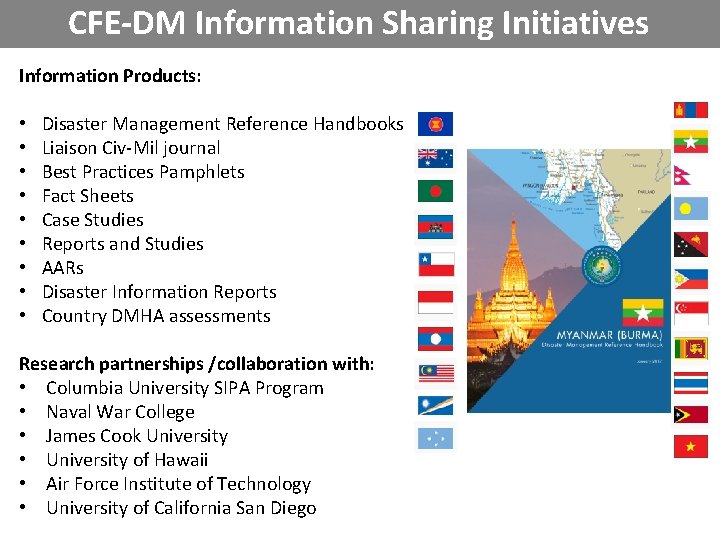
CFE-DM Information Sharing Initiatives Information Products: • • • Disaster Management Reference Handbooks Liaison Civ-Mil journal Best Practices Pamphlets Fact Sheets Case Studies Reports and Studies AARs Disaster Information Reports Country DMHA assessments Research partnerships /collaboration with: • Columbia University SIPA Program • Naval War College • James Cook University • University of Hawaii • Air Force Institute of Technology • University of California San Diego
Joseph D. Martin, Director Joseph. d. martin 2@pacom. mil https: //www. cfe-dhma. org CFE-DM: Meeting Disaster Management Challenges with Excellence 23