
Information Security Trend Threats Challenges Dr Mohsen Kahani
- Slides: 40
Information Security Trend, Threats & Challenges Dr. Mohsen Kahani APA Lab, Ferdowsi Univ. of Mashhad http: //cert. um. ac. ir
Contents • • Security Trends 2011 Security Threats 2011 Web Application top 10 vulnerabilities Problems Observed Locally
2011 Security Trends • • • More threats like Stuxnet More granular and refined web security policies Botnets resort to steganography Attacks will find ways to automate the research Targeted attacks to hit a wider range of organizations Non-English-language spams increase Businesses will work harder to manage security for their distributed workforces. Criminals will continue to use SEO poisoning Security services will continue to migrate to the cloud Extension of attacks into online currencies used in social networking and online marketplaces Criminalware as a Service (Caa. S)
Top 10 Internet Security Threats for 2011 • 1. Increase in Malware creation – a total of over 60 million classified threats. • 2. Cyber war. – stuxnet • 3. Cyber-protests. • 4. Social engineering. • 5. Windows 7 influencing malware development.
Top 10 Internet Security Threats for 2011 • 6. Cell phones. – for Android • • 7. Tablets? 8. Malware for Mac 9. HTML 5. 10. Highly dynamic and encrypted threats.
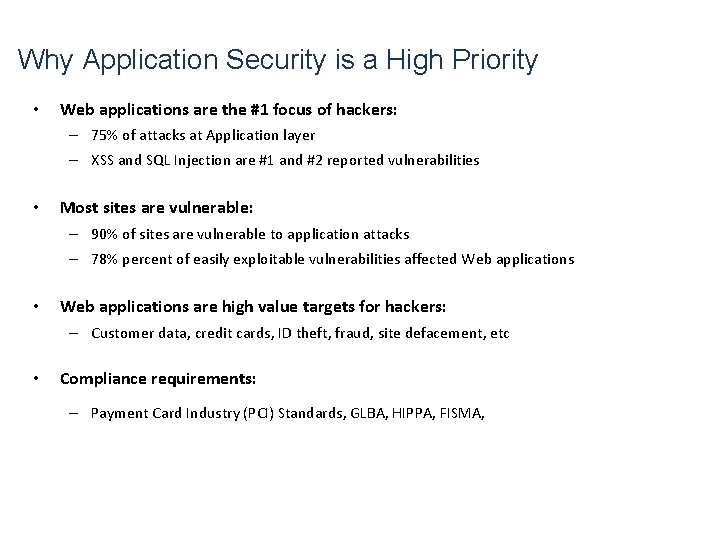
Why Application Security is a High Priority • Web applications are the #1 focus of hackers: – 75% of attacks at Application layer – XSS and SQL Injection are #1 and #2 reported vulnerabilities • Most sites are vulnerable: – 90% of sites are vulnerable to application attacks – 78% percent of easily exploitable vulnerabilities affected Web applications • Web applications are high value targets for hackers: – Customer data, credit cards, ID theft, fraud, site defacement, etc • Compliance requirements: – Payment Card Industry (PCI) Standards, GLBA, HIPPA, FISMA,
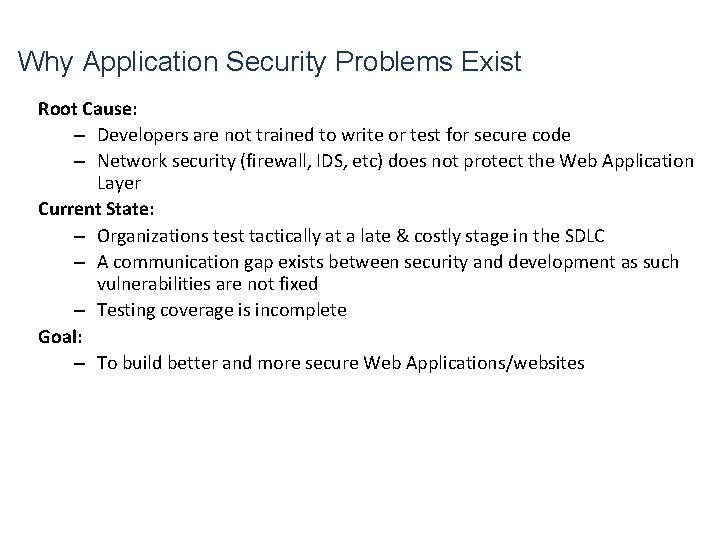
Why Application Security Problems Exist Root Cause: – Developers are not trained to write or test for secure code – Network security (firewall, IDS, etc) does not protect the Web Application Layer Current State: – Organizations test tactically at a late & costly stage in the SDLC – A communication gap exists between security and development as such vulnerabilities are not fixed – Testing coverage is incomplete Goal: – To build better and more secure Web Applications/websites
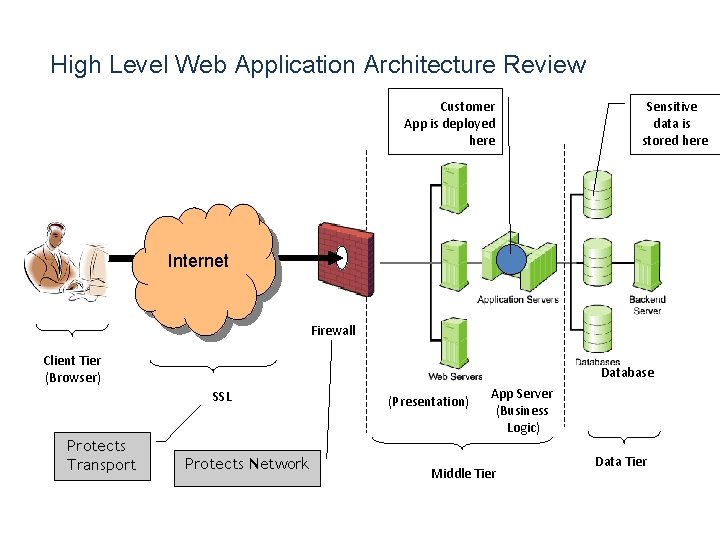
High Level Web Application Architecture Review Customer App is deployed here Sensitive data is stored here Internet Firewall Client Tier (Browser) Database SSL Protects Transport Protects Network (Presentation) App Server (Business Logic) Middle Tier Data Tier
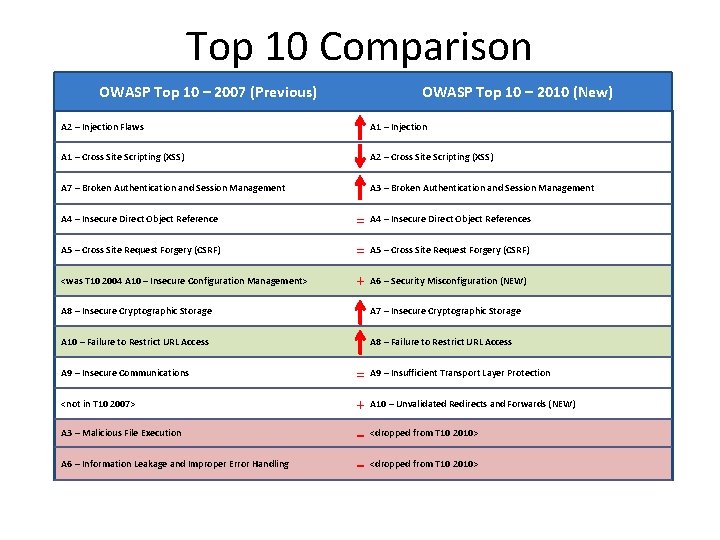
Top 10 Comparison OWASP Top 10 – 2007 (Previous) OWASP Top 10 – 2010 (New) A 2 – Injection Flaws A 1 – Injection A 1 – Cross Site Scripting (XSS) A 2 – Cross Site Scripting (XSS) A 7 – Broken Authentication and Session Management A 3 – Broken Authentication and Session Management A 4 – Insecure Direct Object Reference = A 4 – Insecure Direct Object References A 5 – Cross Site Request Forgery (CSRF) = A 5 – Cross Site Request Forgery (CSRF) <was T 10 2004 A 10 – Insecure Configuration Management> + A 6 – Security Misconfiguration (NEW) A 8 – Insecure Cryptographic Storage A 7 – Insecure Cryptographic Storage A 10 – Failure to Restrict URL Access A 8 – Failure to Restrict URL Access A 9 – Insecure Communications = <not in T 10 2007> + A 10 – Unvalidated Redirects and Forwards (NEW) A 3 – Malicious File Execution A 6 – Information Leakage and Improper Error Handling - A 9 – Insufficient Transport Layer Protection <dropped from T 10 2010>
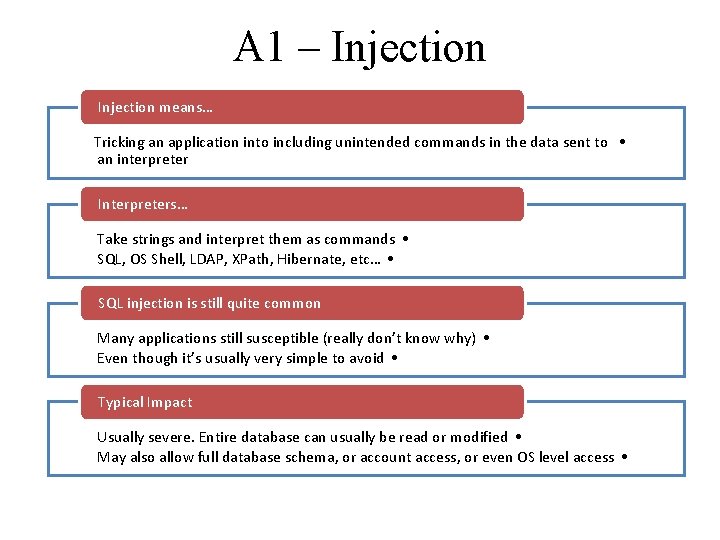
A 1 – Injection means… Tricking an application into including unintended commands in the data sent to • an interpreter Interpreters… Take strings and interpret them as commands • SQL, OS Shell, LDAP, XPath, Hibernate, etc… • SQL injection is still quite common Many applications still susceptible (really don’t know why) • Even though it’s usually very simple to avoid • Typical Impact Usually severe. Entire database can usually be read or modified • May also allow full database schema, or account access, or even OS level access •
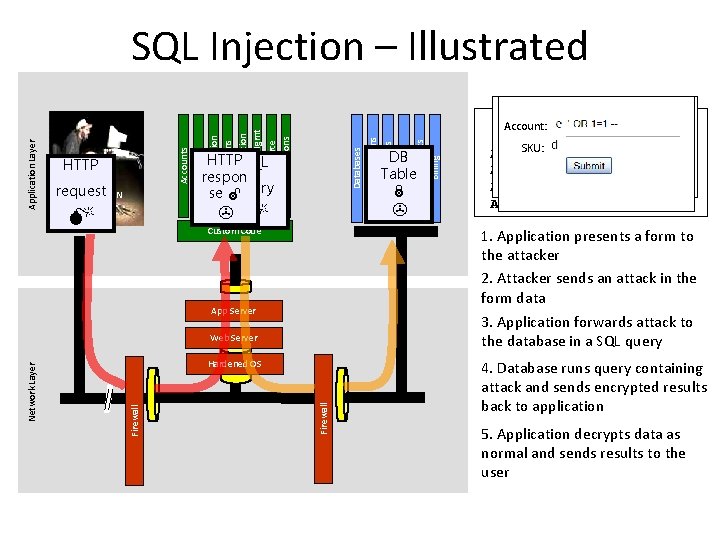
Billing Human Resrcs Acct: 5424 -9383 -2039 -4029 Acct: 4128 -0004 -1234 -0293 3. Application forwards attack to the database in a SQL query Web Server Firewall Hardened OS Firewall "SELECT * FROM Account Summary Account: accounts WHERE SKU: acct=‘’ OR 1=1 -Acct: 5424 -6066 -2134 -4334 Acct: 4128 -7574 -3921 -0192 ’" 1. Application presents a form to the attacker 2. Attacker sends an attack in the form data App Server Network Layer DB Table Custom Code ATTACK Directories request APPLICATION Web Services Databases HTTPSQL respon se query HTTP Legacy Systems Communication Knowledge Mgmt E-Commerce Bus. Functions Administration Transactions Accounts Finance Application Layer SQL Injection – Illustrated 4. Database runs query containing attack and sends encrypted results back to application 5. Application decrypts data as normal and sends results to the user
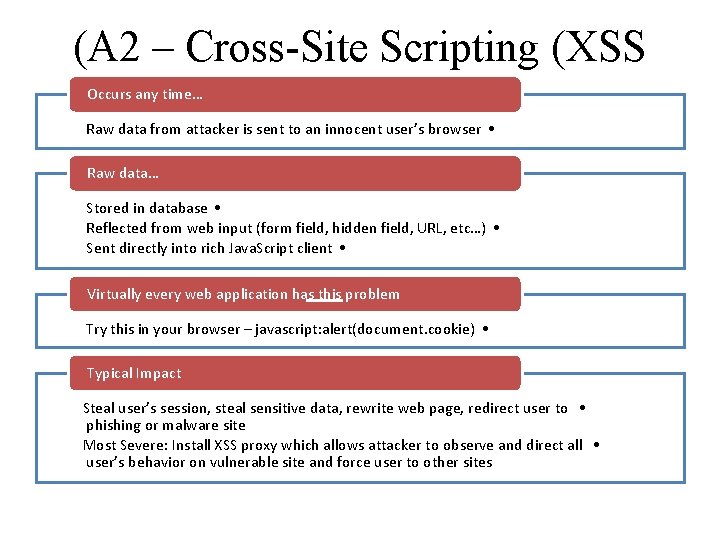
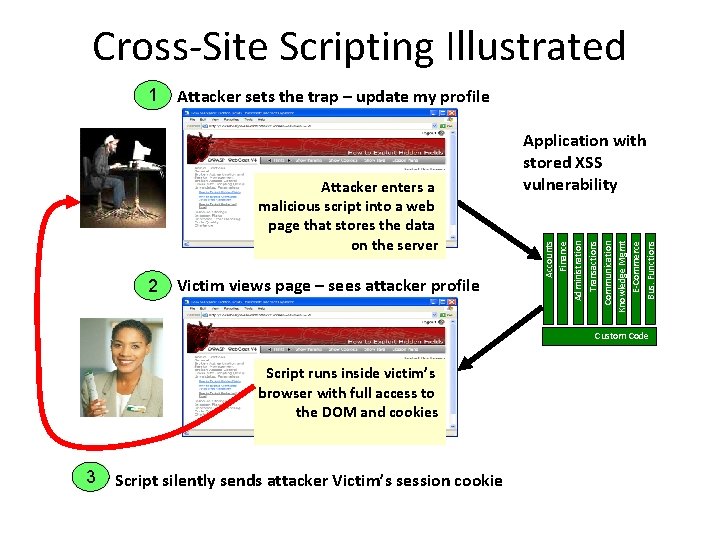
(A 2 – Cross-Site Scripting (XSS Occurs any time… Raw data from attacker is sent to an innocent user’s browser • Raw data… Stored in database • Reflected from web input (form field, hidden field, URL, etc…) • Sent directly into rich Java. Script client • Virtually every web application has this problem Try this in your browser – javascript: alert(document. cookie) • Typical Impact Steal user’s session, steal sensitive data, rewrite web page, redirect user to • phishing or malware site Most Severe: Install XSS proxy which allows attacker to observe and direct all • user’s behavior on vulnerable site and force user to other sites
Cross-Site Scripting Illustrated Attacker sets the trap – update my profile Victim views page – sees attacker profile Communication Knowledge Mgmt E-Commerce Bus. Functions 2 Administration Transactions Attacker enters a malicious script into a web page that stores the data on the server Application with stored XSS vulnerability Accounts Finance 1 Custom Code Script runs inside victim’s browser with full access to the DOM and cookies 3 Script silently sends attacker Victim’s session cookie
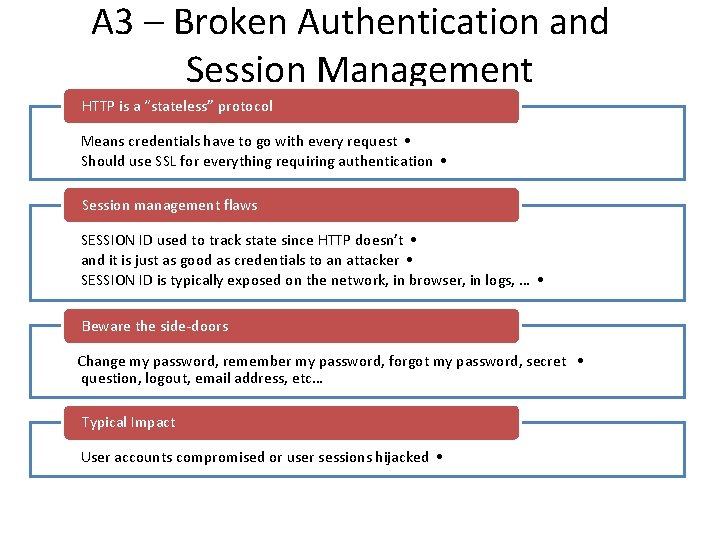
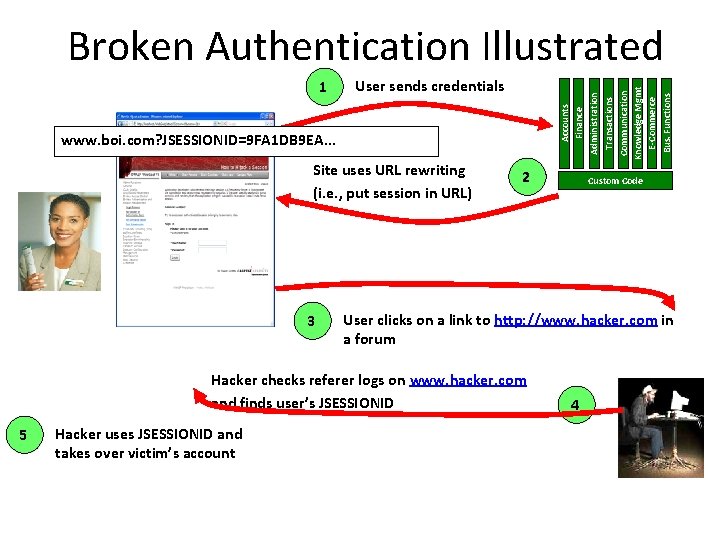
A 3 – Broken Authentication and Session Management HTTP is a “stateless” protocol Means credentials have to go with every request • Should use SSL for everything requiring authentication • Session management flaws SESSION ID used to track state since HTTP doesn’t • and it is just as good as credentials to an attacker • SESSION ID is typically exposed on the network, in browser, in logs, … • Beware the side-doors Change my password, remember my password, forgot my password, secret • question, logout, email address, etc… Typical Impact User accounts compromised or user sessions hijacked •
www. boi. com? JSESSIONID=9 FA 1 DB 9 EA. . . Site uses URL rewriting (i. e. , put session in URL) 3 2 Hacker uses JSESSIONID and takes over victim’s account Custom Code User clicks on a link to http: //www. hacker. com in a forum Hacker checks referer logs on www. hacker. com and finds user’s JSESSIONID 5 Communication Knowledge Mgmt E-Commerce Bus. Functions User sends credentials Accounts Finance 1 Administration Transactions Broken Authentication Illustrated 4
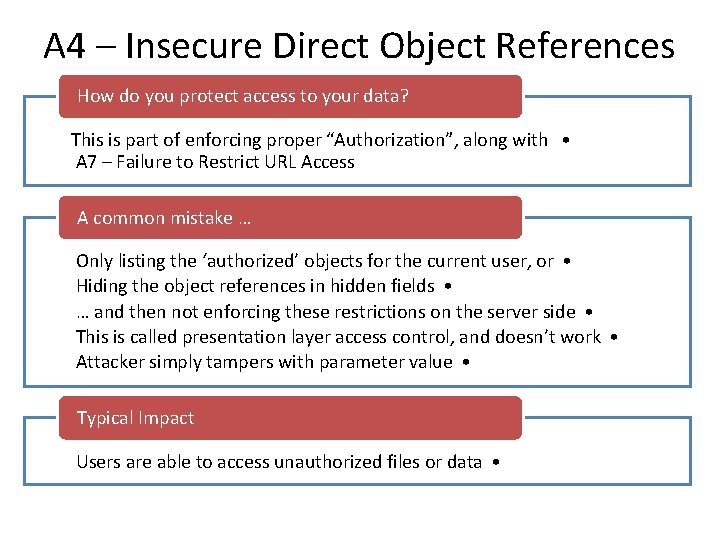
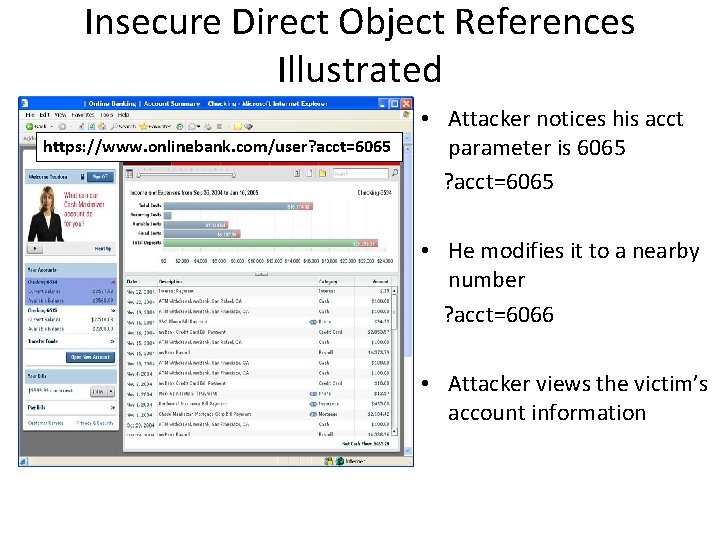
A 4 – Insecure Direct Object References How do you protect access to your data? This is part of enforcing proper “Authorization”, along with • A 7 – Failure to Restrict URL Access A common mistake … Only listing the ‘authorized’ objects for the current user, or • Hiding the object references in hidden fields • … and then not enforcing these restrictions on the server side • This is called presentation layer access control, and doesn’t work • Attacker simply tampers with parameter value • Typical Impact Users are able to access unauthorized files or data •
Insecure Direct Object References Illustrated https: //www. onlinebank. com/user? acct=6065 • Attacker notices his acct parameter is 6065 ? acct=6065 • He modifies it to a nearby number ? acct=6066 • Attacker views the victim’s account information
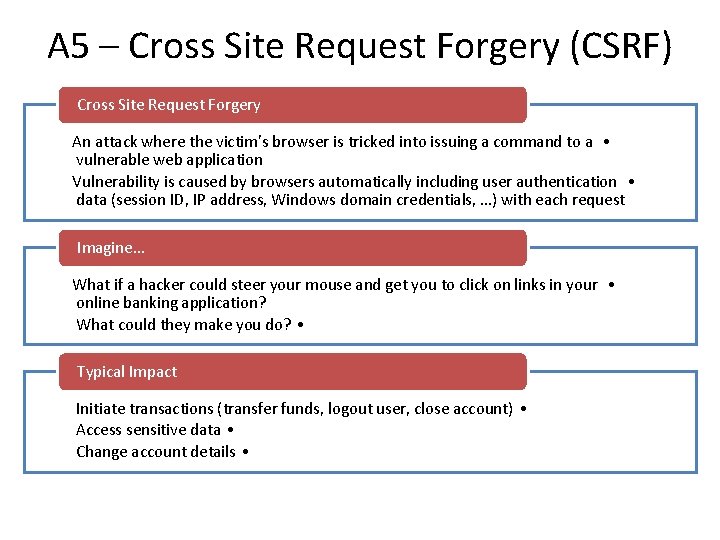
A 5 – Cross Site Request Forgery (CSRF) Cross Site Request Forgery An attack where the victim’s browser is tricked into issuing a command to a • vulnerable web application Vulnerability is caused by browsers automatically including user authentication • data (session ID, IP address, Windows domain credentials, …) with each request Imagine… What if a hacker could steer your mouse and get you to click on links in your • online banking application? What could they make you do? • Typical Impact Initiate transactions (transfer funds, logout user, close account) • Access sensitive data • Change account details •
CSRF Vulnerability Pattern • The Problem – Web browsers automatically include most credentials with each request – Even for requests caused by a form, script, or image on another site • All sites relying solely on automatic credentials are vulnerable! – (almost all sites are this way) • Automatically Provided Credentials – – – Session cookie Basic authentication header IP address Client side SSL certificates Windows domain authentication
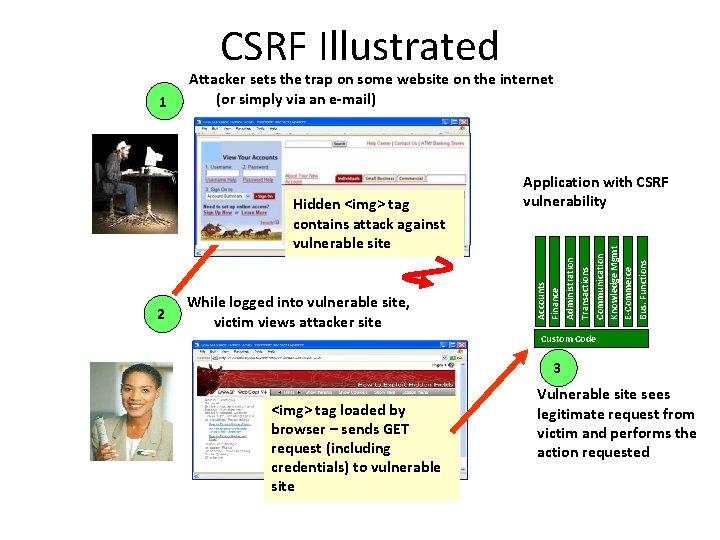
CSRF Illustrated While logged into vulnerable site, victim views attacker site Communication Knowledge Mgmt E-Commerce Bus. Functions 2 Administration Transactions Hidden <img> tag contains attack against vulnerable site Application with CSRF vulnerability Accounts Finance 1 Attacker sets the trap on some website on the internet (or simply via an e-mail) Custom Code 3 <img> tag loaded by browser – sends GET request (including credentials) to vulnerable site Vulnerable site sees legitimate request from victim and performs the action requested
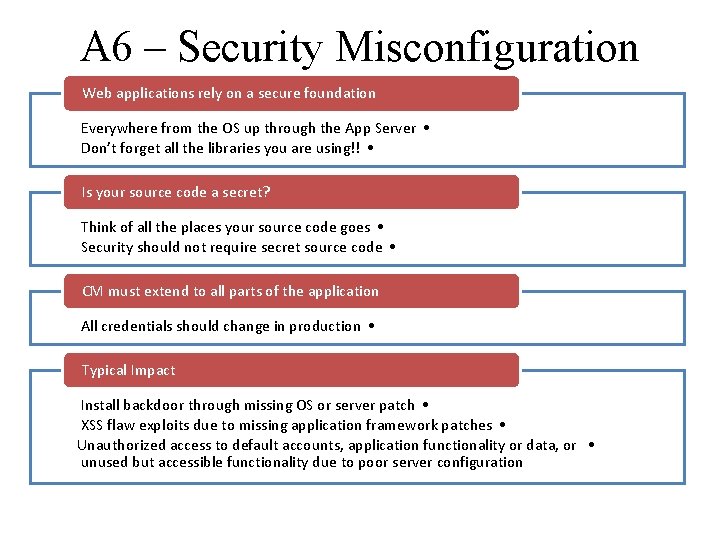
A 6 – Security Misconfiguration Web applications rely on a secure foundation Everywhere from the OS up through the App Server • Don’t forget all the libraries you are using!! • Is your source code a secret? Think of all the places your source code goes • Security should not require secret source code • CM must extend to all parts of the application All credentials should change in production • Typical Impact Install backdoor through missing OS or server patch • XSS flaw exploits due to missing application framework patches • Unauthorized access to default accounts, application functionality or data, or • unused but accessible functionality due to poor server configuration
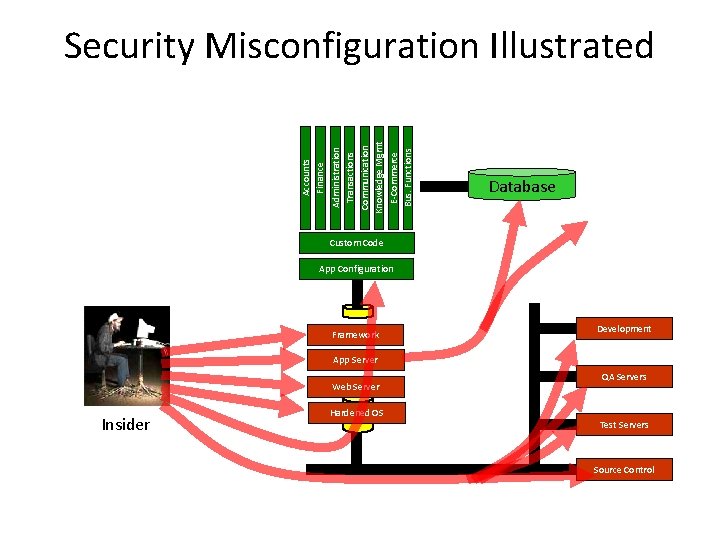
Communication Knowledge Mgmt E-Commerce Bus. Functions Administration Transactions Accounts Finance Security Misconfiguration Illustrated Database Custom Code App Configuration Framework Development App Server Web Server Insider Hardened OS QA Servers Test Servers Source Control
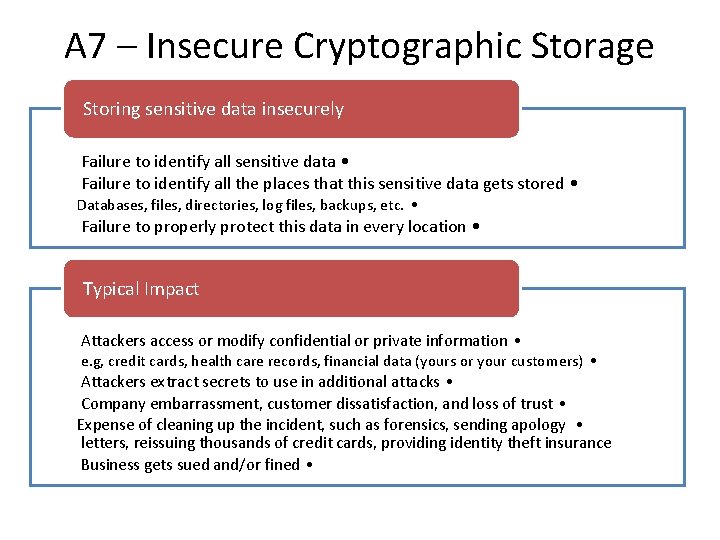
A 7 – Insecure Cryptographic Storage Storing sensitive data insecurely Failure to identify all sensitive data • Failure to identify all the places that this sensitive data gets stored • Databases, files, directories, log files, backups, etc. • Failure to properly protect this data in every location • Typical Impact Attackers access or modify confidential or private information • e. g, credit cards, health care records, financial data (yours or your customers) • Attackers extract secrets to use in additional attacks • Company embarrassment, customer dissatisfaction, and loss of trust • Expense of cleaning up the incident, such as forensics, sending apology • letters, reissuing thousands of credit cards, providing identity theft insurance Business gets sued and/or fined •
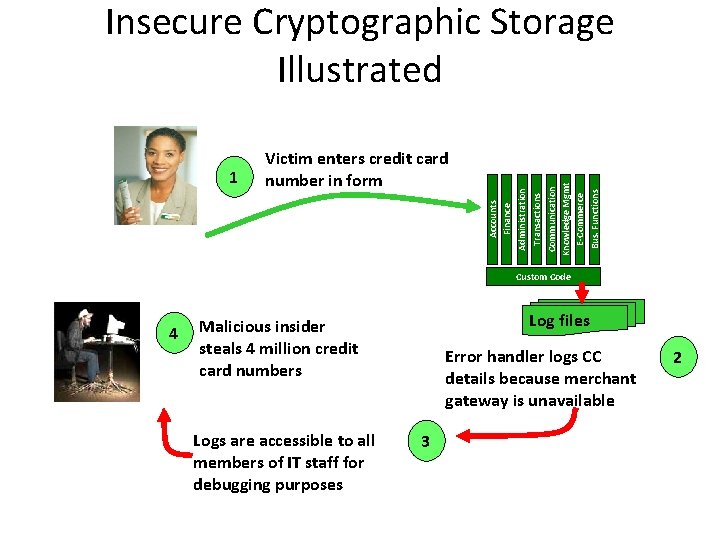
Communication Knowledge Mgmt E-Commerce Bus. Functions Accounts Finance 1 Victim enters credit card number in form Administration Transactions Insecure Cryptographic Storage Illustrated Custom Code 4 Log files Malicious insider steals 4 million credit card numbers Logs are accessible to all members of IT staff for debugging purposes Error handler logs CC details because merchant gateway is unavailable 3 2
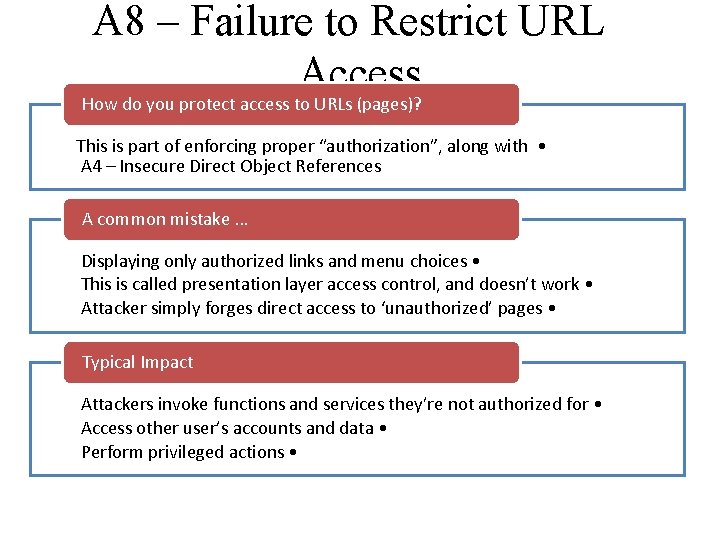
A 8 – Failure to Restrict URL Access How do you protect access to URLs (pages)? This is part of enforcing proper “authorization”, along with • A 4 – Insecure Direct Object References A common mistake … Displaying only authorized links and menu choices • This is called presentation layer access control, and doesn’t work • Attacker simply forges direct access to ‘unauthorized’ pages • Typical Impact Attackers invoke functions and services they’re not authorized for • Access other user’s accounts and data • Perform privileged actions •
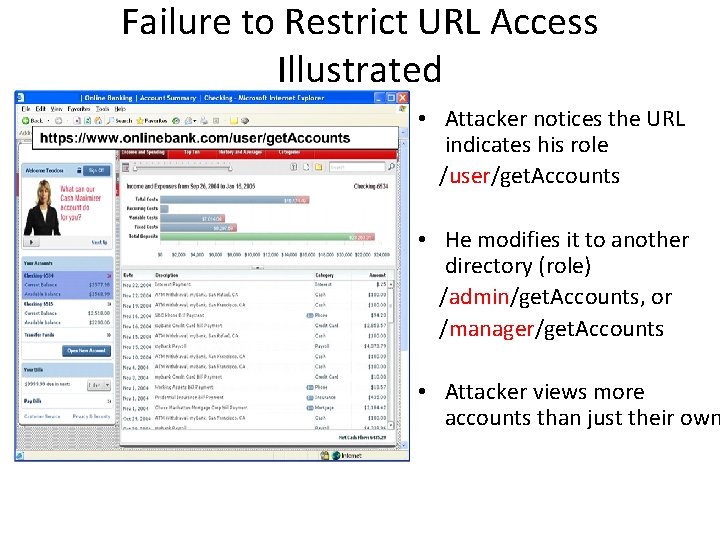
Failure to Restrict URL Access Illustrated • Attacker notices the URL indicates his role /user/get. Accounts • He modifies it to another directory (role) /admin/get. Accounts, or /manager/get. Accounts • Attacker views more accounts than just their own
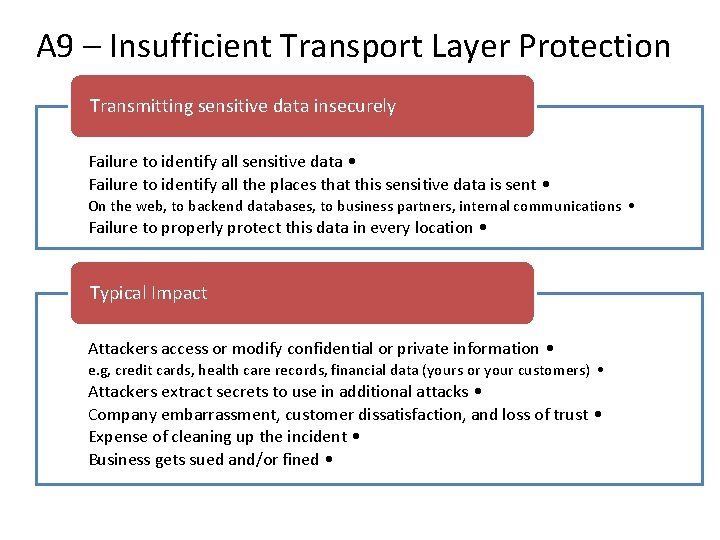
A 9 – Insufficient Transport Layer Protection Transmitting sensitive data insecurely Failure to identify all sensitive data • Failure to identify all the places that this sensitive data is sent • On the web, to backend databases, to business partners, internal communications • Failure to properly protect this data in every location • Typical Impact Attackers access or modify confidential or private information • e. g, credit cards, health care records, financial data (yours or your customers) • Attackers extract secrets to use in additional attacks • Company embarrassment, customer dissatisfaction, and loss of trust • Expense of cleaning up the incident • Business gets sued and/or fined •
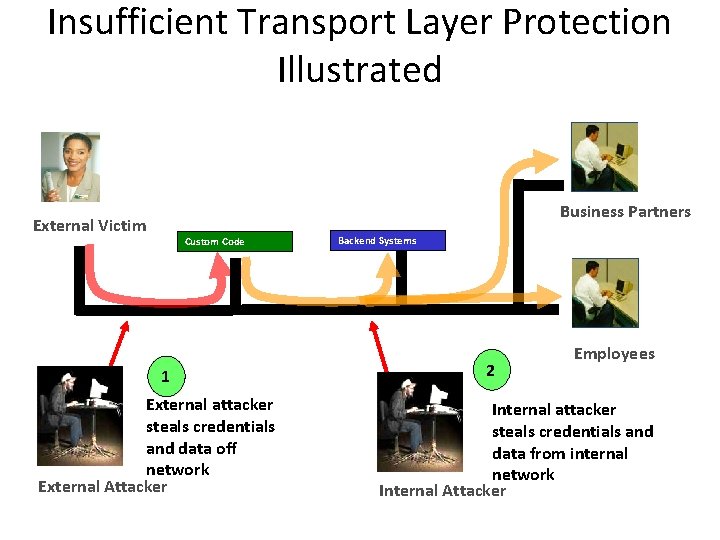
Insufficient Transport Layer Protection Illustrated Business Partners External Victim Custom Code 1 External attacker steals credentials and data off network External Attacker Backend Systems 2 Employees Internal attacker steals credentials and data from internal network Internal Attacker
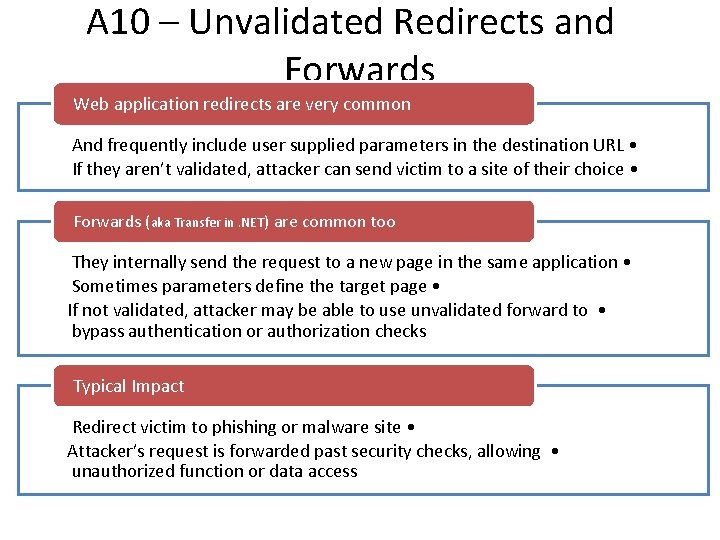
A 10 – Unvalidated Redirects and Forwards Web application redirects are very common And frequently include user supplied parameters in the destination URL • If they aren’t validated, attacker can send victim to a site of their choice • Forwards (aka Transfer in. NET) are common too They internally send the request to a new page in the same application • Sometimes parameters define the target page • If not validated, attacker may be able to use unvalidated forward to • bypass authentication or authorization checks Typical Impact Redirect victim to phishing or malware site • Attacker’s request is forwarded past security checks, allowing • unauthorized function or data access
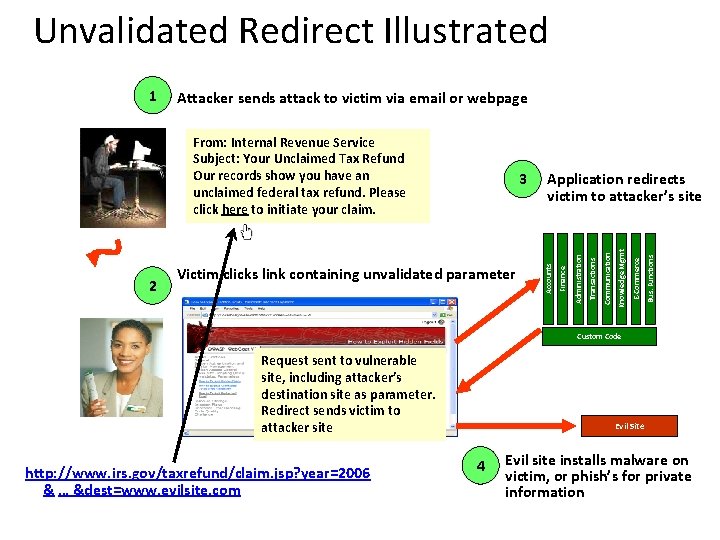
Unvalidated Redirect Illustrated Attacker sends attack to victim via email or webpage Bus. Functions E-Commerce Knowledge Mgmt Communication Transactions Victim clicks link containing unvalidated parameter Application redirects victim to attacker’s site Administration 2 3 Finance From: Internal Revenue Service Subject: Your Unclaimed Tax Refund Our records show you have an unclaimed federal tax refund. Please click here to initiate your claim. Accounts 1 Custom Code Request sent to vulnerable site, including attacker’s destination site as parameter. Redirect sends victim to attacker site http: //www. irs. gov/taxrefund/claim. jsp? year=2006 & … &dest=www. evilsite. com Evil Site 4 Evil site installs malware on victim, or phish’s for private information
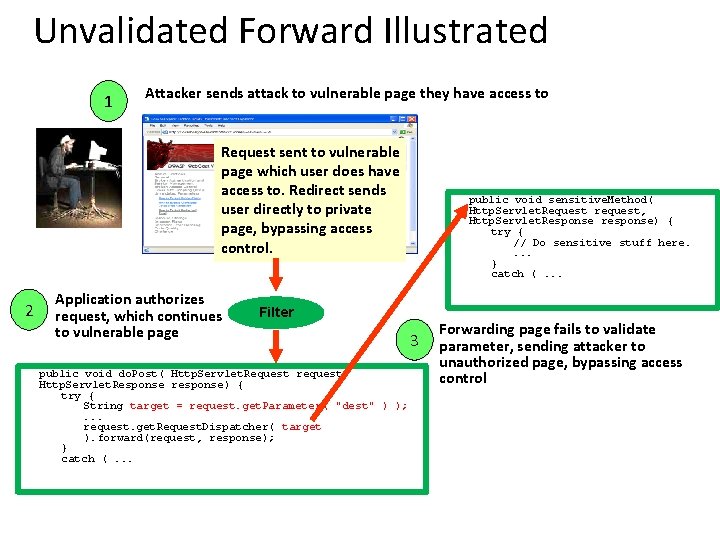
Unvalidated Forward Illustrated 1 Attacker sends attack to vulnerable page they have access to Request sent to vulnerable page which user does have access to. Redirect sends user directly to private page, bypassing access control. 2 Application authorizes request, which continues to vulnerable page public void sensitive. Method( Http. Servlet. Request request, Http. Servlet. Response response) { try { // Do sensitive stuff here. . } catch (. . . Filter public void do. Post( Http. Servlet. Request request, Http. Servlet. Response response) { try { String target = request. get. Parameter( "dest" ) ); . . . request. get. Request. Dispatcher( target ). forward(request, response); } catch (. . . 3 Forwarding page fails to validate parameter, sending attacker to unauthorized page, bypassing access control
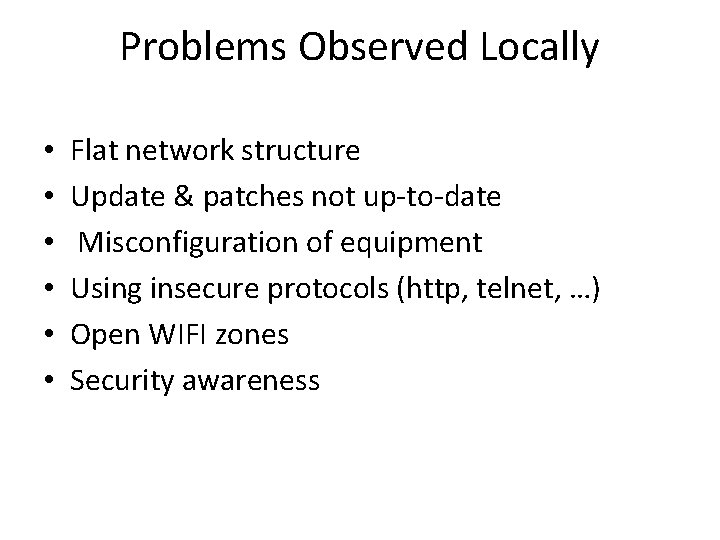
Problems Observed Locally • • • Flat network structure Update & patches not up-to-date Misconfiguration of equipment Using insecure protocols (http, telnet, …) Open WIFI zones Security awareness
Flat network structure • No hierarchy • Attackers have the same access as Admins! • Possible to intercept all traffic
Update & patches not up-to-date • • Clients and/or server are not update Important patches not installed No WSUS server in the organization Easy to attack via automatic tools
Misconfiguration of equipment • Switches and other devices are installed without configuration • Wrong configuration (sometimes worst than factory setting)
Using insecure protocols • Using plain text protocols (http, telnet, …) for access to the important devices • Can be easily intercepted
Open WIFI zones • Open access wireless networks • Using WEP for authentication
Security awareness • Information Security is “Organizational Problem” rather than “IT Problem” • More than 70% of Threats are Internal • More than 60% culprits are First Time fraudsters • Biggest Risk : People • Biggest Asset : People • Social Engineering is major threat • More than 2/3 rd express their inability to determine “Whether my systems are currently compromised? ”
Conclusion • • • More rely on the IT services Security is becoming more important Attacks are becoming more complicated Educating IT professional is very important Security awareness should be considered seriously
End APA FUM http: //cert. um. ac. ir