
Information Security IT 423 Semester II 2017 2018
- Slides: 48
Information Security IT 423 Semester II 2017 - 2018 Dr. Saman Mirza Abdullah saman. mirza@ishik. edu. iq
Class Objective • The main objective of this class is to learn more classical ciphering techniques. o Playfair Ciphering o Hill Cipher. o Polyaplphabetic cipher o One Time Pad (OTP) system o Vigenere. o Auto. Key. Computer Security - Ishik 2
Playfair Ciphering • The Playfair Cipher is a simple transposition cipher offering a relatively weak method of encryption. • It is based around a 5 x 5 matrix, a copy of which is held by both communicating parties, into which • The 25 of the 26 letters of the alphabet (normally either j and i are represented by the same letter or x is ignored) are placed in a random fashion. Computer Security - Ishik 3
Playfair Ciphering • Playfair is now regarded as insecure for any purpose because modern hand-held computers could easily break the cipher within seconds • The first published solution of the Playfair cipher was published in 1914 Computer Security - Ishik 4
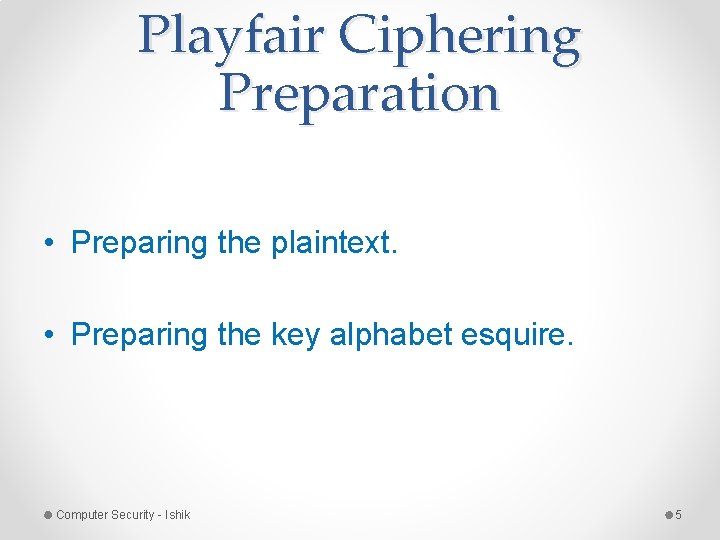
Playfair Ciphering Preparation • Preparing the plaintext. • Preparing the key alphabet esquire. Computer Security - Ishik 5
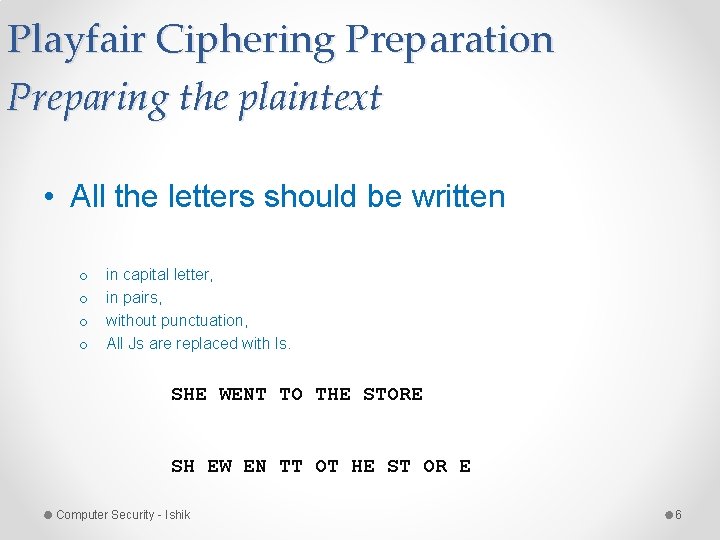
Playfair Ciphering Preparation Preparing the plaintext • All the letters should be written o o in capital letter, in pairs, without punctuation, All Js are replaced with Is. SHE WENT TO THE STORE SH EW EN TT OT HE ST OR E Computer Security - Ishik 6
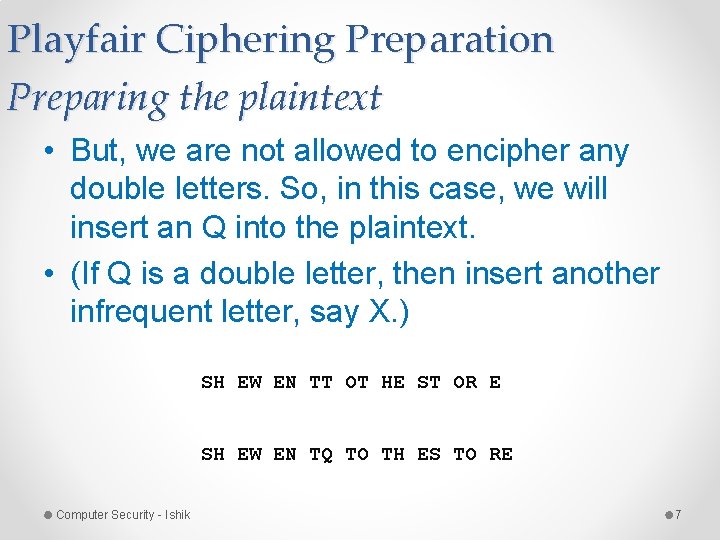
Playfair Ciphering Preparation Preparing the plaintext • But, we are not allowed to encipher any double letters. So, in this case, we will insert an Q into the plaintext. • (If Q is a double letter, then insert another infrequent letter, say X. ) SH EW EN TT OT HE ST OR E SH EW EN TQ TO TH ES TO RE Computer Security - Ishik 7
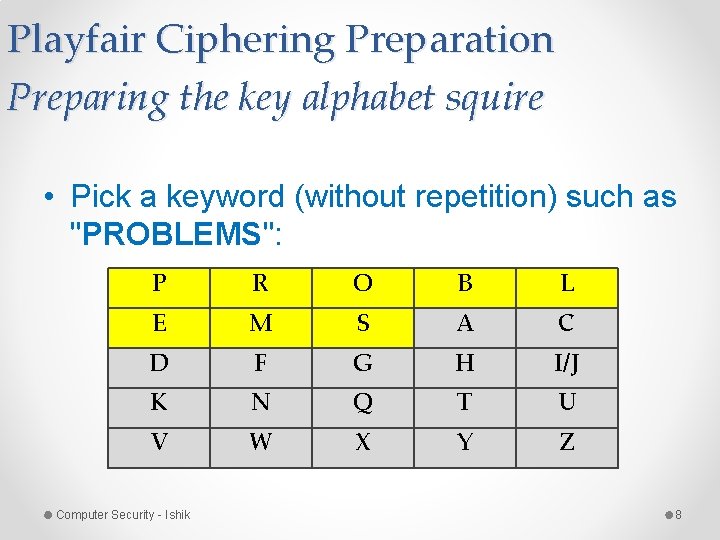
Playfair Ciphering Preparation Preparing the key alphabet squire • Pick a keyword (without repetition) such as "PROBLEMS": P R O B L E M S A C D F G H I/J K N Q T U V W X Y Z Computer Security - Ishik 8
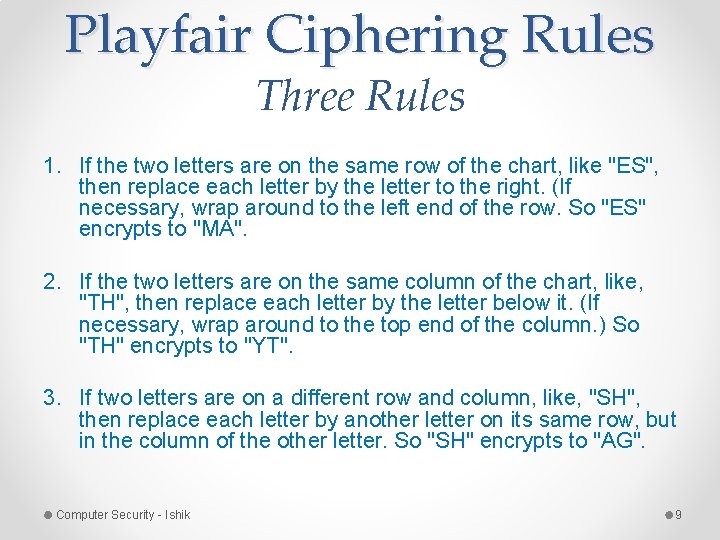
Playfair Ciphering Rules Three Rules 1. If the two letters are on the same row of the chart, like "ES", then replace each letter by the letter to the right. (If necessary, wrap around to the left end of the row. So "ES" encrypts to "MA". 2. If the two letters are on the same column of the chart, like, "TH", then replace each letter by the letter below it. (If necessary, wrap around to the top end of the column. ) So "TH" encrypts to "YT". 3. If two letters are on a different row and column, like, "SH", then replace each letter by another letter on its same row, but in the column of the other letter. So "SH" encrypts to "AG". Computer Security - Ishik 9
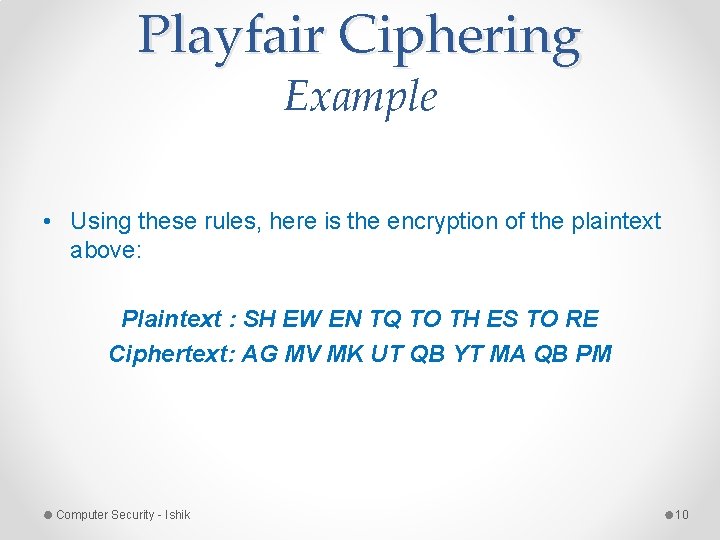
Playfair Ciphering Example • Using these rules, here is the encryption of the plaintext above: Plaintext : SH EW EN TQ TO TH ES TO RE Ciphertext: AG MV MK UT QB YT MA QB PM Computer Security - Ishik 10
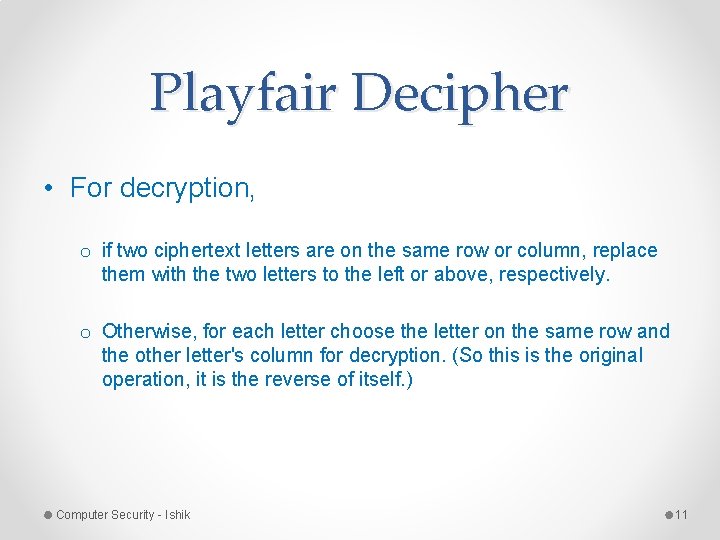
Playfair Decipher • For decryption, o if two ciphertext letters are on the same row or column, replace them with the two letters to the left or above, respectively. o Otherwise, for each letter choose the letter on the same row and the other letter's column for decryption. (So this is the original operation, it is the reverse of itself. ) Computer Security - Ishik 11
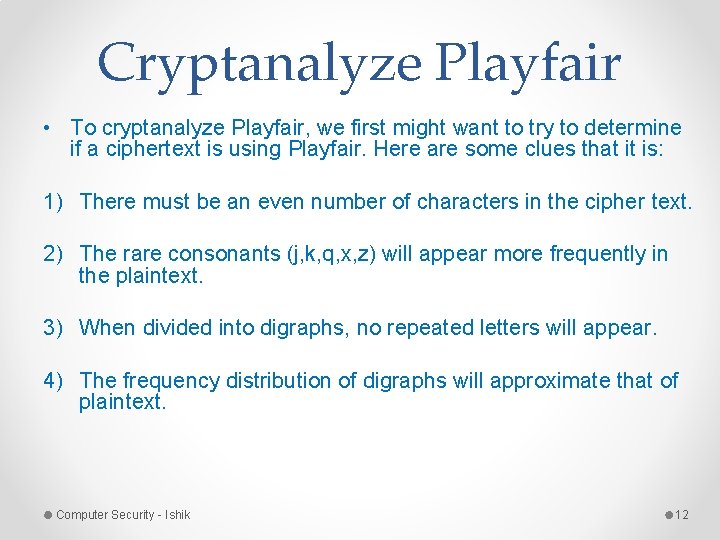
Cryptanalyze Playfair • To cryptanalyze Playfair, we first might want to try to determine if a ciphertext is using Playfair. Here are some clues that it is: 1) There must be an even number of characters in the cipher text. 2) The rare consonants (j, k, q, x, z) will appear more frequently in the plaintext. 3) When divided into digraphs, no repeated letters will appear. 4) The frequency distribution of digraphs will approximate that of plaintext. Computer Security - Ishik 12
Cryptanalyze Playfair • Here are some other unique characteristics of the Playfair cipher: 1) No single letter ever encrypts to itself. 2) Two reversed digraphs in the plaintext will always be represented by reverse digraphs in the ciphertext. 3) Every single letter from the plaintext can be enciphered by one of only five other letters – the one directly below it in the Playfair square or the other four in its row. Computer Security - Ishik 13
Ask yourself? • If I know the Ciphertext, can I determine the followings: • The plaintext • The square ( 5 x 5) keyword alphabets Computer Security - Ishik 14
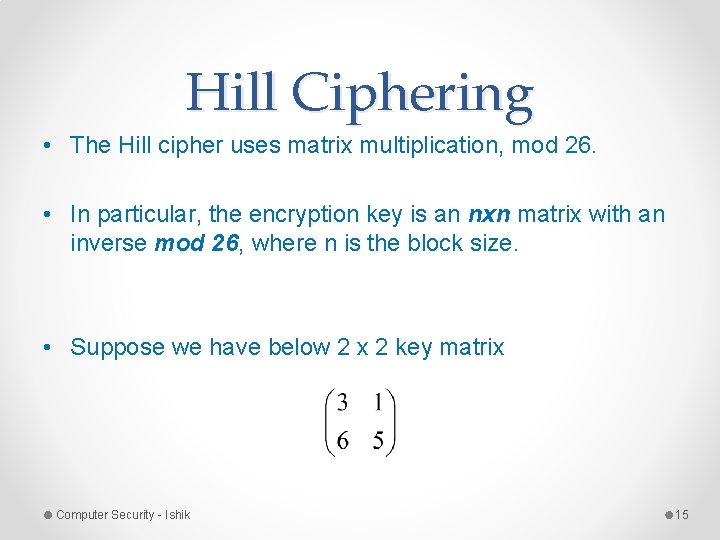
Hill Ciphering • The Hill cipher uses matrix multiplication, mod 26. • In particular, the encryption key is an nxn matrix with an inverse mod 26, where n is the block size. • Suppose we have below 2 x 2 key matrix Computer Security - Ishik 15
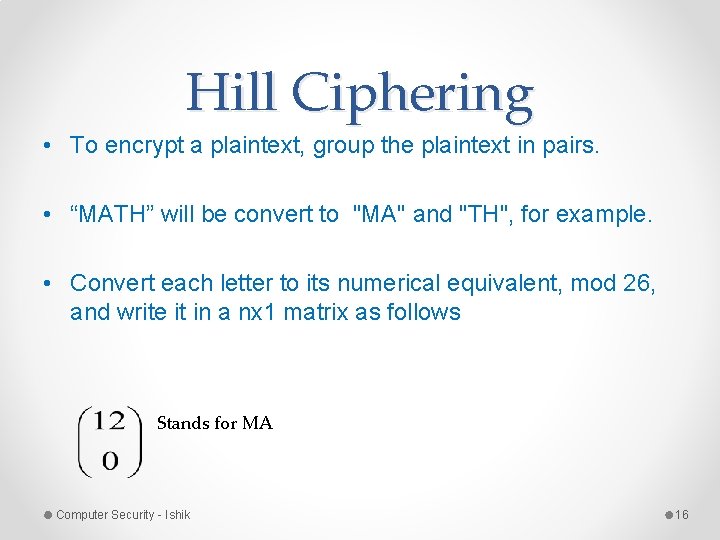
Hill Ciphering • To encrypt a plaintext, group the plaintext in pairs. • “MATH” will be convert to "MA" and "TH", for example. • Convert each letter to its numerical equivalent, mod 26, and write it in a nx 1 matrix as follows Stands for MA Computer Security - Ishik 16
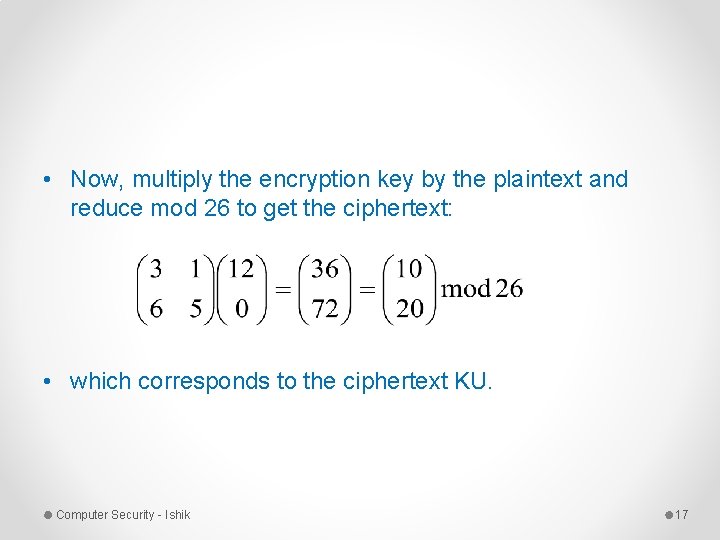
• Now, multiply the encryption key by the plaintext and reduce mod 26 to get the ciphertext: • which corresponds to the ciphertext KU. Computer Security - Ishik 17
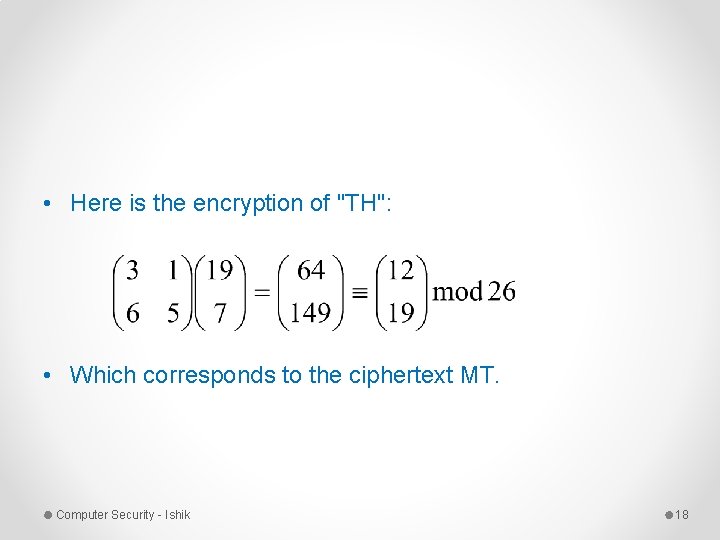
• Here is the encryption of "TH": • Which corresponds to the ciphertext MT. Computer Security - Ishik 18
Polyalphabetic Ciphers Vigenere
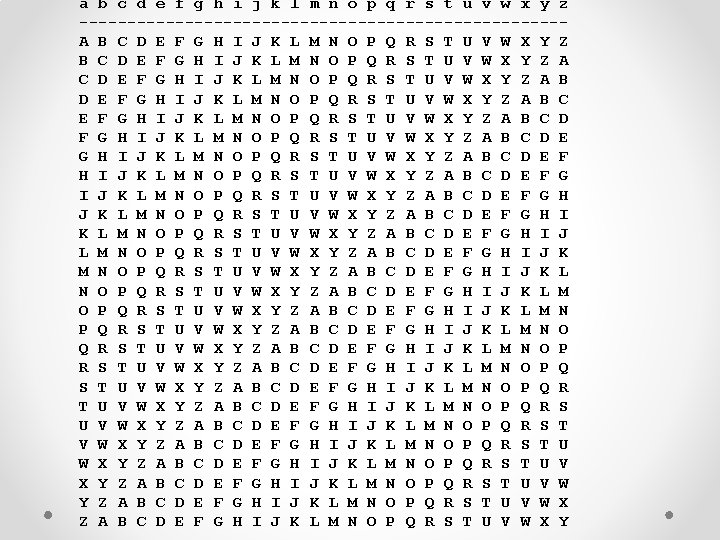
Main Idea • Use multiple monoalphabetic ciphers • Change alphabet every letter • Variations possible, but simple version seems to have been commonly used (even though it can be broken)
a b c d e f g h i j k l m n o p q r s t u v w x y z -------------------------A B C D E F G H I J K L M N O P Q R S T U V W X Y Z A B C E F G H I J K L M N O P Q R S T U V W X Y Z A B C D E F G I J K L M N O P Q R S T U V W X Y Z A B C D E F G H I J K M N O P Q R S T U V W X Y Z A B C D E F G H I J K L M N O Q R S T U V W X Y Z A B C D E F G H I J K L M N O P Q R S U V W X Y Z A B C D E F G H I J K L M N O P Q R S T U V W Y Z A B C D E F G H I J K L M N O P Q R S T U V W X Y
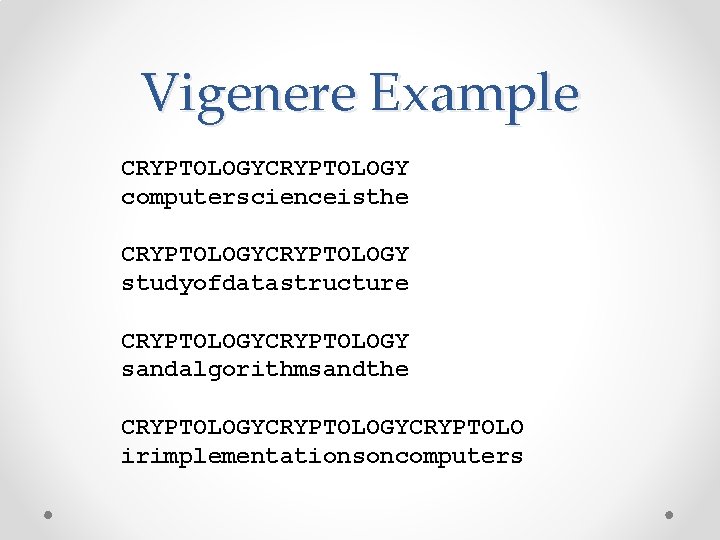
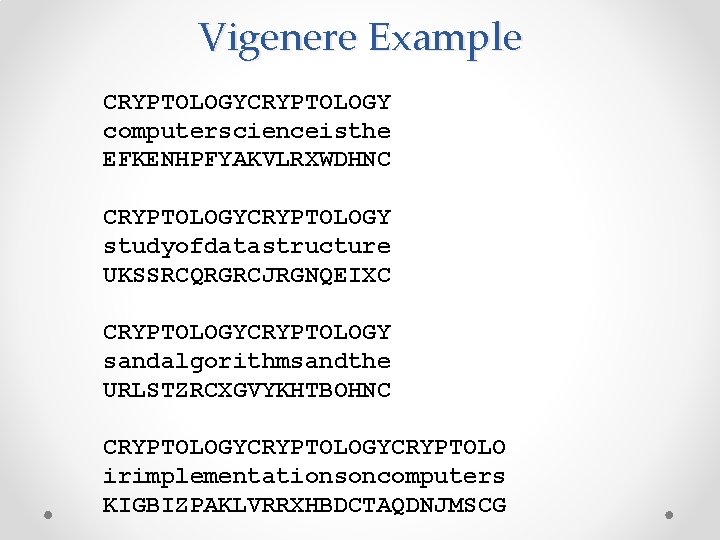
Vigenere Scheme • Keyword (or phrase) used to indicate which alphabet to use for encoding (by first letter) • Keyword repeated over plaintext. • The key-letter over each plaintext letter determines the alphabet used to encipher that letter • Example: use cryptology as keyword
Vigenere Example CRYPTOLOGY computerscienceisthe CRYPTOLOGY studyofdatastructure CRYPTOLOGY sandalgorithmsandthe CRYPTOLOGYCRYPTOLO irimplementationsoncomputers
Vigenere Example CRYPTOLOGY computerscienceisthe EFKENHPFYAKVLRXWDHNC CRYPTOLOGY studyofdatastructure UKSSRCQRGRCJRGNQEIXC CRYPTOLOGY sandalgorithmsandthe URLSTZRCXGVYKHTBOHNC CRYPTOLOGYCRYPTOLO irimplementationsoncomputers KIGBIZPAKLVRRXHBDCTAQDNJMSCG
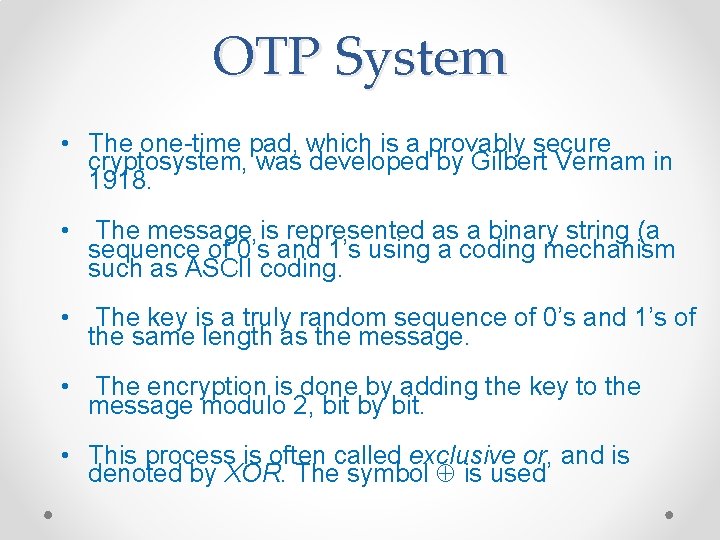
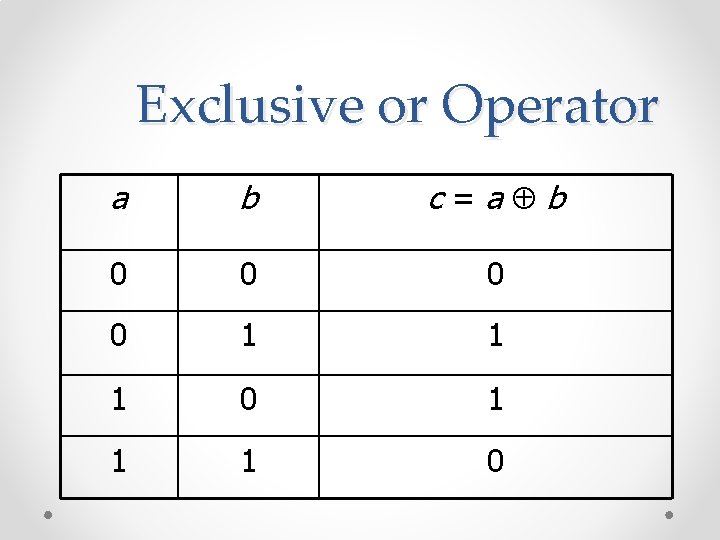
OTP System • The one-time pad, which is a provably secure cryptosystem, was developed by Gilbert Vernam in 1918. • The message is represented as a binary string (a sequence of 0’s and 1’s using a coding mechanism such as ASCII coding. • The key is a truly random sequence of 0’s and 1’s of the same length as the message. • The encryption is done by adding the key to the message modulo 2, bit by bit. • This process is often called exclusive or, and is denoted by XOR. The symbol is used
Exclusive or Operator a b c=a b 0 0 1 1 1 0
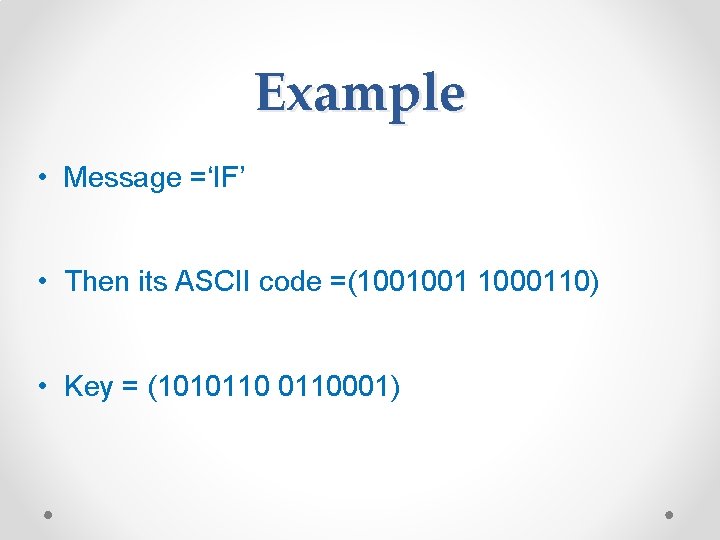
Example • Message =‘IF’ • Then its ASCII code =(1001001 1000110) • Key = (1010110001)
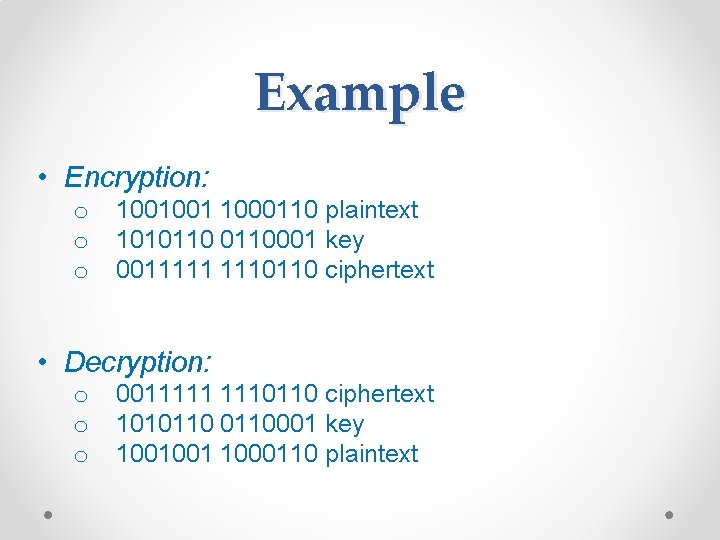
Example • Encryption: o 1001001 1000110 plaintext o 1010110001 key o 0011111 1110110 ciphertext • Decryption: o 0011111 1110110 ciphertext o 1010110001 key o 1001001 1000110 plaintext
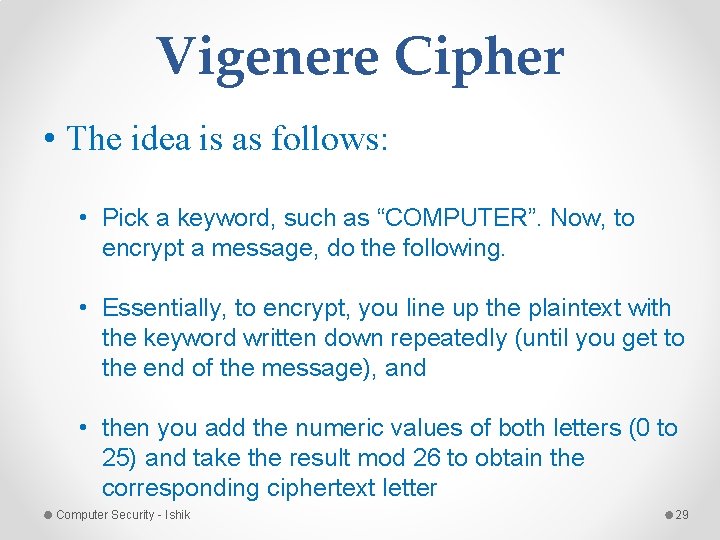
Vigenere Cipher • The idea is as follows: • Pick a keyword, such as “COMPUTER”. Now, to encrypt a message, do the following. • Essentially, to encrypt, you line up the plaintext with the keyword written down repeatedly (until you get to the end of the message), and • then you add the numeric values of both letters (0 to 25) and take the result mod 26 to obtain the corresponding ciphertext letter Computer Security - Ishik 29
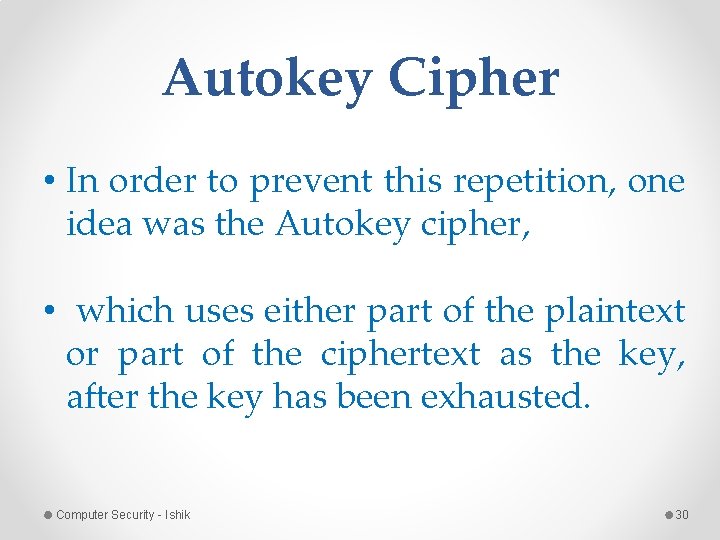
Autokey Cipher • In order to prevent this repetition, one idea was the Autokey cipher, • which uses either part of the plaintext or part of the ciphertext as the key, after the key has been exhausted. Computer Security - Ishik 30
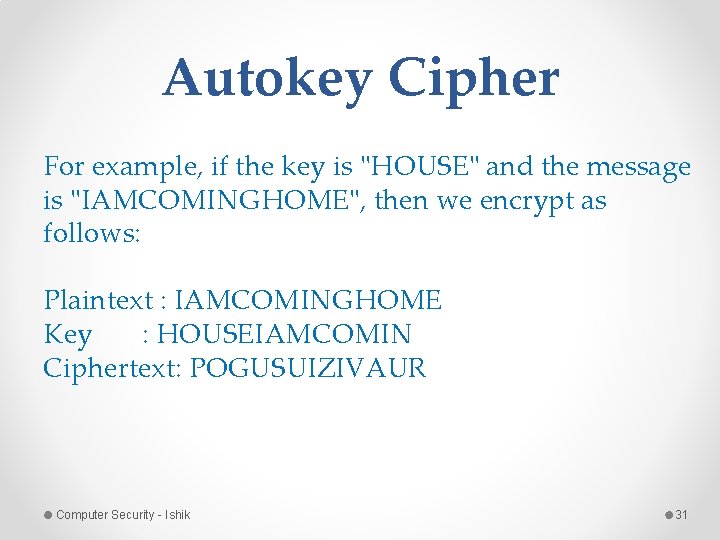
Autokey Cipher For example, if the key is "HOUSE" and the message is "IAMCOMINGHOME", then we encrypt as follows: Plaintext : IAMCOMINGHOME Key : HOUSEIAMCOMIN Ciphertext: POGUSUIZIVAUR Computer Security - Ishik 31
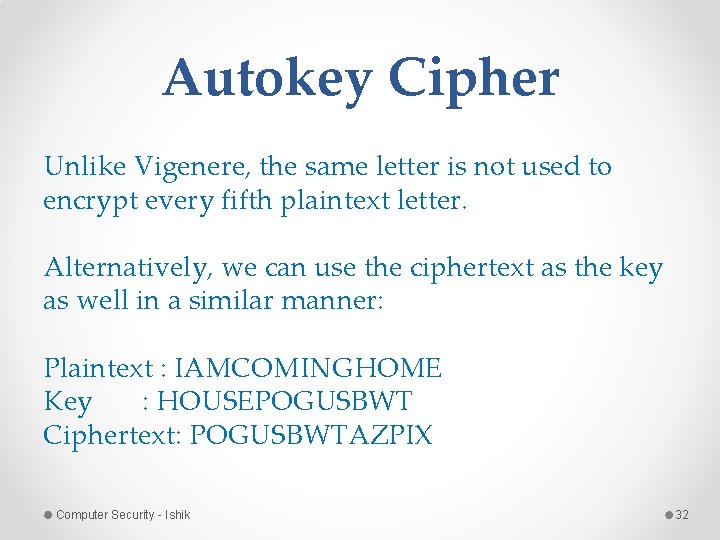
Autokey Cipher Unlike Vigenere, the same letter is not used to encrypt every fifth plaintext letter. Alternatively, we can use the ciphertext as the key as well in a similar manner: Plaintext : IAMCOMINGHOME Key : HOUSEPOGUSBWT Ciphertext: POGUSBWTAZPIX Computer Security - Ishik 32
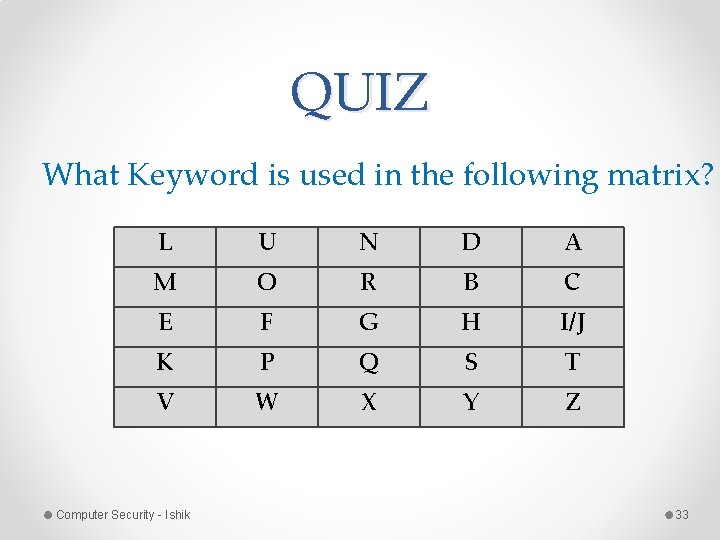
QUIZ What Keyword is used in the following matrix? L U N D A M O R B C E F G H I/J K P Q S T V W X Y Z Computer Security - Ishik 33
Assignment Code the Vigenere classical cipher and decipher technique. Use any programming language you prefer. The class preferred Matlab. Computer Security - Ishik 34
Cryptography -- Block Ciphers
A few terms • block cipher o block of plaintext is treated as a whole & used to produce a ciphertext block of equal length o typical size: 64 bits o most modern ciphers are block ciphers • stream cipher o digital data is encrypted one bit (or one unit) at a time In both cases, plaintext is transformed incrementally
Symmetric ciphers Symmetric suggests ONE key Secret key shared by sender & receiver
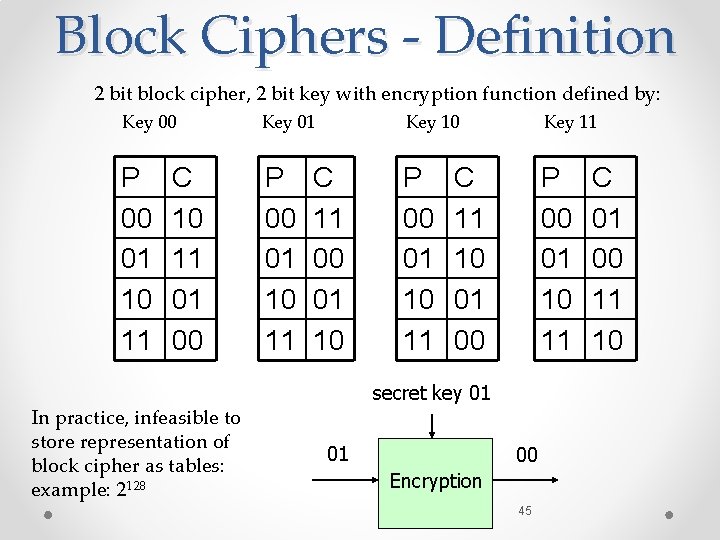
Background • ideally want one extremely large substitution • not practical since would need a table with 264 entries in it for a 64 -bit block • so approximate the ideal by constructing from smaller building blocks
Basis of modern ciphers • Claude Shannon (‘ 45) - information theory • product cipher o perform two or more ciphers in sequence so that result (product) is cryptographically stronger than any component cipher • alternate confusion & diffusion • virtually all significant symmetric block ciphers currently in use are of this type
Shannon’s strategy • Stop cryptanalysis that is based on statistical analysis • hacker has some knowledge of statistical characteristic of plaintext • if statistics are reflected in ciphertext, then analyst may be able to deduce encryption key, or part of it • in Shannon’s ideal cipher, statistics of ciphertext are independent of plaintext
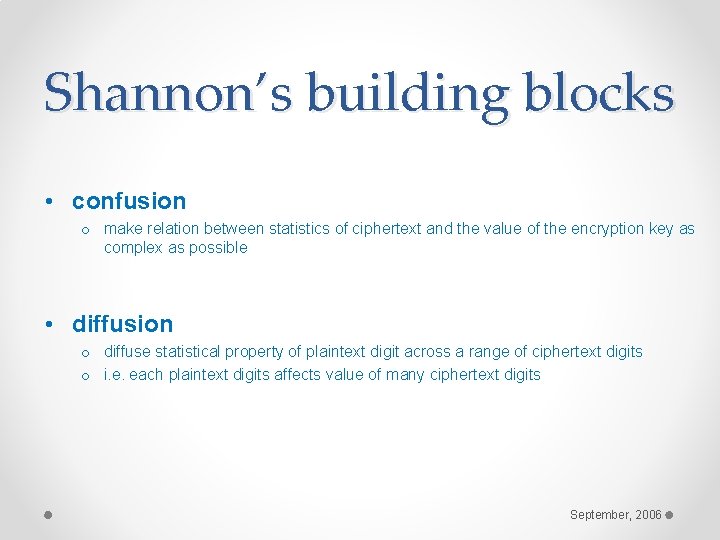
Shannon’s building blocks • confusion o make relation between statistics of ciphertext and the value of the encryption key as complex as possible • diffusion o diffuse statistical property of plaintext digit across a range of ciphertext digits o i. e. each plaintext digits affects value of many ciphertext digits September, 2006
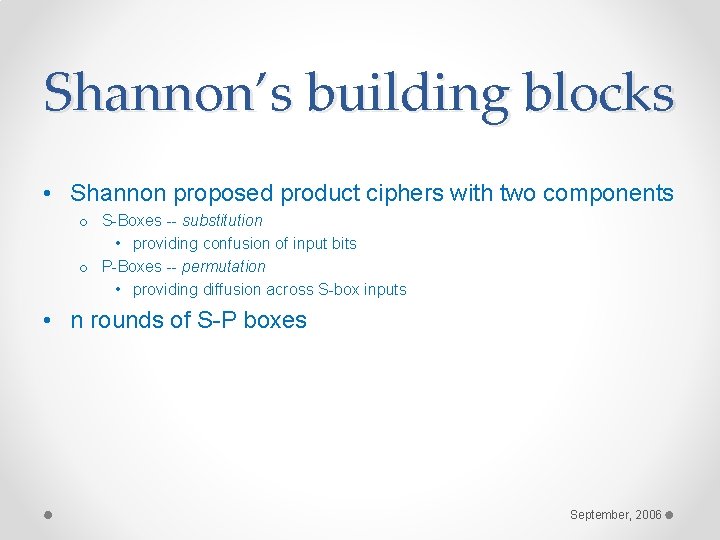
Shannon’s building blocks • Shannon proposed product ciphers with two components o S-Boxes -- substitution • providing confusion of input bits o P-Boxes -- permutation • providing diffusion across S-box inputs • n rounds of S-P boxes September, 2006
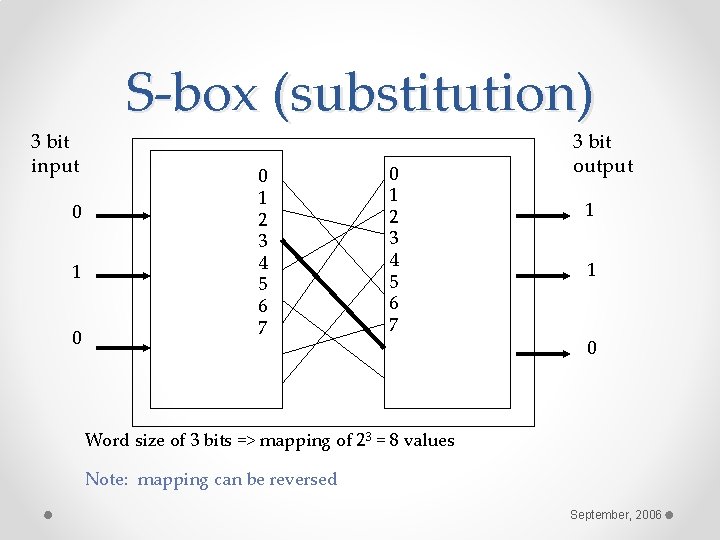
3 bit input 0 1 0 S-box (substitution) 0 1 2 3 4 5 6 7 3 bit output 1 1 0 Word size of 3 bits => mapping of 23 = 8 values Note: mapping can be reversed September, 2006
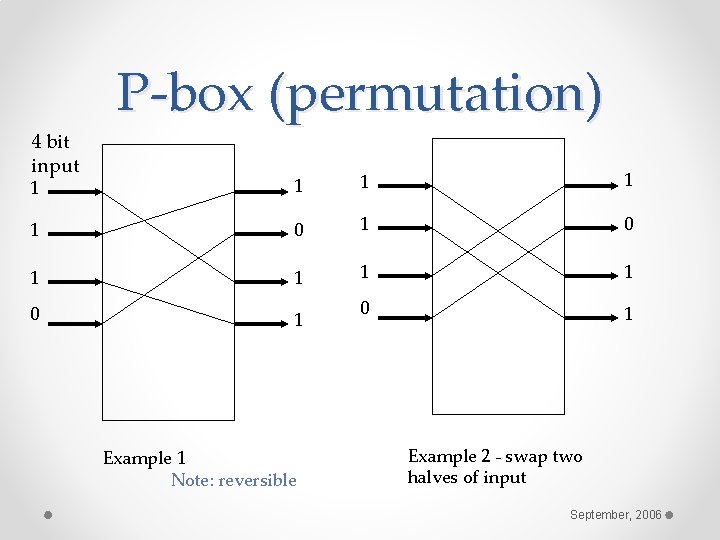
4 bit input P-box (permutation) 1 1 1 0 1 Example 1 Note: reversible Example 2 - swap two halves of input September, 2006
Block Ciphers - Definition 2 bit block cipher, 2 bit key with encryption function defined by: Key 00 Key 01 Key 10 Key 11 P 00 01 10 11 C 10 11 01 00 In practice, infeasible to store representation of block cipher as tables: example: 2128 C 11 00 01 10 C 11 10 01 00 secret key 01 01 00 Encryption 45 C 01 00 11 10
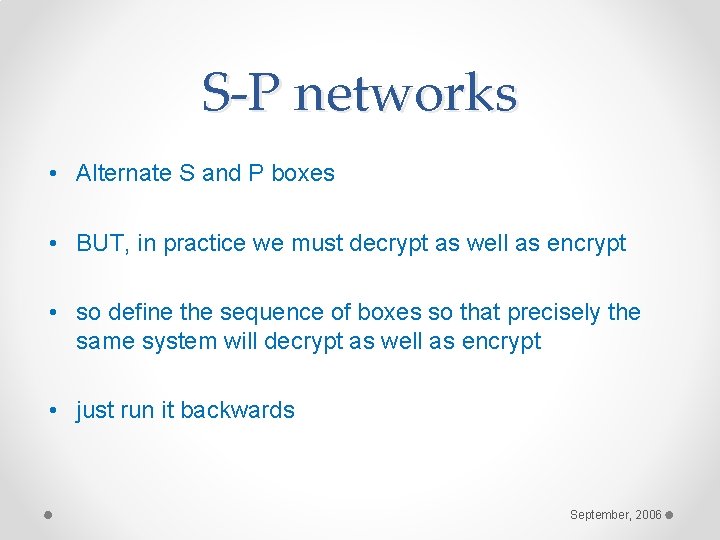
S-P networks • Alternate S and P boxes • BUT, in practice we must decrypt as well as encrypt • so define the sequence of boxes so that precisely the same system will decrypt as well as encrypt • just run it backwards September, 2006
Class End Computer Security - Ishik 47
Class End Computer Security - Ishik 48