
Information Security CS 526 Topic 3 Cryptography Onetime

![Bayes’ Theorem If P[y] > 0 then Corollary X and Y are independent random](https://slidetodoc.com/presentation_image_h/b75bb046c1af2af262cff18dd586848a/image-10.jpg "Bayes’ Theorem If P[y] > 0 then Corollary X and Y are independent random")
![Explanation of the Definition – Pr [PT = m] is what the adversary believes](https://slidetodoc.com/presentation_image_h/b75bb046c1af2af262cff18dd586848a/image-18.jpg "Explanation of the Definition – Pr [PT = m] is what the adversary believes")
- Slides: 32
Information Security CS 526 Topic 3 Cryptography: One-time Pad, Information Theoretic Security, and Stream CIphers CS 526 Topic 3: One-time Pad and Perfect Secrecy 1
Announcements • HW 1 is out, due on Sep 5 – Start early, late policy is 3 total late days • TA Office hour set – Mohammed Almeshekah: Office: LWSN 2161; Office hour: Monday 10 am to 11 am, Thursday 9 am to 10 am – Weining Yang: Office: LWSN 2161; Office hour: Wednesday 10 am to 11 am, Friday 1 pm to 2 pm • Planned project 1: web security, to be assigned on Sep 19 • Planned project 2: implementation of file encryption CS 526 Topic 3: One-time Pad and Perfect Secrecy 2
Readings for This Lecture • Required reading from wikipedia • • One-Time Pad Information theoretic security Stream cipher Pseudorandom number generator • Stream ciphers on Dan Boneh’s Cryptography I course on Coursea CS 526 Topic 3: One-time Pad and Perfect Secrecy 3
Begin Math CS 526 Topic 3: One-time Pad and Perfect Secrecy 4
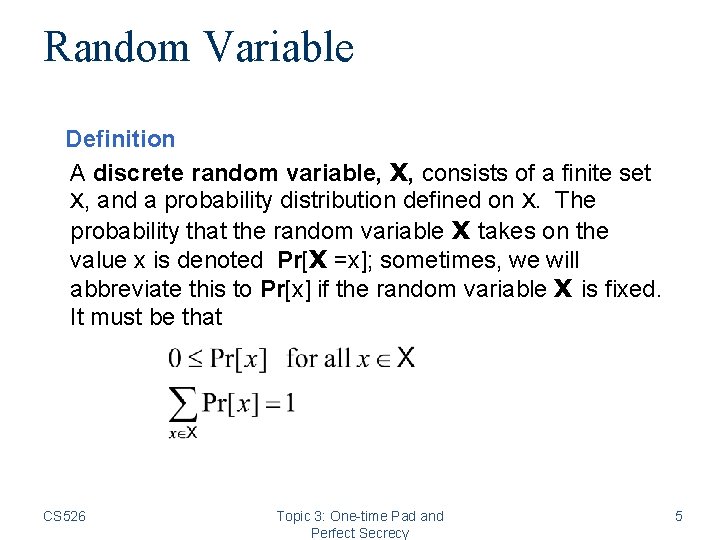
Random Variable Definition A discrete random variable, X, consists of a finite set X, and a probability distribution defined on X. The probability that the random variable X takes on the value x is denoted Pr[X =x]; sometimes, we will abbreviate this to Pr[x] if the random variable X is fixed. It must be that CS 526 Topic 3: One-time Pad and Perfect Secrecy 5
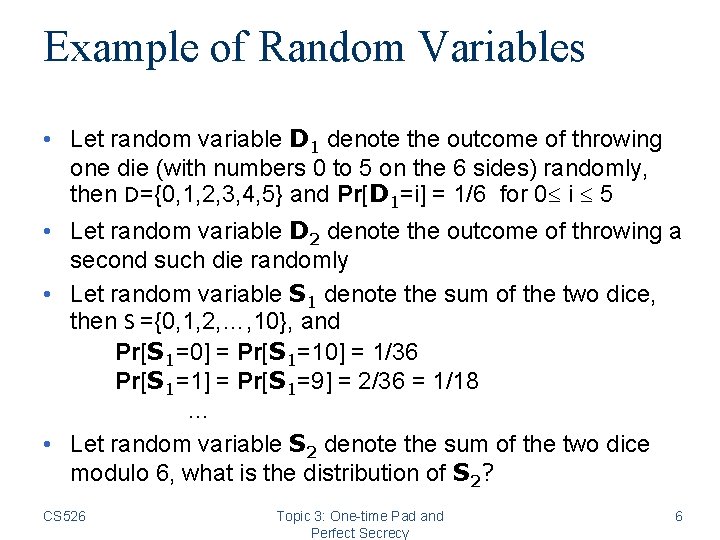
Example of Random Variables • Let random variable D 1 denote the outcome of throwing one die (with numbers 0 to 5 on the 6 sides) randomly, then D={0, 1, 2, 3, 4, 5} and Pr[D 1=i] = 1/6 for 0 i 5 • Let random variable D 2 denote the outcome of throwing a second such die randomly • Let random variable S 1 denote the sum of the two dice, then S ={0, 1, 2, …, 10}, and Pr[S 1=0] = Pr[S 1=10] = 1/36 Pr[S 1=1] = Pr[S 1=9] = 2/36 = 1/18 … • Let random variable S 2 denote the sum of the two dice modulo 6, what is the distribution of S 2? CS 526 Topic 3: One-time Pad and Perfect Secrecy 6
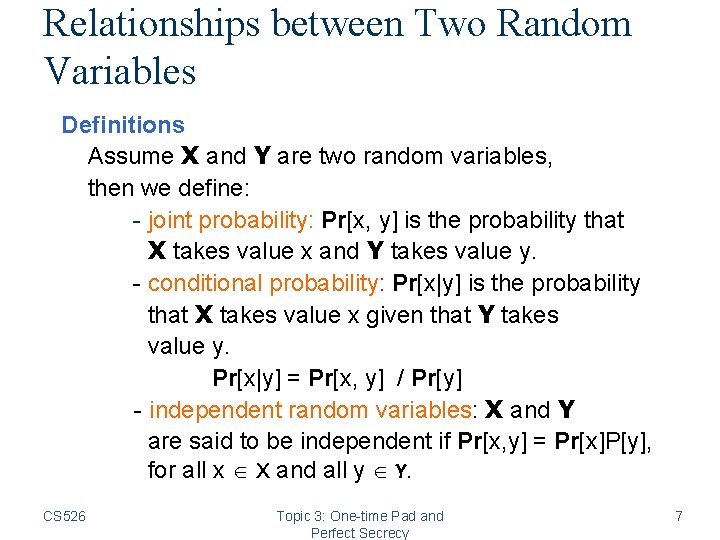
Relationships between Two Random Variables Definitions Assume X and Y are two random variables, then we define: - joint probability: Pr[x, y] is the probability that X takes value x and Y takes value y. - conditional probability: Pr[x|y] is the probability that X takes value x given that Y takes value y. Pr[x|y] = Pr[x, y] / Pr[y] - independent random variables: X and Y are said to be independent if Pr[x, y] = Pr[x]P[y], for all x X and all y Y. CS 526 Topic 3: One-time Pad and Perfect Secrecy 7
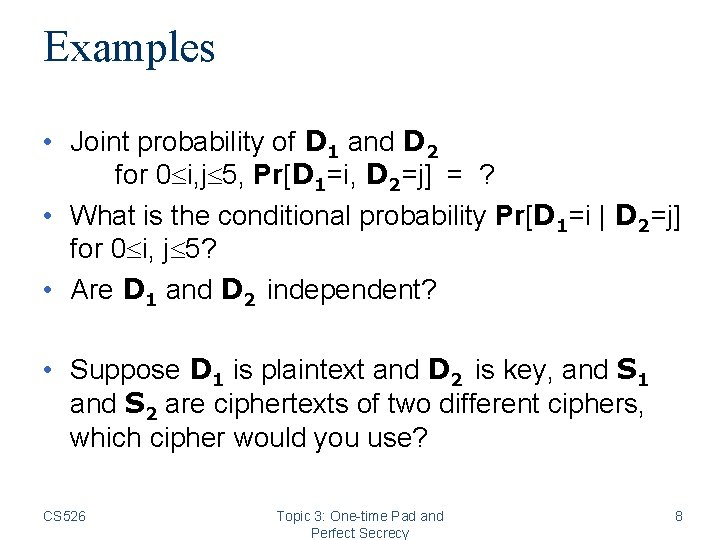
Examples • Joint probability of D 1 and D 2 for 0 i, j 5, Pr[D 1=i, D 2=j] = ? • What is the conditional probability Pr[D 1=i | D 2=j] for 0 i, j 5? • Are D 1 and D 2 independent? • Suppose D 1 is plaintext and D 2 is key, and S 1 and S 2 are ciphertexts of two different ciphers, which cipher would you use? CS 526 Topic 3: One-time Pad and Perfect Secrecy 8
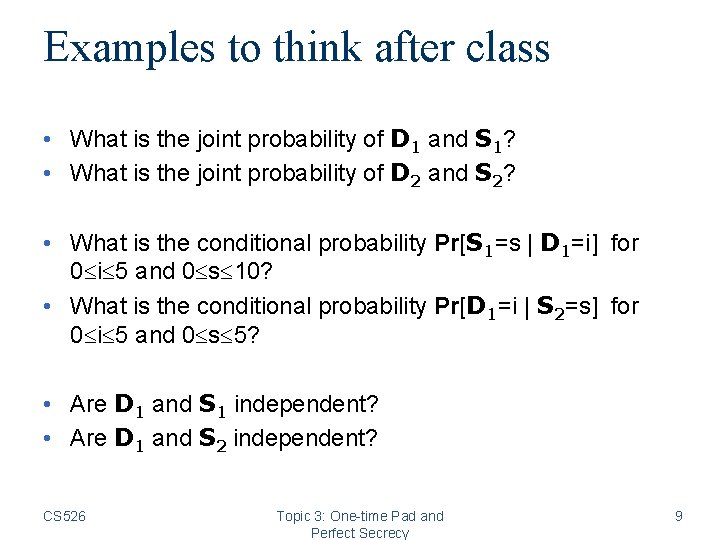
Examples to think after class • What is the joint probability of D 1 and S 1? • What is the joint probability of D 2 and S 2? • What is the conditional probability Pr[S 1=s | D 1=i] for 0 i 5 and 0 s 10? • What is the conditional probability Pr[D 1=i | S 2=s] for 0 i 5 and 0 s 5? • Are D 1 and S 1 independent? • Are D 1 and S 2 independent? CS 526 Topic 3: One-time Pad and Perfect Secrecy 9
Bayes’ Theorem If P[y] > 0 then Corollary X and Y are independent random variables iff P[x|y] = P[x], for all x X and all y Y. CS 526 Topic 3: One-time Pad and Perfect Secrecy 10
End Math CS 526 Topic 3: One-time Pad and Perfect Secrecy 11
One-Time Pad • Fix the vulnerability of the Vigenere cipher by using very long keys • Key is a random string that is at least as long as the plaintext • Encryption is similar to shift cipher • Invented by Vernam in the 1920 s CS 526 Topic 3: One-time Pad and Perfect Secrecy 12
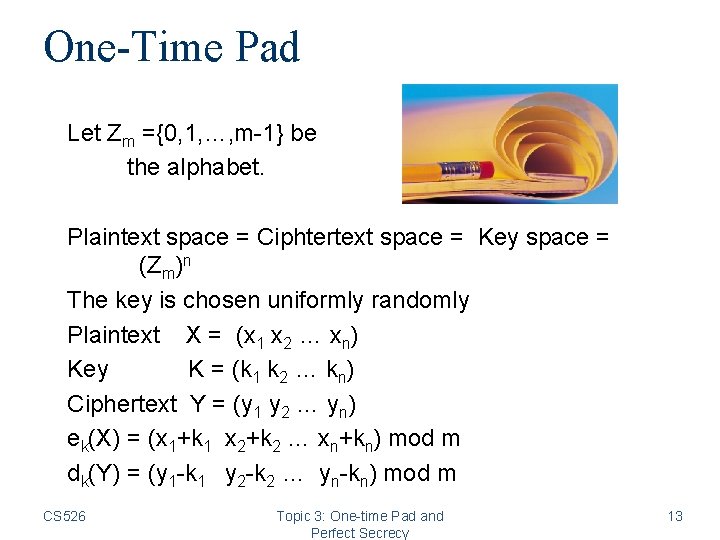
One-Time Pad Let Zm ={0, 1, …, m-1} be the alphabet. Plaintext space = Ciphtertext space = Key space = (Zm)n The key is chosen uniformly randomly Plaintext X = (x 1 x 2 … xn) Key K = (k 1 k 2 … kn) Ciphertext Y = (y 1 y 2 … yn) ek(X) = (x 1+k 1 x 2+k 2 … xn+kn) mod m dk(Y) = (y 1 -k 1 y 2 -k 2 … yn-kn) mod m CS 526 Topic 3: One-time Pad and Perfect Secrecy 13
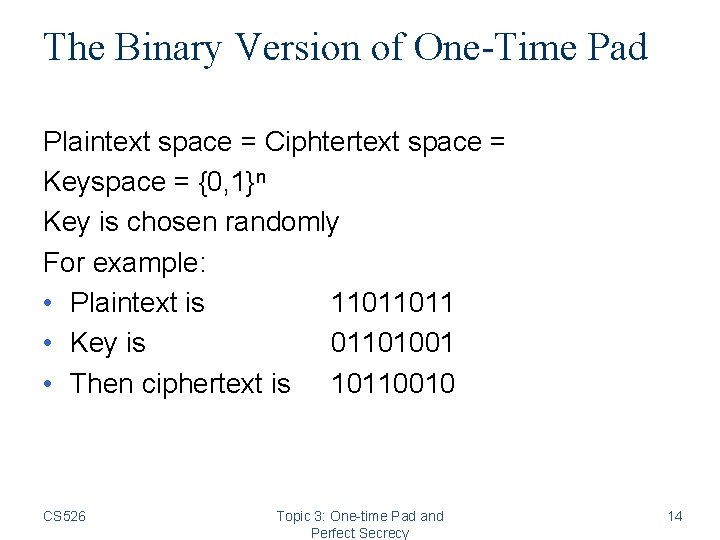
The Binary Version of One-Time Pad Plaintext space = Ciphtertext space = Keyspace = {0, 1}n Key is chosen randomly For example: • Plaintext is 11011011 • Key is 01101001 • Then ciphertext is 10110010 CS 526 Topic 3: One-time Pad and Perfect Secrecy 14
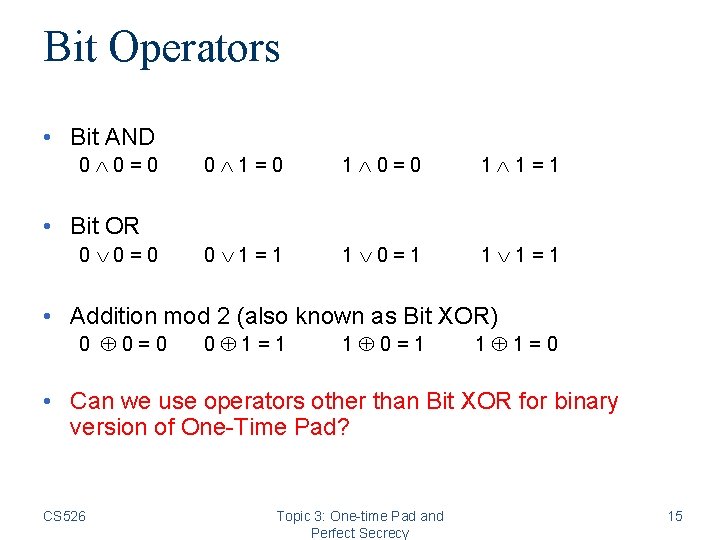
Bit Operators • Bit AND 0 0=0 0 1=0 1 0=0 1 1=1 0 1=1 1 0=1 1 1=1 • Bit OR 0 0=0 • Addition mod 2 (also known as Bit XOR) 0 0 = 0 0 1=1 1 0=1 1 1=0 • Can we use operators other than Bit XOR for binary version of One-Time Pad? CS 526 Topic 3: One-time Pad and Perfect Secrecy 15
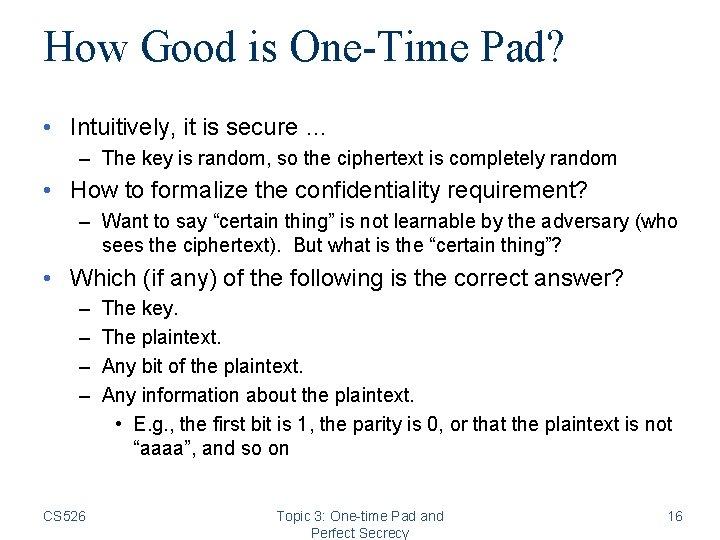
How Good is One-Time Pad? • Intuitively, it is secure … – The key is random, so the ciphertext is completely random • How to formalize the confidentiality requirement? – Want to say “certain thing” is not learnable by the adversary (who sees the ciphertext). But what is the “certain thing”? • Which (if any) of the following is the correct answer? – – CS 526 The key. The plaintext. Any bit of the plaintext. Any information about the plaintext. • E. g. , the first bit is 1, the parity is 0, or that the plaintext is not “aaaa”, and so on Topic 3: One-time Pad and Perfect Secrecy 16
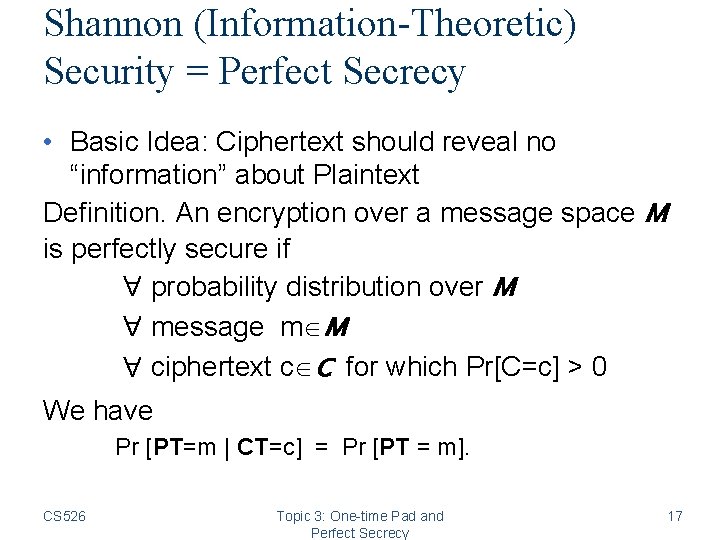
Shannon (Information-Theoretic) Security = Perfect Secrecy • Basic Idea: Ciphertext should reveal no “information” about Plaintext Definition. An encryption over a message space M is perfectly secure if probability distribution over M message m M ciphertext c C for which Pr[C=c] > 0 We have Pr [PT=m | CT=c] = Pr [PT = m]. CS 526 Topic 3: One-time Pad and Perfect Secrecy 17
Explanation of the Definition – Pr [PT = m] is what the adversary believes the probability that the plaintext is m, before seeing the ciphertext – Pr [PT = m | CT=c] is what the adversary believes after seeing that the ciphertext is c – Pr [PT=m | CT=c] = Pr [PT = m] means that after knowing that the ciphertext is C 0, the adversary’s belief does not change. CS 526 Topic 3: One-time Pad and Perfect Secrecy 18
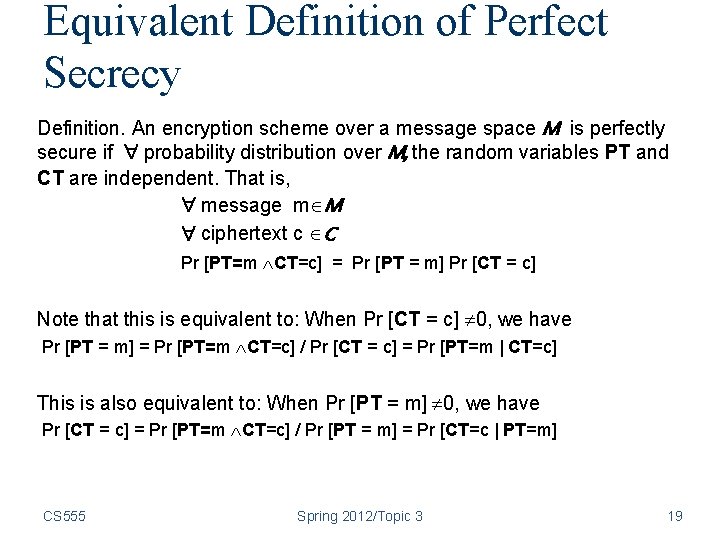
Equivalent Definition of Perfect Secrecy Definition. An encryption scheme over a message space M is perfectly secure if probability distribution over M, the random variables PT and CT are independent. That is, message m M ciphertext c C Pr [PT=m CT=c] = Pr [PT = m] Pr [CT = c] Note that this is equivalent to: When Pr [CT = c] 0, we have Pr [PT = m] = Pr [PT=m CT=c] / Pr [CT = c] = Pr [PT=m | CT=c] This is also equivalent to: When Pr [PT = m] 0, we have Pr [CT = c] = Pr [PT=m CT=c] / Pr [PT = m] = Pr [CT=c | PT=m] CS 555 Spring 2012/Topic 3 19
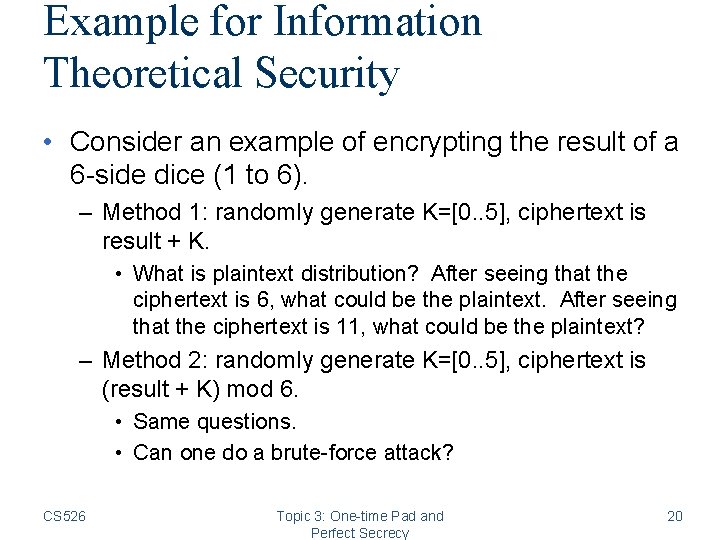
Example for Information Theoretical Security • Consider an example of encrypting the result of a 6 -side dice (1 to 6). – Method 1: randomly generate K=[0. . 5], ciphertext is result + K. • What is plaintext distribution? After seeing that the ciphertext is 6, what could be the plaintext. After seeing that the ciphertext is 11, what could be the plaintext? – Method 2: randomly generate K=[0. . 5], ciphertext is (result + K) mod 6. • Same questions. • Can one do a brute-force attack? CS 526 Topic 3: One-time Pad and Perfect Secrecy 20
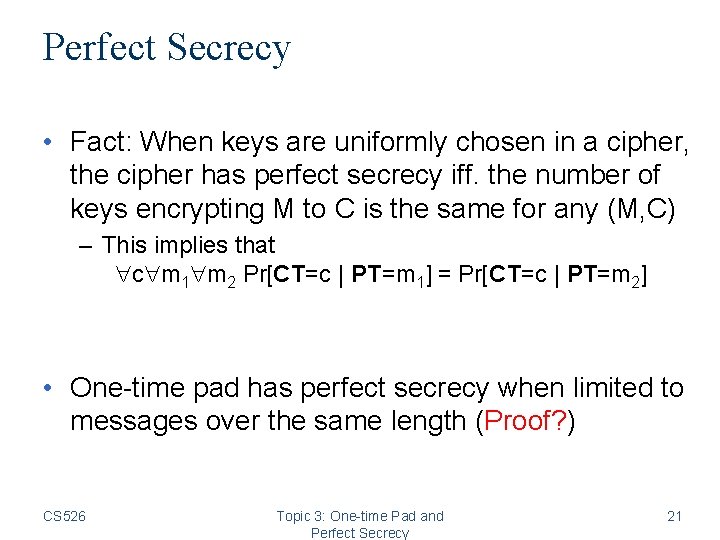
Perfect Secrecy • Fact: When keys are uniformly chosen in a cipher, the cipher has perfect secrecy iff. the number of keys encrypting M to C is the same for any (M, C) – This implies that c m 1 m 2 Pr[CT=c | PT=m 1] = Pr[CT=c | PT=m 2] • One-time pad has perfect secrecy when limited to messages over the same length (Proof? ) CS 526 Topic 3: One-time Pad and Perfect Secrecy 21
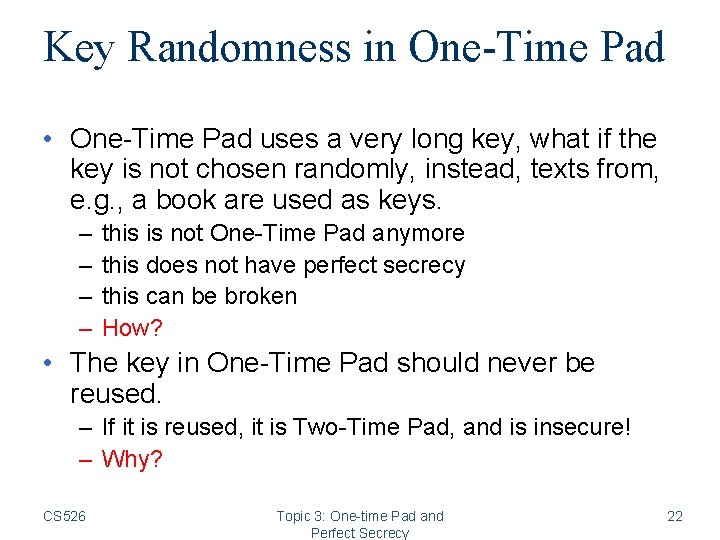
Key Randomness in One-Time Pad • One-Time Pad uses a very long key, what if the key is not chosen randomly, instead, texts from, e. g. , a book are used as keys. – – this is not One-Time Pad anymore this does not have perfect secrecy this can be broken How? • The key in One-Time Pad should never be reused. – If it is reused, it is Two-Time Pad, and is insecure! – Why? CS 526 Topic 3: One-time Pad and Perfect Secrecy 22
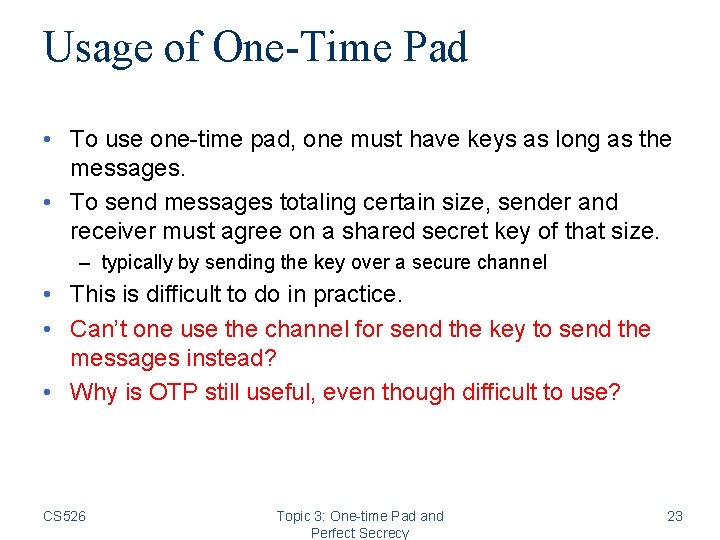
Usage of One-Time Pad • To use one-time pad, one must have keys as long as the messages. • To send messages totaling certain size, sender and receiver must agree on a shared secret key of that size. – typically by sending the key over a secure channel • This is difficult to do in practice. • Can’t one use the channel for send the key to send the messages instead? • Why is OTP still useful, even though difficult to use? CS 526 Topic 3: One-time Pad and Perfect Secrecy 23
Usage of One-Time Pad • The channel for distributing keys may exist at a different time from when one has messages to send. • The channel for distributing keys may have the property that keys can be leaked, but such leakage will be detected – Such as in Quantum cryptography CS 526 Topic 3: One-time Pad and Perfect Secrecy 24
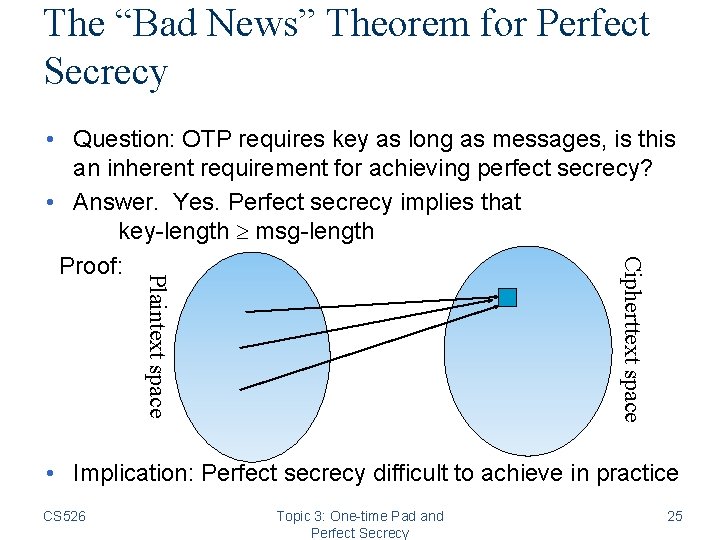
The “Bad News” Theorem for Perfect Secrecy Plaintext space Cipherttext space • Question: OTP requires key as long as messages, is this an inherent requirement for achieving perfect secrecy? • Answer. Yes. Perfect secrecy implies that key-length msg-length Proof: • Implication: Perfect secrecy difficult to achieve in practice CS 526 Topic 3: One-time Pad and Perfect Secrecy 25
Stream Ciphers • In One-Time Pad, a key is a random string of length at least the same as the message • Stream ciphers: – Idea: replace “rand” by “pseudo rand” – Use Pseudo Random Number Generator – PRNG: {0, 1}s {0, 1}n • expand a short (e. g. , 128 -bit) random seed into a long (e. g. , 106 bit) string that “looks random” – Secret key is the seed – Ekey[M] = M PRNG(key) CS 526 Topic 3: One-time Pad and Perfect Secrecy 26
The RC 4 Stream Cipher • A proprietary cipher owned by RSA, designed by Ron Rivest in 1987. • Became public in 1994. • Simple and effective design. • Variable key size (typical 40 to 256 bits), • Output unbounded number of bytes. • Widely used (web SSL/TLS, wireless WEP). • Extensively studied, not a completely secure PRNG, first part of output biased, when used as stream cipher, should use RC 4 -Drop[n] – Which drops first n bytes before using the output – Conservatively, set n=3072 CS 526 Topic 3: One-time Pad and Perfect Secrecy 27
Pseudo Random Number Generator • Useful for cryptography, simulation, randomized algorithm, etc. – Stream ciphers, generating session keys • The same seed always gives the same output stream – Why is this necessary for stream ciphers? • Simulation requires uniform distributed sequences – E. g. , having a number of statistical properties • Cryptographically secure pseudo-random number generator requires unpredictable sequences – satisfies the "next-bit test“: given consecutive sequence of bits output (but not seed), next bit must be hard to predict • Some PRNG’s are weak: knowing output sequence of sufficient length, can recover key. – Do not use these for cryptographic purposes CS 526 Topic 3: One-time Pad and Perfect Secrecy 28
Properties of Stream Ciphers • Typical stream ciphers are very fast • Widely used, often incorrectly – Content Scrambling System (uses Linear Feedback Shift Registers incorrectly), – Wired Equivalent Privacy (uses RC 4 incorrectly) – SSL (uses RC 4, SSLv 3 has no known major flaw) CS 526 Topic 3: One-time Pad and Perfect Secrecy 29
Security Properties of Stream Ciphers • Under known plaintext, chosen plaintext, or chosen ciphertext, the adversary knows the key stream (i. e. , PRNG(key)) – Security depends on PRNG – PRNG must be “unpredictable” • Do stream ciphers have perfect secrecy? • How to break a stream cipher in a brute-force way? • If the same key stream is used twice, then easy to break. – This is a fundamental weakness of stream ciphers; it exists even if the PRNG used in the ciphers is strong CS 526 Topic 3: One-time Pad and Perfect Secrecy 30
Using Stream Ciphers in Practice • If the same key stream is used twice, then easy to break. – This is a fundamental weakness of stream ciphers; it exists even if the PRNG used in the ciphers is strong • In practice, one key is used to encrypt many messages – Example: Wireless communication – Solution: Use Initial vectors (IV). – Ekey[M] = [IV, M PRNG(key || IV)] • IV is sent in clear to receiver; • IV needs integrity protection, but not confidentiality protection • IV ensures that key streams do not repeat, but does not increase cost of brute-force attacks • Without key, knowing IV still cannot decrypt – Need to ensure that IV never repeats! How? CS 526 Topic 3: One-time Pad and Perfect Secrecy 31
Coming Attractions … • Cryptography: Semantic Security, Block ciphers, encryption modes, cryptographic functions CS 526 Topic 3: One-time Pad and Perfect Secrecy 32