
INFORMATION SAFETY ELECTRONIC WASTE CONTAINING POLYCHLORINATED BIPHENYLS PCBs
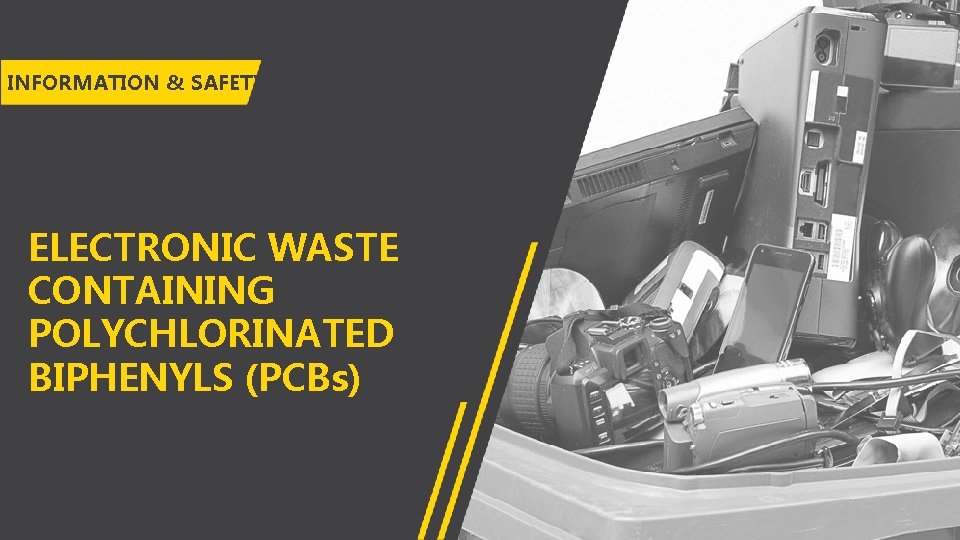
INFORMATION & SAFETY ELECTRONIC WASTE CONTAINING POLYCHLORINATED BIPHENYLS (PCBs)
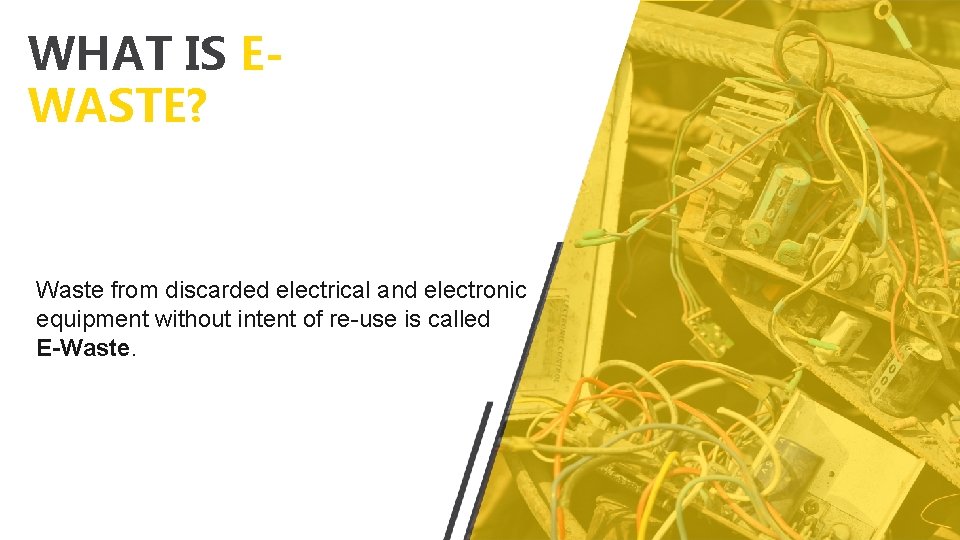
WHAT IS EWASTE? Waste from discarded electrical and electronic equipment without intent of re-use is called E-Waste.
EXPOSURE IN RECYCLING OF E-WASTE Recycling of electronics can be a source of many toxic chemicals including: Metals, Organic chemical compounds, Polychlorinated biphenyls (PCBs). Educational materials developed by Harvard T. H. Chan School of Public Health and Boston University School of Public Health
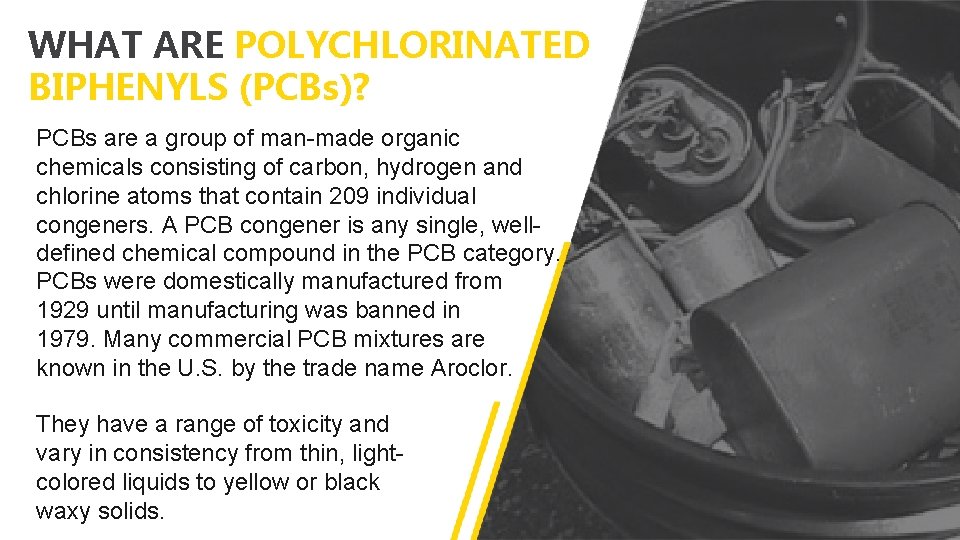
WHAT ARE POLYCHLORINATED BIPHENYLS (PCBs)? PCBs are a group of man-made organic chemicals consisting of carbon, hydrogen and chlorine atoms that contain 209 individual congeners. A PCB congener is any single, welldefined chemical compound in the PCB category. PCBs were domestically manufactured from 1929 until manufacturing was banned in 1979. Many commercial PCB mixtures are known in the U. S. by the trade name Aroclor. They have a range of toxicity and vary in consistency from thin, lightcolored liquids to yellow or black waxy solids.

POLYCHLORINATED BIPHENYLS (PCBs) IN E-WASTE PCBs are often found in the following e-waste: • • • Transformers Large Capacitors Circuit Breakers Reclosers Electromagnets Lamp Ballasts • • • Voltage Regulators Switches Sectionalizers Motor Starters Cable Small Capacitors Educational materials developed by Harvard T. H. Chan School of Public Health and Boston University School of Public Health

HOW ARE WORKERS EXPOSED TO POLYCHLORINATED BIPHENYLS (PCBs) IN E-WASTE RECYCLING? Occupational exposure to PCBs occurs mainly via inhalation and dermal routes.
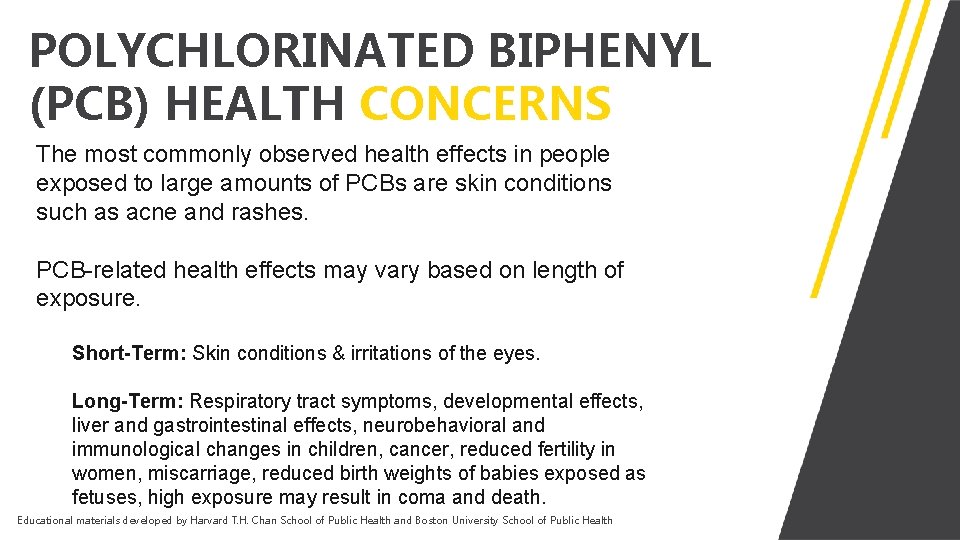
POLYCHLORINATED BIPHENYL (PCB) HEALTH CONCERNS The most commonly observed health effects in people exposed to large amounts of PCBs are skin conditions such as acne and rashes. PCB-related health effects may vary based on length of exposure. Short-Term: Skin conditions & irritations of the eyes. Long-Term: Respiratory tract symptoms, developmental effects, liver and gastrointestinal effects, neurobehavioral and immunological changes in children, cancer, reduced fertility in women, miscarriage, reduced birth weights of babies exposed as fetuses, high exposure may result in coma and death. Educational materials developed by Harvard T. H. Chan School of Public Health and Boston University School of Public Health
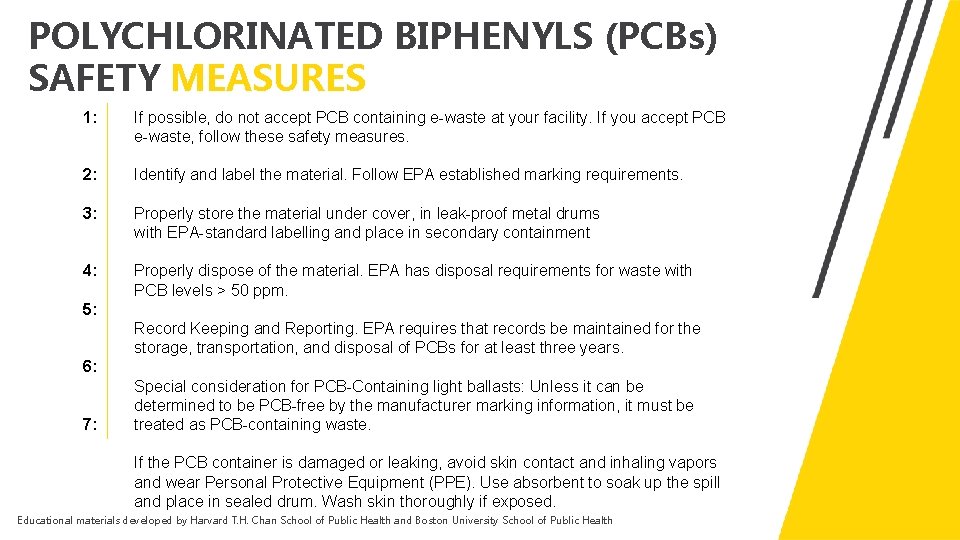
POLYCHLORINATED BIPHENYLS (PCBs) SAFETY MEASURES 1: If possible, do not accept PCB containing e-waste at your facility. If you accept PCB e-waste, follow these safety measures. 2: Identify and label the material. Follow EPA established marking requirements. 3: Properly store the material under cover, in leak-proof metal drums with EPA-standard labelling and place in secondary containment 4: Properly dispose of the material. EPA has disposal requirements for waste with PCB levels > 50 ppm. 5: Record Keeping and Reporting. EPA requires that records be maintained for the storage, transportation, and disposal of PCBs for at least three years. 6: 7: Special consideration for PCB-Containing light ballasts: Unless it can be determined to be PCB-free by the manufacturer marking information, it must be treated as PCB-containing waste. If the PCB container is damaged or leaking, avoid skin contact and inhaling vapors and wear Personal Protective Equipment (PPE). Use absorbent to soak up the spill and place in sealed drum. Wash skin thoroughly if exposed. Educational materials developed by Harvard T. H. Chan School of Public Health and Boston University School of Public Health
For More Information: Your local OSHA office, your Regional OSHA PCB Coordinator, or the National OSHA Office Number 1 -800 -321 -6742 Educational materials developed by Harvard T. H. Chan School of Public Health and Boston University School of Public Health
- Slides: 9