
Information Requirements First of three Analysis Phase activities


- Slides: 21
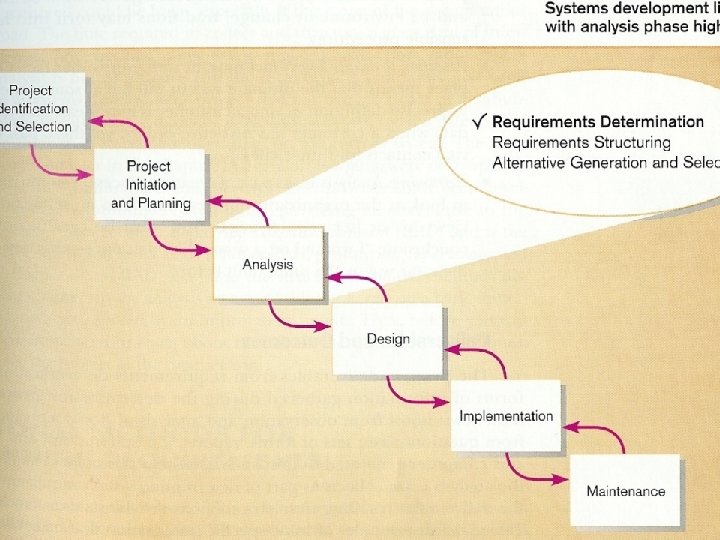
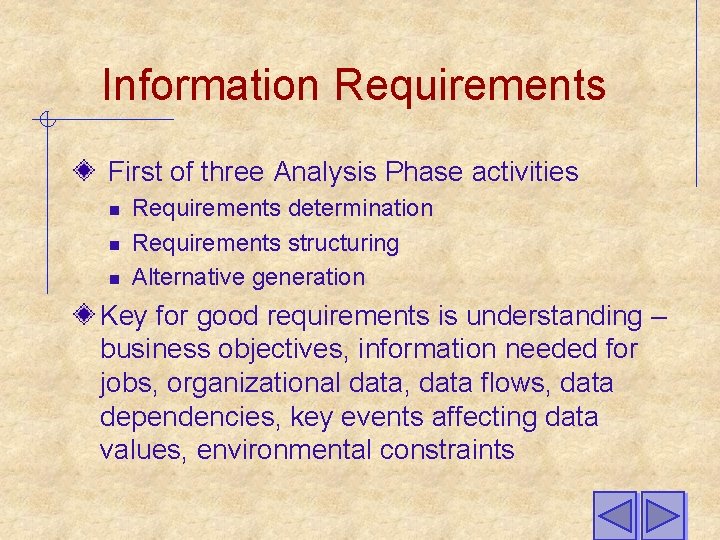
Information Requirements First of three Analysis Phase activities n n n Requirements determination Requirements structuring Alternative generation Key for good requirements is understanding – business objectives, information needed for jobs, organizational data, data flows, data dependencies, key events affecting data values, environmental constraints
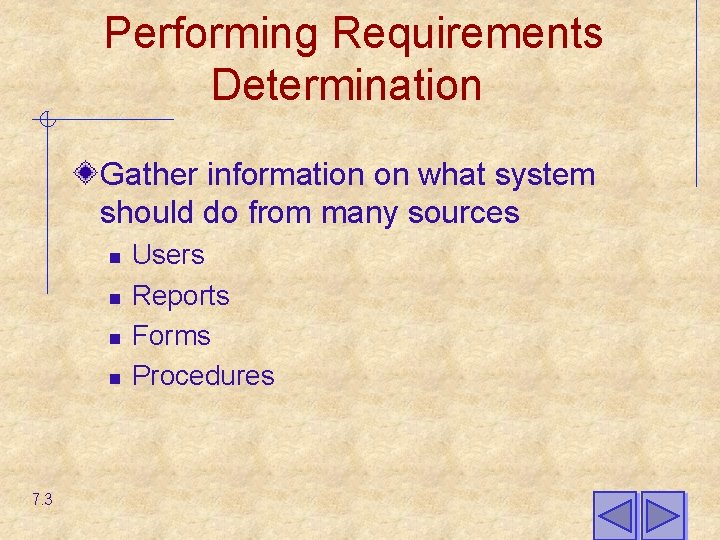
Performing Requirements Determination Gather information on what system should do from many sources n n 7. 3 Users Reports Forms Procedures
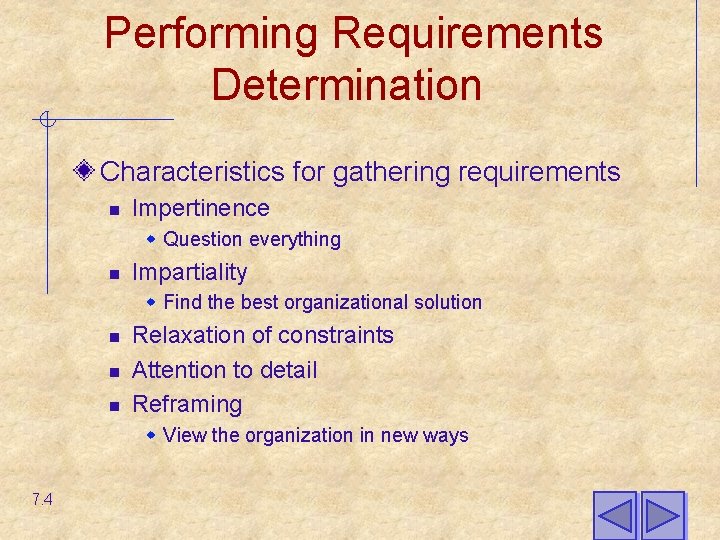
Performing Requirements Determination Characteristics for gathering requirements n Impertinence w Question everything n Impartiality w Find the best organizational solution n Relaxation of constraints Attention to detail Reframing w View the organization in new ways 7. 4
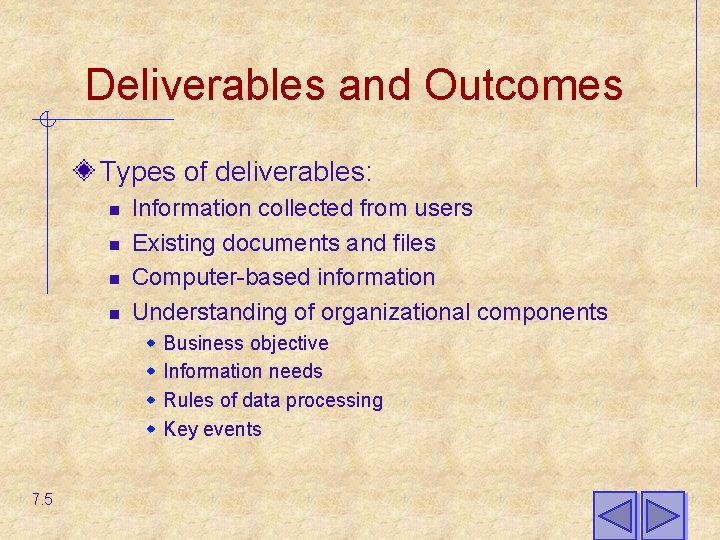
Deliverables and Outcomes Types of deliverables: n n Information collected from users Existing documents and files Computer-based information Understanding of organizational components w w 7. 5 Business objective Information needs Rules of data processing Key events
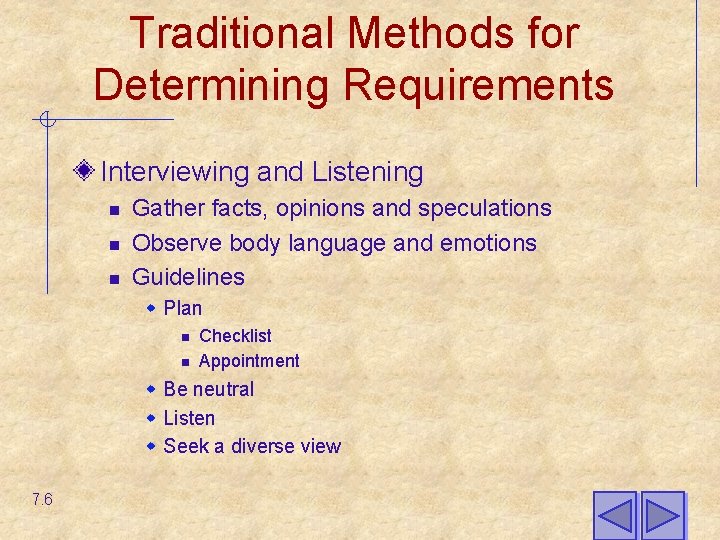
Traditional Methods for Determining Requirements Interviewing and Listening n n n Gather facts, opinions and speculations Observe body language and emotions Guidelines w Plan n n Checklist Appointment w Be neutral w Listen w Seek a diverse view 7. 6
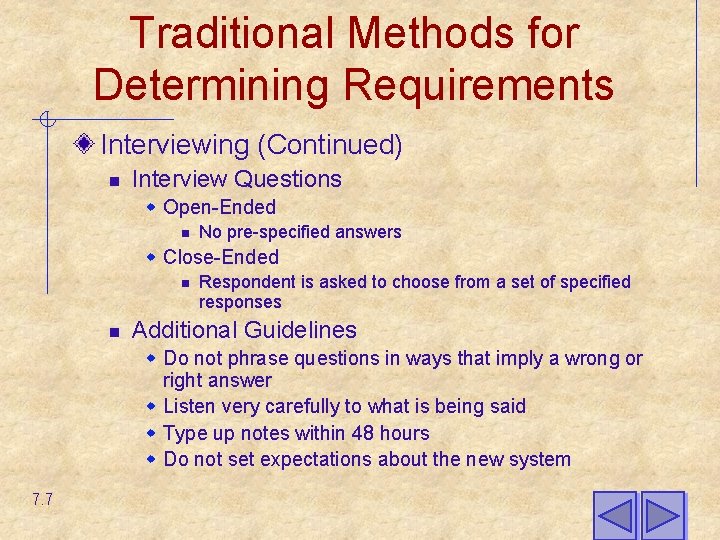
Traditional Methods for Determining Requirements Interviewing (Continued) n Interview Questions w Open-Ended n No pre-specified answers w Close-Ended n n Respondent is asked to choose from a set of specified responses Additional Guidelines w Do not phrase questions in ways that imply a wrong or right answer w Listen very carefully to what is being said w Type up notes within 48 hours w Do not set expectations about the new system 7. 7
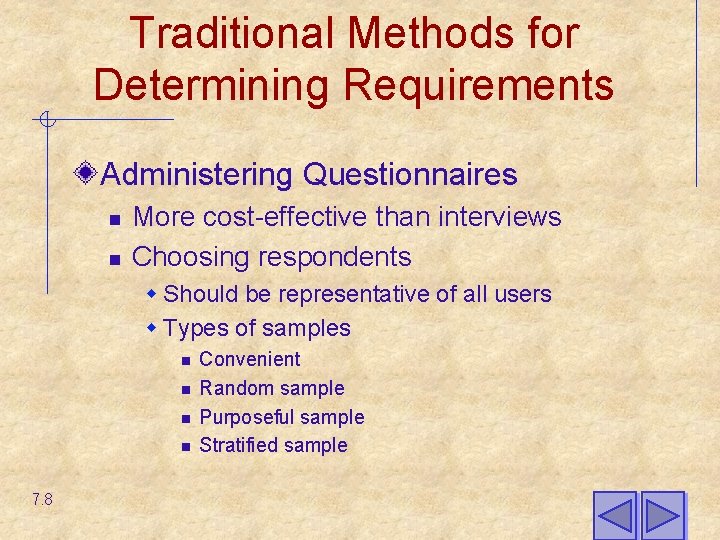
Traditional Methods for Determining Requirements Administering Questionnaires n n More cost-effective than interviews Choosing respondents w Should be representative of all users w Types of samples n n 7. 8 Convenient Random sample Purposeful sample Stratified sample
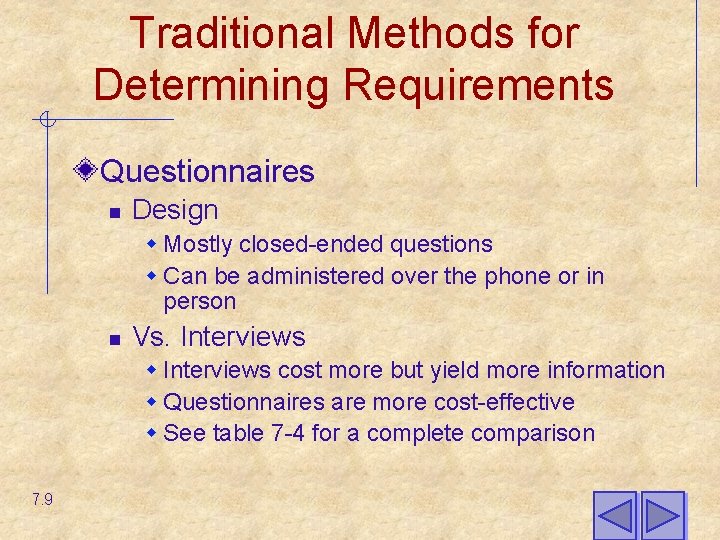
Traditional Methods for Determining Requirements Questionnaires n Design w Mostly closed-ended questions w Can be administered over the phone or in person n Vs. Interviews w Interviews cost more but yield more information w Questionnaires are more cost-effective w See table 7 -4 for a complete comparison 7. 9
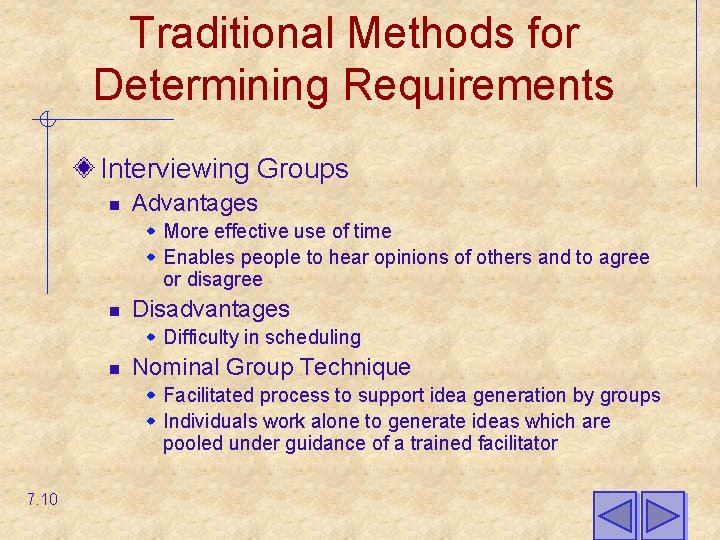
Traditional Methods for Determining Requirements Interviewing Groups n Advantages w More effective use of time w Enables people to hear opinions of others and to agree or disagree n Disadvantages w Difficulty in scheduling n Nominal Group Technique w Facilitated process to support idea generation by groups w Individuals work alone to generate ideas which are pooled under guidance of a trained facilitator 7. 10
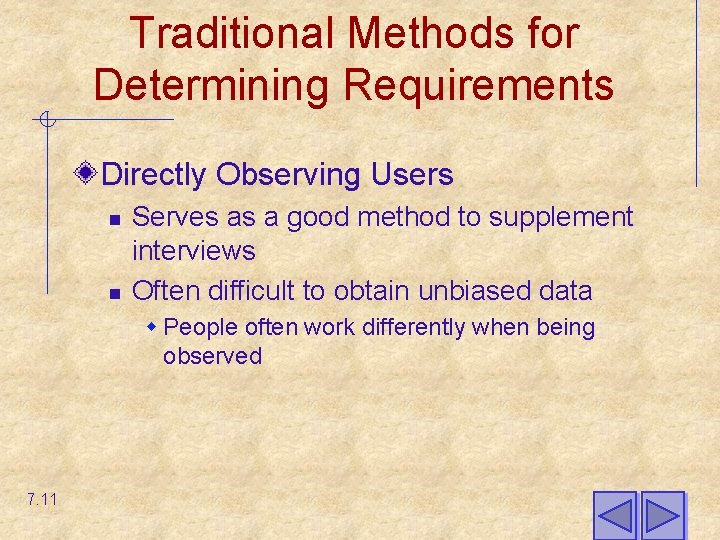
Traditional Methods for Determining Requirements Directly Observing Users n n Serves as a good method to supplement interviews Often difficult to obtain unbiased data w People often work differently when being observed 7. 11
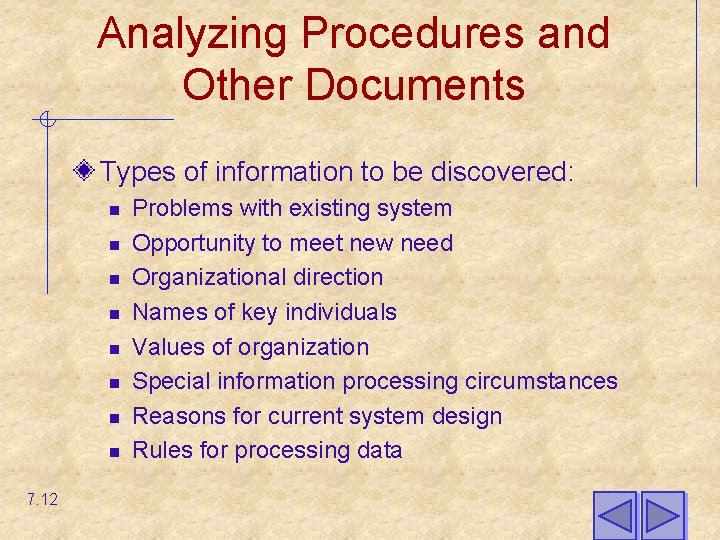
Analyzing Procedures and Other Documents Types of information to be discovered: n n n n 7. 12 Problems with existing system Opportunity to meet new need Organizational direction Names of key individuals Values of organization Special information processing circumstances Reasons for current system design Rules for processing data
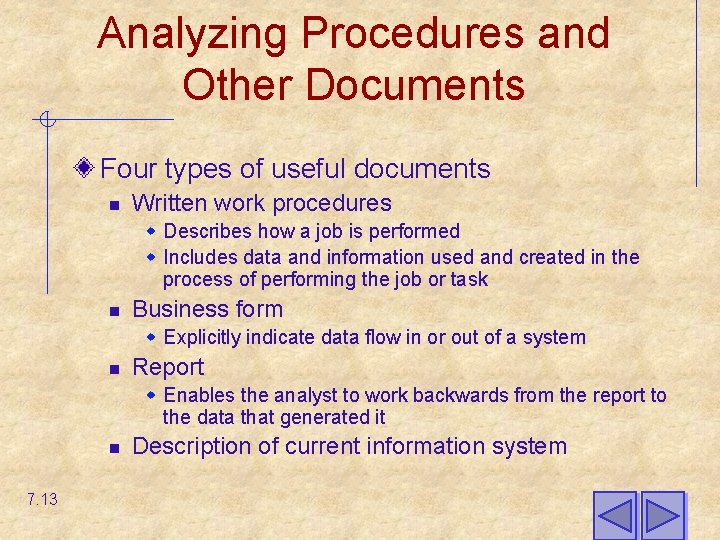
Analyzing Procedures and Other Documents Four types of useful documents n Written work procedures w Describes how a job is performed w Includes data and information used and created in the process of performing the job or task n Business form w Explicitly indicate data flow in or out of a system n Report w Enables the analyst to work backwards from the report to the data that generated it n 7. 13 Description of current information system
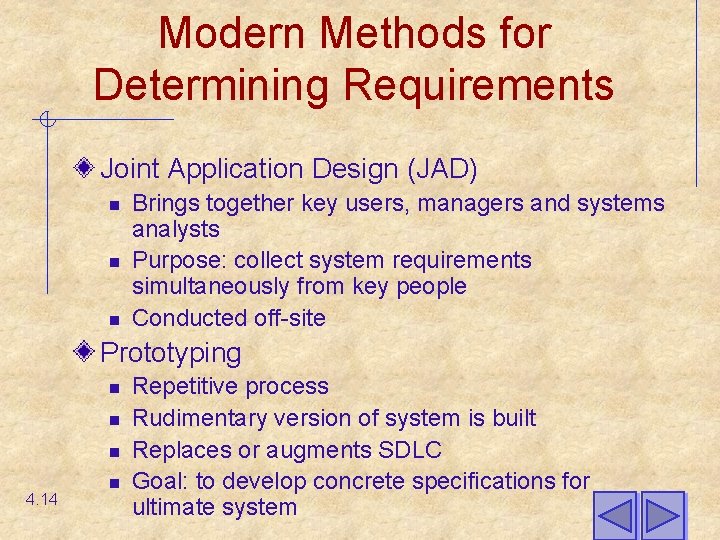
Modern Methods for Determining Requirements Joint Application Design (JAD) n n n Brings together key users, managers and systems analysts Purpose: collect system requirements simultaneously from key people Conducted off-site Prototyping n n n 4. 14 n Repetitive process Rudimentary version of system is built Replaces or augments SDLC Goal: to develop concrete specifications for ultimate system
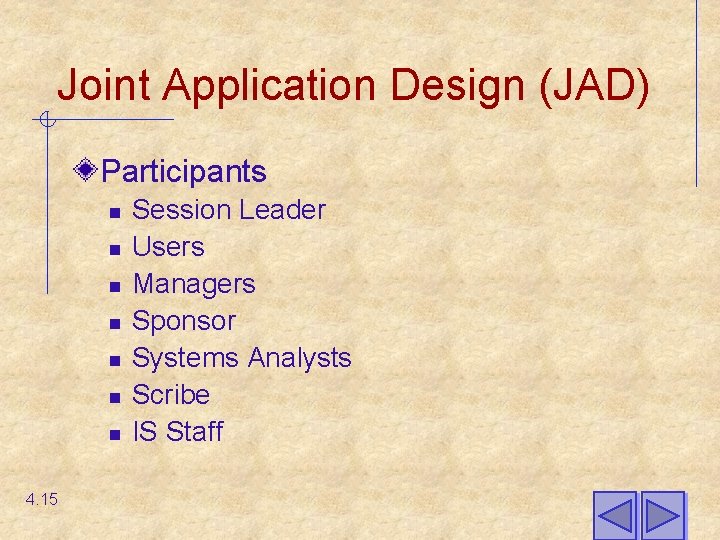
Joint Application Design (JAD) Participants n n n n 4. 15 Session Leader Users Managers Sponsor Systems Analysts Scribe IS Staff
Joint Application Design (JAD) End Result n n Documentation detailing existing system Features of proposed system CASE Tools During JAD n n n 4. 16 Upper CASE tools are used Enables analysts to enter system models directly into CASE during the JAD session Screen designs and prototyping can be done during JAD and shown to users
Joint Application Design (JAD) Supporting JAD with GSS n n n 7. 17 Group support systems (GSS) can be used to enable more participation by group members in JAD Members type their answers into the computer All members of the group see what other members have been typing
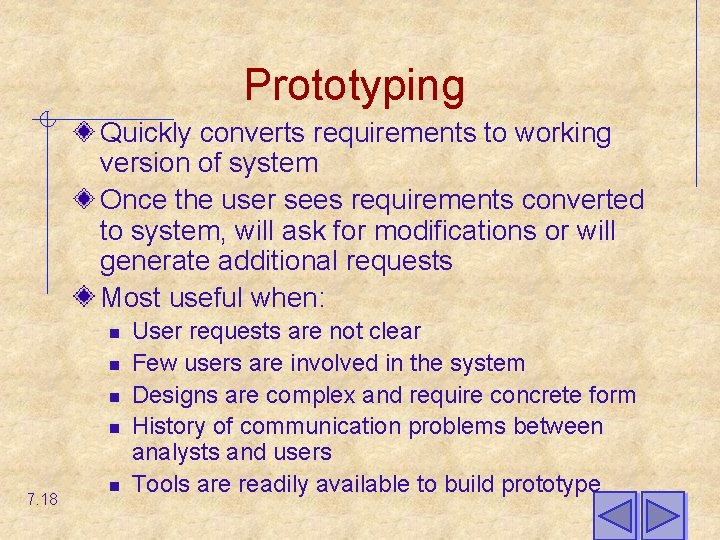
Prototyping Quickly converts requirements to working version of system Once the user sees requirements converted to system, will ask for modifications or will generate additional requests Most useful when: n n 7. 18 n User requests are not clear Few users are involved in the system Designs are complex and require concrete form History of communication problems between analysts and users Tools are readily available to build prototype
Prototyping Drawbacks n n 7. 19 Tendency to avoid formal documentation Difficult to adapt to more general user audience Sharing data with other systems is often not considered Systems Development Life Cycle (SDLC) checks are often bypassed
Business Process Reengineering (BPR) Search for and implementation of radical change in business processes to achieve breakthrough improvements in products and services Goals n n 7. 20 Reorganize complete flow of data in major sections of an organization Eliminate unnecessary steps
Business Process Reengineering (BPR) Goals (Continued) n n Combine steps Become more responsive to future change Identification of processes to reengineer n Key business processes w Set of activities designed to produce specific output for a particular customer or market w Focused on customers and outcome w Same techniques are used as were used for requirements determination 7. 21