
Information Networks Failures and Epidemics in Networks Spread

- Slides: 47
Information Networks Failures and Epidemics in Networks
Spread in Networks § Understanding the spread of viruses (or rumors, information, failures etc) is one of the driving forces behind network analysis § predict and prevent epidemic outbreaks (e. g. the Birdflu outbreak) § protect computer networks (e. g. against worms) § predict and prevent cascading failures (U. S. power grid) § understanding of fads, rumors, trends • viral marketing § anti-terrorism?
Percolation in Networks § Site Percolation: Each node of the network is randomly set as occupied or not-occupied. We are interested in measuring the size of the largest connected component of occupied vertices § Bond Percolation: Each edge of the network is randomly set as occupied or not-occupied. We are interested in measuring the size of the largest component of nodes connected by occupied edges § Good model for failures or attacks
Percolation Threshold § How many nodes should be occupied in order for the network to not have a giant component? (the network does not percolate)
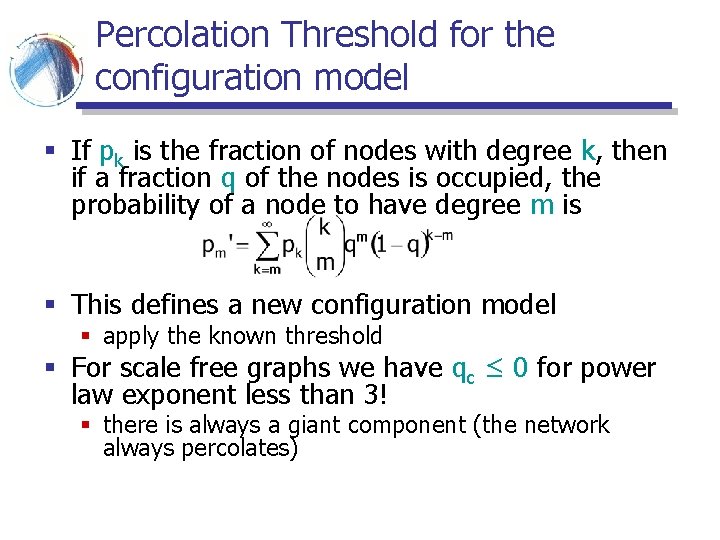
Percolation Threshold for the configuration model § If pk is the fraction of nodes with degree k, then if a fraction q of the nodes is occupied, the probability of a node to have degree m is § This defines a new configuration model § apply the known threshold § For scale free graphs we have qc ≤ 0 for power law exponent less than 3! § there is always a giant component (the network always percolates)
Percolation threshold § An analysis for general graphs is and general occupation probabilities is possible § for scale free graphs it yields the same results § But … if the nodes are removed preferentially (according to degree), then it is easy to disconnect a scale free graph by removing a small fraction of the edges
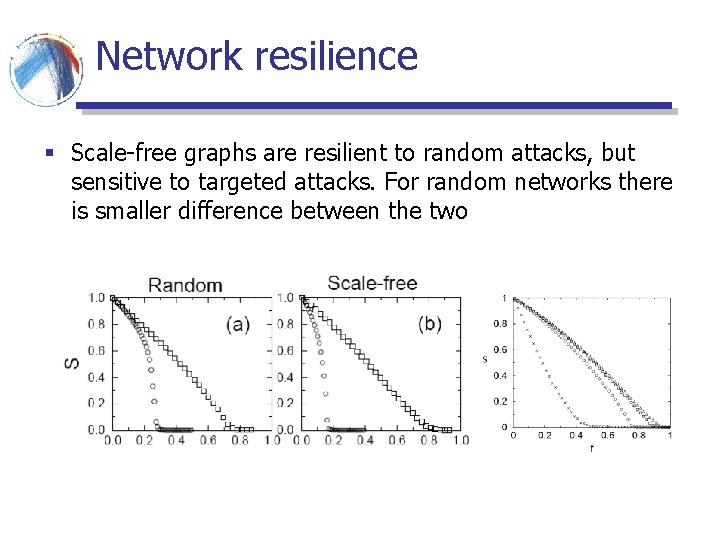
Network resilience § Scale-free graphs are resilient to random attacks, but sensitive to targeted attacks. For random networks there is smaller difference between the two
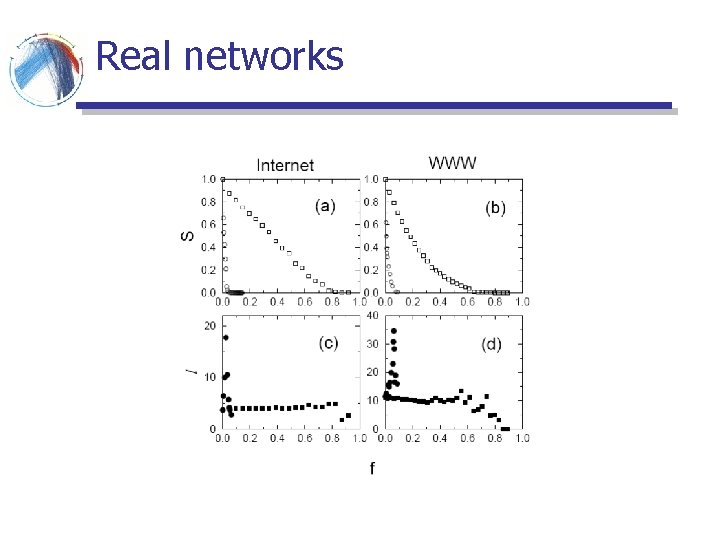
Real networks
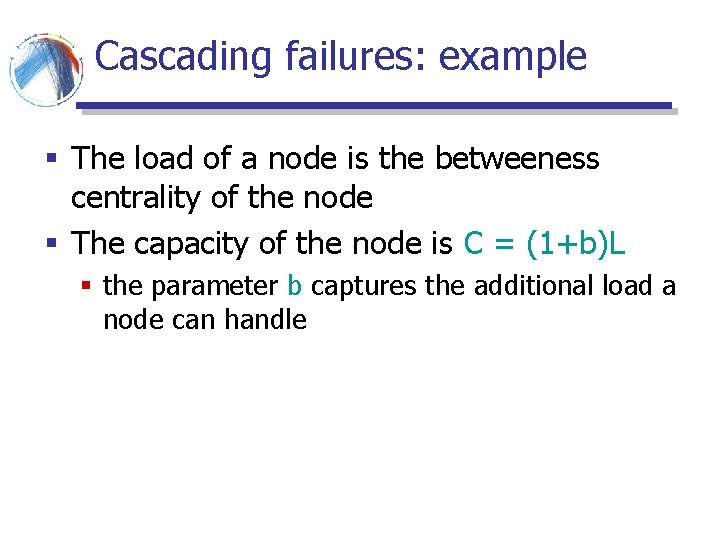
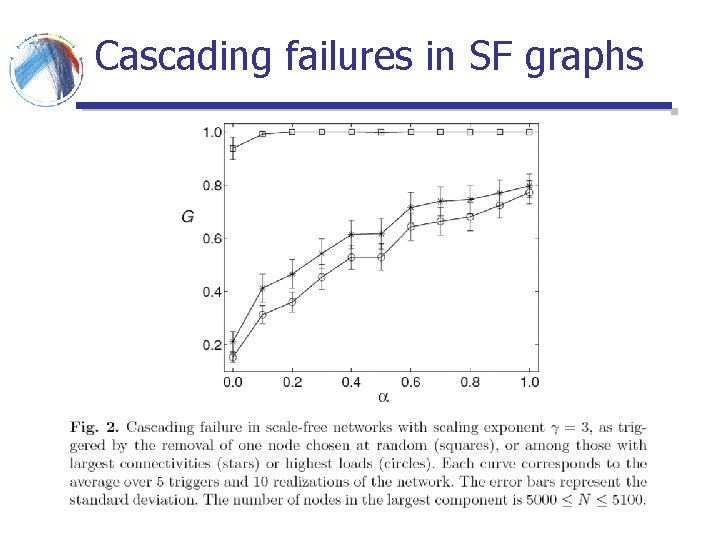
Cascading failures § Each node has a load and a capacity that says how much load it can tolerate. § When a node is removed from the network its load is redistributed to the remaining nodes. § If the load of a node exceeds its capacity, then the node fails
Cascading failures: example § The load of a node is the betweeness centrality of the node § The capacity of the node is C = (1+b)L § the parameter b captures the additional load a node can handle
Cascading failures in SF graphs
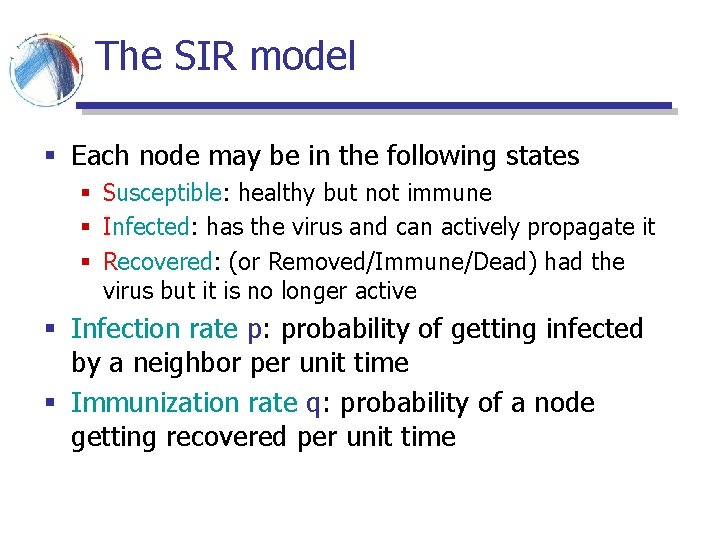
The SIR model § Each node may be in the following states § Susceptible: healthy but not immune § Infected: has the virus and can actively propagate it § Recovered: (or Removed/Immune/Dead) had the virus but it is no longer active § Infection rate p: probability of getting infected by a neighbor per unit time § Immunization rate q: probability of a node getting recovered per unit time
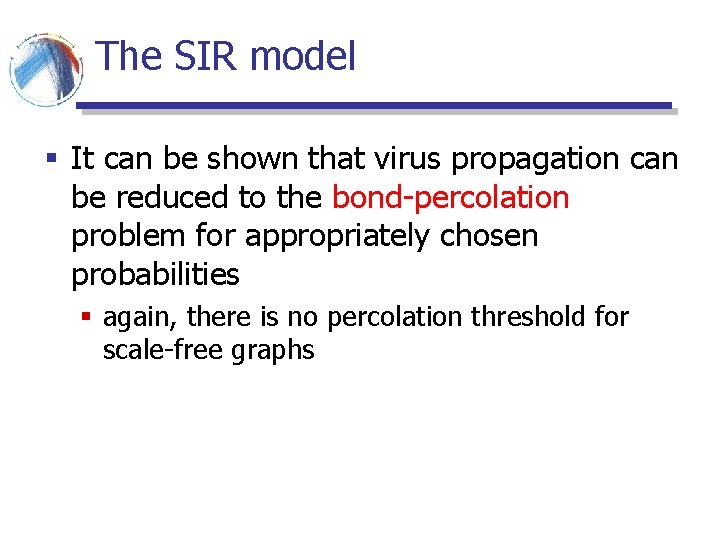
The SIR model § It can be shown that virus propagation can be reduced to the bond-percolation problem for appropriately chosen probabilities § again, there is no percolation threshold for scale-free graphs
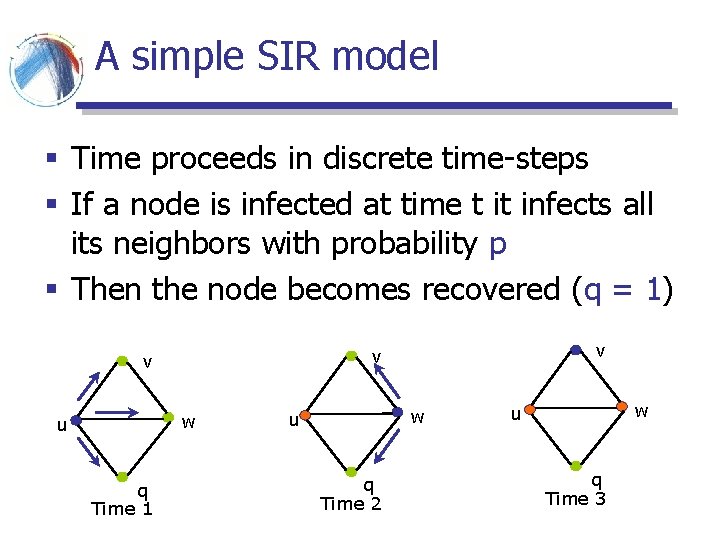
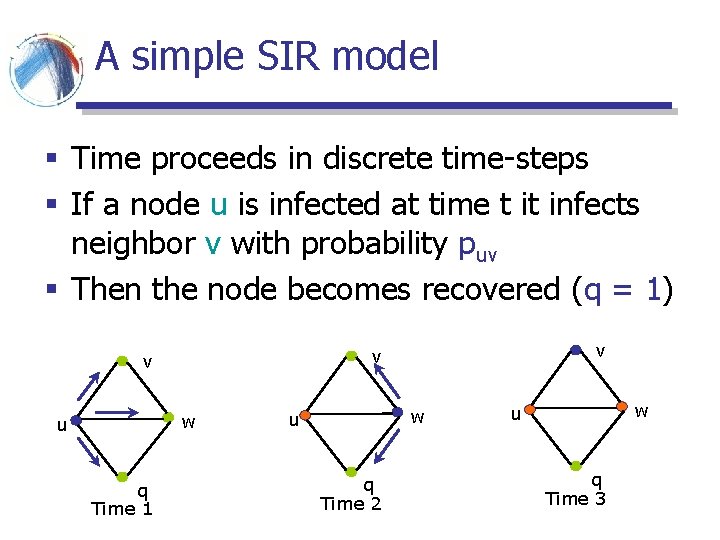
A simple SIR model § Time proceeds in discrete time-steps § If a node is infected at time t it infects all its neighbors with probability p § Then the node becomes recovered (q = 1) w u q Time 1 v v v w u q Time 2 w u q Time 3
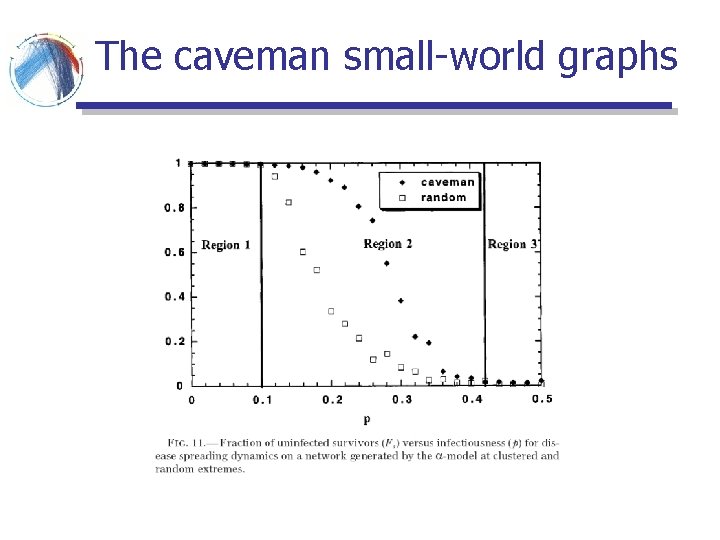
The caveman small-world graphs
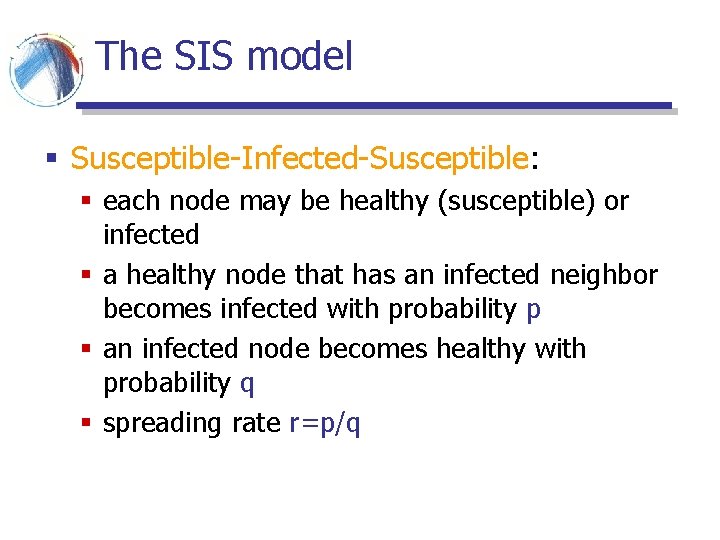
The SIS model § Susceptible-Infected-Susceptible: § each node may be healthy (susceptible) or infected § a healthy node that has an infected neighbor becomes infected with probability p § an infected node becomes healthy with probability q § spreading rate r=p/q
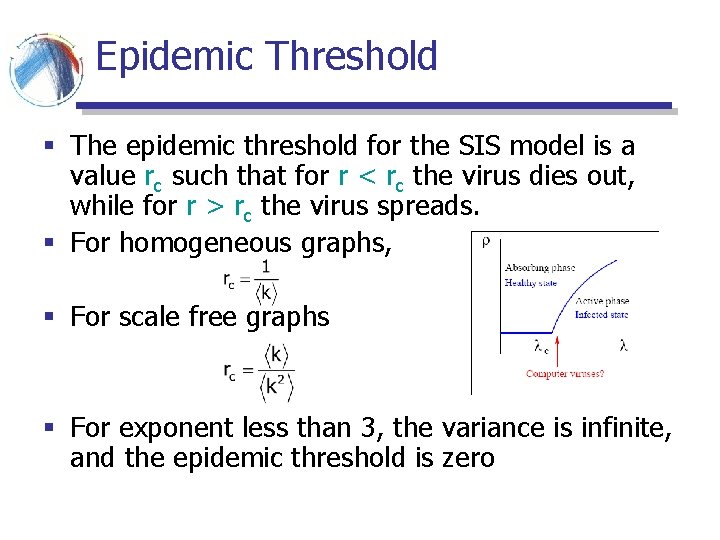
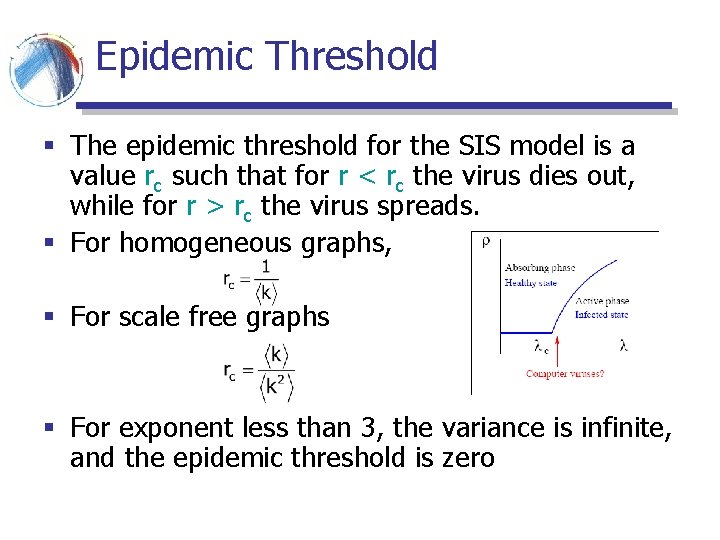
Epidemic Threshold § The epidemic threshold for the SIS model is a value rc such that for r < rc the virus dies out, while for r > rc the virus spreads. § For homogeneous graphs, § For scale free graphs § For exponent less than 3, the variance is infinite, and the epidemic threshold is zero
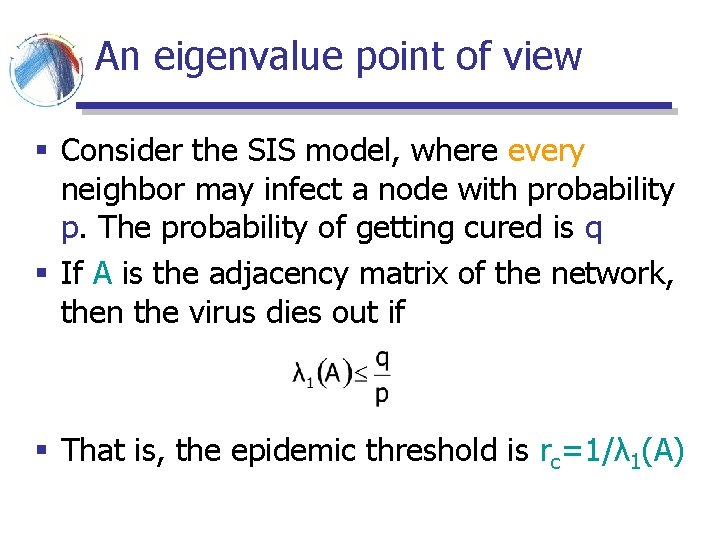
An eigenvalue point of view § Consider the SIS model, where every neighbor may infect a node with probability p. The probability of getting cured is q § If A is the adjacency matrix of the network, then the virus dies out if § That is, the epidemic threshold is rc=1/λ 1(A)
The SIS model § Susceptible-Infected-Susceptible: § each node may be healthy (susceptible) or infected § a healthy node that has an infected neighbor becomes infected with probability p § an infected node becomes healthy with probability q § spreading rate r=p/q
Epidemic Threshold § The epidemic threshold for the SIS model is a value rc such that for r < rc the virus dies out, while for r > rc the virus spreads. § For homogeneous graphs, § For scale free graphs § For exponent less than 3, the variance is infinite, and the epidemic threshold is zero
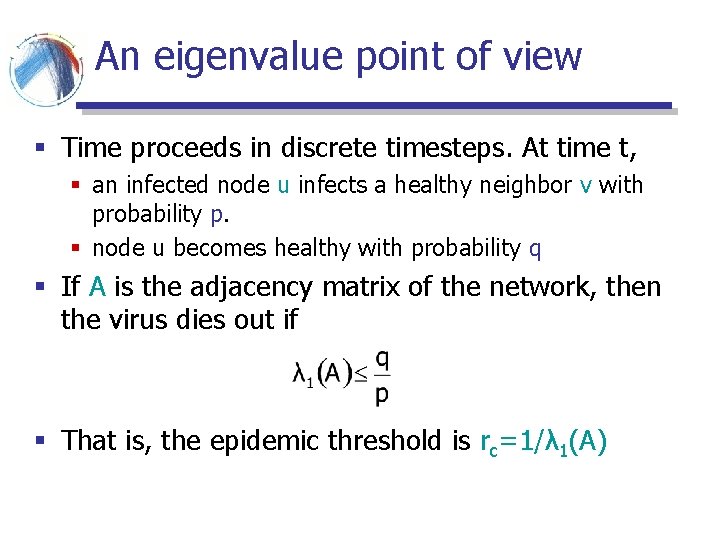
An eigenvalue point of view § Time proceeds in discrete timesteps. At time t, § an infected node u infects a healthy neighbor v with probability p. § node u becomes healthy with probability q § If A is the adjacency matrix of the network, then the virus dies out if § That is, the epidemic threshold is rc=1/λ 1(A)
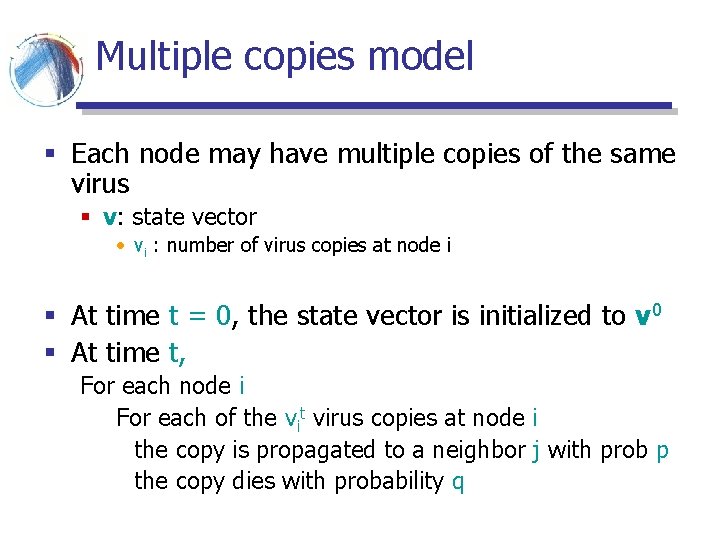
Multiple copies model § Each node may have multiple copies of the same virus § v: state vector • vi : number of virus copies at node i § At time t = 0, the state vector is initialized to v 0 § At time t, For each node i For each of the vit virus copies at node i the copy is propagated to a neighbor j with prob p the copy dies with probability q
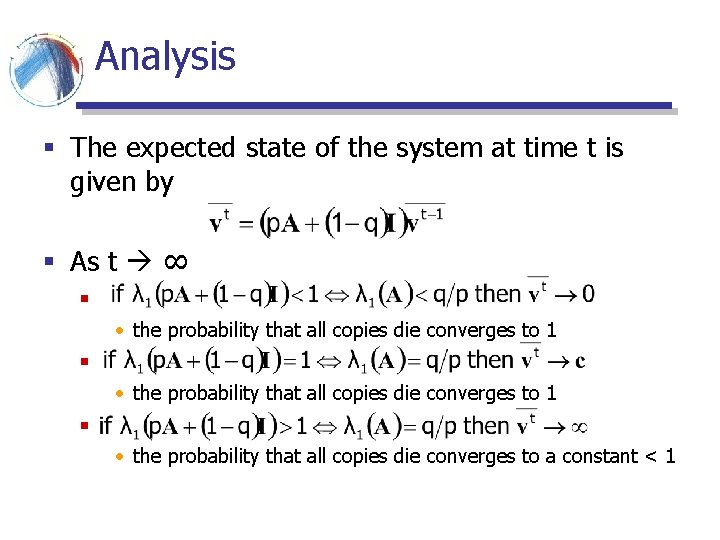
Analysis § The expected state of the system at time t is given by § As t ∞ § • the probability that all copies die converges to 1 § • the probability that all copies die converges to a constant < 1
Immunization § Given a network that contains viruses, which nodes should we immunize in order to contain the spread of the virus? § The flip side of the percolation theory
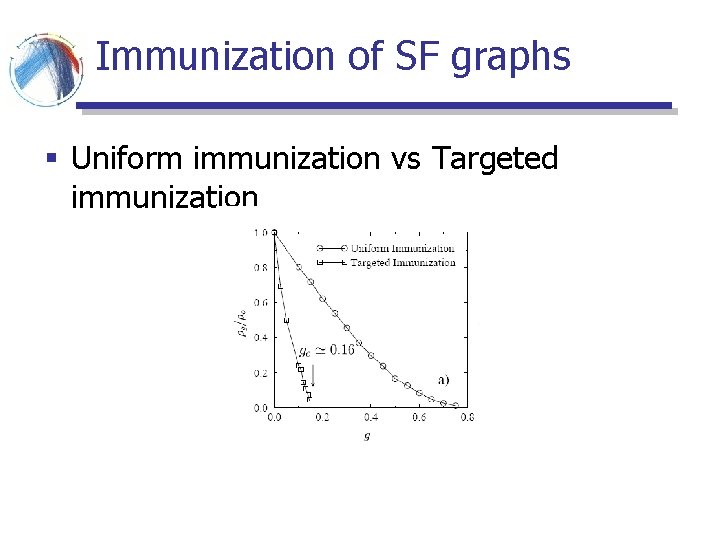
Immunization of SF graphs § Uniform immunization vs Targeted immunization
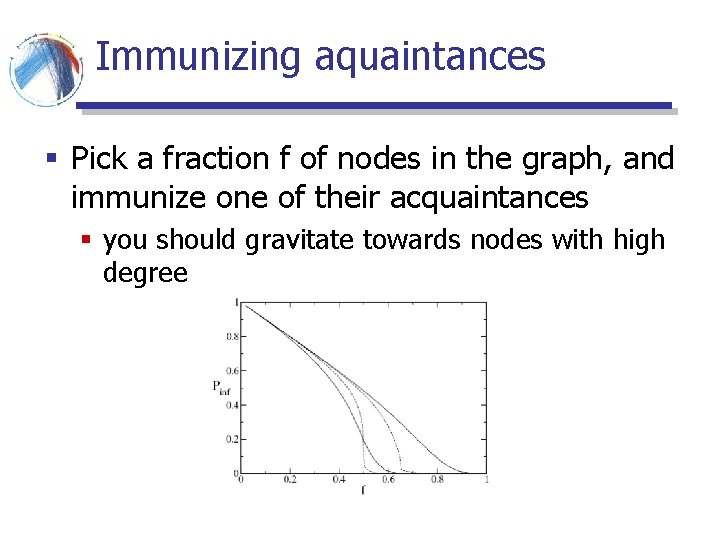
Immunizing aquaintances § Pick a fraction f of nodes in the graph, and immunize one of their acquaintances § you should gravitate towards nodes with high degree
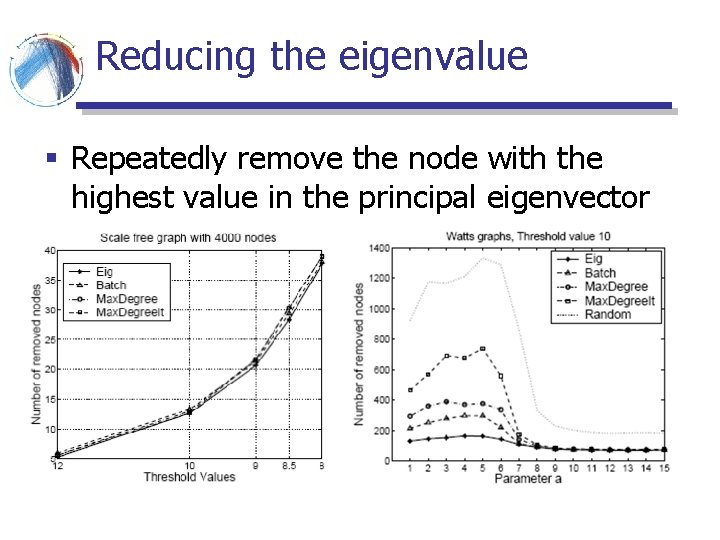
Reducing the eigenvalue § Repeatedly remove the node with the highest value in the principal eigenvector
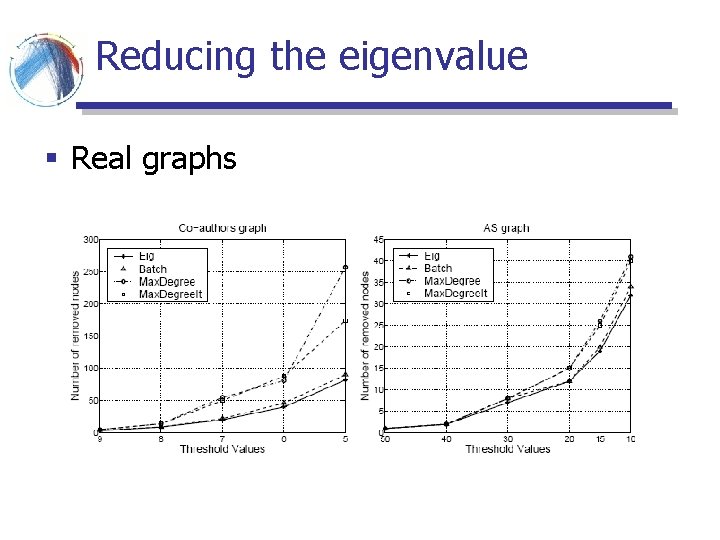
Reducing the eigenvalue § Real graphs
Gossip § Gossip can also be thought of as a virus that propagates in a social network. § Understanding gossip propagation is important for understanding social networks, but also for marketing purposes § Provides also a diffusion mechanism for the network
Independent cascade model § Each node may be active (has the gossip) or inactive (does not have the gossip) § Time proceeds at discrete time-steps. At time t, every node v that became active in time t-1 actives a non-active neighbor w with probability puw. If it fails, it does not try again § the same as the simple SIR model
A simple SIR model § Time proceeds in discrete time-steps § If a node u is infected at time t it infects neighbor v with probability puv § Then the node becomes recovered (q = 1) w u q Time 1 v v v w u q Time 2 w u q Time 3
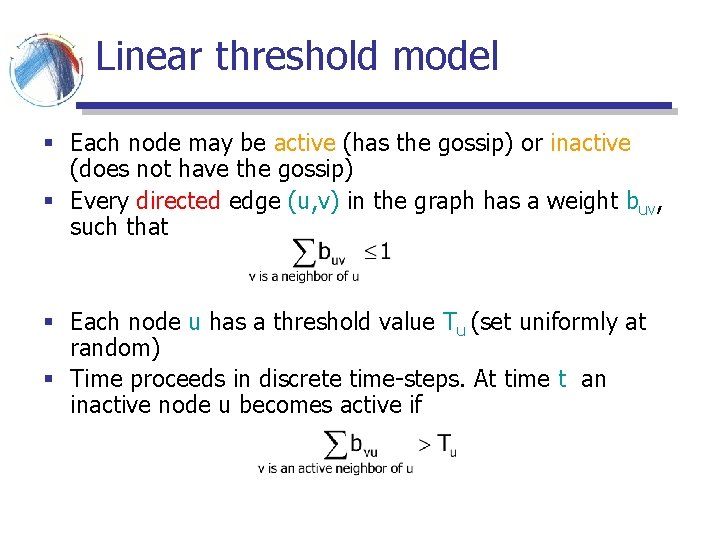
Linear threshold model § Each node may be active (has the gossip) or inactive (does not have the gossip) § Every directed edge (u, v) in the graph has a weight buv, such that § Each node u has a threshold value Tu (set uniformly at random) § Time proceeds in discrete time-steps. At time t an inactive node u becomes active if
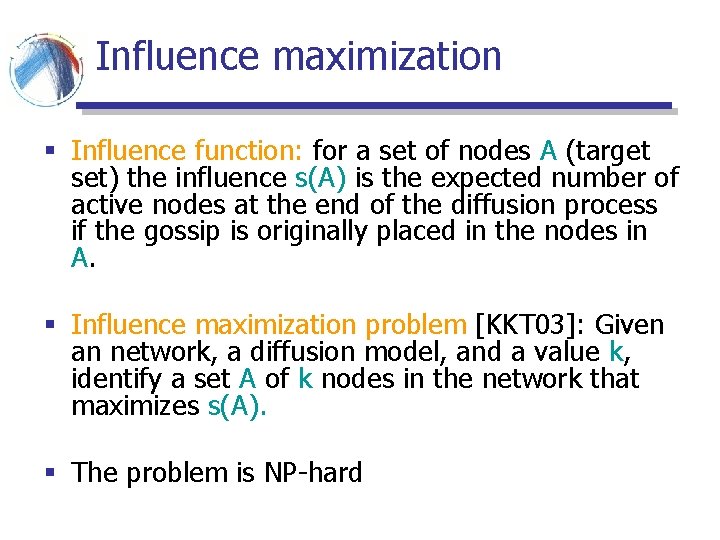
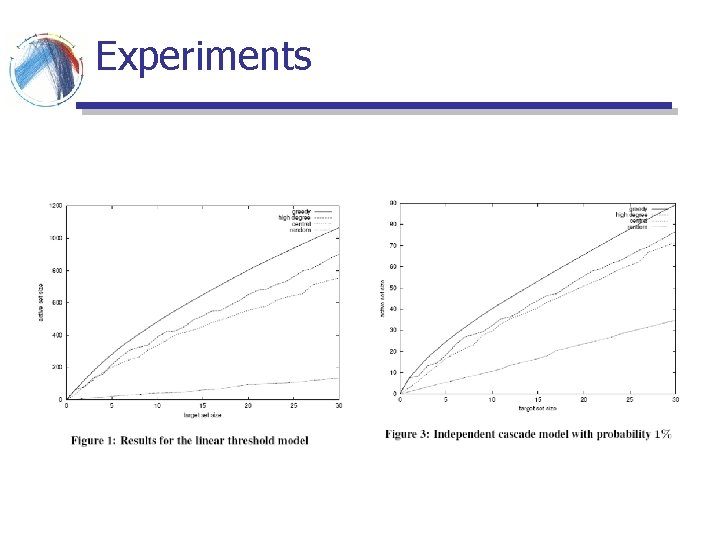
Influence maximization § Influence function: for a set of nodes A (target set) the influence s(A) is the expected number of active nodes at the end of the diffusion process if the gossip is originally placed in the nodes in A. § Influence maximization problem [KKT 03]: Given an network, a diffusion model, and a value k, identify a set A of k nodes in the network that maximizes s(A). § The problem is NP-hard
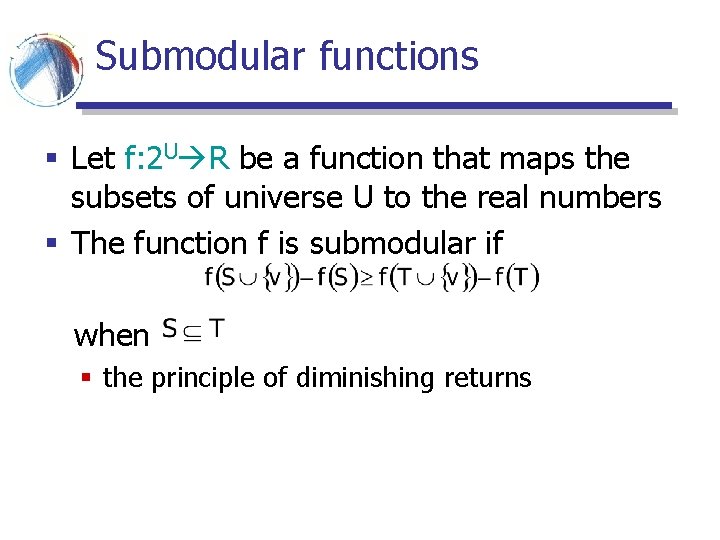
Submodular functions § Let f: 2 U R be a function that maps the subsets of universe U to the real numbers § The function f is submodular if when § the principle of diminishing returns
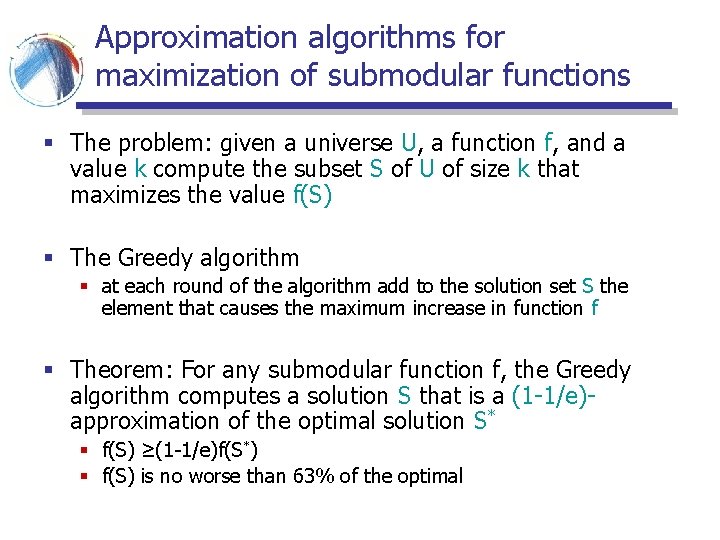
Approximation algorithms for maximization of submodular functions § The problem: given a universe U, a function f, and a value k compute the subset S of U of size k that maximizes the value f(S) § The Greedy algorithm § at each round of the algorithm add to the solution set S the element that causes the maximum increase in function f § Theorem: For any submodular function f, the Greedy algorithm computes a solution S that is a (1 -1/e)approximation of the optimal solution S* § f(S) ≥(1 -1/e)f(S*) § f(S) is no worse than 63% of the optimal
Submodularity of influence § How do we deal with the fact that influence is defined as an expectation? § Express s(A) as an expectation over the input rather than the choices of the algorithm
Independent cascade model § Each edge (u, v) is considered only once, and it is “activated” with probability puv. § We can assume that all random choices have been made in advance § generate a subgraph of the input graph where edge (u, v) is included with probability puv § propagate the gossip deterministically on the input graph § the active nodes at the end of the process are the nodes reachable from the target set A § The influence function is obviously submodular when propagation is deterministic § The weighted combination of submodular functions is also a submodular function
Linear Threshold model § Setting the thresholds in advance does not work § For every node u, sample one of the edges pointing to node u, with probability bvu and make it “live”, or select no edge with probability 1 -∑vbvu § Propagate deterministically on the resulting graph
Model equivalence § For a target set A, the following two distributions are equivalent § The distribution over active sets obtained by running the Linear Threshold model starting from A § The distribution over sets of nodes reachable from A, when live edges are selected as previously described.
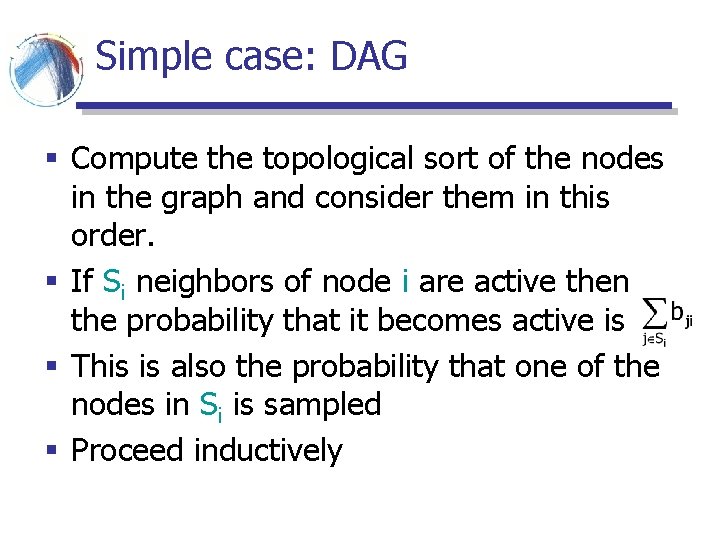
Simple case: DAG § Compute the topological sort of the nodes in the graph and consider them in this order. § If Si neighbors of node i are active then the probability that it becomes active is § This is also the probability that one of the nodes in Si is sampled § Proceed inductively
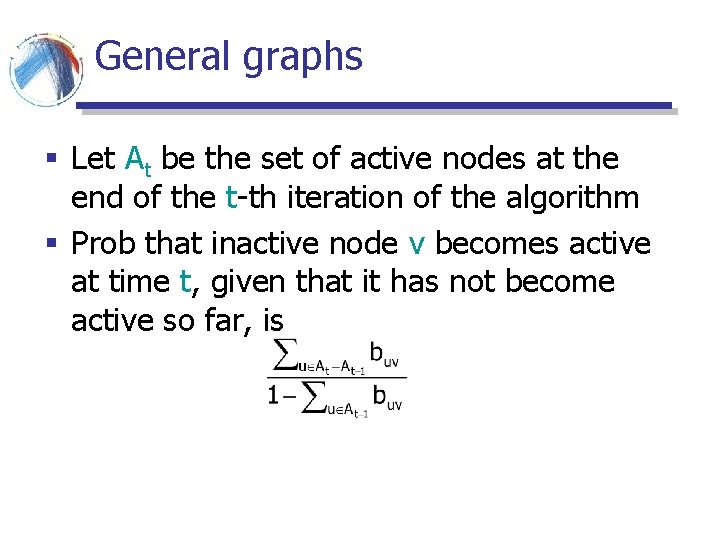
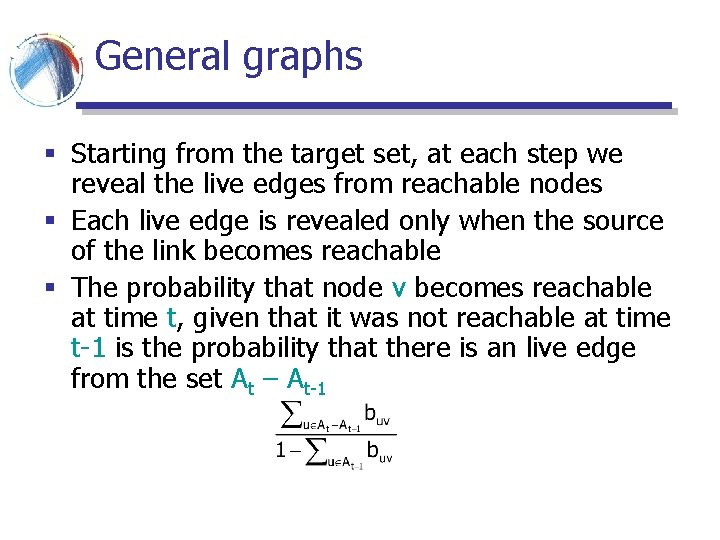
General graphs § Let At be the set of active nodes at the end of the t-th iteration of the algorithm § Prob that inactive node v becomes active at time t, given that it has not become active so far, is
General graphs § Starting from the target set, at each step we reveal the live edges from reachable nodes § Each live edge is revealed only when the source of the link becomes reachable § The probability that node v becomes reachable at time t, given that it was not reachable at time t-1 is the probability that there is an live edge from the set At – At-1
Experiments
Gossip as a method for diffusion of information § In a sensor network a node acquires some new information. How does it propagate the information to the rest of the sensors with a small number of messages? § We want § all nodes to receive the message fast (in logn time) § the neighbors that are (spatially) closer to the node to receive the information faster (in time independent of n)
Information diffusion algorithms § Consider points on a lattice § Randomized rumor spreading: at each round each node sends the message to a node chosen uniformly at random § time to inform all nodes O(logn) § same time for a close neighbor to receive the message § Neighborhood flooding: a node sends the message to all of its neighbors, one at the time, in a round robin fashion § a node at distance d receives the message in time O(d) § time to inform all nodes is O(√n)
Spatial gossip algorithm § At each round, each node u sends the message to the node v with probability proportional to duv-Dr, where D is the dimension of the lattice and 1 < r < 2 § The message goes from node u to node v in time logarithmic in duv. On the way it stays within a small region containing both u and v
References § § § § § M. E. J. Newman, The structure and function of complex networks, SIAM Reviews, 45(2): 167256, 2003 R. Albert and L. A. Barabasi, Statistical Mechanics of Complex Networks, Rev. Mod. Phys. 74, 4797 (2002). Y. -C. Lai, A. E. Motter, T. Nishikawa, Attacks and Cascades in Complex Networks, Springer Verlag D. J. Watts. Networks, Dynamics and Small-World Phenomenon, American Journal of Sociology, Vol. 105, Number 2, 493 -527, 1999 R. Pastor-Satorras and A. Vespignani, Epidemics and immunization in scale-free networks. In "Handbook of Graphs and Networks: From the Genome to the Internet", eds. S. Bornholdt and H. G. Schuster, Wiley-VCH, Berlin, pp. 113 -132 (2002) R. Cohen, S. Havlin, D. Ben-Avraham, Efficient Immunization Strategies for Computer Networks and Populations Phys Rev Lett. 2003 Dec 12; 91(24): 247901. Epub 2003. G. Giakkoupis, A. Gionis, E. Terzi, P. Tsaparas, Models and Algorithms for Network Immunization, Technical Report C-2005 -75, Department of Computer Science, University of Helsinki, 2005. Y. ang Wang, Deepayan Chakrabarti, Chenxi Wang, Christos Faloutsos, Epidemic Spreading in Real Networks: An Eigenvalue Viewpoint, SDRS, 2003 D. Kempe, J. Kleinberg, E. Tardos. Maximizing the Spread of Influence through a Social Network. Proc. 9 th ACM SIGKDD Intl. Conf. on Knowledge Discovery and Data Mining, 2003. (In PDF. ) D. Kempe, J. Kleinberg, A. Demers. Spatial gossip and resource location protocols. Proc. 33 rd ACM Symposium on Theory of Computing, 2001