
Information Mastery Information management Determine usefulness Understand sources
- Slides: 18
Information Mastery Information management Determine usefulness Understand sources (jungle) Make decisions with your patient
Usefulness • Usefulness of medical information = • Relevance x Validity Work
Relevance Three major criteria to determine relevance of an article: – How common? – Patient-oriented outcomes? – Change practice if valid?
POEs and DOEs • POE: Patient-oriented evidence – mortality, morbidity, symptoms, quality of life, cost – final outcome - matter to patients • DOE: Disease-oriented evidence – “intermediate” outcome - matter to researchers – pathophysiology, pharmacology, etiology – premature to change practice
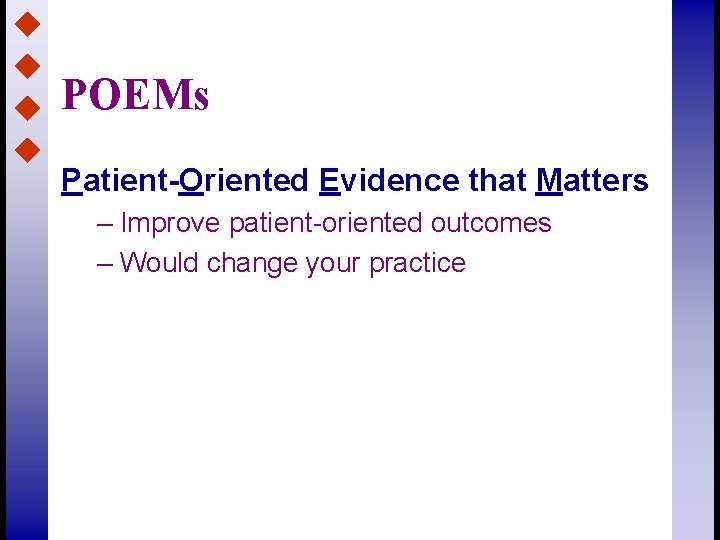
POEMs Patient-Oriented Evidence that Matters – Improve patient-oriented outcomes – Would change your practice
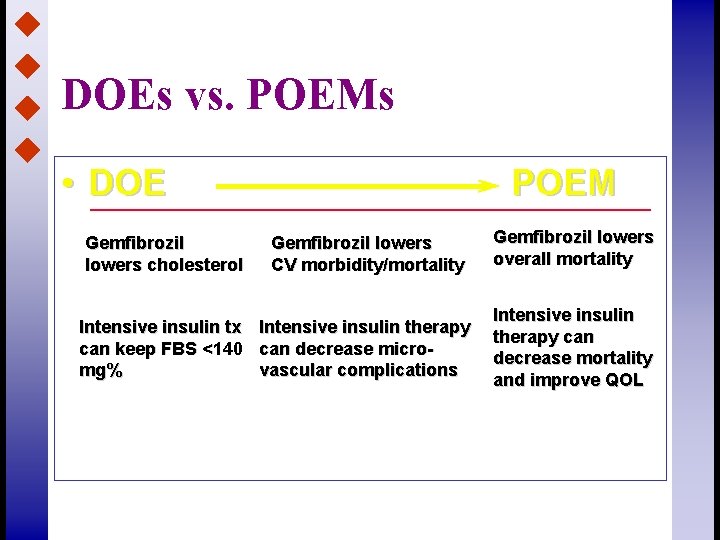
DOEs vs. POEMs • DOE Gemfibrozil lowers cholesterol POEM Gemfibrozil lowers CV morbidity/mortality Intensive insulin tx Intensive insulin therapy can keep FBS <140 can decrease micromg% vascular complications Gemfibrozil lowers overall mortality Intensive insulin therapy can decrease mortality and improve QOL
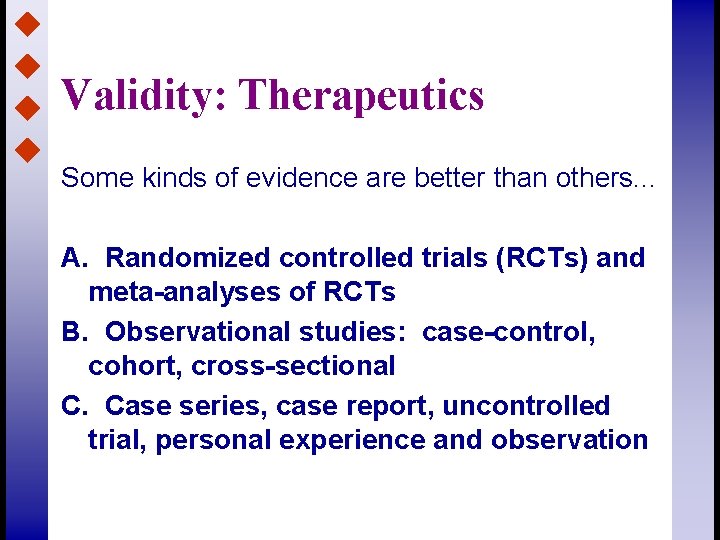
Validity: Therapeutics Some kinds of evidence are better than others. . . A. Randomized controlled trials (RCTs) and meta-analyses of RCTs B. Observational studies: case-control, cohort, cross-sectional C. Case series, case report, uncontrolled trial, personal experience and observation
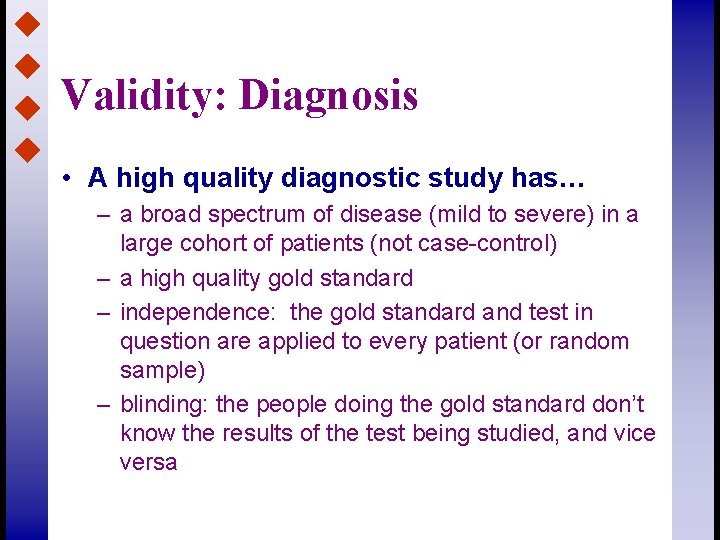
Validity: Diagnosis • A high quality diagnostic study has… – a broad spectrum of disease (mild to severe) in a large cohort of patients (not case-control) – a high quality gold standard – independence: the gold standard and test in question are applied to every patient (or random sample) – blinding: the people doing the gold standard don’t know the results of the test being studied, and vice versa
Reducing Work • Smarter literature searching • Let someone else do the heavy lifting – searching the literature – regularly reviewing journals – critical appraisal – summarizing evidence
Reducing Work • Primary sources – Medline (Pub. MED, Grateful Med) – Databases
Reducing Work • Secondary sources (POEM-based) – Journal of Family Practice POEMs – Evidence-Based Practice newsletter • Secondary sources (other) – Cochrane Database – Best Evidence – ACP Journal Club / Evidence-Based Medicine
Feeling Good About Not Knowing Everything: Information Mastery • Prioritize efforts to identify, validate, and apply common POEMs • Responsibility: less to read, but more important to find and evaluate • Consider work factor with rare POEMs • Ignore and avoid rare DOEs
Searching the medical literature: Pub. MED • Medline: primary bibliographic database of the National Library of Medicine • Covers: Medicine, nursing, dentistry, veterinary medicine, health care system and preclinical sciences • Contains over 10 million citations from over 4, 000 journals
What can Pub. MED do? • Specify basic or advanced search • Allows access to Me. SH terms (medical subject headings) used to index articles • Narrow search strategies: – Clinical queries (therapy, diagnosis, etiology and prognosis) • Numerous hot buttons which link to help pages
What can Pub. MED do? • Advanced search mode: – AND combines Me. SH terms to retrieve only articles that contain all terms (narrows search) – OR combines Me. SH terms to retrieve articles containing any or all terms (expands search)
What can Pub. MED do? • Places limits – Limits search to main point of interest (“Me. SH Major Topic) – Other limiting strategies: “human”, age groups, english – Specify types of designs: clinical trial, case reports, cross-sectional
What can Pub. MED do? • Can order slides through “Lonesome Doc” • Can download citations to your computer (as text file (*. txt))
References • Slawson DC, Shaughnessy AF, Bennett JH. Becoming a medical information master: Feeling good about not knowing everthing. J Fam Pract 1994; 38 (5): 505 -513. • Shaughnessy AF, Slawson DC, Bennett JH. Becoming a medical information master: A guidebook to the medical information jungle. J Fam Pract 1994; 39 (5): 489 -499.