
INFORMATION MANAGEMENT Capacity Building Strategy OVERVIEW 2015 2016
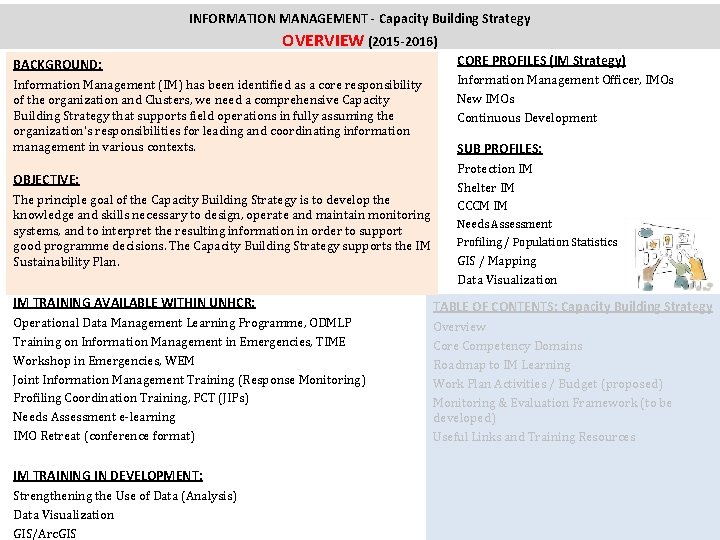
INFORMATION MANAGEMENT - Capacity Building Strategy OVERVIEW (2015 -2016) CORE PROFILES (IM Strategy) BACKGROUND: Information Management Officer, IMOs New IMOs Continuous Development Information Management (IM) has been identified as a core responsibility of the organization and Clusters, we need a comprehensive Capacity Building Strategy that supports field operations in fully assuming the organization's responsibilities for leading and coordinating information management in various contexts. SUB PROFILES: OBJECTIVE: Protection IM Shelter IM CCCM IM The principle goal of the Capacity Building Strategy is to develop the knowledge and skills necessary to design, operate and maintain monitoring systems, and to interpret the resulting information in order to support good programme decisions. The Capacity Building Strategy supports the IM Sustainability Plan. Needs Assessment Profiling / Population Statistics GIS / Mapping Data Visualization IM TRAINING AVAILABLE WITHIN UNHCR: Operational Data Management Learning Programme, ODMLP Training on Information Management in Emergencies, TIME Workshop in Emergencies, WEM Joint Information Management Training (Response Monitoring) Profiling Coordination Training, PCT (JIPs) Needs Assessment e-learning IMO Retreat (conference format) TABLE OF CONTENTS: Capacity Building Strategy Overview Core Competency Domains Roadmap to IM Learning Work Plan Activities / Budget (proposed) Monitoring & Evaluation Framework (to be developed) Useful Links and Training Resources IM TRAINING IN DEVELOPMENT: Strengthening the Use of Data (Analysis) Data Visualization GIS/Arc. GIS
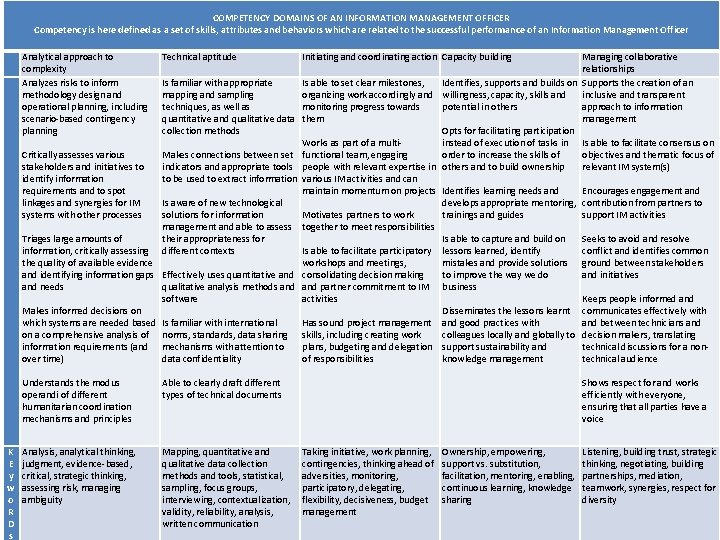
COMPETENCY DOMAINS OF AN INFORMATION MANAGEMENT OFFICER Competency is here defined as a set of skills, attributes and behaviors which are related to the successful performance of an Information Management Officer K E y w o R D s Analytical approach to complexity Analyzes risks to inform methodology design and operational planning, including scenario-based contingency planning Critically assesses various stakeholders and initiatives to identify information requirements and to spot linkages and synergies for IM systems with other processes Triages large amounts of information, critically assessing the quality of available evidence and identifying information gaps and needs Makes informed decisions on which systems are needed based on a comprehensive analysis of information requirements (and over time) Understands the modus operandi of different humanitarian coordination mechanisms and principles Technical aptitude Initiating and coordinating action Capacity building Managing collaborative relationships Identifies, supports and builds on Supports the creation of an willingness, capacity, skills and inclusive and transparent potential in others approach to information management Opts for facilitating participation instead of execution of tasks in Is able to facilitate consensus on order to increase the skills of objectives and thematic focus of others and to build ownership relevant IM system(s) Identifies learning needs and Encourages engagement and develops appropriate mentoring, contribution from partners to trainings and guides support IM activities Is able to capture and build on Seeks to avoid and resolve lessons learned, identify conflict and identifies common mistakes and provide solutions ground between stakeholders to improve the way we do and initiatives business Keeps people informed and Disseminates the lessons learnt communicates effectively with and good practices with and between technicians and colleagues locally and globally to decision makers, translating support sustainability and technical discussions for a nonknowledge management technical audience Shows respect for and works efficiently with everyone, ensuring that all parties have a voice Is familiar with appropriate mapping and sampling techniques, as well as quantitative and qualitative data collection methods Makes connections between set indicators and appropriate tools to be used to extract information Is aware of new technological solutions for information management and able to assess their appropriateness for different contexts Effectively uses quantitative and qualitative analysis methods and software Is familiar with international norms, standards, data sharing mechanisms with attention to data confidentiality Able to clearly draft different types of technical documents Is able to set clear milestones, organizing work accordingly and monitoring progress towards them Works as part of a multifunctional team, engaging people with relevant expertise in various IM activities and can maintain momentum on projects Motivates partners to work together to meet responsibilities Is able to facilitate participatory workshops and meetings, consolidating decision making and partner commitment to IM activities Has sound project management skills, including creating work plans, budgeting and delegation of responsibilities Analysis, analytical thinking, judgment, evidence-based, critical, strategic thinking, assessing risk, managing ambiguity Mapping, quantitative and qualitative data collection methods and tools, statistical, sampling, focus groups, interviewing, contextualization, validity, reliability, analysis, written communication Taking initiative, work planning, contingencies, thinking ahead of adversities, monitoring, participatory, delegating, flexibility, decisiveness, budget management Ownership, empowering, support vs. substitution, facilitation, mentoring, enabling, continuous learning, knowledge sharing Listening, building trust, strategic thinking, negotiating, building partnerships, mediation, teamwork, synergies, respect for diversity
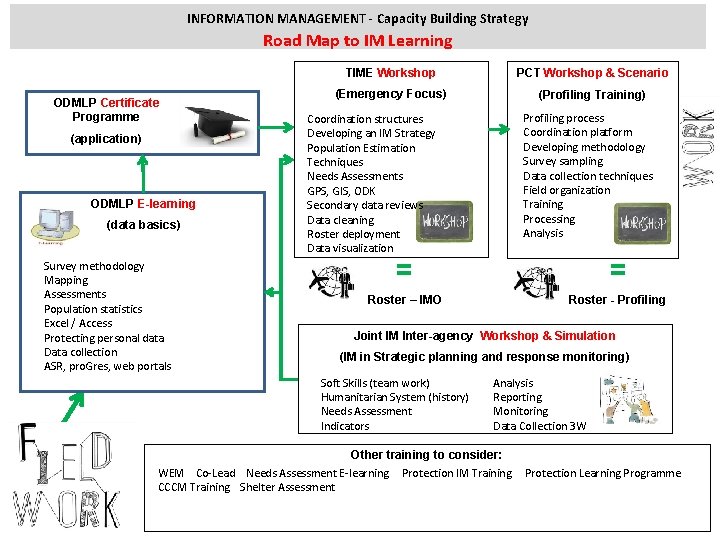
INFORMATION MANAGEMENT - Capacity Building Strategy Road Map to IM Learning ODMLP Certificate Programme (application) ODMLP E-learning (data basics) Survey methodology Mapping Assessments Population statistics Excel / Access Protecting personal data Data collection ASR, pro. Gres, web portals TIME Workshop PCT Workshop & Scenario (Emergency Focus) (Profiling Training) Coordination structures Developing an IM Strategy Population Estimation Techniques Needs Assessments GPS, GIS, ODK Secondary data reviews Data cleaning Roster deployment Data visualization Profiling process Coordination platform Developing methodology Survey sampling Data collection techniques Field organization Training Processing Analysis = = Roster – IMO Roster - Profiling Joint IM Inter-agency Workshop & Simulation (IM in Strategic planning and response monitoring) Soft Skills (team work) Humanitarian System (history) Needs Assessment Indicators Analysis Reporting Monitoring Data Collection 3 W Other training to consider: WEM Co-Lead Needs Assessment E-learning Protection IM Training Protection Learning Programme CCCM Training Shelter Assessment
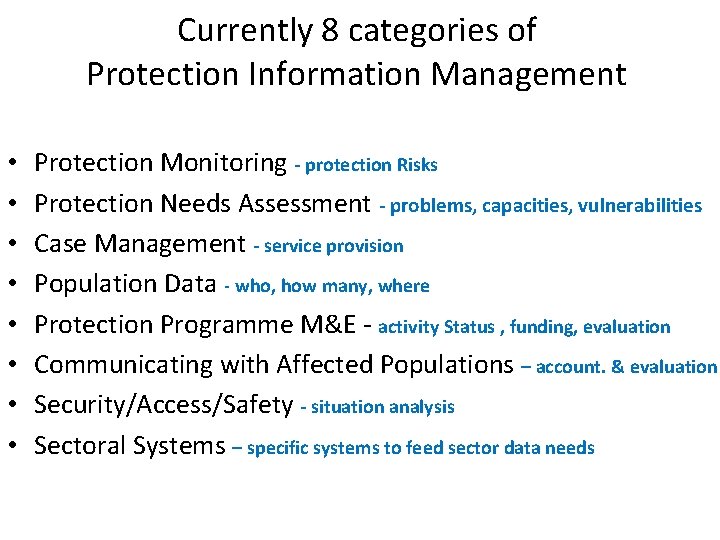
Currently 8 categories of Protection Information Management • • Protection Monitoring - protection Risks Protection Needs Assessment - problems, capacities, vulnerabilities Case Management - service provision Population Data - who, how many, where Protection Programme M&E - activity Status , funding, evaluation Communicating with Affected Populations – account. & evaluation Security/Access/Safety - situation analysis Sectoral Systems – specific systems to feed sector data needs

INFORMATION MANAGEMENT - Capacity Building Strategy Useful Links and Training Resources (please add) NOTES and links to other training material: TIME: docs. google. com/document/d/1 z. SBMe. LW 7 ve. F 8 v 9 w. EByypz 17 Gc. B 04 w. Fb. Jt. E 0 byrktiv. U/edit? usp=sharing 2014 preparation material ODMLP: available on Learn & Connect https: //unhcr. csod. com/client/unhcr/default. aspx Needs Assessment e-learning: TBD Joint-UN IM Induction: https: //www. dropbox. com/sh/dn 1 cdlxhb 5 dq 4 yp/AABABNpu. Q 0 flyi. Sgg. GBmq. AVxa? dl=0 WEM: https: //docs. google. com/document/d/1 d. ZNLruib. MQg 9 u 2 BDx 0 Wzwoe. Ou. EPJXLd. EOSad 97 IAU 0 o/edit? usp=sharing https: //prezi. com/_eninwmbjugk/hq-intro-to-im-july-28 -2013/? utm_campaign=share&utm_medium=copy FAO - Strategic Approaches to Information (methods and tools for developing and implementing an information management strategy in the digital age). www. imarkgroup. org WFP: https: //www. wfp. org/content/monitoring-food-security-technical-guidance-sheet UNICEF M&E Training: http: //www. ceecis. org/remf/Service 3/unicef_eng/index. html Sampling: http: //www. acaps. org/en/resources / http: //www. youtube. com/watch? v=DD 5 npelwh 80 / http: //www. sens. unhcr. org/page. asp? content_id=33621 Excel: https: //www. dropbox. com/sh/xspemxxdoyzy 0 gg/AACQo. GOn. AFJAF 2 Mv. QKAJ--gya? dl=0 Edouard Legoupil - UNHCR JOR -IM: Courtesy from ACAPS / Patrice: https: //www. dropbox. com/sh/xspemxxdoyzy 0 gg/AACQo. GOn. AFJAF 2 Mv. QKAJ--gya? dl=0 Edouard Legoupil - UNHCR JOR -IM: http: //excelwhatelse. blogspot. com/ https: //cwebbbi. wordpress. com/2013/10/18/implementing-common-calculations-in-power-query/ Free online course: https: //www. coursera. org/
- Slides: 5