
Information Literacy Learning and Design Outline Information literacy

- Slides: 20
Information Literacy, Learning and Design
Outline Information literacy and learning Learning outcomes Learning theories Designing information literacy activities Teaching strategies Learning styles
Information Literacy and Learning Alexandria Proclamation, UNESCO, 2005 “Information Literacy lies at the core of lifelong learning. It empowers people in all walks of life to seek, evaluate, use and create information effectively to achieve their personal, social, occupational and educational goals. ” Governments urged to support: “recognition of lifelong learning and information literacy as key elements for the development of generic capabilities which must be required for the accreditation of all education and training programs. “
Learning outcomes Aims/goals, objectives and outcomes - what's what? Aim/goal Objectives Outcomes – the overall broad aim – specific steps to achieve the aim – objectives phrased in terms of what will the learner be able to do / achieve Example: Aim/goal To use search engines effectively Objectives / outcomes Construct a search using Boolean logic Explain how a search engine ranks results
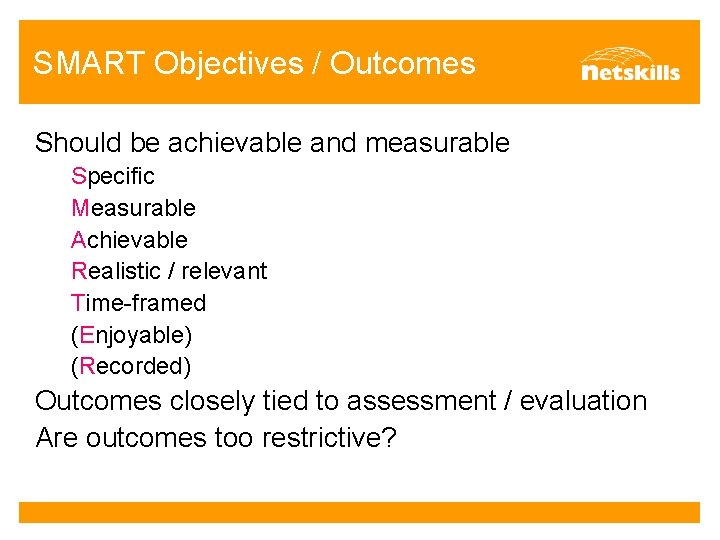
SMART Objectives / Outcomes Should be achievable and measurable Specific Measurable Achievable Realistic / relevant Time-framed (Enjoyable) (Recorded) Outcomes closely tied to assessment / evaluation Are outcomes too restrictive?
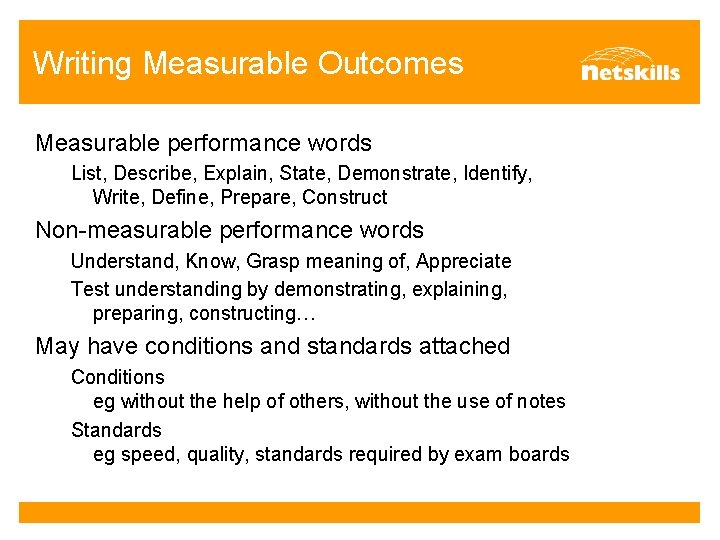
Writing Measurable Outcomes Measurable performance words List, Describe, Explain, State, Demonstrate, Identify, Write, Define, Prepare, Construct Non-measurable performance words Understand, Know, Grasp meaning of, Appreciate Test understanding by demonstrating, explaining, preparing, constructing… May have conditions and standards attached Conditions eg without the help of others, without the use of notes Standards eg speed, quality, standards required by exam boards
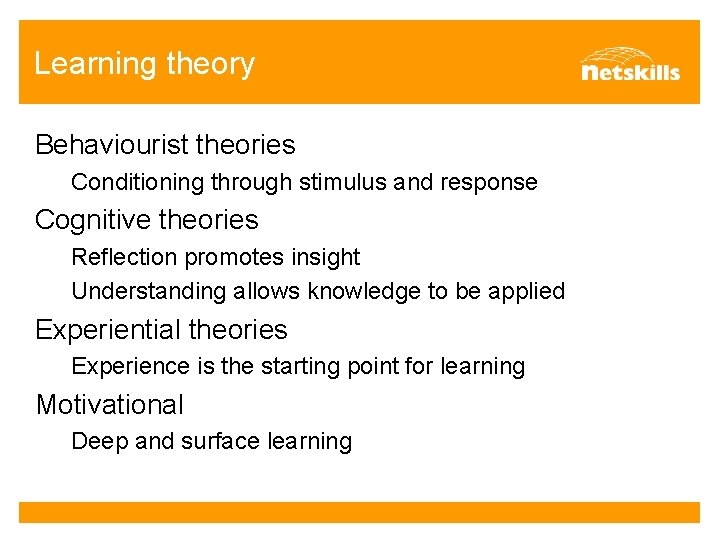
Learning theory Behaviourist theories Conditioning through stimulus and response Cognitive theories Reflection promotes insight Understanding allows knowledge to be applied Experiential theories Experience is the starting point for learning Motivational Deep and surface learning
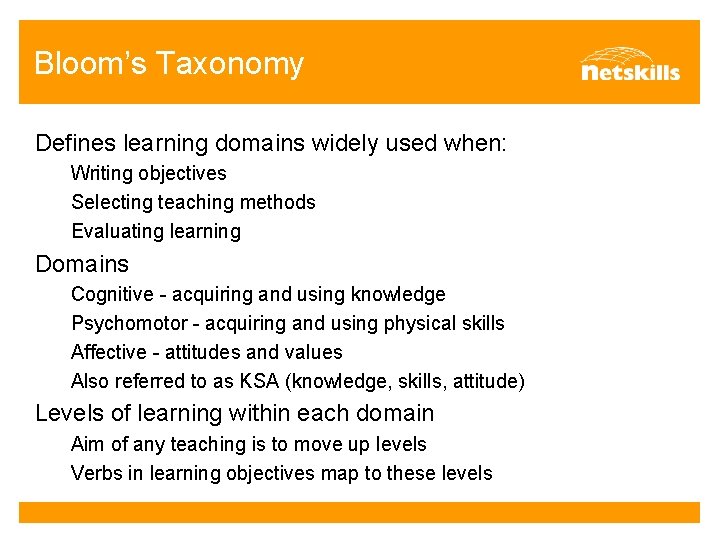
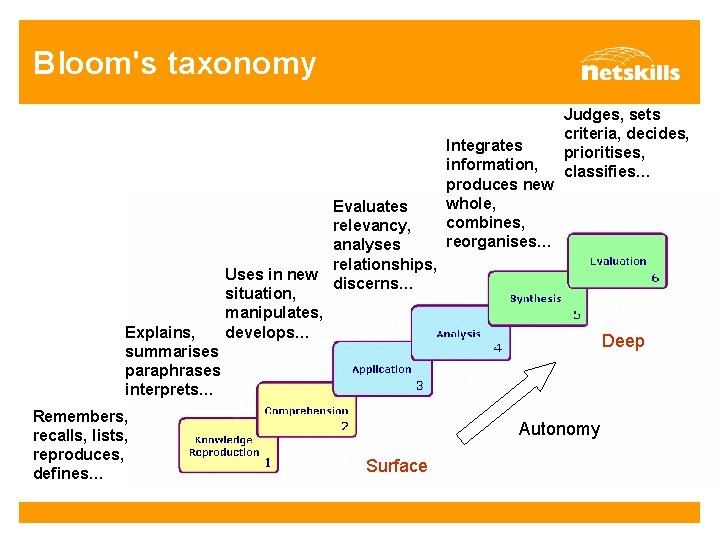
Bloom’s Taxonomy Defines learning domains widely used when: Writing objectives Selecting teaching methods Evaluating learning Domains Cognitive - acquiring and using knowledge Psychomotor - acquiring and using physical skills Affective - attitudes and values Also referred to as KSA (knowledge, skills, attitude) Levels of learning within each domain Aim of any teaching is to move up levels Verbs in learning objectives map to these levels
Bloom's taxonomy Explains, summarises paraphrases interprets… Remembers, recalls, lists, reproduces, defines… Evaluates relevancy, analyses relationships, Uses in new discerns… situation, manipulates, develops… Integrates information, produces new whole, combines, reorganises… Judges, sets criteria, decides, prioritises, classifies… Deep Autonomy Surface
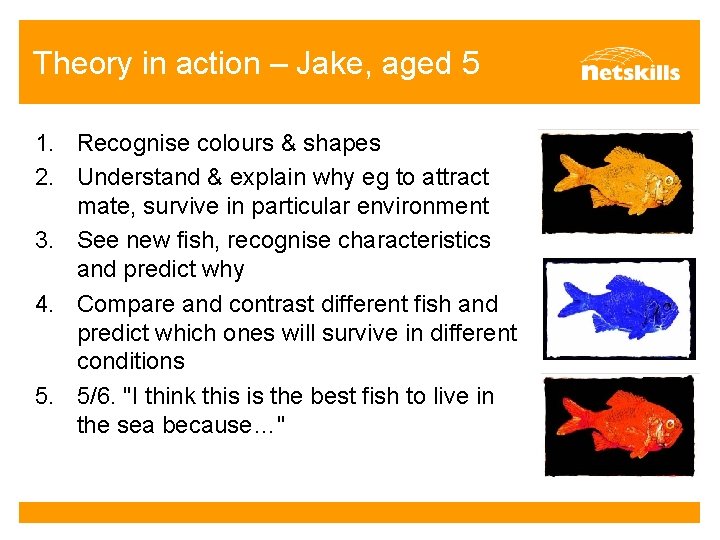
Theory in action – Jake, aged 5 1. Recognise colours & shapes 2. Understand & explain why eg to attract mate, survive in particular environment 3. See new fish, recognise characteristics and predict why 4. Compare and contrast different fish and predict which ones will survive in different conditions 5. 5/6. "I think this is the best fish to live in the sea because…"
Designing Information Literacy Activities
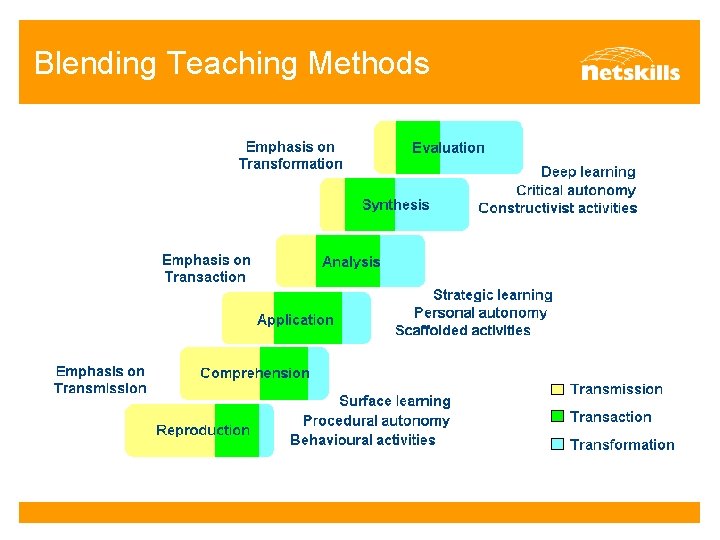
Pedagogy of Teaching Methods Transmission Emphasis on behaviourist approach to learning Directed instruction, reinforcement and feedback Learning strategies fixed, pre-set outcomes Teacher – knowledge presenter Transaction Emphasis on scaffolded approach to learning Learning strategies more flexible, learner-centred Teacher – facilitator Transformation Emphasis on constructivist approach to learning Learner constructs knowledge, analyses and reflects Teacher – advisor HAYWOOD, R. (1997)
Blending Teaching Methods
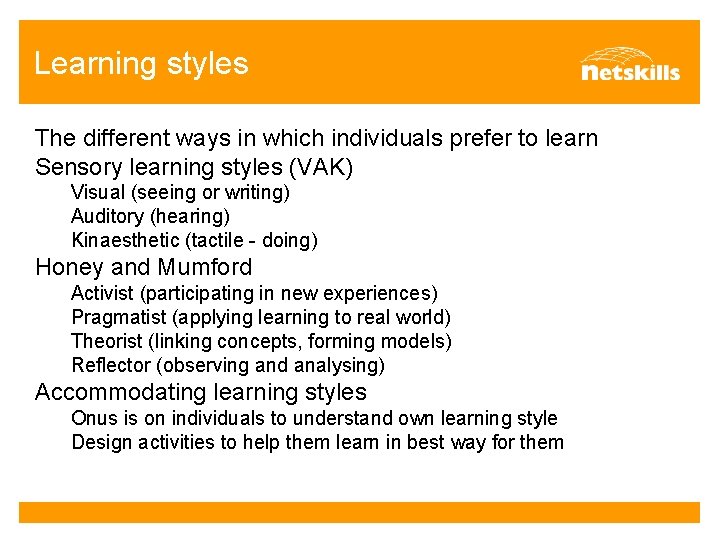
Learning styles The different ways in which individuals prefer to learn Sensory learning styles (VAK) Visual (seeing or writing) Auditory (hearing) Kinaesthetic (tactile - doing) Honey and Mumford Activist (participating in new experiences) Pragmatist (applying learning to real world) Theorist (linking concepts, forming models) Reflector (observing and analysing) Accommodating learning styles Onus is on individuals to understand own learning style Design activities to help them learn in best way for them
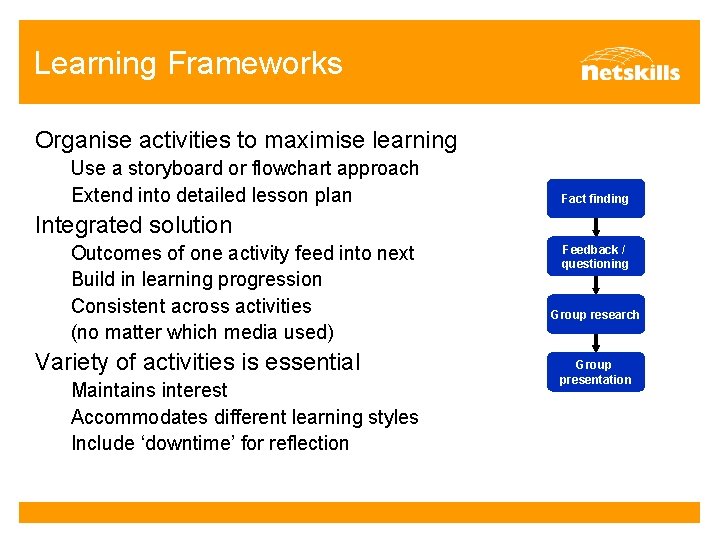
Learning Frameworks Organise activities to maximise learning Use a storyboard or flowchart approach Extend into detailed lesson plan Fact finding Integrated solution Outcomes of one activity feed into next Build in learning progression Consistent across activities (no matter which media used) Variety of activities is essential Maintains interest Accommodates different learning styles Include ‘downtime’ for reflection Feedback / questioning Group research Group presentation
Information Literacy Models PLUS model Purpose, Location, Use, Self-evaluation Big 6™ Task definition, Information seeking strategies, Location and access, Use of information, Synthesis, Evaluation Marland's 9 questions What do I need to do? Where could I go? How do I get to the information? Which resources shall I use? How shall I use the resources? What should I make a record of? Have I got all the information I need? How should I present it? What have I achieved?
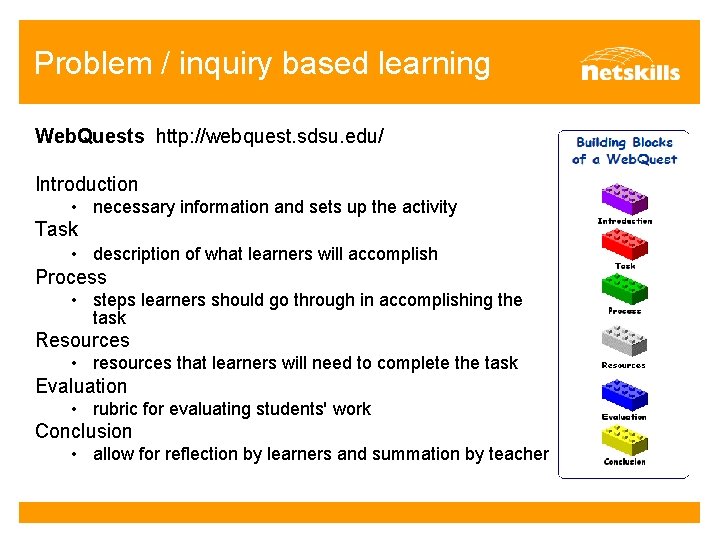
Problem / inquiry based learning Web. Quests http: //webquest. sdsu. edu/ Introduction • necessary information and sets up the activity Task • description of what learners will accomplish Process • steps learners should go through in accomplishing the task Resources • resources that learners will need to complete the task Evaluation • rubric for evaluating students' work Conclusion • allow for reflection by learners and summation by teacher
Tips for activities What do you want to students to achieve and how will you get there? Build in progression and use appropriate activities Use a 'modelling' process and planning form to develop activities Make it relevant - tie it to the curriculum Keep it fun Try different activities – not just worksheets Don't be afraid to try new things Be flexible Don't attempt to cover too much Be prepared Be aware of different learning styles
Summary Write clear aims and objectives Ensure the objectives are pitched at the right level Develop outcomes that foster progression Use appropriate activities to achieve your intended outcome
References Alexandria Proclamation, UNESCO, 2005 http: //portal. unesco. org/ci/en/ev. php-URL_ID=20891&URL_DO= DO_TOPIC&URL_SECTION=201. html HAYWOOD R (1997) Links between learning styles, teaching methods and course requirements, in, EDWARDS T, FITZ-GIBBON C, MEAGHER N, HARDMAN F and HAYWOOD R (eds) (1997) Separate But Equal? : Academic and Vocational Education Post-16. London, Routledge. PLUS Model © James E Herring http: //www. ltscotland. org. uk/5 to 14/specialfocus/informationskills/plus. asp Big 6 ™ http: //new. big 6. com/what-is-the-big 6/ Marland's 9 questions – Marland, M. (1984) Information Skills in the Secondary Curriculum. London: Methuan Educational Web. Quest Taskonomy http: //webquest. sdsu. edu/taskonomy. html