
INFORMATION LITERACY HISTORY The phrase information literacy first
- Slides: 28
INFORMATION LITERACY
HISTORY The phrase information literacy first appeared in print in a 1974 report by Paul G. Zurkowski. It was written on behalf of the National Commission on Libraries and Information Science. Zurkowski used the phrase to describe the "techniques and skills" known by the information literate "for utilizing the wide range of information tools as well as primary sources in molding information solutions to their problems".
The Presidential Committee on Information Literacy released a report on January 10, 1989, outlining the importance of information literacy, opportunities to develop information literacy, and an Information Age School. The report's final name is the Presidential Committee on Information Literacy: Final Report. The recommendations of the Presidential Committee led to the creation later that year of the National Forum on Information Literacy, a coalition of more than 90 national and international organizations.
In 1998, the American Association of School Librarians and the Association for Educational Communications and Technology published Information Power: Building Partnerships for Learning, which further established specific goals for information literacy education, defining some nine standards in the categories of "information literacy", "independent learning", and "social responsibility“. Also in 1998, the Presidential Committee on Information Literacy produced an update on its Final Report. This update outlined the six main recommendations of the original report and examined areas where it made progress and areas that still needed work. The updated report supports further information literacy advocacy and reiterates its importance.
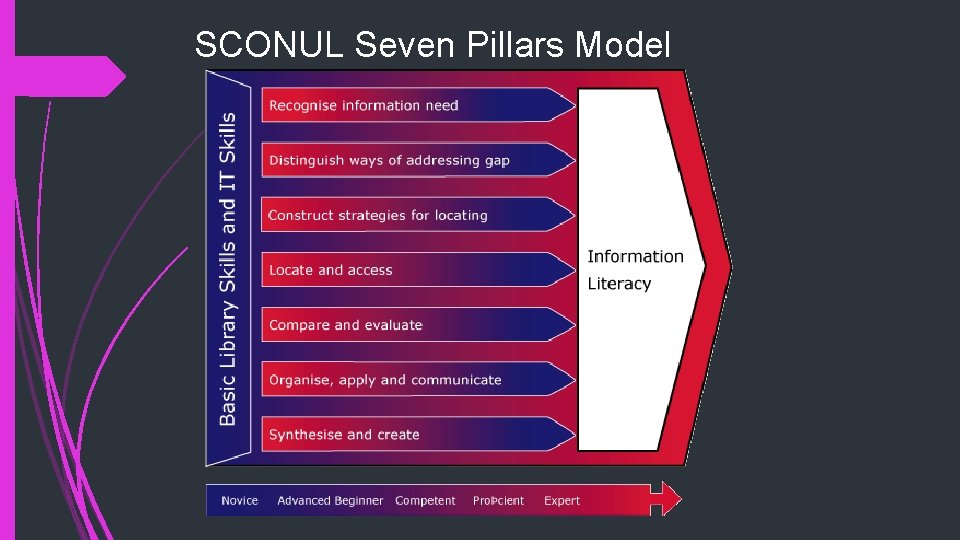
In 1999, the Society of College, National and University Libraries (SCONUL) in the UK, published "The Seven Pillars of Information Literacy" model to "facilitate further development of ideas amongst practitioners in the field. . . stimulate debate about the ideas and about how those ideas might be used by library and other staff in higher education concerned with the development of students' skills. “ A number of other countries have developed information literacy standards since then.
In 2003, the National Forum on Information Literacy, together with UNESCO and the National Commission on Libraries and Information Science, sponsored an international conference in Prague with representatives from some twenty-three countries to discuss the importance of information literacy within a global context. The resulting Prague Declaration described information literacy as a "key to social, cultural, and economic development of nations and communities, institutions and individuals in the 21 st century" and declared its acquisition as "part of the basic human right of life long learning“.
On May 28, 2009, U. S. California Governor Arnold Schwarzenegger signed Executive Order S-06 -09, establishing a California ICT Digital Literacy Leadership Council, which in turn, was directed to establish an ICT Digital Literacy Advisory Committee. “ The Leadership Council, in consultation with the Advisory Committee, shall develop an ICT Digital Literacy Policy, to ensure that California residents are digitally literate. " The Executive Order states further: "ICT Digital Literacy is defined as using digital technology, communications tools and/or networks to access, manage, integrate, evaluate, create, and communicate information in order to function in a knowledgebased economy and society. . .
" The Governor directs ". . . The Leadership Council, in consultation with the Advisory Committee. . . [to] develop a California Action Plan for ICT Digital Literacy (Action Plan). " He also directs "The California Workforce Investment Board (WIB). . . [to] develop a technology literacy component for its five-year Strategic State Plan. " His Executive Order ends with the following: "I FURTHER REQUEST that the Legislature and Superintendent of Public Instruction consider adopting similar goals, and that they join the Leadership Council in issuing a "Call to Action" to schools, higher education institutions, employers, workforce training agencies, local governments, community organizations, and civic leaders to advance California as a global leader in ICT Digital Literacy".
Information literacy rose to national consciousness in the U. S. with President Barack Obama's Proclamation designating October 2009 as National Information Literacy Awareness Month. President Obama's Proclamation stated that "Rather than merely possessing data, we must also learn the skills necessary to acquire, collate, and evaluate information for any situation. . . Though we may know how to find the information we need, we must also know how to evaluate it. Over the past decade, we have seen a crisis of authenticity emerge. We now live in a world where anyone can publish an opinion or perspective, whether true or not, and have that opinion amplified within the information marketplace. At the same time, Americans have unprecedented access to the diverse and independent sources of information, as well as institutions such as libraries and universities, that can help separate truth from fiction and signal from noise. " Obama's proclamation ended with: "Now, therefore, I, Barack Obama, President of the United States of America, by virtue of the authority vested in me by the Constitution and the laws of the United States, do hereby proclaim October 2009 as National Information Literacy Awareness Month. I call upon the people of the United States to recognize the important role information plays in our daily lives, and appreciate the need for a greater understanding of its impact. "
What is Information Literacy? Information Literacy is the ability to identify what information is needed, understand how the information is organized, identify the best sources of information for a given need, locate those sources, evaluate the sources critically, and share that information.
The ALA Definition Information literacy is a set of abilities that enables an individual to “recognize when information is needed and have the ability to effectively locate, evaluate, and use the needed information. " American Library Association. Presidential Committee on Information Literacy. Final Report. (Chicago: American Library Association, 1989). http: //www. ala. org/acrl/nili/ilit 1 st. html
“Information literacy is the ability to locate, evaluate, manage and use information from a range of sources for problem solving, decision making and research. “ Bruce, C. and P. C Candy (1995). Developing information literate graduates: prompts for good practice. The Learning Link: information literacy in practice. D. Booker. Adelaide, AUSLIB press: 245 -252.
The American Library Association (ALA) defines an information literate person as someone who can: Determine the extent of information needed Access the needed information effectively and efficiently Evaluate information and its sources critically Incorporate selected information into one’s knowledge base Use information effectively to accomplish a specific purpose Understand the economic, legal, and social issues surrounding the use of information, and access and use information ethically and legally (From ACRL's Information Literarcy Competency Standards for Higher Education)
Why is information literacy important?
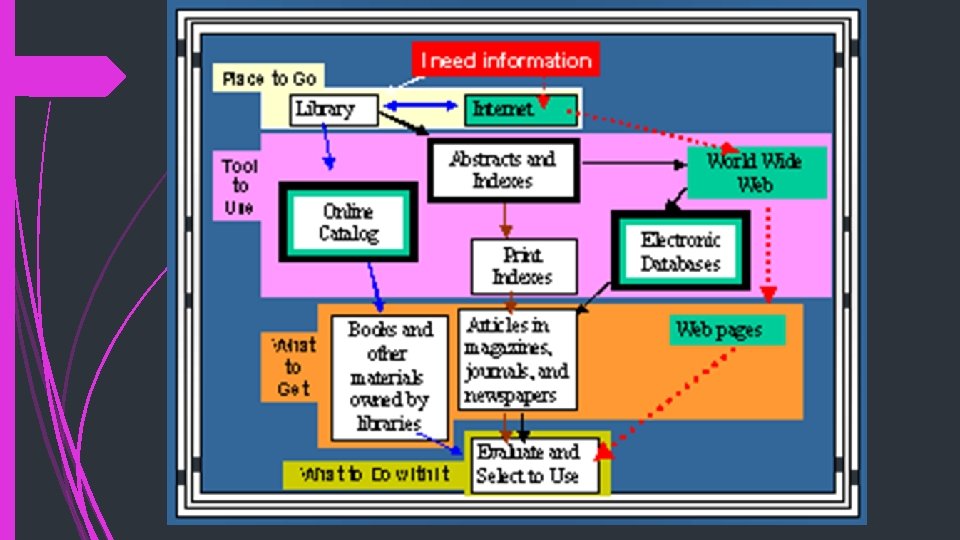
The New Reality Multiple Catalogs and Databases The Library and Its Various Resources Print, electronic, some full-text, some not The Internet as Its Own (Mega) Resource Multiple Access Points Many Other Access Issues
Equips individuals to be self-directed, lifelong learners Goes beyond knowing how to use a computer or learning one specific interface Highlights the global nature of information Includes critical evaluation of information Allows for transfer of knowledge Allows for informed decision making
What are the competencies or standards associated with being information literate?
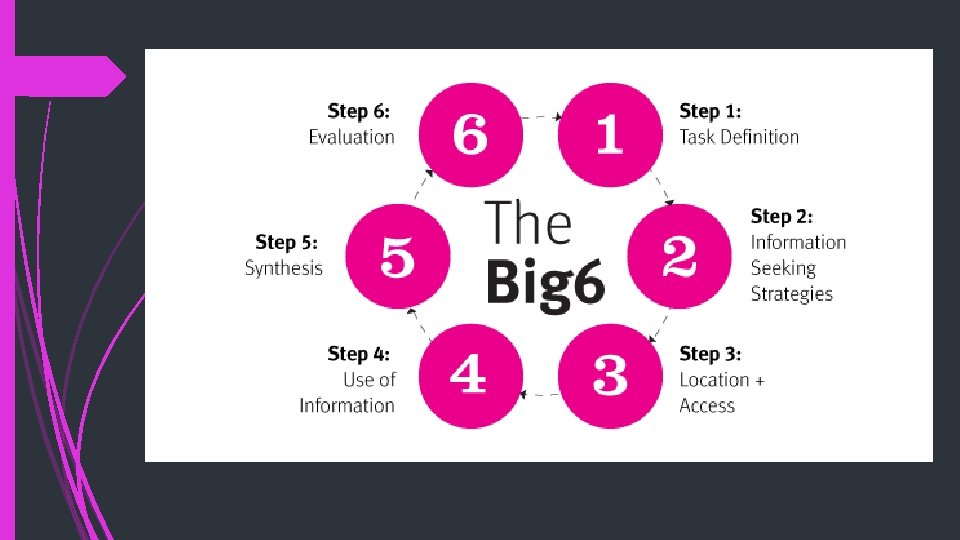
The Big 6 Model Developed by Eisenberg and Berkowitz (2006) Focuses more on processes and skills Characterized as a method for enhancing Information Technology. Literacy Designed with K-12 students Focuses almost exclusively on IL as an information problem solving approach
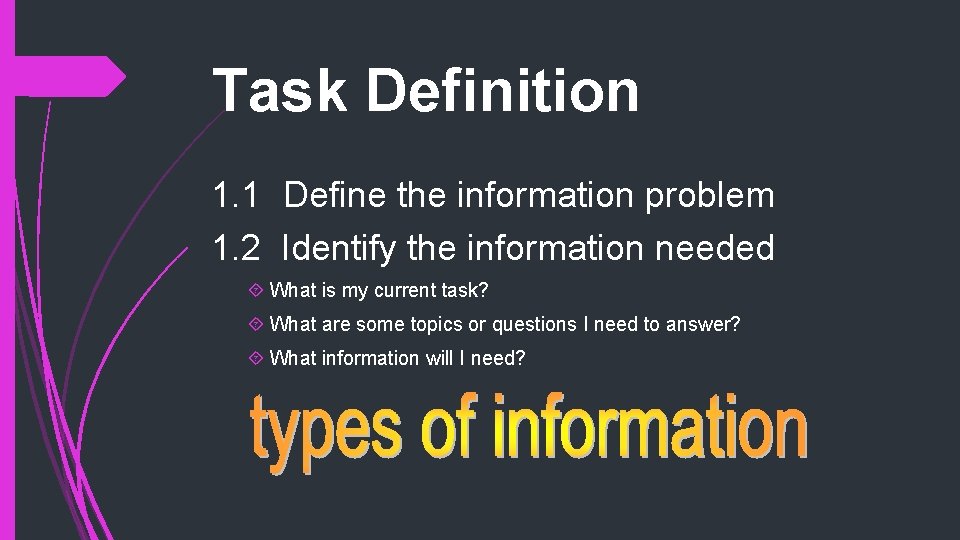
Task Definition 1. 1 Define the information problem 1. 2 Identify the information needed What is my current task? What are some topics or questions I need to answer? What information will I need?
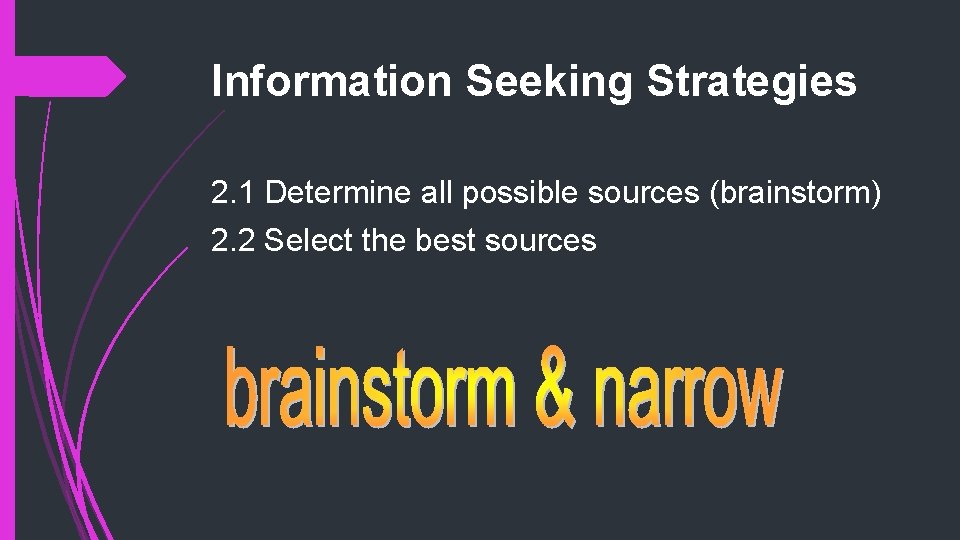
Information Seeking Strategies 2. 1 Determine all possible sources (brainstorm) 2. 2 Select the best sources
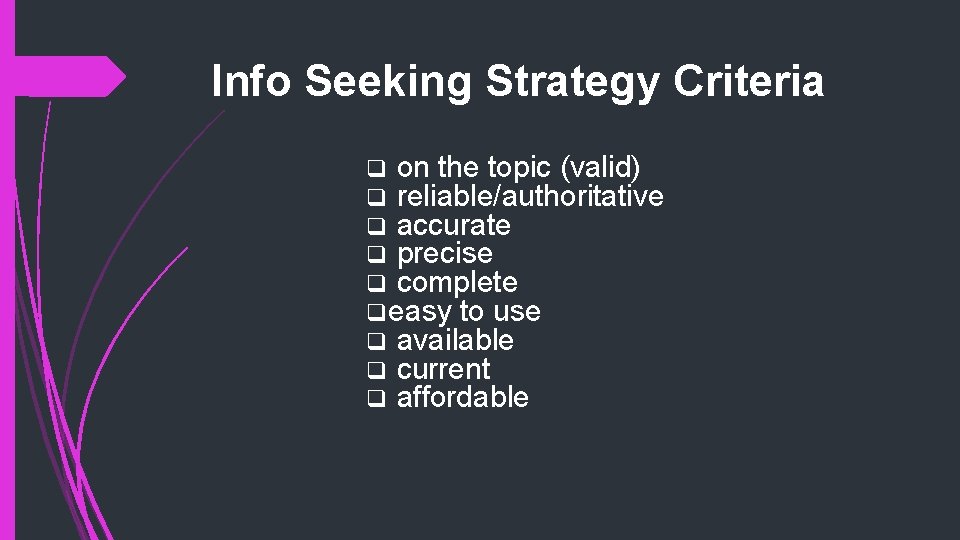
Info Seeking Strategy Criteria q on the topic (valid) q reliable/authoritative q accurate q precise q complete q easy to use q available q current q affordable
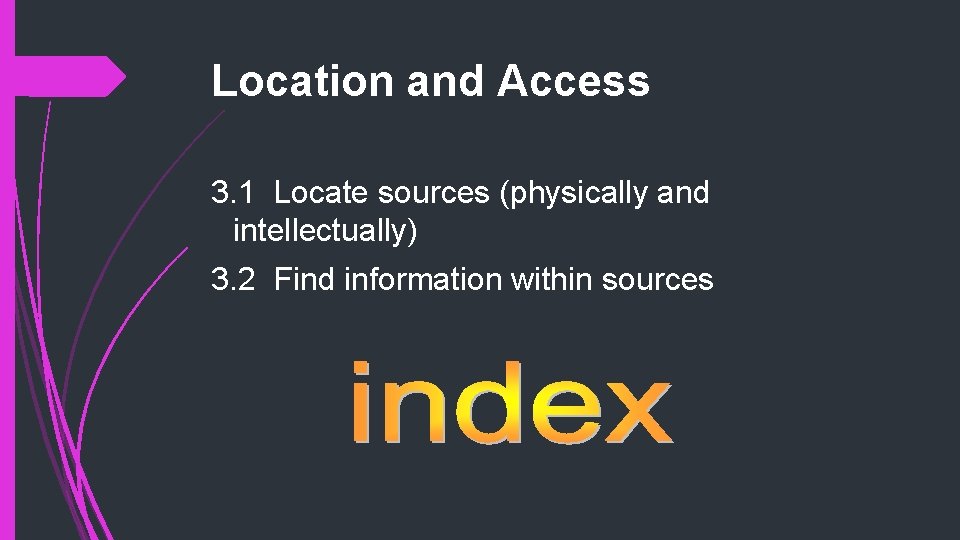
Location and Access 3. 1 Locate sources (physically and intellectually) 3. 2 Find information within sources
Use of Information 4. 1 Engage (read, hear, view) 4. 2 Extract relevant, quality information
Synthesis 5. 1 Organize from multiple sources 5. 2 Present the information v How will I organize my information? v How should I present my information?
Evaluation 6. 1 Judge the result 6. 2 Judge the process
SCONUL Seven Pillars Model