
Information Literacy and the contributions of Library Technicians
Information Literacy and the contributions of Library Technicians in the Academic Library: One Model Session 1012 Welcome! 1
“Professionalism is not an attribute inherent in a title but is demonstrated by behavior and performance. It is the conduct, aims or qualities that characterize or mark a profession or a professional person. “On these grounds it is clearly appropriate to recognize the professionalism of Library Technicians, since they are engaged in a professional activity and conform to the technical standards of the profession in the performance of their daily tasks. ” Albert Casciero, 1990. 2
Information Literacy Definition Information literacy is a set of abilities requiring individuals to "recognize when information is needed and have the ability to locate, evaluate, and use effectively the needed information. " Information Literacy Competency Standards for Higher Education. American Library Association, 2006. 3
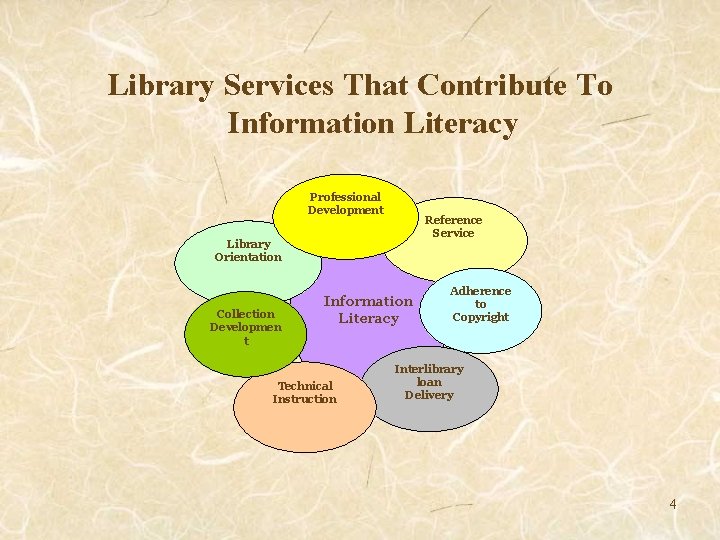
Library Services That Contribute To Information Literacy Professional Development Reference Service Library Orientation Collection Developmen t Information Literacy Technical Instruction Adherence to Copyright Interlibrary loan Delivery 4
5

6
7
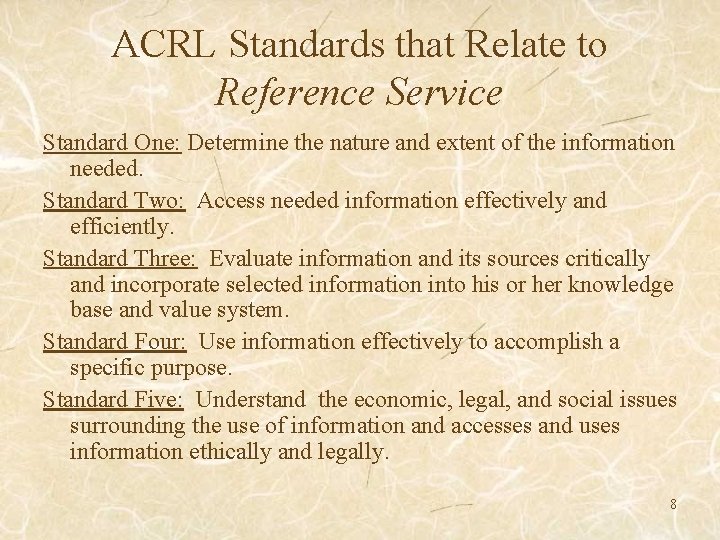
ACRL Standards that Relate to Reference Service Standard One: Determine the nature and extent of the information needed. Standard Two: Access needed information effectively and efficiently. Standard Three: Evaluate information and its sources critically and incorporate selected information into his or her knowledge base and value system. Standard Four: Use information effectively to accomplish a specific purpose. Standard Five: Understand the economic, legal, and social issues surrounding the use of information and accesses and uses information ethically and legally. 8
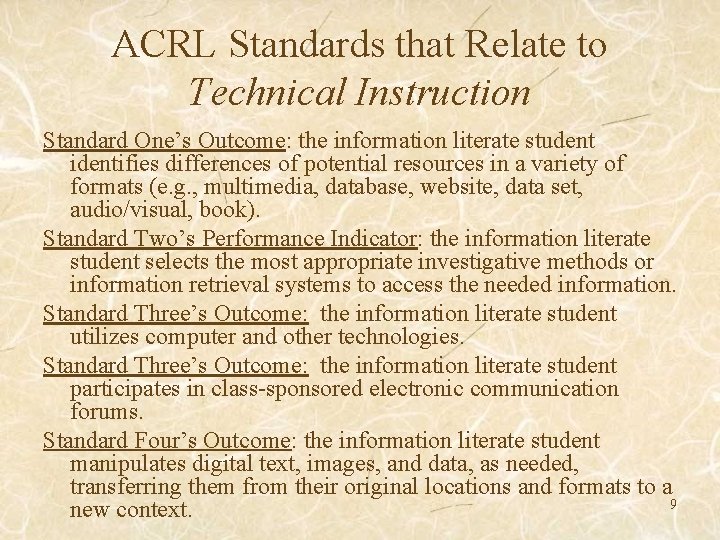
ACRL Standards that Relate to Technical Instruction Standard One’s Outcome: the information literate student identifies differences of potential resources in a variety of formats (e. g. , multimedia, database, website, data set, audio/visual, book). Standard Two’s Performance Indicator: the information literate student selects the most appropriate investigative methods or information retrieval systems to access the needed information. Standard Three’s Outcome: the information literate student utilizes computer and other technologies. Standard Three’s Outcome: the information literate student participates in class-sponsored electronic communication forums. Standard Four’s Outcome: the information literate student manipulates digital text, images, and data, as needed, transferring them from their original locations and formats to a 9 new context.

10
ACRL Standards that Relate to Copyright Standard Five: the information literate student understands many of the economic, legal and social issues surrounding the use of information and accesses and uses information ethically and legally. Outcomes include that the student: 1. has an understanding of intellectual property, copyright and fair use of copyright material. 2. complies with institutional policies on information resources. 3. legally obtains, stores and disseminates text, data and images. 11
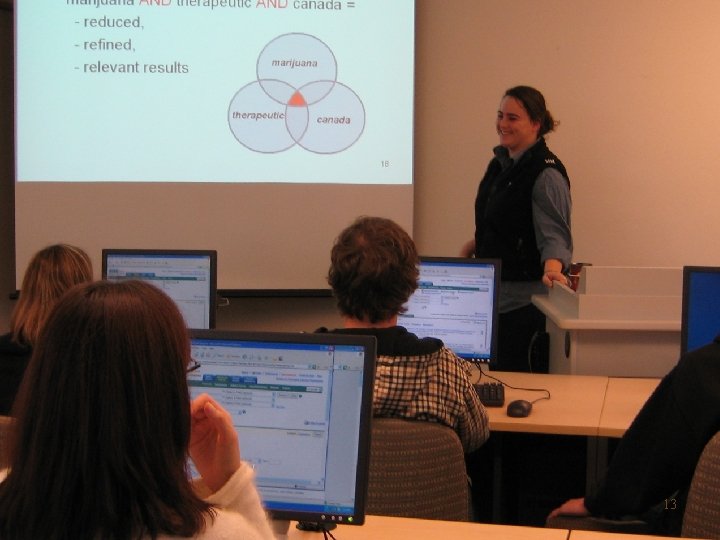
ACRL Standards that Relate to Library Orientation Standard Two’s Performance Indicator The information literate student constructs and implements effectively designed search strategies. Standard Two’s Outcome Identifies keywords, synonyms and related terms for the information needed. Standard Two’s Outcome Constructs a search strategy using appropriate commands for the information retrieval system selected. 12
13
ACRL Standards that Relate to Interlibrary Loan Standard One: the information literate student determines the nature and extent of the information needed. Standard Two: the information literate student access the needed information effectively and efficiently. Outcomes include that the student: 1. determines the availability of needed information and makes decisions on broadening the information seeking process beyond local resources. 2. select efficient and effective approaches for accessing the information needed from the investigative method or information retrieval system. Indirectly, the student will meet outcomes such as: 1. defining and articulating the need for information 2. retrieving the information using a variety of methods 3. following regulations and institutional policies related to the access and use of information. 14
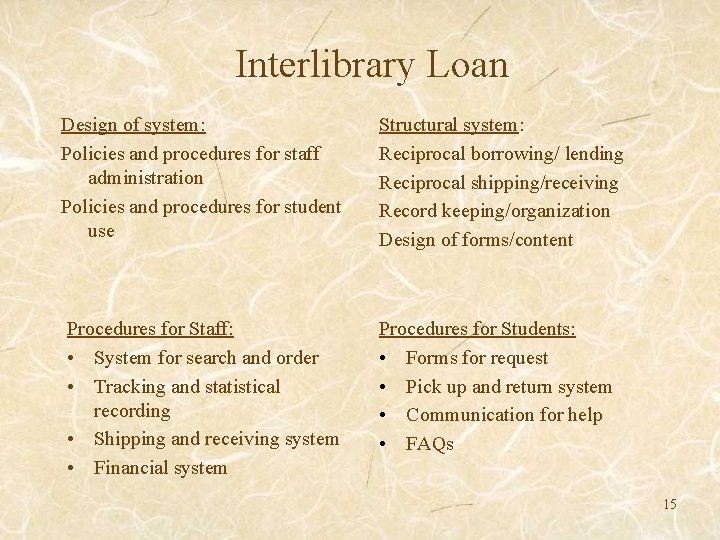
Interlibrary Loan Design of system: Policies and procedures for staff administration Policies and procedures for student use Structural system: Reciprocal borrowing/ lending Reciprocal shipping/receiving Record keeping/organization Design of forms/content Procedures for Staff: • System for search and order • Tracking and statistical recording • Shipping and receiving system • Financial system Procedures for Students: • Forms for request • Pick up and return system • Communication for help • FAQs 15
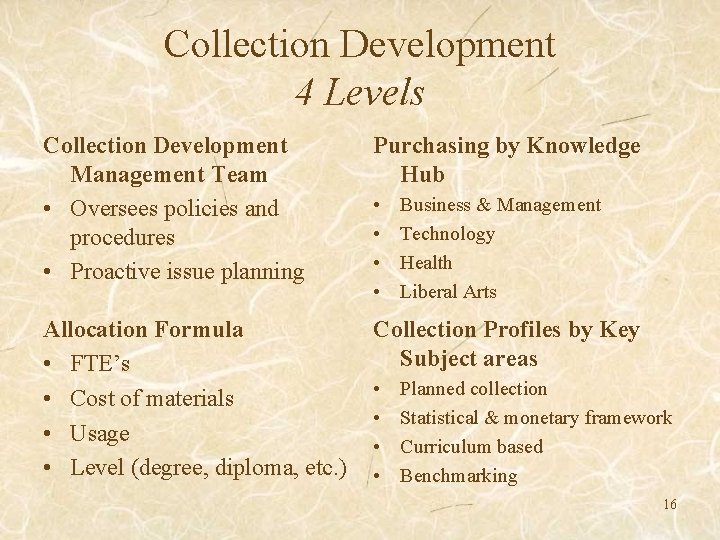
Collection Development 4 Levels Collection Development Management Team • Oversees policies and procedures • Proactive issue planning Purchasing by Knowledge Hub Allocation Formula • FTE’s • Cost of materials • Usage • Level (degree, diploma, etc. ) Collection Profiles by Key Subject areas • • Business & Management Technology Health Liberal Arts Planned collection Statistical & monetary framework Curriculum based Benchmarking 16
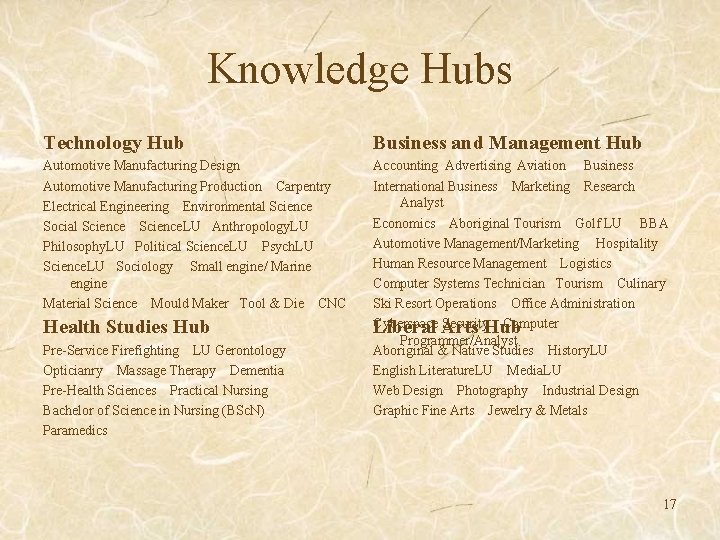
Knowledge Hubs Technology Hub Business and Management Hub Automotive Manufacturing Design Automotive Manufacturing Production Carpentry Electrical Engineering Environmental Science Social Science. LU Anthropology. LU Philosophy. LU Political Science. LU Psych. LU Science. LU Sociology Small engine/ Marine engine Material Science Mould Maker Tool & Die CNC Accounting Advertising Aviation Business International Business Marketing Research Analyst Economics Aboriginal Tourism Golf LU BBA Automotive Management/Marketing Hospitality Human Resource Management Logistics Computer Systems Technician Tourism Culinary Ski Resort Operations Office Administration Cyberspace Security Computer Liberal Arts Hub Programmer/Analyst Aboriginal & Native Studies History. LU English Literature. LU Media. LU Web Design Photography Industrial Design Graphic Fine Arts Jewelry & Metals Health Studies Hub Pre-Service Firefighting LU Gerontology Opticianry Massage Therapy Dementia Pre-Health Sciences Practical Nursing Bachelor of Science in Nursing (BSc. N) Paramedics 17
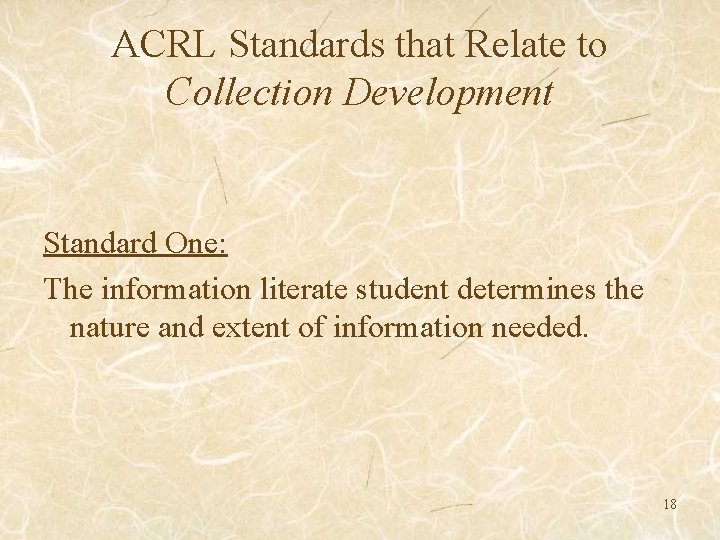
ACRL Standards that Relate to Collection Development Standard One: The information literate student determines the nature and extent of information needed. 18
Collection Development and Technician Involvement “Since our technicians are all so intimately involved in collection development and management, and form the bulk of our front line team, they are the 'face' of IL for many of our first term students. They do a good job of parsing necessary vs. extraneous information, especially for the benefit of the beginning students. ” Kimberly Thomas, Technology Librarian, Georgian College, 2007 19
ACRL Standards that Relate to Professional Development Standard One: Determine the nature and extent of the information needed. Standard Two: Access needed information effectively and efficiently. Standard Three: Evaluate information and its sources critically and incorporate selected information into his or her knowledge base and value system. Standard Four: Use information effectively to accomplish a specific purpose. Standard Five: Understand the economic, legal, and social issues surrounding the use of information and accesses and uses information ethically and legally. 20
Georgian College library technicians Professional peer reviews: • • is a joy as a team member 100% reliable and produces a high quality of work adaptable and adjusts to others working styles consistency in a superior level of work that has a positive impact on all who work with or along side her • has a genuine concern for her co-workers • provides a great deal of leadership • is extremely supportive and patient with new staff members 21
Recommendations Best Practices for Library Administrators: 1. Include technicians in professional development opportunities. 2. Offer technicians work that is challenging and meaningful. 3. Consider the benefits of the creation of collaborative teams of both librarians and technicians. 4. Utilize library technicians who have the relevant interest, training, experience and education in the furtherance of information literacy. 5. Staff in every public service department should be encouraged to schedule time to understand the principles of Information Literacy Standards for Higher Education and the applications that can be made. 6. To ensure consistent best practices in information literacy delivery, a yearly assessment and re-evaluation should be made by all involved library professionals. Information literacy could be a permanent topic on the agenda of an annual Information staff meeting. 22
Recommendations Best Practices for Librarians: 1. Look for areas where collaboration with technicians is possible. 2. Mentor the technicians you work with in your areas of expertise. 23
Recommendations Best Practices for Library Technicians: 1. Seek opportunities to use your skills for your library. 2. Keep yourself abreast of new technology. 3. Consider all educational possibilities and seek ways to engage. Ask for Professional Development opportunities. 4. Speak out about your contributions wherever possible to give technicians a greater professional voice. (Remember silence means agreement) 5. Each interaction between staff and students should model the ACRL Standard outcomes; therefore, ensure you know the standards. 6. Always teach students how to find the answer, never give them the answer. 7. Take advantage of each opportunity to become more involved in the preparation and delivery of on-site training of students in life long information literacy. 8. Never say “I’m not paid enough to do this”. Take every opportunity to write for publication, to speak up, to evaluate and contribute. Keep yourself informed by reading the professional literature. 9. Become involved in local, regional, provincial, and even national library associations. 24
“Traditionally there had always been a ‘line in the sand’ which dictated the level of activity and responsibility available to technicians with Information Services. Technicians are at the forefront of a new frontier with no real end as to what can be achieved. No one can predict where we are heading and technology will be a distinct driver for what happens in the future. But technicians now have a clear career path and opportunities to work at higher levels and branch off into many areas that were denied in the past. ” Carla Pilarski and Vicki Picasso, 2001 25
Information Literacy and the contributions of Library Technicians in the Academic Library: One Model Session 1012 Thank you for joining us! 26
- Slides: 26