
Information hiding 1 The problem with public fields

Information hiding 1
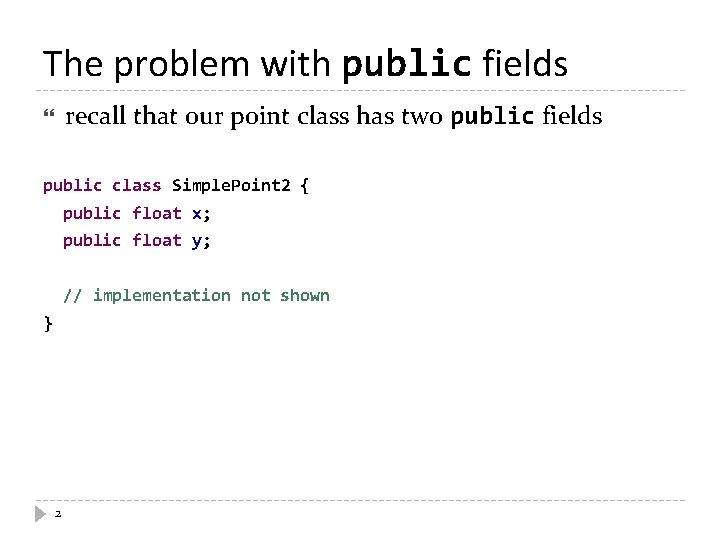
The problem with public fields recall that our point class has two public fields public class Simple. Point 2 { public float x; public float y; // implementation not shown } 2
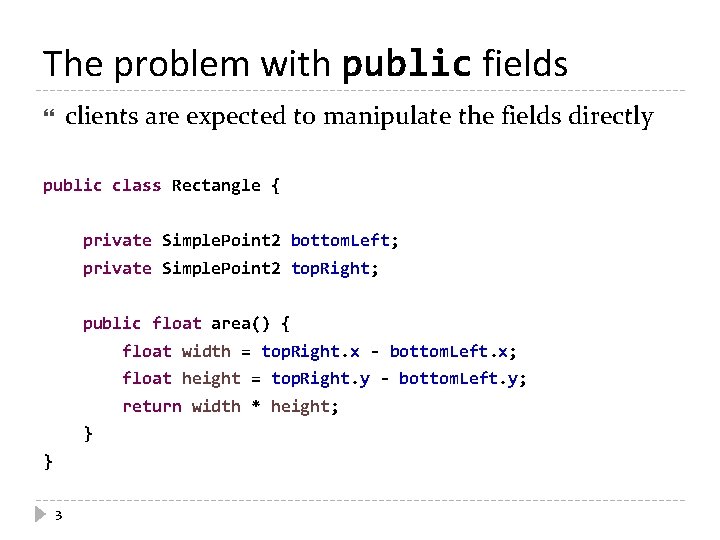
The problem with public fields clients are expected to manipulate the fields directly public class Rectangle { private Simple. Point 2 bottom. Left; private Simple. Point 2 top. Right; public float area() { float width = top. Right. x - bottom. Left. x; float height = top. Right. y - bottom. Left. y; return width * height; } } 3
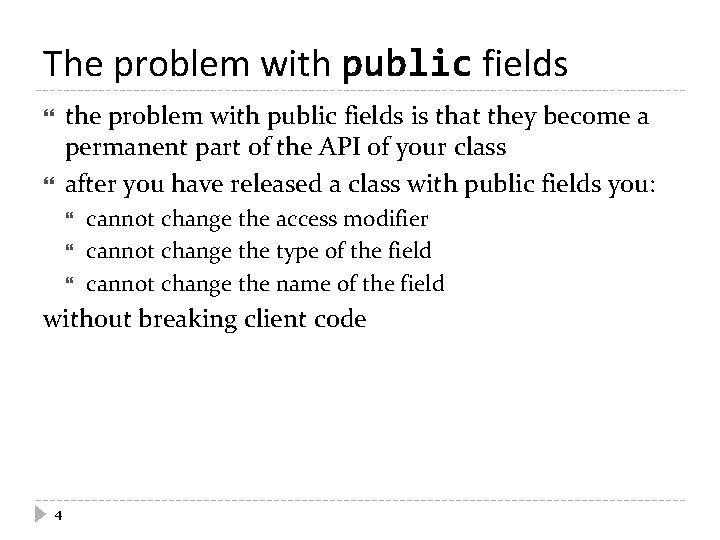
The problem with public fields the problem with public fields is that they become a permanent part of the API of your class after you have released a class with public fields you: cannot change the access modifier cannot change the type of the field cannot change the name of the field without breaking client code 4
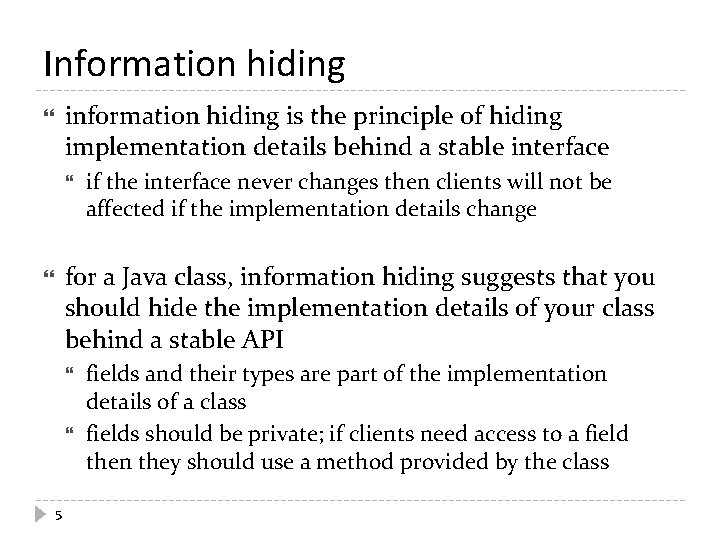
Information hiding is the principle of hiding implementation details behind a stable interface if the interface never changes then clients will not be affected if the implementation details change for a Java class, information hiding suggests that you should hide the implementation details of your class behind a stable API 5 fields and their types are part of the implementation details of a class fields should be private; if clients need access to a field then they should use a method provided by the class

/** * A simple class for representing points in 2 D Cartesian * coordinates. Every <code>Point 2 D</code> instance has an * x and y coordinate. */ public class Point 2 { private double x; private double y; 6
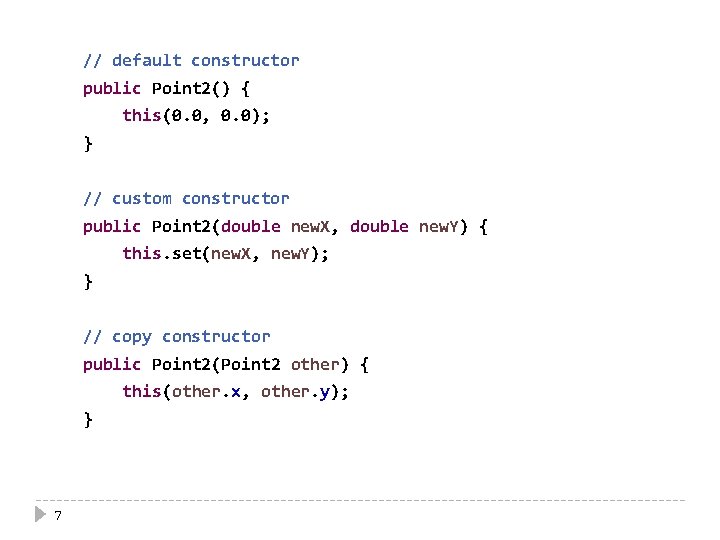
// default constructor public Point 2() { this(0. 0, 0. 0); } // custom constructor public Point 2(double new. X, double new. Y) { this. set(new. X, new. Y); } // copy constructor public Point 2(Point 2 other) { this(other. x, other. y); } 7
Accessors an accessor method enables the client to gain access to an otherwise private field of the class the name of an accessor method often, but not always, begins with get 8
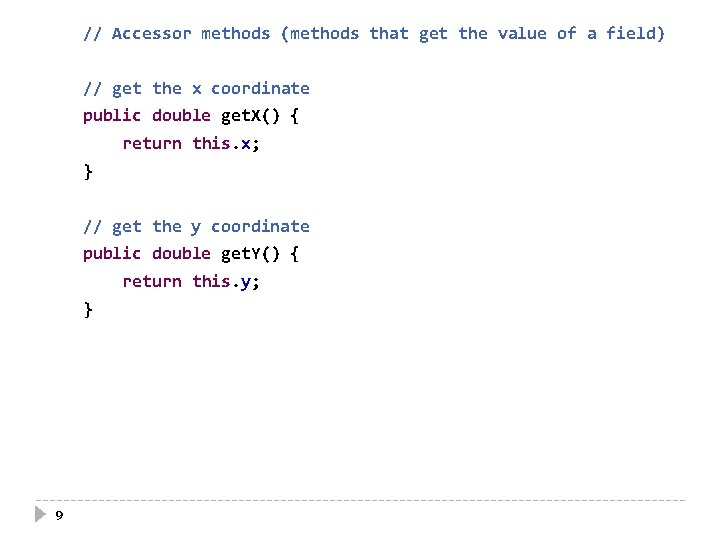
// Accessor methods (methods that get the value of a field) // get the x coordinate public double get. X() { return this. x; } // get the y coordinate public double get. Y() { return this. y; } 9

Mutators a mutator method enables the client to modify (or mutate) an otherwise private field of the class the name of an accessor method often, but not always, begins with set 10

// Mutator methods: methods that change the value of a field // set the x coordinate public void set. X(double new. X) { this. x = new. X; } // set the y coordinate public void set. Y(double new. Y) { this. y = new. Y; } // set both x and y coordinates public void set(double new. X, double new. Y) { this. x = new. X; this. y = new. Y; } 11
Information hiding the implementation details of our class gives us the ability to change the underlying implementation without affecting clients 12 for example, we can use an array to store the coordinates
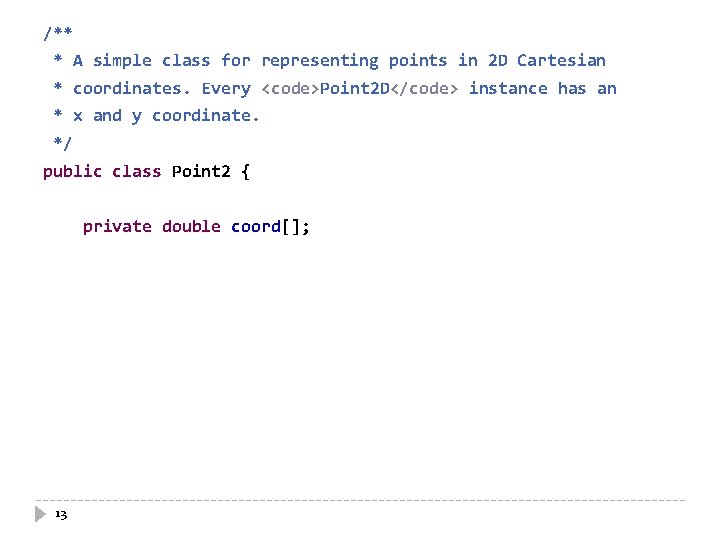
/** * A simple class for representing points in 2 D Cartesian * coordinates. Every <code>Point 2 D</code> instance has an * x and y coordinate. */ public class Point 2 { private double coord[]; 13
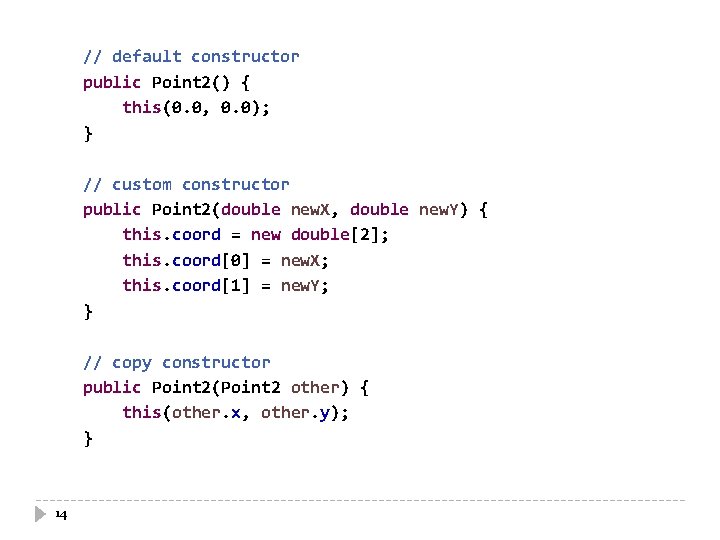
// default constructor public Point 2() { this(0. 0, 0. 0); } // custom constructor public Point 2(double new. X, double new. Y) { this. coord = new double[2]; this. coord[0] = new. X; this. coord[1] = new. Y; } // copy constructor public Point 2(Point 2 other) { this(other. x, other. y); } 14
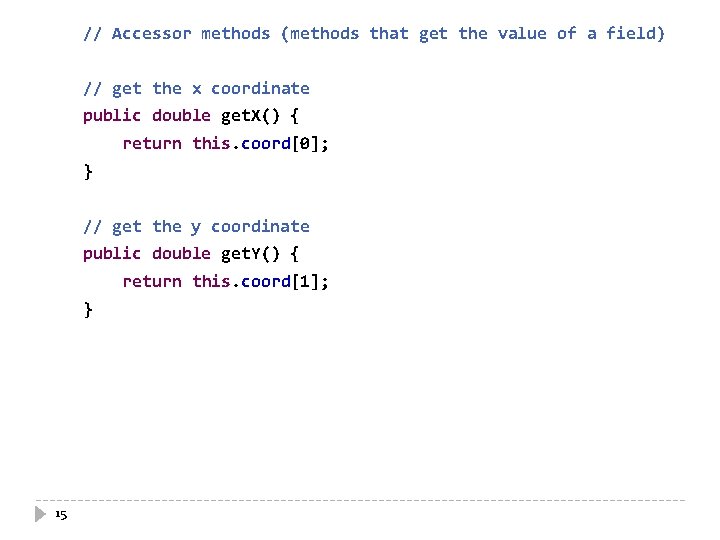
// Accessor methods (methods that get the value of a field) // get the x coordinate public double get. X() { return this. coord[0]; } // get the y coordinate public double get. Y() { return this. coord[1]; } 15
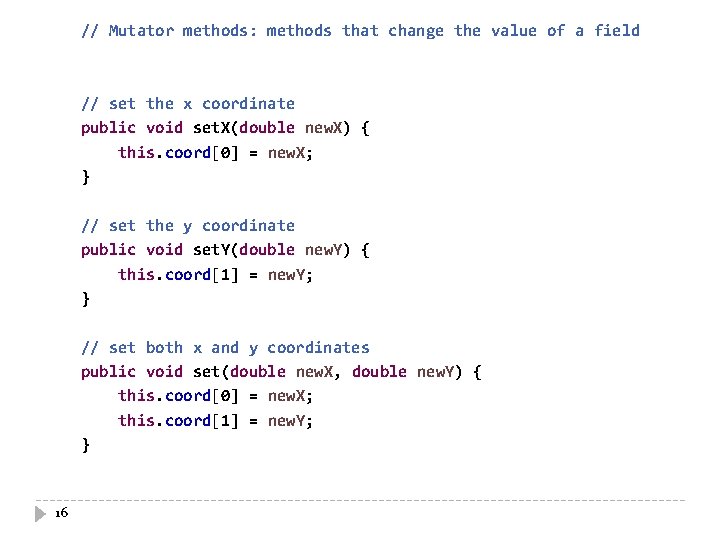
// Mutator methods: methods that change the value of a field // set the x coordinate public void set. X(double new. X) { this. coord[0] = new. X; } // set the y coordinate public void set. Y(double new. Y) { this. coord[1] = new. Y; } // set both x and y coordinates public void set(double new. X, double new. Y) { this. coord[0] = new. X; this. coord[1] = new. Y; } 16
Information hiding notice that: we changed how the point is represented by using an array instead of two separate fields for the coordinates we did not change the API of the class by hiding the implementation details of the class we have insulated all clients of our class from the change 17

Immutability 18
Immutability an immutable object is an object whose state cannot be changed once it has been created examples: String, Integer, Double, and all of the other wrapper classes � advantages of immutability versus mutability � easier to design, implement, and use � can never be put into an inconsistent state after creation � object references can be safely shared � information 19 hiding makes immutability possible

Recipe for Immutability the recipe for immutability in Java is described by Joshua Bloch in the book Effective Java* 1. 2. 3. 4. 5. Do not provide any methods that can alter the state of the object when we talk Prevent the class from being extended revisit about inheritance Make all fields final Make all fields private Prevent clients from obtaining a reference to any revisit when we talk mutable fields about composition 20 *highly recommended reading if you plan on becoming a Java programmer
An immutable point class we can easily make an immutable version of our Point 2 class 21 remove the mutator methods make the fields final (they are already private) make the class final (which satisfies Rule 2 from the recipe)
/** * A simple class for immutable points in 2 D Cartesian * coordinates. Every <code>IPoint 2 D</code> instance has an * x and y coordinate. */ public final class IPoint 2 { final private double x; final private double y; 22
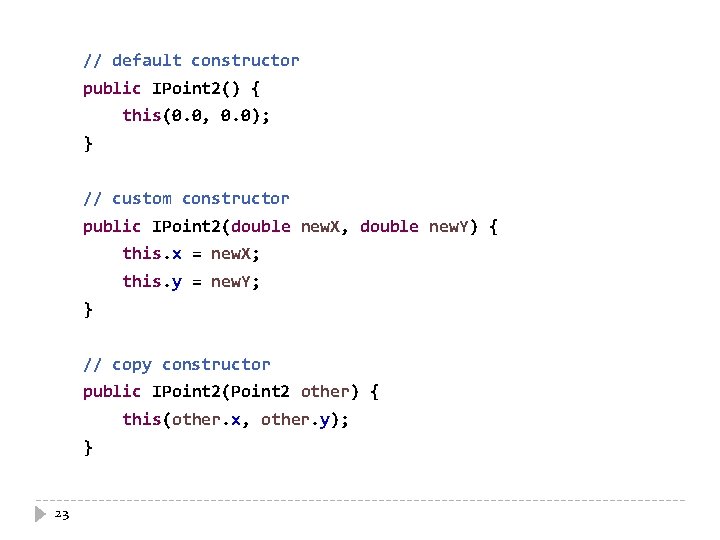
// default constructor public IPoint 2() { this(0. 0, 0. 0); } // custom constructor public IPoint 2(double new. X, double new. Y) { this. x = new. X; this. y = new. Y; } // copy constructor public IPoint 2(Point 2 other) { this(other. x, other. y); } 23
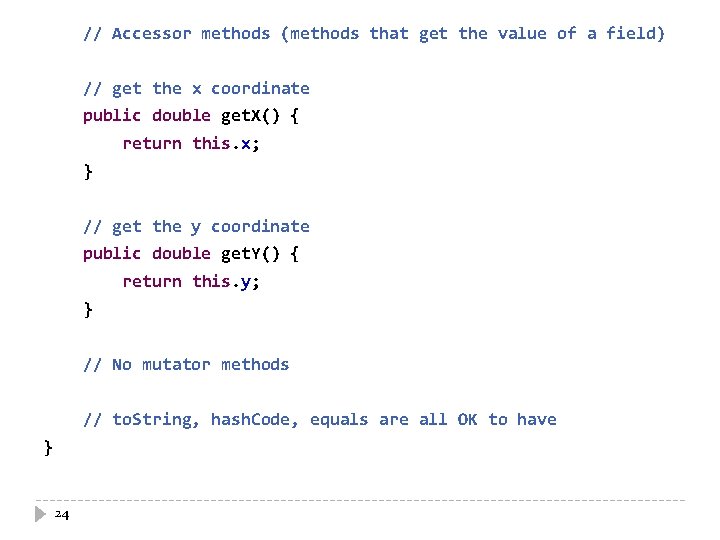
// Accessor methods (methods that get the value of a field) // get the x coordinate public double get. X() { return this. x; } // get the y coordinate public double get. Y() { return this. y; } // No mutator methods // to. String, hash. Code, equals are all OK to have } 24
Class invariants 25
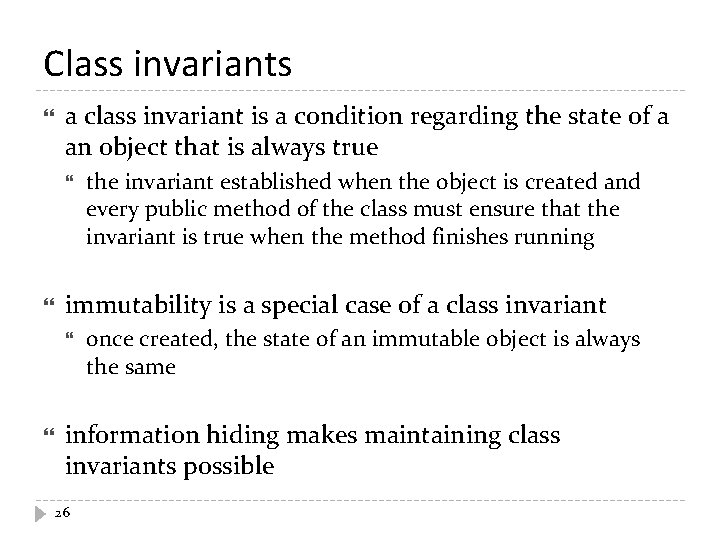
Class invariants a class invariant is a condition regarding the state of a an object that is always true immutability is a special case of a class invariant the invariant established when the object is created and every public method of the class must ensure that the invariant is true when the method finishes running once created, the state of an immutable object is always the same information hiding makes maintaining class invariants possible 26
Class invariants suppose we want to create a point class where the coordinates of a point are always greater than or equal to zero 27 the constructors must not allow a point to be created with negative coordinates if there are mutator methods then those methods must not set the coordinates of the point to a negative value
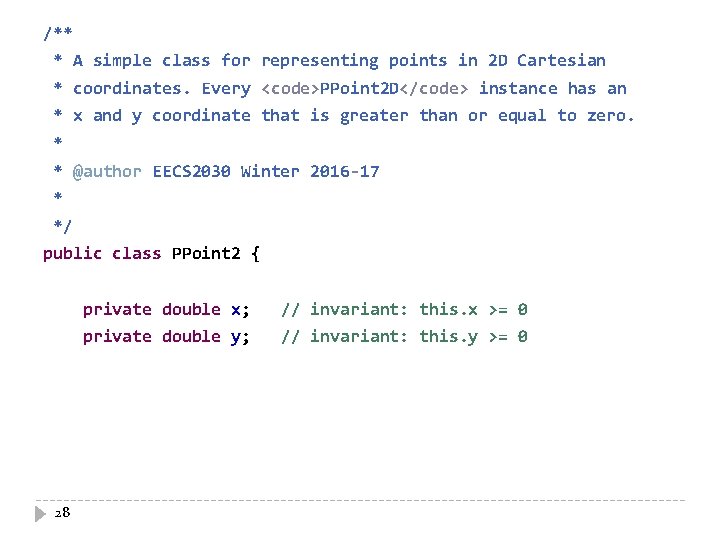
/** * A simple class for representing points in 2 D Cartesian * coordinates. Every <code>PPoint 2 D</code> instance has an * x and y coordinate that is greater than or equal to zero. * * @author EECS 2030 Winter 2016 -17 * */ public class PPoint 2 { 28 private double x; // invariant: this. x >= 0 private double y; // invariant: this. y >= 0
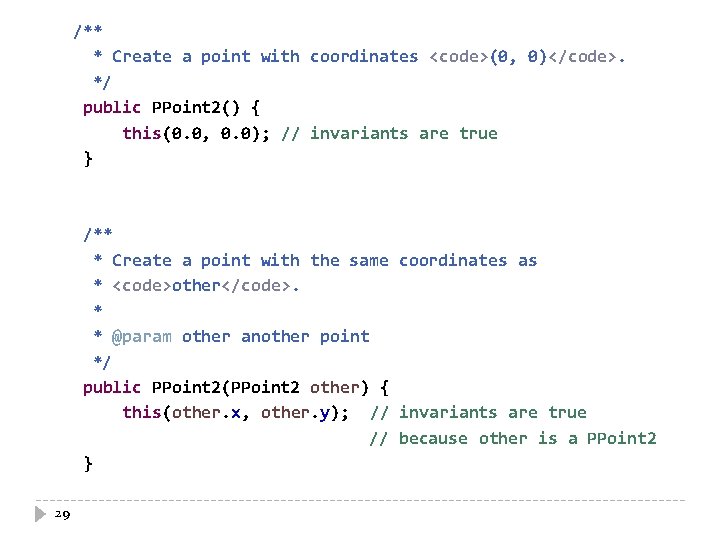
/** * Create a point with coordinates <code>(0, 0)</code>. */ public PPoint 2() { this(0. 0, 0. 0); // invariants are true } /** * Create a point with the same coordinates as * <code>other</code>. * * @param other another point */ public PPoint 2(PPoint 2 other) { this(other. x, other. y); // invariants are true // because other is a PPoint 2 } 29
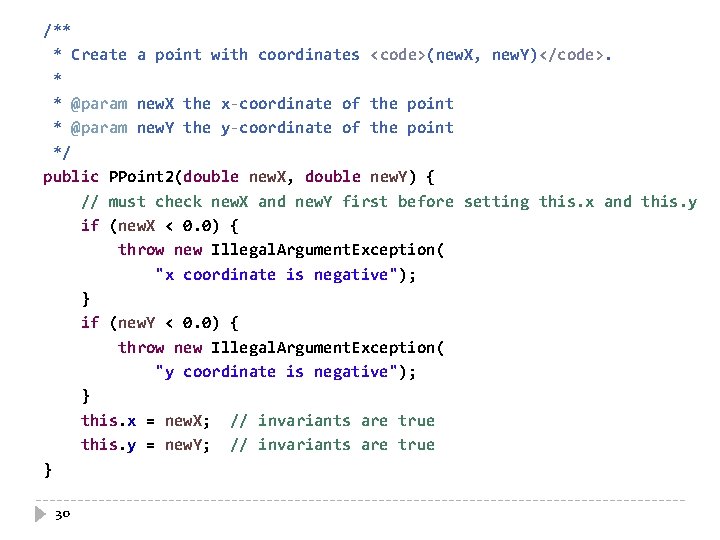
/** * Create a point with coordinates <code>(new. X, new. Y)</code>. * * @param new. X the x-coordinate of the point * @param new. Y the y-coordinate of the point */ public PPoint 2(double new. X, double new. Y) { // must check new. X and new. Y first before setting this. x and this. y if (new. X < 0. 0) { throw new Illegal. Argument. Exception( "x coordinate is negative"); } if (new. Y < 0. 0) { throw new Illegal. Argument. Exception( "y coordinate is negative"); } this. x = new. X; // invariants are true this. y = new. Y; // invariants are true } 30
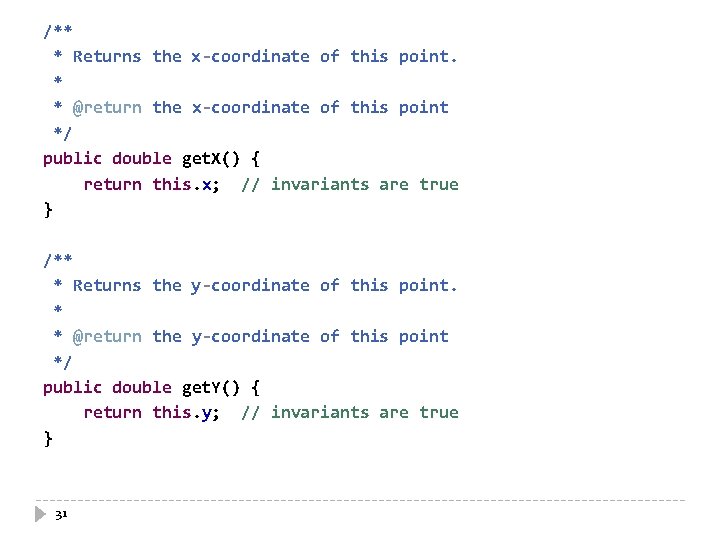
/** * Returns the x-coordinate of this point. * * @return the x-coordinate of this point */ public double get. X() { return this. x; // invariants are true } /** * Returns the y-coordinate of this point. * * @return the y-coordinate of this point */ public double get. Y() { return this. y; // invariants are true } 31
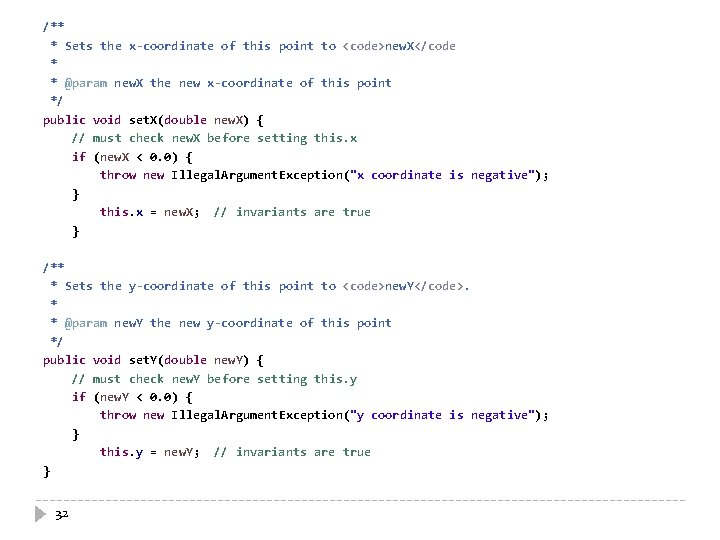
/** * Sets the x-coordinate of this point to <code>new. X</code * * @param new. X the new x-coordinate of this point */ public void set. X(double new. X) { // must check new. X before setting this. x if (new. X < 0. 0) { throw new Illegal. Argument. Exception("x coordinate is negative"); } this. x = new. X; // invariants are true } /** * Sets the y-coordinate of this point to <code>new. Y</code>. * * @param new. Y the new y-coordinate of this point */ public void set. Y(double new. Y) { // must check new. Y before setting this. y if (new. Y < 0. 0) { throw new Illegal. Argument. Exception("y coordinate is negative"); } this. y = new. Y; // invariants are true } 32
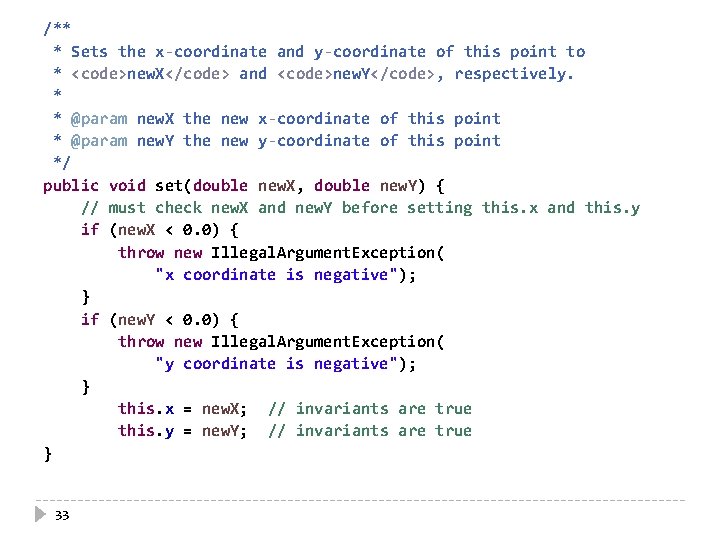
/** * Sets the x-coordinate and y-coordinate of this point to * <code>new. X</code> and <code>new. Y</code>, respectively. * * @param new. X the new x-coordinate of this point * @param new. Y the new y-coordinate of this point */ public void set(double new. X, double new. Y) { // must check new. X and new. Y before setting this. x and this. y if (new. X < 0. 0) { throw new Illegal. Argument. Exception( "x coordinate is negative"); } if (new. Y < 0. 0) { throw new Illegal. Argument. Exception( "y coordinate is negative"); } this. x = new. X; // invariants are true this. y = new. Y; // invariants are true } 33
Removing duplicate code notice that there is a lot of duplicate code related to validating the coordinates of the point one constructor is almost identical to set(double, double) repeats the same validation code as set. X(double) and set. Y(double) we should try to remove the duplicate code by delegating to the appropriate methods 34
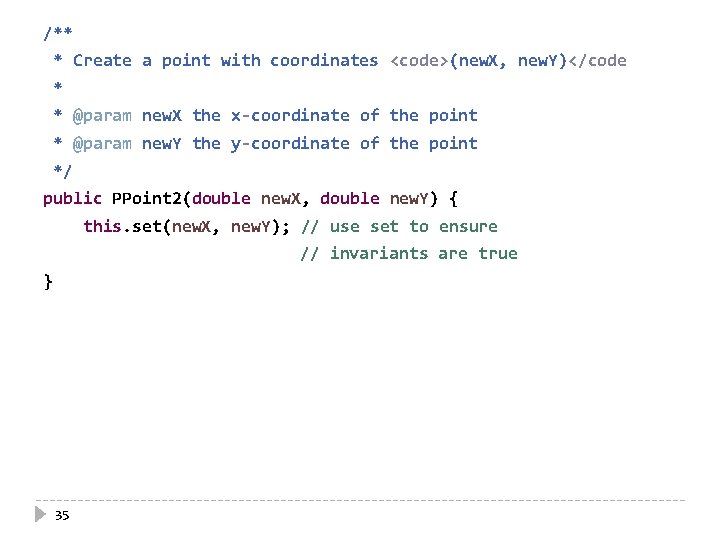
/** * Create a point with coordinates <code>(new. X, new. Y)</code * * @param new. X the x-coordinate of the point * @param new. Y the y-coordinate of the point */ public PPoint 2(double new. X, double new. Y) { this. set(new. X, new. Y); // use set to ensure // invariants are true } 35
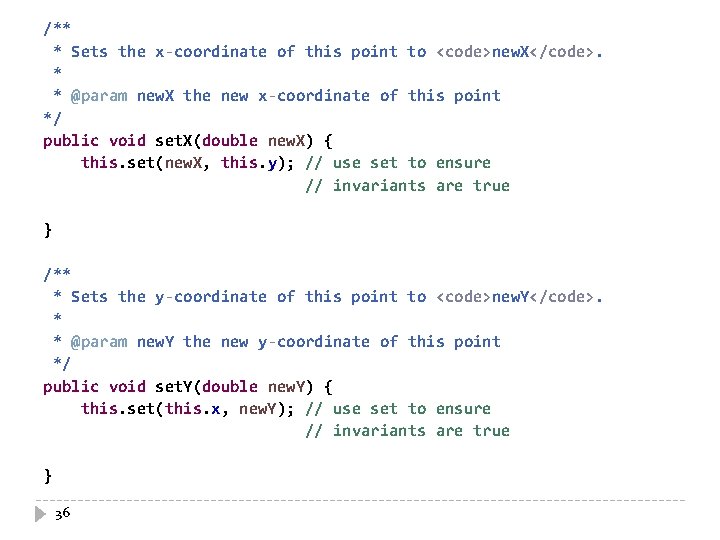
/** * Sets the x-coordinate of this point to <code>new. X</code>. * * @param new. X the new x-coordinate of this point */ public void set. X(double new. X) { this. set(new. X, this. y); // use set to ensure // invariants are true } /** * Sets the y-coordinate of this point to <code>new. Y</code>. * * @param new. Y the new y-coordinate of this point */ public void set. Y(double new. Y) { this. set(this. x, new. Y); // use set to ensure // invariants are true } 36
compare. To 37
Comparable Objects � many value types have a natural ordering � that is, for two objects x and y, x is less than y is meaningful Integer, Float, Double, etc � Strings can be compared in dictionary order � Dates can be compared in chronological order � you might compare points by their distance from the origin � Short, � if your class has a natural ordering, consider implementing the Comparable interface � doing object 38 so allows clients to sort arrays or Collections of your
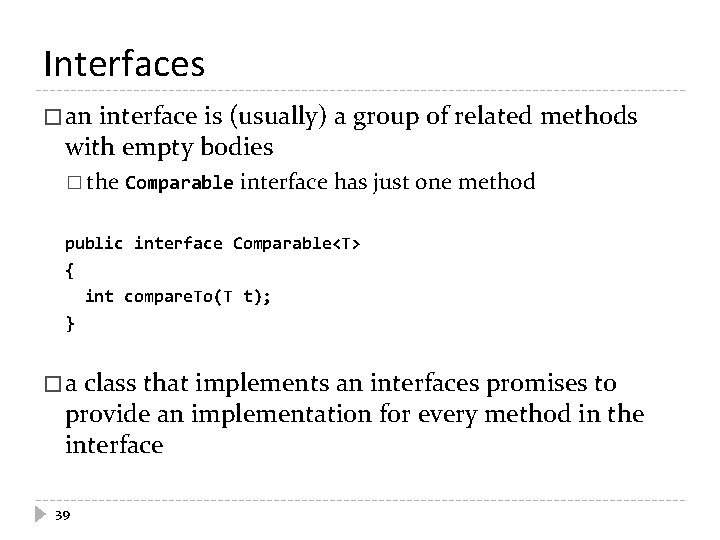
Interfaces � an interface is (usually) a group of related methods with empty bodies � the Comparable interface has just one method public interface Comparable<T> { int compare. To(T t); } �a class that implements an interfaces promises to provide an implementation for every method in the interface 39
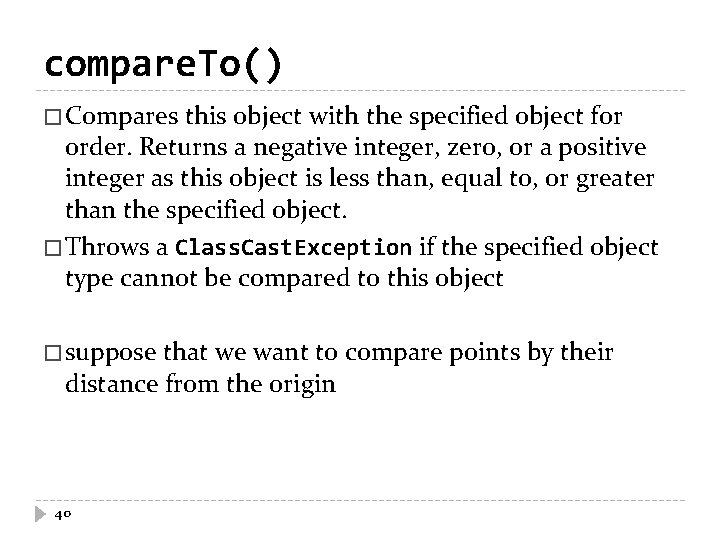
compare. To() � Compares this object with the specified object for order. Returns a negative integer, zero, or a positive integer as this object is less than, equal to, or greater than the specified object. � Throws a Class. Cast. Exception if the specified object type cannot be compared to this object � suppose that we want to compare points by their distance from the origin 40
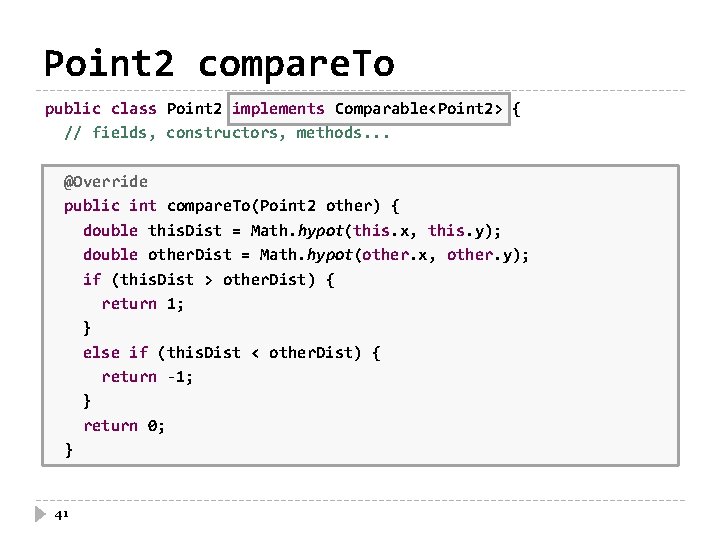
Point 2 compare. To public class Point 2 implements Comparable<Point 2> { // fields, constructors, methods. . . @Override public int compare. To(Point 2 other) { double this. Dist = Math. hypot(this. x, this. y); double other. Dist = Math. hypot(other. x, other. y); if (this. Dist > other. Dist) { return 1; } else if (this. Dist < other. Dist) { return -1; } return 0; } 41
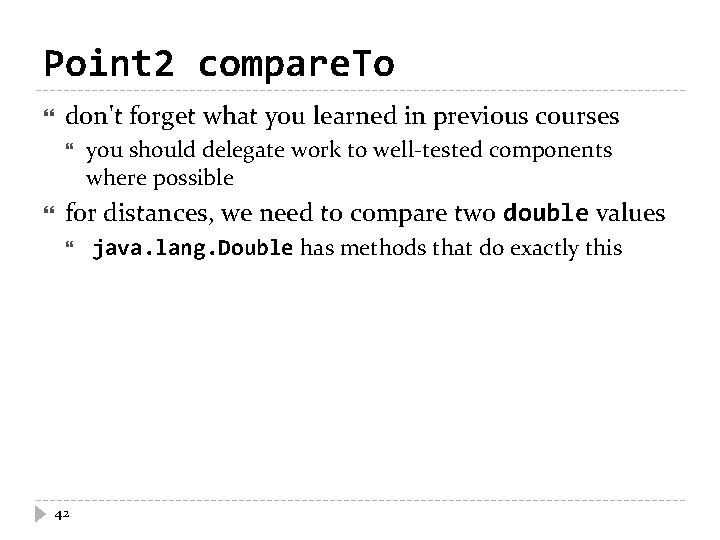
Point 2 compare. To don't forget what you learned in previous courses you should delegate work to well-tested components where possible for distances, we need to compare two double values 42 java. lang. Double has methods that do exactly this
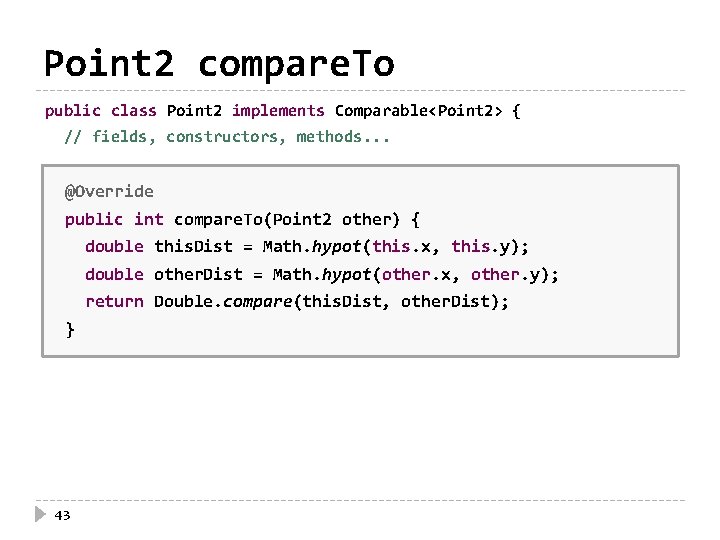
Point 2 compare. To public class Point 2 implements Comparable<Point 2> { // fields, constructors, methods. . . @Override public int compare. To(Point 2 other) { double this. Dist = Math. hypot(this. x, this. y); double other. Dist = Math. hypot(other. x, other. y); return Double. compare(this. Dist, other. Dist); } 43
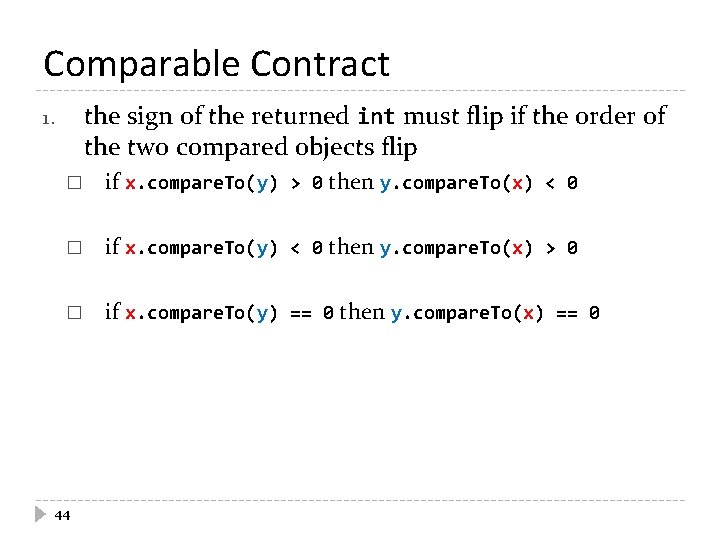
Comparable Contract the sign of the returned int must flip if the order of the two compared objects flip 1. � if x. compare. To(y) > 0 then y. compare. To(x) < 0 � if x. compare. To(y) < 0 then y. compare. To(x) > 0 � if x. compare. To(y) == 0 then y. compare. To(x) == 0 44
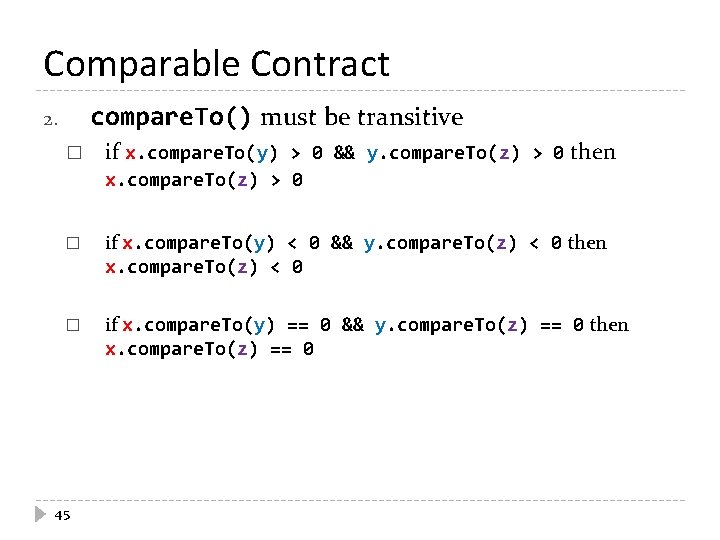
Comparable Contract compare. To() must be transitive 2. � if x. compare. To(y) > 0 && y. compare. To(z) > 0 then x. compare. To(z) > 0 � if x. compare. To(y) < 0 && y. compare. To(z) < 0 then x. compare. To(z) < 0 � if x. compare. To(y) == 0 && y. compare. To(z) == 0 then x. compare. To(z) == 0 45
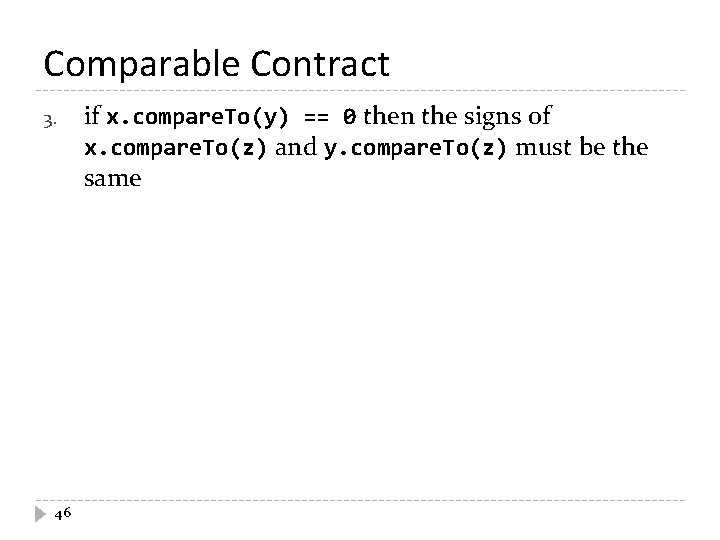
Comparable Contract 3. 46 if x. compare. To(y) == 0 then the signs of x. compare. To(z) and y. compare. To(z) must be the same
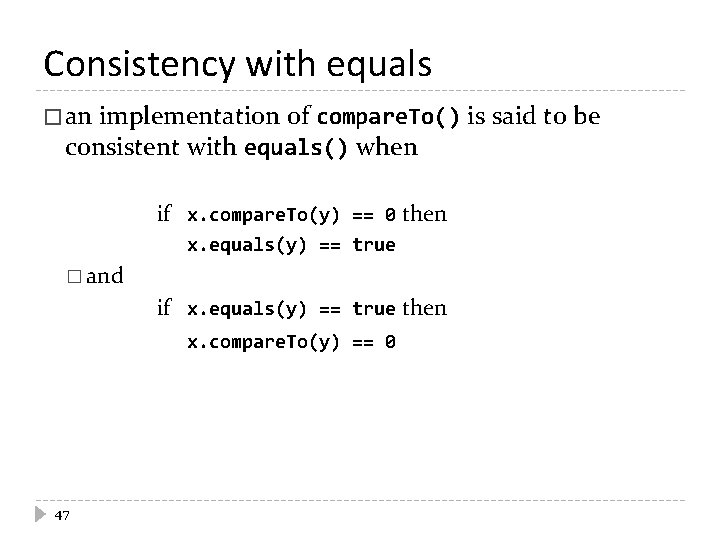
Consistency with equals � an implementation of compare. To() is said to be consistent with equals() when if x. compare. To(y) == 0 then x. equals(y) == true � and if x. equals(y) == true then x. compare. To(y) == 0 47
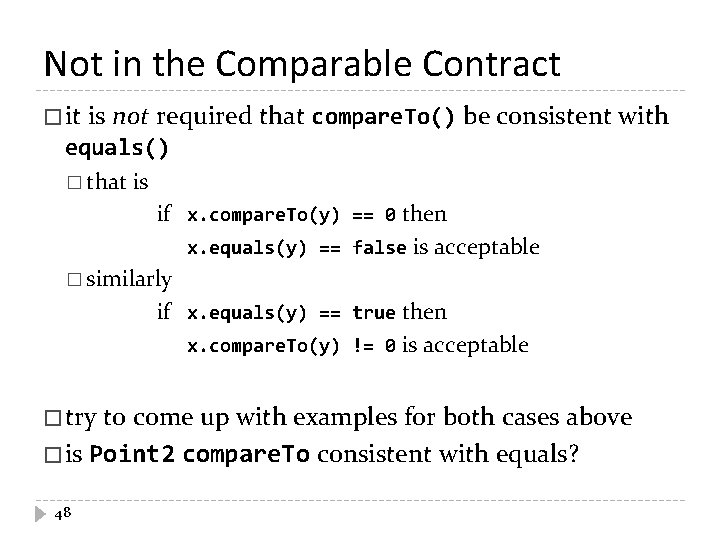
Not in the Comparable Contract � it is not required that compare. To() be consistent with equals() � that is if x. compare. To(y) == 0 then x. equals(y) == false is acceptable � similarly if x. equals(y) == true then x. compare. To(y) != 0 is acceptable � try to come up with examples for both cases above � is Point 2 compare. To consistent with equals? 48
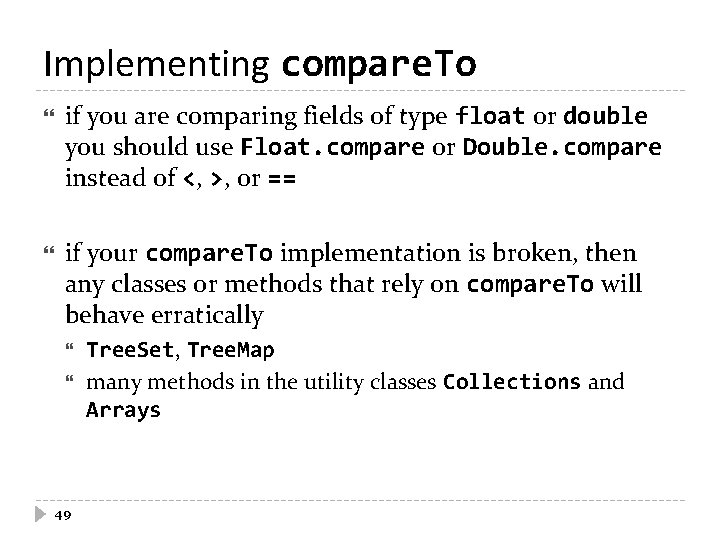
Implementing compare. To if you are comparing fields of type float or double you should use Float. compare or Double. compare instead of <, >, or == if your compare. To implementation is broken, then any classes or methods that rely on compare. To will behave erratically 49 Tree. Set, Tree. Map many methods in the utility classes Collections and Arrays
Mixing Static and Non-Static 50
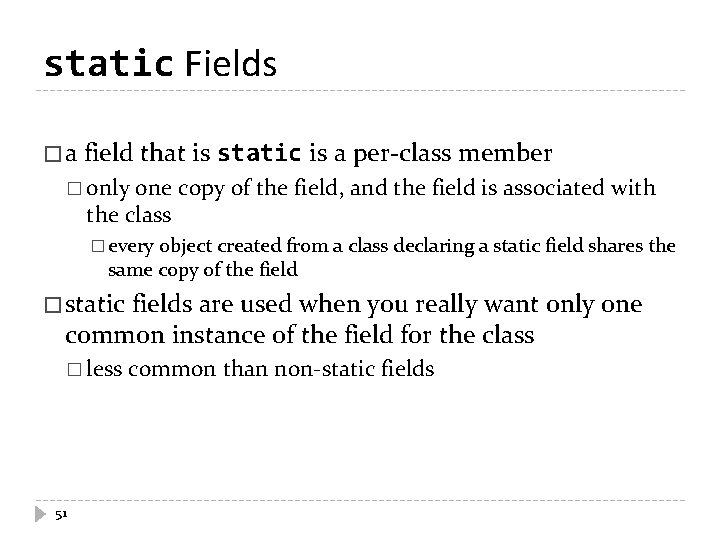
static Fields �a field that is static is a per-class member � only one copy of the field, and the field is associated with the class � every object created from a class declaring a static field shares the same copy of the field � static fields are used when you really want only one common instance of the field for the class � less 51 common than non-static fields
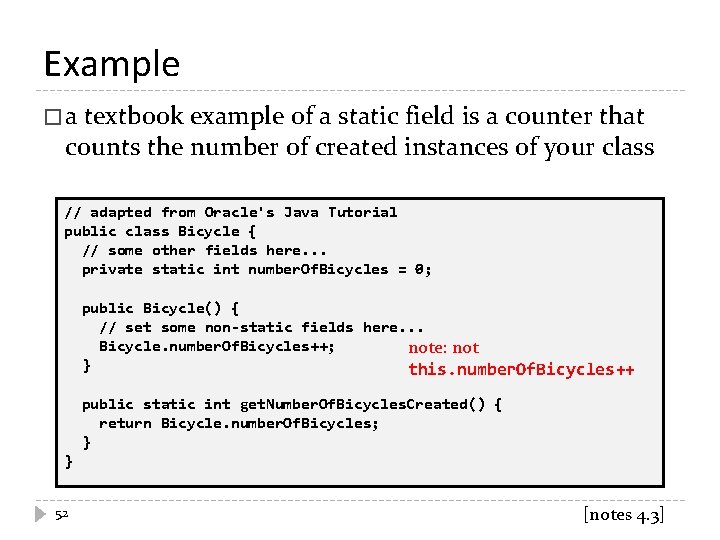
Example �a textbook example of a static field is a counter that counts the number of created instances of your class // adapted from Oracle's Java Tutorial public class Bicycle { // some other fields here. . . private static int number. Of. Bicycles = 0; public Bicycle() { // set some non-static fields here. . . Bicycle. number. Of. Bicycles++; note: not } this. number. Of. Bicycles++ public static int get. Number. Of. Bicycles. Created() { return Bicycle. number. Of. Bicycles; } } 52 [notes 4. 3]
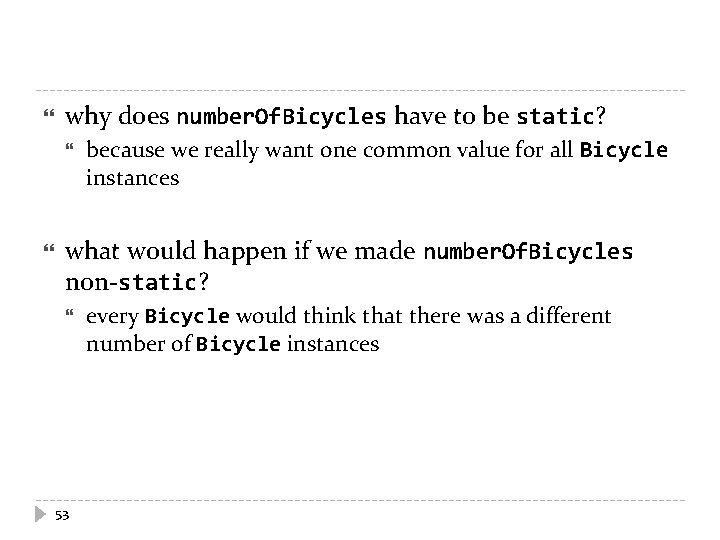
why does number. Of. Bicycles have to be static? because we really want one common value for all Bicycle instances what would happen if we made number. Of. Bicycles non-static? 53 every Bicycle would think that there was a different number of Bicycle instances
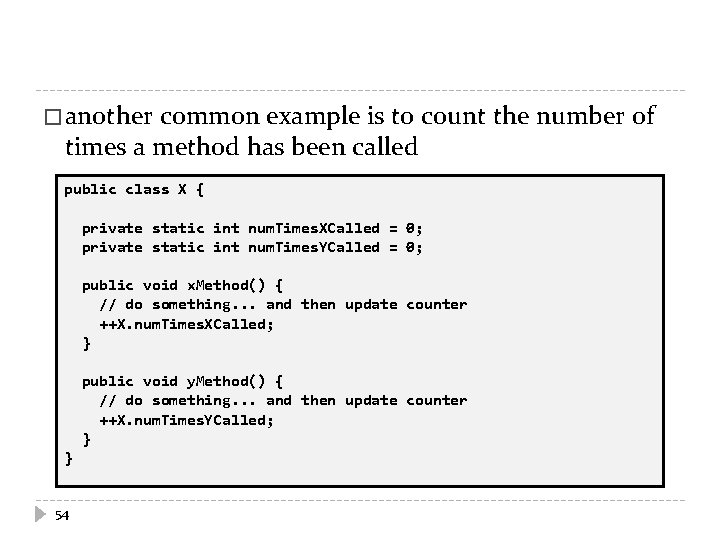
� another common example is to count the number of times a method has been called public class X { private static int num. Times. XCalled = 0; private static int num. Times. YCalled = 0; public void x. Method() { // do something. . . and then update counter ++X. num. Times. XCalled; } public void y. Method() { // do something. . . and then update counter ++X. num. Times. YCalled; } } 54
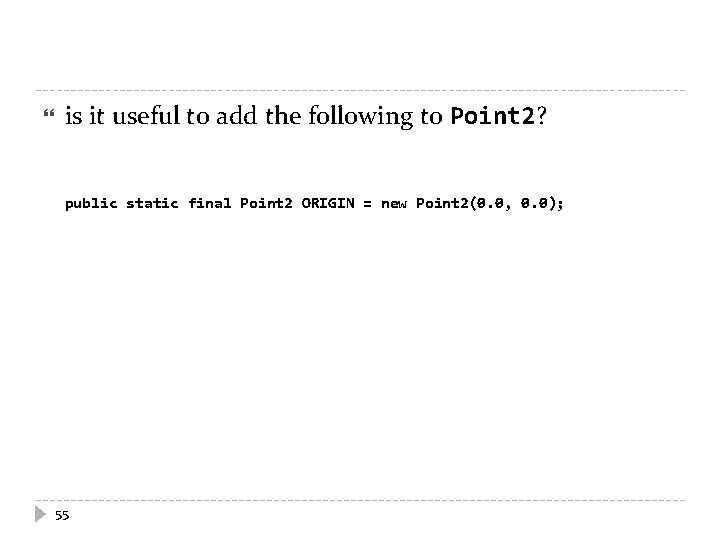
is it useful to add the following to Point 2? public static final Point 2 ORIGIN = new Point 2(0. 0, 0. 0); 55
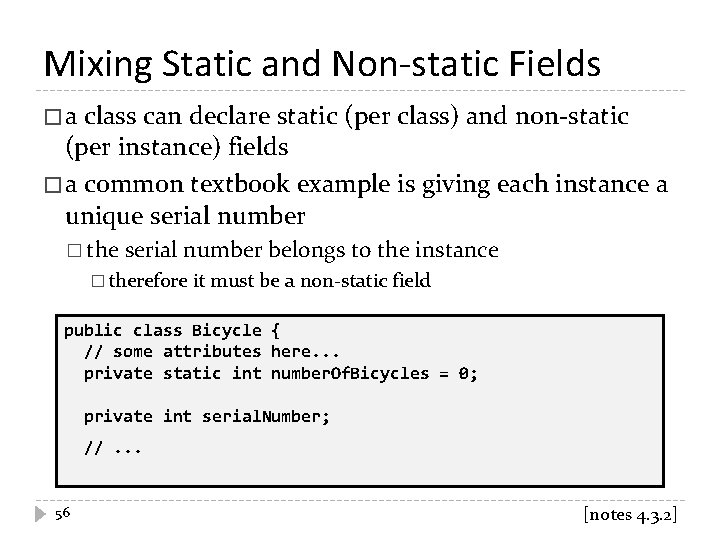
Mixing Static and Non-static Fields �a class can declare static (per class) and non-static (per instance) fields � a common textbook example is giving each instance a unique serial number � the serial number belongs to the instance � therefore it must be a non-static field public class Bicycle { // some attributes here. . . private static int number. Of. Bicycles = 0; private int serial. Number; //. . . 56 [notes 4. 3. 2]
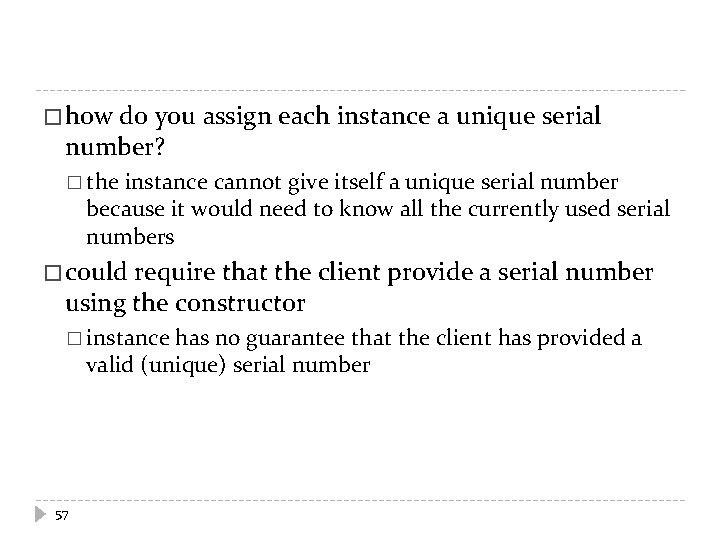
� how do you assign each instance a unique serial number? � the instance cannot give itself a unique serial number because it would need to know all the currently used serial numbers � could require that the client provide a serial number using the constructor � instance has no guarantee that the client has provided a valid (unique) serial number 57
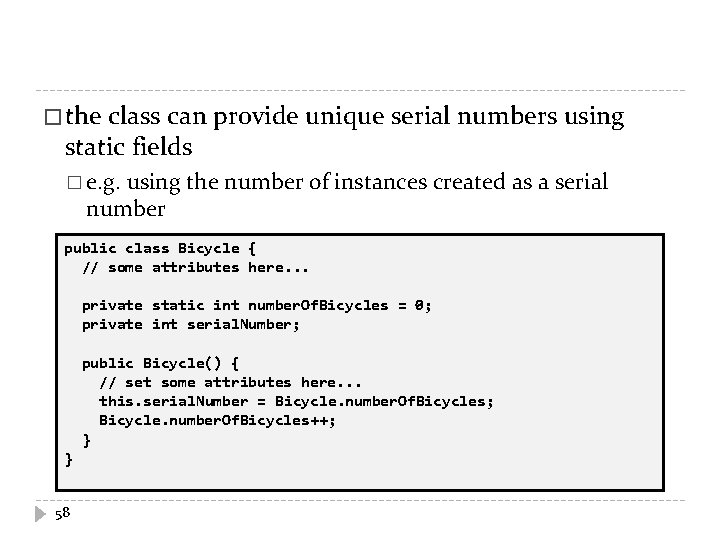
� the class can provide unique serial numbers using static fields � e. g. using the number of instances created as a serial number public class Bicycle { // some attributes here. . . private static int number. Of. Bicycles = 0; private int serial. Number; public Bicycle() { // set some attributes here. . . this. serial. Number = Bicycle. number. Of. Bicycles; Bicycle. number. Of. Bicycles++; } } 58
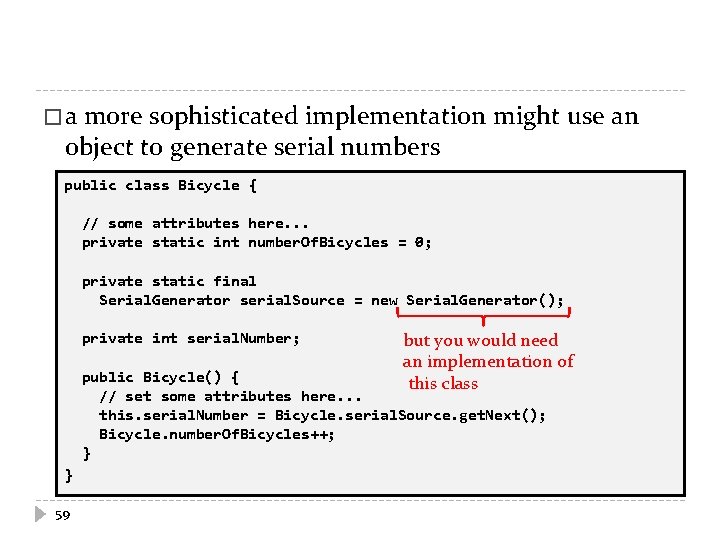
�a more sophisticated implementation might use an object to generate serial numbers public class Bicycle { // some attributes here. . . private static int number. Of. Bicycles = 0; private static final Serial. Generator serial. Source = new Serial. Generator(); private int serial. Number; but you would need an implementation of this class public Bicycle() { // set some attributes here. . . this. serial. Number = Bicycle. serial. Source. get. Next(); Bicycle. number. Of. Bicycles++; } } 59
Static Methods � recall that a static method is a per-class method � client does not need an object to invoke the method � client uses the class name to access the method 60
Static Methods �a static method can use only static fields of the class � static methods have no this parameter because a static method can be invoked without an object � without a this parameter, there is no way to access nonstatic fields � non-static methods can use all of the fields of a class (including static ones) 61
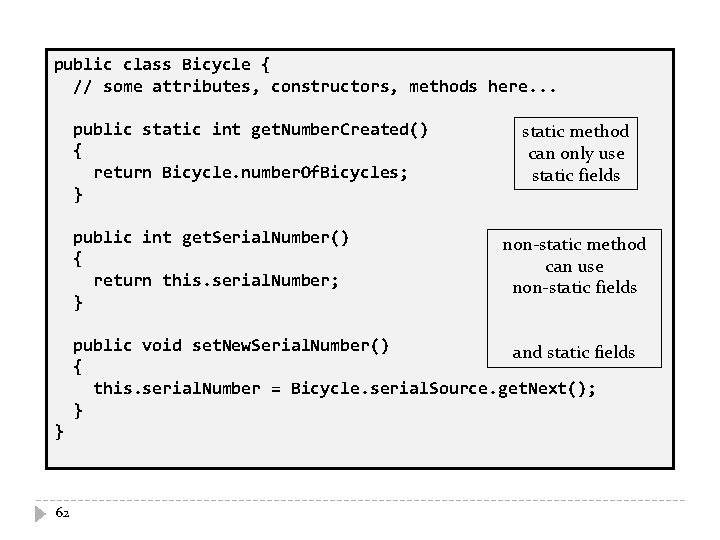
public class Bicycle { // some attributes, constructors, methods here. . . public static int get. Number. Created() { return Bicycle. number. Of. Bicycles; } public int get. Serial. Number() { return this. serial. Number; } static method can only use static fields non-static method can use non-static fields public void set. New. Serial. Number() and static fields { this. serial. Number = Bicycle. serial. Source. get. Next(); } } 62
Static factory methods a common use of static methods in non-utility classes is to create a static factory method is a static method that returns an instance of the class called a factory method because it makes an object and returns a reference to the object you can use a static factory method to create methods that behave like constructors 63 they create and return a reference to a new instance unlike a constructor, the method has a name
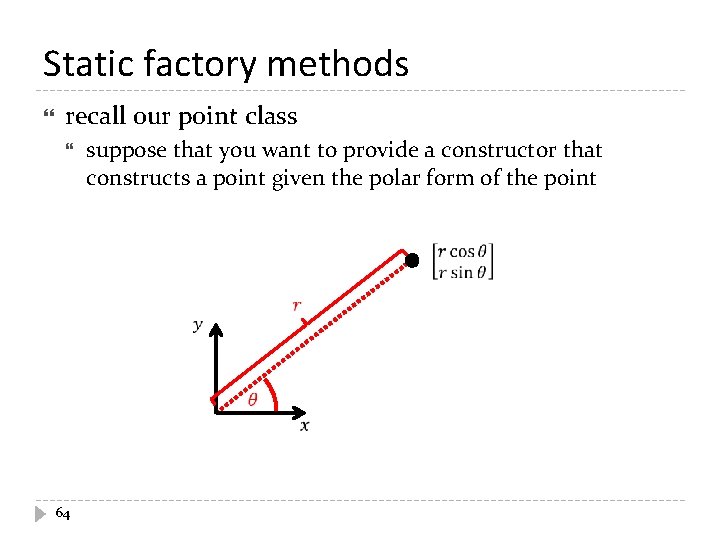
Static factory methods recall our point class 64 suppose that you want to provide a constructor that constructs a point given the polar form of the point
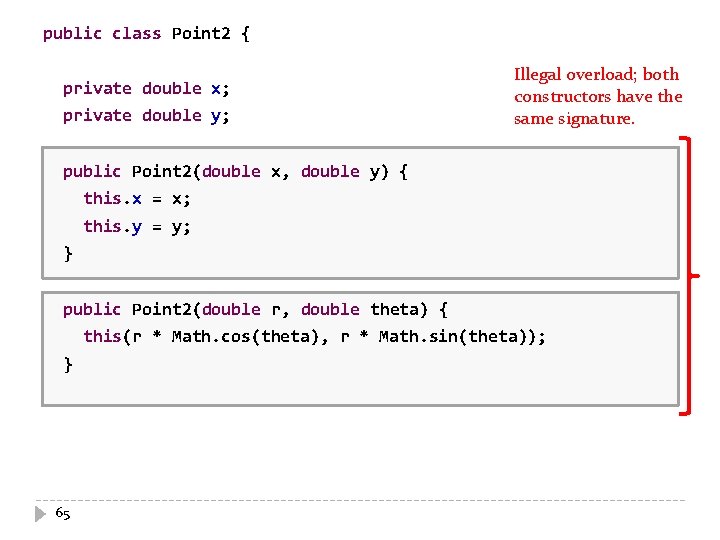
public class Point 2 { private double x; private double y; Illegal overload; both constructors have the same signature. public Point 2(double x, double y) { this. x = x; this. y = y; } public Point 2(double r, double theta) { this(r * Math. cos(theta), r * Math. sin(theta)); } 65
Static factory methods we can eliminate the problem by replacing the second constructor with a static factory method 66
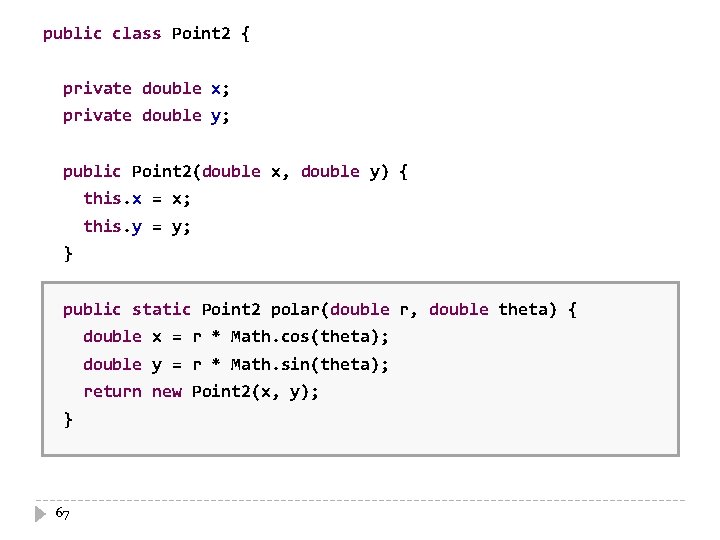
public class Point 2 { private double x; private double y; public Point 2(double x, double y) { this. x = x; this. y = y; } public static Point 2 polar(double r, double theta) { double x = r * Math. cos(theta); double y = r * Math. sin(theta); return new Point 2(x, y); } 67
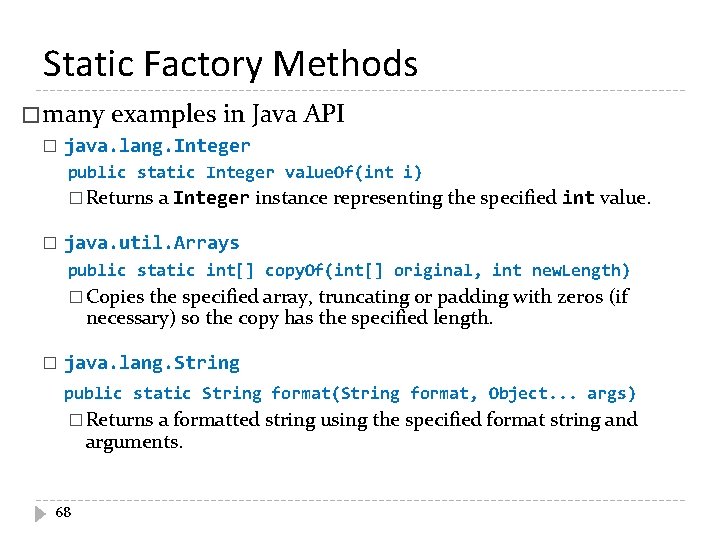
Static Factory Methods � many � examples in Java API java. lang. Integer public static Integer value. Of(int i) � Returns � a Integer instance representing the specified int value. java. util. Arrays public static int[] copy. Of(int[] original, int new. Length) � Copies the specified array, truncating or padding with zeros (if necessary) so the copy has the specified length. � java. lang. String public static String format(String format, Object. . . args) � Returns a formatted string using the specified format string and arguments. 68
- Slides: 68