
Information Fusion Yu Cai Research Paper Johan Schubert

Information Fusion Yu Cai

Research Paper • Johan Schubert, “Clustering belief functions based on attracting and conflicting meta level evidence”, July 2002
Schubert Paper • Clustering belief functions based on attracting and conflicting meta level evidence to separating the belief functions into subsets that should be handled independently. • Why: – For example, in intelligence analysis we may have conflicts (meta level evidence) between two different intelligence reports about sighted objects. – sort belief functions regarding different events. (In the example, considering the presence of a dog…)

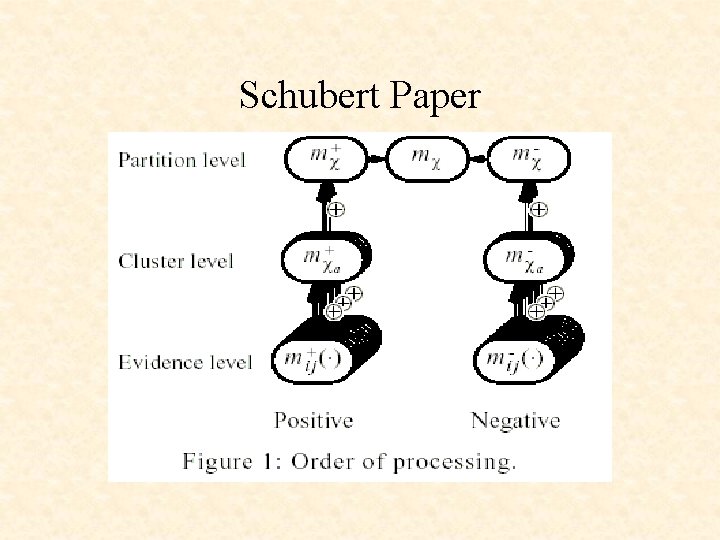
Schubert Paper • Define the attracting and conflicting meta level evidence • Assign vaules to all such pieces of evidence • Combine all attracting metalevel evidence, and all conflicting metalevel evidence within each cluster • Yield belief and do partition • Compare information content
Schubert Paper
Dempster-Shafer Theory • The Dempster-Shafer theory, also known as theory of belief functions, is a generalization of the Bayesian theory of subjective probability. • The Dempster-Shafer theory owes its name to work by A. P. Dempster (1968) and Glenn Shafer (1976). The theory came to the attention of AI researchers in the early 1980 s. • Belief functions have been proposed for modeling someone's degrees of belief. They provide alternatives to the models based on probability functions.
Dempster-Shafer Theory • The Dempster-Shafer theory is based on two ideas: – the idea of obtaining degrees of belief for one question from subjective probabilities for a related question, – Dempster's rule for combining such degrees of belief when they are based on independent items of evidence. • Example: We obtain degrees of belief for one question (Did a limb fall on my car? ) from probabilities for another question (Is the witness reliable? ).
Example: subjective probabilities • My subjective probability – my friend Betty is reliable is 0. 9, – she is unreliable is 0. 1. • Suppose she tells me a limb fell on my car. – This statement, which must true if she is reliable, is not necessarily false if she is unreliable. – So her testimony alone justifies a 0. 9 degree of belief that a limb fell on my car, – but only a zero degree of belief (not a 0. 1 degree of belief) that no limb fell on my car. – This zero merely means that Betty's testimony gives me no reason to believe that no limb fell on my car. – The 0. 9 and the zero together constitute a belief function.
Example: Dempster's rule • Suppose I have 0. 9 probability for the reliability of Sally, and suppose she said, independently of Betty, that a limb fell on my car. – the probability that both are reliable is 0. 9 x 0. 9 = 0. 81, – the probability that neither is reliable is 0. 1 x 0. 1 = 0. 01, – and the probability that at least one is reliable is 1 - 0. 01 = 0. 99. – Since they both said that a limb fell on my car, at least of them being reliable implies that a limb did fall on my car, and hence I may assign this event a degree of belief of 0. 99.
Example: Dempster's rule • Suppose, on the other hand, that Betty and Sally contradict each other—Betty says that a limb fell on my car, and Sally says no limb fell on my car. • In this case, they cannot both be right and hence cannot both be reliable—only one is reliable, or neither is reliable. – The prior probabilities that only Betty is reliable, only Sally is reliable, and that neither is reliable are 0. 09 (0. 9*0. 1), 0. 09, and 0. 01, respectively,
Example • In summary, we obtain degrees of belief for one question (Did a limb fall on my car? ) from probabilities for another question (Is the witness reliable? ). • Implementing the Dempster-Shafer theory in a specific problem generally involves solving two related problems. – First, we must sort the uncertainties in the problem into a priori independent items of evidence. – Second, we must carry out Dempster's rule computationally.
- Slides: 11