
Information for Decision Making Chapter 1 2 Learning
- Slides: 47
Information for Decision Making Chapter 1
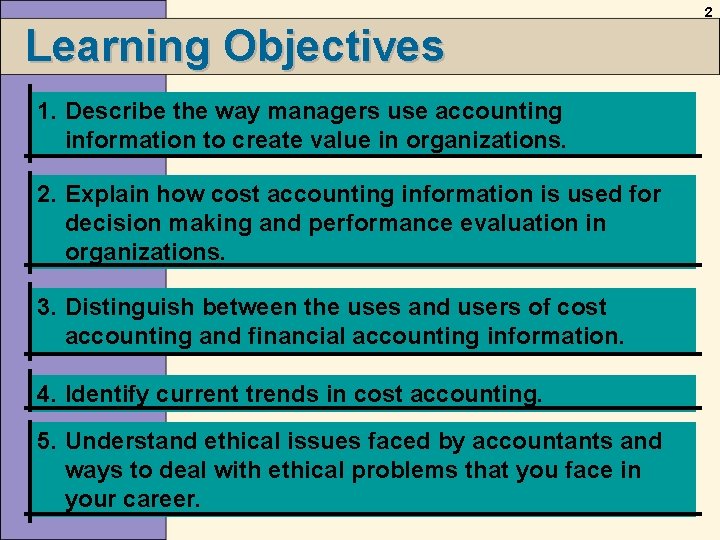
2 Learning Objectives 1. Describe the way managers use accounting information to create value in organizations. 2. Explain how cost accounting information is used for decision making and performance evaluation in organizations. 3. Distinguish between the uses and users of cost accounting and financial accounting information. 4. Identify current trends in cost accounting. 5. Understand ethical issues faced by accountants and ways to deal with ethical problems that you face in your career.
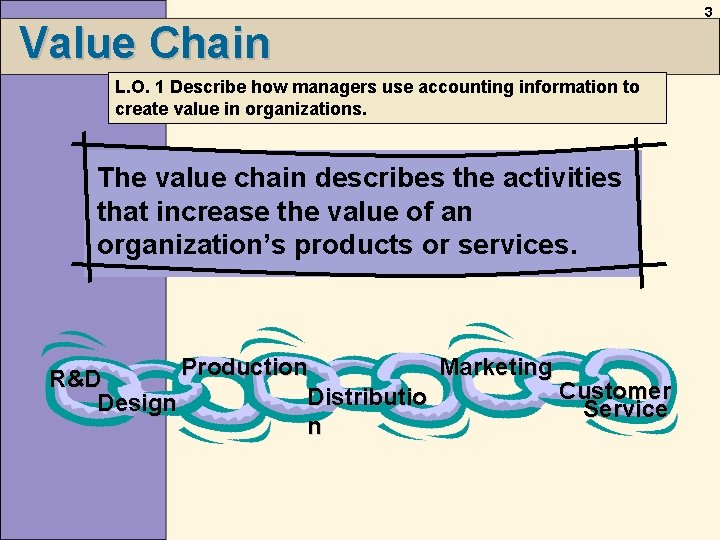
Value Chain L. O. 1 Describe how managers use accounting information to create value in organizations. The value chain describes the activities that increase the value of an organization’s products or services. Production Marketing R&D Customer Distributio Design Service n 3
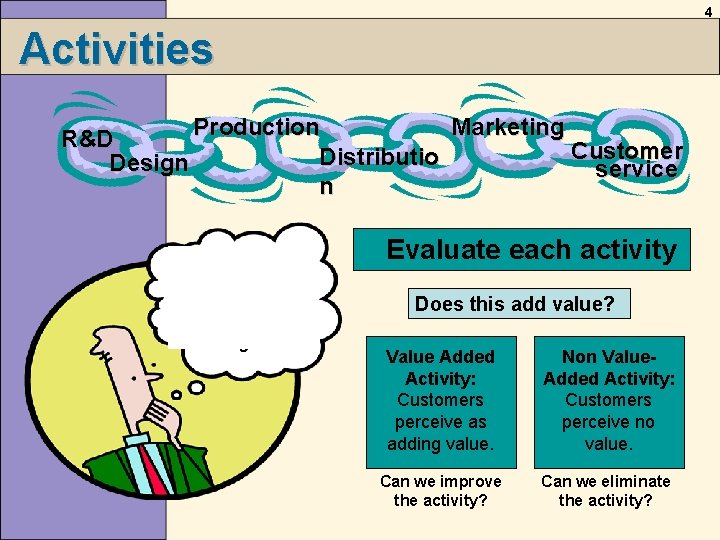
4 Activities Production Marketing R&D Customer Distributio Design service n Value Non Value. Added Activity: Does this Hmmmm…? Customers add value? perceive no as adding value. Evaluate each activity Does this add value? Value Added Activity: Customers perceive as adding value. Non Value. Added Activity: Customers perceive no value. Can we improve the activity? Can we eliminate the activity?
5 R&D Value Chain Research and Development Creating a new product. Value-Added Non Value-Added
6 Value Chain Design Developing and engineering the new product. Value-Added Non Value-Added
7 Value Chain Production Producing the product. Value-Added Non Value-Added
8 Value Chain Marketing Informing potential customers about the product. Value-Added Non Value-Added
9 Value Chain Distribution Delivering the product to customers. Value-Added Non Value-Added
10 CS Value Chain Customer Service Supporting customers who use the product. Value-Added Non Value-Added
11 Managerial Decisions L. O. 2 Explain how cost accounting information is used for decision making and performance evaluation in organizations. What adds value to the firm?
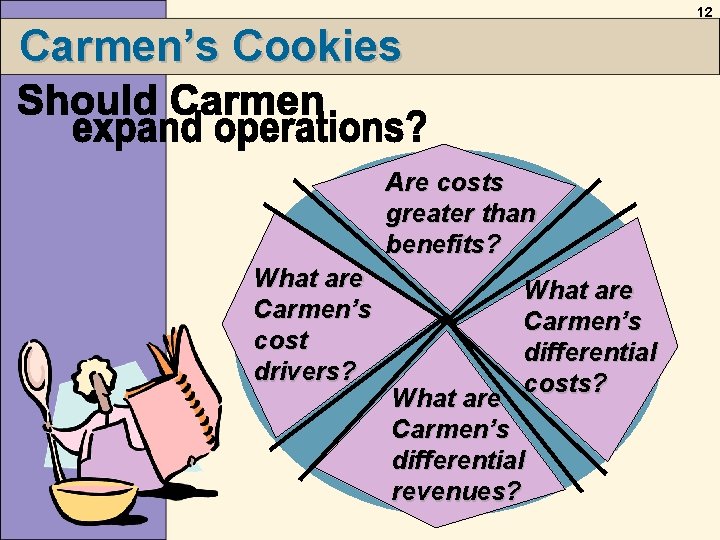
12 Carmen’s Cookies Are costs greater than benefits? What are Carmen’s cost drivers? What are Carmen’s differential costs? What are Carmen’s differential revenues?
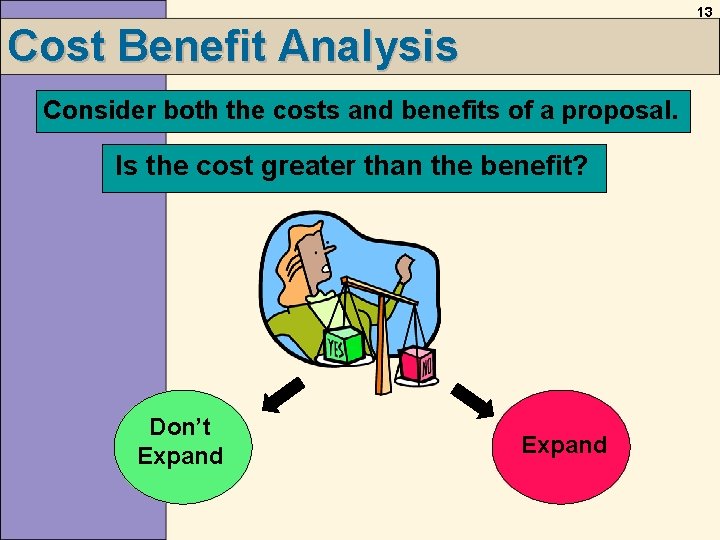
13 Cost Benefit Analysis Consider both the costs and benefits of a proposal. Is the cost greater than the benefit? Don’t Expand
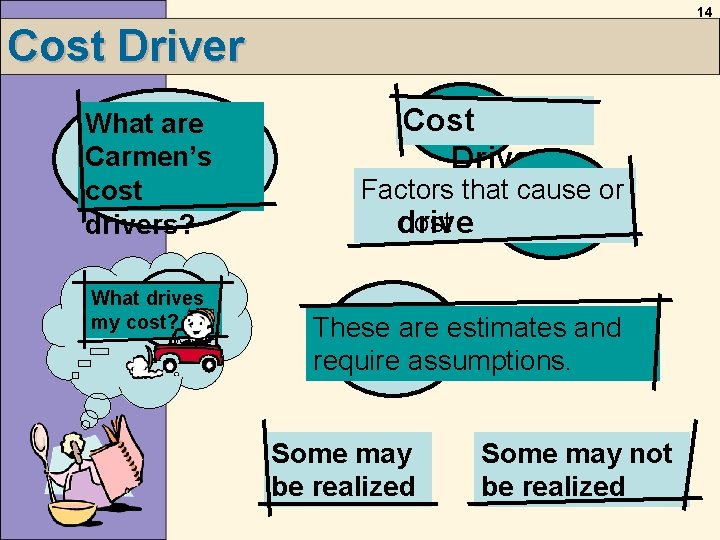
14 Cost Driver What are Carmen’s cost drivers? What drives my cost? Cost Drivers Factors that cause or cost drive These are estimates and require assumptions. Some may be realized Some may not be realized
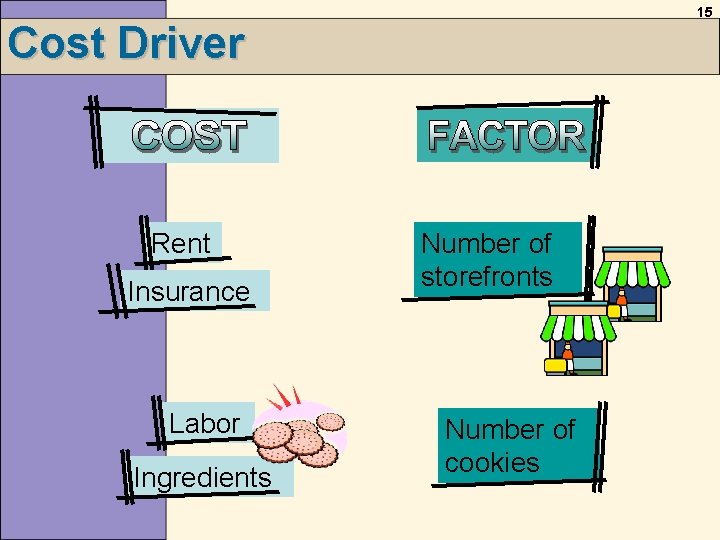
15 Cost Driver Rent Insurance Labor Ingredients Number of storefronts Number of cookies
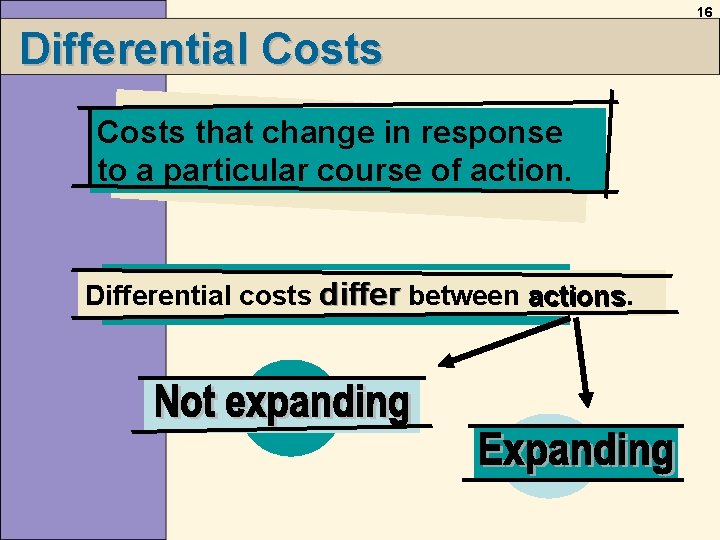
16 Differential Costs that change in response to a particular course of action. Differential costs differ between actions
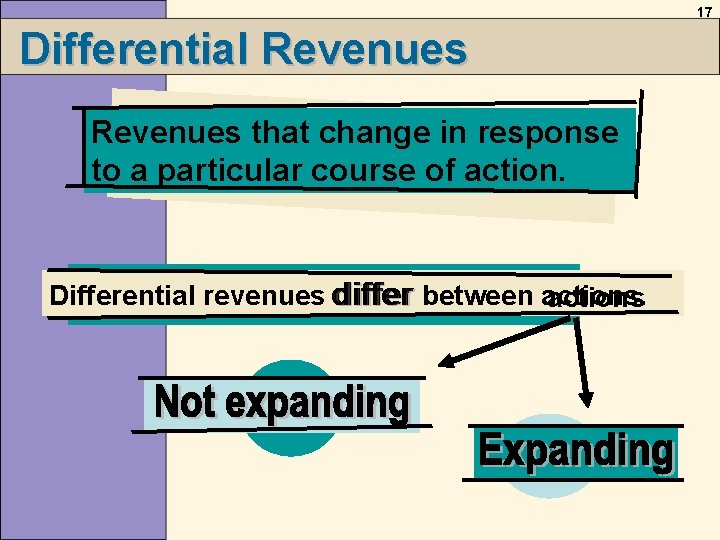
17 Differential Revenues that change in response to a particular course of action. Differential revenues differ between actions
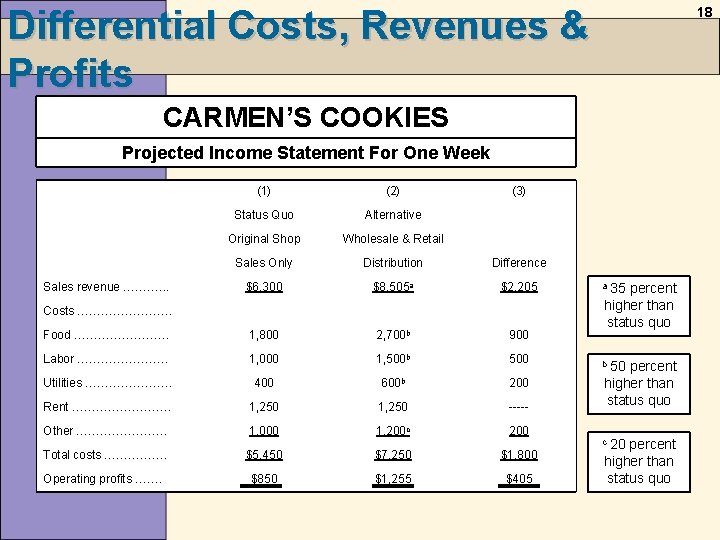
Differential Costs, Revenues & Profits 18 CARMEN’S COOKIES Projected Income Statement For One Week (1) (2) Status Quo Alternative Original Shop Wholesale & Retail Sales Only Distribution Difference $6, 300 $8, 505 a $2, 205 Food ………… 1, 800 2, 700 b 900 Labor …………………. . 1, 000 1, 500 b 500 Utilities …………………. 400 600 b 200 Rent …………. 1, 250 ----- Other …………………. . 1, 000 1, 200 c 200 Total costs ……………. $5, 450 $7, 250 $1, 800 Operating profits ……. $850 $1, 255 $405 Sales revenue ………. . . (3) Costs ………… 35 percent higher than status quo a 50 percent higher than status quo b 20 percent higher than status quo c
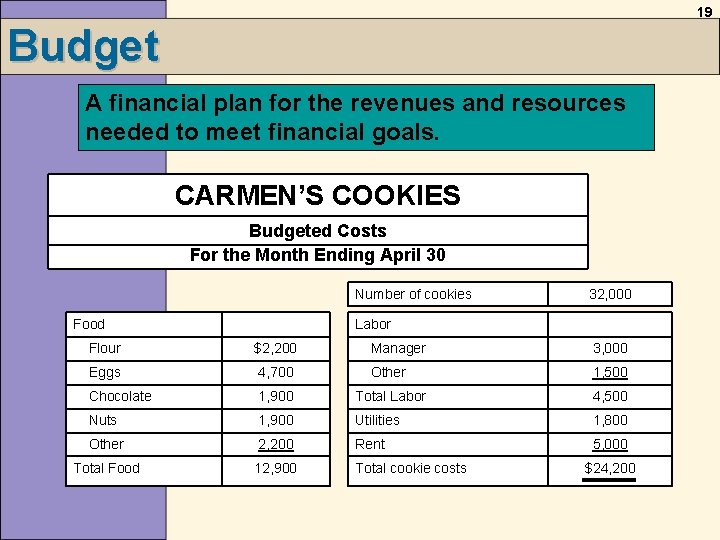
19 Budget A financial plan for the revenues and resources needed to meet financial goals. CARMEN’S COOKIES Budgeted Costs For the Month Ending April 30 Number of cookies Food 32, 000 Labor Flour $2, 200 Manager 3, 000 Eggs 4, 700 Other 1, 500 Chocolate 1, 900 Total Labor 4, 500 Nuts 1, 900 Utilities 1, 800 Other 2, 200 Rent 5, 000 Total Food 12, 900 Total cookie costs $24, 200
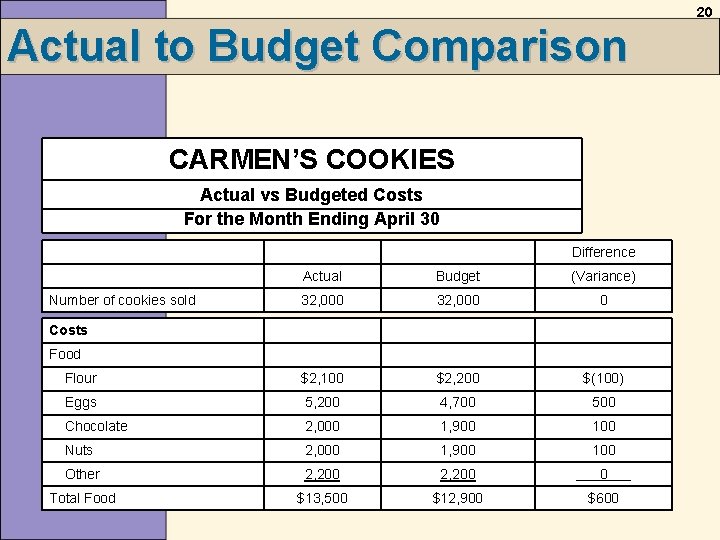
20 Actual to Budget Comparison CARMEN’S COOKIES Actual vs Budgeted Costs For the Month Ending April 30 Difference Actual Budget (Variance) 32, 000 0 Flour $2, 100 $2, 200 $(100) Eggs 5, 200 4, 700 500 Chocolate 2, 000 1, 900 100 Nuts 2, 000 1, 900 100 Other 2, 200 0 Total Food $13, 500 $12, 900 $600 Number of cookies sold Costs Food
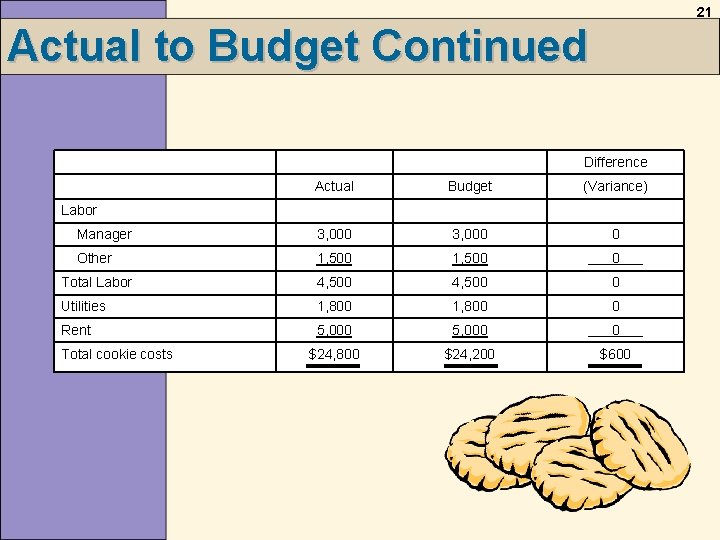
21 Actual to Budget Continued Difference Actual Budget (Variance) Manager 3, 000 0 Other 1, 500 0 Total Labor 4, 500 0 Utilities 1, 800 0 Rent 5, 000 0 $24, 800 $24, 200 $600 Labor Total cookie costs
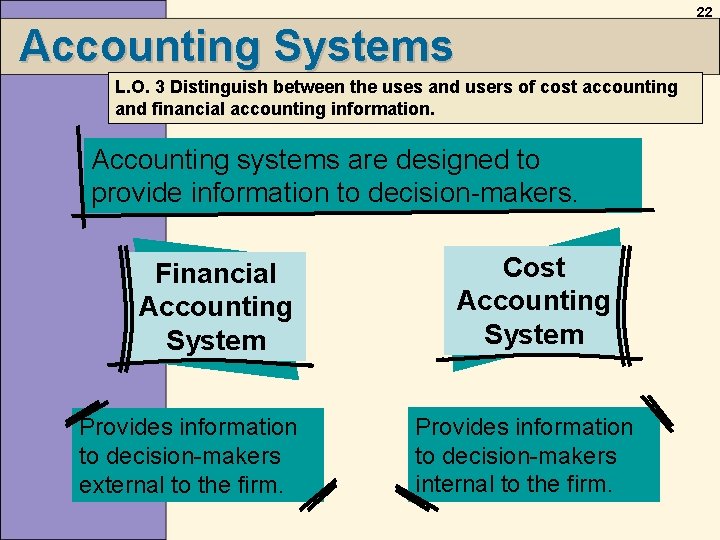
22 Accounting Systems L. O. 3 Distinguish between the uses and users of cost accounting and financial accounting information. Accounting systems are designed to provide information to decision-makers. Financial Accounting System Provides information to decision-makers external to the firm. Cost Accounting System Provides information to decision-makers internal to the firm.
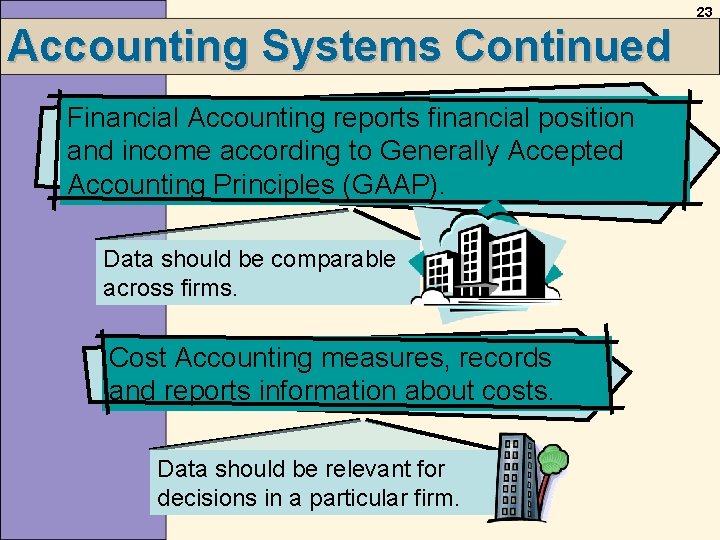
23 Accounting Systems Continued Financial Accounting reports financial position and income according to Generally Accepted Accounting Principles (GAAP). Data should be comparable across firms. Cost Accounting measures, records and reports information about costs. Data should be relevant for decisions in a particular firm.
24 Customers of Cost Accounting I love this I Ilove this customer! customer. Individual who purchases or uses a commodity or a service.
25 Customers of Cost Accounting Individuals who use the information provided. Managers making decisions in the firm. Owners evaluating managers.
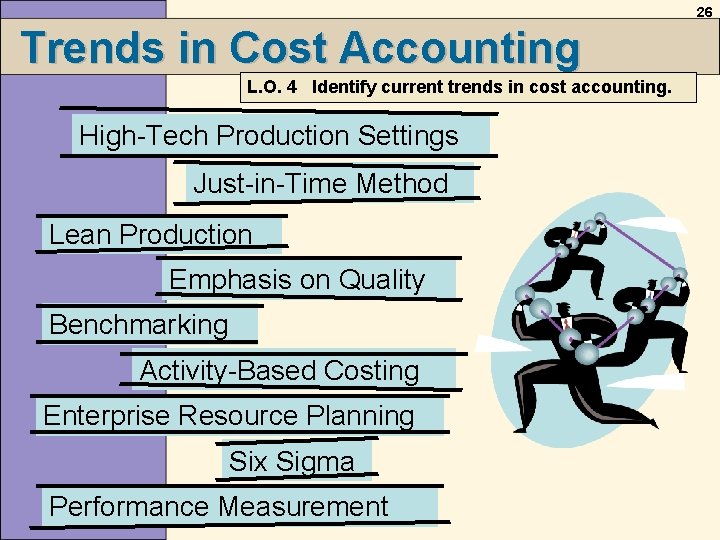
26 Trends in Cost Accounting L. O. 4 Identify current trends in cost accounting. High-Tech Production Settings Just-in-Time Method Lean Production Emphasis on Quality Benchmarking Activity-Based Costing Enterprise Resource Planning Six Sigma Performance Measurement
27 High-Tech Production Settings Manufacturing cost driven by technology rather than labor.
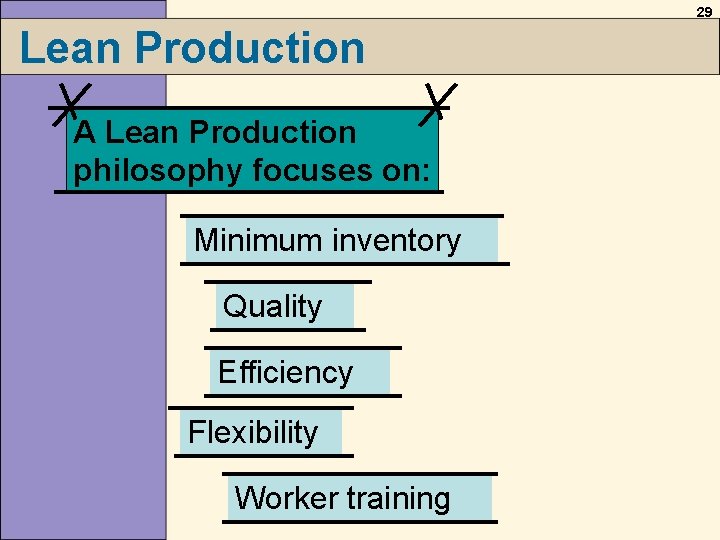
28 Just-in-Time Method Units are produced or purchased just in time for use, keeping inventories at a minimum.
29 Lean Production A Lean Production philosophy focuses on: Minimum inventory Quality Efficiency Flexibility Worker training
30 Emphasis on Quality as defined by the customer Organization is managed to excel on all dimensions.
31 Benchmarking methods measure products, services and activities against the best performance. Benchmarking is an ongoing process resulting in continuous improvement.
32 Activity-Based Costing (ABC) ABC assigns costs of activities needed to make a product then sums the cost of those activities to compute a product’s cost.
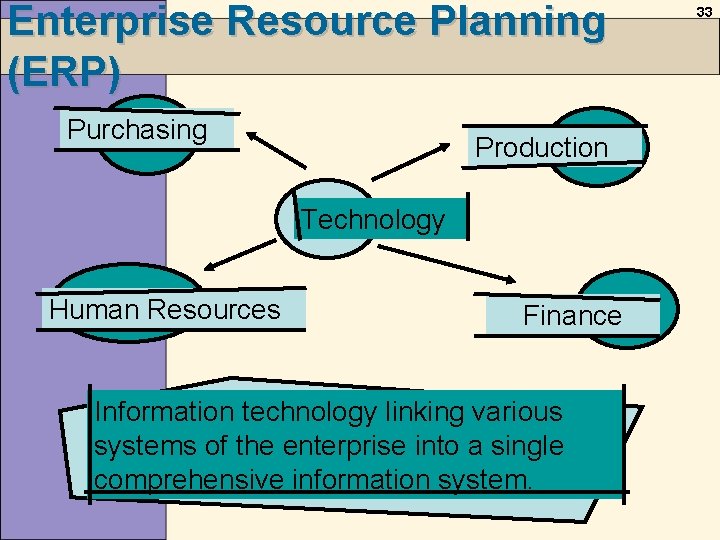
Enterprise Resource Planning (ERP) Purchasing Production Technology Human Resources Finance Information technology linking various systems of the enterprise into a single comprehensive information system. 33
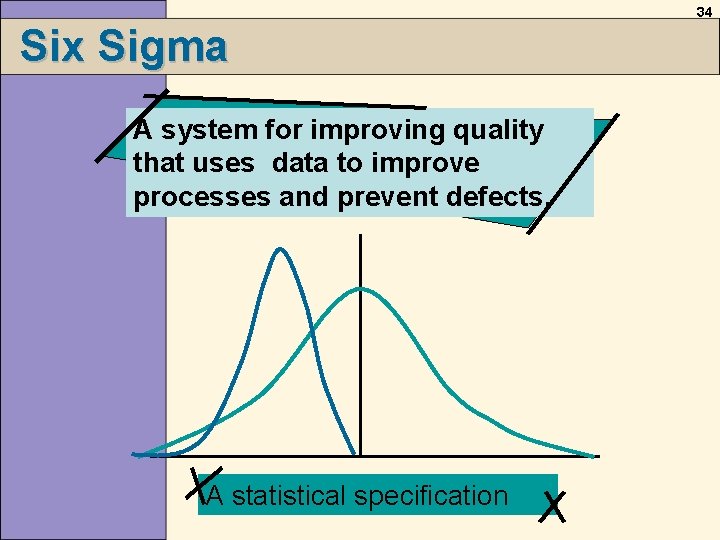
34 Six Sigma A system for improving quality that uses data to improve processes and prevent defects. A statistical specification
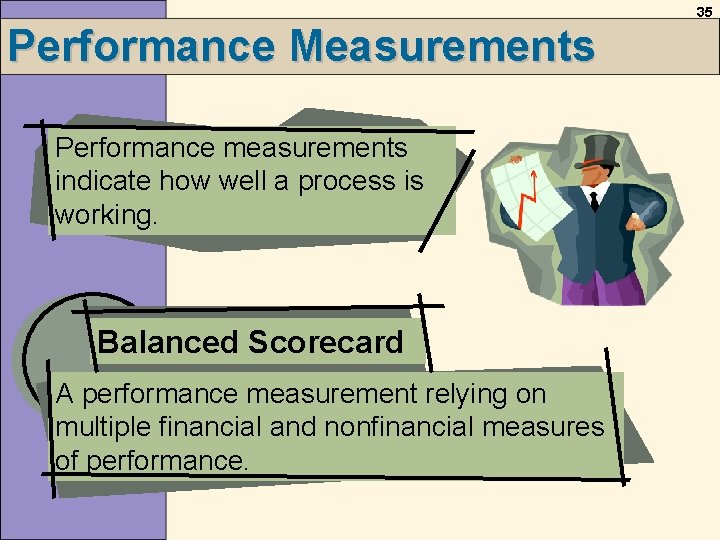
35 Performance Measurements Performance measurements indicate how well a process is working. Balanced Scorecard A performance measurement relying on multiple financial and nonfinancial measures of performance.
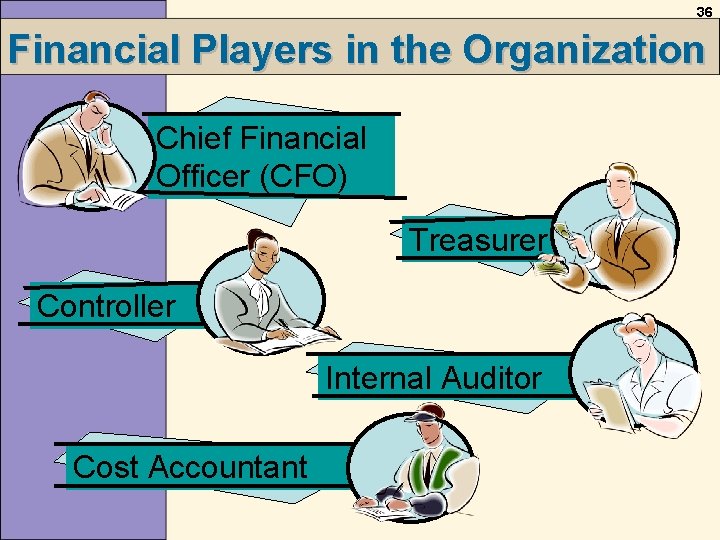
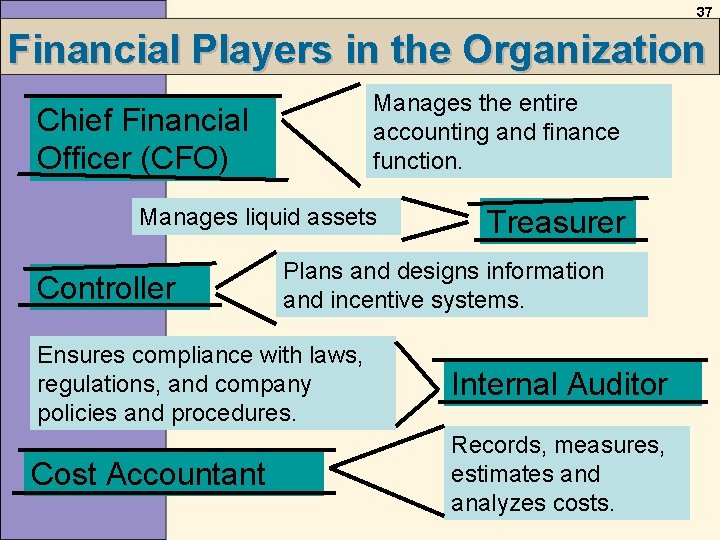
36 Financial Players in the Organization Chief Financial Officer (CFO) Treasurer Controller Internal Auditor Cost Accountant
37 Financial Players in the Organization Manages the entire accounting and finance function. Chief Financial Officer (CFO) Manages liquid assets Controller Treasurer Plans and designs information and incentive systems. Ensures compliance with laws, regulations, and company policies and procedures. Internal Auditor Cost Accountant Records, measures, estimates and analyzes costs.
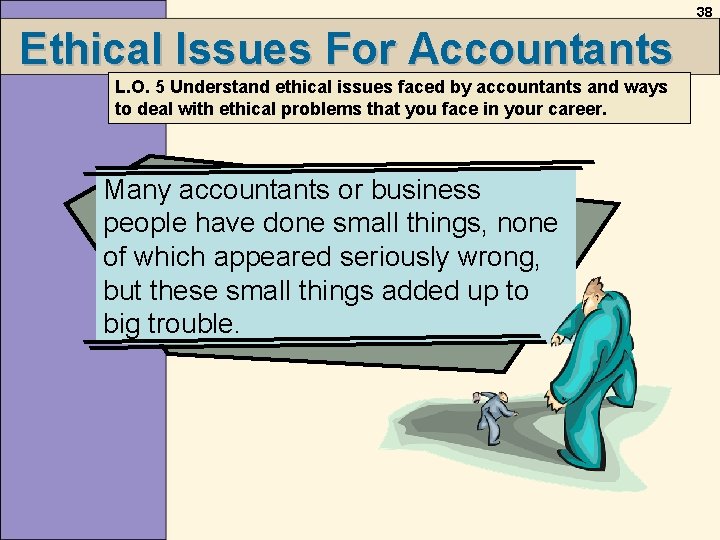
38 Ethical Issues For Accountants L. O. 5 Understand ethical issues faced by accountants and ways to deal with ethical problems that you face in your career. Many accountants or business people have done small things, none of which appeared seriously wrong, but these small things added up to big trouble.
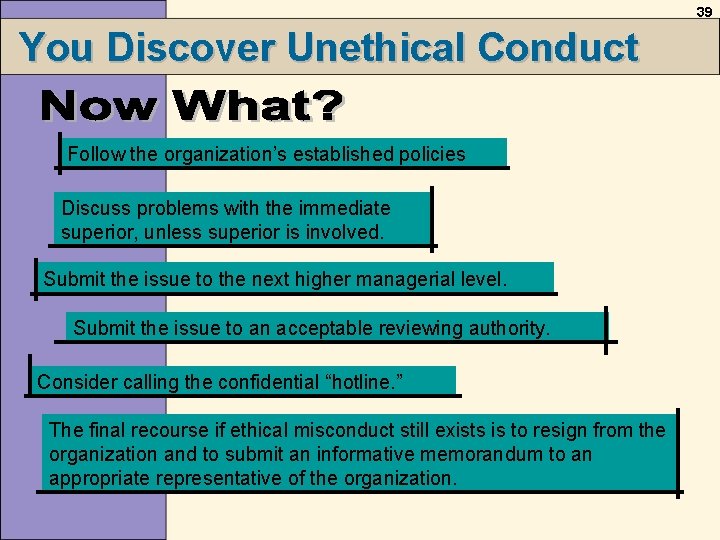
39 You Discover Unethical Conduct Follow the organization’s established policies Discuss problems with the immediate superior, unless superior is involved. Submit the issue to the next higher managerial level. Submit the issue to an acceptable reviewing authority. Consider calling the confidential “hotline. ” The final recourse if ethical misconduct still exists is to resign from the organization and to submit an informative memorandum to an appropriate representative of the organization.
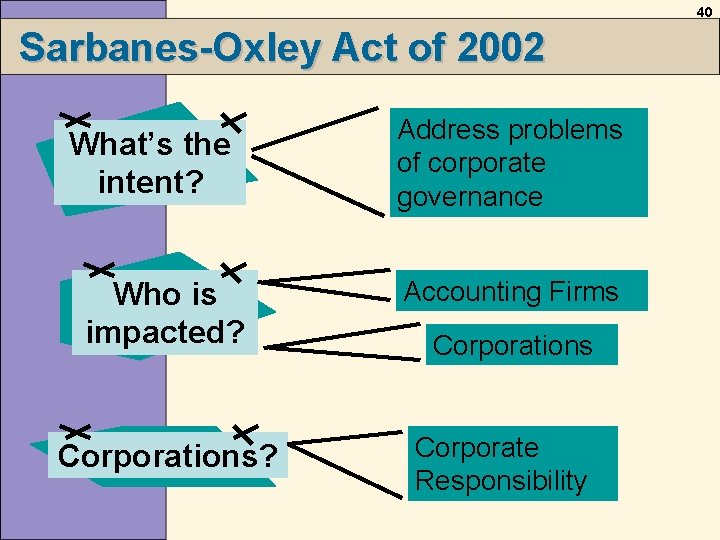
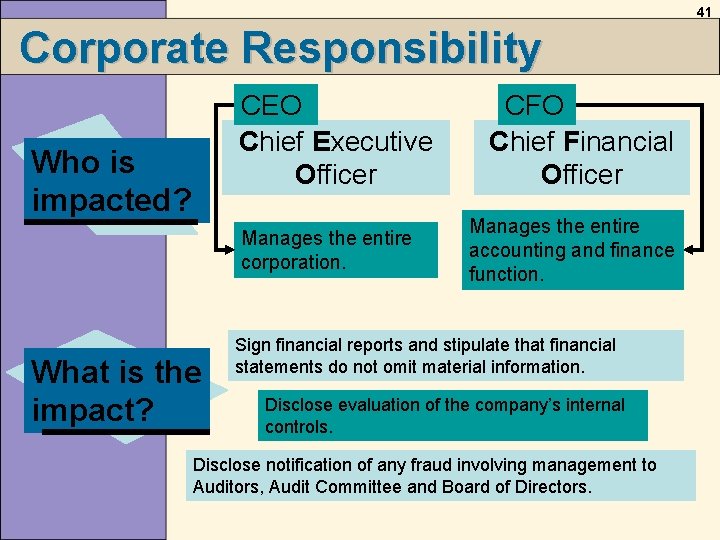
40 Sarbanes-Oxley Act of 2002 What’s the intent? Who is impacted? Corporations? Address problems of corporate governance Accounting Firms Corporations Corporate Responsibility
41 Corporate Responsibility CEO Chief Executive Officer Who is impacted? Manages the entire corporation. What is the impact? CFO Chief Financial Officer Manages the entire accounting and finance function. Sign financial reports and stipulate that financial statements do not omit material information. Disclose evaluation of the company’s internal controls. Disclose notification of any fraud involving management to Auditors, Audit Committee and Board of Directors.
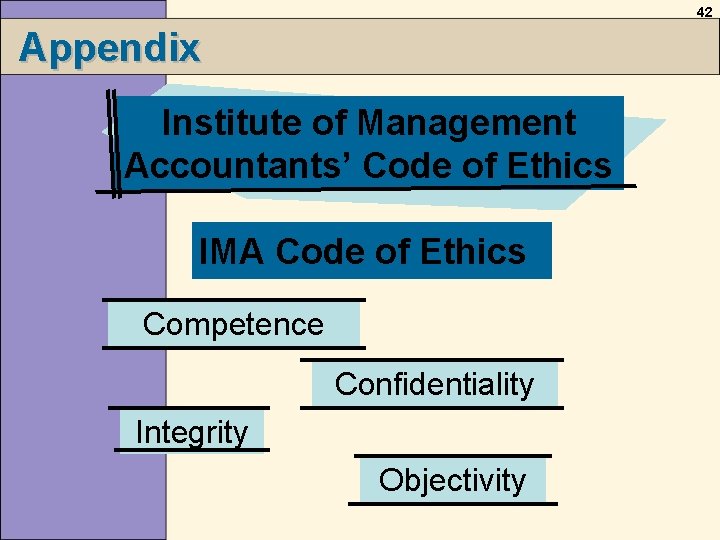
42 Appendix Institute of Management Accountants’ Code of Ethics IMA Code of Ethics Competence Confidentiality Integrity Objectivity
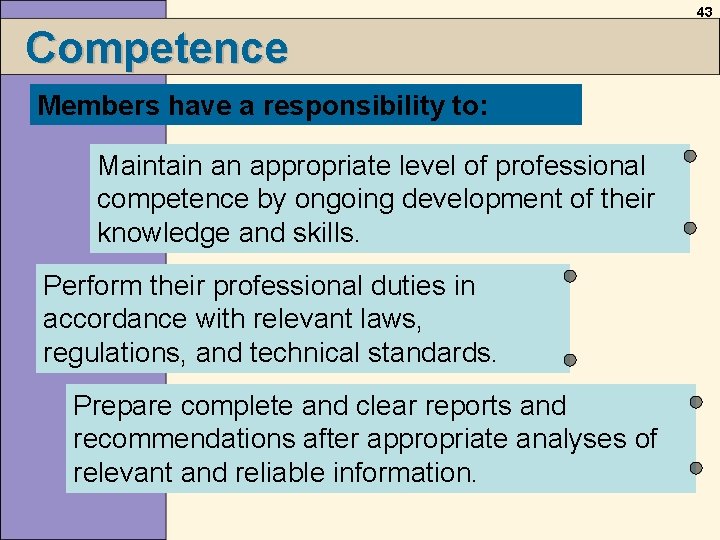
43 Competence Members have a responsibility to: Maintain an appropriate level of professional competence by ongoing development of their knowledge and skills. Perform their professional duties in accordance with relevant laws, regulations, and technical standards. Prepare complete and clear reports and recommendations after appropriate analyses of relevant and reliable information.
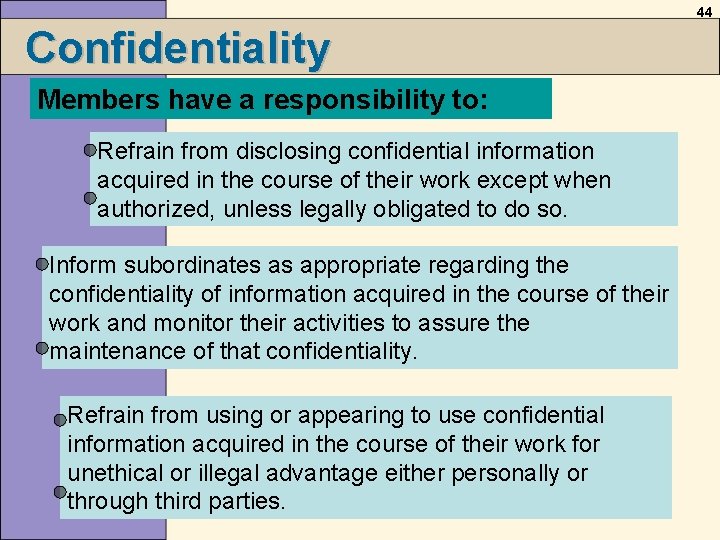
44 Confidentiality Members have a responsibility to: Refrain from disclosing confidential information acquired in the course of their work except when authorized, unless legally obligated to do so. Inform subordinates as appropriate regarding the confidentiality of information acquired in the course of their work and monitor their activities to assure the maintenance of that confidentiality. Refrain from using or appearing to use confidential information acquired in the course of their work for unethical or illegal advantage either personally or through third parties.
Integrity Members have a responsibility to: Avoid actual or apparent conflicts of interest and advise all appropriate parties of any potential conflict. Refrain from engaging in any activity that would prejudice their ability to carry out their duties ethically. Refuse any gift, favor, or hospitality that would influence or would appear to influence their actions. Refrain from either actively or passively subverting the attainment of the organization’s legitimate and ethical objectives. Recognize and communicate professional limitations or other constraints that would preclude responsible judgment or successful performance of an activity. Communicate unfavorable as well as favorable information and professional judgments or opinions. Refrain from engaging in or supporting any activity that would discredit the profession. 45
Objectivity Members have a responsibility to: Communicate information fairly and objectively. Disclose fully all relevant information that could reasonably be expected to influence an intended user’s understanding of the reports, comments, and recommendations presented. 46
47 Chapter 1 Should I expand or not?