
Information exchanges between router agents Dimitri Papadimitriou Email
Information exchanges between router agents Dimitri Papadimitriou Email: dimitri. papadimitriou@alcatel-lucent. com Alcatel-Lucent IETF 83 Meeting Paris, France March 25 -30, 2012

What's an agent ? • What is an agent? – Autonomous and adaptive decision-making discrete entity with heterogeneous properties, individual/shared goals and modifiable behaviors • Agents have internal states (attributes, data, . . . ): memory storing observations (descriptions, representations of environment, etc. ) – Agents interact with their environments beyond concurrent state-determined interaction – Adapt decision on future action to environment changes: using sequence of k observations of k past system state (next action not solely dependent on previous state but depends also on some memory). . . but also on using agent’s beliefs about other agents or the utility of performing some actions, etc. Function + memory Object + autonomy + adaptivity Agent
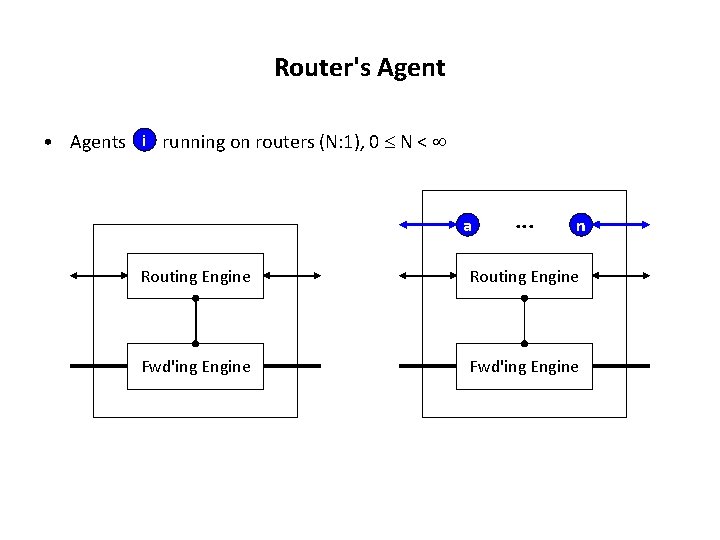
Router's Agent • Agents i running on routers (N: 1), 0 N < a . . . n Routing Engine Fwd'ing Engine
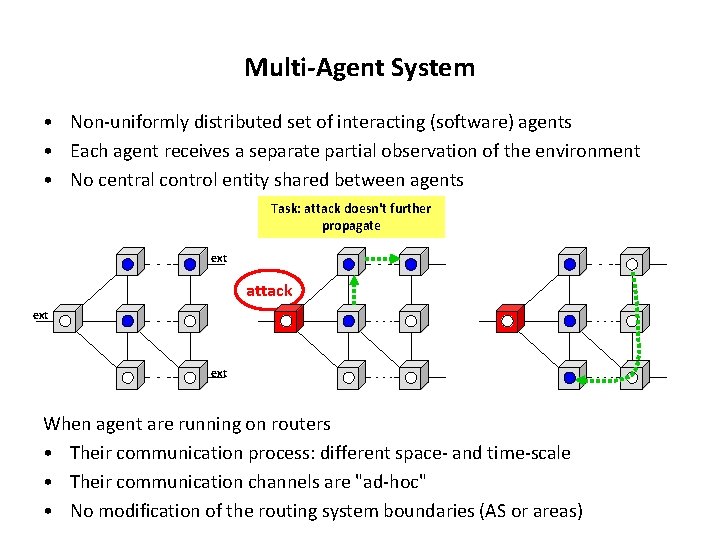
Multi-Agent System • Non-uniformly distributed set of interacting (software) agents • Each agent receives a separate partial observation of the environment • No central control entity shared between agents Task: attack doesn't further propagate ext attack ext When agent are running on routers • Their communication process: different space- and time-scale • Their communication channels are "ad-hoc" • No modification of the routing system boundaries (AS or areas)
Applications Two classes – Networking layer-related • Diagnostic, analysis • Distributed intrusion detection, immunity – Others • Information routing related (caching/storage, processing, etc. ) • etc. In both cases, different objects / information units than those associated to legacy network layer routing (link states, vector, etc. ) Routers' components programmability is by definition going to accelerate these trends

Communication between agents: Current situation • Routing protocols (network layer information exchange and processing) – vectors – states -> compute routes • The "multi-", "opaque-", "extended-". . . problems (because of communication-memory-processing cost) 1) PUSH mode: inefficient when applications are operate at different time and spatial-scale 2) Overlaying is only one out of many means to add functionality (-D. Wheeler quote) 3) Determinism vs uncertainty (stochastic nature of events, interactions, environment, etc. ) • Corollary (out of 3): pushing the uncertainty out of the routing system (ignore it) will in the long term make the system itself under-performing
Communication between agents: What would we need ? 1) PUSH mode: inefficient when applications are operate at different time and spatial-scale -> Hybrid push-pull information communication mode for router's agent to operate at multiple time-scale and multiple space-scale 2) Overlaying is only one out of many means to add functionality -> Routers comprise multiple software agents – run-time behavior (instead of being structured along a stack of functions with static and invariant bindings) 3) Determinism vs uncertainty -> Impossible to ensure "perfect" placement of agents (impossible to fully anticipate) => cooperation between agents from interaction patterns
Summary • Agent: adaptive and autonomous statefull entity (memory) implementing various functions • If agents run on "routers" (entity hosting routing and forwarding function) then the routing system becomes also a multi-agent environment – multi distributed – actually routing and forwarding are also agents but since these agents define the entities themselves and are tightly intricate they are hard to dissociate • Consequently – We need to enable exchange of information between agents to perform – Is the IETF the place to specify this protocol. . . Bo. F in Vancouver
- Slides: 8