
Information Discovery Brokerage and Dissemination in Sensor Networks
Information Discovery, Brokerage, and Dissemination in Sensor Networks Sensing Networking Computation Leonidas Guibas Computer Science Stanford University
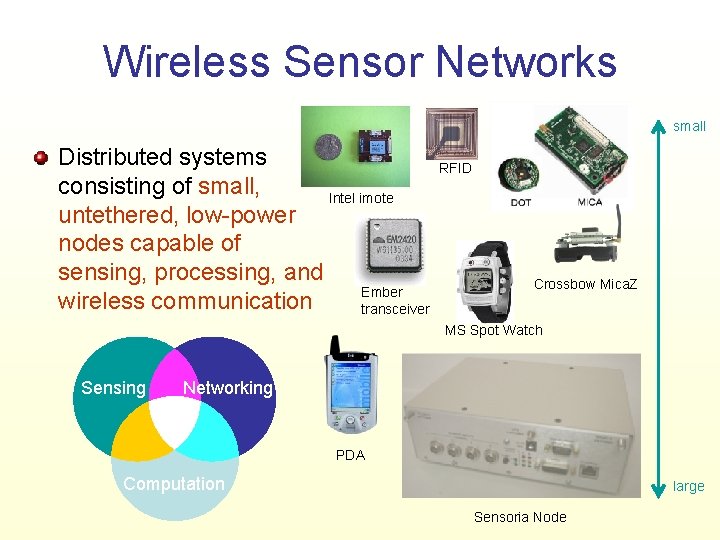
Wireless Sensor Networks small Distributed systems consisting of small, Intel imote untethered, low-power nodes capable of sensing, processing, and Ember wireless communication transceiver RFID Crossbow Mica. Z MS Spot Watch Sensing Networking PDA Computation large Sensoria Node
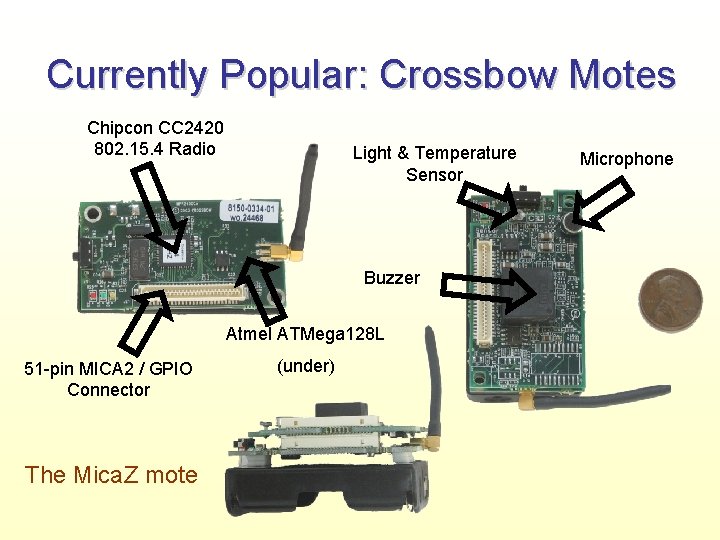
Currently Popular: Crossbow Motes Chipcon CC 2420 802. 15. 4 Radio Light & Temperature Sensor Buzzer Atmel ATMega 128 L 51 -pin MICA 2 / GPIO Connector The Mica. Z mote (under) Microphone
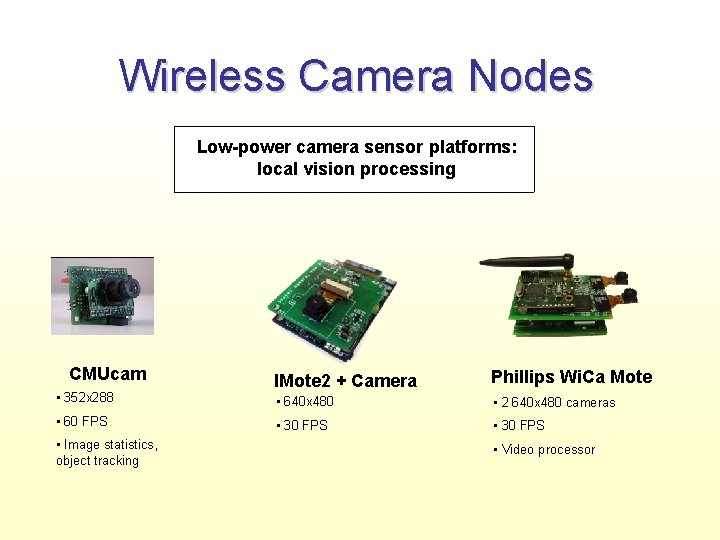
Wireless Camera Nodes Low-power camera sensor platforms: local vision processing CMUcam • 352 x 288 • 60 FPS • Image statistics, object tracking IMote 2 + Camera Phillips Wi. Ca Mote • 640 x 480 • 2 640 x 480 cameras • 30 FPS • Video processor
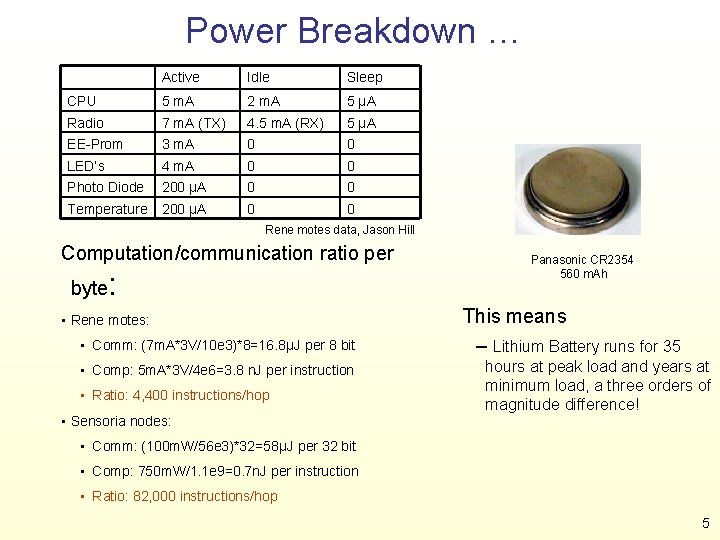
Power Breakdown … Active Idle Sleep CPU 5 m. A 2 m. A 5 μA Radio 7 m. A (TX) 4. 5 m. A (RX) 5 μA EE-Prom 3 m. A 0 0 LED’s 4 m. A 0 0 Photo Diode 200 μA 0 0 Temperature 200 μA 0 0 Rene motes data, Jason Hill Computation/communication ratio per byte : • Rene motes: • Comm: (7 m. A*3 V/10 e 3)*8=16. 8μJ per 8 bit • Comp: 5 m. A*3 V/4 e 6=3. 8 n. J per instruction • Ratio: 4, 400 instructions/hop • Sensoria nodes: Panasonic CR 2354 560 m. Ah This means – Lithium Battery runs for 35 hours at peak load and years at minimum load, a three orders of magnitude difference! • Comm: (100 m. W/56 e 3)*32=58μJ per 32 bit • Comp: 750 m. W/1. 1 e 9=0. 7 n. J per instruction • Ratio: 82, 000 instructions/hop 5
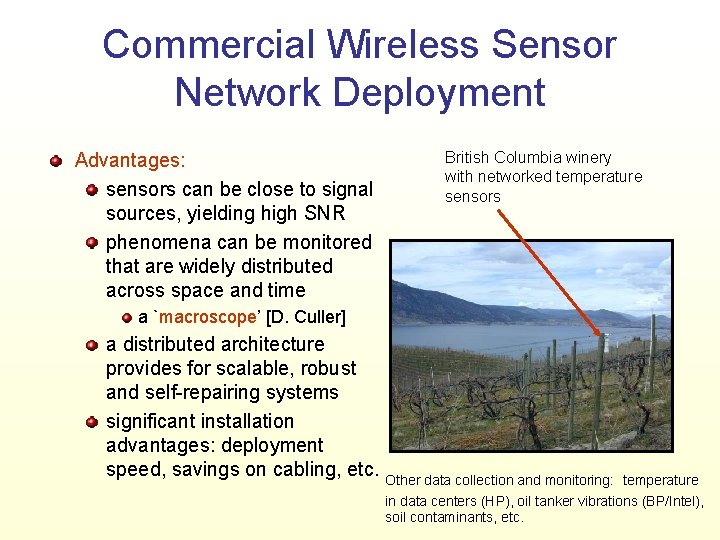
Commercial Wireless Sensor Network Deployment Advantages: sensors can be close to signal sources, yielding high SNR phenomena can be monitored that are widely distributed across space and time British Columbia winery with networked temperature sensors a `macroscope’ [D. Culler] a distributed architecture provides for scalable, robust and self-repairing systems significant installation advantages: deployment speed, savings on cabling, etc. Other data collection and monitoring: temperature in data centers (HP), oil tanker vibrations (BP/Intel), soil contaminants, etc.
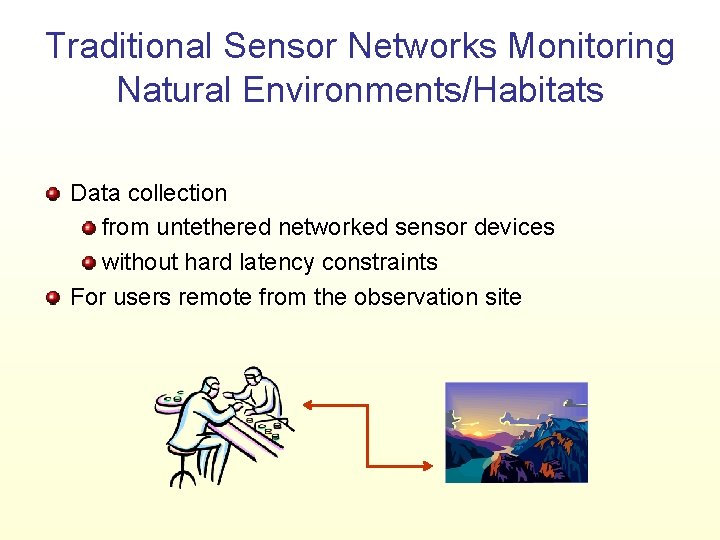
Traditional Sensor Networks Monitoring Natural Environments/Habitats Data collection from untethered networked sensor devices without hard latency constraints For users remote from the observation site
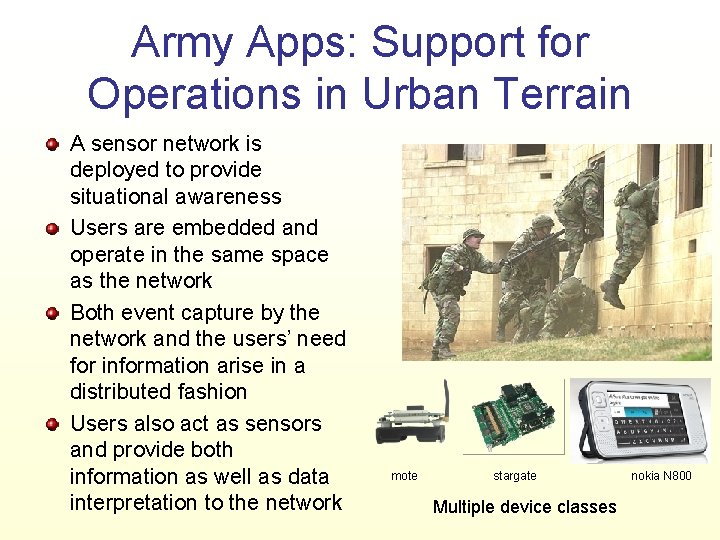
Army Apps: Support for Operations in Urban Terrain A sensor network is deployed to provide situational awareness Users are embedded and operate in the same space as the network Both event capture by the network and the users’ need for information arise in a distributed fashion Users also act as sensors and provide both information as well as data interpretation to the network mote stargate Multiple device classes nokia N 800
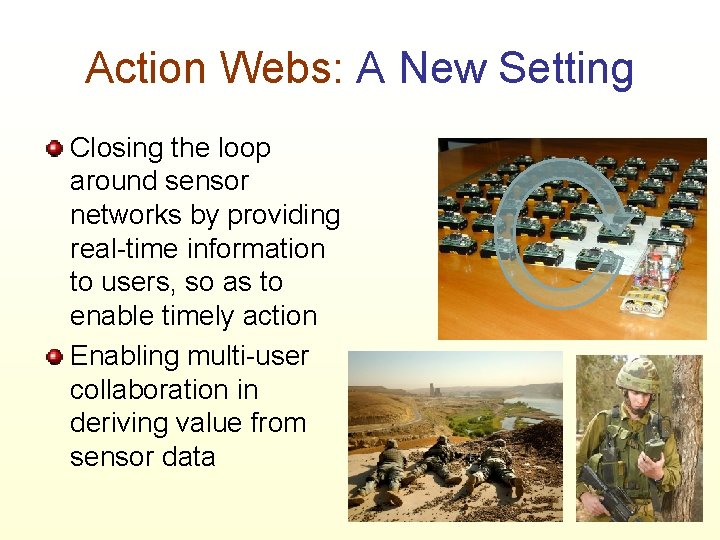
Action Webs: A New Setting Closing the loop around sensor networks by providing real-time information to users, so as to enable timely action Enabling multi-user collaboration in deriving value from sensor data
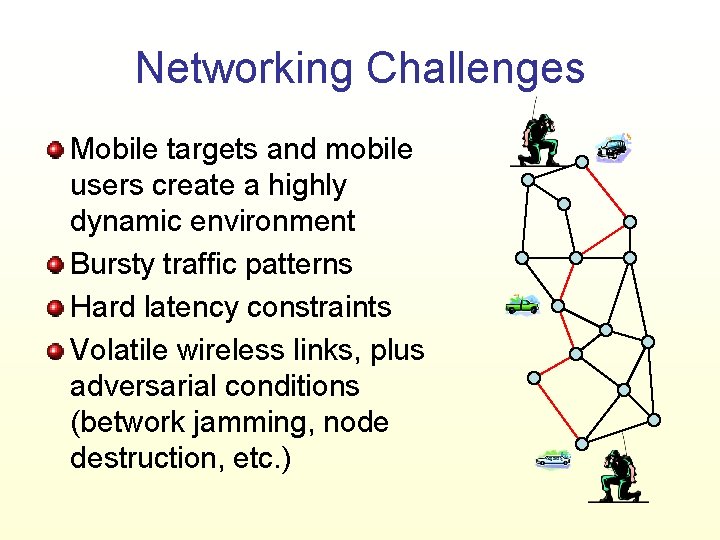
Networking Challenges Mobile targets and mobile users create a highly dynamic environment Bursty traffic patterns Hard latency constraints Volatile wireless links, plus adversarial conditions (betwork jamming, node destruction, etc. )
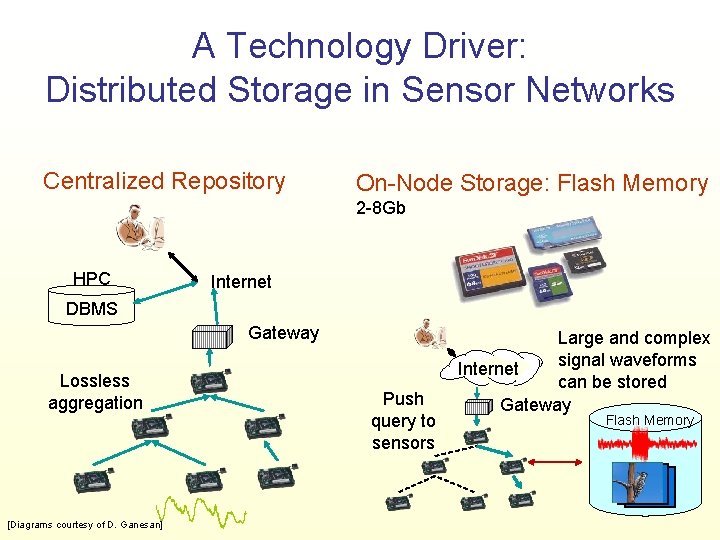
A Technology Driver: Distributed Storage in Sensor Networks Centralized Repository On-Node Storage: Flash Memory 2 -8 Gb HPC Internet DBMS Gateway Lossless aggregation [Diagrams courtesy of D. Ganesan] Push query to sensors Large and complex signal waveforms Internet can be stored Gateway Flash Memory
Data Overload A lot more data will be captured than can or will ever be looked at Classical data indexing methods do not apply Most data must stay on the nodes on a mote-class device, transmitting the entire contents of a single 4 GB flash chip takes approximately 110 hours of uninterrupted communication: just under five days, twice the expected lifetime of a node with 2 AA batteries [P. Levis] We must be highly selective on what data is sent to users
Project Research Themes Enable distance sensitive, low-latency, highly specific data/information delivery to mobile users from a sensor network Allow social-network style user collaboration on interpreting sensor data through the same network Optimize and tune the network through offline HPC computing at servers on the edge of the sensor network
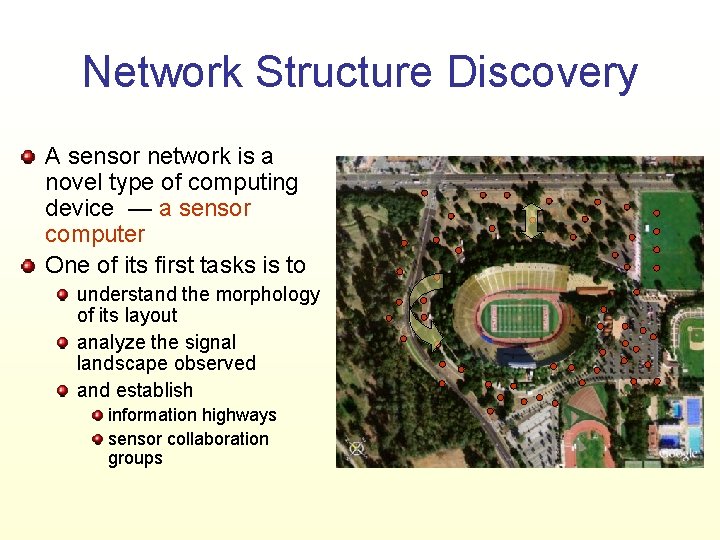
Network Structure Discovery A sensor network is a novel type of computing device — a sensor computer One of its first tasks is to understand the morphology of its layout analyze the signal landscape observed and establish information highways sensor collaboration groups
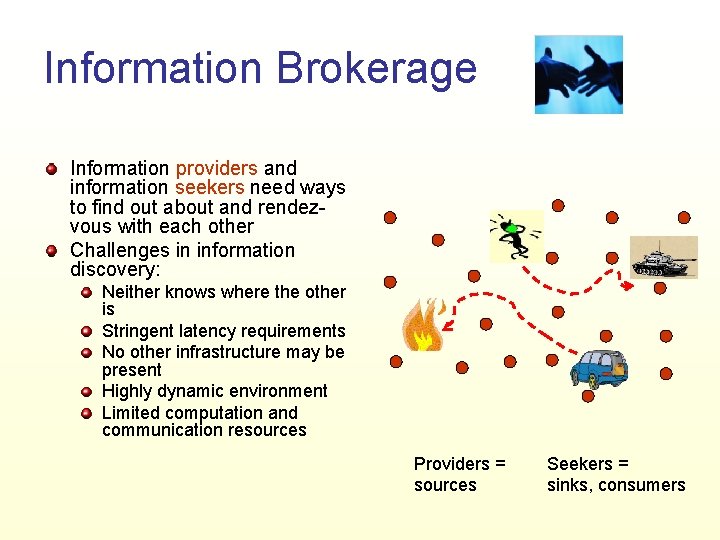
Information Brokerage Information providers and information seekers need ways to find out about and rendezvous with each other Challenges in information discovery: Neither knows where the other is Stringent latency requirements No other infrastructure may be present Highly dynamic environment Limited computation and communication resources Providers = sources Seekers = sinks, consumers
Information Brokerage Issues Find a good balance between cost of information replication (storage size) and cost of information discovery (query time) Push v. pull Load balance Robustness Information brokerage is intimately coupled with how network nodes are named do we have coordinates? how routing is done in the network Distance-Sensitive Information Brokerage: if producer and consumer are at a distance d, the information discovery cost should be O(d) Locality-Awareness
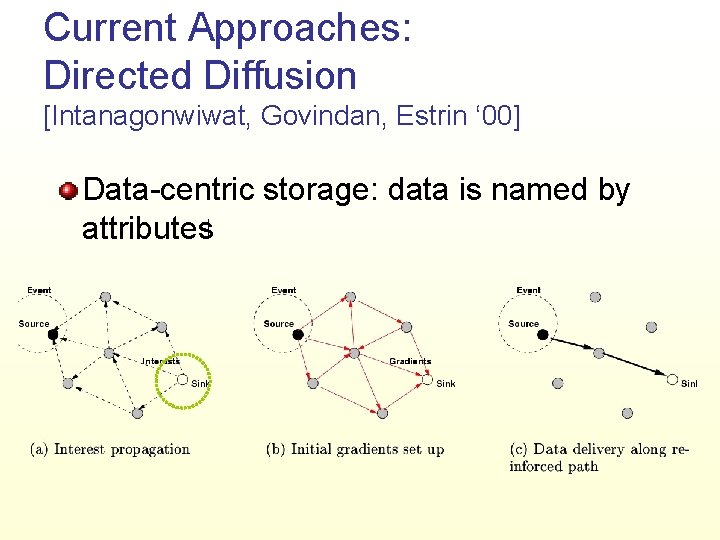
Current Approaches: Directed Diffusion [Intanagonwiwat, Govindan, Estrin ‘ 00] Data-centric storage: data is named by attributes
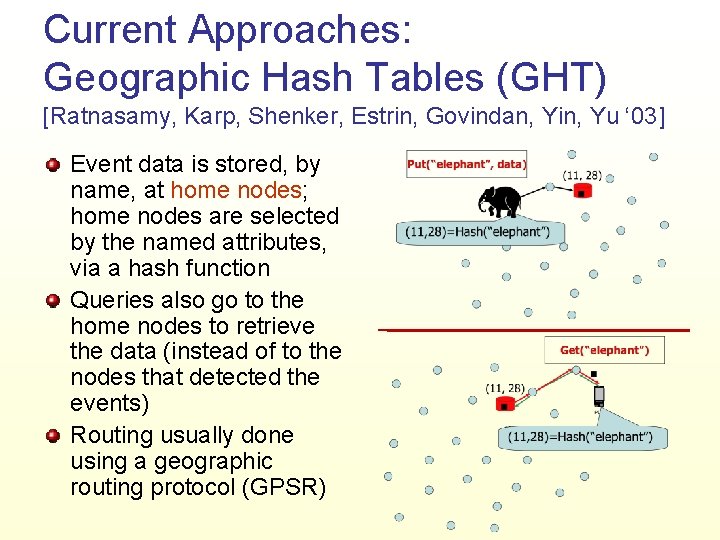
Current Approaches: Geographic Hash Tables (GHT) [Ratnasamy, Karp, Shenker, Estrin, Govindan, Yin, Yu ‘ 03] Event data is stored, by name, at home nodes; home nodes are selected by the named attributes, via a hash function Queries also go to the home nodes to retrieve the data (instead of to the nodes that detected the events) Routing usually done using a geographic routing protocol (GPSR)
Research Agenda Routing: Understand the global structure of the sensor net layout and the signal landscape Use that to detect holes, narrow passages, and other obstructions to connectivity Establish appropriate `road systems’ or `information highways’ in the network Develop efficient update mechanisms Information Storage and Retrieval: Explore where information should be stored and how it should be replicated to allow efficient delivery Study trade-offs between push/pull and in-between mechanisms Address the challenges of content delivery to mobile sinks
Three Quick Vignettes 1. Landmark-based topology extraction 2. Sparse data aggregation 3. Information gradients for information discovery Plus talks later today by Kusy, Downes, Milosavljevic, Skraba, Heath
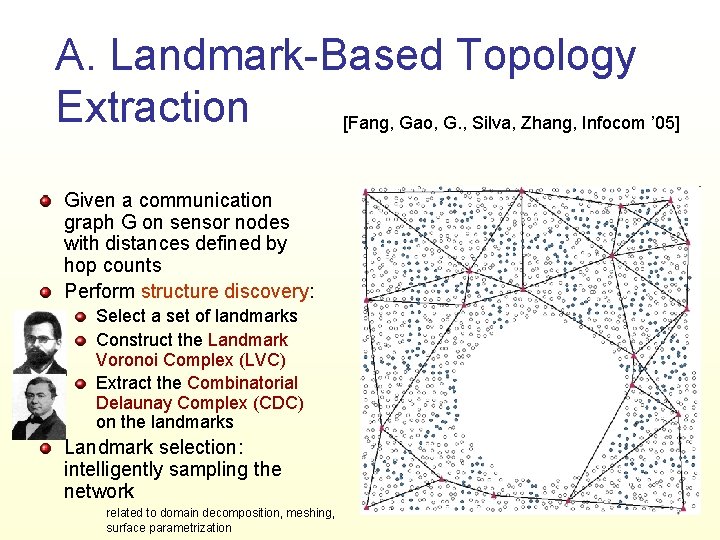
A. Landmark-Based Topology Extraction [Fang, Gao, G. , Silva, Zhang, Infocom ’ 05] Given a communication graph G on sensor nodes with distances defined by hop counts Perform structure discovery: Select a set of landmarks Construct the Landmark Voronoi Complex (LVC) Extract the Combinatorial Delaunay Complex (CDC) on the landmarks Landmark selection: intelligently sampling the network related to domain decomposition, meshing, surface parametrization
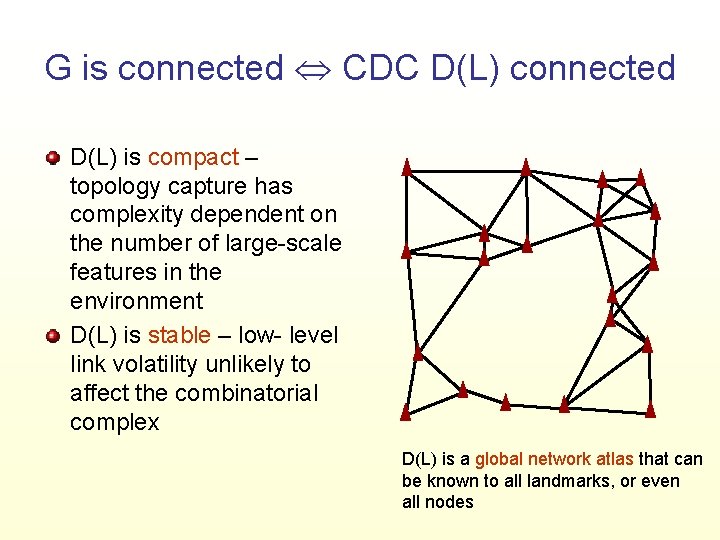
G is connected CDC D(L) connected D(L) is compact – topology capture has complexity dependent on the number of large-scale features in the environment D(L) is stable – low- level link volatility unlikely to affect the combinatorial complex D(L) is a global network atlas that can be known to all landmarks, or even all nodes
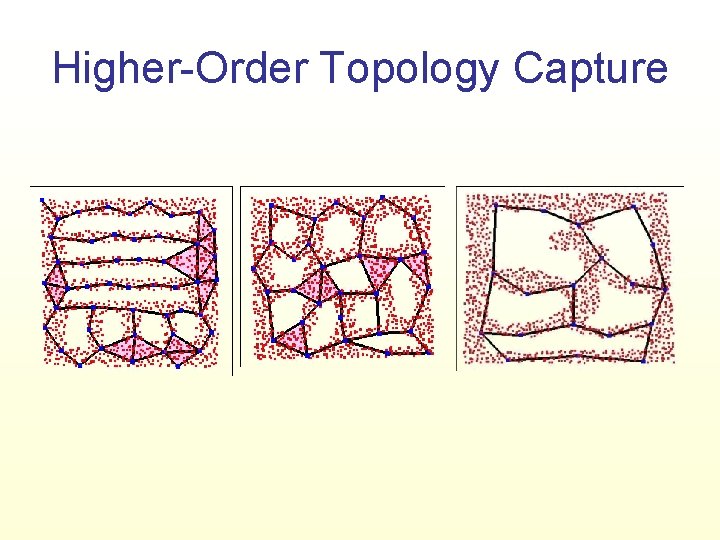
Higher-Order Topology Capture
Local Routing, with Global Guidance: GLIDER Protocol Global Guidance the D(L) encodes global connectivity information that is accessible to every node for proactive route planning on tiles. Local Routing high-level routes on tiles are realized as actual paths in the network by using local reactive protocols.
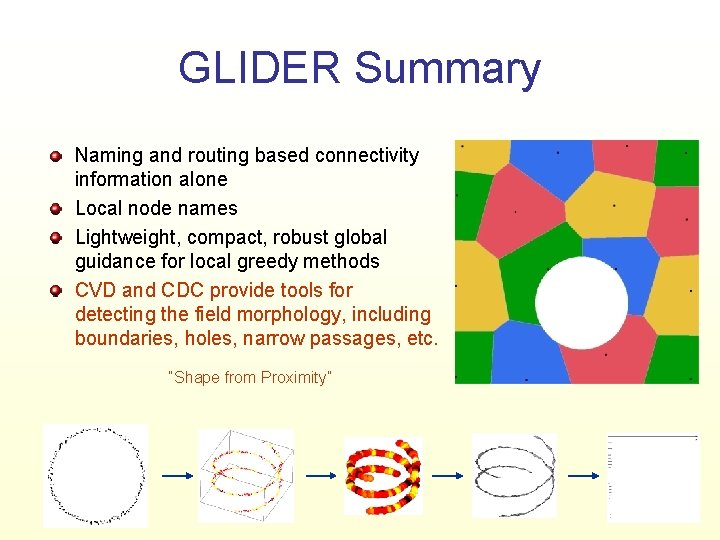
GLIDER Summary Naming and routing based connectivity information alone Local node names Lightweight, compact, robust global guidance for local greedy methods CVD and CDC provide tools for detecting the field morphology, including boundaries, holes, narrow passages, etc. “Shape from Proximity”
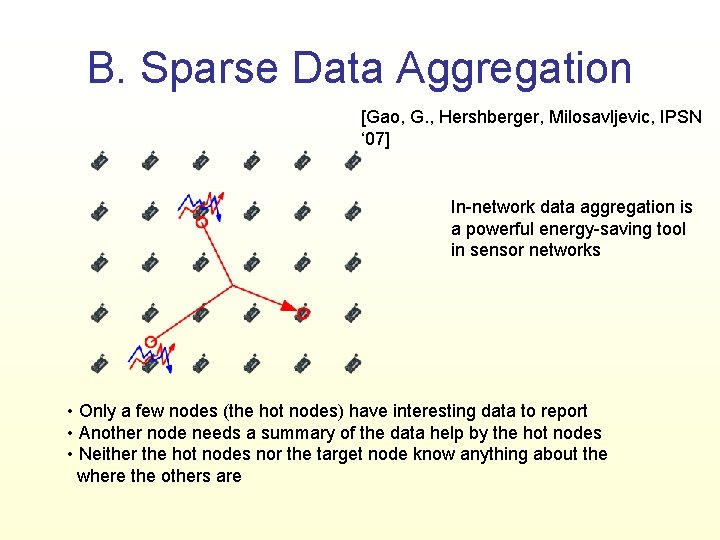
B. Sparse Data Aggregation [Gao, G. , Hershberger, Milosavljevic, IPSN ‘ 07] In-network data aggregation is a powerful energy-saving tool in sensor networks • Only a few nodes (the hot nodes) have interesting data to report • Another node needs a summary of the data help by the hot nodes • Neither the hot nodes nor the target node know anything about the where the others are
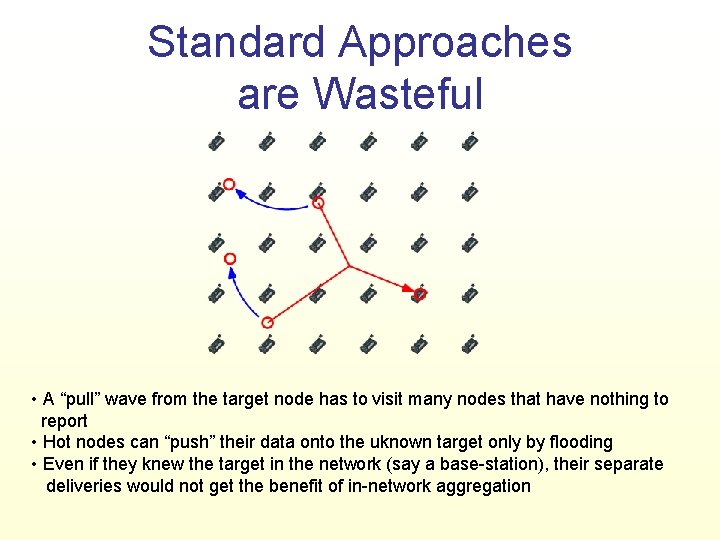
Standard Approaches are Wasteful • A “pull” wave from the target node has to visit many nodes that have nothing to report • Hot nodes can “push” their data onto the uknown target only by flooding • Even if they knew the target in the network (say a base-station), their separate deliveries would not get the benefit of in-network aggregation
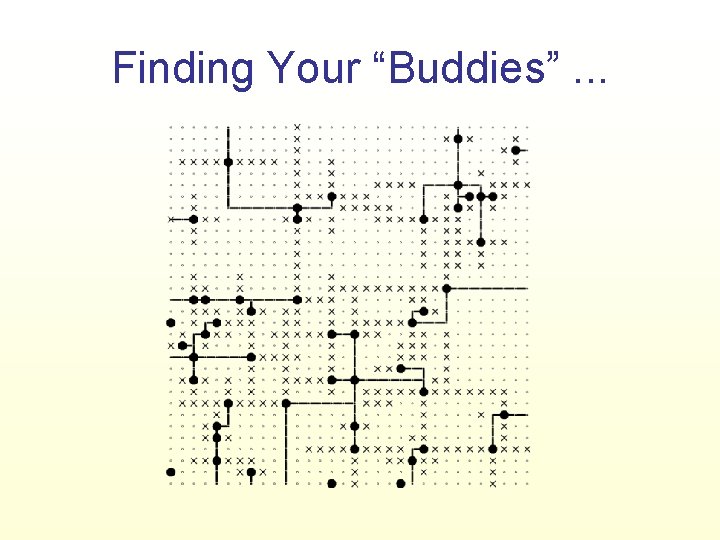
Finding Your “Buddies”. . .
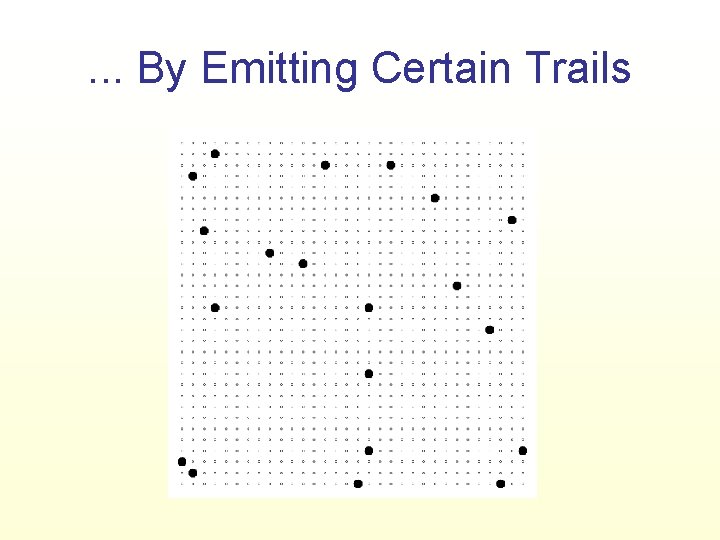
. . . By Emitting Certain Trails
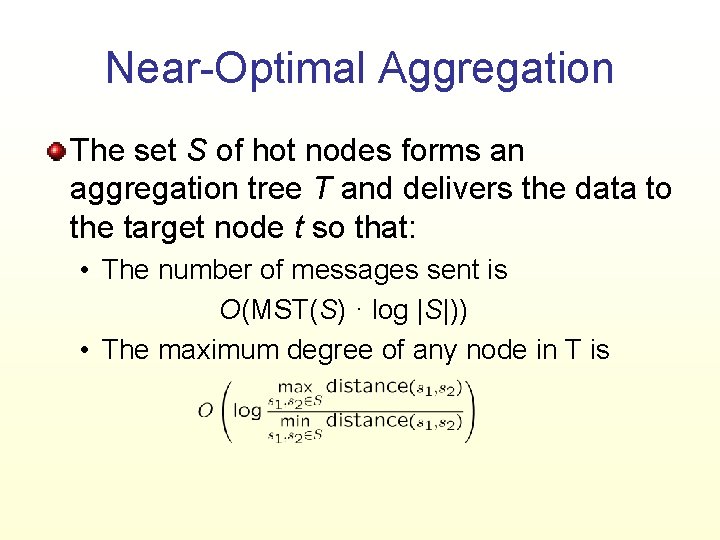
Near-Optimal Aggregation The set S of hot nodes forms an aggregation tree T and delivers the data to the target node t so that: • The number of messages sent is O(MST(S) · log |S|)) • The maximum degree of any node in T is
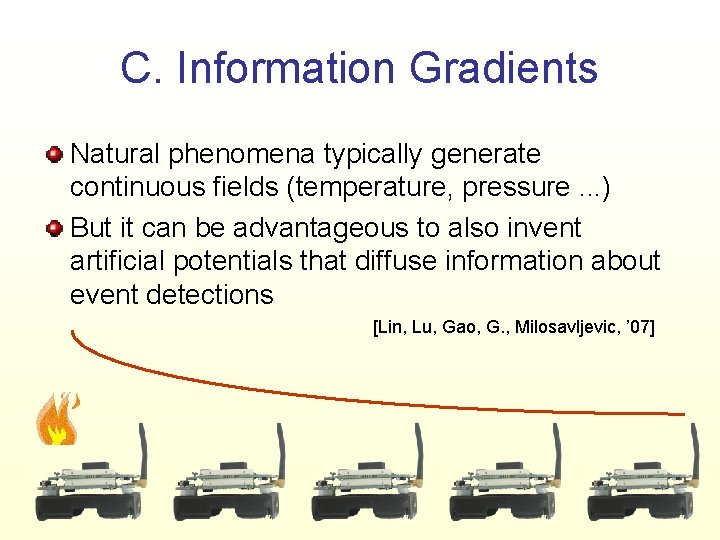
C. Information Gradients Natural phenomena typically generate continuous fields (temperature, pressure. . . ) But it can be advantageous to also invent artificial potentials that diffuse information about event detections [Lin, Lu, Gao, G. , Milosavljevic, ’ 07]
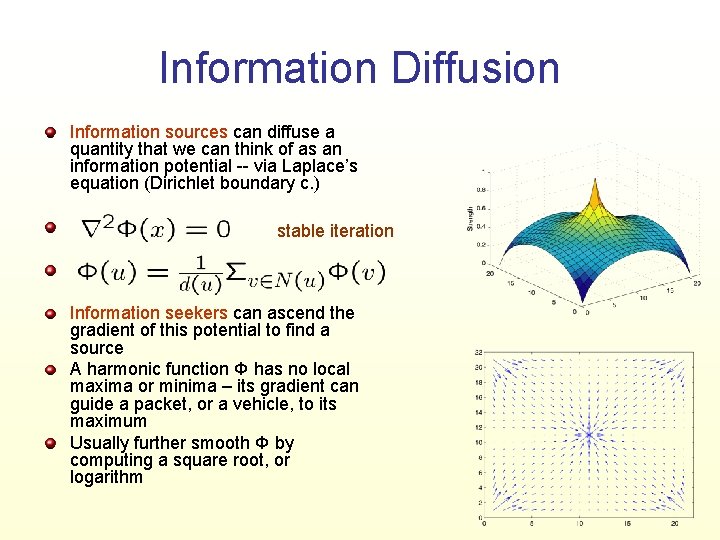
Information Diffusion Information sources can diffuse a quantity that we can think of as an information potential -- via Laplace’s equation (Dirichlet boundary c. ) stable iteration Information seekers can ascend the gradient of this potential to find a source A harmonic function Φ has no local maxima or minima – its gradient can guide a packet, or a vehicle, to its maximum Usually further smooth Φ by computing a square root, or logarithm
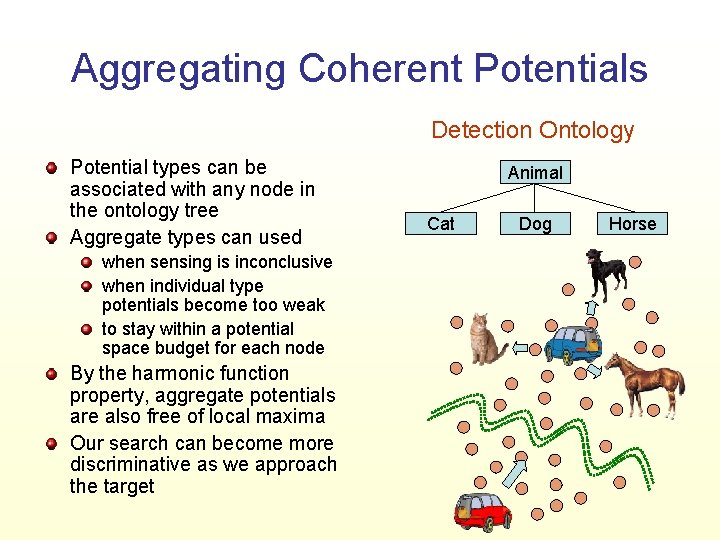
Aggregating Coherent Potentials Detection Ontology Potential types can be associated with any node in the ontology tree Aggregate types can used when sensing is inconclusive when individual type potentials become too weak to stay within a potential space budget for each node By the harmonic function property, aggregate potentials are also free of local maxima Our search can become more discriminative as we approach the target Animal Cat Dog Horse
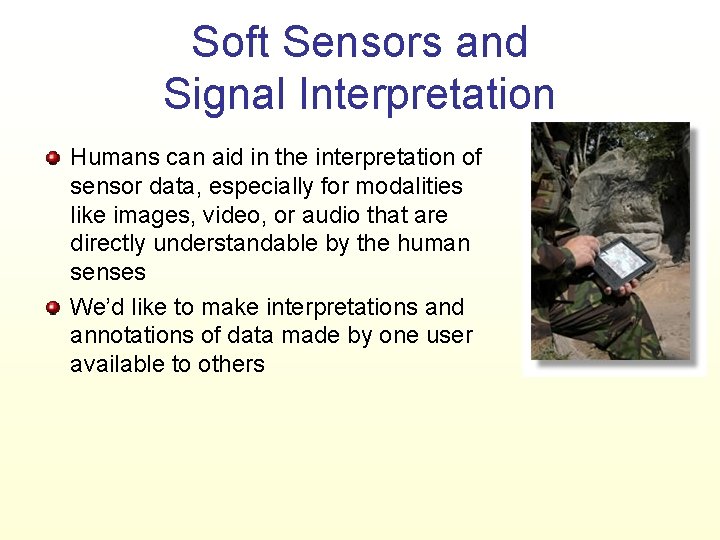
Soft Sensors and Signal Interpretation Humans can aid in the interpretation of sensor data, especially for modalities like images, video, or audio that are directly understandable by the human senses We’d like to make interpretations and annotations of data made by one user available to others
Supporting a User Community on a Sensor Network How can annotations and interpretations entered by one used get propagated in the network and made available to others How can we transfer annotations form some sensor data to other similar data Need tools for the lightweight comparison of signals: signal fingerprints Are there lightweight versions of Web recommendation systems, or Websupported social groups that can function in the constrained world of sensor networks?
Final Remarks Ubiquitous networked sensors provide a dense spatial and temporal sampling of the physical world They allow low-latency access to information that is highly localized in time and space, and thus provide a way to sense and act on the physical world beyond what has been possible up to now To allow timely actions to be taken based on sensor data we must deliver information with hard latency constraints. In particular, we we must match information providers and seekers directly in the network. All protocols and algorithms need to be optimized for the particular deployment parameters using off-line optimization, exploiting more powerful machines at the edge of the network.
Thank You
- Slides: 37