
INFORMATION CENTRES By Anil B Talawar Assistant Professor
INFORMATION CENTRES By Anil B. Talawar Assistant Professor Dept. of Library and Information Sciecne Karnatak University, Dharwad
Origin �In a library the services are based on documents and information is scattered in various documents. Thus a point was reached when the libraries were unable to carry out user needs. �Therefore, the need for a different approach was felt for handling and serving the scattered items of information. �Eventually this led to emergence of information centers which perform reference function besides collecting, disseminating data and offer enquiry and retrospective search. �Access to precise and reliable information to users at right time and in the most convenient form can help to minimize wastage of resources. 3/4/2021 Anil B. Talawar 2
�The John Crerar Library of Chicago recognized the need for a specialized type of library service and as early as 1946 organized a department called the ‘Research Information Service’ which offered the industry various kinds of information services. This led to several other centers in United States patterned after the John Crerar Library. These eventually came to be known as ‘Information Centers’. 3/4/2021 Anil B. Talawar 3
�Information Centers lay emphasis on Information contained in documents as a unit of service whereas a Documentation Center carries all activities based on documentary sources. �However, to lay emphasis on information, the ‘Information Centre’ is more appropriately used to represent both these types of centres laying emphasis on the supply of information and not merely documents. 3/4/2021 Anil B. Talawar 4
Definition �An information centre can be defined as: “an organization that (i) selects, acquires, stores and retrieves specific information in response to requests; (ii) announces, abstracts, extracts and indexes information; and (iii) disseminates information in response to requests from documents or in anticipation”. �Harrod’s Librarians’ Glossary defines an Information Centre as being ‘usually an office, or a section of a bibliographical centres, research bureau or documentation centres, which gives information about books or on a subject with which the organization providing the facilities or the centres is concerned. The functions of this centres include technical writing, indexing, abstracting, SDI, etc. each of intensive nature”. 3/4/2021 Anil B. Talawar 5
An Information Centre, however, collects as well as interprets the collected material for the user. Another earlier definition of an Information Centre in relation to library functions is: �An organization with library as a unit with responsibility to its parent organization, �An organization which charges a fee for its services that cover full cost of the cooperation, and �An organization that relies on the library collection to provide information services for an external user group upon request. 3/4/2021 Anil B. Talawar 6
�The above discussion reveals that the information centre differs from the library in the following ways: �The task of searching and evaluating information is done by the staff. �Information evaluation and exercising judgment while retrieving information / material in relation to the users’ requests. �Providing information itself rather than the document containing information as in the case of libraries. 3/4/2021 Anil B. Talawar 7
�Processing of search input into a variety of search products. �Provides information not only to users of parent organization but also to users outside the organization. �Not only identify, acquire, process, store and retrieve information (the library functions) but also reduce, analyze and present information / data in a suitable form as desired by the users. 3/4/2021 Anil B. Talawar 8
Need for Information Centres Some of the reasons for setting up of an information centre are: �Increase in volume and variety of information sources; �Rising cost of documents; �Emphasis of service from documents to information contained in documents; �To meet the changing complexity of information needs of users; �To keep pace with developments in various subject areas; �Improved decision making by managers, scientists, R & D personnel, planners and policymakers; 3/4/2021 Anil B. Talawar 9
�To be part of resource sharing and networking activity in a region, subject or otherwise; �To have access to new publications, information services and databases. �To avoid duplication of efforts; and �Need for carefully evaluated, analyzed, consolidated and repackaged information oriented towards the special needs of the users. 3/4/2021 Anil B. Talawar 10
Information Centres: Some examples �Ex. NISCAIR, NASSDOC, DESIDOC, ICAR, SENDOC, NIC, IDRC (International Development Research Centre, INPADOC (International Patent Documentation Centre etc. 3/4/2021 Anil B. Talawar 11
Services of Information Centres �Information Scouting �Lending of Books �Technical Enquiry �Inter-Library Lending of Documents �Current Awareness Services �Photocopy Service �Abstracting and Indexing �Document Delivery Service �Information Centre �Reference, Literature Publications Search and Preparation of �CD-ROM Search Bibliographies �Online Access to Databases �Referral Service �Internet Services �Newspaper Clippings �Translation Service 3/4/2021 Anil B. Talawar 12
Unit – 2: Data Centres (Banks)
�A centre that meets the users potential need for data, obtained from various sources. It is an organization infrastructure from where services are offered. It is also considered as a Special Information Centre or sometimes equivalent to Information Analysis Centre (IAC). �It performs three important functions: Data Compilation, Data Evaluation and Data Dissemination. 3/4/2021 Anil B. Talawar 14
�UNESCO defines Data Centre as an “Organization handling quantitative numerical data”. �Data Centres store data related to narrow field of specialization. �They are sometimes associated to a range Information Centres. “Any institution interested in developing data handling capacities may be called a Data Centre. ” 3/4/2021 Anil B. Talawar 15
�The organization of Data Centre ensures a centralized database with which the user interacts for basic data. The main points to be noted in the structure of a Data Centre are: �Volume and kind of data; �Availability of computer facility ; and �Access to other equipment facility. 3/4/2021 Anil B. Talawar 16
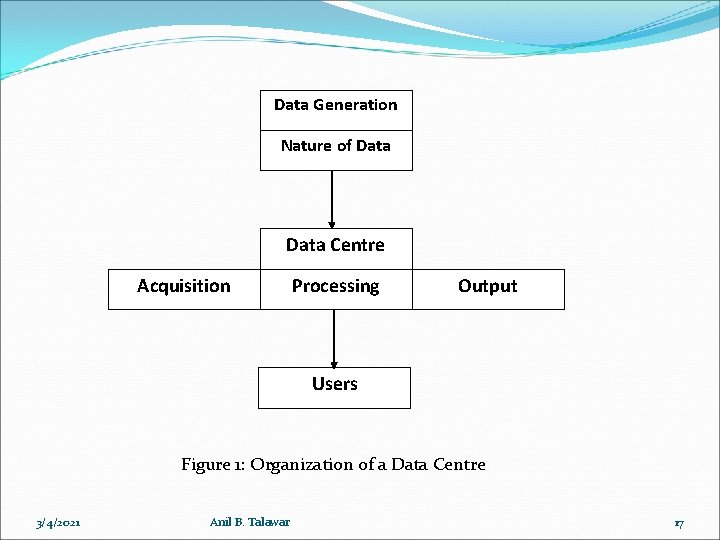
Data Generation Nature of Data Centre Acquisition Processing Output Users Figure 1: Organization of a Data Centre 3/4/2021 Anil B. Talawar 17
Data Centre employs the following categories of personnel: �Data Coordinators �Data Specialists �Data Analysts �Programmers 3/4/2021 Anil B. Talawar 18
Functions The functions performed by a Data Centre are: �Data Collection �Data Control �Data Coding �Data Storage �Data Organization and �Data Dissemination and Retrieval 3/4/2021 Anil B. Talawar 19
�In short a Data Centre is expected to perform the following three functions: �Data Evaluation; �Data Dissemination; and �Referral Service 3/4/2021 Anil B. Talawar 20
INTERNATIONAL DATA CENTRES �NASA Astronomical Data Centre (ADC) �International Centre for Diffraction Data (ICDD) National Data Centres �Environmental Information Centre �National Thermophysical Properties Programme �National Crystal Data Centre (NCDC) 3/4/2021 Anil B. Talawar 21
Unit 2: Information Analysis Centres (IACs) By Anil B. Talawar Assistant Professor Dept. of Library and Information Sciecne Karnatak University, Dharwad
Introduction �The term ‘Information Analysis and Consolidation’ is of recent origin. General Information programme (PGI) of UNESCO, while seeking solutions to the barriers to the use of information in developing countries, suggested ‘information consolidation’ as possible solution. �It was observed that ‘Analysis’ comprised a wide range of functions, such as abstracting, indexing, translation, reviewing, consolidation, etc. 3/4/2021 Anil B. Talawar 23
�However, a number of analysis centres do not always perform the consolidation function. �It was also pointed out that ‘information consolidation activities’ can be performed within institutions or systems other than information analysis centres, even by individuals or groups of individuals. 3/4/2021 Anil B. Talawar 24
Activities, Products and Services of IAC Centres �IACs are committed to provide users timely, authoritative, evaluated, information in most convenient and usable form. �Another distinguishing characteristic in the mode of operation of IAC centres is the use of specialists as consultants. �The centres are in constant interaction with the specialists and keep track of research and development activities in the respective subject field. 3/4/2021 Anil B. Talawar 25
Identifying Users and User’s Needs �User constitutes the most important element in all information consolidation activities and perfect understanding of user’s needs is a pre-requisite for any successful IAC product. �It is observed that centres which make detailed plan for user studies carefully and carry out the study accordingly, bring out the successful IAC product. 3/4/2021 Anil B. Talawar 26
The plan consists of following steps �Surveying the previous studies and literature in general to know about all aspects of user studies. �Statement of the objectives of the study. �Determining the variables to be studied and models to be followed. �Selecting sample of the population to be studied. �Determining the methods for collection of data such as surveying through questionnaire or interview; observation, analysis of previous records or experimentation, etc. �Determining the method of analysis of data. �Determining the ways of presentation and utilization of results. 3/4/2021 Anil B. Talawar 27
Selection of Relevant Information Sources �Based on the information needs of the user and the type of IAC product, relevant information sources are selected. Information sources can be categorized into: a) Documentary sources, b) Institutional sources, and c) Human sources. �Documentary sources are primary, secondary and tertiary sources. �While primary and secondary sources contain information on a subject, tertiary sources are used as an aid for selection of primary, secondary, institutional as well as human sources. 3/4/2021 Anil B. Talawar 28
�Publications (like research reports, conference proceedings, etc) of the institutions actively engaged in research in that subject area should also be considered among the selection of sources. �Last but not the least human resources, i. e. specialists in the subject concerned should be identified for consultation purposes. �Such specialists, when consulted may provide information on the subject concerned which is not readily available from any other source. 3/4/2021 Anil B. Talawar 29
Analysis of Information Involves Following Steps �Study of total contents of selected document or set of documents. �Identification and extraction of the most relevant information conveyed by them. �Assessment and verification of extracted information. �Selection of scheme for organization and systematizing information. �Sorting of extracted information into heading and subheading according to the table of contents, classification scheme or typology for the subject or mission. 3/4/2021 Anil B. Talawar 30
Packing and / or Repackaging of Information �After deciding the contents of the IAC product decision is taken on the media and formats in which information is to be presented. The media can be print, microform, audio / visual, electronic as well interpersonal contact. �According to Saracevic and Wood (1981) “Packaging of information is physical recording, arrangement and presentation of information on a given medium and in a given form. �Repackaging of information is arrangement of physical media and / or form in which information has been presented, which is tailored to the requirement of a specific clientele. 3/4/2021 Anil B. Talawar 31
Dissemination and Communication �The work of IAC centre is not complete with the making of a product or provision of a service. �Its active and effective dissemination through appropriate channels to the target audience and its effective utilization by the user form the integral part of the whole information consolidation process. 3/4/2021 Anil B. Talawar 32
The important channels for communication are �Interpersonal Delivery: The product personally to the users either on request or in anticipation of demand. �Group Personal Delivery: The product is delivered to a whole group of users in a meeting or though a demonstration. �Strategic Placement: The product is placed in locations frequently visited by the users to take notice of and pick it up on their own. 3/4/2021 Anil B. Talawar 33
�Local Depositories: The product is disseminated through local information centres and libraries. �Mass Media: The product delivered or announced through mass media, newspapers, magazines, through broadcasting i. e. radio or television. �Mail: The product is delivered though direct or mass mailing. �Computer networks: The product is delivered through computers via telecommunication networks, online databases, electronic mail or computer conferencing. 3/4/2021 Anil B. Talawar 34
Examples of Information Analysis Centre in India �Tata Energy Research Institute (TERI) �National Institute of Science Communication and Information Resources (NISCAIR) �Indian Council of Agricultural Research (ICAR) �Centre for Monitoring of Indian Economy (CMIE) Pvt. Ltd. 3/4/2021 Anil B. Talawar 35
Information Analysis and Consolidation Centres By Anil B. Talawar Assistant Professor Dept. of Library and Information Sciecne Karnatak University, Dharwad
Introduction �Historically, the concept of information analysis and consolidation evolved in response to the difficulties encountered by the users in the use of information leading to nonuse of information by them and the potential users who would have otherwise benefited if information was available to them in more usable form. �These difficulties or barriers in the use of information by the users are basically due to the inherent characteristics of the world of information, which are as follows: 3/4/2021 Anil B. Talawar 37
Barriers to the use of Information �Exponential growth of information and increasing rate of obsolescence, users have inadequate time reading and assimilating new information. �Interdisciplinary nature of information leading to scattering and seepage of information: Users can specialize only in restricted subject fields; �Wide variation in quality and reliability of information: Users find it difficult and have inadequate time for evaluating and selecting the right information. 3/4/2021 Anil B. Talawar 38
�Information is presented in multiplicity of languages: Users are not familiar with the language (s) to use the information. �Information presented in a wide range of standards and formats: Users may not be familiar with that standard or format to use the information. �Required information is published in documents with restricted circulation: Leading to inaccessibility of information; and �S & T information is highly technical in nature with technical and trade jargons: Potential user with no technical background cannot comprehend it. 3/4/2021 Anil B. Talawar 39
Information Consolidation: Definition Saracevic and Wood (1981) gave the following elaborate definition: �“Consolidated information is public knowledge specifically selected, analyzed, evaluated, and possibly restructured and repackaged for the purpose of serving some of the immediate decisions, problems and information needs of a defined clientele or social group, who otherwise may not be able to effectively and efficiently access and use this knowledge as available in the great amounts of documents or in its original form. �The criteria for selection, evaluation, restructuring, and repackaging of this knowledge are derived from the potential clientele. 3/4/2021 Anil B. Talawar 40
Objectives of Information Consolidation The basic objectives of Information Consolidation can be enumerated as follows: �To increase the effectiveness of information transfer to the target audience; �To make the required information reach larger audience in accessible and usable form; and �To encourage more intensive use of information in wide range of developmental activities. 3/4/2021 Anil B. Talawar 41
Users of Information Analysis and Consolidation Products Different IAC products serve several distinct types o user groups. The users can be categorized into following six groups. �Scientists, engineers, professionals engaged in R & D activities; �Policy makers / planners in Government; �Managers and business people in industry and business; �Technicians, supervisors working in government, departments, industries and other business concerns; �Communicators / intermediaries such as extension workers, teachers, etc. communicating new technology or practices to general public ; and �General public: including both rural and urban population. 3/4/2021 Anil B. Talawar 42
Processes in Information Analysis and Consolidation The basic processes involved in Information Analysis and Consolidation activities are: �Study of potential users to find their information needs and decide on the information products suitable to fulfill those needs. �Selection of relevant information sources, both primary as well secondary information sources, containing the most useful information for the given user’s problems and information needs. �Evaluation of information contained in these sources for its merit, validity and reliability. 3/4/2021 Anil B. Talawar 43
�Analysis of information to identify and extract most salient features conveyed by the given source. �Restructuring (if necessary) the analyzed and extracted information as a new whole, which differ from original presentation and can be used most effectively and efficiently by the user. �This may involve synthesis, condensation, rewriting, simplifying, reviews, state-of-the-art presentation, etc. During synthesis the analyzed information from one or more sources is condensed and presented in a new arrangement or structure with an interpretive or evaluate point of view. �Condensation is derivation of short summary of information from a source of extraction of key statements i. e. sentences, paragraphs, figures, etc. 3/4/2021 Anil B. Talawar 44
�Packaging and / or repackaging of restructured information in a form that will increase its use (Restructuring deals with contents or substance of information while packaging deals with the form of its presentation). �Diffusion or Dissemination of information in ways that will encourage and promote its use. This may also involve educating the users in the use of information and marketing of information. �Feedback from the users and improve the product based on the feedback. 3/4/2021 Anil B. Talawar 45
Unit – 2: Data Centres (Banks) Anil B. Talawar Assistant Professor Dept. of Library and Information Sceicne Karnatak University, Dharwad
�A centre that meets the users potential need for data, obtained from various sources. It is an organization infrastructure from where services are offered. It is also considered as a Special Information Centre or sometimes equivalent to Information Analysis Centre (IAC). �It performs three important functions: Data Compilation, Data Evaluation and Data Dissemination. 3/4/2021 Anil B. Talawar 47
�UNESCO defines Data Centre as an “Organization handling quantitative numerical data”. �Data Centres store data related to narrow field of specialization. �They are sometimes associated to a range Information Centres. “Any institution interested in developing data handling capacities may be called a Data Centre. ” 3/4/2021 Anil B. Talawar 48
�The organization of Data Centre ensures a centralized database with which the user interacts for basic data. The main points to be noted in the structure of a Data Centre are: �Volume and kind of data; �Availability of computer facility ; and �Access to other equipment facility. 3/4/2021 Anil B. Talawar 49
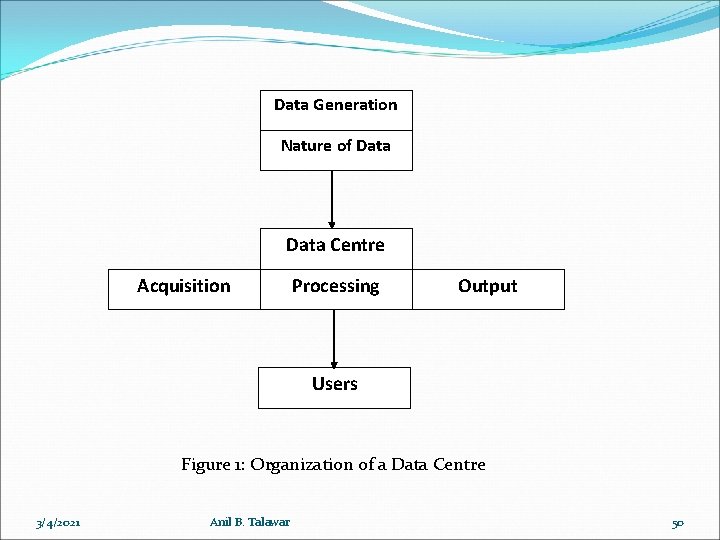
Data Generation Nature of Data Centre Acquisition Processing Output Users Figure 1: Organization of a Data Centre 3/4/2021 Anil B. Talawar 50
Data Centre employs the following categories of personnel: �Data Coordinators �Data Specialists �Data Analysts �Programmers 3/4/2021 Anil B. Talawar 51
Functions The functions performed by a Data Centre are: �Data Collection �Data Control �Data Coding �Data Storage �Data Organization and �Data Dissemination and Retrieval 3/4/2021 Anil B. Talawar 52
�In short a Data Centre is expected to perform the following three functions: �Data Evaluation; �Data Dissemination; and �Referral Service 3/4/2021 Anil B. Talawar 53
INTERNATIONAL DATA CENTRES �NASA Astronomical Data Centre (ADC) �International Centre for Diffraction Data (ICDD) National Data Centres �Environmental Information Centre �National Thermophysical Properties Programme �National Crystal Data Centre (NCDC) 3/4/2021 Anil B. Talawar 54
Information Analysis Centres (IACs) By Anil B. Talawar Assistant Professor Dept. of Library and Information Sciecne Karnatak University, Dharwad
Introduction �The term ‘Information Analysis and Consolidation’ is of recent origin. General Information programme (PGI) of UNESCO, while seeking solutions to the barriers to the use of information in developing countries, suggested ‘information consolidation’ as possible solution. �It was observed that ‘Analysis’ comprised a wide range of functions, such as abstracting, indexing, translation, reviewing, consolidation, etc. 3/4/2021 Anil B. Talawar 56
�However, a number of analysis centres do not always perform the consolidation function. �It was also pointed out that ‘information consolidation activities’ can be performed within institutions or systems other than information analysis centres, even by individuals or groups of individuals. 3/4/2021 Anil B. Talawar 57
Activities, Products and Services of IAC Centres �IACs are committed to provide users timely, authoritative, evaluated, information in most convenient and usable form. �Another distinguishing characteristic in the mode of operation of IAC centres is the use of specialists as consultants. �The centres are in constant interaction with the specialists and keep track of research and development activities in the respective subject field. 3/4/2021 Anil B. Talawar 58
Identifying Users and User’s Needs �User constitutes the most important element in all information consolidation activities and perfect understanding of user’s needs is a pre-requisite for any successful IAC product. �It is observed that centres which make detailed plan for user studies carefully and carry out the study accordingly, bring out the successful IAC product. 3/4/2021 Anil B. Talawar 59
The plan consists of following steps �Surveying the previous studies and literature in general to know about all aspects of user studies. �Statement of the objectives of the study. �Determining the variables to be studied and models to be followed. �Selecting sample of the population to be studied. �Determining the methods for collection of data such as surveying through questionnaire or interview; observation, analysis of previous records or experimentation, etc. �Determining the method of analysis of data. �Determining the ways of presentation and utilization of results. 3/4/2021 Anil B. Talawar 60
Selection of Relevant Information Sources �Based on the information needs of the user and the type of IAC product, relevant information sources are selected. Information sources can be categorized into: a) Documentary sources, b) Institutional sources, and c) Human sources. �Documentary sources are primary, secondary and tertiary sources. �While primary and secondary sources contain information on a subject, tertiary sources are used as an aid for selection of primary, secondary, institutional as well as human sources. 3/4/2021 Anil B. Talawar 61
�Publications (like research reports, conference proceedings, etc) of the institutions actively engaged in research in that subject area should also be considered among the selection of sources. �Last but not the least human resources, i. e. specialists in the subject concerned should be identified for consultation purposes. �Such specialists, when consulted may provide information on the subject concerned which is not readily available from any other source. 3/4/2021 Anil B. Talawar 62
Analysis of Information Involves Following Steps �Study of total contents of selected document or set of documents. �Identification and extraction of the most relevant information conveyed by them. �Assessment and verification of extracted information. �Selection of scheme for organization and systematizing information. �Sorting of extracted information into heading and subheading according to the table of contents, classification scheme or typology for the subject or mission. 3/4/2021 Anil B. Talawar 63
Packing and / or Repackaging of Information �After deciding the contents of the IAC product decision is taken on the media and formats in which information is to be presented. The media can be print, microform, audio / visual, electronic as well interpersonal contact. �According to Saracevic and Wood (1981) “Packaging of information is physical recording, arrangement and presentation of information on a given medium and in a given form. �Repackaging of information is arrangement of physical media and / or form in which information has been presented, which is tailored to the requirement of a specific clientele. 3/4/2021 Anil B. Talawar 64
Dissemination and Communication �The work of IAC centre is not complete with the making of a product or provision of a service. �Its active and effective dissemination through appropriate channels to the target audience and its effective utilization by the user form the integral part of the whole information consolidation process. 3/4/2021 Anil B. Talawar 65
The important channels for communication are �Interpersonal Delivery: The product personally to the users either on request or in anticipation of demand. �Group Personal Delivery: The product is delivered to a whole group of users in a meeting or though a demonstration. �Strategic Placement: The product is placed in locations frequently visited by the users to take notice of and pick it up on their own. 3/4/2021 Anil B. Talawar 66
�Local Depositories: The product is disseminated through local information centres and libraries. �Mass Media: The product delivered or announced through mass media, newspapers, magazines, through broadcasting i. e. radio or television. �Mail: The product is delivered though direct or mass mailing. �Computer networks: The product is delivered through computers via telecommunication networks, online databases, electronic mail or computer conferencing. 3/4/2021 Anil B. Talawar 67
Examples of Information Analysis Centre in India �Tata Energy Research Institute (TERI) �National Institute of Science Communication and Information Resources (NISCAIR) �Indian Council of Agricultural Research (ICAR) �Centre for Monitoring of Indian Economy (CMIE) Pvt. Ltd. 3/4/2021 Anil B. Talawar 68
Information Analysis and Consolidation Centres
Introduction �Historically, the concept of information analysis and consolidation evolved in response to the difficulties encountered by the users in the use of information leading to nonuse of information by them and the potential users who would have otherwise benefited if information was available to them in more usable form. �These difficulties or barriers in the use of information by the users are basically due to the inherent characteristics of the world of information, which are as follows: 3/4/2021 Anil B. Talawar 70
Barriers to the use of Information �Exponential growth of information and increasing rate of obsolescence, users have inadequate time reading and assimilating new information. �Interdisciplinary nature of information leading to scattering and seepage of information: Users can specialize only in restricted subject fields; �Wide variation in quality and reliability of information: Users find it difficult and have inadequate time for evaluating and selecting the right information. 3/4/2021 Anil B. Talawar 71
�Information is presented in multiplicity of languages: Users are not familiar with the language (s) to use the information. �Information presented in a wide range of standards and formats: Users may not be familiar with that standard or format to use the information. �Required information is published in documents with restricted circulation: Leading to inaccessibility of information; and �S & T information is highly technical in nature with technical and trade jargons: Potential user with no technical background cannot comprehend it. 3/4/2021 Anil B. Talawar 72
Information Consolidation: Definition Saracevic and Wood (1981) gave the following elaborate definition: �“Consolidated information is public knowledge specifically selected, analyzed, evaluated, and possibly restructured and repackaged for the purpose of serving some of the immediate decisions, problems and information needs of a defined clientele or social group, who otherwise may not be able to effectively and efficiently access and use this knowledge as available in the great amounts of documents or in its original form. �The criteria for selection, evaluation, restructuring, and repackaging of this knowledge are derived from the potential clientele. 3/4/2021 Anil B. Talawar 73
Objectives of Information Consolidation The basic objectives of Information Consolidation can be enumerated as follows: �To increase the effectiveness of information transfer to the target audience; �To make the required information reach larger audience in accessible and usable form; and �To encourage more intensive use of information in wide range of developmental activities. 3/4/2021 Anil B. Talawar 74
Users of Information Analysis and Consolidation Products Different IAC products serve several distinct types o user groups. The users can be categorized into following six groups. �Scientists, engineers, professionals engaged in R & D activities; �Policy makers / planners in Government; �Managers and business people in industry and business; �Technicians, supervisors working in government, departments, industries and other business concerns; �Communicators / intermediaries such as extension workers, teachers, etc. communicating new technology or practices to general public ; and �General public: including both rural and urban population. 3/4/2021 Anil B. Talawar 75
Processes in Information Analysis and Consolidation The basic processes involved in Information Analysis and Consolidation activities are: �Study of potential users to find their information needs and decide on the information products suitable to fulfill those needs. �Selection of relevant information sources, both primary as well secondary information sources, containing the most useful information for the given user’s problems and information needs. �Evaluation of information contained in these sources for its merit, validity and reliability. 3/4/2021 Anil B. Talawar 76
�Analysis of information to identify and extract most salient features conveyed by the given source. �Restructuring (if necessary) the analyzed and extracted information as a new whole, which differ from original presentation and can be used most effectively and efficiently by the user. �This may involve synthesis, condensation, rewriting, simplifying, reviews, state-of-the-art presentation, etc. During synthesis the analyzed information from one or more sources is condensed and presented in a new arrangement or structure with an interpretive or evaluate point of view. �Condensation is derivation of short summary of information from a source of extraction of key statements i. e. sentences, paragraphs, figures, etc. 3/4/2021 Anil B. Talawar 77
�Packaging and / or repackaging of restructured information in a form that will increase its use (Restructuring deals with contents or substance of information while packaging deals with the form of its presentation). �Diffusion or Dissemination of information in ways that will encourage and promote its use. This may also involve educating the users in the use of information and marketing of information. �Feedback from the users and improve the product based on the feedback. 3/4/2021 Anil B. Talawar 78
Referral Centres and Clearing Houses By Anil B. Talawar Assistant Professor Dept. of Library and Information Sciecne Karnatak University, Dharwad
REFERRAL CENTRES �In reference service the user or the librarian refers directly to the source of document. �On the other hand, referral service directs the inquirer to a source of information, which may be either a document, or an organization or it may be even an individual. 3/4/2021 Anil B. Talawar 80
Referral Centre: Definition and Meaning �“An Organization for directing researchers for information and data to appropriate sources, such as, libraries, information evaluation centres, documents and documentation centres and individuals. A Referral Centre does not supply data or documents. �A Referral Centre is some sort of an “Information Desk” for the scientific and technical community which does not provide enquirers directly with the information they need, but suggest sources (organization, facility individual) likely to satisfy the users / clients. 3/4/2021 Anil B. Talawar 81
�Referral Centre is an organization for the indication of sources (of persons, institutions and publications) from which scientific information may be obtained on a given subject. ” 3/4/2021 Anil B. Talawar 82
Need and Purpose of a Referral Centre �A single institution or organization like a library cannot cater to the users increasing and varied of information. It cannot also perform every function. �Even the large computer systems and / or networks, are unable to cope-up with growing mass of information and simultaneously meet the user demands. This calls for division of labour in information handling. �The basic purpose of a Referral Centre is to ease the stress on a single Information System which is being loaded with all services. 3/4/2021 Anil B. Talawar 83
Functions of a Referral Centre �To collect on a world-wide basis information about information / data sources within the subject or mission. �To prepare a comprehensive inventory of the types of information / data services available from these sources with a detailed subject index to facilitate its access. �To guide users to the appropriate sources where from the required data or information may be obtained. �To function as an intermediary between enquirer and the organization and / or individuals who possess specialized knowledge on the subject of enquiry. 3/4/2021 Anil B. Talawar 84
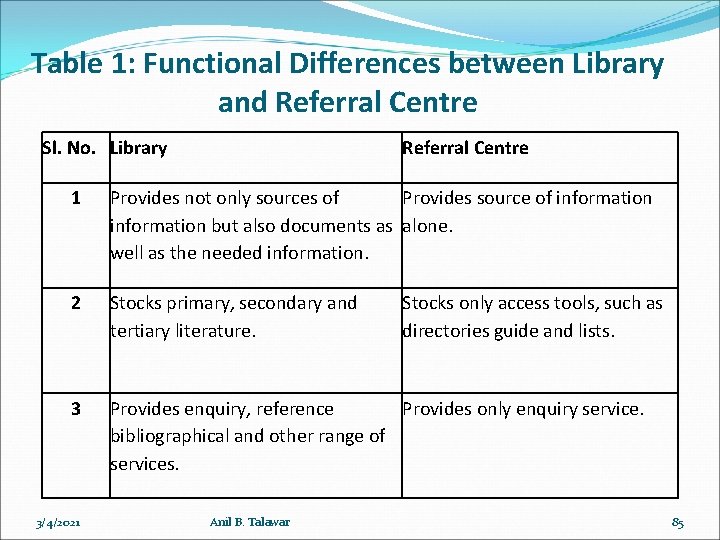
Table 1: Functional Differences between Library and Referral Centre Sl. No. Library Referral Centre 1 Provides not only sources of Provides source of information but also documents as alone. well as the needed information. 2 Stocks primary, secondary and tertiary literature. 3 Provides enquiry, reference Provides only enquiry service. bibliographical and other range of services. 3/4/2021 Anil B. Talawar Stocks only access tools, such as directories guide and lists. 85
CLEARING HOUSE �A Clearing House is a central agency for collection, classification and distribution of information. It may include specialized Information Centres as well as conventional libraries. �In scientific parlance, a Clearing House is a relatively new world. It represents a depository for documents with the additional objective of serving as a central agency engaged in the distribution of information. 3/4/2021 Anil B. Talawar 86
�It also includes such functions as collecting and maintaining records of research and development. �Sometimes, subjective questions about items in these records are referred to the source and thus a Clearing House may have to perform the function of a Referral Centre. 3/4/2021 Anil B. Talawar 87
- Slides: 87