
Information and Communications Engineering Ubiquitous computing environment its
Information and Communications Engineering Ubiquitous computing environment & its security Jangseong Kim
Contents • Goals • Ubiquitous computing environment • Security for ubiquitous computing environment
Goals • Ubiquitous 컴퓨팅 환경이란? – Pervasive / Ambient intelligence vs. ubiquitous – Context-aware – Middleware • Ubiquitous 컴퓨팅 환경에서의 보안요구사항은? – Anonymity vs. authentication / access control – Lightweight – Scalability
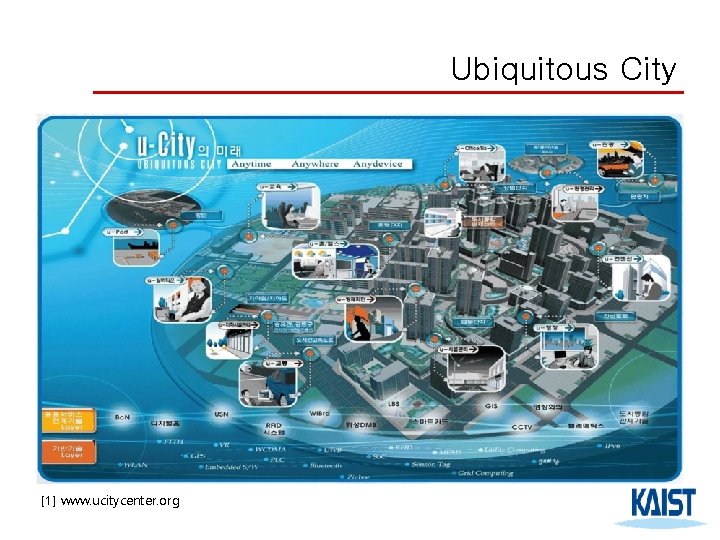
Ubiquitous City [1] www. ucitycenter. org
Ubiquitous computing environment • • • Definition Characteristics Context What is Middleware? Examples of Middleware Typical scenario – Ubiquitous campus – 필요 기술 – 문제점
Definition (2/3)
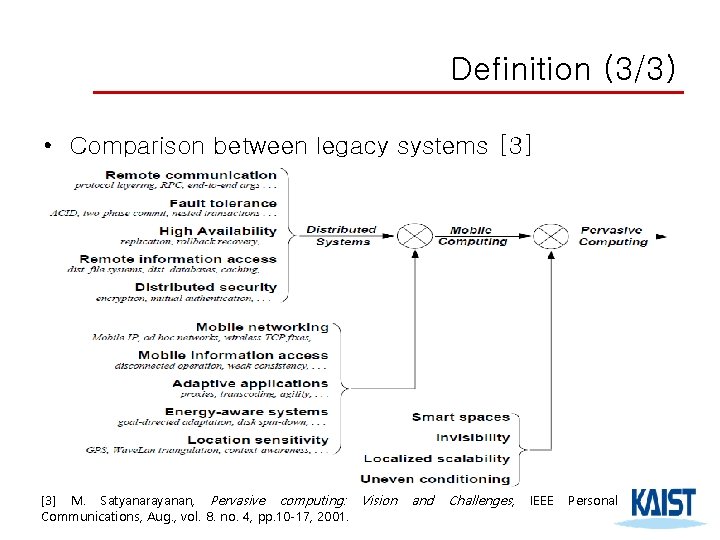
Definition (3/3) • Comparison between legacy systems [3] M. Satyanarayanan, Pervasive computing: Vision Communications, Aug. , vol. 8. no. 4, pp. 10 -17, 2001. and Challenges, IEEE Personal
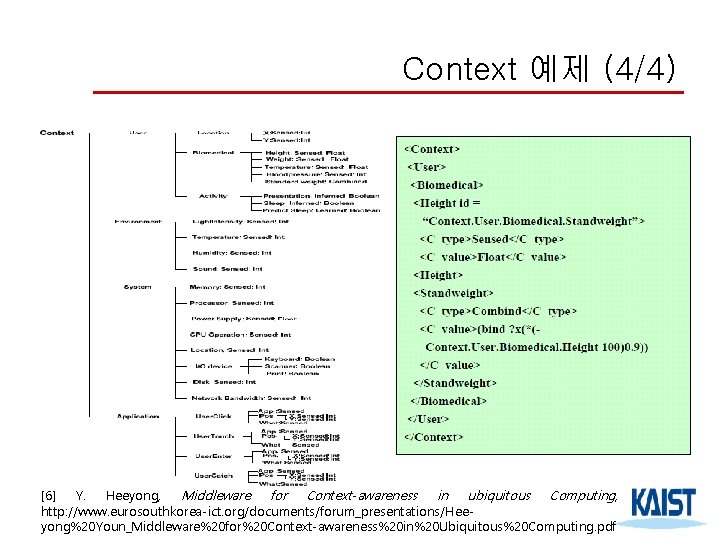
Context (1/4) • Definition of context – In 1994, Schilit et al. [4] • 대상 인물의 주변 환경에 대한 정보 • Ex. 위치, 주변 인물, 물건 – In 2001, Dey [5] • 개체의 상황을 기술하는데 사용되는 정보 • 개체는 사람, 장소, 사용자와 응용프로그램 사이의 상호작용에 관련된 object [4] B. N. Schilit, N. I. Adams, and R. Want, Context-Aware Computing Applications, In Proceedings of the Workshop on Mobile Computing Systems and Applications, Santa Cruz, CA, Dec. 1994. pp. 85 -90. IEEE Computer Society. [5] A. K. Dey, Understanding and Using Context, Personal and Ubiquitous Computing Journal, Vol. 5 (1), 2001, pp. 4 -7.
Context (2/4) • Definition of context aware [5] – 사용자의 task에 따라 관련된 정보 혹은 서비스는 사용자에게 제 공하기 위해 context를 사용하는 의미 • 주변 환경에서 context 정보를 수집하며, context가 변화할 경우 이에 따라 적절하게 반응하는 것을 의미 • Context widget / Context interpreter / Context aggregator • Definition of situation [5] – Context보다 상위 개념 • 특정 시점에서의 주변환경을 기술하는 정보의 집합체 – 개체의 상황을 판단하기 위해 context 정보를 수집 [5] A. K. Dey, Understanding and Using Context, Personal and Ubiquitous Computing Journal, Vol. 5 (1), 2001, pp. 4 -7.
Context (3/4) • Context 종류 [6] – 센싱된 context : 센서에 측정되거나 응용프로그램에 의해 보고 된 context • Ex. User ID, object’s state, user actions – 조합된 context : 센싱된 context에게서 모여지거나 계산된 context • Ex. 스피드 혹은 3개 이상의 센서로부터 측정된 위치 • Ex. 사용자 ID, 단말 ID 혹은 서비스에 기반으로 모여진 context – 상황 context : 다양한 규칙을 통해 추론된 context • Ex. 시간에 관련된 상황, 정적 혹은 동적인 인간관계 – 학습한 context : 기계학습을 통해 배운 context • Ex. 사용자의 선호도, 사용자 예측 [6] Y. Heeyong, Middleware for Context-awareness in ubiquitous Computing, http: //www. eurosouthkorea-ict. org/documents/forum_presentations/Heeyong%20 Youn_Middleware%20 for%20 Context-awareness%20 in%20 Ubiquitous%20 Computing. pdf
Context 예제 (4/4) [6] Y. Heeyong, Middleware for Context-awareness in ubiquitous Computing, http: //www. eurosouthkorea-ict. org/documents/forum_presentations/Heeyong%20 Youn_Middleware%20 for%20 Context-awareness%20 in%20 Ubiquitous%20 Computing. pdf
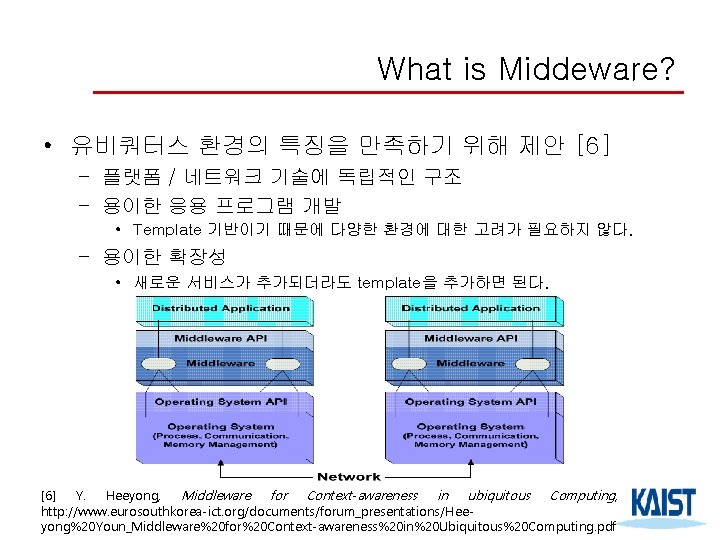
What is Middeware? • 유비쿼터스 환경의 특징을 만족하기 위해 제안 [6] – 플랫폼 / 네트워크 기술에 독립적인 구조 – 용이한 응용 프로그램 개발 • Template 기반이기 때문에 다양한 환경에 대한 고려가 필요하지 않다. – 용이한 확장성 • 새로운 서비스가 추가되더라도 template을 추가하면 된다. [6] Y. Heeyong, Middleware for Context-awareness in ubiquitous Computing, http: //www. eurosouthkorea-ict. org/documents/forum_presentations/Heeyong%20 Youn_Middleware%20 for%20 Context-awareness%20 in%20 Ubiquitous%20 Computing. pdf
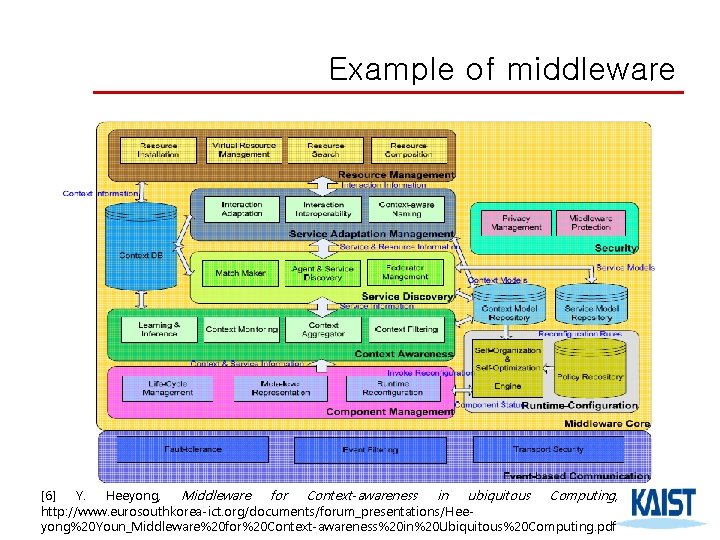
Example of middleware [6] Y. Heeyong, Middleware for Context-awareness in ubiquitous Computing, http: //www. eurosouthkorea-ict. org/documents/forum_presentations/Heeyong%20 Youn_Middleware%20 for%20 Context-awareness%20 in%20 Ubiquitous%20 Computing. pdf
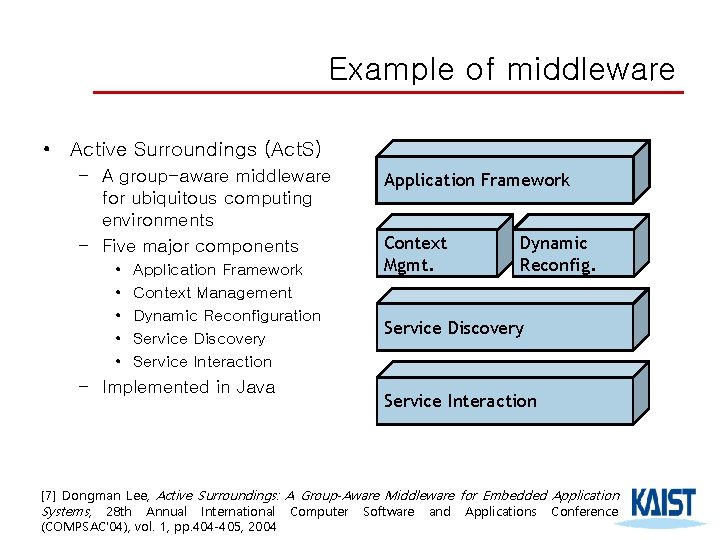
Example of middleware • Active Surroundings (Act. S) – A group-aware middleware for ubiquitous computing environments – Five major components • • • Application Framework Context Management Dynamic Reconfiguration Service Discovery Service Interaction – Implemented in Java Application Framework Context Mgmt. Dynamic Reconfig. Service Discovery Service Interaction [7] Dongman Lee, Active Surroundings: A Group-Aware Middleware for Embedded Application Systems, 28 th Annual International Computer Software and Applications Conference (COMPSAC'04), vol. 1, pp. 404 -405, 2004
Typical scenario (1/3) • 연구실에서의 발표자료 작성 – Fred is in his office, frantically preparing for a meeting at which he will give a presentation and a software demonstration. • 이동하면서 발표자료 작성 – The meeting room is a ten-minute walk across campus. It is time to leave, but Fred is not quite ready. – He grabs his Palm. XXII wireless handheld computer and walks out of the door. – Aura transfers the state of his work from his desktop to his handheld, and allows him to make his final edits using voice commands during his walk. [3] M. Satyanarayanan, Pervasive computing: Vision Communications, Aug. , vol. 8. no. 4, pp. 10 -17, 2001. and Challenges, IEEE Personal
Typical scenario (2/3) • 발표장소로 이동 – Aura infers where Fred is going from his calendar and the campus location tracking service. It downloads the presentation and the demonstration software to the projection computer, and warms up the projector. – Fred finishes his edits just before he enters the meeting room. As he walks in, Aura transfers his final changes to the projection computer. [3] M. Satyanarayanan, Pervasive computing: Vision Communications, Aug. , vol. 8. no. 4, pp. 10 -17, 2001. and Challenges, IEEE Personal
Typical scenario (3/3) • 발표 중 자료수정 – As the presentation proceeds, Fred is about to display a slide with highly sensitive budget information. Aura senses that this might be a mistake: the room’s face detection and recognition capability indicates that there are some unfamiliar faces present. It therefore warns Fred. Realizing that Aura is right, Fred skips the slide. He moves on to other topics and ends on a high note, leaving the audience impressed by his polished presentation. [3] M. Satyanarayanan, Pervasive computing: Vision Communications, Aug. , vol. 8. no. 4, pp. 10 -17, 2001. and Challenges, IEEE Personal
필요 기술 • Wireless communication – Ex. Wifi / HSDPA • 휴대용 단말기 & PC – Ex. PDA / mobile phone • Word processing based on voice recognition • Location tracking – Outdoor (Ex. GPS) / indoor (Ex. Cricket) • Face recognition • Access control
Security for Ubiquitous • Security requirements – Considerations – System architecture for ubiquitous campus – Example case for secure service discovery • • Secure service discovery System architecture for ubiquitous campus Considerations 이슈
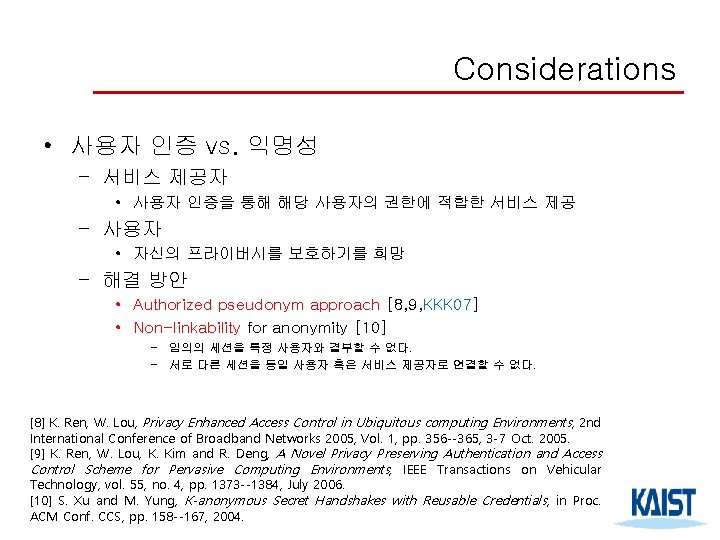
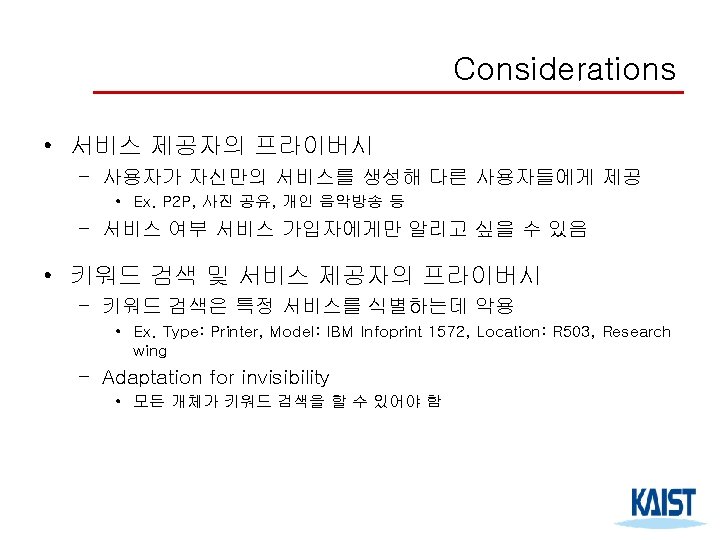
Considerations • 사용자 인증 vs. 익명성 – 서비스 제공자 • 사용자 인증을 통해 해당 사용자의 권한에 적합한 서비스 제공 – 사용자 • 자신의 프라이버시를 보호하기를 희망 – 해결 방안 • Authorized pseudonym approach [8, 9, KKK 07] • Non-linkability for anonymity [10] – 임의의 세션을 특정 사용자와 결부할 수 없다. – 서로 다른 세션을 동일 사용자 혹은 서비스 제공자로 연결할 수 없다. [8] K. Ren, W. Lou, Privacy Enhanced Access Control in Ubiquitous computing Environments, 2 nd International Conference of Broadband Networks 2005, Vol. 1, pp. 356 --365, 3 -7 Oct. 2005. [9] K. Ren, W. Lou, K. Kim and R. Deng, A Novel Privacy Preserving Authentication and Access Control Scheme for Pervasive Computing Environments, IEEE Transactions on Vehicular Technology, vol. 55, no. 4, pp. 1373 --1384, July 2006. [10] S. Xu and M. Yung, K-anonymous Secret Handshakes with Reusable Credentials, in Proc. ACM Conf. CCS, pp. 158 --167, 2004.
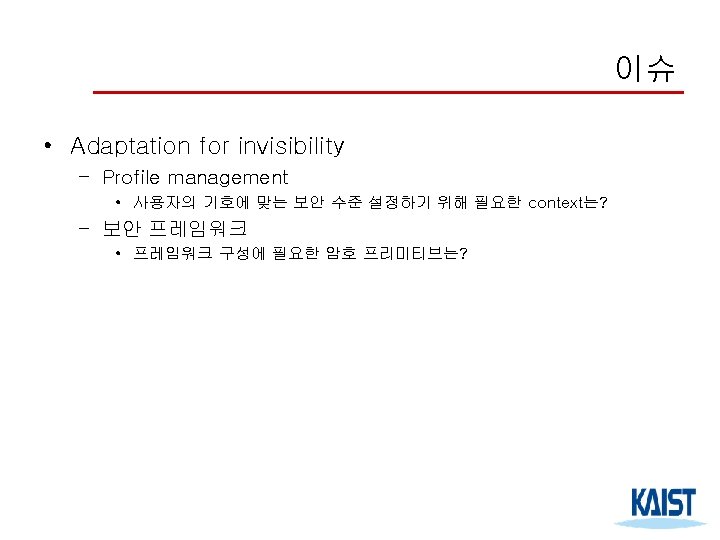
Considerations • 배터리 관리 – 기능이 추가될수록 늘어나는 배터리 소모 • DMB, Multimedia player (e. g. , MP 3, Movies), Wireless communications – 다양한 단말이 활용 • Mobile phone / PDA / Laptop vs. Sensor node • 전력소모의 최소화 – Adaptation for invisibility • Self-tuning / Proactivity • 보안 기술도 사용자의 주변환경 / 네트워크 기술에 맞게 적절하게 변경될 수 있어야 한다. – 경량화된 암호 프로토콜 개발이 필요 [3] M. Satyanarayanan, Pervasive computing: Vision Communications, Aug. , vol. 8. no. 4, pp. 10 -17, 2001. and Challenges, IEEE Personal
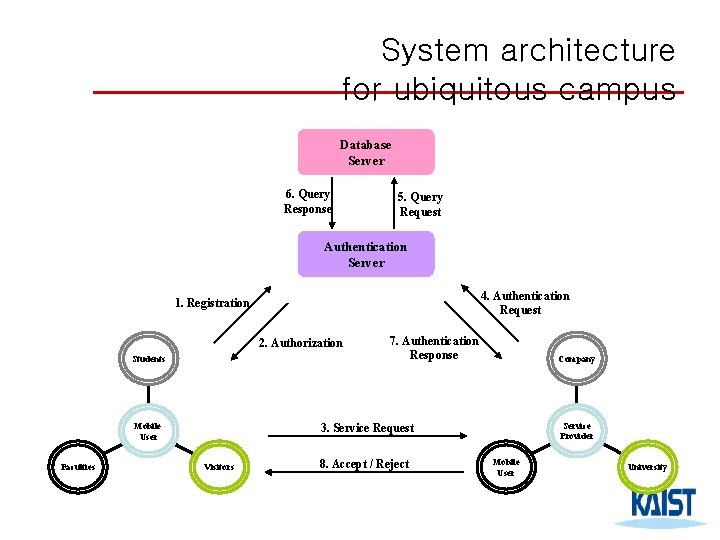
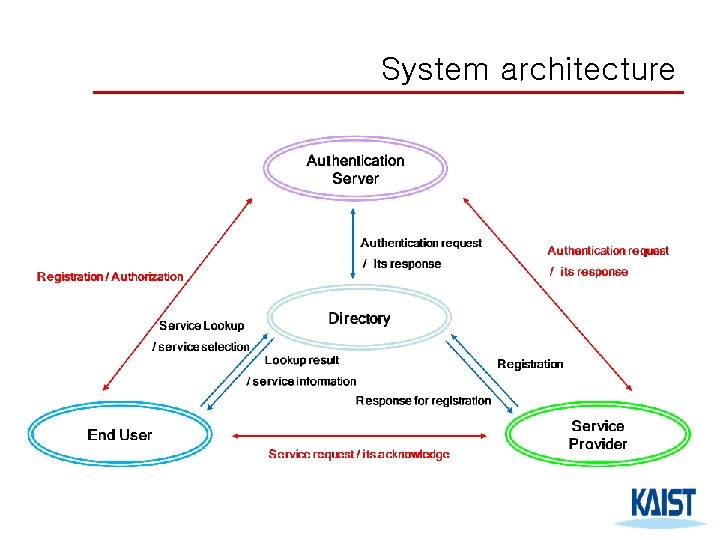
System architecture for ubiquitous campus Database Server 6. Query Response 5. Query Request Authentication Server 4. Authentication Request 1. Registration 2. Authorization Students Mobile User Faculties 7. Authentication Response Company Service Provider 3. Service Request Visitors 8. Accept / Reject Mobile User University
Secure service discovery • Service discovery – 주변 환경에 대한 사전정보 없이도 사용자의 task에 맞는 서비스 를 찾아 주는 기능 • Service lookup : 사용자가 원하는 서비스를 질의 • Announcement : 서비스 제공자가 자신의 서비스의 관련 정보를 통지 – Client-Server model vs. Client-Directory-Server model [11] • Scalability – 모든 서비스 제공자에게 원하는 서비스 정보를 query? – Directory에서 서비스 정보를 query? • Trusted entity – Directory는 누가 관리하며, 이는 신뢰할 수 있는가? [11] R. M. Perianu, P. Hartel and H. Scholten, A Classification of Service Discovery Protocols , http: //eprints. eemcs. utwente. nl/735/01/0000012 d. pdf, 2005
Secure service discovery • Secure service discovery – 대다수 보안이 고려되지 않음 [12] – In 1999, Czerwinski et al [13] • Directory는 신뢰된 개체 • 사용자 및 서비스 제공자는 자신의 프라이버시 보호가 되지 않음. – In 2006, Zhu et al [14] • 사용자는 인접한 Agent에게 서비스 검색 요청 – 사용자가 agent에게 서비스 검색에 필요한 모든 정보 전송 • 프라이버시 침해 – 권한이 있는 서비스만 검색할 수 있어야 함에도 불구하고 접근 권한이 없어도 사용자는 검색 가능 • 서비스 제공자는 자신만의 directory가 필요 [12] F. Zhu, M. Mutka and L. Ni, Service Discovery in Pervasive Computing Environments, IEEE Pervasive Computing, vol. 4, pp. 81 -90, 2005. [13] S. Czerwinski, B. Y. Zhao, T. Hodes, A. Joseph, and R. Katz, An Architecture for a Secure Service Discovery Service, Proc. Fifth annual. Intl. conference. Mobile Computing and Networks (Mobi. Com '99), pp. 24 -35, 1999. [14] F. Zhu, M. Mutka and L. Ni, A Private, Secure, and User-Centric Information Exposure Model for Service Discovery Protocols, IEEE Transactions on Mobile Computing, vol. 5, no. 4, pp. 418 -429, Apr. 2006.
System architecture
- Slides: 31