
Information and Communication Unit 5 Lesson 4 Explanation

- Slides: 9
Information and Communication Unit 5, Lesson 4 Explanation © 2011 International Technology and Engineering Educators Association, STEM Center for Teaching and Learning™ Foundations of Technology
The Unit Big Idea The designed world is the product of a design process, which provides ways to turn resources - materials, tools and machines, people, information, energy, capital, and time - into products and services. © 2011 International Technology and Engineering Educators Association, STEM Center for Teaching and Learning™ Foundations of Technology
The Lesson Big Idea Information and communication systems greatly impact our quality of life. © 2011 International Technology and Engineering Educators Association, STEM Center for Teaching and Learning™ Foundations of Technology
Systems Model q Information and Communication systems follow the systems model and require inputs, processes, outputs and feedback. q Example: Text messaging q Inputs: a phone, a person operating the phone, cell phone service, etc. q Process: transmitting the message using phone, landlines and/or satellite, phone q Output: message sent q Feedback: undeliverable message or confirmation of message sent © 2011 International Technology and Engineering Educators Association, STEM Center for Teaching and Learning™ Foundations of Technology
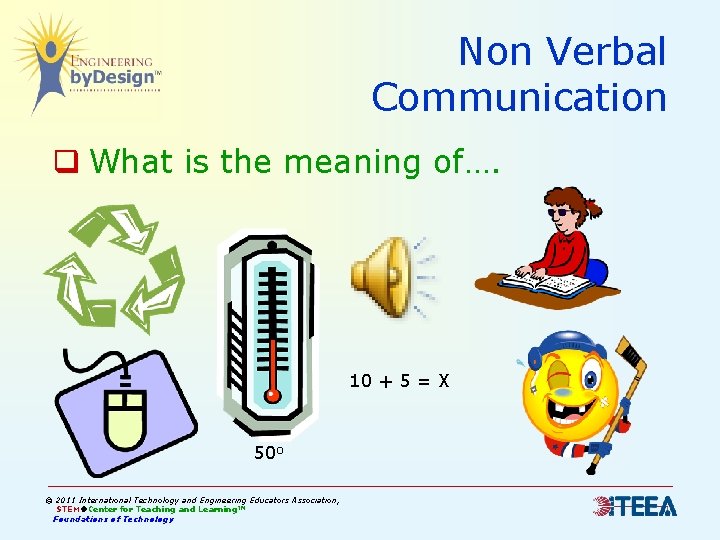
Non Verbal Communication q What is the meaning of…. 10 + 5 = X 50 o © 2011 International Technology and Engineering Educators Association, STEM Center for Teaching and Learning™ Foundations of Technology
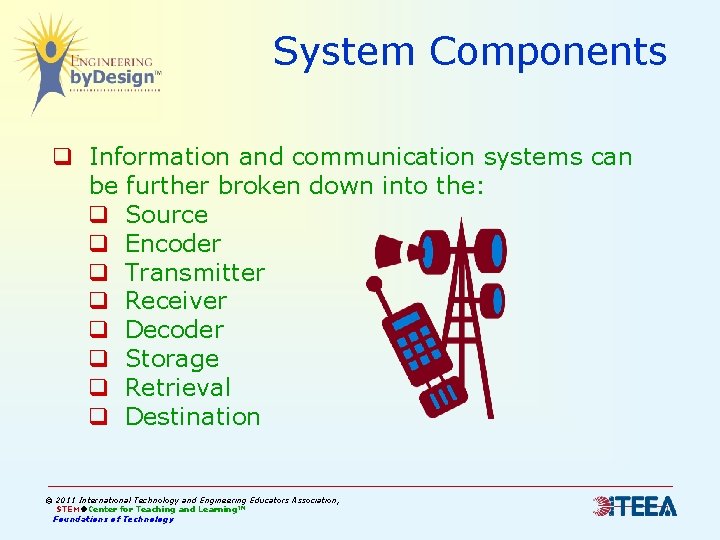
System Components q Information and communication systems can be further broken down into the: q Source q Encoder q Transmitter q Receiver q Decoder q Storage q Retrieval q Destination © 2011 International Technology and Engineering Educators Association, STEM Center for Teaching and Learning™ Foundations of Technology
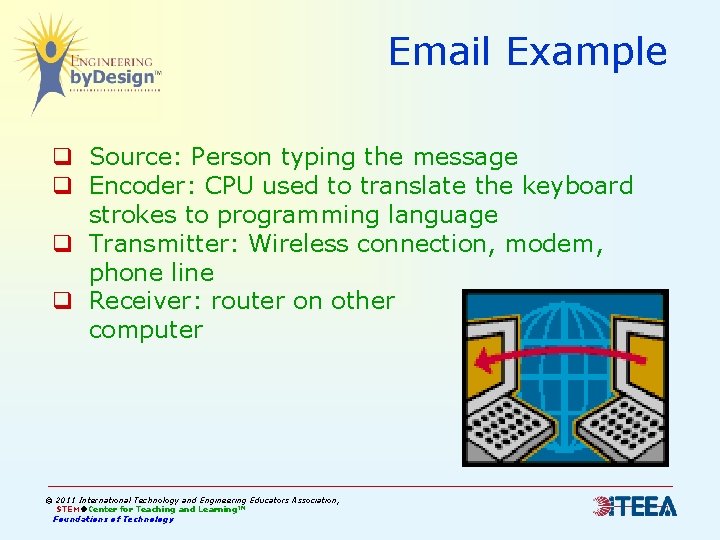
Email Example q Source: Person typing the message q Encoder: CPU used to translate the keyboard strokes to programming language q Transmitter: Wireless connection, modem, phone line q Receiver: router on other computer © 2011 International Technology and Engineering Educators Association, STEM Center for Teaching and Learning™ Foundations of Technology
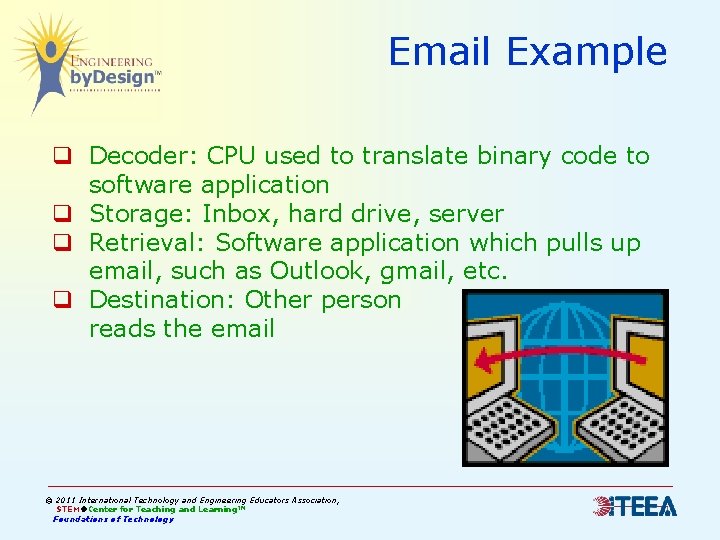
Email Example q Decoder: CPU used to translate binary code to software application q Storage: Inbox, hard drive, server q Retrieval: Software application which pulls up email, such as Outlook, gmail, etc. q Destination: Other person reads the email © 2011 International Technology and Engineering Educators Association, STEM Center for Teaching and Learning™ Foundations of Technology
Reflection q Can you think of other I&C systems and identify the inputs, process, output and feedback? q Can you identify the source, encoder, transmitter, receiver, decoder , storage, retrieval , and destination? © 2011 International Technology and Engineering Educators Association, STEM Center for Teaching and Learning™ Foundations of Technology